REVIEW 3 major objections 3 minor 204 references
BAT AGN Spectroscopic Survey -- XIII. The nature of the most luminous obscured AGN in the low-redshift universe
T0 review · 3 major / 3 minor · reviewed 2026-08-14 · deepseek-v4-flash
Pith's one-line read The most luminous obscured AGN in the nearby Universe stay obscured because their Eddington ratios are too low for radiation pressure to expel the dusty gas, not because they are faint, and this supports radiation-pressure-driven…
desk verdict Solid multi-wavelength characterization of 28 luminous obscured AGN; the radiation-pressure conclusion is reasonable but not robust to the stated 0.5 dex MBH systematics. read the letter →
The pith
A machine-rendered reading of the paper's core claim, the machinery that carries it, and where it could break.
The reading
What carries the argument
The central object is the lambda_Edd-N_H plane, a diagram plotting Eddington ratio against line-of-sight column density with a "blow-out" wedge marking where radiation pressure expels dusty circumnuclear gas. The argument is carried by placing each source in this plane, using black hole masses derived from stellar velocity dispersions through the M_BH-sigma* relation and column densities from X-ray spectral fits. The wedge boundary encodes the radiative-feedback threshold: obscuration can persist only where the Eddington ratio lies below the value that would launch a dusty outflow at that column density.
What would settle it
Measure independent black hole masses for a subset of the 28 sources using reverberation mapping or spatially resolved gas dynamics, then recompute their Eddington ratios. If the revised masses move a large fraction of the sample across the wedge boundary into the high-lambda_Edd blow-out region, the conclusion that radiation pressure keeps these AGN obscured would be overturned.
Extended reading notes
Core claim
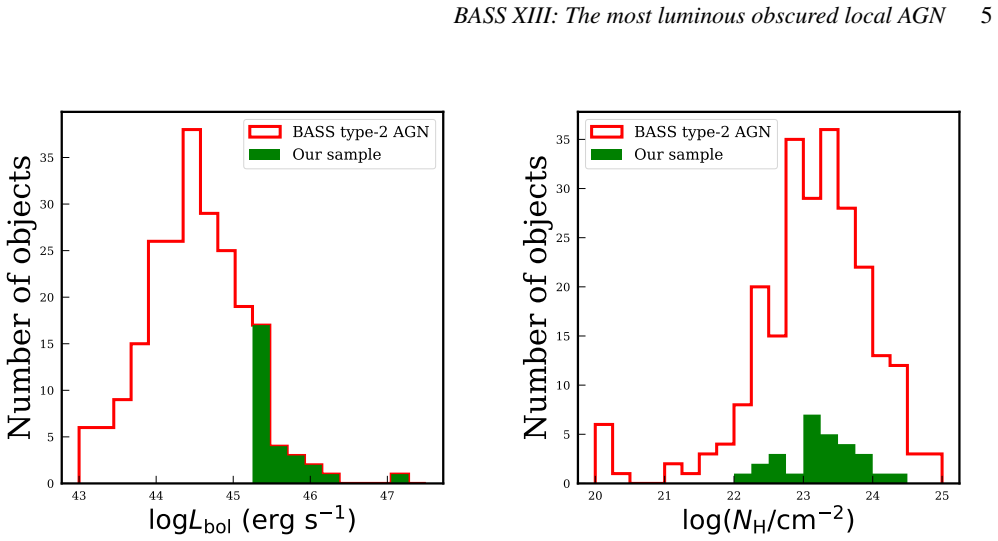
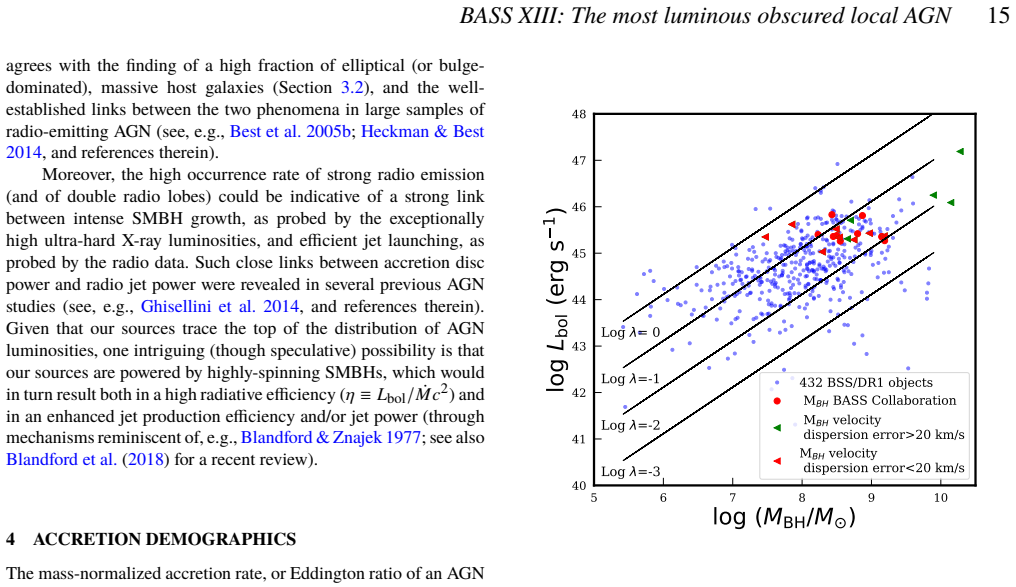
On the paper's own terms, the most luminous narrow-line AGN in the low-redshift Universe, selected by ultra-hard X-ray luminosity with log L_bol > 45.25, are powered by black holes of roughly $10^{7}$.5 to $10^{10}$.3 solar masses accreting at about 0.01 to 1 times the Eddington rate. In the lambda_Edd-N_H plane introduced by Ricci et al. (2017c), 26 of the 28 sources sit outside the "blow-out" wedge, meaning their Eddington ratios are too low for radiation pressure on dusty gas to push the obscuring material away; the two sources inside the wedge are consistent with the picture given the roughly 0.3-0.5 dex systematic uncertainties. The paper therefore claims that the very existence of these highly luminous obscured AGN is predicted by radiation-pressure-driven unification (Fabian et al. 2008; Ricci et al. 2017c) and challenges the receding-torus scenario (Lawrence 1991), which would make such a population rare.
Load-bearing premise
Every source's Eddington ratio is built on the assumption that these AGN fall on the same M_BH-sigma* relation as inactive galaxies; if the relation overestimates their black hole masses, the true Eddington ratios would be higher and could move a substantial part of the sample into the blow-out wedge.
Editorial extensions
If this is right
- If correct, obscuration of the most luminous local AGN is governed by Eddington ratio rather than bolometric luminosity alone, so a population of luminous, heavily obscured AGN can persist.
- The receding-torus model's predicted sharp decline in the obscured fraction with increasing luminosity is weakened for these sources.
- The positions of these sources in the lambda_Edd-N_H plane imply that their obscuration can be long-lived, not merely a transient blow-out phase.
- The absence of distinctive black hole masses or Eddington ratios means ultra-hard X-ray selection is not biased toward extreme accretion states at the highest luminosities.
- The high radio-loud fraction and double-lobe incidence become supplementary clues about jet launching, not defining properties of the most luminous obscured AGN.
Reading between the lines
- The same wedge test could be applied to higher-redshift type-2 quasar samples whose reported Eddington ratios are higher; if those samples genuinely lie inside the blow-out wedge, they would represent a later evolutionary stage where obscuration is being cleared.
- If Eddington ratio controls obscuration, major mergers that boost accretion should temporarily deplete the obscured population; a time-dependent test could compare merging and isolated obscured AGN matched in luminosity and column density.
- Independent black hole masses from reverberation mapping or gas dynamical modelling for a subset of these 28 sources would turn the ~0.5 dex systematic uncertainty into a direct calibration of where the wedge boundary actually lies.
- The excess of radio-loud sources hints that high black hole spin may accompany these luminous phases; combining the wedge test with spin estimates from reflection spectroscopy could link obscuration geometry to spin.
Signed reviews
Editorial analysis
A structured set of objections, weighed in public.
Referee Report
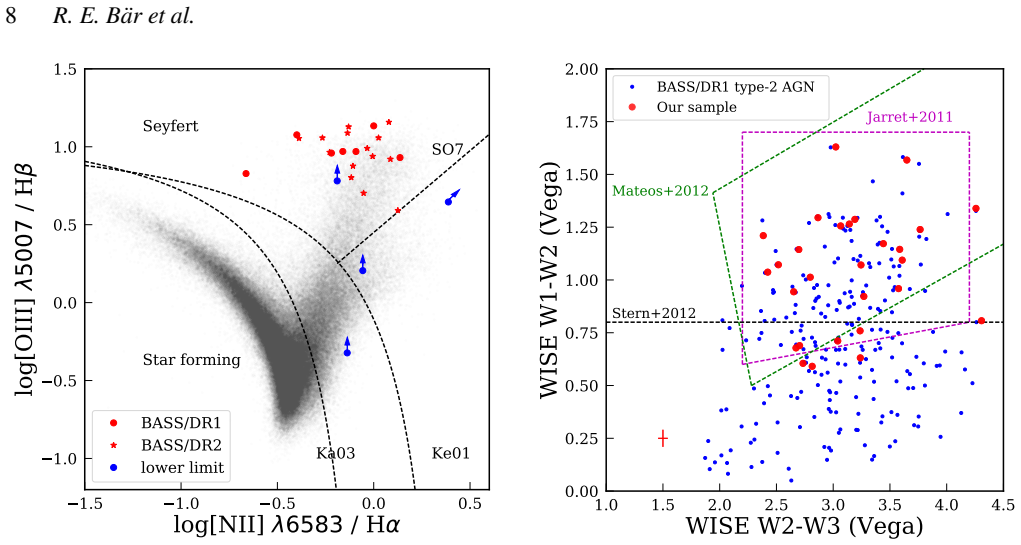
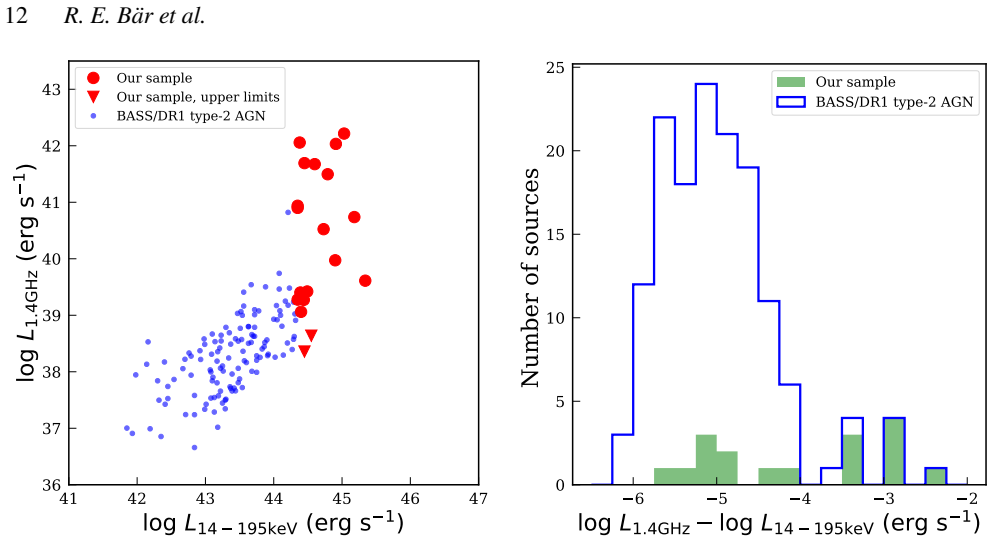
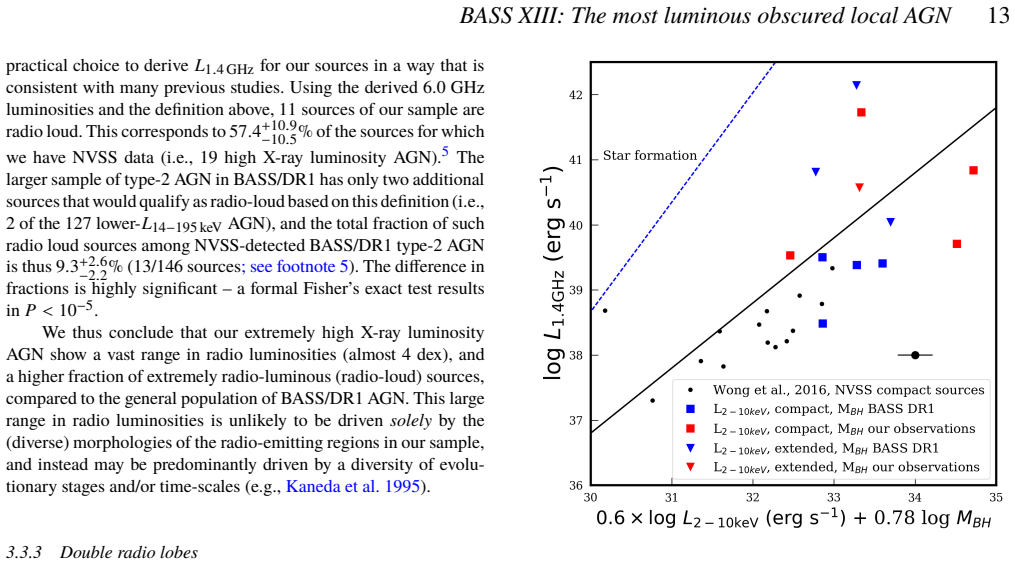
Summary. The paper presents a multiwavelength study of 28 of the most luminous narrow-line (type-2) AGN in the local Universe, selected from the Swift/BAT 70-month survey with bolometric luminosities log(L_bol/erg/s) > 45.25. The authors combine BASS/DR1 data with new VLT/XSHOOTER, Palomar/DBSP, and Keck/LRIS spectroscopy to obtain stellar velocity dispersions, black hole masses, and Eddington ratios. They find that the sources are robustly classified as AGN by optical emission-line ratios and mid-infrared colours, are hosted predominantly in massive elliptical galaxies, show a very broad range of radio luminosities and a high incidence of radio-loud sources and double radio lobes, and span a wide range of MBH and lambda_Edd without clustering at extreme values. The central interpretive claim is that the positions of these sources in the lambda_Edd-NH plane lie mostly outside the 'blow-out' wedge of Ricci et al. (2017c), supporting a radiation-pressure-driven unification scenario in which luminous AGN can remain obscured if their Eddington ratios are not high enough to expel the dusty gas, and challenging the receding-torus picture.
Significance. If the central claim holds, the paper extends the Ricci et al. (2017c) radiative-feedback unification scenario to the most luminous obscured AGN in the low-redshift universe, using a well-defined, ultra-hard-X-ray-selected sample with dedicated spectroscopy. The study is valuable for its transparent sample construction, public/tabulated data, explicit tests of alternative bolometric corrections, and statistical controls in the host-galaxy morphology analysis. The main caveat is that the interpretation in the lambda_Edd-NH plane depends on black hole masses estimated from the MBH-sigma* relation, whose stated systematic uncertainty (about 0.5 dex) is not propagated into the central diagnostic; this makes the headline consistency claim less robust than the text suggests.
major comments (3)
- [Section 2.3 and Section 4, Fig. 10] The central conclusion that the sample lies outside the Ricci et al. (2017c) blow-out wedge depends on lambda_Edd, which inherits MBH from the Kormendy & Ho (2013) MBH-sigma* relation. Section 2.3 states that the overall MBH uncertainties may be of order 0.5 dex, yet the robustness discussion in Section 4 varies only the bolometric correction and dismisses the two in-wedge sources using an approximately 0.3 dex systematic floor. Because the wedge boundary is a theoretical curve and is not recalibrated to the same MBH scale, a systematic offset in MBH-sigma* for these massive, mostly elliptical hosts could shift the sample horizontally in Fig. 10 by an amount comparable to or larger than the margin by which the sources sit outside the wedge. I request a quantitative robustness test: for example, shift all lambda_Edd values by +/-0.5 dex (or use an alternative MBH-sigma* calibration) and report how many sources cross into the blow-out region. Without such a test, the claim that the sample is 'consistent' with radiative-feedback unification is not yet supported at the stated confidence.
- [Section 4 and Section 5] The test presented in Fig. 10 is only a necessary-condition test, because the sample was selected to contain obscured AGN. All 28 sources are, by construction, narrow-line and X-ray obscured; finding them outside the blow-out wedge shows that their existence is not inconsistent with the radiative-feedback scenario, but it does not by itself demonstrate that the wedge separates obscured from unobscured populations. To strengthen the 'in contrast to the receding torus' claim, the authors should compare the distribution of these sources in the lambda_Edd-NH plane with that of a matched sample of unobscured BAT AGN at similar Lbol, or provide a quantitative prediction from the receding-torus model for the expected number of such luminous obscured sources. As written, the final summary bullet overstates the discriminating power of the current analysis.
- [Section 1 and Section 4] The paper states that the very existence of luminous obscured AGN challenges the receding-torus model, but it does not quantify what the receding-torus model actually predicts for the number of such objects at Lbol > 10^45.25 erg/s in the BAT survey. The receding-torus model predicts a decreasing obscured fraction with luminosity, not necessarily zero obscured objects, and the sample selection is based on the brightest obscured sources, so the observed sample size must be compared with an explicit expectation. Without such a quantitative comparison, the conclusion that these 28 objects are inconsistent with the receding-torus scenario is not supported. I recommend either adding a calculation of the expected number under both models given the BAT survey selection function, or softening the claim to state that the sample is consistent with the radiative-feedback scenario without asserting a strong exclusion of the receding-torus model.
minor comments (3)
- [Throughout] There are several typographical errors, including 'cicumnuclear' and 'cicrum-nuclear' in the Introduction, 'intermoftheir' in Section 1, 'K-badluminosities' in Section 3.2, and 'our our sources' in the caption of Fig. 4. A careful proofreading pass is needed.
- [Fig. 10 caption and Section 4] The error bar shown in Fig. 10 is described as representing 'mean measurement-related errors', but the text later quotes a >=0.3 dex systematic floor. Please clarify which components are included in the displayed error bar (sigma* measurement, luminosity, distance) and which are excluded, so the reader can assess the visual claim that the two in-wedge sources are compatible with the wedge boundary.
- [Section 2.1, Table 2] BAT ID 1204 (the Phoenix cluster AGN) is a clear outlier in luminosity and redshift; the paper keeps it in the sample, which is defensible, but the main conclusions are driven by the remaining 27 sources. I suggest explicitly stating whether the Section 4 conclusions change if this source is removed.
Circularity Check
No significant circularity: the λ_Edd–N_H positions are measured quantities and the consistency claim is not imposed by construction.
full rationale
The paper's central interpretive step is the placement of 28 luminous obscured AGN in the log λ_Edd–log N_H plane (Section 4, Fig. 10) and the statement that they lie outside the Ricci et al. (2017c) 'blow-out' wedge. λ_Edd is constructed from measured stellar velocity dispersions through the external Kormendy & Ho (2013) M_BH–σ* relation and from BAT hard X-ray luminosities with a fixed bolometric correction; N_H is measured from X-ray spectroscopy. No parameter in the present paper is fitted to the wedge boundary or to the target conclusion. The wedge and the 392-object parent diagram are imported from Ricci et al. (2017c), and the paper deliberately adopts the same L_bol prescription 'to be consistent with the analysis performed by Ricci et al. (2017c)' — an alignment of conventions, not a fitting of the conclusion. The overlapping author list and BASS data lineage are limitations on independence, but the Ricci et al. wedge is an externally published, falsifiable result, and 18 of the 28 sources have new velocity-dispersion measurements from the dedicated XSHOOTER/Palomar/Keck campaign. The paper itself flags the two main robustness limitations: the M_BH–σ* assumption and its ~0.5 dex systematic uncertainty (Section 2.3), and the inconclusive placement of the two in-wedge sources (Fig. 10 caption). These are correctness/systematics concerns, not circular reductions: there is no equation in which a predicted quantity equals a fitted input, and no uniqueness theorem or ansatz is imported from the authors' prior work to force the choice. I therefore find no circular step.
Assumptions & free parameters
free parameters (4)
- Bolometric correction fbol =
8
- Radio spectral index alpha_nu =
-0.7
- Control-sample matching bins (Delta MK, Delta z) =
+/-0.5 mag, +/-0.0005
- Kellermann radio-loudness threshold L6GHz =
1e23.2 W/Hz
assumptions (4)
- domain assumption AGN in the sample lie on the same MBH-sigma* relation as inactive galaxies (Kormendy & Ho 2013).
- domain assumption The radiation-pressure blow-out wedge boundary in Fig. 10 from Ricci et al. (2017c) correctly maps where dusty gas cannot survive.
- domain assumption Constant bolometric correction fbol=8 applied to observed 14-195 keV luminosity approximates true bolometric output for all 28 sources.
- domain assumption Radio emission traced by NVSS measures the AGN's jet or core rather than star formation for these sources.
Cite this review
Pith. "Pith review of BAT AGN Spectroscopic Survey -- XIII. The nature of the most luminous obscured AGN in the low-redshift universe." pith.science (2026). https://pith.science/paper/HF75EU4A
@misc{pith2026190807546,
  author       = {Pith},
  title        = {Pith review of: BAT AGN Spectroscopic Survey -- XIII. The nature of the most luminous obscured AGN in the low-redshift universe},
  year         = {2026},
  howpublished = {\url{https://pith.science/paper/HF75EU4A}},
  note         = {Machine review of arXiv:1908.07546}
}
read the original abstract
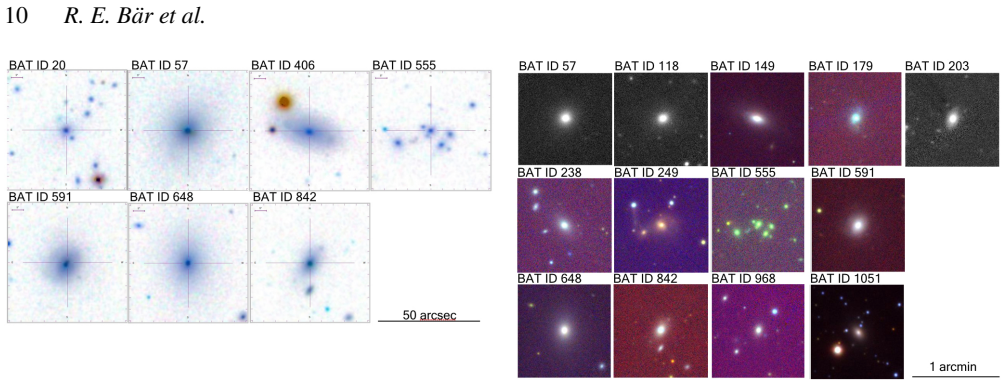
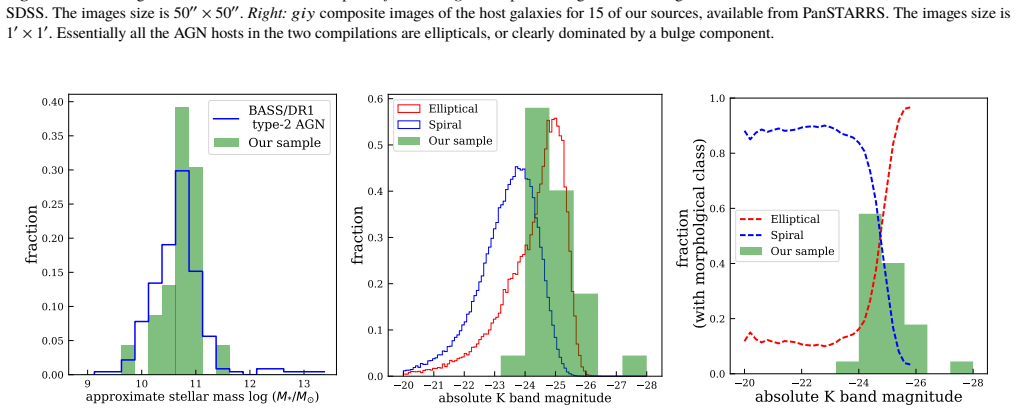
We present a multi wavelength analysis of 28 of the most luminous low-redshift narrow-line, ultra-hard X-ray selected active galactic nuclei (AGN) drawn from the 70 month Swift/BAT all-sky survey, with bolometric luminosities of log(L_bol/erg/s) > 45.25. The broad goal of our study is to determine whether these objects have any distinctive properties, potentially setting them aside from lower-luminosity obscured AGN in the local Universe. Our analysis relies on the first data release of the BAT AGN Spectroscopic Survey (BASS/DR1) and on dedicated observations with the VLT, Palomar, and Keck observatories. We find that the vast majority of our sources agree with commonly used AGN selection criteria which are based on emission line ratios and on mid-infrared colours. Our AGN are predominantly hosted in massive galaxies (9.8 < log(M_*/M_sun) < 11.7); based on visual inspection of archival optical images, they appear to be mostly ellipticals. Otherwise, they do not have distinctive properties. Their radio luminosities, determined from publicly available survey data, show a large spread of almost 4 orders of magnitude - much broader than what is found for lower X-ray luminosity obscured AGN in BASS. Moreover, our sample shows no preferred combination of black hole masses (M_BH) and/or Eddington ratio (lambda_Edd), covering 7.5 < log(M_BH/M_sun) < 10.3 and 0.01 < lambda_Edd < 1. Based on the distribution of our sources in the lambda_Edd-N_H plane, we conclude that our sample is consistent with a scenario where the amount of obscuring material along the line of sight is determined by radiation pressure exerted by the AGN on the dusty circumnuclear gas.
Figures

Figures from the paper (6 more)

Reference graph
Works this paper leans on
-
[1]
Abazajian K. N., et al., 2009, @doi [ ] 10.1088/0067-0049/182/2/543 , http://adsabs.harvard.edu/abs/2009ApJS..182..543A 182, 543
-
[2]
Abolfathi B., et al., 2018, @doi [ ] 10.3847/1538-4365/aa9e8a , http://adsabs.harvard.edu/abs/2018ApJS..235...42A 235, 42
-
[3]
Abramowicz M. A., Fragile P. C., 2013, @doi [Living Reviews in Relativity] 10.12942/lrr-2013-1 , http://adsabs.harvard.edu/abs/2013LRR....16....1A 16, 1
-
[4]
Acero F., et al., 2015, @doi [ ] 10.1088/0067-0049/218/2/23 , http://adsabs.harvard.edu/abs/2015ApJS..218...23A 218, 23
-
[5]
Adelman-McCarthy J. K., et al., 2008, @doi [ ] 10.1086/524984 , http://adsabs.harvard.edu/abs/2008ApJS..175..297A 175, 297
doi:10.1086/524984 2008
-
[6]
Aird J., Coil A. L., Georgakakis A., 2018, @doi [ ] 10.1093/mnras/stx2700 , http://adsabs.harvard.edu/abs/2018MNRAS.474.1225A 474, 1225
-
[7]
Ajello M., et al., 2008, @doi [ ] 10.1086/524104 , http://adsabs.harvard.edu/abs/2008ApJ...673...96A 673, 96
-
[8]
Akiyama M., et al., 2018, @doi [ ] 10.1093/pasj/psx091 , http://adsabs.harvard.edu/abs/2018PASJ...70S..34A 70, S34
Show all 204 references
-
[9]
Akylas A., Georgantopoulos I., Ranalli P., Gkiokas E., Corral A., Lanzuisi G., 2016, @doi [ ] 10.1051/0004-6361/201628711 , http://adsabs.harvard.edu/abs/2016A
2016 doi
-
[10]
Alexandroff R., et al., 2013, @doi [ ] 10.1093/mnras/stt1500 , http://adsabs.harvard.edu/abs/2013MNRAS.435.3306A 435, 3306
2013 doi
-
[11]
T., Rodr \' guez L
Anglada G., Villuendas E., Estalella R., Beltr \'a n M. T., Rodr \' guez L. F., Torrelles J. M., Curiel S., 1998, @doi [ ] 10.1086/300637 , http://adsabs.harvard.edu/abs/1998AJ....116.2953A 116, 2953
1998 doi
-
[12]
Antonucci R., 1993, @doi [ ] 10.1146/annurev.aa.31.090193.002353 , 31, 473
1993
-
[13]
J., et al., 2010, @doi [ ] 10.1088/0004-637X/713/2/970 , http://adsabs.harvard.edu/abs/2010ApJ...713..970A 713, 970
Assef R. J., et al., 2010, @doi [ ] 10.1088/0004-637X/713/2/970 , http://adsabs.harvard.edu/abs/2010ApJ...713..970A 713, 970
2010 doi
-
[14]
J., et al., 2015, @doi [ ] 10.1088/0004-637X/804/1/27 , 804, 27
Assef R. J., et al., 2015, @doi [ ] 10.1088/0004-637X/804/1/27 , 804, 27
2015 doi
-
[15]
Astropy Collaboration et al., 2013, @doi [ ] 10.1051/0004-6361/201322068 , http://adsabs.harvard.edu/abs/2013A
2013 doi
-
[16]
A., Pastoriza M
Audibert A., Riffel R., Sales D. A., Pastoriza M. G., Ruschel-Dutra D., 2017, @doi [ ] 10.1093/mnras/stw2477 , http://adsabs.harvard.edu/abs/2017MNRAS.464.2139A 464, 2139
2017 doi
-
[17]
N., Kirhakos S., Saxe D
Bahcall J. N., Kirhakos S., Saxe D. H., Schneider D. P., 1997, @doi [ ] 10.1086/303926 , 479, 642
1997 doi
-
[18]
K., Glazebrook K., Brinkmann J., Ivezi \' c Z ., Lupton R
Baldry I. K., Glazebrook K., Brinkmann J., Ivezi \' c Z ., Lupton R. H., Nichol R. C., Szalay A. S., 2004, @doi [ ] 10.1086/380092 , 600, 681
2004 doi
-
[19]
A., Phillips M
Baldwin J. A., Phillips M. M., Terlevich R., 1981, @doi [ ] 10.1086/130766 , http://adsabs.harvard.edu/abs/1981PASP...93....5B 93, 5
1981 doi
-
[20]
Ballo L., Heras F. J. H., Barcons X., Carrera F. J., 2012, @doi [ ] 10.1051/0004-6361/201117464 , http://adsabs.harvard.edu/abs/2012A
2012 doi
-
[21]
Balmaverde B., et al., 2012, @doi [ ] 10.1051/0004-6361/201219561 , http://adsabs.harvard.edu/abs/2012A
2012 doi
-
[23]
C., McMahon R
Banerji M., Alaghband-Zadeh S., Hewett P. C., McMahon R. G., 2015, @doi [ ] 10.1093/mnras/stu2649 , http://adsabs.harvard.edu/abs/2015MNRAS.447.3368B 447, 3368
2015 doi
-
[24]
L., Jones G., Wagg J., McMahon R
Banerji M., Carilli C. L., Jones G., Wagg J., McMahon R. G., Hewett P. C., Alaghband-Zadeh S., Feruglio C., 2017, @doi [ ] 10.1093/mnras/stw3019 , http://adsabs.harvard.edu/abs/2017MNRAS.465.4390B 465, 4390
2017 doi
-
[25]
D., et al., 2005, @doi [ ] 10.1007/s11214-005-5096-3 , http://adsabs.harvard.edu/abs/2005SSRv..120..143B 120, 143
Barthelmy S. D., et al., 2005, @doi [ ] 10.1007/s11214-005-5096-3 , http://adsabs.harvard.edu/abs/2005SSRv..120..143B 120, 143
2005 doi
-
[26]
H., Tueller J., Markwardt C
Baumgartner W. H., Tueller J., Markwardt C. B., Skinner G., Barthelmy S., Mushotzky R. F., Evans P. A., Gehrels N., 2013, @doi [ ] 10.1088/0067-0049/207/2/19 , 207, 19
2013 doi
-
[27]
H., White R
Becker R. H., White R. L., Helfand D. J., 1995, @doi [ ] 10.1086/176166 , http://adsabs.harvard.edu/abs/1995ApJ...450..559B 450, 559
1995 doi
-
[28]
F., 2003, @doi [ ] 10.1086/367829 , http://adsabs.harvard.edu/abs/2003ApJ...586..794B 586, 794
Bell E. F., 2003, @doi [ ] 10.1086/367829 , http://adsabs.harvard.edu/abs/2003ApJ...586..794B 586, 794
2003 doi
-
[30]
F., McIntosh D
Bell E. F., McIntosh D. H., Katz N., Weinberg M. D., 2003b, @doi [ ] 10.1086/378847 , 149, 289
-
[31]
Berney S., et al., 2015, @doi [ ] 10.1093/mnras/stv2181 , 454, 3622
2015 doi
-
[35]
D., K \"o nigl A., 1979, @doi [ ] 10.1086/157262 , http://adsabs.harvard.edu/abs/1979ApJ...232...34B 232, 34
Blandford R. D., K \"o nigl A., 1979, @doi [ ] 10.1086/157262 , http://adsabs.harvard.edu/abs/1979ApJ...232...34B 232, 34
1979 doi
-
[36]
D., Znajek R
Blandford R. D., Znajek R. L., 1977, @doi [ ] 10.1093/mnras/179.3.433 , https://ui.adsabs.harvard.edu/abs/1977MNRAS.179..433B 179, 433
1977 doi
-
[37]
arXiv:1812.06025
Blandford R., Meier D., Readhead A., 2018, , https://ui.adsabs.harvard.edu/abs/2018arXiv181206025B p. arXiv:1812.06025
2018 arXiv
-
[38]
R., et al., 2005, @doi [ ] 10.1086/429803 , http://adsabs.harvard.edu/abs/2005AJ....129.2562B 129, 2562
Blanton M. R., et al., 2005, @doi [ ] 10.1086/429803 , http://adsabs.harvard.edu/abs/2005AJ....129.2562B 129, 2562
2005 doi
-
[39]
Bonchi A., La Franca F., Melini G., Bongiorno A., Fiore F., 2013, @doi [ ] 10.1093/mnras/sts456 , http://adsabs.harvard.edu/abs/2013MNRAS.429.1970B 429, 1970
2013 doi
-
[40]
N., Alexander D
Brandt W. N., Alexander D. M., 2015, @doi [ ] 10.1007/s00159-014-0081-z , http://adsabs.harvard.edu/abs/2015A
2015 doi
-
[41]
Burlon D., Ghirlanda G., Murphy T., Chhetri R., Sadler E., Ajello M., 2013, @doi [ ] 10.1093/mnras/stt343 , http://adsabs.harvard.edu/abs/2013MNRAS.431.2471B 431, 2471
2013 doi
-
[42]
R., et al., 2015, @doi [ ] 10.1088/0004-637X/809/2/168 , http://adsabs.harvard.edu/abs/2015ApJ...809..168C 809, 168
Callingham J. R., et al., 2015, @doi [ ] 10.1088/0004-637X/809/2/168 , http://adsabs.harvard.edu/abs/2015ApJ...809..168C 809, 168
2015 doi
-
[43]
M., Netzer H., Lira P., Trakhtenbrot B., 2015, @doi [ ] 10.1093/mnras/stu2266 , 446, 3427
Capellupo D. M., Netzer H., Lira P., Trakhtenbrot B., 2015, @doi [ ] 10.1093/mnras/stu2266 , 446, 3427
2015 doi
-
[44]
J., Trakhtenbrot B., 2015, @doi [ ] 10.1088/0004-637X/811/2/148 , 811, 148
Caplar N., Lilly S. J., Trakhtenbrot B., 2015, @doi [ ] 10.1088/0004-637X/811/2/148 , 811, 148
2015 doi
-
[45]
Cappellari M., Emsellem E., 2004, @doi [ ] 10.1086/381875 , http://adsabs.harvard.edu/abs/2004PASP..116..138C 116, 138
2004 doi
-
[46]
L., Perley R
Carilli C. L., Perley R. A., Dreher J. W., Leahy J. P., 1991, @doi [ ] 10.1086/170813 , http://adsabs.harvard.edu/abs/1991ApJ...383..554C 383, 554
1991 doi
-
[47]
Castell \'o -Mor N., Netzer H., Kaspi S., 2016, @doi [ ] 10.1093/mnras/stw445 , http://adsabs.harvard.edu/abs/2016MNRAS.458.1839C 458, 1839
2016 doi
-
[48]
J., Cotton W
Condon J. J., Cotton W. D., Greisen E. W., Yin Q. F., Perley R. A., Taylor G. B., Broderick J. J., 1998, @doi [ ] 10.1086/300337 , http://adsabs.harvard.edu/abs/1998AJ....115.1693C 115, 1693
1998 doi
-
[50]
A., Stout D
Daly R. A., Stout D. A., Mysliwiec J. N., 2018, @doi [ ] 10.3847/1538-4357/aad08b , https://ui.adsabs.harvard.edu/abs/2018ApJ...863..117D 863, 117
2018 doi
-
[51]
I., et al., 2017, @doi [ ] 10.1093/mnras/stx045 , http://adsabs.harvard.edu/abs/2017MNRAS.466.4917D 466, 4917
Davies R. I., et al., 2017, @doi [ ] 10.1093/mnras/stx045 , http://adsabs.harvard.edu/abs/2017MNRAS.466.4917D 466, 4917
2017 doi
-
[52]
Deeley S., et al., 2017, @doi [ ] 10.1093/mnras/stx441 , http://adsabs.harvard.edu/abs/2017MNRAS.467.3934D 467, 3934
2017 doi
-
[53]
C., Celotti A., Erlund M
Fabian A. C., Celotti A., Erlund M. C., 2006, @doi [ ] 10.1111/j.1745-3933.2006.00234.x , http://adsabs.harvard.edu/abs/2006MNRAS.373L..16F 373, L16
2006
-
[54]
C., Vasudevan R
Fabian A. C., Vasudevan R. V., Gandhi P., 2008, @doi [ ] 10.1111/j.1745-3933.2008.00430.x , 385, L43
2008
-
[55]
C., Vasudevan R
Fabian A. C., Vasudevan R. V., Mushotzky R. F., Winter L. M., Reynolds C. S., 2009, @doi [ ] 10.1111/j.1745-3933.2009.00617.x , http://adsabs.harvard.edu/abs/2009MNRAS.394L..89F 394, L89
2009
-
[56]
L., 1995, , http://adsabs.harvard.edu/abs/1995A
Falcke H., Biermann P. L., 1995, , http://adsabs.harvard.edu/abs/1995A
1995
-
[57]
Falcke H., K \"o rding E., Markoff S., 2004, @doi [ ] 10.1051/0004-6361:20031683 , http://adsabs.harvard.edu/abs/2004A
2004 doi
-
[58]
L., Riley J
Fanaroff B. L., Riley J. M., 1974, @doi [ ] 10.1093/mnras/167.1.31P , http://adsabs.harvard.edu/abs/1974MNRAS.167P..31F 167, 31P
1974 doi
-
[59]
W., 2016, @doi [ ] 10.1017/pasa.2016.44 , http://adsabs.harvard.edu/abs/2016PASA...33...52F 33, e052
Flesch E. W., 2016, @doi [ ] 10.1017/pasa.2016.44 , http://adsabs.harvard.edu/abs/2016PASA...33...52F 33, e052
2016 doi
-
[60]
A., et al., 2016, preprint, http://adsabs.harvard.edu/abs/2016arXiv161205243F ( @eprint arXiv 1612.05243 )
Flewelling H. A., et al., 2016, preprint, http://adsabs.harvard.edu/abs/2016arXiv161205243F ( @eprint arXiv 1612.05243 )
2016 arXiv
-
[61]
M., Ballester P., Forchi V., Garc \' a-Dabl \'o C
Freudling W., Romaniello M., Bramich D. M., Ballester P., Forchi V., Garc \' a-Dabl \'o C. E., Moehler S., Neeser M. J., 2013, @doi [ ] 10.1051/0004-6361/201322494 , http://adsabs.harvard.edu/abs/2013A
2013 doi
-
[62]
Gehrels N., et al., 2004, @doi [ ] 10.1086/422091 , http://adsabs.harvard.edu/abs/2004ApJ...611.1005G 611, 1005
2004 doi
-
[63]
Ghisellini G., Tavecchio F., Maraschi L., Celotti A., Sbarrato T., 2014, @doi [ ] 10.1038/nature13856 , https://ui.adsabs.harvard.edu/abs/2014Natur.515..376G 515, 376
2014 doi
-
[64]
Glikman E., 2017, @doi [Research Notes of the American Astronomical Society] 10.3847/2515-5172/aaa0c0 , http://adsabs.harvard.edu/abs/2017RNAAS...1a..48G 1, 48
2017 doi
-
[65]
J., White R
Glikman E., Helfand D. J., White R. L., Becker R. H., Gregg M. D., Lacy M., 2007, @doi [ ] 10.1086/521073 , http://adsabs.harvard.edu/abs/2007ApJ...667..673G 667, 673
2007 doi
-
[66]
M., Lacy M., 2015, @doi [ ] 10.1088/0004-637X/806/2/218 , http://adsabs.harvard.edu/abs/2015ApJ...806..218G 806, 218
Glikman E., Simmons B., Mailly M., Schawinski K., Urry C. M., Lacy M., 2015, @doi [ ] 10.1088/0004-637X/806/2/218 , http://adsabs.harvard.edu/abs/2015ApJ...806..218G 806, 218
2015 doi
-
[67]
D., et al., 2018, @doi [ ] 10.3847/1538-4357/aab040 , http://adsabs.harvard.edu/abs/2018ApJ...856....4G 856, 4
Goulding A. D., et al., 2018, @doi [ ] 10.3847/1538-4357/aab040 , http://adsabs.harvard.edu/abs/2018ApJ...856....4G 856, 4
2018 doi
-
[68]
W., Scott N., 2013, @doi [ ] 10.1088/0004-637X/764/2/151 , http://adsabs.harvard.edu/abs/2013ApJ...764..151G 764, 151
Graham A. W., Scott N., 2013, @doi [ ] 10.1088/0004-637X/764/2/151 , http://adsabs.harvard.edu/abs/2013ApJ...764..151G 764, 151
2013 doi
-
[69]
E., Zakamska N
Greene J. E., Zakamska N. L., Ho L. C., Barth A. J., 2011, @doi [ ] 10.1088/0004-637X/732/1/9 , 732
2011 doi
-
[70]
J., et al., 2013, @doi [ ] 10.1088/0004-637X/773/2/90 , 773, 90
Grier C. J., et al., 2013, @doi [ ] 10.1088/0004-637X/773/2/90 , 773, 90
2013 doi
-
[71]
G \" u ltekin K., et al., 2009a, @doi [ ] 10.1088/0004-637X/698/1/198 , 698, 198
-
[72]
M., Miller J
G \"u ltekin K., Cackett E. M., Miller J. M., Di Matteo T., Markoff S., Richstone D. O., 2009b, @doi [ ] 10.1088/0004-637X/706/1/404 , http://adsabs.harvard.edu/abs/2009ApJ...706..404G 706, 404
-
[73]
M., 2017, @doi [Nature Astronomy] 10.1038/s41550-017-0165 , 1, 0165
Harrison C. M., 2017, @doi [Nature Astronomy] 10.1038/s41550-017-0165 , 1, 0165
2017 doi
-
[74]
E., et al., 2016, @doi [ ] 10.1093/mnras/stw1588 , http://adsabs.harvard.edu/abs/2016MNRAS.461.3663H 461, 3663
Hart R. E., et al., 2016, @doi [ ] 10.1093/mnras/stw1588 , http://adsabs.harvard.edu/abs/2016MNRAS.461.3663H 461, 3663
2016 doi
-
[75]
Hasinger G., Miyaji T., Schmidt M., 2005, @doi [ ] 10.1051/0004-6361:20042134 , http://adsabs.harvard.edu/abs/2005A
2005 doi
-
[76]
M., Best P
Heckman T. M., Best P. N., 2014, @doi [ ] 10.1146/annurev-astro-081913-035722 , http://adsabs.harvard.edu/abs/2014ARA
2014 doi
-
[78]
C., Alexander D
Hickox R. C., Alexander D. M., 2018, @doi [ ] 10.1146/annurev-astro-081817-051803 , 56, 625
2018 doi
-
[79]
C., Mullaney J
Hickox R. C., Mullaney J. R., Alexander D. M., Chen C.-T. J., Civano F. M., Goulding A. D., Hainline K. N., 2014, @doi [ ] 10.1088/0004-637X/782/1/9 , http://adsabs.harvard.edu/abs/2014ApJ...782....9H 782, 9
2014 doi
-
[80]
C., Lamassa S
Hickox R. C., Lamassa S. M., Silverman J. D., Kolodzig A., 2016, @doi [IAU Focus Meeting] 10.1017/S1743921316004592 , http://adsabs.harvard.edu/abs/2016IAUFM..29B.113H 29, 113
2016 doi
-
[81]
D., 2007, @doi [Computing In Science & Engineering] 10.1109/MCSE.2007.55 , 9, 90
Hunter J. D., 2007, @doi [Computing In Science & Engineering] 10.1109/MCSE.2007.55 , 9, 90
2007 doi
-
[82]
J., 2017, @doi [ ] 10.3847/1538-4357/835/1/74 , http://adsabs.harvard.edu/abs/2017ApJ...835...74I 835, 74
Ichikawa K., Ricci C., Ueda Y., Matsuoka K., Toba Y., Kawamuro T., Trakhtenbrot B., Koss M. J., 2017, @doi [ ] 10.3847/1538-4357/835/1/74 , http://adsabs.harvard.edu/abs/2017ApJ...835...74I 835, 74
2017 doi
-
[83]
Ichikawa K., et al., 2019, @doi [ ] 10.3847/1538-4357/aaef8f , http://adsabs.harvard.edu/abs/2019ApJ...870...31I 870, 31
2019 doi
-
[84]
Inayoshi K., Haiman Z., 2016, @doi [ ] 10.3847/0004-637X/828/2/110 , https://ui.adsabs.harvard.edu/abs/2016ApJ...828..110I 828, 110
2016 doi
-
[85]
H., et al., 2011, @doi [ ] 10.1088/0004-637X/735/2/112 , http://adsabs.harvard.edu/abs/2011ApJ...735..112J 735, 112
Jarrett T. H., et al., 2011, @doi [ ] 10.1088/0004-637X/735/2/112 , http://adsabs.harvard.edu/abs/2011ApJ...735..112J 735, 112
2011 doi
-
[86]
H., et al., 2012, @doi [ ] 10.1088/0004-6256/144/2/68 , http://adsabs.harvard.edu/abs/2012AJ....144...68J 144, 68
Jarrett T. H., et al., 2012, @doi [ ] 10.1088/0004-6256/144/2/68 , http://adsabs.harvard.edu/abs/2012AJ....144...68J 144, 68
2012 doi
-
[88]
Kaneda H., et al., 1995, @doi [ ] 10.1086/309742 , http://adsabs.harvard.edu/abs/1995ApJ...453L..13K 453, L13
1995 doi
-
[89]
M., Rudnick L., Anderson M
Katz-Stone D. M., Rudnick L., Anderson M. C., 1993, @doi [ ] 10.1086/172536 , http://adsabs.harvard.edu/abs/1993ApJ...407..549K 407, 549
1993 doi
-
[90]
Kauffmann G., et al., 2003, @doi [ ] 10.1046/j.1365-8711.2003.06291.x , http://adsabs.harvard.edu/abs/2003MNRAS.341...33K 341, 33
2003
-
[91]
I., Sramek R., Schmidt M., Shaffer D
Kellermann K. I., Sramek R., Schmidt M., Shaffer D. B., Green R., 1989, @doi [ ] 10.1086/115207 , http://adsabs.harvard.edu/abs/1989AJ.....98.1195K 98, 1195
1989 doi
-
[92]
I., Condon J
Kellermann K. I., Condon J. J., Kimball A. E., Perley R. A., Ivezi \'c Z ., 2016, @doi [ ] 10.3847/0004-637X/831/2/168 , http://adsabs.harvard.edu/abs/2016ApJ...831..168K 831, 168
2016 doi
-
[93]
C., Shen Y., 2013, @doi [ ] 10.1088/0004-637X/764/1/45 , 764, 45
Kelly B. C., Shen Y., 2013, @doi [ ] 10.1088/0004-637X/764/1/45 , 764, 45
2013 doi
-
[94]
J., Heisler C
Kewley L. J., Heisler C. A., Dopita M. A., Lumsden S., 2001a, @doi [ ] 10.1086/318944 , 132, 37
-
[95]
J., Dopita M
Kewley L. J., Dopita M. A., Sutherland R. S., Heisler C. A., Trevena J., 2001b, @doi [ ] 10.1086/321545 , http://adsabs.harvard.edu/abs/2001ApJ...556..121K 556, 121
-
[96]
R., 2016, @doi [ ] 10.1093/mnrasl/slv186 , 456, L109
King A. R., 2016, @doi [ ] 10.1093/mnrasl/slv186 , 456, L109
2016 doi
-
[97]
Komatsu E., et al., 2011, @doi [ ] 10.1088/0067-0049/192/2/18 , http://adsabs.harvard.edu/abs/2011ApJS..192...18K 192, 18
2011 doi
-
[98]
C., 2018, @doi [ ] arXiv:1804.09852v1 , 859, 116
Kong M., Ho L. C., 2018, @doi [ ] arXiv:1804.09852v1 , 859, 116
2018 arXiv
-
[99]
K \" o rding E., Falcke H., Corbel S., 2006, @doi [ ] 10.1051/0004-6361:20054144 , 456, 439
2006 doi
-
[100]
418, Galactic Bulges
Kormendy J., 2016, in Laurikainen E., Peletier R., Gadotti D., eds, Astrophysics and Space Science Library Vol. 418, Galactic Bulges. p. 431 ( @eprint arXiv 1504.03330 ), @doi 10.1007/978-3-319-19378-6_16
2016 arXiv
-
[101]
C., 2013, @doi [ ] 10.1146/annurev-astro-082708-101811 , http://adsabs.harvard.edu/abs/2013ARA
Kormendy J., Ho L. C., 2013, @doi [ ] 10.1146/annurev-astro-082708-101811 , http://adsabs.harvard.edu/abs/2013ARA
2013 doi
-
[102]
Koss M., Mushotzky R., Veilleux S., Winter L., 2010, @doi [ ] 10.1088/2041-8205/716/2/L125 , http://adsabs.harvard.edu/abs/2010ApJ...716L.125K 716, L125
2010 doi
-
[103]
M., Baumgartner W., Tueller J., Gehrels N., Valencic L., 2011, @doi [ ] 10.1088/0004-637X/739/2/57 , http://adsabs.harvard.edu/abs/2011ApJ...739...57K 739, 57
Koss M., Mushotzky R., Veilleux S., Winter L. M., Baumgartner W., Tueller J., Gehrels N., Valencic L., 2011, @doi [ ] 10.1088/0004-637X/739/2/57 , http://adsabs.harvard.edu/abs/2011ApJ...739...57K 739, 57
2011 doi
-
[104]
J., et al., 2016, @doi [ ] 10.3847/0004-637X/825/2/85 , http://adsabs.harvard.edu/abs/2016ApJ...825...85K 825, 85
Koss M. J., et al., 2016, @doi [ ] 10.3847/0004-637X/825/2/85 , http://adsabs.harvard.edu/abs/2016ApJ...825...85K 825, 85
2016 doi
-
[105]
Koss M., et al., 2017, @doi [ ] 10.3847/1538-4357/aa8ec9 , http://adsabs.harvard.edu/abs/2017ApJ...850...74K 850, 74
2017 doi
-
[106]
J., et al., 2018, @doi [ ] 10.1038/s41586-018-0652-7 , http://adsabs.harvard.edu/abs/2018Natur.563..214K 563, 214
Koss M. J., et al., 2018, @doi [ ] 10.1038/s41586-018-0652-7 , http://adsabs.harvard.edu/abs/2018Natur.563..214K 563, 214
2018 doi
-
[107]
P., Hardcastle M
Kraft R. P., Hardcastle M. J., Worrall D. M., Murray S. S., 2005, @doi [ ] 10.1086/427822 , http://adsabs.harvard.edu/abs/2005ApJ...622..149K 622, 149
2005 doi
-
[108]
M., et al., 2017, @doi [ ] 10.3847/1538-4357/aa87b5 , http://adsabs.harvard.edu/abs/2017ApJ...847..100L 847, 100
LaMassa S. M., et al., 2017, @doi [ ] 10.3847/1538-4357/aa87b5 , http://adsabs.harvard.edu/abs/2017ApJ...847..100L 847, 100
2017 doi
-
[109]
Lawrence A., 1991, @doi [ ] 10.1093/mnras/252.4.586 , http://adsabs.harvard.edu/abs/1991MNRAS.252..586L 252, 586
1991 doi
-
[110]
Lintott C., et al., 2011, @doi [ ] 10.1111/j.1365-2966.2010.17432.x , http://adsabs.harvard.edu/abs/2011MNRAS.410..166L 410, 166
2011
-
[111]
M., 1992, @doi [ ] 10.1093/mnras/257.4.545 , http://adsabs.harvard.edu/abs/1992MNRAS.257..545L 257, 545
Liu R., Pooley G., Riley J. M., 1992, @doi [ ] 10.1093/mnras/257.4.545 , http://adsabs.harvard.edu/abs/1992MNRAS.257..545L 257, 545
1992 doi
-
[112]
L., Greene J
Liu X., Zakamska N. L., Greene J. E., Strauss M. A., Krolik J. H., Heckman T. M., 2009, @doi [ ] 10.1088/0004-637X/702/2/1098 , http://adsabs.harvard.edu/abs/2009ApJ...702.1098L 702, 1098
2009 doi
-
[113]
Lutz D., et al., 2008, @doi [ ] 10.1086/590367 , 684, 853
2008 doi
-
[114]
Maia M. A. G., Machado R. S., Willmer C. N. A., 2003, @doi [ ] 10.1086/378360 , http://adsabs.harvard.edu/abs/2003AJ....126.1750M 126, 1750
2003 doi
-
[115]
Maiolino R., Shemmer O., Imanishi M., Netzer H., Oliva E., Lutz D., Sturm E., 2007, @doi [ ] 10.1051/0004-6361:20077252 , 468, 979
2007 doi
-
[116]
K., Maiolino R., Salvati M., 2004, @doi [ ] 10.1111/j.1365-2966.2004.07765.x , http://adsabs.harvard.edu/abs/2004MNRAS.351..169M 351, 169
Marconi A., Risaliti G., Gilli R., Hunt L. K., Maiolino R., Salvati M., 2004, @doi [ ] 10.1111/j.1365-2966.2004.07765.x , http://adsabs.harvard.edu/abs/2004MNRAS.351..169M 351, 169
2004
-
[117]
Maselli A., et al., 2013, @doi [ ] 10.1088/0067-0049/206/2/17 , http://adsabs.harvard.edu/abs/2013ApJS..206...17M 206, 17
2013 doi
-
[118]
Massaro E., Maselli A., Leto C., Marchegiani P., Perri M., Giommi P., Piranomonte S., 2015, @doi [ ] 10.1007/s10509-015-2254-2 , https://ui.adsabs.harvard.edu/abs/2015Ap&SS.357...75M 357, 75
2015 doi
-
[120]
Mateos S., et al., 2017, @doi [ ] 10.3847/2041-8213/aa7268 , http://adsabs.harvard.edu/abs/2017ApJ...841L..18M 841, L18
2017 doi
-
[121]
J., Ma C.-P., 2013, @doi [ ] 10.1088/0004-637X/764/2/184 , 764, 184
McConnell N. J., Ma C.-P., 2013, @doi [ ] 10.1088/0004-637X/764/2/184 , 764, 184
2013 doi
-
[122]
J., Ma C.-p., Gebhardt K., Wright S
McConnell N. J., Ma C.-p., Gebhardt K., Wright S. A., Murphy J. D., Lauer T. R., Graham J. R., Richstone D. O., 2011, @doi [ ] 10.1038/nature10636 , 480, 215
2011 doi
-
[123]
J., Ma C.-P., Murphy J
McConnell N. J., Ma C.-P., Murphy J. D., Gebhardt K., Lauer T. R., Graham J. R., Wright S. a., Richstone D. O., 2012, @doi [ ] 10.1088/0004-637X/756/2/179 , 756, 179
2012 doi
-
[124]
McDonald M., et al., 2012, @doi [ ] 10.1038/nature11379 , 488, 349
2012 doi
-
[125]
Merloni A., Heinz S., di Matteo T., 2003, @doi [ ] 10.1046/j.1365-2966.2003.07017.x , http://adsabs.harvard.edu/abs/2003MNRAS.345.1057M 345, 1057
2003
-
[126]
R., Hogan M
Mezcua M., Hlavacek-Larrondo J., Lucey J. R., Hogan M. T., Edge A. C., McNamara B. R., 2018, @doi [ ] 10.1093/mnras/stx2812 , http://adsabs.harvard.edu/abs/2018MNRAS.474.1342M 474, 1342
2018 doi
-
[127]
D., Morrison G
Mineo S., Gilfanov M., Lehmer B. D., Morrison G. E., Sunyaev R., 2014, @doi [ ] 10.1093/mnras/stt1999 , http://adsabs.harvard.edu/abs/2014MNRAS.437.1698M 437, 1698
2014 doi
-
[128]
Mingo B., et al., 2017, @doi [ ] 10.1093/mnras/stx1307 , http://adsabs.harvard.edu/abs/2017MNRAS.470.2762M 470, 2762
2017 doi
-
[129]
J., et al., 2016, @doi [ ] 10.1093/mnras/stw1861 , 462, 4336
Moffett A. J., et al., 2016, @doi [ ] 10.1093/mnras/stw1861 , 462, 4336
2016 doi
-
[130]
Mountrichas G., et al., 2017, @doi [ ] 10.1093/mnras/stx572 , http://adsabs.harvard.edu/abs/2017MNRAS.468.3042M 468, 3042
2017 doi
-
[131]
R., Mack K.-H., 2012, @doi [ ] 10.1051/0004-6361/201219702 , http://adsabs.harvard.edu/abs/2012A
Murgia M., Markevitch M., Govoni F., Parma P., Fanti R., de Ruiter H. R., Mack K.-H., 2012, @doi [ ] 10.1051/0004-6361/201219702 , http://adsabs.harvard.edu/abs/2012A
2012 doi
-
[133]
Netzer H., 2015, @doi [ ] 10.1146/annurev-astro-082214-122302 , 53, 365
2015 doi
-
[134]
M., Best P
Nisbet D. M., Best P. N., 2016, @doi [ ] 10.1093/mnras/stv2450 , http://adsabs.harvard.edu/abs/2016MNRAS.455.2551N 455, 2551
2016 doi
-
[135]
Nyland K., et al., 2018, @doi [ ] 10.3847/1538-4357/aab3d1 , http://adsabs.harvard.edu/abs/2018ApJ...859...23N 859, 23
2018 doi
-
[136]
Ochsenbein F., Bauer P., Marcout J., 2000, @doi [ ] 10.1051/aas:2000169 , http://adsabs.harvard.edu/abs/2000A
2000 doi
-
[137]
K., 2011, @doi [ ] 10.1088/0067-0049/195/2/13 , http://adsabs.harvard.edu/abs/2011ApJS..195...13O 195, 13
Oh K., Sarzi M., Schawinski K., Yi S. K., 2011, @doi [ ] 10.1088/0067-0049/195/2/13 , http://adsabs.harvard.edu/abs/2011ApJS..195...13O 195, 13
2011 doi
-
[138]
K., Schawinski K., Koss M., Trakhtenbrot B., Soto K., 2015, @doi [ ] 10.1088/0067-0049/219/1/1 , http://adsabs.harvard.edu/abs/2015ApJS..219....1O 219, 1
Oh K., Yi S. K., Schawinski K., Koss M., Trakhtenbrot B., Soto K., 2015, @doi [ ] 10.1088/0067-0049/219/1/1 , http://adsabs.harvard.edu/abs/2015ApJS..219....1O 219, 1
2015 doi
-
[139]
Oh K., et al., 2017, @doi [ ] 10.1093/mnras/stw2467 , http://adsabs.harvard.edu/abs/2017MNRAS.464.1466O 464, 1466
2017 doi
-
[140]
Oh K., et al., 2018, @doi [ ] 10.3847/1538-4365/aaa7fd , http://adsabs.harvard.edu/abs/2018ApJS..235....4O 235, 4
2018 doi
-
[141]
E., 1981, @doi [ ] 10.1086/159306 , http://adsabs.harvard.edu/abs/1981ApJ...249..462O 249, 462
Osterbrock D. E., 1981, @doi [ ] 10.1086/159306 , http://adsabs.harvard.edu/abs/1981ApJ...249..462O 249, 462
1981 doi
-
[142]
Pacucci F., Natarajan P., Ferrara A., 2017, @doi [ ] 10.3847/2041-8213/835/2/L36 , 835, L36
2017 doi
-
[143]
Padmanabhan N., et al., 2008, @doi [ ] 10.1086/524677 , http://adsabs.harvard.edu/abs/2008ApJ...674.1217P 674, 1217
2008 doi
-
[144]
Padovani P., 1993, @doi [ ] 10.1093/mnras/263.2.461 , http://adsabs.harvard.edu/abs/1993MNRAS.263..461P 263, 461
1993 doi
-
[145]
Padovani P., 2017, @doi [Nature Astronomy] 10.1038/s41550-017-0194 , http://adsabs.harvard.edu/abs/2017NatAs...1E.194P 1, 0194
2017 doi
-
[146]
Panessa F., et al., 2015, @doi [ ] 10.1093/mnras/stu2455 , http://adsabs.harvard.edu/abs/2015MNRAS.447.1289P 447, 1289
2015 doi
-
[148]
C., et al., 2018, @doi [ ] 10.3847/1538-4357/aabd7f , http://adsabs.harvard.edu/abs/2018ApJ...858..110P 858, 110
Powell M. C., et al., 2018, @doi [ ] 10.3847/1538-4357/aabd7f , http://adsabs.harvard.edu/abs/2018ApJ...858..110P 858, 110
2018 doi
-
[149]
E., Crenshaw D
Rafter S. E., Crenshaw D. M., Wiita P. J., 2009, @doi [ ] 10.1088/0004-6256/137/1/42 , http://adsabs.harvard.edu/abs/2009AJ....137...42R 137, 42
2009 doi
-
[150]
pp E1.19--6--14
Ramos Almeida C., 2014, in 40th COSPAR Scientific Assembly. pp E1.19--6--14
2014
-
[151]
Ramos Almeida C., Ricci C., 2017, @doi [Nature Astronomy] 10.1038/s41550-017-0232-z , http://adsabs.harvard.edu/abs/2017NatAs...1..679R 1, 679
2017 doi
-
[153]
E., Volonteri M., 2015, @doi [ ] 10.1088/0004-637X/813/2/82 , 813, 82
Reines A. E., Volonteri M., 2015, @doi [ ] 10.1088/0004-637X/813/2/82 , 813, 82
2015 doi
-
[154]
Reyes R., et al., 2008, @doi [ ] 10.1088/0004-6256/136/6/2373 , http://adsabs.harvard.edu/abs/2008AJ....136.2373R 136, 2373
2008 doi
-
[155]
J., Trakhtenbrot B., Bauer F
Ricci C., Ueda Y., Koss M. J., Trakhtenbrot B., Bauer F. E., Gandhi P., 2015, @doi [ ] 10.1088/2041-8205/815/1/L13 , http://adsabs.harvard.edu/abs/2015ApJ...815L..13R 815, L13
2015 doi
-
[156]
Ricci C., et al., 2017a, @doi [ ] 10.3847/1538-4365/aa96ad , http://adsabs.harvard.edu/abs/2017ApJS..233...17R 233, 17
-
[157]
Ricci C., et al., 2017b, @doi [ ] 10.1093/mnras/stx173 , http://adsabs.harvard.edu/abs/2017MNRAS.468.1273R 468, 1273
-
[158]
Ricci C., et al., 2017c, @doi [ ] 10.1038/nature23906 , http://adsabs.harvard.edu/abs/2017Natur.549..488R 549, 488
-
[159]
T., et al., 2006, @doi [ ] 10.1086/503559 , http://adsabs.harvard.edu/abs/2006AJ....131.2766R 131, 2766
Richards G. T., et al., 2006, @doi [ ] 10.1086/503559 , http://adsabs.harvard.edu/abs/2006AJ....131.2766R 131, 2766
2006 doi
-
[160]
R., Diamond-Stanic A
Rigby J. R., Diamond-Stanic A. M., Aniano G., 2009, @doi [ ] 10.1088/0004-637X/700/2/1878 , http://adsabs.harvard.edu/abs/2009ApJ...700.1878R 700, 1878
2009 doi
-
[161]
P., et al., 2013, @doi [ ] 10.1088/0004-637X/773/1/14 , http://adsabs.harvard.edu/abs/2013ApJ...773...14R 773, 14
Ross N. P., et al., 2013, @doi [ ] 10.1088/0004-637X/773/1/14 , http://adsabs.harvard.edu/abs/2013ApJ...773...14R 773, 14
2013 doi
-
[162]
P., et al., 2015, @doi [ ] 10.1093/mnras/stv1710 , http://adsabs.harvard.edu/abs/2015MNRAS.453.3932R 453, 3932
Ross N. P., et al., 2015, @doi [ ] 10.1093/mnras/stv1710 , http://adsabs.harvard.edu/abs/2015MNRAS.453.3932R 453, 3932
2015 doi
-
[163]
Satyapal S., Vega D., Heckman T., O'Halloran B., Dudik R., 2007, @doi [ ] 10.1086/519995 , http://adsabs.harvard.edu/abs/2007ApJ...663L...9S 663, L9
2007 doi
-
[164]
Sazonov S., Churazov E., Krivonos R., 2015, @doi [ ] 10.1093/mnras/stv2069 , http://adsabs.harvard.edu/abs/2015MNRAS.454.1202S 454, 1202
2015 doi
-
[167]
Schulze A., Wisotzki L., 2010, @doi [ ] 10.1051/0004-6361/201014193 , 516, A87
2010 doi
-
[168]
Schulze A., et al., 2015, @doi [ ] 10.1093/mnras/stu2549 , 447, 2085
2015 doi
-
[169]
J., Satyapal S., Gliozzi M., Cheung C
Secrest N. J., Satyapal S., Gliozzi M., Cheung C. C., Seth A. C., B \"o ker T., 2012, @doi [ ] 10.1088/0004-637X/753/1/38 , http://adsabs.harvard.edu/abs/2012ApJ...753...38S 753, 38
2012 doi
-
[170]
J., Dudik R
Secrest N. J., Dudik R. P., Dorland B. N., Zacharias N., Makarov V., Fey A., Frouard J., Finch C., 2015, @doi [ ] 10.1088/0067-0049/221/1/12 , http://adsabs.harvard.edu/abs/2015ApJS..221...12S 221, 12
2015 doi
-
[171]
M., Corbett E
Shemmer O., Netzer H., Maiolino R., Oliva E., Croom S. M., Corbett E. A., di Fabrizio L., 2004, @doi [ ] 10.1086/423607 , 614, 547
2004 doi
-
[172]
Sikora M., Stawarz ., Lasota J.-P., 2007, @doi [ ] 10.1086/511972 , http://adsabs.harvard.edu/abs/2007ApJ...658..815S 658, 815
2007 doi
-
[173]
Simpson C., 2005, @doi [ ] 10.1111/j.1365-2966.2005.09043.x , http://adsabs.harvard.edu/abs/2005MNRAS.360..565S 360, 565
2005
-
[174]
F., et al., 2006, @doi [ ] 10.1086/498708 , http://adsabs.harvard.edu/abs/2006AJ....131.1163S 131, 1163
Skrutskie M. F., et al., 2006, @doi [ ] 10.1086/498708 , http://adsabs.harvard.edu/abs/2006AJ....131.1163S 131, 1163
2006 doi
-
[175]
Stern J., Laor A., 2013, @doi [ ] 10.1093/mnras/stt211 , 431, 836
2013 doi
-
[176]
Stern D., et al., 2012, @doi [ ] 10.1088/0004-637X/753/1/30 , http://adsabs.harvard.edu/abs/2012ApJ...753...30S 753, 30
2012 doi
-
[177]
Stern D., et al., 2014, @doi [ ] 10.1088/0004-637X/794/2/102 , http://adsabs.harvard.edu/abs/2014ApJ...794..102S 794, 102
2014 doi
-
[178]
Tadhunter C., 2016, @doi [ ] 10.1007/s00159-016-0094-x , http://adsabs.harvard.edu/abs/2016A
2016 doi
-
[179]
B., 2005, in Shopbell P., Britton M., Ebert R., eds, Astronomical Society of the Pacific Conference Series Vol
Taylor M. B., 2005, in Shopbell P., Britton M., Ebert R., eds, Astronomical Society of the Pacific Conference Series Vol. 347, Astronomical Data Analysis Software and Systems XIV. p. 29
2005
-
[180]
Trakhtenbrot B., Netzer H., 2012, @doi [ ] 10.1111/j.1365-2966.2012.22056.x , 427, 3081
2012
-
[181]
Trakhtenbrot B., et al., 2016, @doi [ ] 10.3847/0004-637X/825/1/4 , 825, 4
2016 doi
-
[182]
Trakhtenbrot B., et al., 2017, @doi [ ] 10.1093/mnras/stx1117 , http://adsabs.harvard.edu/abs/2017MNRAS.470..800T 470, 800
2017 doi
-
[183]
H., Dullemond C., 2008, @doi [ ] 10.1086/586698 , http://adsabs.harvard.edu/abs/2008ApJ...679..140T 679, 140
Treister E., Krolik J. H., Dullemond C., 2008, @doi [ ] 10.1086/586698 , http://adsabs.harvard.edu/abs/2008ApJ...679..140T 679, 140
2008 doi
-
[184]
M., Simmons B
Treister E., Schawinski K., Urry C. M., Simmons B. D., 2012, @doi [ ] 10.1088/2041-8205/758/2/L39 , http://adsabs.harvard.edu/abs/2012ApJ...758L..39T 758, L39
2012 doi
-
[185]
Ueda Y., Akiyama M., Ohta K., Miyaji T., 2003, @doi [ ] 10.1086/378940 , http://adsabs.harvard.edu/abs/2003ApJ...598..886U 598, 886
2003 doi
-
[186]
Ueda S., Hayashida K., Anabuki N., Nakajima H., Koyama K., Tsunemi H., 2013, @doi [ ] 10.1088/0004-637X/778/1/33 , http://adsabs.harvard.edu/abs/2013ApJ...778...33U 778, 33
2013 doi
-
[187]
G., 2014, @doi [ ] 10.1088/0004-637X/786/2/104 , http://adsabs.harvard.edu/abs/2014ApJ...786..104U 786, 104
Ueda Y., Akiyama M., Hasinger G., Miyaji T., Watson M. G., 2014, @doi [ ] 10.1088/0004-637X/786/2/104 , http://adsabs.harvard.edu/abs/2014ApJ...786..104U 786, 104
2014 doi
-
[188]
M., Padovani P., 1995, @doi [ ] 10.1086/133630 , 107, 803
Urry C. M., Padovani P., 1995, @doi [ ] 10.1086/133630 , 107, 803
1995 doi
-
[189]
V., Fabian A
Vasudevan R. V., Fabian A. C., 2007, @doi [ ] 10.1111/j.1365-2966.2007.12328.x , 381, 1235
2007
-
[191]
E., 1987, @doi [ ] 10.1086/191166 , http://adsabs.harvard.edu/abs/1987ApJS...63..295V 63, 295
Veilleux S., Osterbrock D. E., 1987, @doi [ ] 10.1086/191166 , http://adsabs.harvard.edu/abs/1987ApJS...63..295V 63, 295
1987 doi
-
[192]
Veilleux S., et al., 2009, @doi [ ] 10.1088/0004-637X/701/1/587 , http://adsabs.harvard.edu/abs/2009ApJ...701..587V 701, 587
2009 doi
-
[193]
Vernet J., et al., 2011, @doi [ ] 10.1051/0004-6361/201117752 , http://adsabs.harvard.edu/abs/2011A
2011 doi
-
[194]
S., 2009, @doi [ ] 10.1088/0004-637X/699/1/800 , 699, 800
Vestergaard M., Osmer P. S., 2009, @doi [ ] 10.1088/0004-637X/699/1/800 , 699, 800
2009 doi
-
[195]
G., Colina L., Arribas S., 2011, @doi [ ] 10.1111/j.1365-2966.2011.19622.x , 418, 2032
Villar-Mart \' i n M., Humphrey A., Delgado R. G., Colina L., Arribas S., 2011, @doi [ ] 10.1111/j.1365-2966.2011.19622.x , 418, 2032
2011
-
[196]
Villar-Mart \' i n M., Arribas S., Emonts B., Humphrey A., Tadhunter C., Bessiere P., Cabrera Lavers A., Ramos Almeida C., 2016, @doi [ ] 10.1093/mnras/stw901 , 460, 130
2016 doi
-
[197]
J., Sollerman J., Zackrisson E., 2017, @doi [ ] 10.3847/1538-4357/aa5d5a , http://adsabs.harvard.edu/abs/2017ApJ...837..110V 837, 110
Villarroel B., Nyholm A., Karlsson T., Comer \'o n S., Korn A. J., Sollerman J., Zackrisson E., 2017, @doi [ ] 10.3847/1538-4357/aa5d5a , http://adsabs.harvard.edu/abs/2017ApJ...837..110V 837, 110
2017 doi
-
[198]
Vito F., et al., 2018, @doi [ ] 10.1093/mnras/stx3120 , http://adsabs.harvard.edu/abs/2018MNRAS.474.4528V 474, 4528
2018 doi
-
[199]
Vollmer B., et al., 2010, @doi [ ] 10.1051/0004-6361/200913460 , http://adsabs.harvard.edu/abs/2010A
2010 doi
-
[200]
Wang F., et al., 2015, @doi [ ] 10.1088/2041-8205/807/1/L9 , 807, L9
2015 doi
-
[201]
T., 2009, @doi [ ] 10.1111/j.1365-2966.2009.15345.x , http://adsabs.harvard.edu/abs/2009MNRAS.400.1803W 400, 1803
Watabe Y., Kawakatu N., Imanishi M., Takeuchi T. T., 2009, @doi [ ] 10.1111/j.1365-2966.2009.15345.x , http://adsabs.harvard.edu/abs/2009MNRAS.400.1803W 400, 1803
2009
-
[202]
K., Schawinski K., Bruderer C., 2016, @doi [ ] 10.1093/mnras/stw756 , 459, 2150
Weigel A. K., Schawinski K., Bruderer C., 2016, @doi [ ] 10.1093/mnras/stw756 , 459, 2150
2016 doi
-
[203]
K., Schawinski K., Caplar N., Wong O
Weigel A. K., Schawinski K., Caplar N., Wong O. I., Treister E., Trakhtenbrot B., 2017, @doi [ ] 10.3847/1538-4357/aa803b , http://adsabs.harvard.edu/abs/2017ApJ...845..134W 845, 134
2017 doi
-
[204]
K., Schawinski K., Treister E., Trakhtenbrot B., Sanders D
Weigel A. K., Schawinski K., Treister E., Trakhtenbrot B., Sanders D. B., 2018, @doi [ ] 10.1093/mnras/sty383 , http://adsabs.harvard.edu/abs/2018MNRAS.476.2308W 476, 2308
2018 doi
-
[205]
L., Becker R
White R. L., Becker R. H., 1992, @doi [ ] 10.1086/191656 , http://adsabs.harvard.edu/abs/1992ApJS...79..331W 79, 331
1992 doi
-
[206]
W., et al., 2013, @doi [ ] 10.1093/mnras/stt1458 , http://adsabs.harvard.edu/abs/2013MNRAS.435.2835W 435, 2835
Willett K. W., et al., 2013, @doi [ ] 10.1093/mnras/stt1458 , http://adsabs.harvard.edu/abs/2013MNRAS.435.2835W 435, 2835
2013 doi
-
[207]
I., et al., 2016, @doi [ ] 10.1093/mnras/stw957 , http://adsabs.harvard.edu/abs/2016MNRAS.460.1588W 460, 1588
Wong O. I., et al., 2016, @doi [ ] 10.1093/mnras/stw957 , http://adsabs.harvard.edu/abs/2016MNRAS.460.1588W 460, 1588
2016 doi
-
[208]
C., Riechers D
Woo J.-H., Schulze A., Park D., Kang W.-R., Kim S. C., Riechers D. a., 2013, @doi [ ] 10.1088/0004-637X/772/1/49 , 772, 49
2013 doi
-
[209]
L., et al., 2010, @doi [ ] 10.1088/0004-6256/140/6/1868 , 140, 1868
Wright E. L., et al., 2010, @doi [ ] 10.1088/0004-6256/140/6/1868 , 140, 1868
2010 doi
-
[210]
Wu X.-B., et al., 2015, @doi [ ] 10.1038/nature14241 , 518, 512
2015 doi
-
[211]
Wu J., et al., 2018, @doi [ ] 10.3847/1538-4357/aa9ff3 , http://adsabs.harvard.edu/abs/2018ApJ...852...96W 852, 96
2018 doi
-
[212]
G., et al., 2000, @doi [ ] 10.1086/301513 , http://adsabs.harvard.edu/abs/2000AJ....120.1579Y 120, 1579
York D. G., et al., 2000, @doi [ ] 10.1086/301513 , http://adsabs.harvard.edu/abs/2000AJ....120.1579Y 120, 1579
2000 doi
-
[213]
C., 2009, @doi [ ] 10.1088/0004-637X/703/1/1034 , http://adsabs.harvard.edu/abs/2009ApJ...703.1034Y 703, 1034
Yuan F., Yu Z., Ho L. C., 2009, @doi [ ] 10.1088/0004-637X/703/1/1034 , http://adsabs.harvard.edu/abs/2009ApJ...703.1034Y 703, 1034
2009 doi
-
[214]
A., Zakamska N
Yuan S., Strauss M. A., Zakamska N. L., 2016, @doi [ ] 10.1093/mnras/stw1747 , http://adsabs.harvard.edu/abs/2016MNRAS.462.1603Y 462, 1603
2016 doi
-
[215]
L., et al., 2003, @doi [ ] 10.1086/378610 , http://adsabs.harvard.edu/abs/2003AJ....126.2125Z 126, 2125
Zakamska N. L., et al., 2003, @doi [ ] 10.1086/378610 , http://adsabs.harvard.edu/abs/2003AJ....126.2125Z 126, 2125
2003 doi
-
[216]
L., Strauss M
Zakamska N. L., Strauss M. A., Heckman T. M., Ivezi \'c Z ., Krolik J. H., 2004, @doi [ ] 10.1086/423220 , http://adsabs.harvard.edu/abs/2004AJ....128.1002Z 128, 1002
2004 doi
-
[217]
L., et al., 2006, @doi [ ] 10.1086/506986 , http://adsabs.harvard.edu/abs/2006AJ....132.1496Z 132, 1496
Zakamska N. L., et al., 2006, @doi [ ] 10.1086/506986 , http://adsabs.harvard.edu/abs/2006AJ....132.1496Z 132, 1496
2006 doi
-
[218]
H., Becker R
de Vries W. H., Becker R. H., White R. L., 2006, @doi [ ] 10.1086/499303 , http://adsabs.harvard.edu/abs/2006AJ....131..666D 131, 666
2006 doi
-
[219]
C., Varoquaux G., 2011, @doi [Computing in Science and Engineering] 10.1109/MCSE.2011.37 , https://ui.adsabs.harvard.edu/abs/2011CSE....13b..22V 13, 22
van der Walt S., Colbert S. C., Varoquaux G., 2011, @doi [Computing in Science and Engineering] 10.1109/MCSE.2011.37 , https://ui.adsabs.harvard.edu/abs/2011CSE....13b..22V 13, 22
2011 doi
Reviewed August 14, 2026 · model on record in the stance chip above.
Discussion (0). Continue with ORCID to comment.