REVIEW 2 major objections 4 minor 1 cited by
Birational Geometry of sextic del Pezzo surfaces
T0 review · 2 major / 4 minor · reviewed 2026-08-06 · deepseek-v4-flash
Pith's one-line read Sextic del Pezzo surfaces of Picard rank 1 are classified up to isomorphism and birationality by explicit Galois-cocycle data, they are the only solid del Pezzo surfaces with infinite pliability, and their birational automorphism groups…
desk verdict Genuinely strong paper on degree-6 del Pezzos over perfect fields; the new birational results and infinite pliability example are real, but the imported relational Sarkisov program needs its hypotheses spelt out. read the letter →
The pith
A machine-rendered reading of the paper's core claim, the machinery that carries it, and where it could break.
The reading
What carries the argument
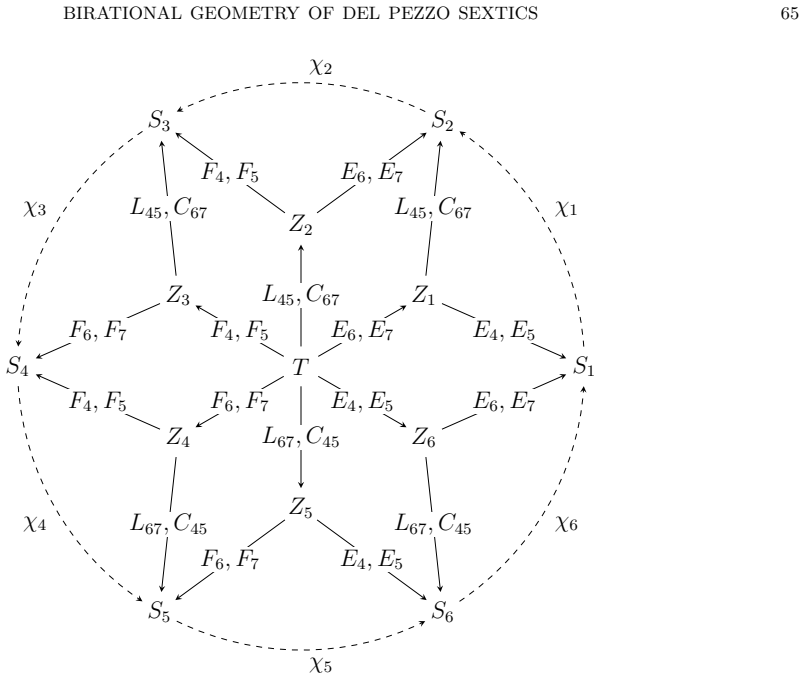
The load-bearing object is the Severi-Brauer data of a rank-1 sextic del Pezzo surface: the pair of structures obtained by contracting each of the two Galois-invariant triples of (-1)-curves over a quadratic extension K, giving a Severi-Brauer surface X over K, and by contracting the pairs of opposite (-1)-curves over a cubic or sextic extension L, giving an involution surface Y over L, with the Amitsur groups recording their Brauer classes. The technical work is an explicit cocycle description of the twisted action of Gal(F/k) on the split surface, with values in the semidirect product of the two-dimensional torus with the dihedral group D6 of symmetries of the hexagon of (-1)-curves, and the classification theorems say that two surfaces are isomorphic precisely when these cocycle data are cohomologous. The birational behaviour is then carried by the Sarkisov link analysis: a degree-2 link passing through the Clebsch graph of a quartic del Pezzo surface, or a degree-3 link passing through the Schlafli graph of a cubic surface, has a closed point as centre, and its effect on the Severi-Brauer data is simply to substitute the point's splitting field into the K-slot or the L-slot. Counting the possible splitting fields of points in general position therefore counts the birational models, which turns finiteness of pliability into a question about field extensions.
What would settle it
Find a solid del Pezzo surface of degree other than 6 whose pliability is infinite, since the degree-8, degree-9, degree-4, and degree at most 3 cases are all covered by Theorem C's dichotomy, so a single such example would break the 'only sextic' claim. In the positive direction, take the surface of Example 5.16 and compute the isomorphism classes of the models obtained by 3-links at the points E_z: if two distinct parameters z gave isomorphic models despite E_z being unequal to E_v, the principle that splitting fields count models, recorded in Corollary 6.11, would fail.
Extended reading notes
Core claim
On the paper's own terms, the central structural discovery is that the birational models of a rank-1 sextic del Pezzo surface S are organized by the splitting fields of its degree-2 and degree-3 points in general position. Writing the twisted Galois action explicitly as a cocycle in the semidirect product of the torus with the dihedral group of hexagon symmetries, the authors show that S is determined up to isomorphism by its Severi-Brauer data (the fields K and L and the Amitsur groups over them), and that a Sarkisov link based at a point with splitting field E replaces K by E for degree-2 centres, or L by E for degree-3 centres, leaving the other piece unchanged. It follows that two such surfaces are birational exactly when their K- and L-data meet one of the four conditions of Theorem B, and that the collection of splitting fields of points in general position is a birational invariant. The central consequence is Theorem C: among solid del Pezzo surfaces, infinite pliability occurs precisely in degree 6 with index 2 or 3, and examples exist, since the constructed surface over the invariant field of a rational function field has a 3-point in general position for each complex parameter. Theorem D records that the birational automorphism groups of these surfaces surject onto large free products, so in the index-3 case they are not generated by elements of finite order once at least three birational models occur.
Load-bearing premise
The argument rests on the strong surface Sarkisov program, namely that every relation between Sarkisov links is generated by trivial and elementary relations, imported from the literature without spelling out the precise field and characteristic hypotheses under which the statement holds over an arbitrary perfect field; if that decomposition required extra hypotheses, the pliability and quotient theorems would need to be restricted to those settings.
Editorial extensions
If this is right
- If Theorem C is correct, solid del Pezzo surfaces with infinite pliability exist and are exactly the sextic ones of index 2 or 3, providing the first known solid Fano varieties of Picard number 1 with infinitely many birational models.
- The birational classification of Theorem B gives a complete answer to the birationality question for rank-1 sextic del Pezzo surfaces raised by Rost's work: birationality is decided by the four listed cases relating the K- and L-Amitsur data.
- The sets of splitting fields of degree-2 and degree-3 points in general position are birational invariants, so any two birational rank-1 sextic del Pezzo surfaces catalogue the same field extensions from their points.
- Theorem D shows the birational automorphism groups of these surfaces surject onto free products of copies of Z (index 3) or Z/2 (index 2), and in the index-3 case with at least three birational models the group is not generated by elements of finite order.
- Index-6 sextic surfaces are birationally super-rigid with Bir_k(S) equal to Aut_k(S), an abelian group, so the trichotomy of the index (2, 3, or 6) mirrors the trichotomy of birational group behaviour.
Reading between the lines
- Editorial extension: for the surface of Example 5.16 the pliability is uncountable, not merely infinite, because Corollary 6.11 makes each distinct splitting field E_z give a distinct model and there are uncountably many parameters z; the paper only states infinitude.
- Editorial extension: the mechanism suggests a general recipe, namely that whenever birational models of a variety are parametrized by splitting fields of link centres, pliability cardinality measures the spectrum of field extensions available; the same counting could be tried on involution surfaces or on G-Fano threefolds to find further solid varieties with infinite pliability.
- Editorial extension: because the graph G_S together with its edge signs is determined up to isomorphism by S, the homomorphisms of Theorem D show that the algebraic structure of Bir_k(S) is essentially read off from the combinatorics of this graph once it has more than two vertices, making the large-quotient phenomenon a purely combinatorial consequence of the Sarkisov decomposition.
- Editorial extension: the birational invariance of the splitting-field sets suggests refining pliability into a tuple of invariants, namely the cardinalities and field-theoretic structure of those sets together with the isomorphism type of the graph, which would distinguish surfaces that plain pliability cannot.
Editorial analysis
A structured set of objections, weighed in public.
Referee Report
Summary. The paper studies minimal sextic del Pezzo surfaces over arbitrary perfect fields, i.e. degree 6 del Pezzo surfaces with Picard rank 1. It gives explicit Galois-cocycle parametrizations for the three possible Galois groups acting on the hexagon of (-1)-curves (Z/6, S3, and D6), and uses them to recover the biregular classification of such surfaces in terms of Severi-Brauer data and Amitsur groups (Theorem A), to compute automorphism groups (Section 4), to parametrize closed points of degree 2 and 3 and their general position (Section 5), and to describe Sarkisov links centered at such points (Section 6). From these descriptions the authors deduce a birational classification of sextic del Pezzo surfaces (Theorem B), a characterization of solid del Pezzo surfaces with infinite pliability (Theorem C), and presentations of the groups of birational transformations Bir_k(S) together with nontrivial quotients, including free products of copies of Z and Z/2 indexed by potentially uncountable sets (Theorem D).
Significance. If correct, Theorems C and D are substantial and interesting: Theorem C would provide the first examples of solid Fano varieties with infinite pliability and would single out degree 6 among del Pezzo surfaces, while Theorem D gives explicit presentations and uncountable free quotients for Bir_k(S) of non-rational sextic del Pezzo surfaces of index 2 and 3. A genuine strength of the paper is its concrete and elementary cocycle method: Section 3 produces very explicit matrices and norm conditions, and Example 5.16 constructs a surface with uncountably many splitting fields of 3-points by explicit cubic extensions. The biregular part partly reorganizes known classification results, but the birational applications are new. The main caveats are that the relational form of the Sarkisov program is imported without a precise statement of its field and characteristic hypotheses, and that one load-bearing point in the proof of the D6 classification is only sketched.
major comments (2)
- [Section 2.5, Theorem 2.15; used in Section 7, Proposition 7.7 and Theorem 7.12] Theorem 2.15 is stated as a bare assertion for an arbitrary Mori fibre space of dimension 2, with no hypotheses on the base field or the characteristic and no indication of which parts come from which cited source. Part (1) is used already in Proposition 7.4, and part (2) is used essentially in Proposition 7.7, via [LZ20, Prop. 3.15], to reduce every relation in Bir_k(S) to conjugates of trivial and elementary relations; this is the basis of the presentations in Theorems 7.8 and 7.12 and of Theorem D. If the cited sources prove the relational Sarkisov program only over characteristic zero, or only over algebraically or separably closed base fields, then the presentations and Theorem D are not established for arbitrary perfect fields. Please state the precise theorem from the literature that applies in the needed generality, and if necessary restrict Theorems B, C, D and Section 7 accordingly.
- [Section 3.5, proof of Theorem 3.19, final paragraph] The proof of the D6 case of the isomorphism criterion is completed by the assertion that a surface S0 with a 2-point and a 3-point is k-rational: the text says that two '6-curves' have intersection multiplicity 6 but meet in only 5 points with multiplicity 1, and that because the two curves form a Galois orbit the sixth point must be k-rational. This argument is not sufficiently specified for the reader to check: one needs the definition of the two curves, a proof that their intersection scheme over F has degree 6, a proof that exactly five geometric intersection points occur with multiplicity 1, and a precise Galois-action argument showing that the remaining point is k-rational. Since this step is needed to establish the D6 case of Theorem A, please replace the sketch with a complete argument or give a different proof of the existence of the element zeta with N_g(zeta)=1 and N_h(zeta)=N_h(delta).
minor comments (4)
- [Section 3.5, proof of Theorem 3.19] The final paragraph contains apparent typos ('ones all the components', 'a f(delta)') that further obscure an already compressed argument; please proofread and clarify the notation.
- [Theorem D and Section 7] The notation with a circled direct sum over J in Theorem D is not defined; it appears to be intended as a direct sum indexed by J, but this should be stated explicitly.
- [Section 3.2, paragraph before Theorem 3.10] The remark that the characteristic zero assumption in [Cor05] is redundant is asserted without proof; since the paper works over arbitrary perfect fields, a sentence of justification or a reference would be helpful.
- [Section 6.3, Proposition 6.12] In the case p lies in Exc(chi) minus Ind(chi) for a 3-point, the sentence 'there is no Galois extension of degree 3 in between k and E' is a little terse when Gal(E/k) is S3; spelling out that the possible subfield of E is quadratic rather than cubic would improve readability.
Circularity Check
No significant circularity: cocycle parametrization and link analysis are self-contained, and the imported Sarkisov program and self-citations are not load-bearing in a circular way.
full rationale
The paper's derivation chain is non-circular. Section 3 derives the cocycle parametrization of Z/6Z-, S3- and D6-sextic del Pezzo surfaces directly from Hilbert 90 and the explicit Galois action on the hexagon of (-1)-curves; Theorem A is then recovered from equivalence classes of cocycles rather than assumed. Sections 5-6 analyze closed points and Sarkisov links from the Clebsch and Schlafli graphs of (-1)-curves, leading to the birational classification and Theorem C, with the existence claim in Theorem C resting on the explicit construction in Example 5.16. Section 7's presentations use Theorem 2.15 (the Sarkisov program, including its relational part) as an imported tool; that theorem is cited from [HM13], [LZ20] and [BLZ21], which are external to the authors, so even if its hypotheses over arbitrary perfect fields need careful checking, that is a correctness or robustness concern rather than circularity. The self-citations to [BSY22] (for instance Lemma 2.8 on cyclic-degree-3 Severi-Brauer parametrizations, the link-equivalence criterion in Definition 7.1/Remark 7.2, and the index-2 elementary-relation analysis in Proposition 7.10) are technical and independent: they state parameter-free facts about Severi-Brauer surfaces or standard equivalences of links and do not assume the present paper's classification, pliability, or group-theoretic conclusions. No fitted parameter is relabeled as a prediction, and the biregular classification is explicitly presented as a recovery of known results from [CTKM08] and [Blu10] rather than as a derivation from its own conclusions. Accordingly, no circular step can be exhibited.
Assumptions & free parameters
assumptions (5)
- standard math Galois cohomology parametrizes F/k-forms of a quasiprojective variety by H^1(Gal(F/k), Aut(X_F)).
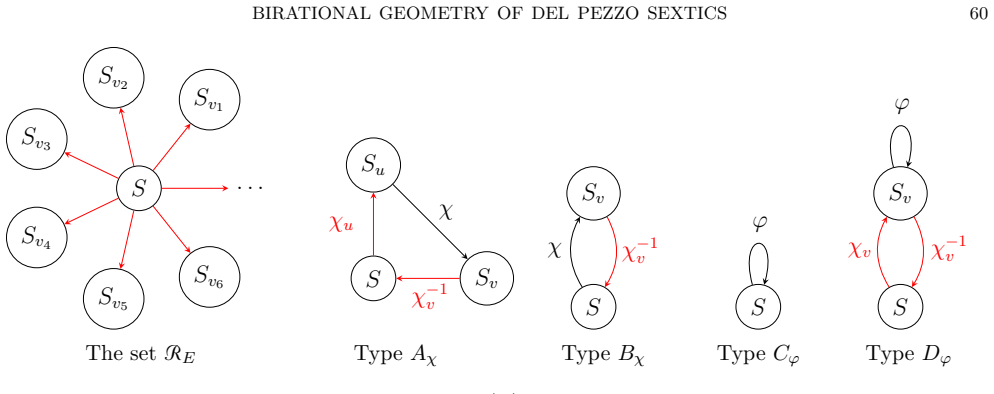
- domain assumption Surface Sarkisov program: every birational map between Mori fibre spaces of dimension 2 factors into Sarkisov links, and all relations are generated by trivial and elementary relations.
- domain assumption Iskovskikh's rationality criterion for minimal geometrically rational surfaces: k-rational if and only if S(k) is nonempty and K^2 is at least 5.
- domain assumption Kollar-Trepalin classification of degree 8 del Pezzo surfaces, or involution surfaces, up to birational and biregular equivalence.
- standard math Springer's theorem and the Lang-Nishimura lemma.
Cite this review
Pith. "Pith review of Birational Geometry of sextic del Pezzo surfaces." pith.science (2026). https://pith.science/paper/HFRA4O4W
@misc{pith2026250721737,
  author       = {Pith},
  title        = {Pith review of: Birational Geometry of sextic del Pezzo surfaces},
  year         = {2026},
  howpublished = {\url{https://pith.science/paper/HFRA4O4W}},
  note         = {Machine review of arXiv:2507.21737}
}
read the original abstract
We study the biregular and birational geometry of degree 6 del Pezzo surfaces with Picard number 1, defined over an arbitrary perfect field. Using Galois cohomology techniques, we obtain an explicit description of cocycles for such surfaces and describe the Severi-Brauer varieties associated with them, recovering the biregular classification of sextic del Pezzo surfaces. We then compute the automorphism groups of such surfaces, describe their closed points in general position and investigate the structure of Sarkisov links at such points and the corresponding birational models, answering a question of M. Rost. Using this description, we show that degree 6 del Pezzo surfaces are the only solid surfaces that admit infinite pliability. We also find a system of generators and relations for the groups of birational transformations of such surfaces and use it to construct nontrivial quotients of these groups, including free groups on uncountable sets.
Figures


Figures from the paper (5 more)


Forward citations
Cited by 1 Pith paper
-
Composition of Sarkisov links between del Pezzo surfaces
Over any perfect field, two birationally equivalent del Pezzo surfaces of Picard rank one are connected by a birational map that factors into at most two Sarkisov links, and this bound is optimal.
Reference graph
Works this paper leans on
-
[1]
Auel , Asher ; Bernardara , Marcello: Semiorthogonal decompositions and birational geometry of del Pezzo surfaces over arbitrary fields. In: Proc. Lond. Math. Soc. (3) 117 (2018), Nr. 1, S. 1--64. http://dx.doi.org/10.1112/plms.12119. -- DOI 10.1112/plms.12119. -- ISSN 0024--6115
-
[2]
Addington , Nicolas ; Hassett , Brendan ; Tschinkel , Yuri ; V \'a rilly-Alvarado , Anthony: Cubic fourfolds fibered in sextic del Pezzo surfaces. In: Am. J. Math. 141 (2019), Nr. 6, S. 1479--1500. http://dx.doi.org/10.1353/ajm.2019.0041. -- DOI 10.1353/ajm.2019.0041. -- ISSN 0002--9327
-
[3]
Ballard , Matthew R. ; Duncan , Alexander ; Lamarche , Alicia ; McFaddin , Patrick K.: Separable algebras and coflasque resolutions. In: Adv. Math. 444 (2024), S. 39. http://dx.doi.org/10.1016/j.aim.2024.109596. -- DOI 10.1016/j.aim.2024.109596. -- ISSN 0001--8708. -- Id/No 109596
-
[4]
Blunk , Mark: Del Pezzo surfaces of degree 6 over an arbitrary field. In: J. Algebra 323 (2010), Nr. 1, S. 42--58. http://dx.doi.org/10.1016/j.jalgebra.2009.09.006. -- DOI 10.1016/j.jalgebra.2009.09.006. -- ISSN 0021--8693
-
[5]
Blanc , J \'e r \'e my ; Lamy , St \'e phane ; Zimmermann , Susanna: Quotients of higher dimensional Cremona groups . In: Acta Math 226 (2021), Nr. 2, S. 211--318
work page 2021
-
[6]
Boitrel , Aurore: Del Pezzo surfaces of degree 5 over perfect fields. (2023). https://arxiv.org/abs/2304.05328
arXiv 2023
-
[7]
Blunk , M. ; Sierra , S. J. ; Smith , S. P.: A derived equivalence for a degree 6 del Pezzo surface over an arbitrary field. In: J. \(K\)-Theory 8 (2011), Nr. 3, S. 481--492. http://dx.doi.org/10.1017/is010011013jkt134. -- DOI 10.1017/is010011013jkt134. -- ISSN 1865--2433
-
[8]
Blanc , Jérémy ; Schneider , Julia ; Yasinsky , Egor: Birational maps of Severi-Brauer surfaces, with applications to Cremona groups of higher rank. 2022
work page 2022
Show all 60 references
-
[9]
Corti , Alessio ; Mella , Massimiliano: Birational geometry of terminal quartic 3-folds. I . In: Am. J. Math. 126 (2004), Nr. 4, S. 739--761. http://dx.doi.org/10.1353/ajm.2004.0026. -- DOI 10.1353/ajm.2004.0026. -- ISSN 0002--9327
2004
-
[10]
Coray , Daniel: Points algebriques sur les surfaces de del Pezzo . In: C. R. Acad. Sci., Paris, S \'e r. A 284 (1977), S. 1531--1534. -- ISSN 0366--6034
1977
-
[11]
In: Math
Corn , Patrick: Del Pezzo surfaces of degree 6. In: Math. Res. Lett. 12 (2005), Nr. 1, S. 75--84. http://dx.doi.org/10.4310/MRL.2005.v12.n1.a8. -- DOI 10.4310/MRL.2005.v12.n1.a8. -- ISSN 1073--2780
2005 doi
-
[12]
Coxeter , H. S. M.: The polytope \(2_ 21 \) , whose twenty-seven vertices correspond to the lines on the general cubic surface. In: Am. J. Math. 62 (1940), S. 457--486. http://dx.doi.org/10.2307/2371466. -- DOI 10.2307/2371466. -- ISSN 0002--9327
1940 doi
-
[13]
Preprint, arXiv :math/0007004 [math
Corti , Alessio ; Reid , Miles: Explicit birational geometry of 3-folds, Foreword . Preprint, arXiv :math/0007004 [math. AG ] (2000). https://arxiv.org/abs/math/0007004. \,Version:\,2000
2000 arXiv
-
[14]
Boca Raton, FL: CRC Press, 2016 (Monogr
Cheltsov , Ivan ; Shramov , Constantin: Cremona groups and the icosahedron. Boca Raton, FL: CRC Press, 2016 (Monogr. Res. Notes Math.). http://dx.doi.org/10.1201/b18980. http://dx.doi.org/10.1201/b18980. -- ISBN 978--1--4822--5159--3; 978--1--4822--5160--9
2016 doi
-
[15]
Cheltsov , Ivan ; Sarikyan , Arman: Equivariant pliability of the projective space. In: Sel. Math., New Ser. 29 (2023), Nr. 5, S. 84. http://dx.doi.org/10.1007/s00029-023-00869-4. -- DOI 10.1007/s00029--023--00869--4. -- ISSN 1022--1824. -- Id/No 71
2023 doi
-
[16]
https://www.imo.universite-paris-saclay.fr/ jean-louis.colliot-thelene/quadsurfbirat.pdf
Colliot-Th \'e l \`e ne , J.-L.: Quadric surfaces birational to each other. https://www.imo.universite-paris-saclay.fr/ jean-louis.colliot-thelene/quadsurfbirat.pdf. (2021)
2021
-
[17]
Karpenko , N
Colliot-Th \'e l \`e ne , J.-L. ; Karpenko , N. A. ; Merkur'ev , A. S.: Rational surfaces and the canonical dimension of \(PGL_6\) . In: St. Petersbg. Math. J. 19 (2008), Nr. 5, S. 793--804. http://dx.doi.org/10.1090/S1061-0022-08-01021-2. -- DOI 10.1090/S1061--0022--08--01021...
2008 doi
-
[18]
Foote , Richard M.: Abstract algebra
Dummit , David S. ; Foote , Richard M.: Abstract algebra. 3rd ed. Chichester: Wiley, 2004. -- ISBN 0--471--45234--3
2004
-
[19]
Duncan , Alexander ; Singh , Pankaj: Classifying torsors of tori with B rauer groups.arXiv: 2505.10386. (2025)
2025 arXiv
-
[20]
In: Transform
Duncan , Alexander: Twisted forms of toric varieties. In: Transform. Groups 21 (2016), Nr. 3, S. 763--802. http://dx.doi.org/10.1007/s00031-016-9394-5. -- DOI 10.1007/s00031--016--9394--5. -- ISSN 1083--4362
2016 doi
-
[21]
In: Invent
Gabber , Ofer ; Liu , Qing ; Lorenzini , Dino: The index of an algebraic variety. In: Invent. Math. 192 (2013), Nr. 3, S. 567--626. http://dx.doi.org/10.1007/s00222-012-0418-z. -- DOI 10.1007/s00222--012--0418--z. -- ISSN 0020--9910
2013 doi
-
[22]
Gille , Philippe ; Szamuely , Tam \'a s: Camb. Stud. Adv. Math.. Bd. 165: Central simple algebras and Galois cohomology . 2nd revised and updated edition. Cambridge: Cambridge University Press, 2017. http://dx.doi.org/10.1017/9781316661277. http://dx.doi.org/10.1017/9781316661...
2017 doi
-
[23]
McKernan , James: The Sarkisov program
Hacon , Christopher D. ; McKernan , James: The Sarkisov program. In: J. Algebr. Geom. 22 (2013), Nr. 2, S. 389--405. http://dx.doi.org/10.1090/S1056-3911-2012-00599-2. -- DOI 10.1090/S1056--3911--2012--00599--2. -- ISSN 1056--3911
2013 doi
-
[24]
A.: Factorization of birational maps of rational surfaces from the viewpoint of Mori theory
Iskovskikh , V. A.: Factorization of birational maps of rational surfaces from the viewpoint of Mori theory . In: Russ. Math. Surv. 51 (1996), Nr. 4, S. 585--652
1996
-
[25]
In: Compos
Kaloghiros , Anne-Sophie: Relations in the Sarkisov program. In: Compos. Math. 149 (2013), Nr. 10, S. 1685--1709. http://dx.doi.org/10.1112/S0010437X13007306. -- DOI 10.1112/S0010437X13007306. -- ISSN 0010--437X
2013 doi
-
[26]
Publ., Am
Knus , Max-Albert ; Merkurjev , Alexander ; Rost , Markus ; Tignol , Jean-Pierre: Colloq. Publ., Am. Math. Soc.. Bd. 44: The book of involutions. With a preface by J . Tits . Providence, RI: American Mathematical Society, 1998. -- ISBN 0--8218--0904--0
1998
-
[27]
Koll \'a r , J \'a nos: Conics in the Grothendieck ring. In: Adv. Math. 198 (2005), Nr. 1, S. 27--35. http://dx.doi.org/10.1016/j.aim.2005.01.004. -- DOI 10.1016/j.aim.2005.01.004. -- ISSN 0001--8708
2005 doi
- [28]
-
[29]
In: Mosc
Kresch , Andrew ; Tschinkel , Yuri: Models of Brauer - Severi surface bundles. In: Mosc. Math. J. 19 (2019), Nr. 3, 549--595. www.mathjournals.org/mmj/2019-019-003/2019-019-003-005.html. -- ISSN 1609--3321
2019
-
[30]
In: Manuscr
Kresch , Andrew ; Tschinkel , Yuri: Stable rationality of Brauer - Severi surface bundles. In: Manuscr. Math. 161 (2020), Nr. 1-2, S. 1--14. http://dx.doi.org/10.1007/s00229-018-1087-z. -- DOI 10.1007/s00229--018--1087--z. -- ISSN 0025--2611
2020 doi
-
[31]
In: Pure Appl
Kresch , Andrew ; Tschinkel , Yuri: Brauer groups of involution surface bundles. In: Pure Appl. Math. Q. 17 (2021), Nr. 2, S. 649--669. http://dx.doi.org/10.4310/PAMQ.2021.v17.n2.a4. -- DOI 10.4310/PAMQ.2021.v17.n2.a4. -- ISSN 1558--8599
2021 doi
-
[32]
In: Rend
Kresch , Andrew ; Tschinkel , Yuri: Fibrations in sextic del Pezzo surfaces with mild singularities. In: Rend. Semin. Mat. Univ. Padova 148 (2022), S. 65--82. http://dx.doi.org/10.4171/RSMUP/109. -- DOI 10.4171/RSMUP/109. -- ISSN 0041--8994
2022 doi
-
[33]
arXiv:2502.02981
Kurz , Elias: A determinant on birational maps of S everi- B rauer surfaces. arXiv:2502.02981. (2025)
2025 arXiv
-
[34]
Kuznetsov , Alexander: Derived categories of families of sextic del Pezzo surfaces. In: Int. Math. Res. Not. 2021 (2021), Nr. 12, S. 9262--9339. http://dx.doi.org/10.1093/imrn/rnz081. -- DOI 10.1093/imrn/rnz081. -- ISSN 1073--7928
2021 doi
-
[35]
Lang , Serge: Some applications of the local uniformization theorem. In: Am. J. Math. 76 (1954), S. 362--374. http://dx.doi.org/10.2307/2372578. -- DOI 10.2307/2372578. -- ISSN 0002--9327
1954 doi
-
[36]
In: Geometry over nonclosed fields
Liedtke , Christian: Morphisms to Brauer - Severi varieties, with applications to del Pezzo surfaces. In: Geometry over nonclosed fields. Proceedings of the Simons symposium, March 22--28, 2015. Cham: Springer, 2017, S. 157--196
2015
-
[37]
http://dx.doi.org/10.14231/ag-2024-004
Lamy , St\' e phane ; Schneider , Julia: Generating the plane C remona groups by involutions . http://dx.doi.org/10.14231/ag-2024-004. \,Version:\,2024
2024 doi
-
[38]
In: Algebr
Lin , Hsueh-Yung ; Shinder , Evgeny ; Zimmermann , Susanna: Factorization centers in dimension 2 and the Grothendieck ring of varieties. In: Algebr. Geom. 10 (2023), Nr. 6, S. 666--693. http://dx.doi.org/10.14231/AG-2023-024. -- DOI 10.14231/AG--2023--024. -- ISSN 2313--1691
2023 doi
-
[39]
Lamy , St \'e phane ; Zimmermann , Susanna: Signature morphisms from the Cremona group over a non-closed field. In: J. Eur. Math. Soc. (JEMS) 22 (2020), Nr. 10, S. 3133--3173. http://dx.doi.org/10.4171/JEMS/983. -- DOI 10.4171/JEMS/983. -- ISSN 1435--9855
2020 doi
-
[40]
I.: North-Holland Math
Manin , Yu. I.: North-Holland Math. Libr.. Bd. 4: Cubic forms. Algebra , geometry, arithmetic. Transl . from the Russian by M . Hazewinkel . 2nd ed . Elsevier (North-Holland), Amsterdam, 1986
1986
-
[41]
Nishimura , Hajime: Some remarks on rational points. In: Mem. Coll. Sci., Univ. Kyoto, Ser. A 29 (1955), S. 189--192. http://dx.doi.org/10.1215/kjm/1250777265. -- DOI 10.1215/kjm/1250777265. -- ISSN 0368--8887
1955
-
[42]
In: Math
Roquette , Peter: On the Galois cohomology of the projective linear group and its applications to the construction of generic splitting fields of algebras. In: Math. Ann. 150 (1963), 411--439. http://dx.doi.org/10.1007/BF01357435. -- DOI 10.1007/BF01357435. -- ISSN 0025--5831
1963 doi
-
[43]
Rost , Markus: Remarks on Jordan algebras (dim 9, deg 3), cubic surfaces, and del Pezzo surfaces (deg 6). (1996). https://www.math.uni-bielefeld.de/ rost/data/JoCub.pdf
1996
-
[44]
In: Algebr
Sarikyan , Arman: On the rationality of Fano - Enriques threefolds. In: Algebr. Geom. 10 (2023), Nr. 6, S. 643--665. http://dx.doi.org/10.14231/AG-2023-023. -- DOI 10.14231/AG--2023--023. -- ISSN 2313--1691
2023 doi
-
[45]
Swinnerton-Dyer , H. P. F.: Rational points on del Pezzo surfaces of degree 5 . Algebraic Geom ., Oslo 1970, Proc . 5th Nordic Summer - School Math ., 287-290 (1972)., 1972
1972
-
[46]
Serre , Jean-Pierre: Galois cohomology. Transl . from the French by Patrick Ion . Berlin: Springer, 1997. -- ISBN 3--540--61990--9
1997
-
[47]
A.: Birational automorphisms of Severi - Brauer surfaces
Shramov , C. A.: Birational automorphisms of Severi - Brauer surfaces. In: Sb. Math. 211 (2020), Nr. 3, S. 466--480. http://dx.doi.org/10.1070/SM9304. -- DOI 10.1070/SM9304. -- ISSN 1064--5616
2020 doi
-
[48]
Shramov , Constantin: Finite groups acting on Severi - Brauer surfaces. In: Eur. J. Math. 7 (2021), Nr. 2, S. 591--612. http://dx.doi.org/10.1007/s40879-020-00448-3. -- DOI 10.1007/s40879--020--00448--3. -- ISSN 2199--675X
2021 doi
-
[49]
Smith , Jonathan M.: Automorphisms of quartic del Pezzo surfaces in characteristic zero. (2023). https://arxiv.org/abs/2308.07904
2023 arXiv
-
[50]
In: Proc
Smith , Jonathan M.: Groups acting on cubic surfaces in characteristic zero. In: Proc. Am. Math. Soc. 153 (2025), Nr. 3, S. 1025--1040. http://dx.doi.org/10.1090/proc/17090. -- DOI 10.1090/proc/17090. -- ISSN 0002--9939
2025 doi
-
[51]
Springer , Tonny A.: Sur les formes quadratiques d'indice z \'e ro. In: C. R. Acad. Sci., Paris 234 (1952), S. 1517--1519. -- ISSN 0001--4036
1952
-
[52]
Shramov , Constantin ; Vologodsky , Vadim: Automorphisms of pointless surfaces, arXiv:1807.06477. 2018
2018 arXiv
-
[53]
arXiv:2505.11596
Shramov , Constantin ; Vikulova , Anastasia: Automorphisms of del Pezzo surfaces without points. arXiv:2505.11596. (2025)
2025
-
[54]
In: \'E pijournal de G \'e om
Schneider , Julia ; Zimmermann , Susanna: Algebraic subgroups of the plane Cremona group over a perfect field. In: \'E pijournal de G \'e om. Alg \'e br., EPIGA 5 (2021), S. 48. http://dx.doi.org/10.46298/epiga.2021.6715. -- DOI 10.46298/epiga.2021.6715. -- ISSN 2491--6765. --...
2021
-
[55]
Trepalin , Andrey: Birational classification of pointless del P ezzo surfaces of degree 8. In: Eur. J. Math. 9 (2023), Nr. 1, [Paper No. 2], 21. http://dx.doi.org/10.1007/s40879-023-00591-7. -- DOI 10.1007/s40879--023--00591--7. -- ISSN 2199--675X,2199--6768
2023 doi
-
[56]
Weinstein , Felix: On birational automorphisms of Severi--Brauer surfaces. 1989
1989
-
[57]
In: Communications in Mathematics Volume 30 (2022), Issue 1 (2022), M \^^b a rz
Weinstein , Felix: On birational automorphisms of Severi-Brauer surfaces . In: Communications in Mathematics Volume 30 (2022), Issue 1 (2022), M \^^b a rz. http://dx.doi.org/10.46298/cm.9040. -- DOI 10.46298/cm.9040
2022 doi
-
[58]
In: Épijournal de Géométrie Algébrique Volume 9 (2025), mai
Yasinsky , Egor: On G -birational rigidity of del Pezzo surfaces. In: Épijournal de Géométrie Algébrique Volume 9 (2025), mai. http://dx.doi.org/10.46298/epiga.2025.11640. -- DOI 10.46298/epiga.2025.11640. -- ISSN 2491--6765
2025
-
[59]
V.: Forms of del Pezzo surfaces of degree 5 and 6
Zaitsev , A. V.: Forms of del Pezzo surfaces of degree 5 and 6. In: Sb. Math. 214 (2023), Nr. 6, S. 816--831. http://dx.doi.org/10.4213/sm9686e. -- DOI 10.4213/sm9686e. -- ISSN 1064--5616
2023 doi
-
[60]
arXiv:2401.15655
Zaitsev , Alexandr: Automorphisms of two-dimensional quadrics. arXiv:2401.15655. 2024
2024 arXiv
Reviewed August 6, 2026 · model on record in the stance chip above.
Discussion (0). Continue with ORCID to comment.