Oscillatory Phase and Acoustic Travel-Time Inconsistencies Measured between SDO/HMI and GONG Dopplergrams
Pith reviewed 2026-06-27 23:16 UTC · model grok-4.3
The pith
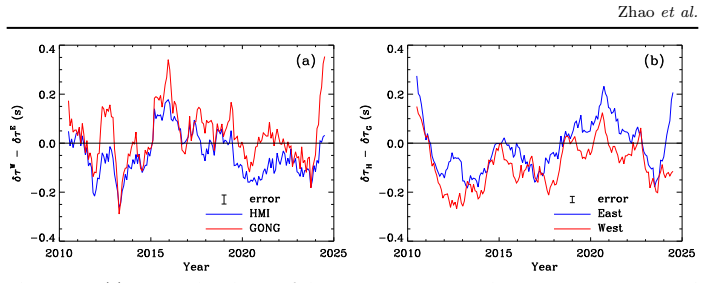
Both SDO/HMI and GONG Dopplergrams exhibit growing phase-shift anomalies and east-west travel-time inconsistencies indicating systematic artifacts.
A machine-rendered reading of the paper's core claim, the machinery that carries it, and where it could break.
Core claim
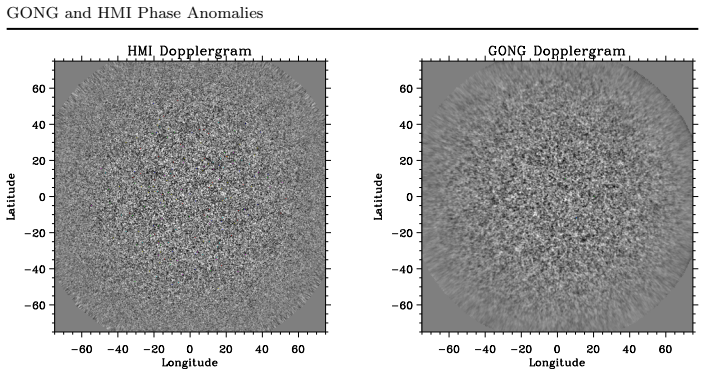
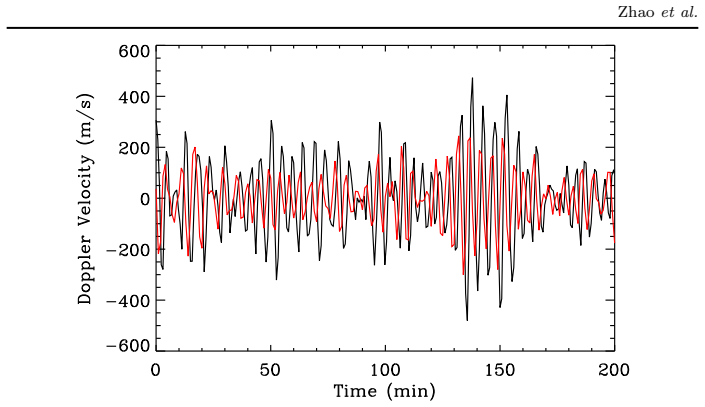
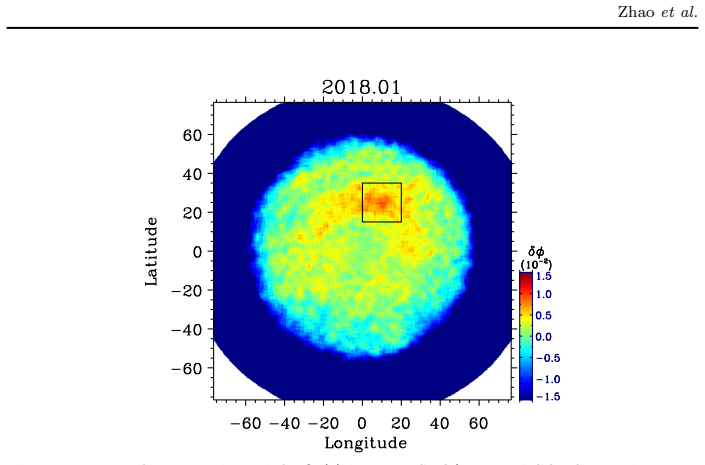
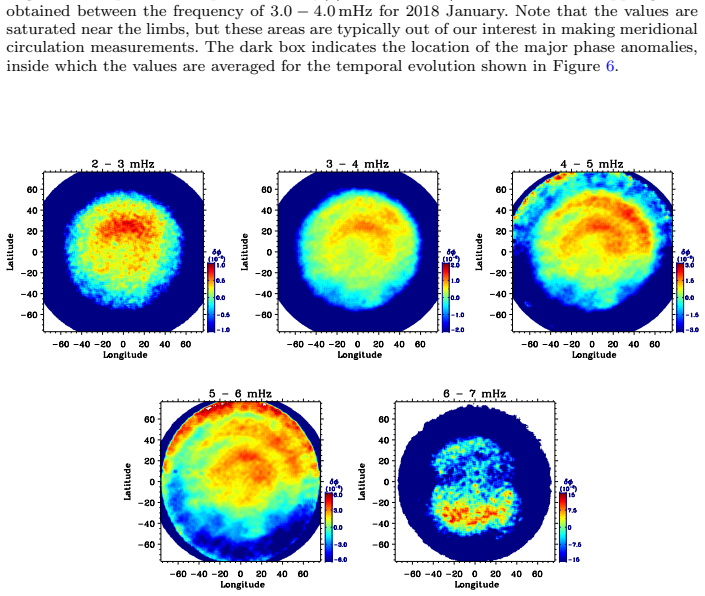
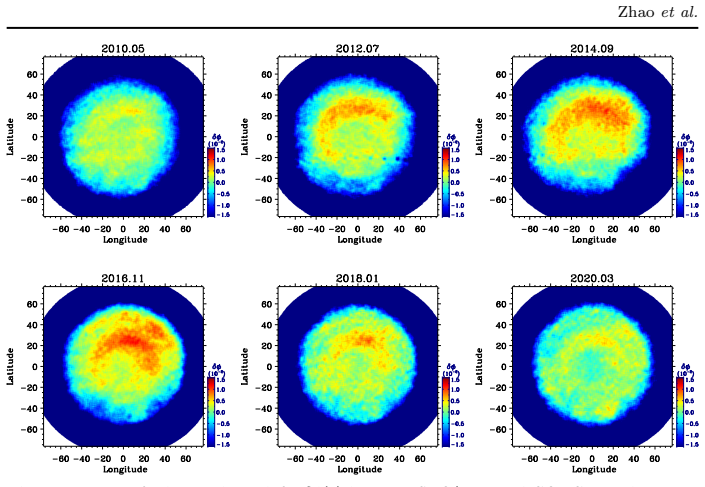
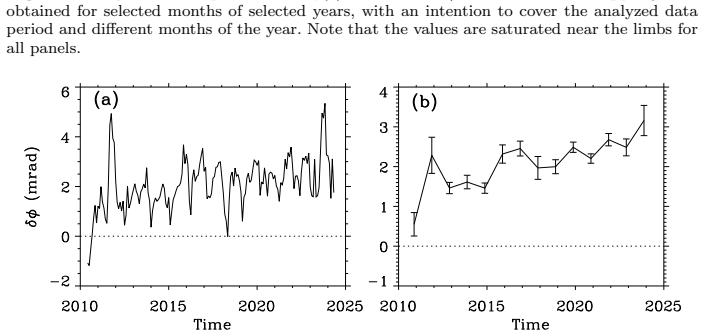
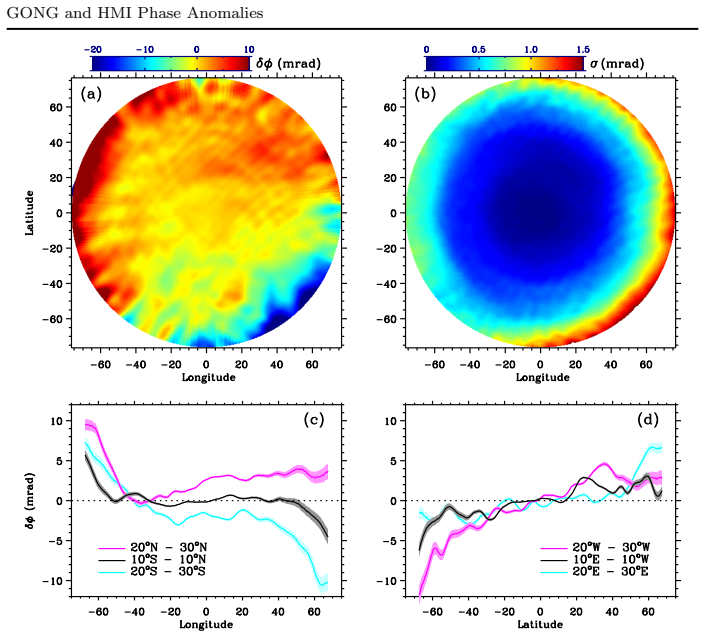
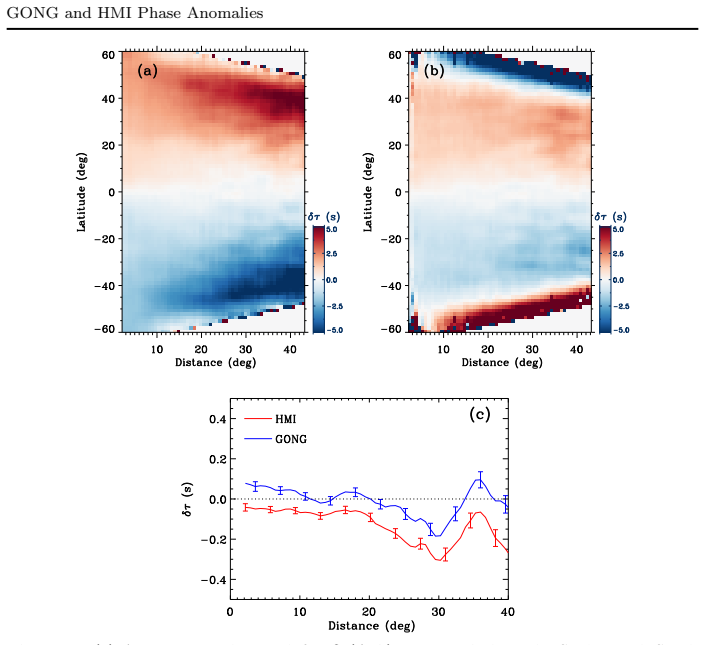
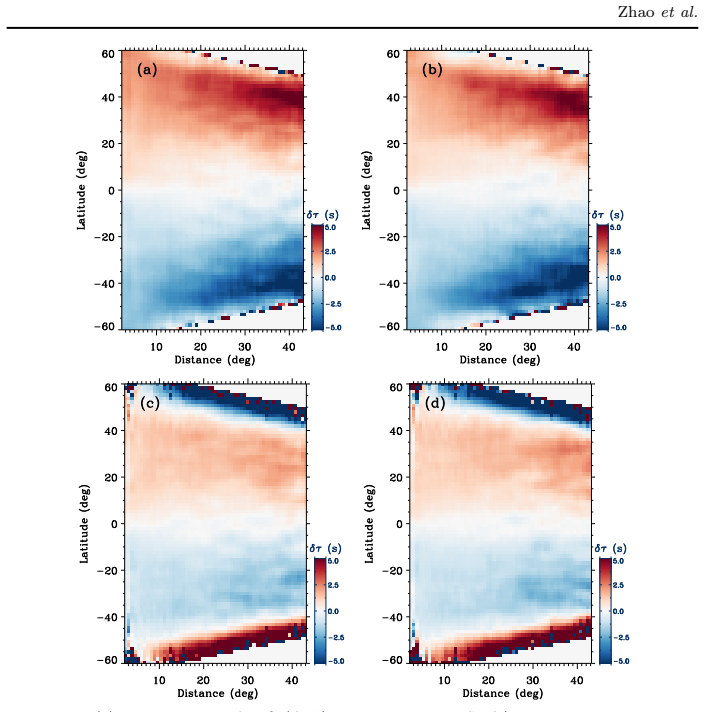
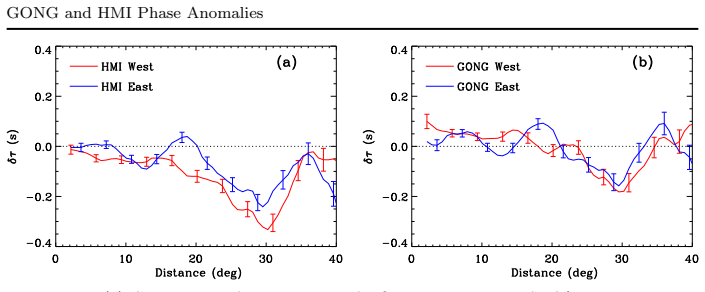
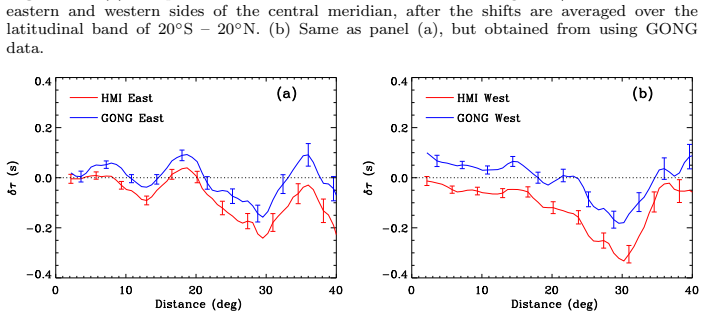
Using consistently processed contemporaneous Dopplergrams, relative oscillatory phase shifts at identical solar locations reveal a persistent area of phase-shift anomalies in the northwestern quadrant whose magnitude increases over the analysis period from 2010 through 2024. After removing the axisymmetric component, the phase-shift maps display a decreasing trend from the northeastern to the southwestern quadrant. The travel-time measurements also show significant inconsistencies on the eastern and western sides of the central meridian for both instruments, although close agreement between both sides is expected.
What carries the argument
Measurement of relative oscillatory phase shifts at identical solar locations together with north-south acoustic travel-time shifts on both sides of the solar central meridian.
If this is right
- Both SDO/HMI and GONG carry systematic artifacts affecting meridional-circulation measurements.
- Time-varying phase anomalies and eastern-western asymmetry pose major challenges for accurate characterization and correction.
- The inconsistencies persist across the full interval from 2010 through 2024.
- Axisymmetric removal still leaves a quadrant trend that can be misinterpreted as flows.
Where Pith is reading between the lines
- Cross-instrument comparisons may help separate real solar signals from artifacts in existing meridional-flow maps.
- Dynamo models that ingest these flow measurements could inherit systematic quadrant biases.
- New processing steps targeting the northwestern anomaly region might reduce the observed discrepancies.
- Similar phase and travel-time diagnostics could be applied to other helioseismic observables to check consistency.
Load-bearing premise
Identical processing of contemporaneous Dopplergrams fully removes all non-instrumental differences so that remaining discrepancies must originate in the instruments rather than in unmodeled solar variability.
What would settle it
A third independent Dopplergram source or a revised calibration that eliminates the northwestern phase anomaly and the east-west travel-time asymmetry while preserving agreement between instruments would test the claim.
Figures
read the original abstract
We investigate the causes of discrepancies in meridional-circulation measurements derived from the helioseismic observations by the Helioseismic and Magnetic Imager onboard the Solar Dynamics Observatory (SDO/HMI) and the Global Oscillation Network Group (GONG). Using contemporaneous Dopplergrams from both instruments that are processed consistently, we measure relative oscillatory phase shifts at identical solar locations and analyze north-south acoustic travel-time shifts on both sides of the solar central meridian. Our analysis reveals a persistent area of phase-shift anomalies in the northwestern quadrant of the solar disk, whose magnitude increases over the analysis period from 2010 through 2024. After removing the axisymmetric component, the phase-shift maps display a deceasing trend from the northeastern to the southwestern quadrant, which can be misinterpreted as flows in helioseismic analyses. The travel-time measurements also show significant inconsistencies on the eastern and western sides of the central meridian for both instruments, although a close agreement between both sides is expected. These findings indicate that both SDO/HMI and GONG carry systematic artifacts affecting meridional-circulation measurements, and that the time-varying phase anomalies and eastern-western asymmetry pose major challenges for their accurate characterization and correction.
Editorial analysis
A structured set of objections, weighed in public.
Referee Report
Summary. The paper claims that identical processing of contemporaneous Dopplergrams from SDO/HMI and GONG reveals persistent phase-shift anomalies in the northwestern solar quadrant (increasing 2010–2024), a decreasing NE-to-SW trend after axisymmetric removal, and east-west acoustic travel-time inconsistencies on either side of the central meridian. These are interpreted as evidence of systematic instrumental artifacts in both datasets that affect meridional-circulation inferences.
Significance. If the attribution to instrumental artifacts holds after proper validation, the result would be significant for helioseismology because it directly compares two widely used independent datasets and flags time-varying biases that could compromise meridional-flow measurements. The observational nature of the comparison (no free parameters or fitted models) is a methodological strength.
major comments (2)
- [Abstract] Abstract: the attribution of all remaining discrepancies to instrumental artifacts rests on the unvalidated premise that identical processing fully removes non-instrumental differences (solar variability, residual calibration); no forward-modeling tests or comparisons to simulated Dopplergrams with known flows are described to support this.
- [Abstract] Abstract: the reported phase anomalies and travel-time inconsistencies are presented without error bars, statistical significance tests, or any description of the extraction methods for phase and travel times, so the load-bearing claim that these features are real and instrument-specific cannot be assessed from the given information.
minor comments (2)
- [Abstract] Abstract: 'deceasing trend' is a typographical error and should read 'decreasing trend'.
- [Abstract] Abstract: the sentence 'although a close agreement between both sides is expected' is grammatically awkward and could be rephrased for clarity.
Simulated Author's Rebuttal
We thank the referee for the detailed and constructive report. We address each major comment below, indicating where revisions to the manuscript will be made to strengthen the presentation.
read point-by-point responses
-
Referee: [Abstract] Abstract: the attribution of all remaining discrepancies to instrumental artifacts rests on the unvalidated premise that identical processing fully removes non-instrumental differences (solar variability, residual calibration); no forward-modeling tests or comparisons to simulated Dopplergrams with known flows are described to support this.
Authors: We agree that forward-modeling with simulated Dopplergrams containing known flows would provide stronger validation of the instrumental interpretation. Our current approach relies on the direct, parameter-free comparison of two independent datasets processed identically, which reveals the same time-varying anomalies in both; such consistency is difficult to attribute to solar variability or residual calibration. We will add an explicit discussion of this limitation and the rationale for our interpretation in a revised discussion section. revision: yes
-
Referee: [Abstract] Abstract: the reported phase anomalies and travel-time inconsistencies are presented without error bars, statistical significance tests, or any description of the extraction methods for phase and travel times, so the load-bearing claim that these features are real and instrument-specific cannot be assessed from the given information.
Authors: The full manuscript contains the extraction methods in Section 2 and quantitative measures of the anomalies, but we acknowledge that the abstract lacks error bars, significance tests, and a concise methods summary. We will revise the abstract to include these elements so that the strength of the claims can be evaluated directly from it. revision: yes
Circularity Check
No circularity: pure observational comparison of two independent datasets
full rationale
The paper performs direct measurements of phase shifts and travel times on contemporaneous Dopplergrams from HMI and GONG after consistent processing. No equations, fitted parameters, or derivations are presented that reduce reported discrepancies to prior results or self-citations. The central claims rest on empirical differences between the two instruments rather than any self-referential construction. This matches the default expectation of no significant circularity for observational comparisons.
Axiom & Free-Parameter Ledger
Reference graph
Works this paper leans on
-
[1]
Living Reviews in Solar Physics , keywords =
Dynamo models of the solar cycle. Living Reviews in Solar Physics , keywords =. doi:10.1007/s41116-020-00025-6 , adsurl =
-
[2]
Verification of the helioseismic Fourier-Legendre analysis for meridional flow measurements
Verification of the helioseismic Fourier-Legendre analysis for meridional flow measurements. , keywords =. doi:10.1051/0004-6361/201526971 , archivePrefix =. 1606.05202 , primaryClass =
work page internal anchor Pith review Pith/arXiv arXiv doi:10.1051/0004-6361/201526971
-
[3]
Recalibration of Mount-Wilson Doppler Measurements. , keywords =. doi:10.1007/BF00153796 , adsurl =
-
[4]
Wavelength Dependence of the Helioseismic and Magnetic Imager (HMI) Instrument onboard the Solar Dynamics Observatory (SDO). , keywords =. doi:10.1007/s11207-011-9723-8 , adsurl =
-
[5]
On-Orbit Performance of the Helioseismic and Magnetic Imager Instrument onboard the Solar Dynamics Observatory. , keywords =. doi:10.1007/s11207-018-1259-8 , archivePrefix =. 1802.01731 , primaryClass =
work page internal anchor Pith review Pith/arXiv arXiv doi:10.1007/s11207-018-1259-8
-
[6]
Science China Physics, Mechanics, and Astronomy , keywords =
The meridional circulation of the Sun: Observations, theory and connections with the solar dynamo. Science China Physics, Mechanics, and Astronomy , keywords =. doi:10.1007/s11433-020-1628-1 , archivePrefix =. 2008.09347 , primaryClass =
-
[7]
Evolving Submerged Meridional Circulation Cells within the Upper Convection Zone Revealed by Ring-Diagram Analysis. , keywords =. doi:10.1086/339631 , adsurl =
-
[8]
Torsional Oscillation, Meridional Flows, and Vorticity Inferred in the Upper Convection Zone of the Sun by Time-Distance Helioseismology. , keywords =. doi:10.1086/381489 , adsurl =
-
[9]
Meridional Circulation During the Extended Solar Minimum: Another Component of the Torsional Oscillation?. , keywords =. doi:10.1088/2041-8205/713/1/L16 , archivePrefix =. 1003.1685 , primaryClass =
work page internal anchor Pith review Pith/arXiv arXiv doi:10.1088/2041-8205/713/1/l16 2041
-
[10]
Solar-Cycle Variation of Subsurface Meridional Flow Derived with Ring-Diagram Analysis. , keywords =. doi:10.1007/s11207-015-0729-5 , adsurl =
-
[11]
Variations in the Sun s Meridional Flow over a Solar Cycle. Science , keywords =. doi:10.1126/science.1181990 , adsurl =
-
[12]
Systematic Center-to-limb Variation in Measured Helioseismic Travel Times and its Effect on Inferences of Solar Interior Meridional Flows. , keywords =. doi:10.1088/2041-8205/749/1/L5 , archivePrefix =. 1203.1904 , primaryClass =
work page internal anchor Pith review Pith/arXiv arXiv doi:10.1088/2041-8205/749/1/l5 2041
-
[13]
Frequency Dependence of Helioseismic Measurements of the Center-to-Limb Effect and Flow-induced Travel-time Shifts. , keywords =. doi:10.3847/1538-4357/aaa3e3 , adsurl =
-
[14]
Effects of Asymmetric Flows in Solar Convection on Oscillation Modes
Effects of Asymmetric Flows in Solar Convection on Oscillation Modes. , keywords =. doi:10.1088/2041-8205/760/1/L1 , archivePrefix =. 1210.1583 , primaryClass =
work page internal anchor Pith review Pith/arXiv arXiv doi:10.1088/2041-8205/760/1/l1 2041
-
[15]
The Helioseismic and Magnetic Imager (HMI) Investigation for the Solar Dynamics Observatory (SDO). , keywords =. doi:10.1007/s11207-011-9834-2 , adsurl =
-
[16]
Design and Ground Calibration of the Helioseismic and Magnetic Imager (HMI) Instrument on the Solar Dynamics Observatory (SDO). , keywords =. doi:10.1007/s11207-011-9842-2 , adsurl =
-
[17]
The Solar Dynamics Observatory (SDO). , keywords =. doi:10.1007/s11207-011-9841-3 , adsurl =
-
[18]
The Solar Oscillations Investigation - Michelson Doppler Imager. , keywords =. doi:10.1007/BF00733429 , adsurl =
-
[19]
The SOHO Mission: an Overview. , keywords =. doi:10.1007/BF00733425 , adsurl =
-
[20]
Science , year = 1996, month = may, volume =
The Global Oscillation Network Group (GONG) Project. Science , year = 1996, month = may, volume =. doi:10.1126/science.272.5266.1284 , adsurl =
-
[21]
Time-distance helioseismology. , keywords =. doi:10.1038/362430a0 , adsurl =
-
[22]
Detection of Equatorward Meridional Flow and Evidence of Double-cell Meridional Circulation inside the Sun. , keywords =. doi:10.1088/2041-8205/774/2/L29 , archivePrefix =. 1307.8422 , primaryClass =
work page internal anchor Pith review Pith/arXiv arXiv doi:10.1088/2041-8205/774/2/l29 2041
-
[23]
A Comprehensive Method to Measure Solar Meridional Circulation and the Center-to-limb Effect Using Time-Distance Helioseismology. , keywords =. doi:10.3847/1538-4357/aa8eec , archivePrefix =. 1709.07905 , primaryClass =
work page internal anchor Pith review Pith/arXiv arXiv doi:10.3847/1538-4357/aa8eec
-
[24]
Solar-cycle Variations of Meridional Flows in the Solar Convection Zone Using Helioseismic Methods. , keywords =. doi:10.3847/1538-4357/aac026 , adsurl =
-
[25]
Meridional Flow in the Solar Convection Zone. II. Helioseismic Inversions of GONG Data. , keywords =. doi:10.1088/0004-637X/805/2/133 , archivePrefix =. 1504.08071 , primaryClass =
work page internal anchor Pith review Pith/arXiv arXiv doi:10.1088/0004-637x/805/2/133
-
[26]
Meridional Circulation in the Solar Convection Zone: Time-Distance Helioseismic Inferences from Four Years of HMI/SDO Observations. , keywords =. doi:10.1088/0004-637X/813/2/114 , archivePrefix =. 1510.01843 , primaryClass =
work page internal anchor Pith review Pith/arXiv arXiv doi:10.1088/0004-637x/813/2/114
-
[27]
Meridional flow in the Sun s convection zone is a single cell in each hemisphere. Science , keywords =. doi:10.1126/science.aaz7119 , adsurl =
-
[28]
Inversions for Deep Solar Meridional Flow Using Spherical Born Kernels
Inversions for Deep Solar Meridional Flow Using Spherical Born Kernels. , keywords =. doi:10.3847/1538-4357/aa7af0 , archivePrefix =. 1707.08803 , primaryClass =
work page internal anchor Pith review Pith/arXiv arXiv doi:10.3847/1538-4357/aa7af0
-
[29]
Constraining Global Solar Models through Helioseismic Analysis. , keywords =. doi:10.3847/1538-4357/ac7a44 , archivePrefix =. 2204.05207 , primaryClass =
-
[30]
Inversion for Inferring Solar Meridional Circulation: The Case with Constraints on Angular Momentum Transport inside the Sun. , keywords =. doi:10.3847/1538-4357/ad596c , archivePrefix =. 2406.12077 , primaryClass =
-
[31]
Probing the Solar Meridional Circulation Using Fourier Legendre Decomposition. , keywords =. doi:10.3847/1538-4357/abe7e4 , archivePrefix =. 2103.02499 , primaryClass =
-
[32]
Helioseismic Measurements of the Subsurface Meridional Flow. , keywords =. doi:10.1086/311727 , adsurl =
-
[33]
, keywords =
unknown. , keywords =
-
[34]
Phase Shifts Measured in Evanescent Acoustic Waves above the Solar Photosphere and Their Possible Impacts on Local Helioseismology. , keywords =. doi:10.3847/1538-4357/ac722d , adsurl =
-
[35]
Nonzero Phase Shifts of Acoustic Waves in the Lower Solar Atmosphere Measured from Realistic Simulations and Their Role in Local Helioseismology. , keywords =. doi:10.3847/1538-4357/accae2 , archivePrefix =. 2304.02057 , primaryClass =
-
[36]
2025, MNRAS, 538, 797, doi: 10.1093/mnras/staf309
Observed dispersive properties of the slow magnetoacoustic waves propagating in coronal fan loops above sunspots. , keywords =. doi:10.1093/mnras/staf309 , archivePrefix =. 2502.17870 , primaryClass =
discussion (0)
Sign in with ORCID, Apple, or X to comment. Anyone can read and Pith papers without signing in.