REVIEW 3 major objections 4 minor 67 references
Equationless quadratic Chabauty for non-split Cartan modular curves
T0 review · 3 major / 4 minor · reviewed 2026-08-12 · deepseek-v4-flash
Pith's one-line read This paper describes a fully equationless implementation of geometric quadratic Chabauty for the non-split Cartan modular curves $X_{\rm{ns}}^+(N)$, and uses it to rederive Theorem 1.1: the rational points of $X_{\rm{ns}}^+(13)$ are…
desk verdict A genuinely new equationless quadratic Chabauty framework for non-split Cartan curves, with a clean N=13 rederivation, but one load-bearing computational spanning condition is asserted on faith and the code isn't shipped. read the letter →
The pith
A machine-rendered reading of the paper's core claim, the machinery that carries it, and where it could break.
The reading
What carries the argument
The Mumford torsor $M^\times$ is the central object: the $\mathbb{G}_m$-torsor over $J\times J^0$ associated with the Mumford bundle, whose biextension structure allows bilinear combinations of integral lifts and supports the two maps whose intersection is computed. Carrying the arithmetic are section-space representations of divisor classes, where a point of the Jacobian is a subspace $W_D$ of global sections of a fixed line bundle and the group law and torsor operations become linear algebra; these representations are fed by moduli-friendly modular forms evaluated on triples $(E,P,Q)$, so no $q$-expansions or defining equations of $X$ are needed. The special fiber of a regular model of $X_{\rm{ns}}^+(N)$ supplies the vertical divisor $B$ and the specialization data that make the integral formulas for $\widetilde{j}_b$ explicit.
What would settle it
A direct test is to compute, for a given $N$ and $p$ satisfying the other assumptions, the $\mathbb{F}_p$-span of those traces inside $M_2(\Gamma)$: if its dimension is strictly less than $\dim M_2(\Gamma)$, the construction of the $p$-adic section-space Jacobian fails and the method's claimed scope collapses. A second, end-to-end falsifier is to run the level-13 algorithm at $p=5$ to higher precision: if the gcd of the $\theta$-polynomials for $f_1=T_3-T_2$ and $f_2=2T_7-3T_2$ ever leaves a common root whose higher-residue-disc congruences never contradict and which is not one of the seven CM points, the intersection computation would not separate rational from $p$-adic points.
Extended reading notes
Core claim
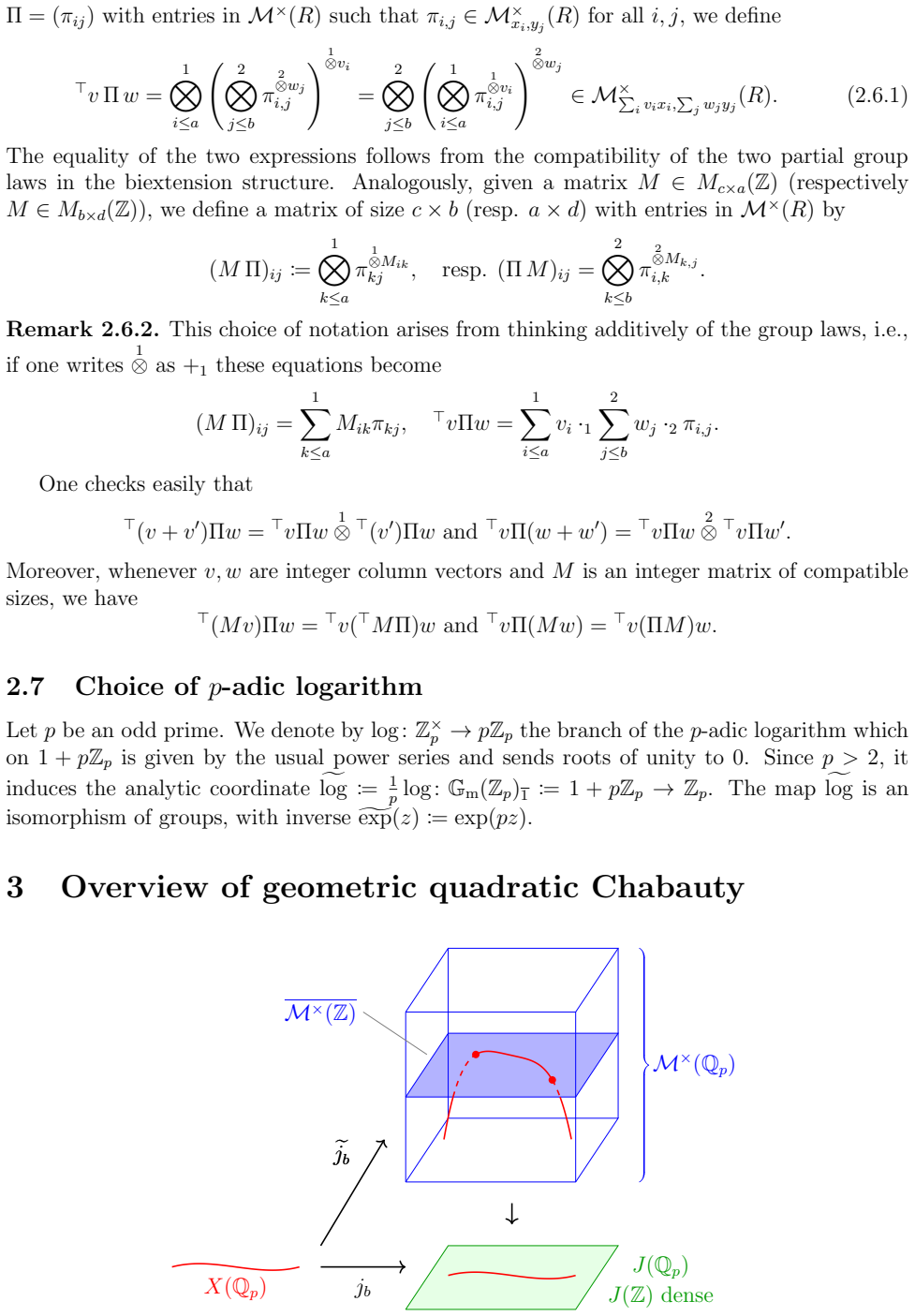
The central claim is that geometric quadratic Chabauty can be run without equations on $X_{\rm{ns}}^+(N)$. The implementation represents rational points by their moduli data, computes in the Jacobian and in the Mumford torsor $M^\times$, the $\mathbb{G}_m$-torsor attached to the Mumford bundle over $J\times J^0$, and uses the biextension structure of $M^\times$ together with section-space divisor arithmetic to make the two relevant maps explicit: $\widetilde{j}_b$, the lift of $(\mathrm{id}_J,h)\circ j_b$ to $M^\times$, and $\kappa$, the $p$-adic parameterization of the closure of the integral points of $M^\times$ in a residue disc. In the chosen analytic coordinates, $M^\times(\mathbb{Z})$ closes up to the slice with last coordinate $0$, while the image of $\widetilde{j}_b$ is given by a power series that is at most quadratic modulo $p$; intersecting the two recovers the rational point set. For $N=13$ and $p=5$ this computation gives Theorem 1.1: $X_{\rm{ns}}^+(13)(\mathbb{Q})$ is precisely the set of seven known CM points.
Load-bearing premise
The load-bearing assumption is that, for the chosen auxiliary prime $p$, the traces of the moduli-friendly modular forms to the level of $X_{\rm{ns}}^+(N)$ span the space $M_2(\Gamma)$ over $\mathbb{F}_p$; the authors state this is not proven and cite termination of their code as evidence, so if it fails the $p$-adic model of the Jacobian in Section 4.1.4 cannot be constructed.
Editorial extensions
If this is right
- The level-13 result is recovered without the plane model used in the original computation, confirming the equationless pipeline end to end.
- For any prime $N$ with $r=g$ and satisfying the auxiliary-prime assumptions, the rational points of $X_{\rm{ns}}^+(N)$ can in principle be bounded by enumerating residue discs of elliptic curves and Cartan structures and solving polynomial congruences.
- The method extends to levels where a projective model is unavailable or has bad reduction, since the model enters only through the regular model's special fiber and the moduli forms.
- Multiple trace-zero endomorphisms can be combined to rule out spurious $p$-adic solutions, so the same framework scales with the Néron–Severi rank.
- All computations are performed modulo $p^e$ with explicit precision control, and the approach naturally produces upper bounds on the number of rational points per residue disc.
Reading between the lines
- The proof of the spanning condition in Remark 4.1.8 is the spot I would check first: an independent verification that traces of moduli-friendly forms span $M_2(\Gamma)$ modulo $p$ would remove the reliance on code termination and make the method fully conditional.
- The same section-space/torsor machinery should transfer to other modular curves whose Jacobian has rank equal to genus and a supply of Hecke endomorphisms, not only the non-split Cartan family.
- Because the integral closure of $M^\times(\mathbb{Z})$ is linear in these coordinates while $\widetilde{j}_b$ is quadratic modulo $p$, the method isolates the classical Chabauty dichotomy in a particularly clean form; this coordinate choice may be reusable in other $p$-adic Chabauty settings.
- If the approach scales, the natural next stress test is a level where $\rho>3$ or where some residue disc has no known rational point and the gcd of several $\theta$-polynomials is needed to close the argument.
Signed reviews
Editorial analysis
A structured set of objections, weighed in public.
Referee Report
Summary. The paper proposes an equationless geometric quadratic Chabauty method for the non-split Cartan modular curves X_ns^+(N) of prime level N. Instead of using projective equations, the method works with the moduli interpretation: points are pairs (E,[φ]) consisting of an elliptic curve and a normalizer-of-non-split-Cartan level structure. The Jacobian and the Mumford torsor are manipulated through Makdisi and Mascot's divisor-arithmetic algorithms, using spaces of modular forms as section spaces. The paper develops the necessary framework over Z and Z_p: formulas for the lifted Abel-Jacobi map e_jb, analytic coordinates on the Mumford torsor, a description of the p-adic closure of the integral points, vertical correction divisors on a regular model, and model-free algorithms for enumerating residue discs, computing Hecke operators, interpolating e_jb, and intersecting with the image of κ. As an illustration, the paper reports a computation for X_ns^+(13) at p=5 that rederives the known result that the Q-rational points are precisely the 7 CM points.
Significance. If the computational claims are fully substantiated, this is a significant methodological advance: it replaces the equation-based cohomological quadratic Chabauty computations for non-split Cartan curves with a directly modular, equation-free geometric method, and it demonstrates the feasibility of combining geometric quadratic Chabauty with Makdisi-Mascot arithmetic on modular Jacobians and Mumford torsors. The paper contains several substantial and carefully stated theoretical contributions, including the general formula for e_jb in Proposition 4.2.31, the integrality statement in Lemma 4.2.36, the analytic-coordinate description of the Mumford torsor in Section 4.3, the description of integral points in Theorem 4.4.6, and the detailed special-fiber calculations of Section 5. It is also a strength that the authors are explicit about several limitations and dependencies, including the unproved spanning condition in Remark 4.1.8 and the reliance on unpublished work of Love, Studnia and Vonk.
major comments (3)
- [§4.1.4, Remark 4.1.8, Assumption 6.2(2)] The condition that the traces down to level Γ of Makdisi's moduli-friendly modular forms span M_2(Γ) in characteristic p is load-bearing for constructing the p-adic Makdisi model of the Jacobian, and hence for every computation in Sections 6–8. The paper states that this condition is not proved and that termination of the code is the evidence. Termination is not a proof: nontermination could equally arise from an implementation bug, and the characteristic-0 generation statement from [KM12] does not by itself imply the characteristic-p trace-spanning statement for the specific auxiliary prime p=5 used in Section 8. If the span is proper, the subspaces W_D constructed in Section 4.1.1 may fail to represent the intended points of J(F_p), so the θ-polynomials in Table 2 lose their guaranteed meaning. Please provide a proof, or an independent finite verification over F_p for the pairs (Γ,N,p) used, rather than inferring the condition from a successful run.
- [§8, Table 2] The central claim that the method 'rederives' the rational points on X_ns^+(13) is a computational assertion, but the PARI/GP and Magma code that produces Table 2 is not included, and the paper provides no execution logs, input files, or reproducible scripts. The textual descriptions in Sections 6.8–6.10 and Example 6.5.3 are detailed, but they are not sufficient for an independent check of the exact θ-polynomials, the higher-residue-disc computations, or the claimed 2-minute runtimes without a substantial reimplementation. For a paper whose novelty is primarily a new computational method, please make the code and data available, or provide a complete certificate (for instance, the matrices γ_i,j, the local equations, and the interpolation data) so that the numerical table can be verified independently.
- [§5.3, Proposition 5.3.9] The proof of Proposition 5.3.9 depends on [LSV26, Theorem A and Section 2], which the preprint cites as unpublished and does not include. This proposition is used in Section 5.4 to justify that ∆^*T_ℓ contains no smooth component of X_{F_N}, which is needed to compute the vertical divisor B in (5.4.2)–(5.4.3); B in turn enters directly into the formula for e_jb in Proposition 4.2.31 and therefore into the N=13 computation. Since the result is load-bearing and the external work is not available to the reader, please either state the needed results from [LSV26] explicitly in the paper, or replace the dependency with a self-contained proof.
minor comments (4)
- [§2.6] The bilinear-combination notation ⊤vΠw is introduced very tersely; a short explicit example with small matrices would help the reader verify the compatibility of the two partial group laws.
- [§5.1, Figure 2] The component labels in Figure 2 are difficult to read at normal print size; consider a higher-resolution figure or an accompanying table listing the components and their intersection numbers.
- [§6.5, Example 6.5.3] The statement that relations among the γ_i were checked 'up to e=10' should specify whether this is a computational verification modulo p^e or an exact identity in J(Z); this distinction matters for what is being asserted about Γ.
- [§8, Table 2] The symbols '✓' and 'Inspect' in Table 2 are informal; please define them in the caption or in the surrounding text so that the table is self-contained.
Circularity Check
No circularity: the known CM points enter only as Mordell–Weil generators and as checks that the computed root counts match; the upper bound on X_ns^+(13)(Q) comes from the computed quadratic Chabauty polynomials, not from the asserted result.
full rationale
I walked the derivation chain from the geometric quadratic Chabauty framework through the Makdisi/Mascot arithmetic in the Mumford torsor to the N=13 computation. No step reduces the conclusion to its own input. The known 7 CM points are used in two standard, non-circular ways: they generate the finite-index subgroup Gamma of J(Q) used to build coordinates for the map kappa, and they provide the rational points whose number is compared with the root count of the Chabauty polynomials. The paper states this explicitly: 'First, we note that there are 7 rational Heegner points on X_ns^+(13). We verify that their pairwise differences generate J_Q(Q) up to finite index which is coprime to p.' The upper bound is produced independently: for each residue disc, theta_{2g+1} mod p is computed by interpolating values of ejb at three chosen lifts, and by Corollary 4.3.11 this interpolant is the true mod-p reduction because theta is at most quadratic mod p. The roots are then compared with the known points, and the discs with no known point are eliminated at higher p-adic precision in Section 8 and Table 2. This is the standard Chabauty paradigm, not a fitted prediction.
Assumptions & free parameters
free parameters (4)
- Auxiliary Chabauty prime p =
5
- Non-square epsilon defining C_ns^+ =
2
- Base point b =
a rational CM point
- Trace-zero endomorphisms f1, f2 =
T3-T2; 2T7-3T2
assumptions (7)
- standard math Faltings finiteness: a curve of genus at least 2 has finitely many rational points
- domain assumption r = g for X_ns^+(N) with N prime and N < 100, in particular for N = 13
- domain assumption Existence of a rational base point b on X_ns^+(N)
- domain assumption Assumption 6.2 on the auxiliary prime p: p>3, p does not divide N+1, p not congruent to plus or minus 1 mod N, and surjectivity condition (4.4.1)
- ad hoc to paper Traces of Makdisi's moduli-friendly modular forms span M_2(Gamma) in characteristic p
- domain assumption Proposition 5.3.9, credited to unpublished work of Love, Studnia and Vonk, asserting that Delta^*T_l contains no smooth component of the special fiber
- domain assumption The subgroup Gamma of J(Q) generated by Heegner divisors satisfies conditions (1)-(3) of Section 6.4
Cite this review
Pith. "Pith review of Equationless quadratic Chabauty for non-split Cartan modular curves." pith.science (2026). https://pith.science/paper/HGHH6QBW
@misc{pith2026260810919,
  author       = {Pith},
  title        = {Pith review of: Equationless quadratic Chabauty for non-split Cartan modular curves},
  year         = {2026},
  howpublished = {\url{https://pith.science/paper/HGHH6QBW}},
  note         = {Machine review of arXiv:2608.10919}
}
abstract
The aim of this article is to describe an equationless method for determining the rational points on the non-split Cartan curve $X_{\rm{ns}}^+(N)$ of prime level $N \geqslant 13$. Instead of using a projective model for the modular curve, our method uses the moduli interpretation of the curve, namely we work directly with elliptic curves and Cartan level structures. To accomplish this, we use the geometric version of the quadratic Chabauty method. We show that this can be combined with algorithms for divisor arithmetic developed by Makdisi and Mascot so as to apply to modular curves. As an illustration, we rederive the set of rational points on the curve $X_{\rm{ns}}^+(13)$.
Figures

Reference graph
Works this paper leans on
-
[1]
Tuitman, Jan , TITLE =. Finite Fields Appl. , FJOURNAL =. 2017 , PAGES =. doi:10.1016/j.ffa.2016.12.008 , URL =
-
[2]
Hashimoto, Sachi , TITLE =. Trans. Amer. Math. Soc. , FJOURNAL =. 2023 , NUMBER =
work page 2023
-
[3]
Isabel Rendell , year=. arXiv preprint arXiv:2509.02291 , primaryClass=. 2509.02291 , archivePrefix=
- [4]
-
[5]
Balakrishnan, Jennifer S. and Besser, Amnon and M\". Quadratic. J. Reine Angew. Math. , FJOURNAL =. 2016 , PAGES =. doi:10.1515/crelle-2014-0048 , URL =
-
[6]
Katz, Nicholas M. and Mazur, Barry , TITLE =. 1985 , PAGES =. doi:10.1515/9781400881710 , URL =
-
[7]
Modular functions of one variable,
Deligne, Pierre and Rapoport, Michael , TITLE =. Modular functions of one variable,. 1973 , MRCLASS =
work page 1973
-
[8]
and Zureick-Brown, David , TITLE =
Rouse, Jeremy and Sutherland, Andrew V. and Zureick-Brown, David , TITLE =. Forum Math. Sigma , FJOURNAL =. 2022 , PAGES =. doi:10.1017/fms.2022.38 , URL =
Show all 67 references
-
[9]
Arithmetic intersections on non-split
Love, Jonathan and Studnia, \'Elie and Vonk, Jan , journal=. Arithmetic intersections on non-split. 2026 , note=
2026
-
[10]
Explicit methods in number theory , SERIES =
McCallum, William and Poonen, Bjorn , TITLE =. Explicit methods in number theory , SERIES =. 2012 , ISBN =
2012
-
[11]
Kohen, Daniel and Pacetti, Ariel , TITLE =. Canad. J. Math. , FJOURNAL =. 2016 , NUMBER =. doi:10.4153/CJM-2015-047-6 , URL =
2016 doi
-
[12]
Serre, Jean-Pierre , journal=. Propri
-
[13]
, TITLE =
Coleman, Robert F. , TITLE =. Duke Math. J. , FJOURNAL =. 1985 , NUMBER =. doi:10.1215/S0012-7094-85-05240-8 , URL =
1985 doi
-
[14]
The. The. 2026 , note =
2026
-
[15]
Alexander Betts , year=
L. Alexander Betts , year=. On a non-abelian analogue of a conjecture of. arXiv preprint arXiv:2508.19947 , primaryClass=. 2508.19947 , archivePrefix=
-
[16]
Expositiones Mathematicae , year =
Geometric quadratic. Expositiones Mathematicae , year =. doi:https://doi.org/10.1016/j.exmath.2023.05.003 , url =
2023 doi
-
[17]
GEOMETRIC QUADRATIC
Edixhoven, Bas and Lido, Guido Maria , year=. GEOMETRIC QUADRATIC. doi:10.1017/S1474748021000244 , journal=
-
[18]
Edixhoven, Bas and Parent, Pierre , TITLE =. Doc. Math. , FJOURNAL =. 2024 , PAGES =
2024
-
[19]
Edixhoven, Bas and Parent, Pierre , TITLE =. Doc. Math. , FJOURNAL =. 2021 , PAGES =
2021
-
[20]
Khuri-Makdisi, Kamal , TITLE =. Math. Comp. , FJOURNAL =. 2004 , NUMBER =. doi:10.1090/S0025-5718-03-01567-9 , URL =
2004 doi
-
[21]
Khuri-Makdisi, Kamal , TITLE =. Int. J. Number Theory , FJOURNAL =. 2012 , NUMBER =. doi:10.1142/S1793042112500418 , URL =
2012 doi
-
[23]
Acta Arith
Hashimoto, Sachi and Spelier, Pim , TITLE =. Acta Arith. , FJOURNAL =. 2022 , NUMBER =. doi:10.4064/aa210616-6-10 , URL =
2022 doi
-
[25]
2004 , PAGES =
Birkenhake, Christina and Lange, Herbert , TITLE =. 2004 , PAGES =. doi:10.1007/978-3-662-06307-1 , URL =
2004 doi
-
[26]
Mascot, Nicolas , TITLE =. Math. Comp. , FJOURNAL =. 2020 , NUMBER =. doi:10.1090/mcom/3484 , URL =
2020 doi
-
[27]
, title=
Milne, James S. , title=. 2008 , pages=
2008
-
[28]
Dissertationes Math
Kraus, Alain , TITLE =. Dissertationes Math. (Rozprawy Mat.) , FJOURNAL =. 1997 , PAGES =
1997
-
[29]
and Zagier, Don B
Gross, Benedict H. and Zagier, Don B. , TITLE =. J. Reine Angew. Math. , FJOURNAL =. 1985 , PAGES =. doi:10.1515/crll.1985.355.191 , URL =
1985 doi
-
[30]
1984 , publisher=
Intersection theory , author=. 1984 , publisher=
1984
-
[31]
Kaneko, Masanobu , TITLE =. Osaka J. Math. , FJOURNAL =. 1989 , NUMBER =
1989
-
[32]
Lauter, Kristin and Viray, Bianca , TITLE =. Int. Math. Res. Not. IMRN , FJOURNAL =. 2015 , NUMBER =. doi:10.1093/imrn/rnu223 , URL =
2015 doi
-
[33]
Kowalski, Emmanuel and Michel, Philippe and VanderKam, Jeffrey , TITLE =. J. Reine Angew. Math. , FJOURNAL =. 2000 , NUMBER =
2000
-
[34]
2021 , url=
Lido, Guido Maria , title =. 2021 , url=
2021
-
[35]
Seminar on
Diamond, Fred and Im, John , TITLE =. Seminar on. 1995 , ISBN =
1995
-
[36]
Arithmetic
Chinburg, Ted , TITLE =. Arithmetic. 1986 , ISBN =
1986
-
[37]
1994 , PAGES =
Shimura, Goro , TITLE =. 1994 , PAGES =
1994
-
[38]
2020 , PAGES =
G\"ortz, Ulrich and Wedhorn, Torsten , TITLE =. 2020 , PAGES =. doi:10.1007/978-3-658-30733-2 , URL =
2020 doi
-
[39]
, TITLE =
Milne, James S. , TITLE =. Arithmetic geometry (. 1986 , ISBN =
1986
-
[40]
2002 , PAGES =
Algebraic geometry and arithmetic curves , AUTHOR=. 2002 , PAGES =
2002
-
[41]
1972 , PAGES =
Groupes de monodromie en g\'eom\'etrie alg\'ebrique. 1972 , PAGES =
1972
-
[42]
Mathematics of Computation , volume=
Linear algebra algorithms for divisors on an algebraic curve , author=. Mathematics of Computation , volume=
-
[43]
Asymptotically fast group operations on
Khuri-Makdisi, Kamal , journal=. Asymptotically fast group operations on
-
[44]
Moduli interpretation of
Khuri-Makdisi, Kamal , journal=. Moduli interpretation of. 2012 , publisher=
2012
-
[45]
Poincar\'e \`a la
Mascot, Nicolas , year=. Poincar\'e \`a la
-
[46]
1997 , PAGES =
Serre, Jean-Pierre , TITLE =. 1997 , PAGES =. doi:10.1007/978-3-663-10632-6 , URL =
1997 doi
-
[47]
Mascot, Nicolas , TITLE =. Res. Number Theory , FJOURNAL =. 2022 , NUMBER =. doi:10.1007/s40993-022-00329-6 , URL =
2022 doi
-
[48]
Pacific J
Melistas, Mentzelos , TITLE =. Pacific J. Math. , FJOURNAL =. 2024 , NUMBER =. doi:10.2140/pjm.2024.329.233 , URL =
2024 doi
-
[49]
Serre, Jean-Pierre , TITLE =. Inst. Hautes \'Etudes Sci. Publ. Math. , FJOURNAL =. 1981 , PAGES =
1981
-
[50]
, TITLE =
Mazur, B. , TITLE =. Invent. Math. , FJOURNAL =. 1978 , NUMBER =. doi:10.1007/BF01390348 , URL =
1978 doi
-
[51]
Bilu, Yuri and Parent, Pierre , TITLE =. Ann. of Math. (2) , FJOURNAL =. 2011 , NUMBER =. doi:10.4007/annals.2011.173.1.13 , URL =
2011 doi
-
[52]
Bilu, Yuri and Parent, Pierre and Rebolledo, Marusia , TITLE =. Ann. Inst. Fourier (Grenoble) , FJOURNAL =. 2013 , NUMBER =. doi:10.5802/aif.2781 , URL =
2013 doi
-
[53]
and Dogra, Netan , TITLE =
Balakrishnan, Jennifer S. and Dogra, Netan , TITLE =. Duke Math. J. , FJOURNAL =. 2018 , NUMBER =. doi:10.1215/00127094-2018-0013 , URL =
2018 doi
-
[54]
and Dogra, Netan , TITLE =
Balakrishnan, Jennifer S. and Dogra, Netan , TITLE =. Int. Math. Res. Not. IMRN , FJOURNAL =. 2021 , NUMBER =. doi:10.1093/imrn/rnz362 , URL =
2021 doi
-
[55]
Generalised height pairings and the
Dogra, Netan , journal=. Generalised height pairings and the. 2025 , note=
2025
-
[56]
Chabauty, Claude , TITLE =. C. R. Acad. Sci. Paris , FJOURNAL =. 1941 , PAGES =
1941
-
[57]
and Dogra, Netan and M\"uller, J
Balakrishnan, Jennifer S. and Dogra, Netan and M\"uller, J. Steffen and Tuitman, Jan and Vonk, Jan , TITLE =. Ann. of Math. (2) , FJOURNAL =. 2019 , NUMBER =. doi:10.4007/annals.2019.189.3.6 , URL =
2019 doi
-
[58]
and Dogra, Netan and M\"uller, J
Balakrishnan, Jennifer S. and Dogra, Netan and M\"uller, J. Steffen and Tuitman, Jan and Vonk, Jan , TITLE =. Compos. Math. , FJOURNAL =. 2023 , NUMBER =. doi:10.1112/s0010437x23007170 , URL =
2023 doi
-
[59]
Mercuri, Pietro and Schoof, Ren\'e , TITLE =. Math. Comp. , FJOURNAL =. 2020 , NUMBER =. doi:10.1090/mcom/3503 , URL =
2020 doi
-
[60]
Dogra, Netan and Le Fourn, Samuel , TITLE =. Math. Ann. , FJOURNAL =. 2021 , NUMBER =. doi:10.1007/s00208-020-02112-3 , URL =
2021 doi
-
[61]
Kim, Minhyong , TITLE =. Invent. Math. , FJOURNAL =. 2005 , NUMBER =. doi:10.1007/s00222-004-0433-9 , URL =
2005 doi
-
[62]
Kim, Minhyong , TITLE =. Publ. Res. Inst. Math. Sci. , FJOURNAL =. 2009 , NUMBER =. doi:10.2977/prims/1234361156 , URL =
2009
-
[63]
Ast\'erisque , FJOURNAL =
Kato, Kazuya , TITLE =. Ast\'erisque , FJOURNAL =. 2004 , PAGES =
2004
-
[64]
Chen, Imin , TITLE =. Proc. London Math. Soc. (3) , FJOURNAL =. 1998 , NUMBER =. doi:10.1112/S0024611598000392 , URL =
1998 doi
-
[65]
On 7-adic
Lorenzo Furio and Davide Lombardo , year=. On 7-adic. 2507.17967 , journal=
-
[66]
2021 , PAGES =
Voight, John , TITLE =. 2021 , PAGES =. doi:10.1007/978-3-030-56694-4 , URL =
2021 doi
-
[67]
Explicit open images for elliptic curves over
David Zywina , year=. Explicit open images for elliptic curves over. arXiv preprint arXiv:2206.14959 , primaryClass=. 2206.14959 , archivePrefix=
-
[68]
On the possible images of the mod ell representations associated to elliptic curves over
David Zywina , year=. On the possible images of the mod ell representations associated to elliptic curves over. arXiv preprint arXiv:1508.07660 , primaryClass=. 1508.07660 , archivePrefix=
-
[69]
2026 , eprint=
Computing with necklaces on elliptic curves , author=. 2026 , eprint=
2026
Reviewed August 12, 2026 · model on record in the stance chip above.
Discussion (0). Continue with ORCID to comment.