REVIEW 3 major objections 5 minor 4 cited by
Spectral siren cosmology from gravitational-wave observations in GWTC-4.0
T0 review · 3 major / 5 minor · reviewed 2026-08-05 · deepseek-v4-flash
Pith's one-line read Spectral siren cosmology on 152 GWTC-4.0 black hole mergers, combined with the GW170817 bright siren, yields H0 = 69 (+7/−6) km/s/Mpc, a 10% measurement.
desk verdict First spectral-siren H0 constraint from GWTC-4.0, a clean application of standard methods; the headline 10% number rests on the authors' own GP model and on an unquantified no-redshift-evolution assumption. read the letter →
The pith
A machine-rendered reading of the paper's core claim, the machinery that carries it, and where it could break.
The reading
What carries the argument
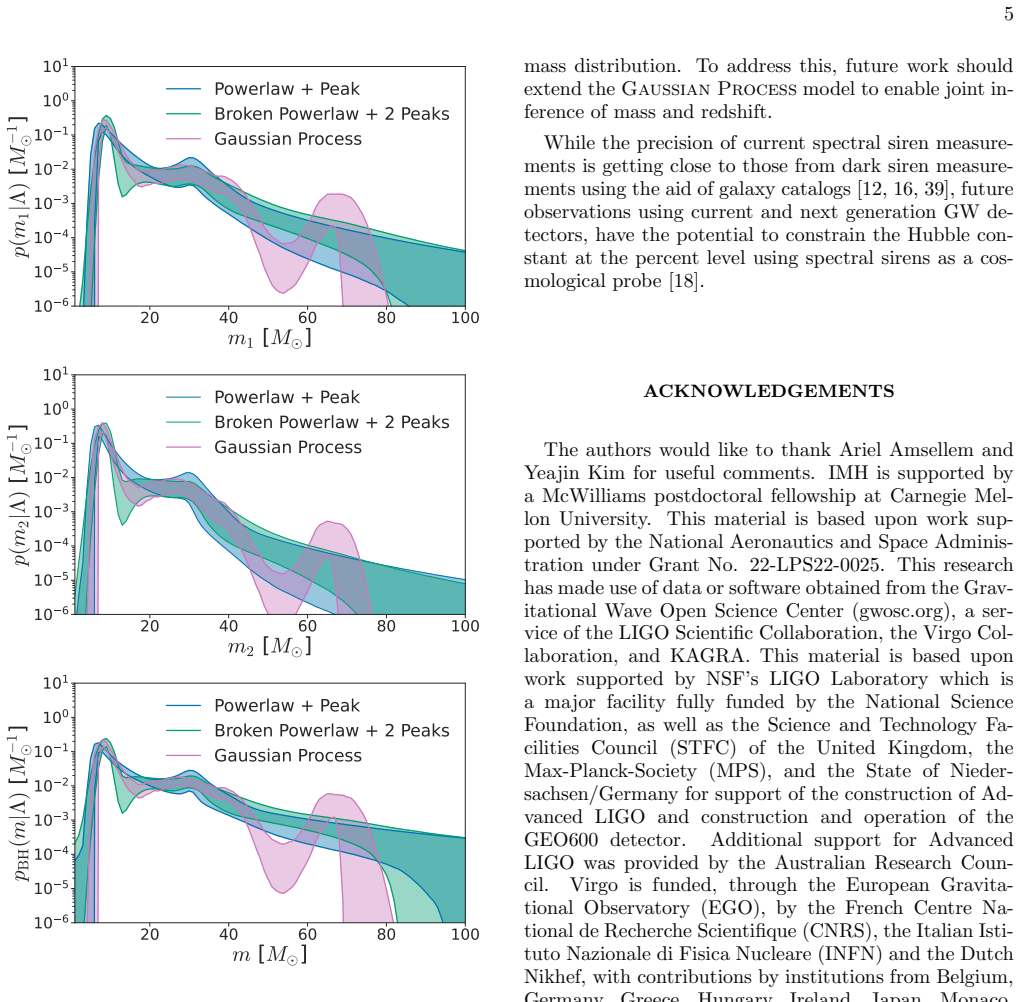
The spectral-siren ruler: observed detector-frame masses relate to source-frame masses by m_det = (1+z) m_source, so a fixed feature in the source-frame mass spectrum appears at different detector-frame masses depending on the redshift. The analysis scans over the Hubble constant, and the value that best aligns all events' inferred source-frame masses with the model's peaks and gaps wins. The three population models provide the feature templates, with the Gaussian Process model's flexibility capturing the 10–40 solar-mass structure and the ~45 solar-mass pair-instability shoulder that carry the tightest H0 information.
What would settle it
Split the GWTC-4.0 BBH sample by inferred redshift and compare the position of the ~10 solar-mass peak under the Gaussian Process model at fixed H0; if the peak's location shifts with redshift by more than the posterior uncertainty, the no-evolution assumption fails.
Extended reading notes
Core claim
Using 152 confident binary-black-hole mergers from GWTC-4.0, the paper reports the first spectral-siren Hubble-constant measurement with this catalog. Three mass models give BBH-only H0 = 78 (+93/−33), 66 (+48/−32), and 61 (+29/−13) km/s/Mpc. Combining the Gaussian Process model with the GW170817 bright-siren measurement gives H0 = 69 (+7/−6) km/s/Mpc, a 10% constraint. The paper argues that the extra 10–40 solar-mass structure—chiefly the ~10 solar-mass peak shifting upward—drives the lower H0 relative to Powerlaw + Peak, and that the Gaussian Process model's 45 and 60–70 solar-mass features carry the added constraining power.
Load-bearing premise
The black-hole mass spectrum is assumed to have the same shape at every redshift; if the peaks and bumps move to different masses in the past, the inferred Hubble constant will be biased.
Editorial extensions
If this is right
- Spectral sirens can measure H0 without electromagnetic counterparts or complete galaxy catalogs, reaching 10% precision when a flexible mass model is combined with a single bright siren.
- Model choice changes the BBH-only central H0 by about 17 km/s/Mpc (78 versus 61), so the mass model is now a dominant systematic for this method.
- The pair-instability-related features (the ~45 solar-mass shoulder and the 60–70 solar-mass excess) act as extra calibrators; better population modeling should tighten H0 further as events accumulate.
- The resulting H0 overlaps both CMB and local distance-ladder measurements within its error bars, so spectral sirens currently probe the Hubble tension without resolving it.
- As the catalog grows, this framework points toward percent-level H0 measurements from spectral sirens alone.
Reading between the lines
- Editorial inference: if the 10–40 solar-mass structure traces metallicity-driven evolution, the lower H0 preferred by flexible models could partly be unmodeled redshift evolution masquerading as cosmology.
- Editorial inference: cross-checking spectral-siren H0 against dark-siren galaxy-catalog analyses on the same events would isolate method-specific systematics, since the two routes break the mass–redshift degeneracy differently.
- Editorial inference: the apparent pair-instability features could be calibrated with independent stellar-population or electromagnetic constraints, converting an astrophysical feature into an absolute mass standard for H0.
- Editorial inference: extending the Gaussian Process model to jointly infer mass and redshift evolution—the paper's stated next step—would turn the main caveat into a measured parameter, letting the data choose between a fixed and an evolving mass spectrum.
Editorial analysis
A structured set of objections, weighed in public.
Referee Report
Summary. The paper presents a spectral-siren measurement of the Hubble constant using 152 binary black hole (BBH) mergers from GWTC-4.0. It uses three models for the source-frame black hole mass distribution: the Powerlaw + Peak and Broken Powerlaw + 2 Peaks parametric models, and a non-parametric Gaussian Process (GP) model. The analysis jointly infers population and cosmological parameters in a hierarchical Bayesian framework with selection effects estimated from public injections. The main result is that the GP model combined with the GW170817 bright-siren measurement yields H0 = 69^{+7}_{-6} km/s/Mpc (10% precision), while the parametric models give broader constraints. The paper claims broad consistency among the three models and compares with Planck and SH0ES.
Significance. If the result holds, this is a useful step for spectral-siren cosmology: it is one of the first cosmological measurements with GWTC-4.0, it uses three population models, and it demonstrates that a flexible non-parametric mass model can improve H0 precision compared to simple parametric forms. The analysis uses public GWTC-4.0 data and injections, follows standard hierarchical Bayesian methods, and is transparent about its main caveat regarding redshift evolution of the mass distribution. However, the headline 10% precision rests on the GP model, whose astrophysically motivated features may partly be prior-driven, and on an assumed redshift-invariant mass spectrum that the paper itself acknowledges is unquantified. The quoted GW170817 posterior also appears to be misreported. These issues limit the importance of the central claim until addressed.
major comments (3)
- [Section IV and Table I] The headline 10% result assumes that the BBH source-frame mass distribution does not evolve with redshift. The authors explicitly state this caveat and cite Refs. [13,23,53] showing that redshift-evolving features can bias cosmological inference, but they do not quantify the resulting systematic uncertainty. Since the spectral-siren mapping in Eq. (1) identifies features in the mass spectrum, even a mild drift of the 10–40 Msun structure could shift H0 by more than the quoted 69^{+7}_{-6}. The paper should add a sensitivity test, e.g., by injecting mock populations with redshift-dependent peaks or by using a redshift-evolving GP model, and should either include the resulting systematic in the error budget or justify why it is negligible. As written, the quoted precision is conditional on an unquantified assumption.
- [Section III, Table I] The GW170817 posterior used in the combined constraints is misreported. The text says "H0 = 71^{+23}_{-8} km/s/Mpc obtained from Ref. [8]", but Ref. [8] (Abbott et al. 2017, Nature 551, 85) reports H0 = 70.0^{+12.0}_{-8.0} km/s/Mpc. The upper error is wrong by roughly a factor of two. Because the second column of Table I is obtained by combining the BBH-only posteriors with this GW170817 measurement, the combined H0 values and their uncertainties need to be recomputed with the correct posterior. If a different posterior is intended, it must be cited explicitly.
- [Section II C and Figure 2] The most constraining result comes from the Gaussian Process model of Ref. [36]. The paper states that the GP model captures a "shoulder-like feature around ~45 Msun" and a suppression consistent with the PISN mass gap, and that these features are "consistent with Ref. [36]". These features are the ones that drive the spectral-siren H0 constraint, but the paper does not show the GP prior versus the posterior, nor any sensitivity to the GP kernel or hyperparameters. Because Ref. [36] is by the same authors and the model is described as "astrophysics informed", it is important to demonstrate that these mass-spectrum features are actually demanded by the data rather than imposed by the prior. Please add a prior/posterior comparison or a hyperparameter sensitivity study for the GP model.
minor comments (5)
- [Equation (4)] The selection function β(Λ) is introduced in Eq. (4) but never defined explicitly. Please provide its integral form or point to the exact equation in the cited injection papers [20,21,26,51].
- [Section II C] The functional forms of the three mass models are not given; the reader is referred to other papers. For a self-contained journal submission, at least the Powerlaw + Peak and Broken Powerlaw + 2 Peaks formulas should be included in an appendix or stated explicitly.
- [Figure 1 caption] The caption describes the light blue band as "standard candle type 1A SN measurements" from [45]. This is imprecise: SH0ES is a Cepheid-calibrated Type Ia supernova distance ladder, not simply a type-Ia measurement. Please clarify.
- [References] Many bibliography entries are incomplete, containing only an arXiv URL and year (e.g., [1], [2], [3], [4], [15], [21], [36], [37], [43]). Journal style requires full author/title information. Please complete all references.
- [Abstract / Section III] The abstract states 153 significant BBH mergers, but the analysis uses 152 after excluding GW231123. The exclusion is explained in Section III, but the abstract should be consistent or note the exclusion explicitly.
Circularity Check
No significant circularity: H0 is a free parameter in a joint hierarchical fit; the same-author GP model is a model choice, not a pre-fitted H0 input.
full rationale
The paper infers H0 through a hierarchical Bayesian likelihood (Eq. 4) in which H0 is a free parameter controlling the mapping between detector-frame and source-frame masses (Eq. 1). The reported H0 posteriors are the output of this joint fit, not a re-statement of an input. The redshift-evolution caveat quoted in Section IV is an explicitly stated modeling assumption, not a circular definition: it does not define H0 in terms of the mass distribution or vice versa. The only same-author citation is Ref. [36] for the 'astrophysics informed Gaussian Process' model. That model is a population-model choice; its parameters are re-fit jointly with H0 in this work, and its features (e.g., PISN gap) are motivated by astrophysical theory rather than by the target H0. The phrase 'extending the results of Ref. [36] under a fixed cosmological model' indicates that the earlier work fixed a cosmology, but this paper varies H0 as a free parameter, and no equation or passage shows that the GP model's output is equivalent to its input. Therefore no circular step meeting the required evidence threshold is present; the self-citation is minor and not load-bearing.
Assumptions & free parameters
free parameters (4)
- Mass model hyperparameters (Powerlaw + Peak, Broken Powerlaw + 2 Peaks, Gaussian Process) =
Not stated in this paper
- kappa (merger rate redshift evolution slope) =
Not stated in this paper
- beta (mass-ratio pairing slope) =
Not stated in this paper
- Omega_m (matter density) =
Uniform prior [0, 1]
assumptions (5)
- domain assumption Flat LCDM cosmology with H(z) = H0 sqrt(Omega_m (1+z)^3 + (1 - Omega_m))
- domain assumption The BBH mass distribution does not evolve with redshift
- domain assumption Functional forms and priors of the three mass models are taken at face value from Refs [2, 11, 36, 48]
- standard math Hierarchical Bayesian likelihood with importance sampling and injection-based selection (Eqs. 3 and 4)
- domain assumption GW170817 bright siren posterior of H0 = 71 +23/-8 km/s/Mpc is a valid external constraint for combination
Cite this review
Pith. "Pith review of Spectral siren cosmology from gravitational-wave observations in GWTC-4.0." pith.science (2026). https://pith.science/paper/HGOLNENF
@misc{pith2026250903607,
  author       = {Pith},
  title        = {Pith review of: Spectral siren cosmology from gravitational-wave observations in GWTC-4.0},
  year         = {2026},
  howpublished = {\url{https://pith.science/paper/HGOLNENF}},
  note         = {Machine review of arXiv:2509.03607}
}
abstract
Gravitational wave standard sirens offer a promising avenue for cosmological inference, particularly in measuring the expansion history of the universe. Traditionally, bright sirens require an electromagnetic counterpart to determine the redshift of the emission source while dark sirens rely on the presence of complete galaxy catalogs over large sky regions. Spectral sirens, using GW data alone, can circumvent these limitations by leveraging features in the mass distribution of compact binaries. With the recent release of the Gravitational-Wave Transient Catalog 4 (GWTC-4.0), the number of significant binary black hole (BBH) merger candidates has increased to 153, enabling more robust population studies and cosmological constraints. This work builds upon previous spectral siren analyses by analyzing the latest BBH observations with parametric and non-parametric models. In particular, we consider a parametric approach using the Powerlaw + Peak and Broken Powerlaw + 2 Peaks models as well as a more flexible non-parametric model based on Gaussian processes. We find broad consistency in the inferred Hubble constant $H_0$ constraints across models. Our most constraining result is from the Gaussian Process model, which, combined with the GW170817 bright siren measurement, results in $H_0 = 69^{+7}_{-6} \ \mathrm{km\,s^{-1}\,Mpc^{-1}}$, a 10% precision measurement. For the Powerlaw + Peak and Broken Powerlaw + 2 Peaks we find fractional uncertainties of 17% and 13% respectively.
Figures

Forward citations
Cited by 4 Pith papers
-
Assessing the waveform systematics from parameter estimation to population inference with eccentricity
Eccentric waveform-model differences, small per event, accumulate across the GWTC-4 catalog and alter inferred redshift evolution and effective-spin population distributions.
-
Cosmology beyond standard sirens: cross-correlation of gravitational waves and neutral hydrogen intensity mapping
Forecast: ET2L+CE and SKAO can jointly constrain H0 to 0.5% and σ8 to 1.6%, but the pure GW×HI cross-correlation alone gives 2.9% and 5.3%.
-
Inferring cosmological parameters from galaxy and dark sirens cross-correlation
A full-likelihood forecast shows dark-siren×galaxy cross-correlations with 3G detectors and Euclid could constrain H0 at 0.7% and complement galaxy clustering on other parameters.
-
The Hubble tension: A decade review
Pure early or late fixes to the Hubble tension are tightly constrained; remaining options are combined early-late interacting dark energy or new physics at the local-to-homogeneous transition.
Reference graph
Works this paper leans on
- [8]
-
[36]
—. 2025. https://arxiv.org/abs/2508.19208
arXiv 2025
- [1]
- [2]
- [3]
-
[4]
—. 2025. https://arxiv.org/abs/2507.08219
arXiv 2025
-
[5]
Abbott, B., et al. 2017, Phys. Rev. Lett., 119, 161101, doi: 10.1103/PhysRevLett.119.161101
-
[6]
2019, Physical Review X, 9, 011001
Abbott, B., Abbott, R., Abbott, T., et al. 2019, Physical Review X, 9, 011001
work page 2019
Show all 54 references
-
[7]
P., Abbott, R., Abbott, T., et al
Abbott, B. P., Abbott, R., Abbott, T., et al. 2017, The Astrophysical Journal Letters, 848, L13 6
2017
-
[9]
2021, Astrophys
Abbott, R., et al. 2021, Astrophys. J. Lett., 913, L7, doi: 10.3847/2041-8213/abe949
2021 doi
-
[10]
2023, Phys
—. 2023, Phys. Rev. X, 13, 041039, doi: 10.1103/ PhysRevX.13.041039
2023
-
[11]
2023, Phys
—. 2023, Phys. Rev. X, 13, 011048, doi: 10.1103/ PhysRevX.13.011048
2023
-
[12]
2023, Astrophys
—. 2023, Astrophys. J., 949, 76, doi: 10.3847/ 1538-4357/ac74bb
2023
-
[13]
2025, Blinded Mock Data Challenge for Gravitational-Wave Cosmology-I: Assessing the Robustness of Methods Us- ing Binary Black Holes Mass Spectrum
Agarwal, A., Dupletsa, U., Leyde, K., et al. 2025, Blinded Mock Data Challenge for Gravitational-Wave Cosmology-I: Assessing the Robustness of Methods Us- ing Binary Black Holes Mass Spectrum. https://arxiv. org/abs/2412.14244
2025 arXiv
-
[14]
2020, As- tronomy & Astrophysics, 641, A6
Aghanim, N., Akrami, Y., Ashdown, M., et al. 2020, As- tronomy & Astrophysics, 641, A6
2020
-
[15]
Antonini, F., Callister, T., Dosopoulou, F., Romero- Shaw, I., & Chattopadhyay, D. 2025. https://arxiv. org/abs/2506.09154
2025 arXiv
-
[16]
R., Alfradique, V., Palmese, A., et al
Bom, C. R., Alfradique, V., Palmese, A., et al. 2024, Mon. Not. Roy. Astron. Soc., 535, 961, doi: 10.1093/ mnras/stae2390
2024
-
[17]
A., & Farr, W
Callister, T. A., & Farr, W. M. 2024, Phys. Rev. X, 14, 021005, doi: 10.1103/PhysRevX.14.021005
2024 doi
-
[18]
M., & Gupta, I
Chen, H.-Y., Ezquiaga, J. M., & Gupta, I. 2024. https: //arxiv.org/abs/2402.03120
2024 arXiv
-
[19]
2023, Astrophys
Edelman, B., Farr, B., & Doctor, Z. 2023, Astrophys. J., 946, 16, doi: 10.3847/1538-4357/acb5ed
2023 doi
-
[20]
2022, Precision Requirements for Monte Carlo Sums within Hierarchical Bayesian Infer- ence
Essick, R., & Farr, W. 2022, Precision Requirements for Monte Carlo Sums within Hierarchical Bayesian Infer- ence. https://arxiv.org/abs/2204.00461
2022 arXiv
-
[21]
Essick, R., et al. 2025. https://arxiv.org/abs/2508. 10638
2025
-
[22]
Ezquiaga, J. M. 2021, Phys. Lett. B, 822, 136665, doi:10. 1016/j.physletb.2021.136665
2021
-
[23]
M., & Holz, D
Ezquiaga, J. M., & Holz, D. E. 2022, Phys. Rev. Lett., 129, 061102, doi: 10.1103/PhysRevLett.129.061102
2022 doi
-
[24]
M., Callister, T
Farah, A. M., Callister, T. A., Ezquiaga, J. M., Zevin, M., & Holz, D. E. 2025, Astrophys. J., 978, 153, doi: 10. 3847/1538-4357/ad9253
2025
-
[25]
M., Fishbach, M., & Holz, D
Farah, A. M., Fishbach, M., & Holz, D. E. 2024, Astro- phys. J., 962, 69, doi: 10.3847/1538-4357/ad0558
2024 doi
-
[26]
Farr, W. M. 2019, Research Notes of the AAS, 3, 66, doi: 10.3847/2515-5172/ab1d5f
2019 doi
-
[27]
M., Fishbach, M., Ye, J., & Holz, D
Farr, W. M., Fishbach, M., Ye, J., & Holz, D. 2019, Astrophys. J. Lett., 883, L42, doi: 10.3847/2041-8213/ ab4284
2019 doi
-
[28]
Fishbach, M., & Holz, D. E. 2020, Astrophys. J. Lett., 891, L27, doi: 10.3847/2041-8213/ab7247
2020 doi
-
[29]
E., & Farr, W
Fishbach, M., Holz, D. E., & Farr, W. M. 2018, Astro- phys. J. Lett., 863, L41, doi: 10.3847/2041-8213/aad800
2018 doi
-
[30]
Golomb, J., Isi, M., & Farr, W. M. 2024, Astrophys. J., 976, 121, doi: 10.3847/1538-4357/ad8572
2024 doi
-
[31]
2025, Phys
Heinzel, J., Mould, M., ´Alvarez-L´ opez, S., & Vitale, S. 2025, Phys. Rev. D, 111, 063043, doi: 10.1103/ PhysRevD.111.063043
2025
-
[32]
E., & Hughes, S
Holz, D. E., & Hughes, S. A. 2005, Astrophys. J., 629, 15, doi: 10.1086/431341
2005 doi
-
[33]
2022, Journal of Cos- mology and Astroparticle Physics, 2022, 012, doi: 10
Leyde, K., Mastrogiovanni, S., Steer, D., Chassande- Mottin, E., & Karathanasis, C. 2022, Journal of Cos- mology and Astroparticle Physics, 2022, 012, doi: 10. 1088/1475-7516/2022/09/012
2022
-
[34]
2023, Phys
Maga˜ na Hernandez, I. 2023, Phys. Rev. D, 107, 084033, doi: 10.1103/PhysRevD.107.084033
2023 doi
-
[35]
2025, Phys
Maga˜ na Hernandez, I., & Palmese, A. 2025, Phys. Rev. D, 111, 083031, doi: 10.1103/PhysRevD.111.083031
2025 doi
-
[37]
2024.https://arxiv
Maga˜ na Hernandez, I., & Ray, A. 2024.https://arxiv. org/abs/2404.02522
2024 arXiv
-
[38]
2025, Astrophys
Mali, U., & Essick, R. 2025, Astrophys. J., 980, 85, doi: 10.3847/1538-4357/ad9de7
2025 doi
-
[39]
R., Mucesh, S., & Hartley, W
Palmese, A., Bom, C. R., Mucesh, S., & Hartley, W. G. 2023, Astrophys. J., 943, 56, doi: 10.3847/1538-4357/ aca6e3
2023 doi
-
[40]
2024, Phys
Palmese, A., Kaur, R., Hajela, A., et al. 2024, Phys. Rev. D, 109, 063508, doi: 10.1103/PhysRevD.109.063508
2024 doi
-
[41]
Palmese, A., & Mastrogiovanni, S. 2025. https://arxiv. org/abs/2502.00239
2025 arXiv
-
[42]
2024, Phys
Pierra, G., Mastrogiovanni, S., Perri` es, S., & Mapelli, M. 2024, Phys. Rev. D, 109, 083504, doi: 10.1103/ PhysRevD.109.083504
2024
-
[43]
Ray, A., Maga˜ na Hernandez, I., Breivik, K., & Creighton, J. 2024. https://arxiv.org/abs/2404.03166
2024 arXiv
-
[44]
2023, Astrophys
Ray, A., Maga˜ na Hernandez, I., Mohite, S., Creighton, J., & Kapadia, S. 2023, Astrophys. J., 957, 37, doi: 10. 3847/1538-4357/acf452
2023
-
[45]
G., Wenlong, Y., Macri Lucas, M., et al
Riess, A. G., Wenlong, Y., Macri Lucas, M., et al. 2022, Astrophys. J. Lett, 934, L7
2022
-
[46]
K., van Son, L
Roy, S. K., van Son, L. A. C., & Farr, W. M. 2025. https://arxiv.org/abs/2507.01086
2025
-
[47]
Schutz, B. F. 1986, Nature, 323, 310, doi: 10.1038/ 323310a0
1986
-
[48]
2018, Astrophys
Talbot, C., & Thrane, E. 2018, Astrophys. J., 856, 173, doi: 10.3847/1538-4357/aab34c
2018 doi
-
[49]
R., & Gair, J
Taylor, S. R., & Gair, J. R. 2012, Phys. Rev. D, 86, 023502, doi: 10.1103/PhysRevD.86.023502
2012 doi
-
[50]
2019, Publications of the As- tronomical Society of Australia, 36, doi: 10.1017/pasa
Thrane, E., & Talbot, C. 2019, Publications of the As- tronomical Society of Australia, 36, doi: 10.1017/pasa. 2019.2
2019 doi
-
[51]
2018, Class
Tiwari, V. 2018, Class. Quant. Grav., 35, 145009, doi:10. 1088/1361-6382/aac89d
2018
-
[52]
2022, Astrophys
—. 2022, Astrophys. J., 928, 155, doi: 10.3847/ 1538-4357/ac589a
2022
-
[53]
2025, Astrophys
Tong, H., Fishbach, M., & Thrane, E. 2025, Astrophys. J., 985, 220, doi: 10.3847/1538-4357/adcec5
2025 doi
-
[54]
M., & Taylor, S
Vitale, S., Gerosa, D., Farr, W. M., & Taylor, S. R. 2020, doi: 10.1007/978-981-15-4702-7_45-1
2020 doi
Reviewed August 5, 2026 · model on record in the stance chip above.
Discussion (0). Sign in to comment.