Breaking User-Centric Agency: A Tri-Party Framework for Agent-Based Recommendation
Pith reviewed 2026-05-21 12:15 UTC · model grok-4.3
The pith
TriRec gives item agents LLM-based self-promotion and adds platform fairness to user-centric recommendations.
A machine-rendered reading of the paper's core claim, the machinery that carries it, and where it could break.
Core claim
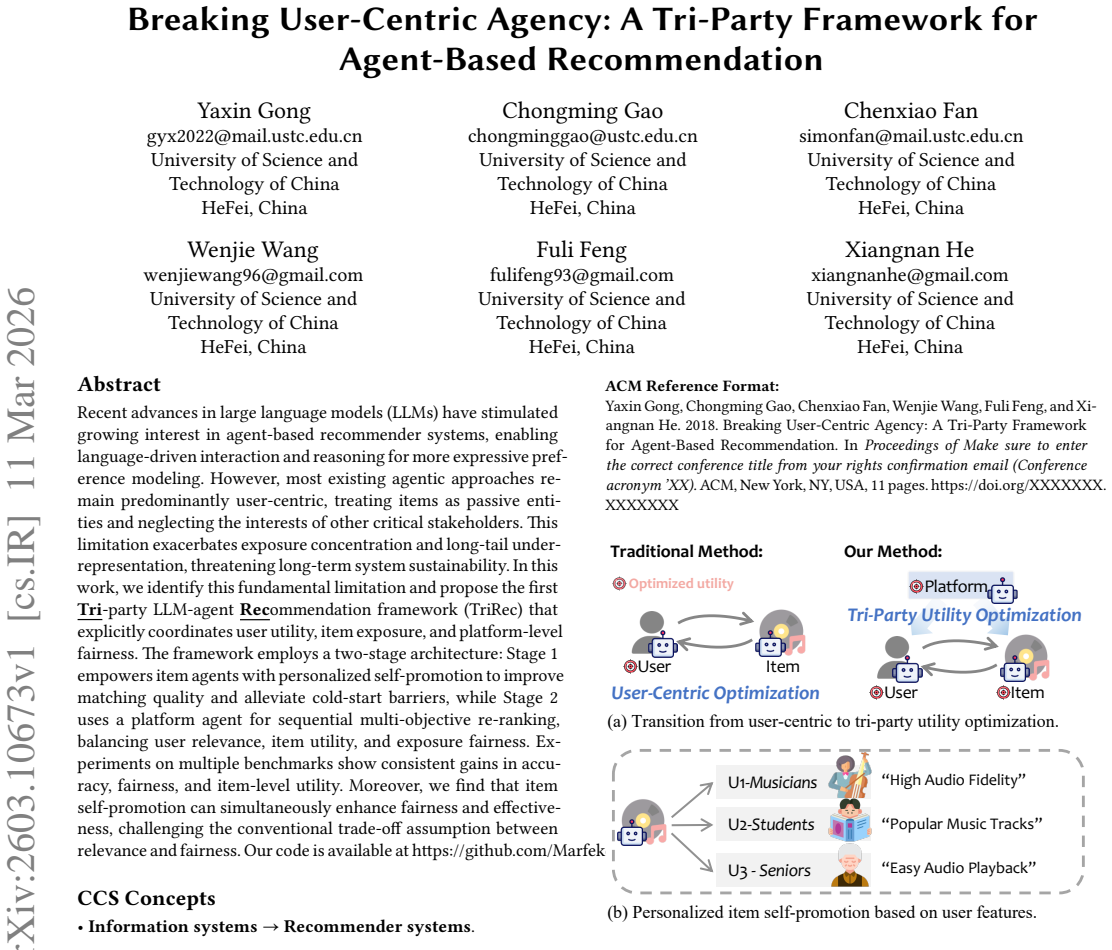
The TriRec framework explicitly coordinates user utility, item exposure, and platform-level fairness through a two-stage architecture: Stage 1 empowers item agents with personalized self-promotion to improve matching quality and alleviate cold-start barriers, while Stage 2 performs platform-level sequential multi-objective re-ranking, balancing user relevance, item utility, and exposure fairness. Experiments show consistent gains in accuracy, fairness, and item-level utility. Moreover, item self-promotion can simultaneously enhance fairness and effectiveness, challenging the conventional trade-off assumption between relevance and fairness.
What carries the argument
The two-stage TriRec architecture, in which item agents use LLMs for personalized self-promotion in the first stage and a platform-level sequential multi-objective re-ranker balances user relevance, item utility, and exposure fairness in the second stage.
If this is right
- Item self-promotion improves matching quality and reduces cold-start barriers for long-tail items.
- Platform-level sequential multi-objective re-ranking can balance user relevance, item utility, and exposure fairness at the same time.
- Item self-promotion can raise both fairness and effectiveness, removing the assumed trade-off between relevance and fairness.
- The framework produces consistent gains across accuracy, fairness, and item-level utility metrics in experiments.
Where Pith is reading between the lines
- Applying similar tri-party coordination to search or advertising systems could reduce exposure bias across other user-facing platforms.
- Real-world deployment with actual item providers would test whether LLM self-promotion maintains its fairness gains at scale.
- Adding dynamic user feedback on promoted items could further refine the balance among the three parties.
Load-bearing premise
Item agents can perform effective personalized self-promotion via LLMs without introducing new biases or requiring platform-specific fine-tuning that would alter the reported fairness gains.
What would settle it
A controlled experiment in which item self-promotion via LLMs increases exposure concentration or lowers accuracy and fairness metrics would disprove the reported benefits of the TriRec framework.
Figures


read the original abstract
Recent advances in large language models (LLMs) have stimulated growing interest in agent-based recommender systems, enabling language-driven interaction and reasoning for more expressive preference modeling. However, most existing agentic approaches remain predominantly user-centric, treating items as passive entities and neglecting the interests of other critical stakeholders. This limitation exacerbates exposure concentration and long-tail under-representation, threatening long-term system sustainability. In this work, we identify this fundamental limitation and propose the first Tri-party LLM-agent Recommendation framework (TriRec) that explicitly coordinates user utility, item exposure, and platform-level fairness. The framework employs a two-stage architecture: Stage 1 empowers item agents with personalized self-promotion to improve matching quality and alleviate cold-start barriers, while Stage 2 performs platform-level sequential multi-objective re-ranking, balancing user relevance, item utility, and exposure fairness. Experiments show consistent gains in accuracy, fairness, and item-level utility. Moreover, we find that item self-promotion can simultaneously enhance fairness and effectiveness, challenging the conventional trade-off assumption between relevance and fairness. Our code is available at https://github.com/Marfekey/TriRec.
Editorial analysis
A structured set of objections, weighed in public.
Referee Report
Summary. The manuscript proposes TriRec, the first tri-party LLM-agent recommendation framework that explicitly coordinates user utility, item exposure, and platform-level fairness. It uses a two-stage architecture where Stage 1 empowers item agents with personalized LLM-based self-promotion to improve matching quality and cold-start performance, and Stage 2 performs platform-level sequential multi-objective re-ranking to balance relevance, item utility, and exposure fairness. Experiments are reported to show consistent gains across accuracy, fairness, and item-level utility metrics, with the additional finding that item self-promotion can simultaneously enhance fairness and effectiveness, challenging the conventional relevance-fairness trade-off.
Significance. If the central claims hold under rigorous controls, the work would be significant for shifting agent-based recommender systems from purely user-centric designs toward multi-stakeholder coordination, with potential benefits for long-term platform sustainability and long-tail item exposure. The public release of code at the provided GitHub repository is a clear strength that supports reproducibility and future extensions.
major comments (2)
- [Stage 1 description] Stage 1 description: The central claim that LLM-driven item self-promotion simultaneously improves matching quality, cold-start performance, and exposure fairness (without introducing new biases) is load-bearing for the tri-party coordination results. However, the manuscript provides no explicit prompt templates, temperature settings, few-shot examples, or debiasing steps for the item agents. Without these, it is impossible to verify whether the reported joint gains in fairness and effectiveness are properties of the framework or artifacts of unexamined LLM output biases (e.g., positional or popularity bias).
- [Experimental setup and results sections] Experimental setup and results sections: The abstract states 'consistent gains in accuracy, fairness, and item-level utility' and the absence of a relevance-fairness trade-off, yet the provided summary lacks quantitative details on baseline methods, statistical significance tests, dataset splits, ablation controls isolating Stage 1 from Stage 2, or fairness metric definitions. These omissions prevent assessment of whether the multi-objective claims are robustly supported.
minor comments (2)
- [Abstract] The abstract would benefit from including at least one quantitative result (e.g., relative improvement percentages or specific metric values) to allow readers to gauge effect sizes without immediately consulting the full experimental tables.
- [Stage 2 description] Notation for the multi-objective re-ranking function in Stage 2 could be clarified with an explicit equation showing how user relevance, item utility, and fairness terms are combined (e.g., via weighted sum or Pareto optimization).
Simulated Author's Rebuttal
We thank the referee for their thorough and constructive review of our manuscript. Their comments have helped us identify areas where additional details can strengthen the presentation of our tri-party framework. We address each major comment below.
read point-by-point responses
-
Referee: Stage 1 description: The central claim that LLM-driven item self-promotion simultaneously improves matching quality, cold-start performance, and exposure fairness (without introducing new biases) is load-bearing for the tri-party coordination results. However, the manuscript provides no explicit prompt templates, temperature settings, few-shot examples, or debiasing steps for the item agents. Without these, it is impossible to verify whether the reported joint gains in fairness and effectiveness are properties of the framework or artifacts of unexamined LLM output biases (e.g., positional or popularity bias).
Authors: We appreciate the referee's emphasis on transparency in the LLM agent implementation. While the full implementation details, including prompts and configurations, are available in the publicly released code repository, we agree that the manuscript should explicitly document these elements. In the revised manuscript, we will add a dedicated appendix or subsection that includes the exact prompt templates for item self-promotion, the temperature setting of 0.7, few-shot examples, and the debiasing measures employed, such as diversity-promoting sampling and bias auditing steps. This will allow readers to verify that the gains are attributable to the framework design rather than unintended LLM biases. revision: yes
-
Referee: Experimental setup and results sections: The abstract states 'consistent gains in accuracy, fairness, and item-level utility' and the absence of a relevance-fairness trade-off, yet the provided summary lacks quantitative details on baseline methods, statistical significance tests, dataset splits, ablation controls isolating Stage 1 from Stage 2, or fairness metric definitions. These omissions prevent assessment of whether the multi-objective claims are robustly supported.
Authors: We acknowledge that the experimental reporting can be enhanced for greater rigor. The full manuscript does contain descriptions of the experimental setup, but to address the referee's concern, we will expand the relevant sections in the revision to provide: a detailed list and descriptions of all baseline methods compared, results of statistical significance tests with p-values, explicit information on dataset splits and sizes, ablation studies that separately evaluate Stage 1 (item self-promotion) and Stage 2 (re-ranking), and clear definitions of the fairness metrics (e.g., how exposure fairness is quantified). These additions will better demonstrate the robustness of our claims regarding consistent gains without a relevance-fairness trade-off. revision: yes
Circularity Check
TriRec framework derivation is self-contained with independent experimental validation
full rationale
The paper introduces TriRec as a novel two-stage agent-based recommendation framework that coordinates user utility, item exposure, and platform fairness via LLM-powered item self-promotion in Stage 1 and multi-objective re-ranking in Stage 2. All central claims about simultaneous gains in accuracy, fairness, and item utility are presented as outcomes of experiments rather than algebraic identities or parameter fits. No load-bearing step reduces by construction to a fitted input, self-citation chain, or definitional equivalence; the reported challenge to the relevance-fairness trade-off rests on empirical results from the implemented system. The derivation chain therefore remains independent of its own outputs.
Axiom & Free-Parameter Ledger
axioms (2)
- domain assumption LLM agents can generate personalized item self-promotion that improves matching quality without introducing new biases
- domain assumption Sequential multi-objective re-ranking can simultaneously improve user relevance, item utility, and exposure fairness
Reference graph
Works this paper leans on
-
[1]
Amanda Aird, Paresha Farastu, Joshua Sun, Elena Stefancová, Cassidy All, Amy Voida, Nicholas Mattei, and Robin Burke. 2024. Dynamic Fairness-aware Rec- ommendation Through Multi-agent Social Choice. ACM Trans. Recomm. Syst. 3, 2, Article 21 (2024)
work page 2024
-
[2]
Jincheng Bai, Zhenyu Zhang, Jennifer Zhang, and Jason Zhu. 2025. Insight Agents: An LLM-Based Multi-Agent System for Data Insights (SIGIR ’25) . As- sociation for Computing Machinery, 4335–4339
work page 2025
-
[3]
Nicolas Bougie and Narimawa Watanabe. 2025. SimUSER: Simulating User Be- havior with Large Language Models for Recommender System Evaluation. In Proceedings of the 63rd Annual Meeting of the Association for Computational Lin- guistics (Volume 6: Industry Track) . Association for Computational Linguistics, 43–60
work page 2025
-
[4]
Shihao Cai, Jizhi Zhang, Keqin Bao, Chongming Gao, Qifan Wang, Fuli Feng, and Xiangnan He. 2025. Agentic Feedback Loop Modeling Improves Recommen- dation and User Simulation (SIGIR ’25). Association for Computing Machinery, 2235–2244
work page 2025
-
[5]
Junyi Chen, Lu Chi, Siliang Xu, Shiwei Ran, Bingyue Peng, and Zehuan Yuan
-
[6]
HLLM-Creator: Hierarchical LLM-based Personalized Creative Genera- tion. arXiv: 2508.18118 [cs.IR]
-
[7]
Lei Chen, Jingtao Ding, Min Yang, Chengming Li, Chonggang Song, and Lingling Yi. 2022. Item-Provider Co-learning for Sequential Recommendation (SIGIR ’22). Association for Computing Machinery, 1817–1822
work page 2022
-
[8]
Xiaoshuang Chen, Yibo Wang, Yao Wang, Husheng Liu, Kaiqiao Zhan, Ben Wang, and Kun Gai. 2025. Creator-Side Recommender System: Challenges, Designs, and Applications (WWW ’25) . Association for Computing Machinery, 162–170
work page 2025
-
[9]
Fangxiaoyu Feng, Yinfei Yang, Daniel Cer, Naveen Arivazhagan, and Wei Wang
-
[10]
Language-agnostic BERT Sentence Embedding. In Proceedings of the 60th Annual Meeting of the Association for Computational Linguistics (Volume 1: Long Papers). Association for Computational Linguistics, 878–891
-
[11]
Chongming Gao, Ruijun Chen, Shuai Yuan, Kexin Huang, Yuanqing Yu, and Xiangnan He. 2025. SPRec: Self-Play to Debias LLM-based Recommendation (WWW ’25). 5075–5084
work page 2025
-
[12]
Chongming Gao, Mengyao Gao, Chenxiao Fan, Shuai Yuan, Wentao Shi, and Xiangnan He. 2025. Process-Supervised LLM Recommenders via Flow-guided Tuning (SIGIR ’25). Association for Computing Machinery, 1934–1943
work page 2025
-
[13]
Chongming Gao, Kexin Huang, Jiawei Chen, Yuan Zhang, Biao Li, Peng Jiang, Shiqi Wang, Zhong Zhang, and Xiangnan He. 2023. Alleviating Matthew Effect of Offline Reinforcement Learning in Interactive Recommendation (SIGIR ’23) . Association for Computing Machinery, 238–248
work page 2023
-
[14]
Mengyao Gao, Chongming Gao, Jiakai Tang, Jingsen Zhang, Xinpeng Zhao, Bo- hao Wang, Jiawei Chen, Haoran He, Ling Pan, Xu Chen, Xin Xin, Qingpeng Cai, Peng Jiang, Kun Gai, Haoyan Liu, Fuli Feng, and Xiangnan He. 2026. Integrat- ing Large Language Models with Reinforcement Learning: A Survey of LLM-RL Synergistic Recommendation. TechRxiv Preprint (2026)
work page 2026
-
[15]
Azin Ghazimatin, Oana Balalau, Rishiraj Saha Roy, and Gerhard Weikum. 2020. PRINCE: Provider-side Interpretability with Counterfactual Explanations in Rec- ommender Systems (WSDM ’20) . Association for Computing Machinery, 196– 204
work page 2020
-
[16]
Xu Huang, Jianxun Lian, Yuxuan Lei, Jing Yao, Defu Lian, and Xing Xie. 2025. Recommender AI Agent: Integrating Large Language Models for Interactive Rec- ommendations. ACM Trans. Inf. Syst. 43, 4, Article 96 (2025). Breaking User-Centric Agency: A Tri-Party Framework for Agent-Based Recommendation Conference acronym ’XX, June 03–05, 2018, Woodstock, NY
work page 2025
-
[17]
Jiahao Liu, Shengkang Gu, Dongsheng Li, Guangping Zhang, Mingzhe Han, Hansu Gu, Peng Zhang, Tun Lu, Li Shang, and Ning Gu. 2025. AgentCF++: Memory-enhanced LLM-based Agents for Popularity-aware Cross-domain Rec- ommendations (SIGIR ’25). Association for Computing Machinery, 2566–2571
work page 2025
-
[18]
Hanjia Lyu, Song Jiang, Hanqing Zeng, Yinglong Xia, Qifan Wang, Si Zhang, Ren Chen, Chris Leung, Jiajie Tang, and Jiebo Luo. 2024. LLM-Rec: Personal- ized Recommendation via Prompting Large Language Models. In Findings of the Association for Computational Linguistics: NAACL 2024 . Association for Compu- tational Linguistics, 583–612
work page 2024
-
[19]
Guangtao Nie, Rong Zhi, Xiaofan Yan, Yufan Du, Xiangyang Zhang, Jianwei Chen, Mi Zhou, Hongshen Chen, Tianhao Li, Ziguang Cheng, Sulong Xu, and Jinghe Hu. 2024. A Hybrid Multi-Agent Conversational Recommender System with LLM and Search Engine in E-commerce (RecSys ’24). Association for Com- puting Machinery, 745–747
work page 2024
-
[20]
Tao Qi, Fangzhao Wu, Chuhan Wu, Peijie Sun, Le Wu, Xiting Wang, Yongfeng Huang, and Xing Xie. 2022. ProFairRec: Provider Fairness-aware News Recom- mendation (SIGIR ’22). Association for Computing Machinery, 1164–1173
work page 2022
-
[21]
Rahmani, Mohammadmehdi Naghiaei, and Yashar Deldjoo
Hossein A. Rahmani, Mohammadmehdi Naghiaei, and Yashar Deldjoo. 2024. A Personalized Framework for Consumer and Producer Group Fairness Optimiza- tion in Recommender Systems. ACM Trans. Recomm. Syst. 2, 3, Article 19 (2024)
work page 2024
-
[22]
Wentao Shi, Xiangnan He, Yang Zhang, Chongming Gao, Xinyue Li, Jizhi Zhang, Qifan Wang, and Fuli Feng. 2024. Large Language Models are Learnable Planners for Long-Term Recommendation (SIGIR ’24). 1893–1903
work page 2024
-
[23]
Ashudeep Singh and Thorsten Joachims. 2018. Fairness of Exposure in Rankings (KDD ’18). Association for Computing Machinery, 2219–2228
work page 2018
- [24]
-
[25]
Lei Wang, Jingsen Zhang, Hao Yang, Zhi-Yuan Chen, Jiakai Tang, Zeyu Zhang, Xu Chen, Yankai Lin, Hao Sun, Ruihua Song, Xin Zhao, Jun Xu, Zhicheng Dou, Jun Wang, and Ji-Rong Wen. 2025. User Behavior Simulation with Large Lan- guage Model-based Agents. ACM Trans. Inf. Syst. 43, 2, Article 55 (2025)
work page 2025
-
[26]
Mingze Wang, Chongming Gao, Wenjie Wang, Yangyang Li, and Fuli Feng. 2025. Tunable LLM-based Proactive Recommendation Agent. InProceedings of the 63rd Annual Meeting of the Association for Computational Linguistics (Volume 1: Long Papers). Association for Computational Linguistics, 19262–19276
work page 2025
-
[27]
Xinyuan Wang, Liang Wu, Liangjie Hong, Hao Liu, and Yanjie Fu. 2025. LLM- Enhanced User–Item Interactions: Leveraging Edge Information for Optimized Recommendations. ACM Trans. Intell. Syst. Technol. 16, 5, Article 117 (2025)
work page 2025
-
[28]
Yancheng Wang, Ziyan Jiang, Zheng Chen, Fan Yang, Yingxue Zhou, Eunah Cho, Xing Fan, Yanbin Lu, Xiaojiang Huang, and Yingzhen Yang. 2024. RecMind: Large Language Model Powered Agent For Recommendation. In Findings of the Association for Computational Linguistics: NAACL 2024 . Association for Compu- tational Linguistics, 4351–4364
work page 2024
-
[29]
Zhefan Wang, Yuanqing Yu, Wendi Zheng, Weizhi Ma, and Min Zhang. 2024. MACRec: A Multi-Agent Collaboration Framework for Recommendation (SIGIR ’24). Association for Computing Machinery, 2760–2764
work page 2024
-
[30]
Xinye Wanyan, Danula Hettiachchi, Chenglong Ma, Ziqi Xu, and Jeffrey Chan
-
[31]
Association for Computing Machinery, 5335–5339
Temporal-Aware User Behaviour Simulation with Large Language Models for Recommender Systems (CIKM ’25) . Association for Computing Machinery, 5335–5339
-
[32]
Chenghao Wu, Ruiyang Ren, Junjie Zhang, Ruirui Wang, Zhongrui Ma, Qi Ye, and Wayne Xin Zhao. 2025. STARec: An Efficient Agent Framework for Recom- mender Systems via Autonomous Deliberate Reasoning (CIKM ’25). Association for Computing Machinery, 3355–3365
work page 2025
-
[33]
Yao Wu, Jian Cao, Guandong Xu, and Yudong Tan. 2021. TFROM: A Two-sided Fairness-Aware Recommendation Model for Both Customers and Providers. In Proceedings of the 44th International ACM SIGIR Conference on Research and De- velopment in Information Retrieval (SIGIR ’21) . Association for Computing Ma- chinery, 1013–1022
work page 2021
-
[34]
Zijing Wu, Leheng Sheng, Yuanlin Xia, Yi Zhang, Yuxin Chen, and An Zhang
-
[35]
In Compan- ion Proceedings of the ACM on Web Conference 2025 (WWW ’25)
Personalized Recommendation Agents with Self-Consistency. In Compan- ion Proceedings of the ACM on Web Conference 2025 (WWW ’25) . 2978–2982
work page 2025
-
[36]
Chen Xu, Sirui Chen, Jun Xu, Weiran Shen, Xiao Zhang, Gang Wang, and Zhen- hua Dong. 2023. P-MMF: Provider Max-min Fairness Re-ranking in Recom- mender System (WWW ’23). Association for Computing Machinery, 3701–3711
work page 2023
-
[37]
Chen Xu, Xiaopeng Ye, Jun Xu, Xiao Zhang, Weiran Shen, and Ji-Rong Wen
- [38]
-
[39]
Wujiang Xu, Yunxiao Shi, Zujie Liang, Xuying Ning, Kai Mei, Kun Wang, Xi Zhu, Min Xu, and Yongfeng Zhang. 2025. iAgent: LLM Agent as a Shield between User and Recommender Systems. InFindings of the Association for Computational Linguistics: ACL 2025. Association for Computational Linguistics, 18056–18084
work page 2025
-
[40]
Yuwei Yan, Yu Shang, Qingbin Zeng, Yu Li, Keyu Zhao, Zhiheng Zheng, Xuefei Ning, Tianji Wu, Shengen Yan, Yu Wang, Fengli Xu, and Yong Li. 2025. AgentSo- ciety Challenge: Designing LLM Agents for User Modeling and Recommen- dation on Web Platforms (WWW ’25) . Association for Computing Machinery, 2963–2967
work page 2025
-
[41]
Xiaopeng Ye, Chen Xu, Zhongxiang Sun, Jun Xu, Gang Wang, Zhenhua Dong, and Ji-Rong Wen. 2025. LLM-Empowered Creator Simulation for Long-Term Evaluation of Recommender Systems Under Information Asymmetry(SIGIR ’25). Association for Computing Machinery, 201–211
work page 2025
-
[42]
An Zhang, Yuxin Chen, Leheng Sheng, Xiang Wang, and Tat-Seng Chua. 2024. On Generative Agents in Recommendation (SIGIR ’24). Association for Comput- ing Machinery, 1807–1817
work page 2024
-
[43]
Jizhi Zhang, Keqin Bao, Wenjie Wang, Yang Zhang, Wentao Shi, Wanhong Xu, Fuli Feng, and Tat-Seng Chua. 2025. Envisioning Recommendations on an LLM- Based Agent Platform. Commun. ACM 68, 5 (2025), 48–57
work page 2025
-
[44]
Junjie Zhang, Yupeng Hou, Ruobing Xie, Wenqi Sun, Julian McAuley, Wayne Xin Zhao, Leyu Lin, and Ji-Rong Wen. 2024. AgentCF: Collaborative Learning with Autonomous Language Agents for Recommender Systems (WWW ’24) . Associ- ation for Computing Machinery, 3679–3689
work page 2024
-
[45]
Yihua Zhang, Xi Liu, Xihuan Zeng, Mingfu Liang, Jiyan Yang, Rong Jin, Wen-Yen Chen, Yiping Han, Hao Ma, Bo Long, Huayu Li, Buyun Zhang, Liang Luo, Sijia Liu, and Tianlong Chen. 2025. ReasonRec: A Reasoning-Augmented Multimodal Agent for Unified Recommendation. In ICML 2025 Workshop on Programmatic Representations for Agent Learning
work page 2025
- [46]
-
[47]
Zaibin Zhang, Zhenfei Yin, and Jing Shao. 2024. GENSS: A GENERALIZED AND SCALABLE LLM-BASED AGENTS SOCIAL NETWORK SIMULATOR. In NeurIPS 2024 Workshop on Open-World Agents
work page 2024
- [48]
-
[49]
Yuyue Zhao, Jiancan Wu, Xiang Wang, Wei Tang, Dingxian Wang, and Maarten de Rijke. 2024. Let Me Do It For You: Towards LLM Empowered Recommenda- tion via Tool Learning (SIGIR ’24). Association for Computing Machinery, 1796– 1806
work page 2024
-
[50]
Ziyi Zhao, Chongming Gao, Yang Zhang, Haoyan Liu, Weinan Gan, Huifeng Guo, Yong Liu, and Fuli Feng. 2026. Don’t Start Over: A Cost-Effective Frame- work for Migrating Personalized Prompts Between LLMs. The 40th Annual AAAI Conference on Artificial Intelligence (AAAI 2026) (2026)
work page 2026
-
[51]
Yongsen Zheng, Ruilin Xu, Guohua Wang, Liang Lin, and Kwok-Yan Lam
-
[52]
Associ- ation for Computational Linguistics, 1455–1466
Mitigating Matthew Effect: Multi-Hypergraph Boosted Multi-Interest Self- Supervised Learning for Conversational Recommendation (EMNLP ’24). Associ- ation for Computational Linguistics, 1455–1466
-
[53]
Lixi Zhu, Xiaowen Huang, and Jitao Sang. 2025. A LLM-based Controllable, Scalable, Human-Involved User Simulator Framework for Conversational Rec- ommender Systems (WWW ’25) . Association for Computing Machinery, 4653– 4661
work page 2025
-
[54]
Yaochen Zhu, Harald Steck, Dawen Liang, Yinhan He, Nathan Kallus, and Jun- dong Li. 2025. LLM-based Conversational Recommendation Agents with Col- laborative Verbalized Experience (EMNLP ’25) . Association for Computational Linguistics, 2207–2220
work page 2025
discussion (0)
Sign in with ORCID, Apple, or X to comment. Anyone can read and Pith papers without signing in.