Complexity Reveals the Microscopic Origins of Macroscopic Dynamics
Pith reviewed 2026-06-28 11:48 UTC · model grok-4.3
The pith
Structural disorder in empirical random networks induces spectral localization of Laplacian modes, enabling collective dynamics to be traced to dominant nodes.
A machine-rendered reading of the paper's core claim, the machinery that carries it, and where it could break.
Core claim
Structural disorder in empirical random networks induces spectral localization, causing Laplacian modes to concentrate on small subsets of nodes and producing a mode-node correspondence in which collective dynamics becomes governed predominantly by the local behavior of a dominant node together with their effective coupling to the surrounding network. As a consequence, stability properties can be interpreted directly in node space rather than purely in spectral space. Exploiting this principle yields a node-resolved framework that predicts transition onsets, identifies the nodes responsible for emergent collective behavior, and restores interpretability in systems where classical modal theor
What carries the argument
Spectral localization of Laplacian eigenmodes induced by structural disorder, which creates a mode-node correspondence that maps collective behavior onto local node properties.
If this is right
- Stability properties of the network can be interpreted directly from node space rather than spectral space alone.
- A node-resolved framework predicts the onset of collective transitions and identifies the specific nodes driving them.
- In heterogeneous reaction networks, subsets of nodes spontaneously develop distinct dynamical behaviors.
- Classical modal analysis loses direct interpretability when networks exhibit the disorder levels typical of empirical systems.
Where Pith is reading between the lines
- If the mode-node correspondence holds generally, targeting a small number of dominant nodes could provide a practical route to controlling macroscopic transitions without global interventions.
- The framework may apply to other linear operators on networks beyond the Laplacian, such as adjacency or normalized variants, when similar disorder is present.
- In empirical settings, the nodes identified as dominant could be cross-checked against measurable attributes like degree or centrality to test whether localization aligns with observable network features.
Load-bearing premise
The structural disorder present in the empirical random networks studied is sufficient to produce spectral localization and the claimed mode-node correspondence for the Laplacian operator.
What would settle it
An empirical random network in which Laplacian eigenmodes remain delocalized across many nodes despite structural disorder, or in which observed transition onsets and node contributions deviate from predictions based on the identified dominant nodes and their couplings.
Figures
read the original abstract
Real complex systems often exhibit collective transitions emerging from interactions across many components. Classical stability theory describes such transitions in spectral space, where dynamics is organized by spatially extended global eigenmodes whose collective nature obscures direct association with individual physical components. Here, we show that structural disorder in empirical random networks can fundamentally alter this picture. These properties induce spectral localization, causing Laplacian modes to concentrate on small subsets of nodes and producing a mode--node correspondence in which collective dynamics becomes governed predominantly by the local behavior of a dominant node together with their effective coupling to the surrounding network. As a consequence, stability properties can be interpreted directly in node space rather than purely in spectral space. Exploiting this principle, we develop a node-resolved framework that predicts transition onsets, identifies the nodes responsible for emergent collective behavior, and restores interpretability in systems where classical modal theories fail. In heterogeneous reaction networks, the same mechanism gives rise to exotic collective states where different subsets of nodes develop distinct dynamical behaviors beyond those associated with homogeneous assumptions. Our results show that complex network structures naturally generate spectral localization, revealing the microscopic drivers of macroscopic dynamics.
Editorial analysis
A structured set of objections, weighed in public.
Referee Report
Summary. The manuscript claims that structural disorder in empirical random networks induces spectral localization of Laplacian modes, concentrating them on small node subsets and establishing a mode-node correspondence. This shifts collective dynamics interpretation from spectral to node space, enabling a node-resolved framework to predict transition onsets, identify dominant nodes, and explain exotic collective states in heterogeneous reaction networks beyond homogeneous assumptions.
Significance. If the central attribution holds, the result would provide a concrete bridge between network microstructure and macroscopic stability, restoring node-level interpretability where classical extended-mode theories fail. The node-resolved framework and exotic-state predictions represent potentially falsifiable advances for nonlinear dynamics on disordered networks.
major comments (2)
- [Abstract] Abstract, paragraph 2: the assertion that 'structural disorder ... induces spectral localization' is load-bearing for the mode-node correspondence and node-resolved framework, yet the manuscript provides no control (e.g., degree-sequence-preserving rewiring or configuration-model nulls) to isolate wiring disorder from degree heterogeneity, community structure, or finite-size effects.
- [Abstract] The weakest assumption identified in the stress-test note remains unaddressed: without such a control, it is unclear whether the reported localization and node dominance arise specifically from the claimed structural disorder rather than other network statistics preserved in the empirical examples.
Simulated Author's Rebuttal
We appreciate the referee's detailed feedback on our manuscript. The comments highlight the importance of controls to substantiate the role of structural disorder. Below we respond to each major comment.
read point-by-point responses
-
Referee: [Abstract] Abstract, paragraph 2: the assertion that 'structural disorder ... induces spectral localization' is load-bearing for the mode-node correspondence and node-resolved framework, yet the manuscript provides no control (e.g., degree-sequence-preserving rewiring or configuration-model nulls) to isolate wiring disorder from degree heterogeneity, community structure, or finite-size effects.
Authors: We agree that additional controls are needed to isolate the effects of wiring disorder from degree heterogeneity and other factors. The empirical networks in our study are random but heterogeneous, and while we believe the localization arises from the disordered structure, we will incorporate configuration-model nulls and degree-preserving rewirings in the revised manuscript to provide a direct comparison. This will clarify the specific contribution of structural disorder. revision: yes
-
Referee: [Abstract] The weakest assumption identified in the stress-test note remains unaddressed: without such a control, it is unclear whether the reported localization and node dominance arise specifically from the claimed structural disorder rather than other network statistics preserved in the empirical examples.
Authors: We acknowledge this concern. To address it, the revised manuscript will include the suggested null-model analyses, demonstrating that the observed spectral localization and node dominance are indeed attributable to the structural disorder beyond preserved statistics like degree sequences. revision: yes
Circularity Check
No significant circularity; claims rest on empirical observation of localization in disordered networks without reduction to fitted inputs or self-citation chains.
full rationale
The paper presents spectral localization and mode-node correspondence as observed consequences of structural disorder in empirical random networks, then builds a node-resolved framework on that observation. No equations or steps in the provided abstract reduce a claimed prediction to an input fit by construction, nor do they rely on load-bearing self-citations or imported uniqueness theorems. The derivation chain treats localization as an independent property induced by the networks' wiring rather than a quantity defined in terms of the framework itself. This is the common case of a self-contained empirical claim with no tautological reduction.
Axiom & Free-Parameter Ledger
axioms (1)
- domain assumption Laplacian eigenmodes of disordered random networks localize on small node subsets
Reference graph
Works this paper leans on
-
[1]
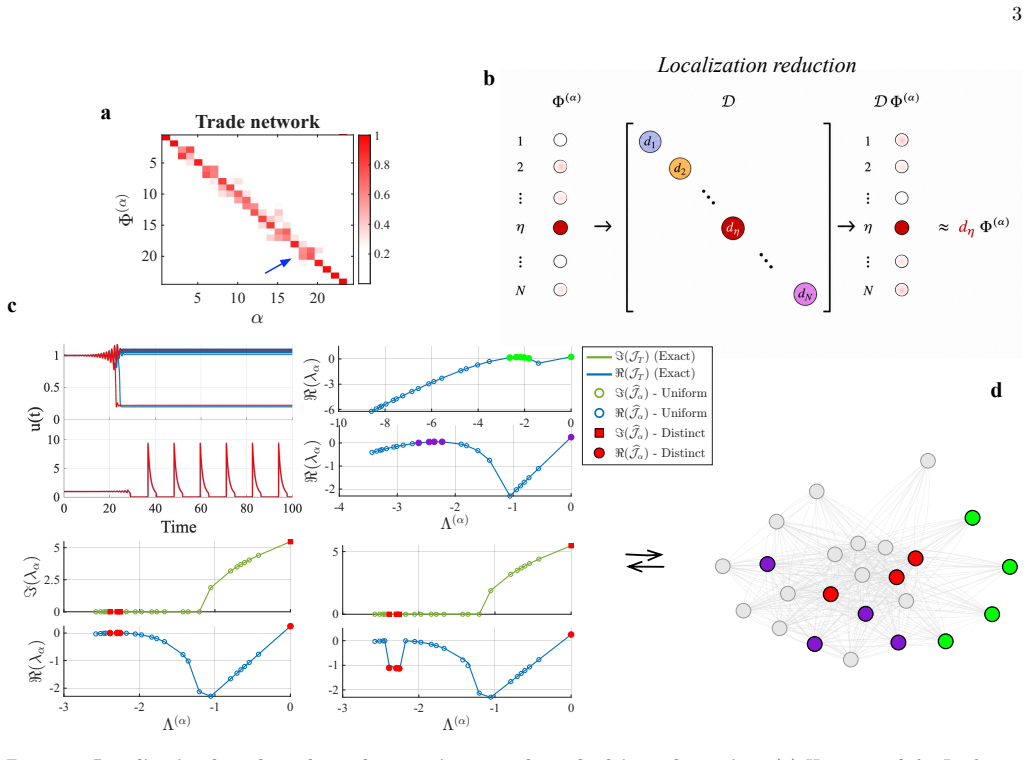
Logistic survivability As a concrete illustration of the localization reduction method for analysing dynamics in heterogeneous empirical systems, we consider the trade network shown in Fig. S3. Despite its modest size, this network already exhibits pronounced Laplacian eigenvector localization, making it a suitable testbed for the framework. To keep the d...
-
[2]
In its standard adjacency-based form, the SIS dynamics reads ˙xi =−γx i +β(1−x i) NX j=1 Aijxj, i= 1,
Distributed controlled in information spreading As a second illustration, we consider a contagion process on a network. In its standard adjacency-based form, the SIS dynamics reads ˙xi =−γx i +β(1−x i) NX j=1 Aijxj, i= 1, . . . , N,(S19) wherex i(t) denotes the activity level at nodei, interpreted for instance as infection prevalence, adoption probability...
2066
-
[3]
Newman,Networks: An Introduction(Oxford university press, 2010)
M. Newman,Networks: An Introduction(Oxford university press, 2010)
2010
-
[4]
Sugitani, Y
Y. Sugitani, Y. Zhang, and A. E. Motter, Physical review letters126, 164101 (2021)
2021
-
[5]
J. Sun, E. M. Bollt, and T. Nishikawa, EPL (Europhysics Letters)85, 60011 (2009)
2009
-
[6]
Acharyya and R
S. Acharyya and R. Amritkar, Europhysics Letters99, 40005 (2012)
2012
-
[7]
Nazerian, S
A. Nazerian, S. Panahi, and F. Sorrentino, Communications Physics6, 253 (2023)
2023
-
[8]
L. M. Pecora and T. L. Carroll, Phys. Rev. Lett.80, 2109 (1998)
1998
-
[9]
Arenas, A
A. Arenas, A. D´ ıaz-Guilera, J. Kurths, Y. Moreno, and C. Zhou, Physics Reports469, 93 (2008)
2008
-
[10]
Nakao and A
H. Nakao and A. S. Mikhailov, Nature Physics6, 544 (2010)
2010
-
[11]
Asllani, J
M. Asllani, J. D. Challenger, F. S. Pavone, L. Sacconi, and D. Fanelli, Nature Communications5, 4517 (2014)
2014
-
[12]
Diego, L
X. Diego, L. Marcon, P. M¨ uller, and J. Sharpe, Physical Review X8, 021071 (2018)
2018
-
[13]
van der Kolk, G
J. van der Kolk, G. Garc´ ıa-P´ erez, N. E. Kouvaris, M.´A. Serrano, and M. Bogu˜ n´ a, Physical Review X13, 021038 (2023)
2023
-
[14]
Panahi and F
S. Panahi and F. Sorrentino, Physical Review E104, 054314 (2021)
2021
-
[15]
Acharyya and R
S. Acharyya and R. Amritkar, Physical Review E92, 052902 (2015)
2015
-
[16]
Ricci, R
F. Ricci, R. Tonelli, L. Huang, and Y.-C. Lai, Phys. Rev. E86, 027201 (2012)
2012
-
[17]
W. Lu, B. Liu, and T. Chen, Chaos: An Interdisciplinary Journal of Nonlinear Science20, 013120 (2010)
2010
-
[18]
Belykh, V
I. Belykh, V. Belykh, K. Nevidin, and M. Hasler, Chaos: An Interdisciplinary Journal of Nonlinear Science13, 165 (2003)
2003
-
[19]
Cross and H
M. Cross and H. Greenside,Pattern Formation and Dynamics in Nonequilibrium Systems(Cambridge University Press, 2009)
2009
-
[20]
P. J. Menck, J. Heitzig, N. Marwan, and J. Kurths, Nature physics9, 89 (2013)
2013
-
[21]
Asllani, R
M. Asllani, R. Lambiotte, and T. Carletti, Sci. Adv.4, eaau9403 (2018)
2018
-
[22]
Meena, C
C. Meena, C. Hens, S. Acharyya, S. Haber, S. Boccaletti, and B. Barzel, Nature Physics19, 1033 (2023)
2023
-
[23]
Pastor-Satorras and A
R. Pastor-Satorras and A. Vespignani, Physical review letters86, 3200 (2001)
2001
-
[24]
Liu, J.-J
Y.-Y. Liu, J.-J. Slotine, and A.-L. Barab´ asi, Nature473, 167 (2011)
2011
-
[25]
P. N. McGraw and M. Menzinger, Phys. Rev. E77, 031102 (2008)
2008
-
[26]
Hata and H
S. Hata and H. Nakao, Scientific Reports7, 1121 (2017)
2017
-
[27]
Pastor-Satorras and C
R. Pastor-Satorras and C. Castellano, Scientific reports6, 18847 (2016)
2016
-
[28]
F. L. Metz and I. Neri, Physical Review Letters126, 040604 (2021)
2021
-
[29]
See Supplementary Material for extended empirical evidence and statistical analysis across a large dataset of real-world networks
-
[30]
V. N. Belykh, G. V. Osipov, V. S. Petrov, J. A. Suykens, and J. Vandewalle, Chaos: An Interdisciplinary Journal of Nonlinear Science18, 037106 (2008)
2008
-
[31]
Sorrentino, L
F. Sorrentino, L. M. Pecora, A. M. Hagerstrom, T. E. Murphy, and R. Roy, Science Advances2, e1501737 (2016)
2016
-
[32]
B. A. Siebert, C. L. Hall, J. P. Gleeson, and M. Asllani, Phys. Rev. E102, 052306 (2020)
2020
-
[33]
G. C. Sethia, A. Sen, and G. L. Johnston, Physical Review E88, 042917 (2013)
2013
-
[34]
Kuramoto and D
Y. Kuramoto and D. Battogtokh, J. Nonlin. Phenom. Complex Syst.5, 380 (2002)
2002
-
[35]
D. M. Abrams and S. H. Strogatz, Phys. Rev. Lett.93, 174102 (2004)
2004
-
[36]
M. J. Panaggio and D. M. Abrams, Nonlinearity28, R67 (2015)
2015
-
[37]
Zakharova,Chimera Patterns in Networks: Interplay between Dynamics, Structure, Noise, and Delay(2020)
A. Zakharova,Chimera Patterns in Networks: Interplay between Dynamics, Structure, Noise, and Delay(2020)
2020
-
[38]
Asllani, B
M. Asllani, B. A. Siebert, A. Arenas, and J. P. Gleeson, Chaos: An Interdisciplinary Journal of Nonlinear Science32, 013107 (2022)
2022
-
[39]
P. B. Umbanhowar, F. Melo, and H. L. Swinney, Nature382, 793 (1996)
1996
-
[40]
V. K. Vanag and I. R. Epstein, Phys. Rev. Lett.92, 128301 (2004)
2004
-
[41]
Johnson and N
S. Johnson and N. S. Jones, Proc. Natl. Acad. Sci. USA114, 5618 (2017)
2017
-
[42]
C. Duan, T. Nishikawa, D. Eroglu, and A. E. Motter, Science Advances8, eabm8310 (2022)
2022
-
[43]
Muolo, J
R. Muolo, J. D. O’Brien, T. Carletti, and M. Asllani, The European Physical Journal B97, 6 (2024)
2024
-
[44]
de Nooy, A
W. de Nooy, A. Mrvar, and V. Batagelj,Exploratory Social Network Analysis with Pajek, Structural Analysis in the Social Sciences (Cambridge University Press, 2011)
2011
-
[45]
For stationary homogeneous states, the growth exponents correspond to the eigenvalues of the local Jacobian, while for homogeneous oscillatory solutions they correspond to the Lyapunov exponents of the synchronous solution
-
[46]
Nakao, The European Physical Journal Special Topics223, 2411 (2014)
H. Nakao, The European Physical Journal Special Topics223, 2411 (2014)
2014
-
[47]
Di Patti, D
F. Di Patti, D. Fanelli, F. Miele, and T. Carletti, Communications in Nonlinear Science and Numerical Simulation56, 447 (2018)
2018
-
[48]
Asllani and A
M. Asllani and A. Arenas, Physical Review E111, 044306 (2025)
2025
-
[49]
Schmidt and D
H. Schmidt and D. Avitabile, Chaos: An Interdisciplinary Journal of Nonlinear Science30, 033133 (2020)
2020
-
[50]
Zakharova, M
A. Zakharova, M. Kapeller, and E. Sch¨ oll, Phys. Rev. Lett.112, 154101 (2014)
2014
-
[51]
Prigogine and R
I. Prigogine and R. Lefever, The Journal of Chemical Physics48, 1695 (1968)
1968
-
[52]
H. W. Kuhn, Naval research logistics quarterly2, 83 (1955)
1955
-
[53]
Munkres, Journal of the society for industrial and applied mathematics5, 32 (1957)
J. Munkres, Journal of the society for industrial and applied mathematics5, 32 (1957)
1957
-
[54]
Bota and L
M. Bota and L. W. Swanson, J. Comp. Neurol.500, 807 (2007)
2007
-
[55]
Harriger, M
L. Harriger, M. P. V. D. Heuvel, and O. Sporns, PLoS ONE7, e46497 (2012). 22
2012
-
[56]
N. T. Markov, M. Ercsey-Ravasz, C. Lamy, A. R. R. Gomes, L. Magrou, P. Misery, P. Giroud, P. Barone, C. Dehay, Z. Toroczkai,et al., Proc. Natl. Acad. Sci. USA110, 5187 (2013)
2013
-
[57]
R. M. Ewing, P. Chu, F. Elisma, H. Li, P. Taylor, S. Climie, L. McBroom-Cerajewski, M. D. Robinson, L. O’Connor, M. Li,et al., Mol. Syst. Biol.3, 89 (2007)
2007
-
[58]
Clutton-Brock, P
T. Clutton-Brock, P. Greenwood, and R. Powell, Z. Tierpsychol.41, 202 (1976)
1976
-
[59]
R. M. Thompson and C. Townsend, Ecology84, 145 (2003)
2003
-
[60]
J. A. Dunne, K. D. Lafferty, A. P. Dobson, R. F. Hechinger, A. M. Kuris, N. D. Martinez, J. P. McLaughlin, K. N. Mouritsen, R. Poulin, K. Reise,et al., PLoS Biol.11, e1001579 (2013)
2013
-
[61]
Ekl¨ of, U
A. Ekl¨ of, U. Jacob, J. Kopp, J. Bosch, R. Castro-Urgal, N. P. Chacoff, B. Dalsgaard, C. de Sassi, M. Galetti, P. R. Guimar˜ aes,et al., Ecol. Lett.16, 577 (2013)
2013
-
[62]
Garfield, Index of citation networks produced by analyses from the software histcite, http://www.garfield.library.upenn.edu/histcomp/index.html
E. Garfield, Index of citation networks produced by analyses from the software histcite, http://www.garfield.library.upenn.edu/histcomp/index.html
-
[63]
Opsahl and P
T. Opsahl and P. Panzarasa, Social Networks31, 155 (2009)
2009
-
[64]
Transportation Networks for Research Core Team, Transportation networks for research, https://github.com/bstabler/TransportationNetworks
-
[65]
J. D. Murray,Mathematical biology, 3rd ed., Interdisciplinary applied mathematics (Springer, New York, 2002)
2002
-
[66]
Mimura and J
M. Mimura and J. Murray, Journal of Theoretical Biology75, 249 (1978)
1978
-
[67]
L. A. Adamic and N. Glance,The Political Blogosphere and the 2004 U.S. Election: Divided They Blog(ACM Press, New York, NY, 2005)
2004
-
[68]
Kunegis, Dnc emails co-recipients, kONECT, the Koblenz Network Collection (2016), https://networks.skewed.de/net/dnc
J. Kunegis, Dnc emails co-recipients, kONECT, the Koblenz Network Collection (2016), https://networks.skewed.de/net/dnc
2016
-
[69]
R. Milo, S. Itzkovitz, N. Kashtan, R. Levitt, S. Shen-Orr, I. Ayzenshtat, M. Sheffer, and U. Alon, Science303, 1538 (2004)
2004
-
[70]
Johnson, Network data repository from various sources, https://www.samuel-johnson.org/data
S. Johnson, Network data repository from various sources, https://www.samuel-johnson.org/data
-
[71]
M. J. Williams and M. Musolesi, Royal Society Open Science3, 160196 (2016)
2016
-
[72]
Opsahl, F
T. Opsahl, F. Agneessens, and J. Skvoretz, Soc. Networks32, 245 (2010)
2010
-
[73]
Demetrescu, 9th dimacs implementation challenge - shortest paths, http://archive.dimacs.rutgers.edu/Workshops/Challenge9/
C. Demetrescu, 9th dimacs implementation challenge - shortest paths, http://archive.dimacs.rutgers.edu/Workshops/Challenge9/
-
[74]
Munoz-Mendez, K
F. Munoz-Mendez, K. Han, K. Klemmer, and S. Jarvis,Community Structures, Interactions and Dynamics in London’s Bicycle Sharing Network(ACM Press, New York, NY, 2018)
2018
-
[75]
L. J. LeBlanc, E. K. Morlok, and W. P. Pierskalla, Transportation Research9, 309 (1975)
1975
-
[76]
Schubert, Scientometrics53, 3 (2002)
A. Schubert, Scientometrics53, 3 (2002)
2002
-
[77]
N. P. Hummon and P. Dereian, Social Networks11, 39 (1989)
1989
-
[78]
Yodzis, J
P. Yodzis, J. Anim. Ecol.67, 635 (1998)
1998
-
[79]
R. M. Thompson and A. R. Mcintosh, Ecol Lett.1, 200 (1998)
1998
-
[80]
Havens, Science257, 1107 (1992)
K. Havens, Science257, 1107 (1992)
1992
discussion (0)
Sign in with ORCID, Apple, or X to comment. Anyone can read and Pith papers without signing in.