REVIEW 46 references
Quantum Twin Interferometers
T0 review · reviewed 2026-08-10 · deepseek-v4-flash
Pith's one-line read A quantum twin interferometer, built from two parallel pairs of entangled twin beams, reports 3 dB quantum noise reduction in phase sensing at milliwatt-scale power and a signal-to-noise ratio three orders of magnitude beyond earlier…
desk verdict Real 3 dB sub-shot-noise phase sensing at 400 µW, but the quantitative theory is tied to an attenuation-weighted observable that the main text never says was implemented. read the letter →
The pith
A machine-rendered reading of the paper's core claim, the machinery that carries it, and where it could break.
The reading
What carries the argument
The central object is the quantum twin interferometer: two parallel four-wave-mixing-based parametric amplifiers whose signal and idler outputs are separately combined at beam splitters and detected by balanced differential detectors, with the readout formed from the two differential currents ($I_1+I_2$, or with loss equalization, the weighted sum $\eta I_1+I_2$ with $\eta$ chosen from the loss parameters). This entangled detection exploits the correlation between the two reference beams: the signal terms add coherently while the vacuum and thermal noise contributions combine with opposite signs at the $\varphi_1=\varphi_2=\pi/2$ operating point. The formula that carries the argument is the SNR expression for $\zeta_{\mathrm{QTI}}$ together with the loss-included version (Supplementary Eq. S42) used to fit the measured traces.
What would settle it
Re-run the SNR comparison at the same $I_{\mathrm{ps}}=400\,\mu$W and gain $G_q=3$ with the loss-equalization attenuation removed, so the readout is the raw sum $\hat{I}_1+\hat{I}_2$: if the noise floor remains 3.5 dB below the classical Mach-Zehnder level, the model's loss equalization is not the source of the enhancement; if the enhancement disappears, the fitted-loss model is confirmed. A second observation is the SNR at deliberately imbalanced seed powers $R\ne 1/2$, which the theory predicts to degrade continuously toward the truncated SU(1,1) limit.
Extended reading notes
Core claim
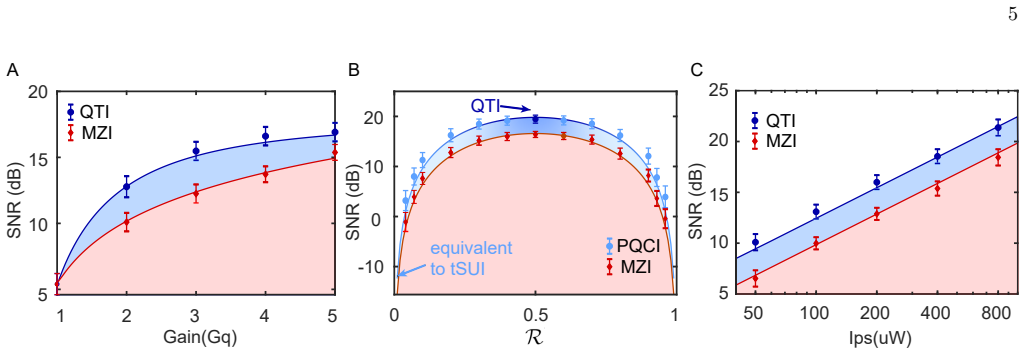
The central claim is that a pair of independently pumped parametric amplifiers, arranged in parallel rather than cascaded, can serve as a loss-tolerant photon-correlated interferometer whose readout does not require a strong classical local oscillator. Writing the output as the sum of the two differential currents $I = I_1 + I_2$, the authors derive the signal-to-noise ratio $\zeta_{\mathrm{QTI}} = [\cosh^2(s)\delta\varphi_1 + \sinh^2(s)\delta\varphi_2]^2 \alpha^2$ in the lossless balanced case, achieving its optimum when the seed powers are equal ($R=1/2$). With equal seed powers the phase-sensing power is $I_{\mathrm{ps}} = \cosh(2s)\alpha^2/2$, and at a gain $G_q=\cosh^2(s)=3$ the measured noise floor sits about 3.5 dB below the shot-noise level of a classical Mach-Zehnder interferometer with the same $I_{\mathrm{ps}} = 400\,\mu$W, giving an SNR improvement of 3 dB for a 2 MHz phase signal. The authors state this advances the SNR record for photon-correlated interferometers by three orders of magnitude and that, in the limit of few seed photons, the sensitivity can approach the Heisenberg scaling $\delta\varphi_{\mathrm{HL}}=1/I_{\mathrm{ps}}$.
Load-bearing premise
The 3 dB claim stands on the assumption that the measured output is the loss-equalized weighted sum $\eta \hat{I}_1 + \hat{I}_2$ with the attenuation factor derived from the fitted loss parameters; if the raw sum $\hat{I}_1 + \hat{I}_2$ is what the electronics actually produced, the SNR formula that yields the enhancement would not describe the data.
Editorial extensions
If this is right
- A Mach-Zehnder-class interferometer can be made quantum-enhanced without a squeezed vacuum injection port; both inputs are entangled twin beams.
- Because the readout is a sum of two balanced differential detections, the method avoids the high-power local oscillator and mode-matching overheads of homodyne-based truncated SU(1,1) interferometry.
- The 3 dB SNR gain persists as phase-sensing power approaches milliwatts, so quantum-enhanced phase sensing is not confined to sub-µW probe powers.
- In the few-photon seed limit the theoretical sensitivity approaches Heisenberg scaling, $\delta\varphi_{\mathrm{HL}} = 1/I_{\mathrm{ps}}$.
- The same architecture supports distributed phase sensing, since signals appearing as a common-mode phase $\delta\varphi_1=\delta\varphi_2$ combine constructively in the output.
Reading between the lines
- An immediate corollary the authors leave implicit: for a fixed target SNR, the QTI needs only half the phase-sensing power of a classical Mach-Zehnder interferometer at the same signal, a 3 dB power saving that is independent of the three-orders-of-magnitude increase in accessible power.
- Because the theory predicts the quantum advantage persists across all seed-power ratios $R$, with $R\to 0$ continuously degrading into the truncated SU(1,1) configuration, the same tabletop setup can serve as a tunable benchmark for how much quantum enhancement a given loss budget permits.
- If the loss-equalization formula is robust, the architecture could be transferred to other nonlinear media by calibrating the two loss factors; the main practical task is stabilizing the electrical attenuation $\eta$ against drift, since the quoted SNR is computed at a fixed set of fitted losses.
Signed reviews
Editorial analysis
A structured set of objections, weighed in public.
Circularity Check
No load-bearing circularity: the QTI SNR formulas are derived from standard linear input-output relations and the 3 dB enhancement is a direct in-loop measurement; the fitted loss model and observable mismatch are correctness concerns, not circularity.
full rationale
The central derivation chain (Supplementary Eqs. S3-S22) starts from the FWM interaction Hamiltonian and linear beam-splitter/PA transformations and obtains the PQCI SNR algebraically. The main-text Eq. 4 and Supplementary Eq. S22 agree in the lossless limit, and these formulas are not constructed from the measured SNR values. The 3 dB figure is an experimental comparison: Fig. 3B shows QTI and MZI noise traces at the same Ips, and Fig. 3C reports directly measured SNR values of 15.5 dB (MZI) and 18.5 dB (QTI), so the enhancement does not reduce to a fitted parameter or a self-citation. The loss model in Supplementary Text III is explicitly fitted ("Eq. S42 and Eq. S43 are used in fitting to the measured data... The optimal fitting parameters are..."), and the paper does not relabel this fit as a prediction. The only flagged concern is internal consistency: the main text says "The AC parts of the differential currents are summed," while Text III models the output as eta*I1 + I2 with an attenuation eta introduced to equalize losses; these two observables give different lossless-limit SNR expressions. This is a completeness/credibility issue about which observable was measured and whether the fitted loss parameters apply, not a circular derivation. Self-citations ([22,25,32,41]) are used for comparison and context, not as the load-bearing justification of the QTI result. No step in the paper defines the predicted quantity in terms of the measured output or imports an unverified uniqueness theorem from the authors' prior work.
Assumptions & free parameters
free parameters (6)
- kappa_s (signal-arm optical loss) =
0.2
- kappa_i (idler-arm optical loss) =
0.1
- sigma_s (signal mode-mismatch loss) =
0.03
- sigma_i (idler mode-mismatch loss) =
0.02
- Gq (parametric gain, cosh^2(s)) =
3
- Electrical attenuation eta =
sinh(s)(1-sigma_i)(1-kappa_i)/(cosh(s)(1-sigma_s)(1-kappa_s))
assumptions (4)
- domain assumption Two-mode squeezing Hamiltonian H_n = i*hbar*xi*a_dagger_n*b_dagger_n + h.c. describes each FWM process (Eq. 1).
- domain assumption The two PAs are independent and identical for QTI (s1=s2=s, R=1/2).
- ad hoc to paper Mode-mismatch and optical losses are modeled by vacuum and thermal noise operators with <delta^2 X_Lst> = <delta^2 X_Lit> = e^{2s}.
- domain assumption The phase is locked at the operating point phi10 = phi20 = pi/2 by PID feedback.
Cite this review
Pith. "Pith review of Quantum Twin Interferometers." pith.science (2026). https://pith.science/paper/HI6E6FMV
@misc{pith2026250104244,
  author       = {Pith},
  title        = {Pith review of: Quantum Twin Interferometers},
  year         = {2026},
  howpublished = {\url{https://pith.science/paper/HI6E6FMV}},
  note         = {Machine review of arXiv:2501.04244}
}
read the original abstract
Quantum-correlated interferometer is a newly emerging tool in quantum technology that offers classical-limit-breaking phase sensitivity. But to date, there exists a configurational bottleneck for its practicability due to the low phase-sensitive photon numbers limited by the current detection strategies. Here we establish an innovative development termed as ``quantum twin interferometer'' with dual pairs of entangled twin beams arranged in the parallel configuration, allowing fully exploits the quantum resource through the new configuration of entangled detection. We observe the distributed phase sensing with 3 dB quantum noise reduction in phase-sensing power at the level of milliwatts, which advances the record of signal-to-noise ratio so far achieved in photon-correlated interferometers by three orders of magnitude. The developed techniques in this work can be used to revolutionize a diversity of quantum devices requiring phase measurement.
Figures


Figures from the paper (4 more)


Reference graph
Works this paper leans on
-
[1]
R. E. Slusher, Rev. Mod. Phys. 71, S471 (1999)
work page 1999
-
[2]
Pezz` e, A
L. Pezz` e, A. Smerzi, M. K. Oberthaler, R. Schmied, and P. Treutlein, Rev. Mod. Phys. 90, 035005 (2018)
2018
- [3]
- [4]
-
[5]
Budker and M
D. Budker and M. Romalis, Nat. Phys. 3, 227 (2007)
2007
-
[6]
S. Wu, D. Zhang, Z. Li, M. Shi, P. Yang, J. Guo, W. Du, G. Bao, and W. Zhang, Phys. Rev. Appl. 20, 064028 (2023)
work page 2023
-
[7]
K. S. Thorne, Rev. Mod. Phys. 52, 285 (1980)
work page 1980
-
[8]
B. P. Abbott, R. Abbott, T. Abbott, M. Abernathy, F. Acernese, K. Ackley, C. Adams, T. Adams, P. Ad- desso, R. X. Adhikari, et al., Phys. Rev. Lett. 116, 061102 (2016)
work page 2016
Show all 46 references
-
[9]
C. M. Caves, Phys. Rev. D 23, 1693 (1981)
1981
-
[10]
D. F. Walls, Nature 306, 141 (1983)
1983
-
[11]
L.-A. Wu, H. J. Kimble, J. L. Hall, and H. Wu, Phys. Rev. Lett. 57, 2520 (1986)
1986
-
[12]
Slusher, L
R. Slusher, L. Hollberg, B. Yurke, J. Mertz, and J. Val- ley, Phys. Rev. Lett. 55, 2409 (1985)
1985
-
[13]
Vahlbruch, M
H. Vahlbruch, M. Mehmet, K. Danzmann, and R. Schn- abel, Phys. Rev. Lett. 117, 110801 (2016)
2016
-
[14]
Xiao, L.-A
M. Xiao, L.-A. Wu, and H. J. Kimble, Phys. Rev. Lett. 59, 278 (1987)
1987
-
[15]
M. J. Holland and K. Burnett, Phys. Rev. Lett. 71, 1355 6 (1993)
1993
-
[16]
M. W. Mitchell, J. S. Lundeen, and A. M. Steinberg, Nature 429, 161 (2004)
2004
-
[17]
Aasi et al., Nat
J. Aasi et al., Nat. Phys. 7, 962 (2011)
2011
-
[18]
J. Aasi, J. Abadie, B. Abbott, R. Abbott, T. Abbott, M. Abernathy, C. Adams, T. Adams, P. Addesso, R. Ad- hikari, et al., Nat. Photonics. 7, 613 (2013)
2013
-
[19]
M. Tse, H. Yu, N. Kijbunchoo, A. Fernandez-Galiana, P. Dupej, L. Barsotti, C. Blair, D. Brown, S. Dwyer, A. Effler, et al., Phys. Rev. Lett. 123, 231107 (2019)
2019
-
[20]
Yurke, S
B. Yurke, S. L. McCall, and J. R. Klauder, Phys. Rev. A 33, 4033 (1986)
1986
-
[21]
W. N. Plick, J. P. Dowling, and G. S. Agarwal, New J. Phys. 12, 083014 (2010)
2010
-
[22]
Hudelist, J
F. Hudelist, J. Kong, C. Liu, J. Jing, Z. Ou, and W. Zhang, Nat. Commun. 5, 3049 (2014)
2014
-
[23]
Manceau, G
M. Manceau, G. Leuchs, F. Khalili, and M. Chekhova, Phys. Rev. Lett. 119, 223604 (2017)
2017
-
[24]
Y. Liu, N. Huo, J. Li, L. Cui, X. Li, and Z. J. Ou, Opt. Express 27, 11292 (2019)
2019
-
[25]
W. Du, J. Kong, G. Bao, P. Yang, J. Jia, S. Ming, C.-H. Yuan, J. Chen, Z. Ou, M. W. Mitchell, and W. Zhang, Phys. Rev. Lett. 128, 033601 (2022)
2022
-
[26]
B. Chen, C. Qiu, S. Chen, J. Guo, L. Chen, Z. Ou, and W. Zhang, Phys. Rev. Lett. 115, 043602 (2015)
2015
-
[27]
Gross, T
C. Gross, T. Zibold, E. Nicklas, J. Esteve, and M. K. Oberthaler, Nature 464, 1165 (2010)
2010
-
[28]
Linnemann, H
D. Linnemann, H. Strobel, W. Muessel, J. Schulz, R. J. Lewis-Swan, K. V. Kheruntsyan, and M. K. Oberthaler, Phys. Rev. Lett. 117, 013001 (2016)
2016
-
[29]
Liu, L.-N
Q. Liu, L.-N. Wu, J.-H. Cao, T.-W. Mao, X.-W. Li, S.-F. Guo, M. K. Tey, and L. You, Nat. Phys. 18, 167 (2022)
2022
-
[30]
A. M. Marino, N. Corzo Trejo, and P. D. Lett, Phys. Rev. A 86, 023844 (2012)
2012
-
[31]
R. C. Pooser, A. M. Marino, V. Boyer, K. M. Jones, and P. D. Lett, Opt. Express 17, 16722 (2009)
2009
-
[32]
B. E. Anderson, P. Gupta, B. L. Schmittberger, T. Hor- rom, C. Hermann-Avigliano, K. M. Jones, and P. D. Lett, Optica 4, 752 (2017)
2017
-
[33]
B. E. Anderson, B. L. Schmittberger, P. Gupta, K. M. Jones, and P. D. Lett, Phys. Rev. A 95, 063843 (2017)
2017
-
[34]
M. A. Taylor and W. P. Bowen, Phys. Rep.615, 1 (2016)
2016
-
[35]
Pooser, N
R. Pooser, N. Savino, E. Batson, J. Beckey, J. Garcia, and B. Lawrie, Phys. Rev. Lett. 124, 230504 (2020)
2020
-
[36]
C. A. Casacio, L. S. Madsen, A. Terrasson, M. Waleed, K. Barnscheidt, B. Hage, M. A. Taylor, and W. P. Bowen, Nature 594, 201 (2021)
2021
-
[37]
C. H. Camp Jr and M. T. Cicerone, Nat. Photonics. 9, 295 (2015)
2015
-
[38]
P. P. Laissue, R. A. Alghamdi, P. Tomancak, E. G. Rey- naud, and H. Shroff, Nat. Methods 14, 657 (2017)
2017
-
[39]
Z. Zhou, L. E. de Araujo, M. DiMario, B. Anderson, J. Zhao, K. M. Jones, and P. D. Lett, Optica Quantum 1, 71 (2023)
2023
-
[40]
Y. Liu, J. Li, L. Cui, N. Huo, S. M. Assad, X. Li, and Z. Ou, Opt. Express 26, 27705 (2018)
2018
-
[41]
X. Zuo, Z. Yan, Y. Feng, J. Ma, X. Jia, C. Xie, and K. Peng, Phys. Rev. Lett. 124, 173602 (2020)
2020
-
[42]
McCormick, A
C. McCormick, A. M. Marino, V. Boyer, and P. D. Lett, Phys. Rev. A 78, 043816 (2008)
2008
-
[43]
W. Du, J. Jia, J. Chen, Z. Ou, and W. Zhang, Opt. Lett. 43, 1051 (2018)
2018
-
[44]
Gupta, R
P. Gupta, R. W. Speirs, K. M. Jones, and P. D. Lett, Opt. Express 28, 652 (2020)
2020
-
[45]
Michael, L
Y. Michael, L. Bello, M. Rosenbluh, and A. Pe’er, Npj Quantum Inf. 5, 81 (2019)
2019
-
[46]
(1 − σs) r κs(1 − κs) 2 ˆXLsv(−π/2) + p σs(1 − κs)(1 − σs) ˆXLst(0) # − sinh(s)α
C. A. Casacio, L. S. Madsen, A. Terrasson, M. Waleed, K. Barnscheidt, B. Hage, M. A. Taylor, and W. P. Bowen, Nature 594, 201 (2021). ACKNOWLEDGMENTS F unding: This work was supported by the Innova- tion Program for Quantum Science and Technology (2021ZD0303200), the National ...
2021
Reviewed August 10, 2026 · model on record in the stance chip above.
Discussion (0). Continue with ORCID to comment.