REVIEW 3 major objections 6 minor 80 references
SimSpark: Interactive Simulation of Social Media Behaviors
T0 review · 3 major / 6 minor · reviewed 2026-08-07 · deepseek-v4-flash
Pith's one-line read The paper claims that SimSpark, an interactive LLM-powered system, generates social media behavior that human judges misclassify as real 43.34% of the time, near the 50% chance level, and that this full workflow significantly outperforms…
desk verdict The system and interface are genuinely useful, but the paper's central comparative claim collapses once you check Table 3 against Table 2. read the letter →
The pith
A machine-rendered reading of the paper's core claim, the machinery that carries it, and where it could break.
The reading
What carries the argument
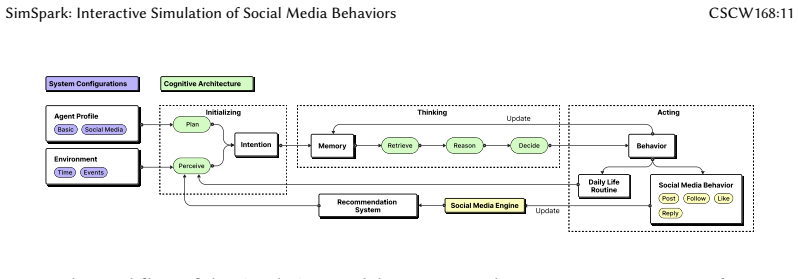
The cognitive architecture, adapted from generative-agent planning with a memory system and retrieve-reason-decide modules, is the load-bearing mechanism that produces both actions and their stated reasons. Its work is to keep each agent's behavior consistent across daily life and social media, and the ablation study shows that removing either the daily-life layer or the social-habits layer makes agents detectably non-human.
What would settle it
Present the same simulated text logs alongside real timelines, images, and platform context in a blind test with a larger and more diverse panel, and check whether misclassification rates drop well below the reported 43.34 percent.
Extended reading notes
Core claim
The paper claims that believable social media behavior comes from a three-part simulation workflow: system configuration (agent demographics and social habits), a social media engine with an LLM-scored recommendation mechanism, and a cognitive architecture that makes agents perceive, retrieve memories, reason, decide, and act. Because agents first live out ordinary daily routines and are given stable posting and engagement habits, their posts and interactions stay consistent with their identities. The 43.34% misclassification rate in the Real vs. Agents experiment, significantly above the ablated conditions, is presented as evidence that the generated behaviors are hard to distinguish from real text-posting users.
Load-bearing premise
The believability claim rests on treating 20 recruited text-posting users aged 18 to 28, along with their self-reported reasons, as a fair stand-in for real human social media behavior when the comparison strips away images, real timelines, and platform context.
Editorial extensions
If this is right
- Researchers can test hypotheses about social media dynamics, such as reactions to public events or the spread of promotional content, in a controlled and replicable environment without real user data.
- The system outputs a reasoning trace for every action and for every decision not to act, giving analysts an interpretable check on whether an agent's behavior matches its profile.
- The two case studies (football-match outcomes and targeted product promotion) demonstrate scenario-conditional behavioral shifts that align with prior empirical work on passion and affect.
- The ablation results imply that simpler LLM-agent setups, which skip daily life or social-habit configuration, produce more detectable and less believable social media behavior.
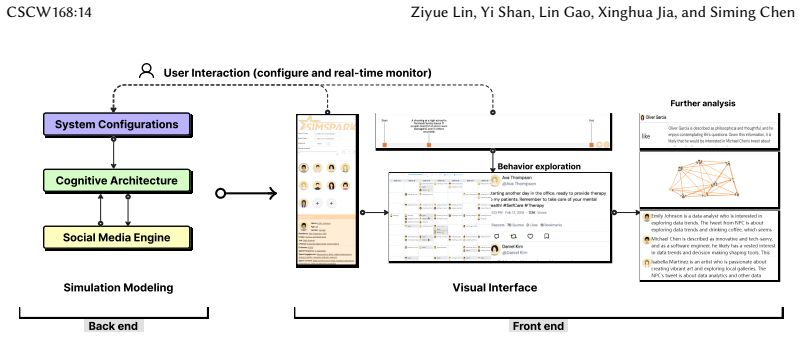
- Natural-language configuration and real-time parameter adjustment make the system accessible to researchers without programming skills.
Reading between the lines
- The believability measurement compares text-only logs and self-reported reasons; in a realistic deployment with images, full timelines, and platform context, error rates could be lower, so the 43.34% figure is best read as an upper bound on indistinguishability.
- A natural next test is feeding the same simulated logs to automated bot detectors; human-believable outputs might still be trivially classified by computational detectors, which would refine the claim about evading detection.
- The emphasis on recording reasons for abstention (decide-not-to-do) is a promising extension for studying why users ignore content, such as why rumors fail to spread.
- The reliance on a single LLM backend leaves open whether the results transfer to cheaper or open-weights models, which would matter for scalability.
Editorial analysis
A structured set of objections, weighed in public.
Referee Report
Summary. SimSpark is an interactive system for creating small text-only simulated social media platforms. It combines an LLM-driven cognitive architecture with a social media engine (posting, liking, following, replying, and a recommendation mechanism), customizable agent profiles, and a visual interface for parameter control, process monitoring, and result exploration. The evaluation consists of two case studies, an expert interview study, and a human classification experiment in which participants tried to distinguish real users from simulated agents; the full simulation produced a reported 43.34% mean misclassification rate, and pairwise ANOVA results are reported as showing significantly higher error rates than two ablated versions. The paper claims that the system generates believable social media behaviors and provides a flexible, interpretable testbed for social media researchers and stakeholders.
Significance. If its central quantitative claim were properly supported, SimSpark would be a useful contribution to CSCW/HCI: it addresses data-access and ethics problems, supports controlled scenario generation, and grounds its workflow in social bot detection and generative-agent literature. The system design is thoughtful, and the qualitative evaluation with experts and case studies is informative. However, the main quantitative evidence is currently not trustworthy as reported: the test statistics in Table 3 are inconsistent with the descriptive statistics in Table 2, and the study lacks a direct comparison with prior simulation systems and a representative human baseline. The believability claim therefore needs substantial statistical and methodological repair before the paper's main contribution is established.
major comments (3)
- [Section 6.2.3, Tables 2 and 3] The reported ANOVA results are internally inconsistent with the reported means and standard deviations. For Experiment 1 vs. Experiment 2, assuming per-participant error rates with n=25 per group, the mean difference of 11.68 percentage points with standard deviations 5.4 and 3.6 yields a two-sample t-ratio of approximately 9.0 and F of approximately 81, not F=3.25; moreover, the stated p=0.034 does not correspond to F=3.25 for a two-group comparison (p is approximately 0.078). Similar discrepancies affect Experiment 1 vs. Experiment 3 and Experiment 2 vs. Experiment 3. Because raw per-participant data are not provided, the reader cannot determine which numbers are correct. This undermines the load-bearing claim that the full workflow yields significantly more believable behavior than the ablations; the 43.34% near-chance rate alone is a single-arm descriptive result that does not distinguish the full pipeline from simpler LLM-based generation. Please supply raw data or corrected statistics, including confidence intervals and effect sizes.
- [Sections 6.2.1 and 6.2.3] The believability result depends on the representativeness of the human baseline. The 20 real users were volunteers aged 18-28 who were selected partly for inclination to publish textual content, and participants saw anonymized two-day behavior summaries with self-reported reasons, stripped of images, full timelines, and platform context. This design may inflate error rates relative to realistic deployment, and the paper does not report any calibration of the baseline (for example, how often participants correctly identify real users as real). Please discuss this threat to external validity and ideally test it directly, for example with real-vs-real catch trials or a broader and more diverse sample.
- [Section 6.2.4] The conclusion that existing frameworks [53,54] 'without targeted modifications' would fall short is not supported by the experiments, because the ablation conditions are variations of SimSpark's own pipeline, not implementations of those prior systems. A direct comparison with Social Simulacra or another appropriate LLM-only baseline is needed before making that comparative claim, or the claim should be substantially softened.
minor comments (6)
- [Introduction] The word 'Thrid' in Section 1 should be 'Third'.
- [Figure 1 caption and Section 5.2.2] 'Calender View' should be 'Calendar View'; the same typo appears in the interface description.
- [Section 6.3.3] The phrase 'closely aligned with genius users' should presumably read 'genuine users'.
- [Section 6.2.2] The power analysis is reported only as alpha and power; the assumed effect size, software, and resulting target sample size should be stated.
- [Section 4.2 and Section 6.2] The recommendation threshold is user-configurable, but the paper does not report which threshold was used in the user study or whether results are sensitive to this choice; please specify the experimental settings.
- [General] No link to code or de-identified experimental data is provided; making these available would improve reproducibility and would have allowed verification of the statistical results.
Circularity Check
No significant circularity: the believability claim rests on external human judges, and no parameter is fitted to the evaluation outcome.
full rationale
SimSpark's central claim—that full-workflow outputs are hard to distinguish from real user behavior—is evaluated by 75 external human judges in a forced-choice classification task, with error rates as the dependent measure. No simulation parameter is fitted to those error rates, and no quantity used in the workflow is defined in terms of the evaluation outcome. The workflow design (system configuration, social-media engine, cognitive architecture) is justified by external bot-detection literature [13,17] and by prior LLM-agent work [53,54], none of which is authored by the present paper's authors; there are no load-bearing self-citations. The ablation comparison (full vs. no-daily-life vs. no-social-habits) is also an externally judged comparison, not a fitted quantity renamed as a prediction. The fact that the same LLM produces both agent behaviors and the 'Reasoning' text shown to judges is a potential validity threat (shared-source cues), but it is not circularity: human judgments remain an outside benchmark. The ANOVA numbers in Table 3 appear internally inconsistent with Table 2 as reported (the F-to-p mapping and the implied t-statistics do not match), but inconsistency is a correctness/statistical-reporting problem, not a definitional or self-citation reduction. Under the hard rule that circularity requires an exhibited Eq-X-equals-Eq-Y reduction or a fitted-input-renamed-as-prediction step, no such step exists in this paper.
Assumptions & free parameters
free parameters (3)
- Recommendation threshold =
Not reported in paper
- Memory retrieval weights =
Not specified
- Simulation interval and event settings =
Not fully specified for user study
assumptions (5)
- domain assumption GPT-4 produces sufficiently coherent, contextually appropriate social media text and reasoning for the simulated agents.
- domain assumption Generative-agents cognitive architecture (Park et al. 2023) transfers to social media behavior simulation.
- domain assumption Chain-of-thought prompting improves output controllability and produces explanations that correspond to the real decision process.
- domain assumption Design choices inspired by bot-detection features (user metadata, content style, network interactions) make agents believable.
- domain assumption Human inability to distinguish agents from real users is a valid operational measure of believability.
invented entities (3)
-
Sparkle
-
Spark
-
NPC/KOL agents
Cite this review
Pith. "Pith review of SimSpark: Interactive Simulation of Social Media Behaviors." pith.science (2026). https://pith.science/paper/HIH3FVGD
@misc{pith2026250614476,
  author       = {Pith},
  title        = {Pith review of: SimSpark: Interactive Simulation of Social Media Behaviors},
  year         = {2026},
  howpublished = {\url{https://pith.science/paper/HIH3FVGD}},
  note         = {Machine review of arXiv:2506.14476}
}
read the original abstract
Understanding user behaviors on social media has garnered significant scholarly attention, enhancing our comprehension of how virtual platforms impact society and empowering decision-makers. Simulating social media behaviors provides a robust tool for capturing the patterns of social media behaviors, testing hypotheses, and predicting the effects of various interventions, ultimately contributing to a deeper understanding of social media environments. Moreover, it can overcome difficulties associated with utilizing real data for analysis, such as data accessibility issues, ethical concerns, and the complexity of processing large and heterogeneous datasets. However, researchers and stakeholders need more flexible platforms to investigate different user behaviors by simulating different scenarios and characters, which is not possible yet. Therefore, this paper introduces SimSpark, an interactive system including simulation algorithms and interactive visual interfaces which is capable of creating small simulated social media platforms with customizable characters and social environments. We address three key challenges: generating believable behaviors, validating simulation results, and supporting interactive control for generation and results analysis. A simulation workflow is introduced to generate believable behaviors of agents by utilizing large language models. A visual interface enables real-time parameter adjustment and process monitoring for customizing generation settings. A set of visualizations and interactions are also designed to display the models' outputs for further analysis. Effectiveness is evaluated through case studies, quantitative simulation model assessments, and expert interviews.
Figures

Figures from the paper (4 more)


Reference graph
Works this paper leans on
-
[1]
Seyed Ali Alhosseini, Raad Bin Tareaf, Pejman Najafi, and Christoph Meinel. 2019. Detect Me If You Can: Spam Bot Detection Using Inductive Representation Learning. In Companion Proceedings of The 2019 World Wide Web Conference (San Francisco, USA) (WWW ’19). Association for Computing Machinery, New York, NY , USA, 148–153. doi:10.1145/3308560.3316504
-
[2]
Steven C. Bankes. 2002. Agent-based modeling: A revolution? Proceedings of the National Academy of Sciences 99, suppl_3 (2002), 7199–7200. doi:10.1073/pnas.072081299 arXiv:https://www.pnas.org/doi/pdf/10.1073/pnas.072081299
-
[3]
Joseph Bates et al. 1994. The role of emotion in believable agents. Commun. ACM 37, 7 (1994), 122–125
work page 1994
-
[4]
Hudson, Ehsan Adeli, Russ Altman, Simran Arora, Sydney von Arx, Michael S
Rishi Bommasani, Drew A. Hudson, Ehsan Adeli, Russ Altman, Simran Arora, Sydney von Arx, Michael S. Bernstein, Jeannette Bohg, Antoine Bosselut, Emma Brunskill, Erik Brynjolfsson, Shyamal Buch, Dallas Card, Rodrigo Castellon, Niladri Chatterji, Annie Chen, Kathleen Creel, Jared Quincy Davis, Dora Demszky, Chris Donahue, Moussa Doumbouya, Esin Durmus, Stef...
arXiv 2022
-
[5]
Michael Brenner. 2010. Creating Dynamic Story Plots with Continual Multiagent Planning. Proceedings of the AAAI Conference on Artificial Intelligence 24, 1 (July 2010), 1517–1522. doi:10.1609/aaai.v24i1.7567
-
[6]
Brooks, Cynthia Breazeal, Matthew Marjanovi´c, Brian Scassellati, and Matthew M
Rodney A. Brooks, Cynthia Breazeal, Matthew Marjanovi´c, Brian Scassellati, and Matthew M. Williamson. 1999. The Cog Project: Building a Humanoid Robot. In Computation for Metaphors, Analogy, and Agents, Chrystopher L. Nehaniv (Ed.). Springer Berlin Heidelberg, Berlin, Heidelberg, 52–87
work page 1999
-
[7]
Tom Brown, Benjamin Mann, Nick Ryder, Melanie Subbiah, Jared D Kaplan, Prafulla Dhariwal, Arvind Neelakantan, Pranav Shyam, Girish Sastry, Amanda Askell, Sandhini Agarwal, Ariel Herbert-V oss, Gretchen Krueger, Tom Henighan, Rewon Child, Aditya Ramesh, Daniel Ziegler, Jeffrey Wu, Clemens Winter, Chris Hesse, Mark Chen, Eric Sigler, Mateusz Litwin, Scott G...
work page 2020
-
[8]
Lucy H. Butler, Padraig Lamont, Dean Law Yim Wan, Toby Prike, Mehwish Nasim, Bradley Walker, Nicolas Fay, and Ullrich K. H. Ecker. 2024. The (Mis)Information Game: A social media simulator. Behavior Research Methods 56, 3 (March 2024), 2376–2397. doi:10.3758/s13428-023-02153-x Proc. ACM Hum.-Comput. Interact., V ol. 9, No. 2, Article CSCW168. Publication ...
Show all 80 references
-
[9]
Martin, Daphne Ippolito, Suma Bailis, and David Reitter
Chris Callison-Burch, Gaurav Singh Tomar, Lara J. Martin, Daphne Ippolito, Suma Bailis, and David Reitter. 2022. Dungeons and Dragons as a Dialog Challenge for Artificial Intelligence. arXiv:2210.07109 [cs.CL]
2022 arXiv
-
[10]
Carley, D.B
K.M. Carley, D.B. Fridsma, E. Casman, A. Yahja, N. Altman, Li-Chiou Chen, B. Kaminsky, and D. Nave. 2006. BioWar: scalable agent-based model of bioattacks. IEEE Transactions on Systems, Man, and Cybernetics - Part A: Systems and Humans 36, 2 (2006), 252–265. doi:10.1109/TSMCA....
2006
-
[11]
Carr and Rebecca A
Caleb T. Carr and Rebecca A. Hayes. 2015. Social Media: Defining, Developing, and Divin- ing. Atlantic Journal of Communication 23, 1 (2015), 46–65. doi:10.1080/15456870.2015.972282 arXiv:https://doi.org/10.1080/15456870.2015.972282
2015
-
[12]
Rosaria Conte and Mario Paolucci. 2014. On agent-based modeling and computational social science. Frontiers in Psychology 5 (2014). doi:10.3389/fpsyg.2014.00668
2014
-
[13]
Stefano Cresci. 2020. A Decade of Social Bot Detection.Commun. ACM 63, 10 (sep 2020), 72–83. doi:10.1145/3409116
2020 doi
-
[14]
danah boyd and Kate Crawford. 2012. CRITICAL QUESTIONS FOR BIG DATA.Information, Communication & Soci- ety 15, 5 (2012), 662–679. doi:10.1080/1369118X.2012.678878 arXiv:https://doi.org/10.1080/1369118X.2012.678878
2012
-
[15]
Doyne Farmer and Robert L
J. Doyne Farmer and Robert L. Axtell. 2022. Agent-Based Modeling in Economics and Finance: Past, Present, and Future. INET Oxford Working Papers 2022-10. Institute for New Economic Thinking at the Oxford Martin School, University of Oxford. https://ideas.repec.org/p/amz/wpaper...
2022
-
[16]
Shangbin Feng, Zhaoxuan Tan, Rui Li, and Minnan Luo. 2022. Heterogeneity-Aware Twitter Bot Detection with Relational Graph Transformers. Proceedings of the AAAI Conference on Artificial Intelligence 36, 4 (Jun. 2022), 3977–3985. doi:10.1609/aaai.v36i4.20314
2022 doi
-
[17]
Shangbin Feng, Zhaoxuan Tan, Herun Wan, Ningnan Wang, Zilong Chen, Binchi Zhang, Qinghua Zheng, Wenqian Zhang, Zhenyu Lei, Shujie Yang, Xinshun Feng, Qingyue Zhang, Hongrui Wang, Yuhan Liu, Yuyang Bai, Heng Wang, Zijian Cai, Yanbo Wang, Lijing Zheng, Zihan Ma, Jundong Li, and ...
2022
-
[18]
Shangbin Feng, Herun Wan, Ningnan Wang, Jundong Li, and Minnan Luo. 2021. SATAR: A Self-Supervised Approach to Twitter Account Representation Learning and Its Application in Bot Detection. In Proceedings of the 30th ACM International Conference on Information & Knowledge Manag...
2021
-
[19]
Stan Franklin and Art Graesser. 1997. Is It an agent, or just a program?: A taxonomy for autonomous agents. InIntelligent Agents III Agent Theories, Architectures, and Languages, Jörg P. Müller, Michael J. Wooldridge, and Nicholas R. Jennings (Eds.). Springer Berlin Heidelberg...
1997
-
[20]
Jonas Freiknecht and Wolfgang Effelsberg. 2020. Procedural Generation of Interactive Stories Using Language Models. In Proceedings of the 15th International Conference on the Foundations of Digital Games(Bugibba, Malta) (FDG ’20). Association for Computing Machinery, New York,...
2020
-
[21]
Chen Gao, Xiaochong Lan, Zhihong Lu, Jinzhu Mao, Jinghua Piao, Huandong Wang, Depeng Jin, and Yong Li. 2023. S3: Social-network Simulation System with Large Language Model-Empowered Agents. arXiv:2307.14984 [cs.SI] https://arxiv.org/abs/2307.14984
2023 arXiv
-
[22]
Chen Gao, Yu Zheng, Nian Li, Yinfeng Li, Yingrong Qin, Jinghua Piao, Yuhan Quan, Jianxin Chang, Depeng Jin, Xiangnan He, and Yong Li. 2023. A Survey of Graph Neural Networks for Recommender Systems: Challenges, Methods, and Directions. ACM Trans. Recomm. Syst. 1, 1, Article 3 ...
2023 doi
-
[23]
Maíra Gatti, Paulo Cavalin, Samuel Barbosa Neto, Claudio Pinhanez, Cícero dos Santos, Daniel Gribel, and Ana Paula Appel. 2014. Large-Scale Multi-agent-Based Modeling and Simulation of Microblogging-Based Online Social Network. In Multi-Agent-Based Simulation XIV, Shah Jamal A...
2014
-
[24]
Yuanzheng Ge, Liang Liu, Xiaogang Qiu, Hongbin Song, Yong Wang, and Kedi Huang. 2013. A framework of multilayer social networks for communication behavior with agent-based modeling. SIMULATION 89, 7 (2013), 810–828. doi:10.1177/0037549713477682 arXiv:https://doi.org/10.1177/00...
2013 doi
-
[25]
Norjihan Abdul Ghani, Suraya Hamid, Ibrahim Abaker Targio Hashem, and Ejaz Ahmed. 2019. Social media big data analytics: A survey. Computers in Human Behavior 101 (2019), 417–428. doi:10.1016/j.chb.2018.08.039
2019 doi
-
[26]
Perttu Hämäläinen, Mikke Tavast, and Anton Kunnari. 2023. Evaluating Large Language Models in Generating Synthetic HCI Research Data: A Case Study. InProceedings of the 2023 CHI Conference on Human Factors in Computing Systems (Hamburg, Germany) (CHI ’23). Association for Comp...
2023
-
[27]
Dirk Helbing. 2012. Agent-Based Modeling. In Social Self-Organization: Agent-Based Simulations and Experiments to Study Emergent Social Behavior, Dirk Helbing (Ed.). Springer, Berlin, Heidelberg, 25–70. doi:10.1007/978-3-642- 24004-1_2 Proc. ACM Hum.-Comput. Interact., V ol. 9...
2012 doi
-
[28]
Keith J Holyoak and Robert G Morrison. 2005. The Cambridge handbook of thinking and reasoning . Cambridge University Press
2005
-
[29]
Sirui Hong, Mingchen Zhuge, Jonathan Chen, Xiawu Zheng, Yuheng Cheng, Ceyao Zhang, Jinlin Wang, Zili Wang, Steven Ka Shing Yau, Zijuan Lin, Liyang Zhou, Chenyu Ran, Lingfeng Xiao, Chenglin Wu, and Jürgen Schmidhuber
-
[30]
John J Horton. 2023. Large Language Models as Simulated Economic Agents: What Can We Learn from Homo Silicus? Working Paper 31122. National Bureau of Economic Research. doi:10.3386/w31122
2023 doi
-
[31]
KATHERINE ISBISTER and CLIFFORD NASS. 2000. Consistency of personality in interactive characters: verbal cues, non-verbal cues, and user characteristics. International Journal of Human-Computer Studies 53, 2 (2000), 251–267. doi:10.1006/ijhc.2000.0368
2000
-
[32]
Zhao Kaiya, Michelangelo Naim, Jovana Kondic, Manuel Cortes, Jiaxin Ge, Shuying Luo, Guangyu Robert Yang, and Andrew Ahn. 2023. Lyfe Agents: Generative agents for low-cost real-time social interactions. arXiv:2310.02172 [cs.HC] https://arxiv.org/abs/2310.02172
2023 arXiv
-
[33]
Chaitanya Kaligotla, Enver Yücesan, and Stephen E. Chick. 2015. An agent based model of spread of competing rumors through online interactions on social media. In 2015 Winter Simulation Conference (WSC). 3985–3996. doi:10.1109/ WSC.2015.7408553
2015
-
[34]
Kaplan and Michael Haenlein
Andreas M. Kaplan and Michael Haenlein. 2010. Users of the world, unite! The challenges and opportunities of Social Media. Business Horizons 53, 1 (2010), 59–68. doi:10.1016/j.bushor.2009.09.003
2010 doi
-
[35]
Rana, Pushp Patil, Yogesh K
Kawaljeet Kaur Kapoor, Kuttimani Tamilmani, Nripendra P. Rana, Pushp Patil, Yogesh K. Dwivedi, and Sridhar Nerur
-
[36]
Kerr, Robyn M
Cliff C. Kerr, Robyn M. Stuart, Dina Mistry, Romesh G. Abeysuriya, Katherine Rosenfeld, Gregory R. Hart, Rafael C. Núñez, Jamie A. Cohen, Prashanth Selvaraj, Brittany Hagedorn, Lauren George, Michał Jastrz˛ ebski, Amanda S. Izzo, Greer Fowler, Anna Palmer, Dominic Delport, Nic...
2021
-
[37]
Sneha Kudugunta and Emilio Ferrara. 2018. Deep neural networks for bot detection. Information Sciences 467 (2018), 312–322. doi:10.1016/j.ins.2018.08.019
2018 doi
-
[38]
John Laird and Michael VanLent. 2001. Human-Level AI’s Killer Application: Interactive Computer Games. AI Magazine 22, 2 (June 2001), 15. doi:10.1609/aimag.v22i2.1558
2001 doi
-
[39]
John E. Laird. 2001. It Knows What You’re Going to Do: Adding Anticipation to a Quakebot. InProceedings of the Fifth International Conference on Autonomous Agents (Montreal, Quebec, Canada) (AGENTS ’01). Association for Computing Machinery, New York, NY , USA, 385–392. doi:10....
2001
-
[40]
Carmen Leong, Shan Pan, Peter Ractham, and Laddawan Kaewkitipong. 2015. ICT-Enabled Community Empowerment in Crisis Response: Social Media in Thailand Flooding 2011. Journal of the Association for Information Systems 16, 3 (March 2015). doi:10.17705/1jais.00390
2015 doi
-
[41]
Siyu Li, Jin Yang, and Kui Zhao. 2023. Are you in a Masquerade? Exploring the Behavior and Impact of Large Language Model Driven Social Bots in Online Social Networks. arXiv:2307.10337 [cs.SI] https://arxiv.org/abs/2307.10337
2023 arXiv
-
[42]
Jiaju Lin, Haoran Zhao, Aochi Zhang, Yiting Wu, Huqiuyue Ping, and Qin Chen. 2023. AgentSims: An Open-Source Sandbox for Large Language Model Evaluation. arXiv:2308.04026 [cs.AI] https://arxiv.org/abs/2308.04026
2023 arXiv
-
[43]
Lundmark, Chong Oh, and J
Leif W. Lundmark, Chong Oh, and J. Cameron Verhaal. 2017. A little Birdie told me: Social media, organizational legitimacy, and underpricing in initial public offerings. Information Systems Frontiers 19, 6 (Dec. 2017), 1407–1422. doi:10.1007/s10796-016-9654-x
2017 doi
-
[44]
Macal and M.J
C.M. Macal and M.J. North. 2005. Tutorial on agent-based modeling and simulation. In Proceedings of the Winter Simulation Conference, 2005. 14 pp.–. doi:10.1109/WSC.2005.1574234
2005
-
[45]
Macal and Michael J
Charles M. Macal and Michael J. North. 2009. Agent-based modeling and simulation. In Proceedings of the 2009 Winter Simulation Conference (WSC). 86–98. doi:10.1109/WSC.2009.5429318
2009
-
[46]
Hamilton
Ryan Marcotte and Howard J. Hamilton. 2017. Behavior Trees for Modelling Artificial Intelligence in Games: A Tutorial. The Computer Games Journal 6, 3 (Sept. 2017), 171–184. doi:10.1007/s40869-017-0040-9
2017 doi
-
[47]
Markel, Steven G
Julia M. Markel, Steven G. Opferman, James A. Landay, and Chris Piech. 2023. GPTeach: Interactive TA Training with GPT-based Students. In Proceedings of the Tenth ACM Conference on Learning @ Scale(Copenhagen, Denmark) (L@S ’23). Association for Computing Machinery, New York, ...
2023
-
[48]
Shohei Miyashita, Xinyu Lian, Xiao Zeng, Takashi Matsubara, and Kuniaki Uehara. 2017. Developing game AI agent behaving like human by mixing reinforcement learning and supervised learning. In 2017 18th IEEE/ACIS International Conference on Software Engineering, Artificial Inte...
2017
-
[49]
Moreno, Natalie Goniu, Peter S
Megan A. Moreno, Natalie Goniu, Peter S. Moreno, and Douglas Diekema. 2013. Ethics of Social Media Research: Common Concerns and Practical Considerations. Cyberpsychology, Behavior, and Social Networking 16, 9 (2013), 708–713. doi:10.1089/cyber.2012.0334 arXiv:https://doi.org/...
2013
-
[50]
Michael D Myers. 2019. Qualitative Research in Business and Management . SAGE Publications Ltd, London. http://digital.casalini.it/9781526418326
2019
-
[51]
Reiichiro Nakano, Jacob Hilton, Suchir Balaji, Jeff Wu, Long Ouyang, Christina Kim, Christopher Hesse, Shantanu Jain, Vineet Kosaraju, William Saunders, Xu Jiang, Karl Cobbe, Tyna Eloundou, Gretchen Krueger, Kevin Button, Matthew Knight, Benjamin Chess, and John Schulman. 2022...
2022 arXiv
-
[52]
Agnieszka Onuchowska and Donald J Berndt. 2019. Using Agent-Based Modelling to Address Malicious Behavior on Social Media.. In ICIS. https://core.ac.uk/download/pdf/301383842.pdf
2019
-
[53]
O’Brien, Carrie J
Joon Sung Park, Joseph C. O’Brien, Carrie J. Cai, Meredith Ringel Morris, Percy Liang, and Michael S. Bernstein. 2023. Generative Agents: Interactive Simulacra of Human Behavior. arXiv:2304.03442 [cs.HC]
2023 arXiv
-
[54]
Bernstein
Joon Sung Park, Lindsay Popowski, Carrie Cai, Meredith Ringel Morris, Percy Liang, and Michael S. Bernstein. 2022. Social Simulacra: Creating Populated Prototypes for Social Computing Systems. In Proceedings of the 35th Annual ACM Symposium on User Interface Software and Techn...
2022
-
[55]
Mark Riedl and Vadim Bulitko. 2021. Interactive Narrative: A Novel Application of Artificial Intelligence for Computer Games. Proceedings of the AAAI Conference on Artificial Intelligence 26, 1 (Sept. 2021), 2160–2165. doi:10.1609/aaai. v26i1.8447
2021 doi
-
[56]
Rips and Frederick G
Lance J. Rips and Frederick G. Conrad. 1989. Folk psychology of mental activities. Psychological Review 96, 2 (1989), 187–207. doi:10.1037/0033-295X.96.2.187 Place: US Publisher: American Psychological Association
1989 doi
-
[57]
Stuart J Russell and Peter Norvig. 2016. Artificial intelligence: a modern approach. Pearson
2016
-
[58]
Arun V Sathanur, Miao Sui, and Vikram Jandhyala. 2015. Assessing strategies for controlling viral rumor propagation on social media - a simulation approach. In 2015 IEEE International Symposium on Technologies for Homeland Security (HST). 1–6. doi:10.1109/THS.2015.7225278
2015
-
[59]
Claudio Savaglio, Maria Ganzha, Marcin Paprzycki, Costin B ˘adic˘a, Mirjana Ivanovi´c, and Giancarlo Fortino. 2020. Agent-based Internet of Things: State-of-the-art and research challenges. Future Generation Computer Systems 102 (Jan. 2020), 1038–1053. doi:10.1016/j.future.2019.09.016
2020 doi
-
[60]
Jose U Scher and Georg Schett. 2021. Key opinion leaders—a critical perspective. Nature Reviews Rheumatology 17, 2 (2021), 119–124. doi:10.1038/s41584-020-00539-1
2021 doi
-
[61]
Ho Chit Siu, Jaime Peña, Edenna Chen, Yutai Zhou, Victor Lopez, Kyle Palko, Kimberlee Chang, and Ross Allen
-
[62]
Pawel Sobkowicz, Michael Kaschesky, and Guillaume Bouchard. 2012. Opinion mining in social media: Modeling, simulating, and forecasting political opinions in the web. Government Information Quarterly 29, 4 (2012), 470–479. doi:10.1016/j.giq.2012.06.005 Social Media in Governme...
2012 doi
-
[63]
Brent Thoma, Victoria Brazil, Jesse Spurr, Janice Palaganas, Walter Eppich, Vincent Grant, and Adam Cheng. 2018. Establishing a Virtual Community of Practice in Simulation: The Value of Social Media. Simulation in Healthcare 13, 2 (April 2018), 124. doi:10.1097/SIH.0000000000000284
2018 doi
-
[64]
Petter Törnberg, Diliara Valeeva, Justus Uitermark, and Christopher Bail. 2023. Simulating Social Media Using Large Language Models to Evaluate Alternative News Feed Algorithms. arXiv:2310.05984 [cs.SI]
2023 arXiv
-
[65]
Czarnecki, Michaël Mathieu, Andrew Dudzik, Junyoung Chung, David H
Oriol Vinyals, Igor Babuschkin, Wojciech M. Czarnecki, Michaël Mathieu, Andrew Dudzik, Junyoung Chung, David H. Choi, Richard Powell, Timo Ewalds, Petko Georgiev, Junhyuk Oh, Dan Horgan, Manuel Kroiss, Ivo Danihelka, Aja Huang, Laurent Sifre, Trevor Cai, John P. Agapiou, Max J...
2019
-
[66]
Robin Wakefield and Kirk Wakefield. 2016. Social media network behavior: A study of user passion and affect. The Journal of Strategic Information Systems 25, 2 (2016), 140–156. doi:10.1016/j.jsis.2016.04.001 Proc. ACM Hum.-Comput. Interact., V ol. 9, No. 2, Article CSCW168. Pu...
2016 doi
-
[67]
Guanzhi Wang, Yuqi Xie, Yunfan Jiang, Ajay Mandlekar, Chaowei Xiao, Yuke Zhu, Linxi Fan, and Anima Anandkumar
-
[68]
Feng Wei and Uyen Trang Nguyen. 2019. Twitter Bot Detection Using Bidirectional Long Short-Term Memory Neural Networks and Word Embeddings. In 2019 First IEEE International Conference on Trust, Privacy and Security in Intelligent Systems and Applications (TPS-ISA). 101–109. do...
2019
-
[69]
Jason Wei, Xuezhi Wang, Dale Schuurmans, Maarten Bosma, brian ichter, Fei Xia, Ed Chi, Quoc V Le, and Denny Zhou
-
[70]
Jennings
Michael Wooldridge and Nicholas R. Jennings. 1995. Intelligent agents: theory and practice.The Knowledge Engineering Review 10, 2 (1995), 115–152. doi:10.1017/S0269888900008122
1995 doi
-
[71]
arXiv:2305.16291 [cs.AI] https: //arxiv.org/abs/2305.16291
V oyager: An Open-Ended Embodied Agent with Large Language Models. arXiv:2305.16291 [cs.AI] https: //arxiv.org/abs/2305.16291
-
[72]
Zhiheng Xi, Wenxiang Chen, Xin Guo, Wei He, Yiwen Ding, Boyang Hong, Ming Zhang, Junzhe Wang, Senjie Jin, Enyu Zhou, Rui Zheng, Xiaoran Fan, Xiao Wang, Limao Xiong, Yuhao Zhou, Weiran Wang, Changhao Jiang, Yicheng Zou, Xiangyang Liu, Zhangyue Yin, Shihan Dou, Rongxiang Weng, W...
2023 arXiv
-
[73]
Junliang Yu, Hongzhi Yin, Xin Xia, Tong Chen, Jundong Li, and Zi Huang. 2023. Self-Supervised Learning for Recommender Systems: A Survey. IEEE Transactions on Knowledge and Data Engineering (2023), 1–20. doi:10.1109/ TKDE.2023.3282907
2023
-
[74]
Federico Zanettin. [n. d.]. X Develop Platform. https://developer.x.com/en/docs/x-api/getting-started/about-x-api#item0
-
[75]
But the data is already public
Michael Zimmer. 2010. "But the data is already public": on the ethics of research in Facebook. Ethics and Inf. Technol. 12, 4 (Dec. 2010), 313–325. doi:10.1007/s10676-010-9227-5 A Appendix A.1 Social Media Engine The core of the prompt template is shown below: There is basic i...
2010 doi
-
[76]
Tongshuang Wu, Ellen Jiang, Aaron Donsbach, Jeff Gray, Alejandra Molina, Michael Terry, and Carrie J Cai. 2022. PromptChainer: Chaining Large Language Model Prompts through Visual Programming. In Extended Abstracts of the 2022 CHI Conference on Human Factors in Computing Syste...
2022
-
[2018]
Information Systems Frontiers 20, 3 (June 2018), 531–558
Advances in Social Media Research: Past, Present and Future. Information Systems Frontiers 20, 3 (June 2018), 531–558. doi:10.1007/s10796-017-9810-y
2018 doi
-
[2021]
In Advances in Neural In- formation Processing Systems , M
Evaluation of Human-AI Teams for Learned and Rule-Based Agents in Hanabi. In Advances in Neural In- formation Processing Systems , M. Ranzato, A. Beygelzimer, Y . Dauphin, P. S. Liang, and J. Wortman Vaughan (Eds.), V ol. 34. Curran Associates, Inc., 16183–16195. https://proce...
2021
-
[2022]
InAdvances in Neural Information Pro- cessing Systems, S
Chain-of-Thought Prompting Elicits Reasoning in Large Language Models. InAdvances in Neural Information Pro- cessing Systems, S. Koyejo, S. Mohamed, A. Agarwal, D. Belgrave, K. Cho, and A. Oh (Eds.), V ol. 35. Curran Associates, Inc., 24824–24837. https://proceedings.neurips.c...
2022
-
[2023]
arXiv:2308.00352 [cs.AI] https: //arxiv.org/abs/2308.00352
MetaGPT: Meta Programming for A Multi-Agent Collaborative Framework. arXiv:2308.00352 [cs.AI] https: //arxiv.org/abs/2308.00352
Reviewed August 7, 2026 · model on record in the stance chip above.
Discussion (0). Sign in to comment.