REVIEW 4 major objections 4 minor 133 references
Canvas3D: Empowering Precise Spatial Control for Image Generation with Constraints from a 3D Virtual Canvas
T0 review · 4 major / 4 minor · reviewed 2026-08-05 · deepseek-v4-flash
Pith's one-line read Canvas3D argues that direct 3D object manipulation gives users precise spatial control over generated images, and reports it beating slider-based controls on every measured metric.
desk verdict A well-built HCI system with a genuine integration, but the evaluation does not isolate the direct-manipulation claim. read the letter →
The pith
A machine-rendered reading of the paper's core claim, the machinery that carries it, and where it could break.
The reading
What carries the argument
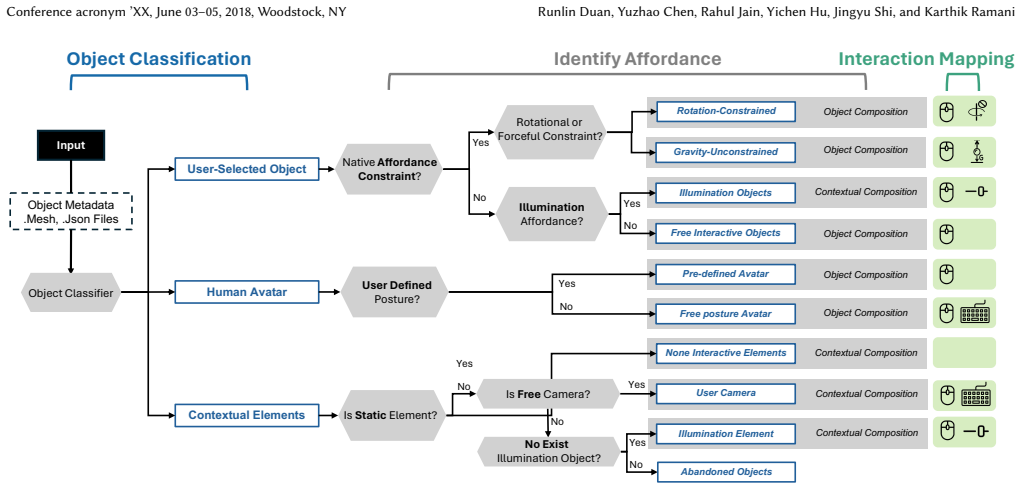
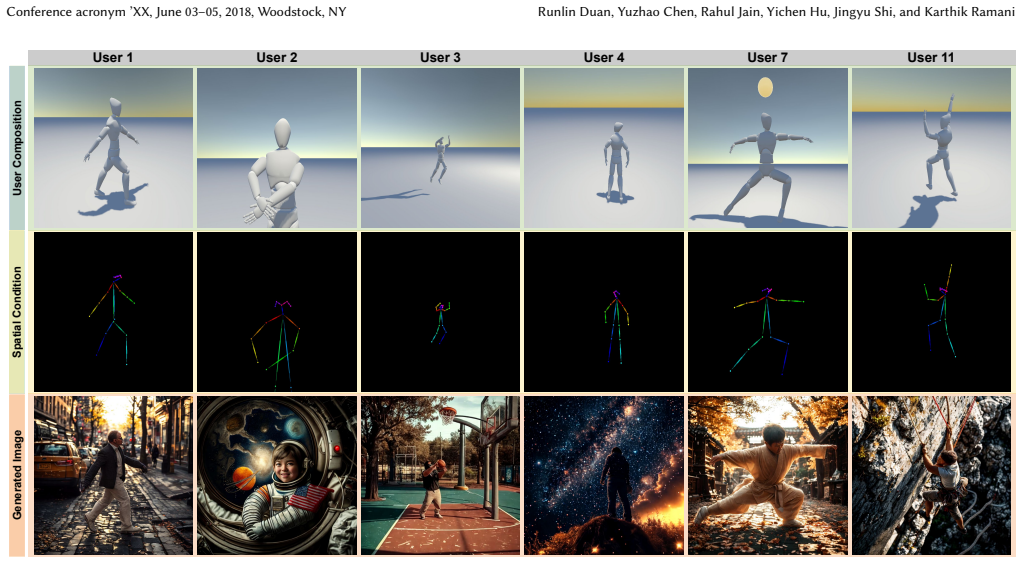
The load-bearing mechanism is the spatial-condition encoding pipeline: an automatically constructed 3D canvas plus a function library that exports the user's arrangement as depth images, scene screenshots, OpenPose-format skeletons, and lighting JSON, along with native mesh data. This encoding sits between the interaction layer and the generative model; it is what makes the user's mouse movements into constraints a conditional diffusion model can actually obey. The automatic object registration and scene synthesis from the prompt matter too, because they remove the setup burden and keep the comparison about spatial control rather than 3D modeling skill.
What would settle it
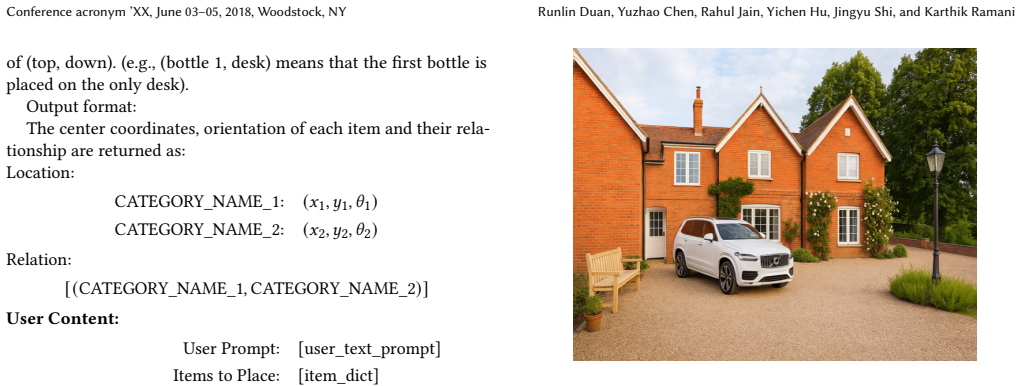
Place two objects very close together in depth on the Canvas3D canvas under the same prompt, and check whether the generated image keeps them as distinct objects; the paper reports this failing for a car near a house. More broadly, rerunning the closed-ended comparison with a larger sample and more scenes would settle whether the Uni-Det and Recall advantages persist beyond the 12 participants.
Extended reading notes
Core claim
Canvas3D's central claim is that direct 3D manipulation gives users genuinely precise spatial control over generated images, and that this precision survives the trip from user intent to final image. The authors argue that a 3D engine captures spatial intent intuitively because users manipulate actual objects rather than sliders or bounding boxes. The closed-ended study gave participants a target image and asked them to reproduce its spatial composition with Canvas3D or with a slider-based baseline; both used the same conditional generative backbone. Canvas3D outperformed the baseline on all five metrics, with significant advantages on GPT-CLIP (p=0.0024), Uni-Det (p=0.0034), and Recall (p=0
Load-bearing premise
The pipeline assumes the encoded spatial conditions, especially the depth image, preserve the user's 3D arrangement intact; the paper's own study shows that objects close in depth can be conflated, and that chaining separate models for pose and lighting adds style inconsistency.
Editorial extensions
If this is right
- Users can specify object placement, orientation, human posture, camera viewpoint, and lighting by arranging a 3D scene, then regenerate while keeping the same spatial constraints.
- Spatial-alignment metrics and user ratings both improve relative to slider-based control when the generation backbone is held fixed.
- The system lowers the skill barrier: no sketching ability or slider calibration is needed, since the canvas is created automatically from a text prompt.
- The same encoded conditions (depth, skeleton, lighting) can be retargeted to other conditional generative models through the extensible encoder library.
- Because the canvas enforces physical constraints, common scene violations such as floating or intersecting objects are reduced before generation.
Reading between the lines
- The documented near-depth failure suggests depth-only encoding is the weak link; combining depth with instance segmentation or an explicit relation graph would likely resolve cases where two objects merge, and this is a cheap test the paper does not run.
- The comparison's outcome is tied to the slider baseline's interaction design; a head-to-head against sketch-based or drag-based controllers would clarify whether the advantage comes from 3D direct manipulation or simply from not using sliders.
- The same prompt-to-canvas workflow could plausibly steer non-image generative tasks, such as 3D model generation or embodied-agent instructions, since the system already exports native 3D meshes and scene metadata; the paper only sketches those uses.
- The reported effect sizes come from 12 participants; a larger replication varying scenes and user backgrounds would show how far the advantage generalizes.
Editorial analysis
A structured set of objections, weighed in public.
Referee Report
Summary. The paper presents Canvas3D, an interactive system for image generation with explicit spatial control. A user enters a text prompt; the system registers 3D objects from ShapeNet/Objaverse, synthesizes an initial scene with an LLM, and maps mouse/keyboard input to object affordances in a Unity-based canvas. The user can rearrange objects, adjust camera and lighting, and configure human posture. The system encodes the resulting arrangement into spatial conditions (depth, skeleton, lighting JSON, etc.) that are passed to conditional generative models (Uni-Con, IC-Light). The paper reports a within-subject study (n=12) comparing Canvas3D to a slider-based baseline with the same generative backbone, finding significant advantages on GPT-CLIP, Uni-Det, Recall, and several NASA-TLX/Likert measures, plus an open-ended usability session with SUS score 82.22. The central claim is that direct 3D manipulation gives users significantly better spatial control than slider-based control.
Significance. If the result holds, Canvas3D is a valuable contribution to controllable generation: it provides an end-to-end pipeline from prompt to manipulable 3D scene to spatial conditions, and the interaction design aligns with natural manipulation. The system is implemented and documented in enough detail to be reproduced, and the use of a within-subject design with counterbalancing and qualitative interviews is appropriate. However, the current evaluation cannot uniquely attribute the observed gains to the proposed manipulation mechanism because the baseline also differs in visual representation and condition fidelity. The paper would need a controlled comparison or additional experiment to support its central claim.
major comments (4)
- [§5.1.1, Figures 10/15] The comparison in §5.1.1/Figures 10,15 does not isolate the proposed 3D-manipulation interaction. The baseline differs from Canvas3D in at least three ways: input modality (sliders vs direct manipulation), visual feedback (bounding boxes vs textured meshes), and the fidelity of the spatial condition (box-derived depth vs mesh-derived depth) fed to the same Uni-Con backbone. §6.1.3 itself attributes baseline failures to bounding boxes being 'frequently misinterpreted as a single object.' Thus the significant gains in GPT-CLIP, Uni-Det, and Recall (Table 1) could arise from the condition-encoding difference alone. To support the central HCI claim, the study needs a control that holds the condition representation fixed (e.g., sliders with mesh-based depth) or adds a third condition isolating each factor.
- [§5.1.2, Figure 18] The closed-ended study uses a single target image (Fig. 18) with one object set and one spatial layout; Table 3 aggregates counts/times for that stimulus. With n=12 and one stimulus, the claim that Canvas3D 'consistently outperforms' the baseline does not generalize across object categories, scene complexity, or spatial arrangements. Additional target scenes (or at least a per-stimulus analysis and a clear acknowledgment of this scope limit) are needed before drawing general conclusions about spatial controllability.
- [§5.1.3, Table 1] Table 1 reports five objective metrics without correction for multiple comparisons, and Fig. 13 adds many subjective tests; the smallest p-values would survive Bonferroni, but the authors should report adjusted p-values or FDR and include effect sizes/confidence intervals so readers can judge magnitudes. In addition, GPT-CLIP and GPT Spatial rely on GPT-generated captions/judgments with no reported reliability (e.g., agreement with human raters or repeatability). Because both conditions are evaluated with the same LLM judge, this is not circular, but it is a source of measurement uncertainty that should be quantified.
- [§7.3] Section 7.3 documents that the depth condition can lose spatial distinctions when objects are close in depth (P11 quote). This is an acknowledged limitation, but the discussion does not connect it to the closed-ended comparison. Since the two conditions use different depth encoders (mesh vs boxes), this failure mode may affect the condition-fidelity confound differently across conditions, and it also bounds the central 'precise spatial control' claim. Please discuss how this limitation interacts with the objective metrics and whether the system-level advantages persist when depth resolution is the bottleneck.
minor comments (4)
- [Figures 2/4/9] Figure 2 contains an untranslated editing note ('放citation'), and Figures 4 and 9 contain Chinese annotation text ('字加大', '字体加粗加大'). These are leftover author annotations and must be removed.
- [§6.2.1/6.2.2] Sections 6.2.1 and 6.2.2 are both titled 'System Usability Questionnaire'; the second appears to be the System Feature Questionnaire. There are also typos: 'Metrice' (§5.1.3), 'Geneartive' (§2.2 heading), 'faciliate', 'perprndicular', and 'wildly'.
- [Table 3] Table 3 reports time-to-first-liked and liked-ratio rows without p-values or confidence intervals. If these are exploratory, say so explicitly; otherwise provide the corresponding tests.
- [Appendix A.6] The Uni-Det score is defined by listing five spatial relationships, but the exact formula for comparing positions/depths of detected boxes is not given (thresholds, normalization, per-relationship scoring). As written, the metric is not fully reproducible.
Circularity Check
No significant circularity: the comparison is an empirical user study with external generative backbones and metrics; no fitted parameter is renamed as a prediction and no load-bearing self-citation chain appears.
full rationale
This paper contains no formal derivation whose conclusion equals its premises. The central claim is an empirical comparison: Canvas3D outperforms a slider/bounding-box baseline on spatial metrics and subjective ratings. The generation backbone (Uni-Con), lighting model (IC-Light), and the quantitative metrics (CLIP, UniDet, Recall) are external to the system, and the perceived-control ratings come from 12 participants. The only passages that could resemble circularity are (1) the taxonomy of spatial composition, which is a design frame rather than a derived prediction; (2) several self-citations in related work, none of which supplies the evaluation's force; and (3) the use of GPT-family models both for scene synthesis and for some caption-based metrics, which is a possible shared-model bias but not a definitional reduction — the metrics are computed on images produced by an external conditional diffusion model, not on the system's own outputs in a way that would force the reported differences. The baseline confound (3D meshes vs. bounding boxes, direct manipulation vs. sliders) is a threat to attribution, not a circularity: the comparison is underdetermined but empirically meaningful. No fitted parameter is renamed as a prediction, and no load-bearing uniqueness/self-citation chain forces the conclusion.
Assumptions & free parameters
free parameters (2)
- Uni-Det relationship set (5 relations) =
house-front-left-trees; house-back-left-lamp; house-back-car; car-back-right-bench; bench-back-flowerpot
- GPT Spatial rubric thresholds =
20, 40, 60, 80, 100
assumptions (4)
- domain assumption Direct manipulation in a 3D canvas captures spatial intent more accurately and intuitively than slider-based control.
- domain assumption The conditional generative backbones (Uni-Con, IC-Light) faithfully render depth, skeleton, and lighting conditions produced by the system.
- domain assumption LLM-based scene synthesis produces reasonable initial layouts that do not bias the comparison.
- domain assumption GPT-4V and CLIP-based scores are valid proxies for spatial accuracy and image quality.
Cite this review
Pith. "Pith review of Canvas3D: Empowering Precise Spatial Control for Image Generation with Constraints from a 3D Virtual Canvas." pith.science (2026). https://pith.science/paper/HIN47JUO
@misc{pith2026250807135,
  author       = {Pith},
  title        = {Pith review of: Canvas3D: Empowering Precise Spatial Control for Image Generation with Constraints from a 3D Virtual Canvas},
  year         = {2026},
  howpublished = {\url{https://pith.science/paper/HIN47JUO}},
  note         = {Machine review of arXiv:2508.07135}
}
read the original abstract
Generative AI (GenAI) has significantly advanced the ease and flexibility of image creation. However, it remains a challenge to precisely control spatial compositions, including object arrangement and scene conditions. To bridge this gap, we propose Canvas3D, an interactive system leveraging a 3D engine to enable precise spatial manipulation for image generation. Upon user prompt, Canvas3D automatically converts textual descriptions into interactive objects within a 3D engine-driven virtual canvas, empowering direct and precise spatial configuration. These user-defined arrangements generate explicit spatial constraints that guide generative models in accurately reflecting user intentions in the resulting images. We conducted a closed-end comparative study between Canvas3D and a baseline system. And an open-ended study to evaluate our system "in the wild". The result indicates that Canvas3D outperforms the baseline on spatial control, interactivity, and overall user experience.
Figures


Figures from the paper (14 more)






Reference graph
Works this paper leans on
-
[1]
Remi Alkemade, Fons J Verbeek, and Stephan G Lukosch. 2017. On the efficiency of a VR hand gesture-based interface for 3D object manipulations in conceptual design. International Journal of Human–Computer Interaction 33, 11 (2017), 882–901
2017
-
[2]
Autodesk. 2025. Autodesk | 3D Design, Engineering & Construction Software. https://www.autodesk.com/ Accessed: 2025-04-09
2025
-
[3]
Omri Avrahami, Rinon Gal, Gal Chechik, Ohad Fried, Dani Lischinski, Arash Vahdat, and Weili Nie. 2024. Diffuhaul: A training-free method for object dragging in images. In SIGGRAPH Asia 2024 Conference Papers . 1–12
2024
-
[4]
Lonni Besançon, Paul Issartel, Mehdi Ammi, and Tobias Isenberg. 2017. Mouse, tactile, and tangible input for 3D manipulation. In Proceedings of the 2017 CHI conference on human factors in computing systems . 4727–4740
2017
-
[5]
Shariq Farooq Bhat, Niloy Mitra, and Peter Wonka. 2024. Loosecontrol: Lift- ing controlnet for generalized depth conditioning. In ACM SIGGRAPH 2024 Conference Papers. 1–11
2024
-
[6]
Stephen Brade, Bryan Wang, Mauricio Sousa, Sageev Oore, and Tovi Gross- man. 2023. Promptify: Text-to-image generation through interactive prompt exploration with large language models. In Proceedings of the 36th Annual ACM Symposium on User Interface Software and Technology . 1–14
2023
-
[7]
Wenxiao Cai, Iaroslav Ponomarenko, Jianhao Yuan, Xiaoqi Li, Wankou Yang, Hao Dong, and Bo Zhao. 2024. Spatialbot: Precise spatial understanding with vision language models. arXiv preprint arXiv:2406.13642 (2024)
arXiv 2024
-
[8]
Zhe Cao, Gines Hidalgo, Tomas Simon, Shih-En Wei, and Yaser Sheikh. 2019. Openpose: Realtime multi-person 2d pose estimation using part affinity fields. IEEE transactions on pattern analysis and machine intelligence 43, 1 (2019), 172– 186
2019
Show all 133 references
-
[9]
Zhe Cao, Tomas Simon, Shih-En Wei, and Yaser Sheikh. 2017. Realtime multi- person 2d pose estimation using part affinity fields. In Proceedings of the IEEE conference on computer vision and pattern recognition . 7291–7299
2017
-
[10]
Angel X Chang, Thomas Funkhouser, Leonidas Guibas, Pat Hanrahan, Qixing Huang, Zimo Li, Silvio Savarese, Manolis Savva, Shuran Song, Hao Su, et al
-
[11]
Hila Chefer, Yuval Alaluf, Yael Vinker, Lior Wolf, and Daniel Cohen-Or. 2023. Attend-and-excite: Attention-based semantic guidance for text-to-image diffu- sion models. ACM transactions on Graphics (TOG) 42, 4 (2023), 1–10
2023
-
[12]
DaEun Choi, Sumin Hong, Jeongeon Park, John Joon Young Chung, and Juho Kim. 2024. CreativeConnect: Supporting Reference Recombination for Graphic Design Ideation with Generative AI. In Proceedings of the 2024 CHI Conference on Human Factors in Computing Systems . 1–25
2024
-
[13]
John Joon Young Chung and Eytan Adar. 2023. Promptpaint: Steering text-to- image generation through paint medium-like interactions. In Proceedings of the 36th Annual ACM Symposium on User Interface Software and Technology . 1–17
2023
-
[14]
Charles E Connor and James J Knierim. 2017. Integration of objects and space in perception and memory. Nature neuroscience 20, 11 (2017), 1493–1503
2017
-
[15]
Hai Dang, Lukas Mecke, and Daniel Buschek. 2022. Ganslider: How users control generative models for images using multiple sliders with and without feedforward information. In Proceedings of the 2022 CHI Conference on Human Factors in Computing Systems . 1–15
2022
-
[16]
Jonas Degrave, Michiel Hermans, Joni Dambre, and Francis Wyffels. 2019. A dif- ferentiable physics engine for deep learning in robotics.Frontiers in neurorobotics 13 (2019), 6
2019
-
[17]
Matt Deitke, Dustin Schwenk, Jordi Salvador, Luca Weihs, Oscar Michel, Eli Van- derBilt, Ludwig Schmidt, Kiana Ehsani, Aniruddha Kembhavi, and Ali Farhadi
-
[18]
Francine L Dolins and Robert W Mitchell. 2010. Spatial cognition, spatial percep- tion: mapping the self and space . Cambridge University Press
2010
-
[19]
Wenqi Dong, Bangbang Yang, Lin Ma, Xiao Liu, Liyuan Cui, Hujun Bao, Yuewen Ma, and Zhaopeng Cui. 2024. Coin3d: Controllable and interactive 3d assets generation with proxy-guided conditioning. InACM SIGGRAPH 2024 Conference Papers. 1–10
2024
-
[20]
Runlin Duan, Xiyun Hu, Min Liu, Jingyu Shi, and Karthik Ramani. 2025. pARa- metric: Empowering In Situ Parametric Modeling in Augment Reality for Per- sonal Fabrication. Journal of Computing and Information Science in Engineering 25, 4 (2025), 041001
2025
-
[21]
Runlin Duan, Nachiketh Karthik, Jingyu Shi, Rahul Jain, Maria C Yang, and Karthik Ramani. 2024. ConceptVis: Generating and Exploring Design Con- cepts for Early-Stage Ideation Using Large Language Model. In International Design Engineering Technical Conferences and Computers a...
2024
-
[22]
David Eberly. 2006. 3D game engine design: a practical approach to real-time computer graphics. CRC Press
2006
-
[23]
Abdelrahman Eldesokey and Peter Wonka. 2024. Build-a-scene: Interac- tive 3d layout control for diffusion-based image generation. arXiv preprint arXiv:2408.14819 (2024)
2024 arXiv
-
[24]
Exocortex Technologies
Inc. Exocortex Technologies. 2013. Clara.io: Online 3D Modeling, 3D Rendering, Free 3D Models. https://clara.io/ Accessed: 2025-04-07
2013
-
[25]
Nan Fairbrother. 1974. The nature of landscape design . Architectural Press London
1974
-
[26]
Weixi Feng, Wanrong Zhu, Tsu-jui Fu, Varun Jampani, Arjun Akula, Xuehai He, Sugato Basu, Xin Eric Wang, and William Yang Wang. 2023. Layoutgpt: Compositional visual planning and generation with large language models. Advances in Neural Information Processing Systems 36 (2023),...
2023
-
[27]
Donato Fiorella, Andrea Sanna, and Fabrizio Lamberti. 2010. Multi-touch user interface evaluation for 3D object manipulation on mobile devices. Journal on Multimodal User Interfaces 4 (2010), 3–10
2010
-
[28]
Gaspare Galati, Gina Pelle, Alain Berthoz, and Giorgia Committeri. 2010. Multi- ple reference frames used by the human brain for spatial perception and memory. Experimental brain research 206 (2010), 109–120
2010
-
[29]
Ruiqi Gao, Aleksander Holynski, Philipp Henzler, Arthur Brussee, Ricardo Martin-Brualla, Pratul Srinivasan, Jonathan T Barron, and Ben Poole. 2024. Cat3d: Create anything in 3d with multi-view diffusion models. arXiv preprint arXiv:2405.10314 (2024)
2024 arXiv
-
[30]
James J Gibson. 2014. The ecological approach to visual perception: classic edition . Psychology press. Canvas3D: Empowering Precise Spatial Control for Image Generation with Constraints from a 3D Virtual Canvas Conference acronym ’XX, June 03–05, 2018, Woodstock, NY
2014
-
[31]
Eg Su Goh, Mohd Shahrizal Sunar, and Ajune Wanis Ismail. 2019. 3D object manipulation techniques in handheld mobile augmented reality interface: A review. IEEE Access 7 (2019), 40581–40601
2019
-
[32]
Tejas Gokhale, Hamid Palangi, Besmira Nushi, Vibhav Vineet, Eric Horvitz, Ece Kamar, Chitta Baral, and Yezhou Yang. 2022. Benchmarking spatial relationships in text-to-image generation. arXiv preprint arXiv:2212.10015 (2022)
2022 arXiv
-
[33]
Bruce Gooch, Erik Reinhard, Chris Moulding, and Peter Shirley. 2001. Artistic composition for image creation. In Rendering Techniques 2001: Proceedings of the Eurographics Workshop in London, United Kingdom, June 25–27, 2001 12. Springer, 83–88
2001
-
[34]
Daniel Gopher, Lilach Armony, and Yaakov Greenshpan. 2000. Switching tasks and attention policies. Journal of Experimental Psychology: General 129, 3 (2000), 308
2000
-
[35]
Daniel J Graham and Christoph Redies. 2010. Statistical regularities in art: Relations with visual coding and perception. Vision research 50, 16 (2010), 1503–1509
2010
-
[36]
SG Hart. 1988. Development of NASA-TLX (Task Load Index): Results of empir- ical and theoretical research. Human mental workload/Elsevier (1988)
1988
-
[37]
Fengming He, Xiyun Hu, Jingyu Shi, Xun Qian, Tianyi Wang, and Karthik Ramani. 2023. UBI edge: authoring edge-based opportunistic tangible user interfaces in augmented reality. In Proceedings of the 2023 CHI Conference on Human Factors in Computing Systems . 1–14
2023
-
[38]
Yihan Hou, Manling Yang, Hao Cui, Lei Wang, Jie Xu, and Wei Zeng. 2024. C2Ideas: Supporting Creative Interior Color Design Ideation with a Large Lan- guage Model. In Proceedings of the CHI Conference on Human Factors in Comput- ing Systems. 1–18
2024
-
[39]
Kaiyi Huang, Chengqi Duan, Kaiyue Sun, Enze Xie, Zhenguo Li, and Xihui Liu
-
[40]
Zheng Huang, Qiang Liu, Stephen Westland, Michael R Pointer, M Ronnier Luo, and Kaida Xiao. 2018. Light dominates colour preference when correlated colour temperature differs. Lighting Research & Technology 50, 7 (2018), 995–1012
2018
-
[41]
Adobe Inc. 2025. Adobe Substance 3D Stager. https://www.adobe.com/products/ substance3d/apps/stager.html Accessed: 2025-04-07
2025
-
[42]
Jacek Jankowski and Martin Hachet. 2013. A survey of interaction techniques for interactive 3D environments. In Eurographics 2013-STAR
2013
-
[43]
Youngseung Jeon, Seungwan Jin, Patrick C Shih, and Kyungsik Han. 2021. Fash- ionQ: an ai-driven creativity support tool for facilitating ideation in fashion design. In Proceedings of the 2021 CHI Conference on Human Factors in Computing Systems. 1–18
2021
-
[44]
Xuan Ju, Ailing Zeng, Chenchen Zhao, Jianan Wang, Lei Zhang, and Qiang Xu
-
[45]
Shehroz S Khan and Daniel Vogel. 2012. Evaluating visual aesthetics in photo- graphic portraiture. In Proceedings of the Eighth Annual Symposium on Compu- tational Aesthetics in Graphics, visualization, and imaging . 55–62
2012
-
[46]
Minseok Kim and Jae Yeol Lee. 2016. Touch and hand gesture-based interac- tions for directly manipulating 3D virtual objects in mobile augmented reality. Multimedia Tools and Applications 75 (2016), 16529–16550
2016
-
[47]
Janin Koch, Andrés Lucero, Lena Hegemann, and Antti Oulasvirta. 2019. May AI? Design ideation with cooperative contextual bandits. In Proceedings of the 2019 CHI Conference on Human Factors in Computing Systems . 1–12
2019
-
[48]
In Proceedings of the IEEE/CVF International Conference on Computer Vision
Humansd: A native skeleton-guided diffusion model for human image generation. In Proceedings of the IEEE/CVF International Conference on Computer Vision. 15988–15998
-
[49]
Mieke HR Leyssen, Sarah Linsen, Jonathan Sammartino, and Stephen E Palmer
-
[50]
Boyu Li, Linping Yuan, Zhe Yan, Qianxi Liu, Yulin Shen, and Zeyu Wang. 2024. AniCraft: Crafting Everyday Objects as Physical Proxies for Prototyping 3D Character Animation in Mixed Reality. In Proceedings of the 37th Annual ACM Symposium on User Interface Software and Technolo...
2024
-
[51]
Xirui Li, Charles Herrmann, Kelvin CK Chan, Yinxiao Li, Deqing Sun, Chao Ma, and Ming-Hsuan Yang. 2024. A simple approach to unifying diffusion-based conditional generation. arXiv preprint arXiv:2410.11439 (2024)
2024 arXiv
-
[52]
James M Leonhardt, Jesse R Catlin, and Dante M Pirouz. 2015. Is your prod- uct facing the ad’s center? Facing direction affects processing fluency and ad evaluation. Journal of Advertising 44, 4 (2015), 315–325
2015
-
[53]
David Chuan-En Lin, Hyeonsu B Kang, Nikolas Martelaro, Aniket Kittur, Yan- Ying Chen, and Matthew K Hong. 2024. Inkspire: Sketching Product Designs with AI. In Adjunct Proceedings of the 37th Annual ACM Symposium on User Interface Software and Technology. 1–6
2024
-
[54]
David Chuan-En Lin, Hyeonsu B Kang, Nikolas Martelaro, Aniket Kittur, Yan- Ying Chen, and Matthew K Hong. 2025. Inkspire: Supporting Design Ex- ploration with Generative AI through Analogical Sketching. arXiv preprint arXiv:2501.18588 (2025)
2025 arXiv
-
[55]
Daochang Liu, Junyu Zhang, Anh-Dung Dinh, Eunbyung Park, Shichao Zhang, and Chang Xu. 2025. Generative Physical AI in Vision: A Survey. arXiv preprint arXiv:2501.10928 (2025)
2025 arXiv
-
[56]
Vivian Liu, Jo Vermeulen, George Fitzmaurice, and Justin Matejka. 2023. 3DALL- E: Integrating text-to-image AI in 3D design workflows. In Proceedings of the 2023 ACM designing interactive systems conference . 1955–1977
2023
-
[57]
Wentong Liao, Kai Hu, Michael Ying Yang, and Bodo Rosenhahn. 2022. Text to image generation with semantic-spatial aware gan. In Proceedings of the IEEE/CVF conference on computer vision and pattern recognition . 18187–18196
2022
-
[58]
Tiange Luo, Chris Rockwell, Honglak Lee, and Justin Johnson. 2023. Scalable 3d captioning with pretrained models. Advances in Neural Information Processing Systems 36 (2023), 75307–75337
2023
-
[59]
Hira Maqbool. 2023. Aesthetic choices: Defining the range of aesthetic views in interactive digital media including games and 3D virtual environments (3D VEs). (2023)
2023
-
[60]
Daniel Mendes, Fabio Marco Caputo, Andrea Giachetti, Alfredo Ferreira, and Joaquim Jorge. 2019. A survey on 3d virtual object manipulation: From the desktop to immersive virtual environments. InComputer graphics forum, Vol. 38. Wiley Online Library, 21–45
2019
-
[61]
Siwei Meng, Yawei Luo, and Ping Liu. 2025. Grounding Creativity in Physics: A Brief Survey of Physical Priors in AIGC. arXiv preprint arXiv:2502.07007 (2025)
2025 arXiv
-
[62]
Ziyi Liu, Zhengzhe Zhu, Enze Jiang, Feichi Huang, Ana M Villanueva, Xun Qian, Tianyi Wang, and Karthik Ramani. 2023. Instrumentar: Auto-generation of augmented reality tutorials for operating digital instruments through recording embodied demonstration. In Proceedings of the 2...
2023
-
[63]
Sicheng Mo, Fangzhou Mu, Kuan Heng Lin, Yanli Liu, Bochen Guan, Yin Li, and Bolei Zhou. 2024. Freecontrol: Training-free spatial control of any text-to-image diffusion model with any condition. In Proceedings of the IEEE/CVF Conference on Computer Vision and Pattern Recognitio...
2024
-
[64]
Chong Mou, Xintao Wang, Liangbin Xie, Yanze Wu, Jian Zhang, Zhongang Qi, and Ying Shan. 2024. T2i-adapter: Learning adapters to dig out more controllable ability for text-to-image diffusion models. In Proceedings of the AAAI conference on artificial intelligence, Vol. 38. 4296–4304
2024
-
[65]
Maria Adriana Neroni, Alfred Oti, and Nathan Crilly. 2021. Virtual Reality design-build-test games with physics simulation: opportunities for researching design cognition. International Journal of Design Creativity and Innovation 9, 3 (2021), 139–173
2021
-
[66]
Jeongseok Oh, Seungju Kim, and Seungjun Kim. 2024. LumiMood: A Creativity Support Tool for Designing the Mood of a 3D Scene. In Proceedings of the 2024 CHI Conference on Human Factors in Computing Systems . 1–21
2024
-
[67]
Zhenxing Mi, Kuan-Chieh Wang, Guocheng Qian, Hanrong Ye, Runtao Liu, Sergey Tulyakov, Kfir Aberman, and Dan Xu. 2025. I Think, Therefore I Diffuse: Enabling Multimodal In-Context Reasoning in Diffusion Models. arXiv preprint arXiv:2502.10458 (2025)
2025 arXiv
-
[68]
OpenAI. 2025. OpenAI. https://openai.com/ Accessed: 2025-04-09
2025
-
[69]
Jonas Oppenlaender, Rhema Linder, and Johanna Silvennoinen. 2024. Prompting AI art: An investigation into the creative skill of prompt engineering. Interna- tional journal of human–computer interaction (2024), 1–23
2024
-
[70]
Stephen E Palmer, Jonathan S Gardner, and Thomas D Wickens. 2008. Aesthetic issues in spatial composition: Effects of position and direction on framing single objects. Spatial vision 21, 3 (2008), 421–450
2008
-
[71]
Stephen E Palmer, Karen B Schloss, and Jonathan Sammartino. 2013. Visual aesthetics and human preference. Annual review of psychology 64, 1 (2013), 77–107
2013
-
[72]
Open Robotics. 2025. Robot Operating System (ROS). https://www.ros.org/ Accessed: 2025-04-09
2025
-
[73]
Henry Rankin Poore. 1976. Composition in art. Courier Corporation
1976
-
[74]
Xun Qian, Fengming He, Xiyun Hu, Tianyi Wang, and Karthik Ramani. 2022. Arnnotate: An augmented reality interface for collecting custom dataset of 3d hand-object interaction pose estimation. In Proceedings of the 35th Annual ACM Symposium on User Interface Software and Technol...
2022
-
[75]
Can Qin, Shu Zhang, Ning Yu, Yihao Feng, Xinyi Yang, Yingbo Zhou, Huan Wang, Juan Carlos Niebles, Caiming Xiong, Silvio Savarese, et al . 2023. Unicontrol: A unified diffusion model for controllable visual generation in the wild. arXiv preprint arXiv:2305.11147 (2023)
2023 arXiv
-
[76]
Aditya Ramesh, Prafulla Dhariwal, Alex Nichol, Casey Chu, and Mark Chen
-
[77]
Xingang Pan, Ayush Tewari, Thomas Leimkühler, Lingjie Liu, Abhimitra Meka, and Christian Theobalt. 2023. Drag your gan: Interactive point-based manipu- lation on the generative image manifold. In ACM SIGGRAPH 2023 conference proceedings. 1–11
2023
-
[78]
Nils Reimers and Iryna Gurevych. 2019. Sentence-bert: Sentence embeddings using siamese bert-networks. arXiv preprint arXiv:1908.10084 (2019)
2019 arXiv
-
[79]
Jason L Reisman, Philip L Davidson, and Jefferson Y Han. 2009. A screen-space formulation for 2D and 3D direct manipulation. InProceedings of the 22nd annual ACM symposium on User interface software and technology . 69–78. Conference acronym ’XX, June 03–05, 2018, Woodstock, N...
2009
-
[80]
Robin Rombach, Andreas Blattmann, Dominik Lorenz, Patrick Esser, and Björn Ommer. 2022. High-resolution image synthesis with latent diffusion models. In Proceedings of the IEEE/CVF conference on computer vision and pattern recognition. 10684–10695
2022
-
[81]
Jonathan Sammartino and Stephen E Palmer. 2012. Aesthetic issues in spatial composition: Effects of vertical position and perspective on framing single objects. Journal of Experimental Psychology: Human Perception and Performance 38, 4 (2012), 865
2012
-
[82]
Kevin L Sample, Henrik Hagtvedt, and S Adam Brasel. 2020. Components of visual perception in marketing contexts: A conceptual framework and review. Journal of the Academy of Marketing Science 48 (2020), 405–421
2020
-
[83]
Aditya Ramesh, Mikhail Pavlov, Gabriel Goh, Scott Gray, Chelsea Voss, Alec Rad- ford, Mark Chen, and Ilya Sutskever. 2021. Zero-shot text-to-image generation. In International conference on machine learning . Pmlr, 8821–8831
2021
-
[84]
Udo Schultheis, Jason Jerald, Fernando Toledo, Arun Yoganandan, and Paul Mlyniec. 2012. Comparison of a two-handed interface to a wand interface and a mouse interface for fundamental 3D tasks. In 2012 IEEE Symposium on 3D User Interfaces (3DUI). IEEE, 117–124
2012
-
[85]
Jingyu Shi, Rahul Jain, Seungguen Chi, Hyungjun Doh, Hyunggun Chi, Alexan- der J Quinn, and Karthik Ramani. 2025. CARING-AI: Towards Authoring Context-aware Augmented Reality INstruction through Generative Artificial Intelligence. arXiv preprint arXiv:2501.16557 (2025)
2025 arXiv
-
[86]
Yang Shi, Yechun Peng, Shengqi Dang, Nanxuan Zhao, and Nan Cao. 2024. Personalizing Products with Stylized Head Portraits for Self-Expression. In Proceedings of the 2024 CHI Conference on Human Factors in Computing Systems . 1–18
2024
-
[87]
Yujun Shi, Chuhui Xue, Jun Hao Liew, Jiachun Pan, Hanshu Yan, Wenqing Zhang, Vincent YF Tan, and Song Bai. 2024. Dragdiffusion: Harnessing diffusion models for interactive point-based image editing. In Proceedings of the IEEE/CVF Conference on Computer Vision and Pattern Recog...
2024
-
[88]
Joonghyuk Shin, Daehyeon Choi, and Jaesik Park. 2024. InstantDrag: Improving Interactivity in Drag-based Image Editing. In SIGGRAPH Asia 2024 Conference Papers. 1–10
2024
-
[89]
Vishnu Sarukkai, Lu Yuan, Mia Tang, Maneesh Agrawala, and Kayvon Fatahalian
-
[90]
Fan-Yun Sun, Weiyu Liu, Siyi Gu, Dylan Lim, Goutam Bhat, Federico Tombari, Manling Li, Nick Haber, and Jiajun Wu. 2024. LayoutVLM: Differentiable Optimization of 3D Layout via Vision-Language Models. arXiv preprint arXiv:2412.02193 (2024)
2024 arXiv
-
[91]
Jiao Sun, Deqing Fu, Yushi Hu, Su Wang, Royi Rassin, Da-Cheng Juan, Dana Alon, Charles Herrmann, Sjoerd van Steenkiste, Ranjay Krishna, et al . 2023. Dreamsync: Aligning text-to-image generation with image understanding feed- back. arXiv preprint arXiv:2311.17946 (2023)
2023 arXiv
-
[92]
Kamila Svobodova, Petr Sklenicka, Kristina Molnarova, and Jiri Vojar. 2014. Does the composition of landscape photographs affect visual preferences? The rule of the Golden Section and the position of the horizon. Journal of Environmental Psychology 38 (2014), 143–152
2014
-
[93]
Gaurav Tevatia and Stefan Schaal. 2000. Inverse kinematics for humanoid robots. In Proceedings 2000 ICRA. Millennium Conference. IEEE International Conference on Robotics and Automation. Symposia Proceedings (Cat. No. 00CH37065) , Vol. 1. IEEE, 294–299
2000
-
[94]
Unity Technologies. [n. d.]. Unity Real-Time Development Platform | 3D, 2D, VR & AR Engine. https://unity.com/ Accessed: 2025-04-08
2025
-
[95]
Troy AW Visser, Walter F Bischof, and Vincent Di Lollo. 1999. Attentional switching in spatial and nonspatial domains: Evidence from the attentional blink. Psychological Bulletin 125, 4 (1999), 458
1999
-
[96]
Dirk Sikkel, Reinder Steenbergen, and Sjoerd Gras. 2014. Clicking vs. dragging: Different uses of the mouse and their implications for online surveys. Public opinion quarterly 78, 1 (2014), 177–190
2014
-
[97]
Shun-Yu Wang, Wei-Chung Su, Serena Chen, Ching-Yi Tsai, Marta Misztal, Katherine M Cheng, Alwena Lin, Yu Chen, and Mike Y Chen. 2024. Room- dreaming: Generative-AI approach to facilitating iterative, preliminary interior design exploration. In Proceedings of the 2024 CHI Confe...
2024
-
[98]
Tianyi Wang, Xun Qian, Fengming He, Xiyun Hu, Yuanzhi Cao, and Karthik Ramani. 2021. Gesturar: An authoring system for creating freehand interactive augmented reality applications. In The 34th Annual ACM Symposium on User Interface Software and Technology. 552–567
2021
-
[99]
Xudong Wang, Trevor Darrell, Sai Saketh Rambhatla, Rohit Girdhar, and Ishan Misra. 2024. Instancediffusion: Instance-level control for image generation. In Proceedings of the IEEE/CVF Conference on Computer Vision and Pattern Recogni- tion. 6232–6242
2024
-
[100]
Zhenwei Wang, Nanxuan Zhao, Gerhard P Hancke, and Rynson WH Lau. 2023. Language-based Photo Color Adjustment for Graphic Designs. ACM Trans. Graph. 42, 4 (2023), 101–1
2023
-
[101]
Qiuhong Anna Wei, Sijie Ding, Jeong Joon Park, Rahul Sajnani, Adrien Poule- nard, Srinath Sridhar, and Leonidas Guibas. 2023. Lego-net: Learning regular rearrangements of objects in rooms. In Proceedings of the IEEE/CVF Conference on Computer Vision and Pattern Recognition . 1...
2023
-
[102]
Blake Williford, Matthew Runyon, Josh Cherian, Wayne Li, Julie Linsey, and Tracy Hammond. 2019. A framework for motivating sketching practice with sketch-based gameplay. In Proceedings of the Annual Symposium on Computer- Human Interaction in Play . 533–544
2019
-
[103]
Samangi Wadinambiarachchi, Ryan M Kelly, Saumya Pareek, Qiushi Zhou, and Eduardo Velloso. 2024. The effects of generative ai on design fixation and divergent thinking. In Proceedings of the 2024 CHI Conference on Human Factors in Computing Systems. 1–18
2024
-
[104]
Jingyuan Yang, Jiawei Feng, and Hui Huang. 2024. EmoGen: Emotional image content generation with text-to-image diffusion models. In Proceedings of the IEEE/CVF Conference on Computer Vision and Pattern Recognition . 6358–6368
2024
-
[105]
Taoxi Yang, Sarita Silveira, Arusu Formuli, Marco Paolini, Ernst Pöppel, Tilmann Sander, and Yan Bao. 2019. Aesthetic experiences across cultures: Neural corre- lates when viewing traditional Eastern or Western landscape paintings.Frontiers in psychology 10 (2019), 798
2019
-
[106]
Xianfang Zeng, Xin Chen, Zhongqi Qi, Wen Liu, Zibo Zhao, Zhibin Wang, Bin Fu, Yong Liu, and Gang Yu. 2024. Paint3d: Paint anything 3d with lighting-less texture diffusion models. In Proceedings of the IEEE/CVF conference on computer vision and pattern recognition . 4252–4262
2024
-
[107]
Hongbo Zhang, Pei Chen, Xuelong Xie, Chaoyi Lin, Lianyan Liu, Zhuoshu Li, Weitao You, and Lingyun Sun. 2024. Protodreamer: A mixed-prototype tool combining physical model and generative AI to support conceptual design. In Proceedings of the 37th Annual ACM Symposium on User In...
2024
-
[108]
Lvmin Zhang, Anyi Rao, and Maneesh Agrawala. 2023. Adding conditional control to text-to-image diffusion models. In Proceedings of the IEEE/CVF inter- national conference on computer vision . 3836–3847
2023
-
[109]
Lvmin Zhang, Anyi Rao, and Maneesh Agrawala. 2025. Scaling in-the-wild training for diffusion-based illumination harmonization and editing by imposing consistent light transport. InThe Thirteenth International Conference on Learning Representations
2025
-
[110]
Siju Wu, Amine Chellali, Samir Otmane, and Guillaume Moreau. 2015. TouchS- ketch: a touch-based interface for 3D object manipulation and editing. In Pro- ceedings of the 21st ACM Symposium on Virtual Reality Software and Technology . 59–68
2015
-
[111]
Yuli Zhang, Hyokjin Kwak, Haeyoung Jeong, and Marina Puzakova. 2019. Facing the “right” side? The effect of product facing direction. Journal of Advertising 48, 2 (2019), 153–166
2019
-
[112]
Yanhao Zhang, Xiaoshuai Sun, Hongxun Yao, Lei Qin, and Qingming Huang
-
[113]
Zibo Zhao, Zeqiang Lai, Qingxiang Lin, Yunfei Zhao, Haolin Liu, Shuhui Yang, Yifei Feng, Mingxin Yang, Sheng Zhang, Xianghui Yang, et al. 2025. Hunyuan3d 2.0: Scaling diffusion models for high resolution textured 3d assets generation. arXiv preprint arXiv:2501.12202 (2025)
2025 arXiv
-
[114]
Guangcong Zheng, Xianpan Zhou, Xuewei Li, Zhongang Qi, Ying Shan, and Xi Li. 2023. Layoutdiffusion: Controllable diffusion model for layout-to-image generation. In Proceedings of the IEEE/CVF Conference on Computer Vision and Pattern Recognition. 22490–22499
2023
-
[115]
Xingyi Zhou, Vladlen Koltun, and Philipp Krähenbühl. 2022. Simple multi- dataset detection. In Proceedings of the IEEE/CVF conference on computer vision and pattern recognition. 7571–7580
2022
-
[116]
Zhengzhe Zhu, Ziyi Liu, Tianyi Wang, Youyou Zhang, Xun Qian, Pashin Farsak Raja, Ana Villanueva, and Karthik Ramani. 2022. MechARspace: An author- ing system enabling bidirectional binding of augmented reality with toys in real-time. In Proceedings of the 35th Annual ACM Sympo...
2022
-
[117]
Tianjun Zhang, Yi Zhang, Vibhav Vineet, Neel Joshi, and Xin Wang. 2023. Con- trollable text-to-image generation with gpt-4. arXiv preprint arXiv:2305.18583 (2023)
2023 arXiv
-
[120]
In 2012 19th IEEE international conference on image processing
Aesthetic composition represetation for portrait photographing recom- mendation. In 2012 19th IEEE international conference on image processing . IEEE, 2753–2756
2012
-
[125]
Coordinate system: Origin (0, 0) is located in the upper left corner; (300, 300) is located in the lower right corner
-
[126]
The x-axis spans the scene’s width (0 to 300), The y-axis spans the scene’s height (0 to 300) Placement Goals:
-
[127]
Item size dictionary
Each object can be simplified to a rectangle in a 2D top view, with the dimensions specified on the "Item size dictionary" part, specifically in (length of the front, length of the side) order. Its "front direction" is the primary orientation of the object during normal use. I...
-
[128]
Place the grounded objects first, then place the accessory objects based on their results
Grounded objects are defined as items stand directly on the floor (e.g., tables); accessory objects are objects placed on top of these grounded objects (e.g., mugs). Place the grounded objects first, then place the accessory objects based on their results
-
[129]
Place items in a practical and aesthetically pleasing way (e.g., chairs near a table, plants near a corner, etc.)
-
[130]
Make sure all coordinates stay within the 300×300 boundary
-
[131]
For items with multiple instances (e.g., 2 chairs), clearly label them (e.g., Chair 1, Chair 2). Task:
-
[132]
Based on the above requirements, come up with the center coordinates and rotation angle (i.e., the counter-clockwise angle between their front direction and the standard negative y-axis, typically from [0, 90, 180, 270]) for each item listed
-
[133]
(e.g., (bottle 1, desk) means that the first bottle is placed on the only desk)
Based on the location result, list all the spatial affordance up and down relationships in the result, and save the result in the form Conference acronym ’XX, June 03–05, 2018, Woodstock, NY Runlin Duan, Yuzhao Chen, Rahul Jain, Yichen Hu, Jingyu Shi, and Karthik Ramani of (to...
2018
-
[2012]
i-Perception 3, 1 (2012), 25–49
Aesthetic preference for spatial composition in multiobject pictures. i-Perception 3, 1 (2012), 25–49
2012
-
[2015]
arXiv preprint arXiv:1512.03012 (2015)
Shapenet: An information-rich 3d model repository. arXiv preprint arXiv:1512.03012 (2015)
2015 arXiv
-
[2022]
arXiv preprint arXiv:2204.06125 1, 2 (2022), 3
Hierarchical text-conditional image generation with clip latents. arXiv preprint arXiv:2204.06125 1, 2 (2022), 3
2022 arXiv
-
[2023]
In Proceedings of the IEEE/CVF conference on computer vision and pattern recognition
Objaverse: A universe of annotated 3d objects. In Proceedings of the IEEE/CVF conference on computer vision and pattern recognition . 13142–13153
-
[2024]
In Proceedings of the 37th Annual ACM Symposium on User Interface Software and Technology
Block and Detail: Scaffolding Sketch-to-Image Generation. In Proceedings of the 37th Annual ACM Symposium on User Interface Software and Technology . 1–13
-
[2025]
IEEE Transactions on Pattern Analysis and Machine Intelligence (2025)
T2I-CompBench++: An Enhanced and Comprehensive Benchmark for Compositional Text-to-Image Generation. IEEE Transactions on Pattern Analysis and Machine Intelligence (2025)
2025
Reviewed August 5, 2026 · model on record in the stance chip above.
Discussion (0). Sign in to comment.