Regimes of Influence in Trust-Uncertainty Gated Networks
Pith reviewed 2026-06-25 22:32 UTC · model grok-4.3
The pith
Trust and uncertainty thresholds create regimes where either high-degree hubs or peripheral agents dominate collective beliefs.
A machine-rendered reading of the paper's core claim, the machinery that carries it, and where it could break.
Core claim
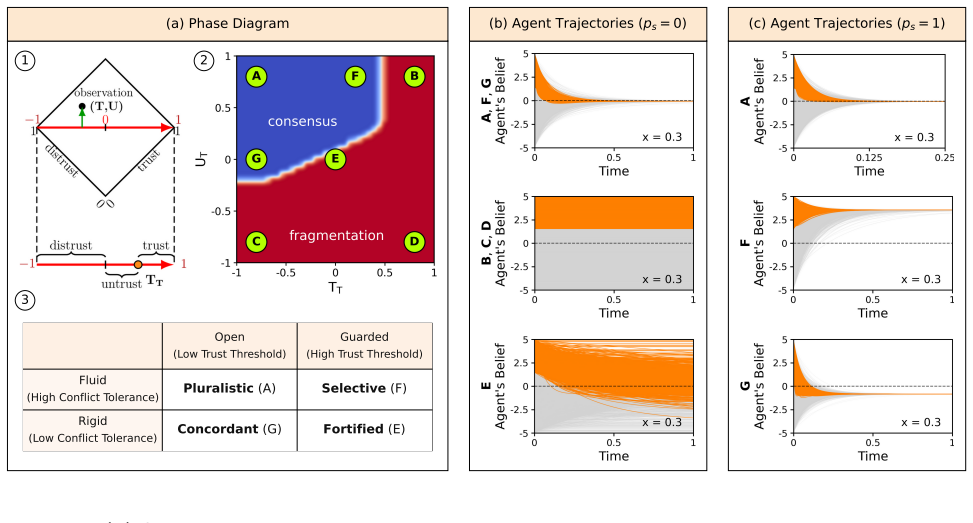
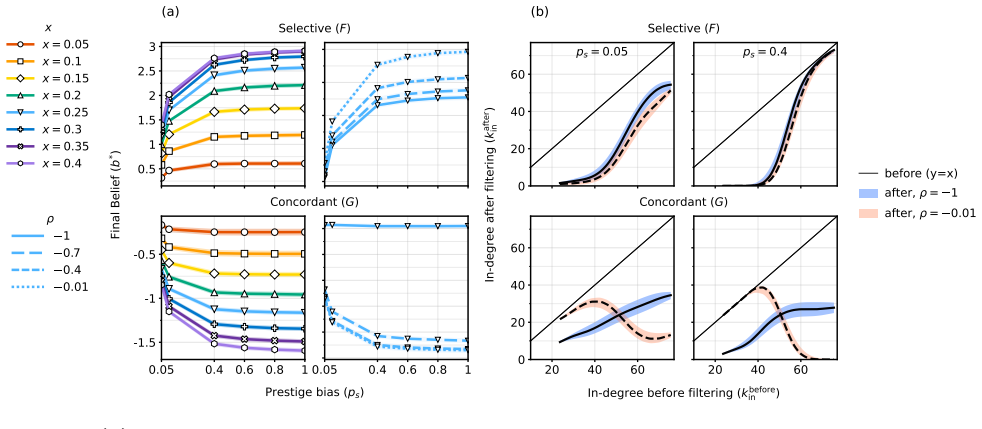
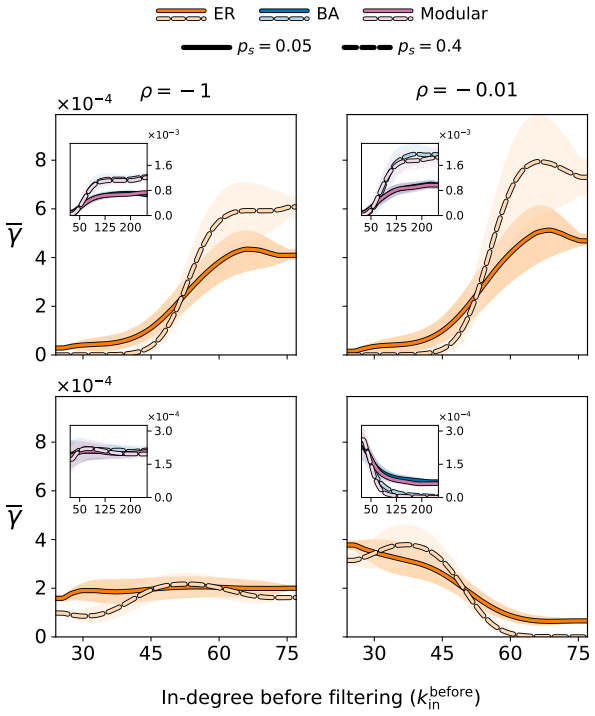
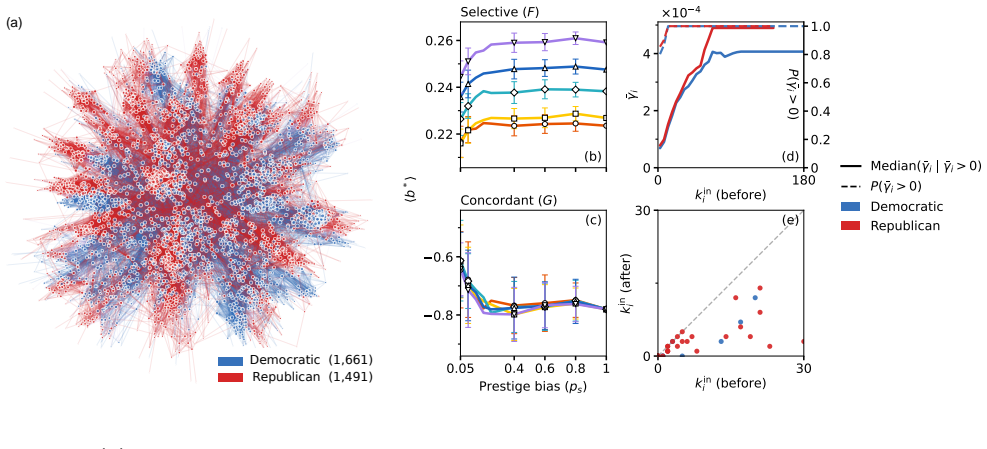
Gated Network Credence encodes separate trust and distrust values on each directed edge. These values yield net trust (willingness to rely on the source) and uncertainty (conflict within the relationship). Agents update beliefs only when net trust exceeds one threshold and uncertainty falls below another, producing an effective influence graph. Sweeping the thresholds reveals four regimes—Pluralistic, Selective, Concordant, and Fortified—and a hub-periphery reversal: high-degree agents dominate in the Selective regime while stringent uncertainty filtering in the Concordant regime disproportionately removes their active channels, enabling peripheral agents to exert greater leverage over colle
What carries the argument
Gated Network Credence, which computes net trust and uncertainty from separate trust and distrust assessments on each directed edge to gate belief updates and define the effective influence graph.
If this is right
- The topology of the effective influence graph determines long-run belief states once the thresholds are fixed.
- The four regimes differ systematically in openness to trust and conflict.
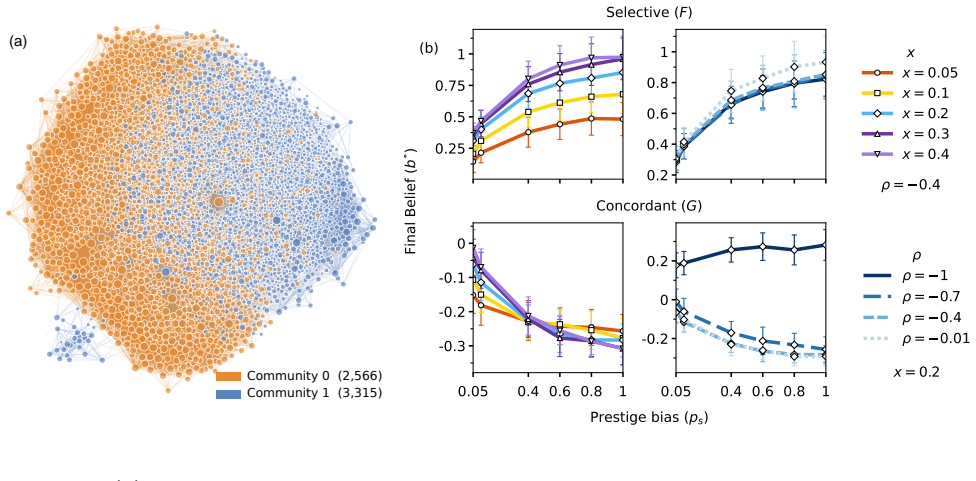
- The hub-periphery reversal is independent of whether the underlying network is synthetic or empirical.
- Collective equilibria therefore depend jointly on network structure and on how relational ambivalence gates updates.
Where Pith is reading between the lines
- Platform designs that adjust uncertainty visibility could shift influence toward or away from high-degree accounts.
- The same gating logic might be tested in laboratory experiments where participants report both trust and distrust toward information sources.
- Extending the thresholds to time-varying values could link regime switches to observed changes in polarization or consensus speed.
Load-bearing premise
Belief updates occur only when net trust exceeds a threshold and uncertainty falls below another threshold, after which the resulting graph topology alone drives long-run states.
What would settle it
Measuring trust and distrust separately in an empirical social network, sweeping the two thresholds, and finding no consistent switch from hub-dominated to periphery-dominated influence would falsify the reversal.
Figures
read the original abstract
In many social communities, individuals can simultaneously trust and distrust the same source, a feature standard opinion-dynamics models often ignore. We formalize this ambivalence with Gated Network Credence, in which each directed relationship encodes distinct trust and distrust assessments. These jointly determine "net trust" - the willingness to rely on a source - and "uncertainty" - the conflict between trust and distrust within the same relationship. Agents update beliefs only when net trust exceeds a threshold and uncertainty falls below another, yielding an effective influence graph whose topology drives long-run belief states. Sweeping both thresholds uncovers four regimes - Pluralistic, Selective, Concordant, and Fortified - that differ in openness to trust and conflict. We find a consistent hub-periphery reversal: in the Selective regime, high-degree agents dominate influence, whereas in the Concordant regime, stringent uncertainty filtering disproportionately removes active influence channels associated with high-degree agents, enabling peripheral lower-degree agents to exert greater leverage over the collective equilibrium. This reversal holds across synthetic and empirical networks. Our results show that belief dynamics depend not only on network structure but also on how relational ambivalence between trust and distrust gates interpersonal influence.
Editorial analysis
A structured set of objections, weighed in public.
Referee Report
Summary. The paper introduces Gated Network Credence to formalize ambivalence in directed social relationships by encoding separate trust and distrust values. These determine net trust (willingness to rely on a source) and uncertainty (internal conflict within the relationship). Belief updates occur only when net trust exceeds one threshold and uncertainty falls below another, producing an effective influence graph whose topology governs long-run states. Threshold sweeps identify four regimes (Pluralistic, Selective, Concordant, Fortified) differing in openness to trust and conflict. The central result is a hub-periphery reversal: high-degree agents dominate influence in the Selective regime, while stringent uncertainty filtering in the Concordant regime removes high-degree channels and elevates peripheral agents. The reversal is reported to hold on both synthetic and empirical networks.
Significance. If the simulation results are robust, the work is significant because it demonstrates that relational ambivalence can produce regime-dependent reversals in influence structure that are not predicted by network topology alone. Extending the finding to empirical networks strengthens its potential relevance for modeling collective belief dynamics in real social systems.
minor comments (1)
- Abstract: the four regimes are named but not briefly characterized by their threshold ranges or openness properties, which would help readers map the parameter space to the reported behaviors.
Simulated Author's Rebuttal
We thank the referee for the thorough summary and positive assessment of the manuscript's significance. The recommendation of minor revision is noted. No specific major comments were provided in the report, so we have no points to address point-by-point at this stage. We will incorporate any minor suggestions during revision.
Circularity Check
No significant circularity identified
full rationale
The paper's core construction defines net trust and uncertainty from trust/distrust pairs, then gates updates on explicit thresholds to produce an effective influence graph; regimes are obtained by sweeping those thresholds and the reported hub-periphery reversal is an observed simulation outcome on both synthetic and empirical networks. No step reduces a claimed prediction or first-principles result to its own inputs by construction, no load-bearing self-citation is invoked, and no parameter is fitted then relabeled as a prediction. The derivation chain is therefore self-contained model exploration rather than tautological.
Axiom & Free-Parameter Ledger
free parameters (2)
- net trust threshold
- uncertainty threshold
axioms (1)
- domain assumption Each directed relationship encodes distinct trust and distrust assessments that jointly determine net trust and uncertainty
invented entities (1)
-
Gated Network Credence
no independent evidence
Reference graph
Works this paper leans on
-
[1]
Noorazar
H. Noorazar. Recent advances in opinion propagation dynamics: A 2020 survey.The Euro- pean Physical Journal Plus, 135:1–20, 2020. 22
2020
-
[2]
Galesic, H
M. Galesic, H. Olsson, J. Dalege, T. Van Der Does, and D. L. Stein. Integrating social and cognitive aspects of belief dynamics: towards a unifying framework.Journal of the Royal Society Interface, 18:20200857, 2021
2021
-
[3]
The group as a polarizer of attitudes.Journal of Personality and Social Psychology, 12(2):125–135, 1969
Serge Moscovici and Marisa Zavalloni. The group as a polarizer of attitudes.Journal of Personality and Social Psychology, 12(2):125–135, 1969
1969
-
[4]
Sunstein
Cass R. Sunstein. The law of group polarization.Journal of Political Philosophy, 10(2): 175–195, 2002
2002
-
[5]
Minority opinion spreading in random geometry.The European Physical Journal B, 25(4):403–406, 2002
Serge Galam. Minority opinion spreading in random geometry.The European Physical Journal B, 25(4):403–406, 2002
2002
-
[6]
Castellano, S
C. Castellano, S. Fortunato, and V. Loreto. Statistical physics of social dynamics.Reviews of Modern Physics, 81(2):591–646, 2009
2009
-
[7]
Affect, not ideology: A social identity perspective on polarization.Public Opinion Quarterly, 76(3):405–431, 2012
Shanto Iyengar, Gaurav Sood, and Yphtach Lelkes. Affect, not ideology: A social identity perspective on polarization.Public Opinion Quarterly, 76(3):405–431, 2012
2012
-
[8]
Sokolov, and Michele Starnini
Fabian Baumann, Philipp Lorenz-Spreen, Igor M. Sokolov, and Michele Starnini. Modeling echo chambers and polarization dynamics in social networks.Physical Review Letters, 124 (4):048301, 2020
2020
-
[9]
Morris H. DeGroot. Reaching a consensus.Journal of the American Statistical Association, 69(345):118–121, 1974
1974
-
[10]
Opinion dynamics and bounded confidence: Models, analysis and simulation.Journal of Artificial Societies and Social Simulation, 5(3), 2002
Rainer Hegselmann and Ulrich Krause. Opinion dynamics and bounded confidence: Models, analysis and simulation.Journal of Artificial Societies and Social Simulation, 5(3), 2002
2002
-
[11]
Deffuant, D
G. Deffuant, D. Neau, F. Amblard, and G. Weisbuch. Mixing beliefs among interacting agents.Advances in Complex Systems, 3:87–98, 2000
2000
-
[12]
Bernardo, C
C. Bernardo, C. Altafini, A. Proskurnikov, and F. Vasca. Bounded confidence opinion dy- namics: A survey.Automatica, 159:111302, 2024
2024
-
[13]
Opinion evolution in closed community.Inter- national Journal of Modern Physics C, 11(6):1157–1165, 2000
Katarzyna Sznajd-Weron and Józef Sznajd. Opinion evolution in closed community.Inter- national Journal of Modern Physics C, 11(6):1157–1165, 2000
2000
-
[14]
Signed bounded confidence models for opinion dynamics.Automatica, 93:114–125, 2018
Claudio Altafini and Francesca Ceragioli. Signed bounded confidence models for opinion dynamics.Automatica, 93:114–125, 2018
2018
-
[15]
Bounded-confidencemodelofopiniondynamicswithheterogeneous node-activity levels.Physical Review Research, 5:023179, 2023
G.J.LiandM.A.Porter. Bounded-confidencemodelofopiniondynamicswithheterogeneous node-activity levels.Physical Review Research, 5:023179, 2023
2023
-
[16]
Lewicki, Daniel J
Roy J. Lewicki, Daniel J. McAllister, and Robert J. Bies. Trust and distrust: New relation- ships and realities.Academy of Management Review, 23(3):438–458, 1998. 23
1998
-
[17]
G. D. Moody, D. F. Galletta, and P. B. Lowry. When trust and distrust collide online: The engenderment and role of consumer ambivalence in online consumer behavior.Electronic Commerce Research and Applications, 13(4):266–282, 2014
2014
-
[18]
G. D. Moody, P. B. Lowry, and D. F. Galletta. It’s complicated: Explaining the relationship between trust, distrust, and ambivalence in online transaction relationships using polynomial regression analysis and response surface analysis.European Journal of Information Systems, 26(4):379–413, 2017
2017
-
[19]
Posten and F
A.-C. Posten and F. Gino. How trust and distrust shape perception and memory.Journal of Personality and Social Psychology, 121:43, 2021
2021
-
[20]
D. M. Lazer et al. The science of fake news.Science, 359:1094–1096, 2018
2018
-
[21]
Guha, Ravi Kumar, Prabhakar Raghavan, and Andrew Tomkins
Ramanathan V. Guha, Ravi Kumar, Prabhakar Raghavan, and Andrew Tomkins. Propa- gation of trust and distrust. InProceedings of the 13th International Conference on World Wide Web, pages 403–412. ACM, 2004
2004
-
[22]
The Slashdot Zoo: Mining a social network with negative edges
Jérôme Kunegis, Andreas Lommatzsch, and Christian Bauckhage. The Slashdot Zoo: Mining a social network with negative edges. InProceedings of the 18th International Conference on World Wide Web, pages 741–750. ACM, 2009
2009
-
[23]
Signed networks in social media
Jure Leskovec, Daniel Huttenlocher, and Jon Kleinberg. Signed networks in social media. InProceedings of the SIGCHI Conference on Human Factors in Computing Systems, pages 1361–1370, New York, NY, USA, 2010. Association for Computing Machinery. doi: 10.1145/ 1753326.1753532
arXiv 2010
-
[24]
Kou et al
H. Kou et al. Building trust/distrust relationships on signed social service network through privacy-aware link prediction process.Applied Soft Computing, 100:106942, 2021
2021
-
[25]
H. Fang, X. Li, and J. Zhang. Integrating social influence modeling and user modeling for trust prediction in signed networks.Artificial Intelligence, 302:103628, 2022
2022
-
[26]
Managing consensus in balanced networks based on opinion and trust/distrust evolutions.Information Sciences, 643:119223,
Qian Zha, Xiaoyu He, Ming Zhan, and Ningning Lang. Managing consensus in balanced networks based on opinion and trust/distrust evolutions.Information Sciences, 643:119223,
-
[27]
doi: 10.1016/j.ins.2023.119223
-
[28]
L. Shi, Y. Cheng, J. Shao, X. Wang, and H. Sheng. Leader-driven opinion dynamics in signed social networks with asynchronous trust/distrust level evolution. arXiv preprint, 2020
2020
-
[29]
A. Ishii. Opinion dynamics theory considering trust and suspicion in human relations. In Group Decision and Negotiation: Behavior, Models, and Support: 19th International Con- ference, GDN 2019, Loughborough, UK, June 11–15, 2019, Proceedings, pages 193–204. Springer, 2019
2019
-
[30]
Ishii and Y
A. Ishii and Y. Kawahata. New opinion dynamics theory considering interpersonal rela- tionship of both trust and distrust. InIEEE/WIC/ACM International Conference on Web Intelligence - Companion Volume, pages 43–50, 2019. 24
2019
-
[31]
Ishii, I
A. Ishii, I. Yomura, and N. Okano. Opinion dynamics including both trust and distrust in hu- man relation for various network structure. In2020 International Conference on Technologies and Applications of Artificial Intelligence (TAAI), pages 131–135. IEEE, 2020
2020
-
[32]
Taghavi, E
A. Taghavi, E. Eslami, E. Herrera-Viedma, and R. Ureña. Trust based group decision making in environments with extreme uncertainty.Knowledge-Based Systems, 191:105168, 2020
2020
-
[33]
Gallos, Shlomo Havlin, Fredrik Liljeros, Lev Muchnik, H
Maksim Kitsak, Lazaros K. Gallos, Shlomo Havlin, Fredrik Liljeros, Lev Muchnik, H. Eugene Stanley, and Hernán A. Makse. Identification of influential spreaders in complex networks. Nature Physics, 6:888–893, 2010. doi: 10.1038/nphys1746
-
[34]
Damon Centola. The spread of behavior in an online social network experiment.Science, 329(5996):1194–1197, 2010. doi: 10.1126/science.1185231
-
[35]
Viktoria Cologna, Niels G. Mede, Sebastian Berger, John Besley, Cameron Brick, Marina Joubert, EdwardW.Maibach, SabinaMihelj, NaomiOreskes, MikeS.Schäfer, Sandervander Linden, et al. Trust in scientists and their role in society across 68 countries.Nature Human Behaviour, 9:713–730, 2025. doi: 10.1038/s41562-024-02090-5
-
[36]
Eli J. Finkel, Christopher A. Bail, Mina Cikara, Peter H. Ditto, Shanto Iyengar, Samara Klar, Lilliana Mason, Mary C. McGrath, Brendan Nyhan, David G. Rand, Linda J. Skitka, Joshua A. Tucker, Jay J. Van Bavel, Cynthia S. Wang, and James N. Druckman. Political sectarianism in america.Science, 370(6516):533–536, 2020. doi: 10.1126/science.abe1715
-
[37]
A system- atic review of worldwide causal and correlational evidence on digital media and democracy
Philipp Lorenz-Spreen, Lisa Oswald, Stephan Lewandowsky, and Ralph Hertwig. A system- atic review of worldwide causal and correlational evidence on digital media and democracy. Nature Human Behaviour, 7:74–101, 2023. doi: 10.1038/s41562-022-01460-1
-
[38]
Ullrich K. H. Ecker, Stephan Lewandowsky, John Cook, Philipp Schmid, Lisa K. Fazio, Nadia M. Brashier, Panayiota Kendeou, Emily K. Vraga, and Michelle A. Amazeen. The psychological drivers of misinformation belief and its resistance to correction.Nature Reviews Psychology, 1:13–29, 2022. doi: 10.1038/s44159-021-00006-y
-
[39]
Shifting attention to accuracy can reduce misinformation online,
Gordon Pennycook, Ziv Epstein, Mohsen Mosleh, Antonio A. Arechar, Dean Eckles, and David G. Rand. Shifting attention to accuracy can reduce misinformation online.Nature, 592:590–595, 2021. doi: 10.1038/s41586-021-03344-2
-
[40]
Networks beyond pairwise interactions: struc- ture and dynamics,
Federico Battiston, Giulia Cencetti, Iacopo Iacopini, Vito Latora, Maxime Lucas, Alice Pata- nia, Jean-Gabriel Young, and Giovanni Petri. Networks beyond pairwise interactions: Struc- ture and dynamics.Physics Reports, 874:1–92, 2020. doi: 10.1016/j.physrep.2020.05.004
-
[41]
Simplicial models of so- cial contagion,
Iacopo Iacopini, Giovanni Petri, Alain Barrat, and Vito Latora. Simplicial models of social contagion.Nature Communications, 10(1):2485, 2019. doi: 10.1038/s41467-019-10431-6
-
[42]
Veerman and Ewan Kummel
J.J.P. Veerman and Ewan Kummel. Diffusion and consensus on weakly connected directed graphs.Linear Algebra and its Applications, 578:184–206, 2019. 25
2019
-
[43]
node2vec: Scalable feature learning for networks
Aditya Grover and Jure Leskovec. node2vec: Scalable feature learning for networks. In Proceedings of the 22nd ACM SIGKDD International Conference on Knowledge Discovery and Data Mining, pages 855–864, 2016
2016
-
[44]
Birds of the same feather tweet together: Bayesian ideal point estimation using Twitter data.Political Analysis, 23(1):76–91, 2015
Pablo Barberá. Birds of the same feather tweet together: Bayesian ideal point estimation using Twitter data.Political Analysis, 23(1):76–91, 2015. 26
2015
discussion (0)
Sign in with ORCID, Apple, or X to comment. Anyone can read and Pith papers without signing in.