REVIEW 4 major objections 6 minor 66 references
Unveiling Galaxy Structures: Systematic Analysis of Bulge+Disk Decomposition Using Simulated JWST/NIRCam Observations
T0 review · 4 major / 6 minor · reviewed 2026-08-15 · deepseek-v4-flash
Pith's one-line read Under CEERS-like JWST/NIRCam conditions, single and double Sérsic fits recover galaxy magnitudes within about 0.5 mag and sizes within about 0.2 dex, down to 27 mag for total light and 26 mag for individual bulge/disk components.
desk verdict Useful JWST/NIRCam bulge+disk error-budget paper, but the single-Sérsic size claim rests on a flux-weighted radius comparison that does not measure half-light radius; the double-component decomposition results are the solid part. read the letter →
The pith
A machine-rendered reading of the paper's core claim, the machinery that carries it, and where it could break.
The reading
What carries the argument
The central object is the Sérsic profile, $I(R)=I_e\exp[-k((R/R_{\rm eff})^{1/n}-1)]$, with $n=4$ for the bulge and $n=1$ for the disk, convolved with real point-spread functions chosen from CEERS F150W and F356W images and embedded in real CEERS sky background with Poisson noise. The argument is carried by a controlled comparison: 5,000 simulated bulge+disk galaxies of known parameters are fit with single and double Sérsic models by a two-dimensional image-fitting pipeline, and recovery accuracy is measured against the known inputs. Two auxiliary tools do key work: the Bayesian Information Criterion decides when the extra component is justified, and the total signal-to-noise ratio is used to make the error budgets portable to other NIRCam surveys.
What would settle it
Take a sample of galaxies with independently known bulge and disk parameters, for example from kinematic decomposition or higher-resolution imaging, degrade them to CEERS-like JWST depth and PSF, and check whether the double Sérsic fits recover those known values within 0.5 mag and 0.2 dex; a simpler version is to rerun the same mock pipeline with pseudo-bulges or barred light and watch whether the recovery error and the BIC separation worsen substantially.
Extended reading notes
Core claim
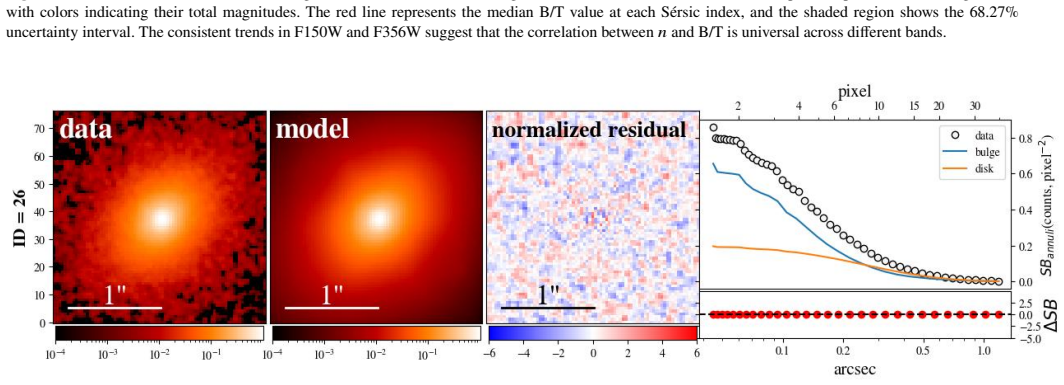
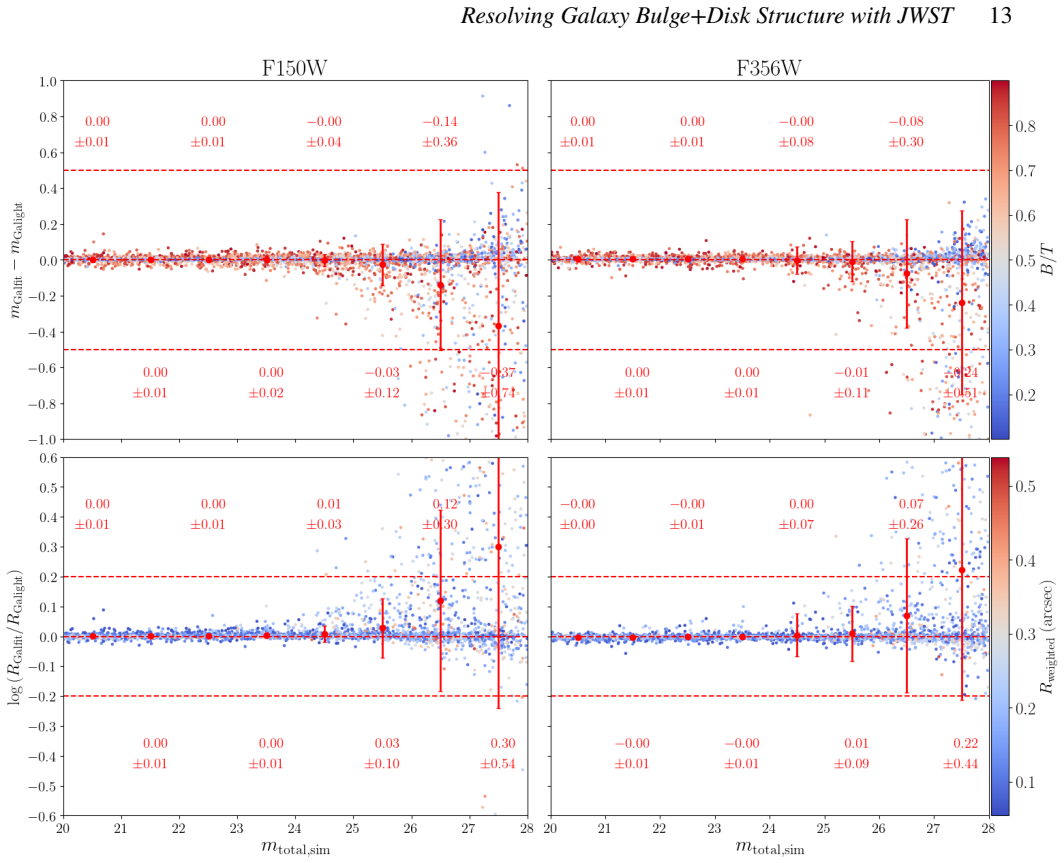
Under CEERS-like NIRCam observing conditions, single Sérsic fits recover the total magnitude of a bulge-plus-disk galaxy within 0.5 mag and its effective radius within 0.2 dex for galaxies as faint as 27 mag, while double Sérsic fits recover the bulge and disk magnitudes within 0.5 mag and effective radii within 0.2 dex for components brighter than 26 mag. The recovered parameters are unbiased and the scatter shrinks as signal to noise increases, with SNR>10 quoted as the threshold for reliable recovery. The fitted single-Sérsic index rises monotonically with the true bulge-to-total flux ratio, so n can serve as a B/T proxy, though the relation scatters heavily near n=1 and n=4 and at magnitudes fainter than 26. For model selection, the Bayesian Information Criterion prefers the double model in 90% of systems brighter than 24.9 mag in F150W or 26.2 mag in F356W, and in 90% of comparable-flux systems with B/T between 30% and 70%.
Load-bearing premise
The load-bearing premise is that the mock galaxies are generated from the same Sérsic model family used in the fits, with the bulge index fixed at 4 and the disk index at 1, and that the fits are initialized with the true parameter values; if real high-redshift galaxies contain pseudo-bulges, bars, clumps, or Sérsic indices outside those fixed values, the quoted recovery accuracies and BIC thresholds will not transfer.
Editorial extensions
If this is right
- Surveys can treat single-Sérsic total magnitudes and sizes as reliable down to 27 mag in F150W and F356W, which extends size evolution studies to the faint high-redshift populations JWST actually detects.
- Bulge and disk magnitudes can be compared at the 0.5 mag level for components brighter than 26 mag, making B/T-based tests of bulge growth versus disk accretion feasible at high redshift.
- The BIC thresholds, with 90% confidence for mag<24.9 in F150W and mag<26.2 in F356W, give a simple pre-analysis rule for deciding when to attempt two-component decomposition.
- The SNR>10 criterion lets other NIRCam programs compute, before fitting, which of their galaxies will yield reliable structural parameters.
- Agreement between two independent fitting codes within 0.1 mag/0.1 dex for single models and 0.5 mag/0.2 dex for double models suggests these error budgets are not quirks of one implementation.
Reading between the lines
- These error budgets are likely optimistic for real high-redshift galaxies because the mocks use exactly the same Sérsic family as the fits, with a classical n=4 bulge and exponential n=1 disk and no bars, clumps, or asymmetric features; adding such substructure would probably degrade the recovery and weaken the BIC separation.
- Because the nominal fits start from the true parameter values, with a footnote reporting that default initialization gave consistent results, a fully blind search over a larger survey would be a useful additional stress test of the quoted accuracies.
- A direct extension would be to repeat the calibration with bulge and disk Sérsic indices left free, or with pseudo-bulges at n~2, to map how much of the 0.5 mag budget is absorbed by index flexibility.
- The BIC magnitude limits translate into a redshift-dependent mass limit: at z~6 only the most luminous galaxies will be bright enough in F356W to support double-component decomposition, so B/T measurements there will be biased toward massive systems.
Signed reviews
Editorial analysis
A structured set of objections, weighed in public.
Referee Report
Summary. The paper presents controlled simulations of bulge+disk galaxies observed under CEERS/NIRCam conditions (F150W and F356W), fits them with single and double Sérsic models using the galight and galfit codes, and quantifies recovery accuracy for total and component magnitudes, effective radii, bulge-to-total ratios, model selection via the Bayesian Information Criterion, and signal-to-noise thresholds. The central numerical claims are that single Sérsic fits recover total magnitudes within about 0.5 mag and sizes within about 0.2 dex down to 27 mag, and double Sérsic fits recover component magnitudes and effective radii within 0.5 mag and 0.2 dex down to 26 mag, with SNR > 10 as a general reliability threshold.
Significance. If the headline results hold, the paper provides a practical reference for JWST/NIRCam morphological studies, including error budgets and BIC-based selection thresholds. The study's strengths are its large sample of 5,000 simulated galaxies, the use of realistic CEERS PSFs and background noise, explicit PSF-mismatch tests, an independent cross-check with galfit, and the SNR-based parameterization of uncertainties. However, the validation is a closed-box test: the generative model and the fitting model share the same Sérsic family with fixed bulge and disk indices, and the single-Sérsic size comparison is made against a flux-weighted radius that is not the true half-light radius of the composite system. These issues mean that the quoted accuracies are ideal-case, same-model errors unless the analysis is revised or the claims are reframed.
major comments (4)
- [§4.1.2, Eq. (2)] The single-Sérsic size recovery is validated against R_weighted = (R_bulge f_bulge + R_disk f_disk)/(f_bulge + f_disk), which is not the half-light radius of the two-component model. The true total half-light radius solves the cumulative-flux condition and depends on the full shape of both Sérsic profiles; for typical simulated parameters (e.g., B/T ≈ 0.5, R_disk/R_bulge ≈ 2) the difference can be ~0.1 dex, comparable to the quoted 0.2 dex accuracy. The abstract and §6 claims of single-Sérsic size recovery within 0.2 dex are therefore not established; the comparison should be made against the numerically computed half-light radius of the composite model, or the claim should be reframed. The same R_weighted is used in the galfit comparison in §5.3, so that consistency test does not validate the size accuracy either.
- [§4.1.2, Figure 3] The threshold statements 'within 0.5 mag' and 'within 0.2 dex' are based on binned means and standard deviations rather than on quantiles of the residuals. For F150W galaxies fainter than 26 mag the magnitude residual is 0.047 ± 0.323 mag; with a 1σ scatter of 0.32 mag a substantial fraction of objects must exceed 0.5 mag, so the statement in the text that 'the overall residuals remain far below 0.5 magnitudes, even for galaxies as faint as 28 mag' is not supported by the reported statistics. Please report the 68th and 90th percentiles of |Δmag| and |Δlog R_eff| and base all threshold claims on those quantiles.
- [§4.2.2 and Abstract] The abstract and §6 state that double-Sérsic effective radii are recovered within 0.2 dex for components brighter than 26 mag, but §4.2.2 reports bulge R_eff uncertainties of 0.17–0.24 dex for bright galaxies in F356W and 0.06–0.19 dex in F150W. The F356W bulge radii therefore exceed the stated 0.2 dex tolerance for part of the bright sample, and no fraction or quantile is given. The claim should be restricted to the band and component combination that actually meets the tolerance, or stated as a percentile-based fraction.
- [§3.1.1, §3.2, §5.4] The accuracy test is closed-box: the mocks are generated with the same Sérsic family used in the fits, with n_bulge fixed to 4 and n_disk fixed to 1, and the fitting is initialized at the true parameter values. The footnote in §3.2 asserts that default initialization gives consistent results, but no comparison is shown and should be presented. While §5.4 correctly lists bars, clumps, pseudo-bulges, and variable Sérsic indices as unmodeled, the abstract and summary do not carry the caveat that the quoted accuracies are ideal-case, same-model errors. I recommend adding a scope statement to the abstract and either quantifying the degradation on mocks with different indices or substructures, or explicitly stating that such a test is beyond the present scope.
minor comments (6)
- [Abstract and §6] The abstract says single-Sérsic total magnitudes are recovered within 0.5 mag, while §6 says within 0.2 mag for galaxies as faint as 27 mag; these numbers should be reconciled, and 'CEERs' in the abstract should be 'CEERS'.
- [Figure 3 caption] The caption states that the color scale for the size panels is limited to 0.1–0.3 arcsec 'to emphasize the correlation,' but this is not the actual range of the plotted sizes and is confusing; please rephrase or use a scale that reflects the data.
- [§3.2] The text says that for single Sérsic fits 'the index value is limited to the range of 1–4,' while for double Sérsic fits the indices are fixed to 4 and 1; please clarify whether the single-Sérsic index was restricted to integer values or to the continuous range.
- [§5.1] There is a typo in 'the single Sérsic and double Sérsic models models'; also the phrase 'double Sérsic models' is used repeatedly and should be made singular where appropriate.
- [§5.2, Eq. (3)] The SNR formula uses integral-like symbols that do not render clearly; please define the integration limits and the noise model explicitly.
- [References] The reference to Kelly et al. (2023) is incomplete; it should include the journal volume and article number.
Circularity Check
Partial circularity: the n–B/T proxy is built into the mock construction, and the single-Sérsic size validation uses an input-weighted radius instead of the true half-light radius.
-
self definitional
[§3.1.1 Table 1 and §4.1.3]
"Bulge Sérsic Index (n_bulge,sim): Fixed (4.0); Disk Sérsic Index (n_disk,sim): Fixed (1.0) ... We collected the Sérsic n values obtained from the single Sérsic fitting and compared them with the truth value of the B/T in the system. The results ... reveal a strong correlation between the fitted n and the true B/T ... When the true B/T increases from 10% to 90%, the fitted n values systematically rise from 1.0 to 4.0."
The mock 'truth' B/T is defined as the flux ratio of an n=4 bulge and an n=1 disk, both fixed in the generative model. A single-Sérsic fit to the sum of these two fixed-shape profiles can only return n values between 1 and 4, so the monotonic n–B/T relation is a mathematical interpolation between the input indices rather than an independent empirical discovery. The paper itself restricts the proxy to classical bulges (n=4), confirming that the claimed relation is tied to the chosen generative indices. Thus the proxy is self-definitional: the relation is loaded into the simulation before any fitting is performed.
-
other
[§4.1.2, Eq. (2)]
"Since our simulations use bulge+disk components, there is no single effective radius for direct comparison with the single Sérsic fitting. Instead, we calculate a flux-weighted effective radius for the simulated galaxy properties, denoted as R_weighted, using: R_weighted = (R_bulge,sim f_bulge,sim + R_disk,sim f_disk,sim) / (f_bulge,sim + f_disk,sim)."
R_weighted is a linear flux-weighted average of the two simulated component radii. It is not the half-light radius of the total two-component Sérsic profile, which depends on the full light distribution including the n=4 bulge wings and the n=1 disk outer flux. The fitted single-Sérsic R_eff is by definition a half-light radius, so the reported 0.2 dex size accuracy in §4.1.2, the abstract, and §6 is scored against an input-derived composite, not against the true size of the generated galaxy. This makes the single-Sérsic size-recovery claim a validation against a quantity defined from the same input radii, rather than against the intrinsic half-light radius it purports to recover.
full rationale
This paper is primarily a simulation-based calibration study. Most of its output—double-Sérsic component magnitude and radius residuals, SNR-dependent scatter, and BIC model-selection thresholds—is obtained by fitting the mocks and is not algebraically identical to the input parameters. The galfit comparison in §5.3 provides an external-code cross-check, and the authors explicitly acknowledge in §5.4 that the idealized fixed-index Sérsic mocks limit transferability to clumpy or barred real galaxies; that acknowledgment is a limitation, not a circularity. However, two internal steps require caveats. First, the claimed n–B/T proxy is self-definitional: the mocks are generated with n_bulge=4 and n_disk=1, so the single-Sérsic n fitted to their sum is constrained to interpolate between these two endpoints as the input flux ratio changes; the correlation is built in by construction. Second, the single-Sérsic size recovery is scored against R_weighted from Eq. (2), a linear flux-weighted average of input radii, rather than against the half-light radius of the total two-component profile; the fitted R_eff is a half-light radius by definition, so the 0.2 dex size claim is validated against an input-derived composite rather than the true size. These issues affect the single-Sérsic proxy and size claims, but the double-Sérsic decomposition accuracy, SNR thresholds, and BIC selection criteria are genuine fitting outputs and keep the paper from being fully circular.
Assumptions & free parameters
assumptions (5)
- domain assumption Bulge+disk galaxies are adequately represented by a Sérsic n=4 bulge plus a Sérsic n=1 disk.
- domain assumption Fitting initialized with the true simulation parameters does not bias recovery statistics.
- domain assumption Empirical PSFs from CEERS5 and random empty sky backgrounds reproduce JWST observing conditions.
- standard math BIC difference ΔBIC < -10 is a reliable indicator of strong model preference.
- standard math Sérsic profiles are a valid description of galaxy surface brightness.
Cite this review
Pith. "Pith review of Unveiling Galaxy Structures: Systematic Analysis of Bulge+Disk Decomposition Using Simulated JWST/NIRCam Observations." pith.science (2026). https://pith.science/paper/HIXW4423
@misc{pith2026250618351,
  author       = {Pith},
  title        = {Pith review of: Unveiling Galaxy Structures: Systematic Analysis of Bulge+Disk Decomposition Using Simulated JWST/NIRCam Observations},
  year         = {2026},
  howpublished = {\url{https://pith.science/paper/HIXW4423}},
  note         = {Machine review of arXiv:2506.18351}
}
read the original abstract
Characterizing and accurately decomposing galaxies into structural components, such as bulges and disks, is essential for understanding galaxy formation and evolution, particularly at high redshift, where galaxies are compact and faint. Leveraging the unparalleled resolution and sensitivity of JWST and imaging data from CEERs program, we simulate galaxies with bulge+disk components and assess the effectiveness of single and double S\'ersic model fittings, respectively. We first evaluate the performance of single S\'ersic fits, and find it can recover total magnitudes (i.e., within 0.5 mag), and size (i.e., within 0.2 dex), down to 27 mag. The features that emerged in the residual map can properly reflect the underlying two-component structures. We also show that S\'ersic indices can serve as proxies for the bulge-to-total flux ratio (B/T). For double S\'ersic models, we find comparable accuracy in recovering bulge and disk magnitudes (i.e., within 0.5 mag), and effective radius (i.e., within 0.2 dex), down to 26 mag. To quantitatively determine whether a double S\'ersic model better describes our two-component systems compared to a single S\'ersic profile, we evaluate the Bayesian Information Criterion for both model configurations. To extend the applicability of our results to other NIRCam programs, we evaluate the signal-to-noise ratio (SNR) of the simulated galaxies and find that model parameters are reliably reproduced when the SNR exceeds 10. Our work demonstrates the detailed morphological measurement uncertainties using single and double S\'ersic models, which provides an essential reference for future JWST/NIRCam-based morphological studies, especially for high-redshift galaxies.
Figures


Figures from the paper (7 more)




Reference graph
Works this paper leans on
-
[1]
Athanassoula E., 2005, @doi [ ] 10.1111/j.1365-2966.2005.08872.x , https://ui.adsabs.harvard.edu/abs/2005MNRAS.358.1477A 358, 1477
arXiv 2005
-
[2]
Bernardi M., Meert A., Vikram V., Huertas-Company M., Mei S., Shankar F., Sheth R. K., 2014, @doi [ ] 10.1093/mnras/stu1106 , https://ui.adsabs.harvard.edu/abs/2014MNRAS.443..874B 443, 874
-
[3]
Bi D., Shlosman I., Romano-D \' az E., 2022a, @doi [ ] 10.1093/mnras/stac363 , https://ui.adsabs.harvard.edu/abs/2022MNRAS.513..693B 513, 693
-
[4]
Bi D., Shlosman I., Romano-D \' az E., 2022b, @doi [ ] 10.3847/1538-4357/ac779b , https://ui.adsabs.harvard.edu/abs/2022ApJ...934...52B 934, 52
-
[5]
Birrer S., Amara A., 2018, @doi [Physics of the Dark Universe] 10.1016/j.dark.2018.11.002 , https://ui.adsabs.harvard.edu/abs/2018PDU....22..189B 22, 189
-
[6]
Birrer S., et al., 2021, @doi [The Journal of Open Source Software] 10.21105/joss.03283 , https://ui.adsabs.harvard.edu/abs/2021JOSS....6.3283B 6, 3283
-
[7]
K., et al., 2024, Nature Astronomy, 8, 774
Blanchard P. K., et al., 2024, Nature Astronomy, 8, 774
work page 2024
-
[8]
Breda I., Papaderos P., Gomes J. M., Amarantidis S., 2019, @doi [ ] 10.1051/0004-6361/201935144 , https://ui.adsabs.harvard.edu/abs/2019A&A...632A.128B 632, A128
Show all 66 references
-
[9]
A., et al., 2014, @doi [ ] 10.1093/mnras/stu1478 , https://ui.adsabs.harvard.edu/abs/2014MNRAS.444.1001B 444, 1001
Bruce V. A., et al., 2014, @doi [ ] 10.1093/mnras/stu1478 , https://ui.adsabs.harvard.edu/abs/2014MNRAS.444.1001B 444, 1001
2014 doi
-
[10]
Casura S., et al., 2022, Monthly Notices of the Royal Astronomical Society, 516, 942
2022
-
[11]
J., 2014, @doi [ ] 10.1146/annurev-astro-081913-040037 , https://ui.adsabs.harvard.edu/abs/2014ARA&A..52..291C 52, 291
Conselice C. J., 2014, @doi [ ] 10.1146/annurev-astro-081913-040037 , https://ui.adsabs.harvard.edu/abs/2014ARA&A..52..291C 52, 291
2014 doi
-
[12]
Ding X., et al., 2020, @doi [The Astrophysical Journal] 10.3847/1538-4357/ab5b90 , 888, 37
2020 doi
-
[13]
D., Onoue M., 2022, @doi [ ] 10.3847/2041-8213/ac9c02 , https://ui.adsabs.harvard.edu/abs/2022ApJ...939L..28D 939, L28
Ding X., Silverman J. D., Onoue M., 2022, @doi [ ] 10.3847/2041-8213/ac9c02 , https://ui.adsabs.harvard.edu/abs/2022ApJ...939L..28D 939, L28
2022 doi
-
[14]
Ding X., et al., 2023, @doi [ ] 10.1038/s41586-023-06345-5 , https://ui.adsabs.harvard.edu/abs/2023Natur.621...51D 621, 51
2023 doi
-
[15]
C., Debattista V
Du M., Ho L. C., Debattista V. P., Pillepich A., Nelson D., Hernquist L., Weinberger R., 2021, The Astrophysical Journal, 919, 135
2021
-
[16]
Ferreira L., et al., 2022, @doi [ ] 10.3847/2041-8213/ac947c , https://ui.adsabs.harvard.edu/abs/2022ApJ...938L...2F 938, L2
2022 doi
-
[17]
L., Pirzkal N., Malhotra S., Rhoads J
Finkelstein S. L., Pirzkal N., Malhotra S., Rhoads J. E., 2017, @doi [The Astrophysical Journal] 10.3847/1538-4357/aa6c80 , 839, 99
2017 doi
-
[18]
L., Bagley M., Ferguson H
Finkelstein S. L., Bagley M., Ferguson H. C., et al., 2022, @doi [The Astrophysical Journal] 10.3847/1538-4357/ac84b1 , 936, 80
2022 doi
-
[19]
B., Drory N., 2008, @doi [ ] 10.1088/0004-6256/136/2/773 , https://ui.adsabs.harvard.edu/abs/2008AJ....136..773F 136, 773
Fisher D. B., Drory N., 2008, @doi [ ] 10.1088/0004-6256/136/2/773 , https://ui.adsabs.harvard.edu/abs/2008AJ....136..773F 136, 773
2008 doi
-
[20]
C., 1970, @doi [ ] 10.1086/150474 , https://ui.adsabs.harvard.edu/abs/1970ApJ...160..811F 160, 811
Freeman K. C., 1970, @doi [ ] 10.1086/150474 , https://ui.adsabs.harvard.edu/abs/1970ApJ...160..811F 160, 811
1970 doi
-
[21]
A., 2009a, @doi [ ] 10.1111/j.1365-2966.2008.14257.x , https://ui.adsabs.harvard.edu/abs/2009MNRAS.393.1531G 393, 1531
Gadotti D. A., 2009a, @doi [ ] 10.1111/j.1365-2966.2008.14257.x , https://ui.adsabs.harvard.edu/abs/2009MNRAS.393.1531G 393, 1531
2008
-
[22]
A., 2009b, Monthly Notices of the Royal Astronomical Society, 393, 1531
Gadotti D. A., 2009b, Monthly Notices of the Royal Astronomical Society, 393, 1531
-
[23]
Genel S., et al., 2018, @doi [ ] 10.1093/mnras/stx3078 , https://ui.adsabs.harvard.edu/abs/2018MNRAS.474.3976G 474, 3976
2018 doi
-
[24]
C., Macchetto F
Giavalisco M., Steidel C. C., Macchetto F. D., 1996, @doi [ ] 10.1086/177859 , https://ui.adsabs.harvard.edu/abs/1996ApJ...470..189G 470, 189
1996 doi
-
[25]
H \"a u ler B., et al., 2013, @doi [ ] 10.1093/mnras/sts633 , https://ui.adsabs.harvard.edu/abs/2013MNRAS.430..330H 430, 330
2013 doi
-
[26]
F., et al., 2009, @doi [ ] 10.1111/j.1365-2966.2009.14983.x , https://ui.adsabs.harvard.edu/abs/2009MNRAS.397..802H 397, 802
Hopkins P. F., et al., 2009, @doi [ ] 10.1111/j.1365-2966.2009.14983.x , https://ui.adsabs.harvard.edu/abs/2009MNRAS.397..802H 397, 802
2009
-
[27]
Jogee S., et al., 2004, @doi [ ] 10.1086/426138 , https://ui.adsabs.harvard.edu/abs/2004ApJ...615L.105J 615, L105
2004 doi
-
[28]
S., Silverman J
Kalita B. S., Silverman J. D., Daddi E., Mercier W., Ho L. C., Ding X., 2025, @doi [ ] 10.1093/mnras/staf031 , https://ui.adsabs.harvard.edu/abs/2025MNRAS.537..402K 537, 402
2025 doi
-
[29]
Kelly P., et al., 2023, The Astrophysical Journal
2023
-
[30]
pp 1942--1945
Kennedy J., Eberhart R., 1995, in Proceedings of the IEEE International Conference on Neural Networks. pp 1942--1945
1995
-
[31]
Kormendy J., 2013, arXiv preprint arXiv:1311.2609
2013 arXiv
-
[32]
Kormendy J., Kennicutt Jr. R. C., 2004, @doi [ ] 10.1146/annurev.astro.42.053102.134024 , https://ui.adsabs.harvard.edu/abs/2004ARA&A..42..603K 42, 603
2004
-
[33]
B., Cornell M
Kormendy J., Fisher D. B., Cornell M. E., Bender R., 2009, @doi [ ] 10.1088/0067-0049/182/1/216 , https://ui.adsabs.harvard.edu/abs/2009ApJS..182..216K 182, 216
2009 doi
-
[34]
D., Bird S., 2025, @doi [The Open Journal of Astrophysics] 10.33232/001c.129991 , 8
LaChance P., Croft R., Ni Y., Chen N., Matteo T. D., Bird S., 2025, @doi [The Open Journal of Astrophysics] 10.33232/001c.129991 , 8
2025 doi
-
[35]
N., Gunn J
Lackner C. N., Gunn J. E., 2012, @doi [ ] 10.1111/j.1365-2966.2012.20450.x , https://ui.adsabs.harvard.edu/abs/2012MNRAS.421.2277L 421, 2277
2012
-
[36]
G., Maddox S
Lambas D. G., Maddox S. J., Loveday J., 1992, @doi [Monthly Notices of the Royal Astronomical Society] 10.1093/mnras/258.2.404 , 258, 404
1992 doi
-
[37]
Lang P., et al., 2014, @doi [ ] 10.1088/0004-637X/788/1/11 , https://ui.adsabs.harvard.edu/abs/2014ApJ...788...11L 788, 11
2014 doi
-
[38]
Le Bail A., et al., 2024, @doi [ ] 10.1051/0004-6361/202347465 , https://ui.adsabs.harvard.edu/abs/2024A&A...688A..53L 688, A53
2024 doi
-
[39]
Meert A., Vikram V., Bernardi M., 2013a, @doi [ ] 10.1093/mnras/stt822 , https://ui.adsabs.harvard.edu/abs/2013MNRAS.433.1344M 433, 1344
-
[40]
Meert A., Vikram V., Bernardi M., 2013b, Monthly Notices of the Royal Astronomical Society, 433, 1344
-
[41]
Miller T. B., et al., 2024, JWST UNCOVERs the Optical Size - Stellar Mass Relation at 4<z<8 : Rapid Growth in the Sizes of Low Mass Galaxies in the First Billion Years of the Universe ( @eprint arXiv 2412.06957 ), https://arxiv.org/abs/2412.06957
2024 arXiv
-
[42]
Cambridge University Press
Mo H., Van den Bosch F., White S., 2010, Galaxy formation and evolution. Cambridge University Press
2010
-
[43]
Montes M., Trujillo I., 2022, The Astrophysical Journal Letters, 940, L51
2022
-
[44]
J., Franx M., 2013, The Astrophysical Journal, 777, 117
Mosleh M., Williams R. J., Franx M., 2013, The Astrophysical Journal, 777, 117
2013
-
[45]
B., Ellis R
Newman A. B., Ellis R. S., Bundy K. e. a., 2012, @doi [ApJ] 10.1088/0004-637X/746/2/162 , 746, 162
2012 doi
-
[46]
Y., Ho L
Peng C. Y., Ho L. C., Impey C. D., Rix H.-W., 2002, @doi [ ] 10.1086/340952 , https://ui.adsabs.harvard.edu/abs/2002AJ....124..266P 124, 266
2002 doi
-
[47]
Y., Ho L
Peng C. Y., Ho L. C., Impey C. D., Rix H.-W., 2010, The Astronomical Journal, 139, 2097
2010
-
[48]
J., et al., 2023, @doi [ ] 10.1088/1538-3873/acac53 , https://ui.adsabs.harvard.edu/abs/2023PASP..135b8001R 135, 028001
Rieke M. J., et al., 2023, @doi [ ] 10.1088/1538-3873/acac53 , https://ui.adsabs.harvard.edu/abs/2023PASP..135b8001R 135, 028001
2023 doi
-
[49]
R., Perrin M
Rigby J. R., Perrin M. D., McElwain M. W., et al., 2022, @doi [Publications of the Astronomical Society of the Pacific] 10.1088/1538-3873/ac8a3a , 134, 073001
2022 doi
-
[50]
Sandage A., 2005, @doi [ ] 10.1146/annurev.astro.43.112904.104839 , https://ui.adsabs.harvard.edu/abs/2005ARA&A..43..581S 43, 581
2005
-
[52]
R., Ellison S
Simard L., Trevor Mendel J., Patton D. R., Ellison S. L., McConnachie A. W., 2011b, @doi [The Astrophysical Journal Supplement Series] 10.1088/0067-0049/196/1/11 , 196, 11
-
[53]
C., Zhuang M.-Y., Ma C., Chen C., Li R., 2024, The Astrophysical Journal, 960, 104
Sun W., Ho L. C., Zhuang M.-Y., Ma C., Chen C., Li R., 2024, The Astrophysical Journal, 960, 104
2024
-
[54]
A., 2016, @doi [MNRAS] 10.1093/mnras/stv2896 , 456, 3378
Sánchez-Janssen R., Gadotti D. A., 2016, @doi [MNRAS] 10.1093/mnras/stv2896 , 456, 3378
2016 doi
-
[55]
L., 1963, Boletin de la Asociacion Argentina de Astronomia, 6, 41
Sérsic J. L., 1963, Boletin de la Asociacion Argentina de Astronomia, 6, 41
1963
-
[56]
P., Johnston E., 2017, @doi [ ] 10.1093/mnras/stw3183 , https://ui.adsabs.harvard.edu/abs/2017MNRAS.466.2024T 466, 2024
Tabor M., Merrifield M., Arag \'o n-Salamanca A., Cappellari M., Bamford S. P., Johnston E., 2017, @doi [ ] 10.1093/mnras/stw3183 , https://ui.adsabs.harvard.edu/abs/2017MNRAS.466.2024T 466, 2024
2017 doi
-
[57]
Treu T., et al., 2023, @doi [ ] 10.3847/2041-8213/ac9283 , https://ui.adsabs.harvard.edu/abs/2023ApJ...942L..28T 942, L28
2023 doi
-
[58]
J., Bundy K., Cooper M
Trujillo I., Conselice C. J., Bundy K., Cooper M. C., Eisenhardt P., Ellis R. S., 2007, @doi [ ] 10.1111/j.1365-2966.2007.12388.x , https://ui.adsabs.harvard.edu/abs/2007MNRAS.382..109T 382, 109
2007
-
[59]
Yang L., et al., 2022, @doi [ ] 10.3847/2041-8213/ac8803 , https://ui.adsabs.harvard.edu/abs/2022ApJ...938L..17Y 938, L17
2022 doi
-
[60]
arXiv:2504.07185
Yang L., et al., 2025, arXiv e-prints, https://ui.adsabs.harvard.edu/abs/2025arXiv250407185Y p. arXiv:2504.07185
2025 arXiv
-
[61]
de Vaucouleurs G., 1948a, Annales d'Astrophysique, https://ui.adsabs.harvard.edu/abs/1948AnAp...11..247D 11, 247
-
[62]
de Vaucouleurs G., 1948b, Annales d'Astrophysique, Vol. 11, p. 247, 11, 247
-
[63]
van der Kruit P., Freeman K., 2011, @doi [Annual Review of Astronomy and Astrophysics] 10.1146/annurev-astro-083109-153241 , 49, 301–371
2011 doi
-
[64]
van der Wel A., et al., 2012, @doi [ ] 10.1088/0067-0049/203/2/24 , https://ui.adsabs.harvard.edu/abs/2012ApJS..203...24V 203, 24
2012 doi
-
[65]
van der Wel A., Franx M., van Dokkum P. G. e. a., 2014, @doi [ApJ] 10.1088/0004-637X/788/1/28 , 788, 28
2014 doi
-
[66]
van der Wel A., et al., 2023, The Astrophysical Journal, 960, 53
2023
-
[67]
write newline
" write newline "" before.all 'output.state := FUNCTION fin.entry write newline FUNCTION new.block output.state before.all = 'skip after.block 'output.state := if FUNCTION new.sentence output.state after.block = 'skip output.state before.all = 'skip after.sentence 'output.stat...
Reviewed August 15, 2026 · model on record in the stance chip above.
Discussion (0). Continue with ORCID to comment.