REVIEW 1 major objections 2 minor 1 cited by
Turing-region preservation in matrix-oriented splitting methods for reaction-diffusion systems
T0 review · 1 major / 2 minor · reviewed 2026-06-26 · grok-4.3
Pith's one-line read For IMEX splitting, an explicit time-step condition preserves the continuous Turing region in reaction-diffusion systems.
desk verdict The paper derives an explicit time-step bound for IMEX splitting that aligns the discrete Turing region with the continuous one and identifies two opposite pathologies in other first-order splitting families. read the letter →
The pith
A machine-rendered reading of the paper's core claim, the machinery that carries it, and where it could break.
The reading
What carries the argument
The fully discrete modal amplification matrices obtained from the splitting integrators applied to tensor-product discretizations, together with the Jury stability conditions that separate continuous from discrete effects.
What would settle it
Running the Gierer-Meinhardt system with IMEX using a time step larger than the derived bound in a continuous Turing-unstable regime and checking whether the expected instability pattern fails to appear.
Extended reading notes
Core claim
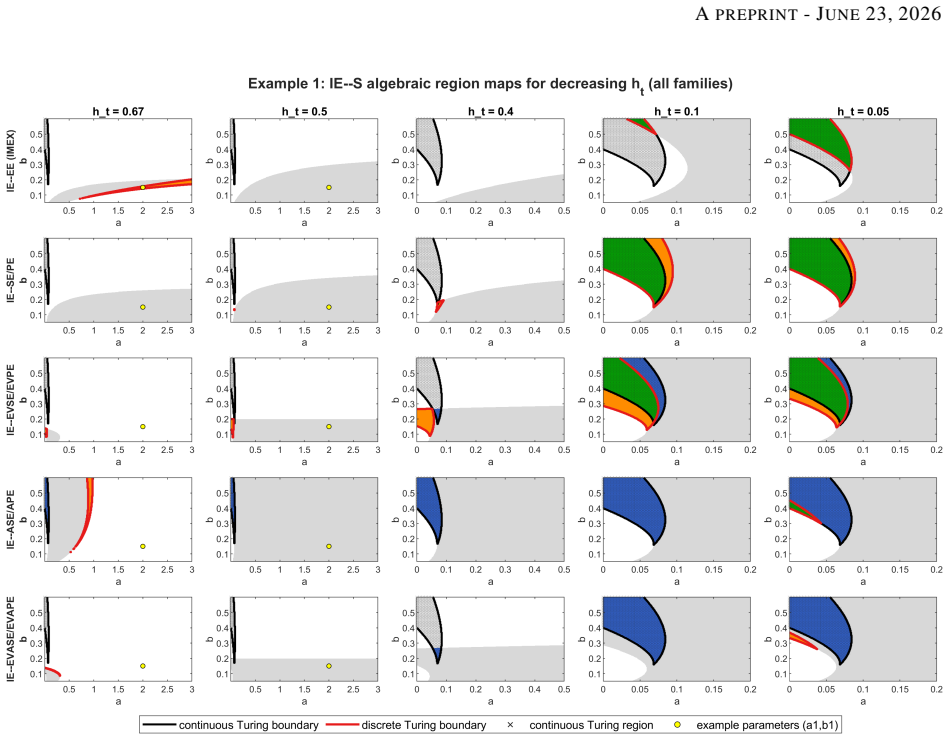
The paper shows that each splitting integrator induces its own discrete Turing region. For the IMEX family, the first Jury condition reproduces exactly the sign of the continuous Turing polynomial, and an explicit time-step condition is given that guarantees preservation of the continuous Turing region. Control of the second Jury condition is needed only in the Turing-stable regime. In contrast, other families like adjoint-symplectic can be spuriously stable in Turing regimes or generate spurious patterns in stable regimes.
Load-bearing premise
The modal amplification matrices from the first-order splitting and tensor-product discretization fully represent the discrete Turing behavior without extra effects from boundaries or higher-order terms.
Editorial analysis
A structured set of objections, weighed in public.
Referee Report
Summary. The manuscript develops matrix-oriented formulations of first-order splitting integrators (IE-S and EX-S families) for two-species reaction-diffusion systems on 2D domains, benchmarked on the Gierer-Meinhardt model. Starting from the continuous modal relation J_μ = J* - μ D, it derives fully discrete modal amplification matrices and applies Jury conditions to separate the continuous Turing mechanism (first Jury condition) from discrete effects (second Jury condition). For the IMEX integrator, an explicit time-step condition is derived to preserve the continuous Turing region; two opposite pathologies are exhibited in which IMEX generates spurious patterns in a Turing-stable regime or the adjoint-symplectic family suppresses patterns in a true Turing regime.
Significance. If the modal derivations hold, the work supplies a concrete, practical tool (the IMEX time-step bound) and a useful analytical separation of continuous versus discrete Turing effects via Jury conditions. This advances structure-preserving integration for pattern-forming systems by requiring that each integrator's induced discrete Turing region be compared against the continuous one before interpreting numerical patterns. The matrix-oriented tensor-product approach and explicit condition are strengths that could directly inform reliable simulation practice.
major comments (1)
- [Derivation of fully discrete modal amplification matrices and Jury conditions] The central claim that the explicit Δt condition for IMEX guarantees preservation of the continuous Turing region rests on the assumption that the eigenmodes of the discrete Laplacian (via tensor-product operators) and the associated Jury conditions fully capture discrete Turing behavior. This is load-bearing because the derivation of the amplification matrix (I - Δt μ D)^{-1}(I + Δt J) and the separation into first and second Jury conditions does not address potential additional artifacts from boundary conditions, nonlinear mode coupling in the Gierer-Meinhardt reaction terms, or the first-order nature of the splitting. If these effects are present, the bound may not ensure the discrete system is unstable precisely where the continuous system is.
minor comments (2)
- The abstract and introduction introduce the families IE-S and EX-S without an immediate explicit definition of the local maps (explicit, symplectic, adjoint-symplectic, Poisson, explicit-variant); a short clarifying sentence or table in §2 would improve readability.
- Notation for the continuous threshold (J_μ = J* - μ D) and the discrete amplification matrices should be cross-referenced consistently between the abstract and the main derivation sections to avoid any ambiguity for readers.
Simulated Author's Rebuttal
We thank the referee for the careful reading and the constructive major comment. We address the concern regarding the assumptions underlying the modal analysis and the IMEX time-step bound below.
read point-by-point responses
-
Referee: The central claim that the explicit Δt condition for IMEX guarantees preservation of the continuous Turing region rests on the assumption that the eigenmodes of the discrete Laplacian (via tensor-product operators) and the associated Jury conditions fully capture discrete Turing behavior. This is load-bearing because the derivation of the amplification matrix (I - Δt μ D)^{-1}(I + Δt J) and the separation into first and second Jury conditions does not address potential additional artifacts from boundary conditions, nonlinear mode coupling in the Gierer-Meinhardt reaction terms, or the first-order nature of the splitting. If these effects are present, the bound may not ensure the discrete system is unstable precisely where the continuous system is.
Authors: The analysis is deliberately restricted to the linearized modal problem, which is the standard approach for determining the onset of Turing instability (both continuous and discrete). The amplification matrix (I - Δt μ D)^{-1}(I + Δt J) is derived exactly for the first-order IMEX splitting applied to the linearized system, so the first-order character of the splitting is already incorporated. The separation into Jury conditions isolates the continuous mechanism (first condition, which reproduces the sign of det(J_μ)) from discrete artifacts (second condition). Nonlinear mode coupling governs post-instability pattern selection but does not change the linear instability threshold; the same linearization is used in the continuous theory and in the numerical examples. Boundary conditions enter through the spectrum of the discrete Laplacian; the tensor-product construction uses the exact eigenmodes of that operator on the chosen rectangular domain and compatible boundary conditions. The explicit Δt bound is therefore a guarantee for the linear discrete Turing region under these standard modeling assumptions. We do not claim the bound controls fully nonlinear or non-modal effects, which lie outside the scope of the linear stability analysis presented. revision: no
Circularity Check
Derivation proceeds directly from continuous modal relation to discrete Jury conditions without self-referential reduction or fitted inputs
full rationale
The paper begins with the given continuous threshold J_μ = J* - μ D and analytically constructs the discrete modal amplification matrices for the splitting methods, then applies standard Jury criteria to separate continuous (first condition) and discrete (second condition) effects. The explicit Δt bound for IMEX is obtained by enforcing sign agreement between the first Jury condition and the continuous Turing polynomial; this is a derived inequality, not a fitted parameter renamed as a prediction. No self-citations, uniqueness theorems, or ansatzes from prior author work are invoked as load-bearing steps in the provided text. The central claim therefore remains independent of its own outputs.
Assumptions & free parameters
assumptions (2)
- standard math Jury stability criteria apply to the modal amplification matrices of the fully discrete system
- domain assumption Tensor-product spatial discretizations yield a differential matrix equation that can be treated exactly or implicitly for the diffusion substep
Cite this review
Pith. "Pith review of Turing-region preservation in matrix-oriented splitting methods for reaction-diffusion systems." pith.science (2026). https://pith.science/paper/HJWREDHI
@misc{pith2026260623211,
  author       = {Pith},
  title        = {Pith review of: Turing-region preservation in matrix-oriented splitting methods for reaction-diffusion systems},
  year         = {2026},
  howpublished = {\url{https://pith.science/paper/HJWREDHI}},
  note         = {Machine review of arXiv:2606.23211}
}
abstract
We develop matrix-oriented formulations of first-order splitting integrators for two-species reaction-diffusion systems on 2D domains, using the Gierer-Meinhardt system as a benchmark for discrete Turing instability. Exploiting the differential matrix equation associated with tensor-product spatial discretizations, we obtain the families IE-S and EX-S, where the diffusive flow is treated by implicit Euler or exactly, respectively, and the reaction substep is approximated by explicit, symplectic, adjoint-symplectic, Poisson, and explicit-variant local maps. Starting from the continuous diffusion-driven instability threshold, expressed through the modal relation $J_\mu = J^* - \mu D$, we derive fully discrete modal amplification matrices and their Jury conditions. These conditions separate the continuous Turing mechanism, carried by the first Jury condition, from discrete effects carried by the second. Specializing the analysis to the Gierer-Meinhardt model, we exhibit two opposite pathologies. First, in a continuous Turing-stable regime, IMEX may generate a stable spurious pattern through a violation of the second Jury condition. Second, in a real continuous Turing regime, the adjoint-symplectic family may be spuriously stable and suppress the pattern that IMEX correctly detects. For IMEX, whose first Jury condition reproduces exactly the sign of the continuous Turing polynomial, we give an explicit time-step condition guaranteeing preservation of the continuous Turing region, and show that controlling the second Jury condition is needed only in the Turing-stable regime. These examples show that each integrator induces its own discrete Turing region, which should be compared with the continuous one before interpreting numerical patterns; we frame this requirement as preserving a qualitative property of the continuous problem, in the spirit of structure-preserving numerical integration.
Figures


Figures from the paper (9 more)


Forward citations
Cited by 1 Pith paper
-
Pattern formation: reactivity is not necessary for chemotaxis--driven instabilities
For reaction-diffusion-chemotaxis systems, a stable and non-reactive homogeneous equilibrium can still be destabilized by sufficiently strong chemotactic transport.
Reference graph
Works this paper leans on
-
[1]
Adaptive POD-DEIM correction for Turing pattern approxi- mation in reaction–diffusion PDE systems.Journal of Numerical Mathematics, 31(3):205–229, 2023
Alessandro Alla, Angela Monti, and Ivonne Sgura. Adaptive POD-DEIM correction for Turing pattern approxi- mation in reaction–diffusion PDE systems.Journal of Numerical Mathematics, 31(3):205–229, 2023
2023
-
[2]
Piecewise DMD for oscillatory and Turing spatio-temporal dynamics.Computers & Mathematics with Applications, 160:108–124, 2024
Alessandro Alla, Angela Monti, and Ivonne Sgura. Piecewise DMD for oscillatory and Turing spatio-temporal dynamics.Computers & Mathematics with Applications, 160:108–124, 2024
2024
-
[3]
A structure-preserving ldg discretization of the fisher-kolmogorov equation for modeling neurodegenerative diseases.Mathematics and Computers in Simulation, 2025
Paola F Antonietti, Mattia Corti, Sergio Gómez, and Ilaria Perugia. A structure-preserving ldg discretization of the fisher-kolmogorov equation for modeling neurodegenerative diseases.Mathematics and Computers in Simulation, 2025
2025
-
[4]
Chapman and Hall/CRC, 2016
Sergio Blanes and Fernando Casas.A concise introduction to geometric numerical integration. Chapman and Hall/CRC, 2016
2016
-
[5]
Positivity-preserving methods for ordinary differential equa- tions.ESAIM: Mathematical Modelling and Numerical Analysis, 56(6):1843–1870, 2022
Sergio Blanes, Arieh Iserles, and Shev Macnamara. Positivity-preserving methods for ordinary differential equa- tions.ESAIM: Mathematical Modelling and Numerical Analysis, 56(6):1843–1870, 2022
2022
-
[6]
Weakly nonlinear analysis of turing patterns in a morphochemical model for metal growth.Computers & Mathematics with Applications, 70(8):1948–1969, 2015
Benedetto Bozzini, Gaetana Gambino, Deborah Lacitignola, Salvatore Lupo, Marco Sammartino, and Ivonne Sgura. Weakly nonlinear analysis of turing patterns in a morphochemical model for metal growth.Computers & Mathematics with Applications, 70(8):1948–1969, 2015
1948
-
[7]
A semi- automatic numerical algorithm for turing patterns formation in a reaction-diffusion model.IEEE Access, 6:4720– 4724, 2017
Rosanna Campagna, Salvatore Cuomo, Francesco Giannino, Gerardo Severino, and Gerardo Toraldo. A semi- automatic numerical algorithm for turing patterns formation in a reaction-diffusion model.IEEE Access, 6:4720– 4724, 2017
2017
-
[8]
General runge– kutta tase methods for reaction–diffusion problems: D
Dajana Conte, Juan Ignacio Montijano, Giovanni Pagano, Beatrice Paternoster, and Luis Rández. General runge– kutta tase methods for reaction–diffusion problems: D. conte et al.Journal of Scientific Computing, 106(2):57, 2026
2026
Show all 30 references
-
[9]
Matrix-oriented discretization methods for reaction-diffusion PDEs: comparisons and applications.Computers & Mathematics with Applications, 78(8):2067–2085, 2019
Maria Chiara D’Autilia, Ivonne Sgura, and Valeria Simoncini. Matrix-oriented discretization methods for reaction-diffusion PDEs: comparisons and applications.Computers & Mathematics with Applications, 78(8):2067–2085, 2019
-
[10]
Numerical analysis of a first-order in time implicit- symplectic scheme for predator–prey systems.Computers & Mathematics with Applications, 74(5):948–961, 2017
Fasma Diele, Marcus Garvie, and Catalin Trenchea. Numerical analysis of a first-order in time implicit- symplectic scheme for predator–prey systems.Computers & Mathematics with Applications, 74(5):948–961, 2017
2017
-
[11]
Krause, Deborah Lacitignola, Carmela Marangi, Angela Monti, and Edgardo Villar- Sepúlveda
Fasma Diele, Andrew L. Krause, Deborah Lacitignola, Carmela Marangi, Angela Monti, and Edgardo Villar- Sepúlveda. Transient instability and patterns of reactivity in diffusive-chemotaxis soil carbon dynamics.Bulletin of Mathematical Biology, 87:162, 2025
2025
-
[12]
Geometric numerical integration in ecological modelling.Mathematics, 8(1):25, 2020
Fasma Diele and Carmela Marangi. Geometric numerical integration in ecological modelling.Mathematics, 8(1):25, 2020
2020
-
[13]
Adapted imex numerical methods for reaction-diffusion problems.International journal of circuits, systems and signal processing, 13:507–515, 2019
Raffaele D’Ambrosio, Martina Moccaldi, Beatrice Paternoster, et al. Adapted imex numerical methods for reaction-diffusion problems.International journal of circuits, systems and signal processing, 13:507–515, 2019
2019
-
[14]
A theory of biological pattern formation.Kybernetik, 12:30–39, 1972
Alfred Gierer and Hans Meinhardt. A theory of biological pattern formation.Kybernetik, 12:30–39, 1972. 31 APREPRINT- JUNE23, 2026
1972
-
[15]
Springer Science & Business Media, 2006
Ernst Hairer, Christian Lubich, and Gerhard Wanner.Geometric numerical integration: structure-preserving algorithms for ordinary differential equations, volume 31. Springer Science & Business Media, 2006
2006
-
[16]
Exploring spatiotem- poral complexity of a predator-prey system with migration and diffusion by a three-chain coupled map lattice
Tousheng Huang, Huayong Zhang, Xuebing Cong, Ge Pan, Xiumin Zhang, and Zhao Liu. Exploring spatiotem- poral complexity of a predator-prey system with migration and diffusion by a three-chain coupled map lattice. Complexity, 2019(1):3148323, 2019
2019
-
[17]
Modified patankar linear multistep methods for production-destruction systems.Journal of Scientific Computing, 102(3):87, 2025
Giuseppe Izzo, Eleonora Messina, Mario Pezzella, and Antonia Vecchio. Modified patankar linear multistep methods for production-destruction systems.Journal of Scientific Computing, 102(3):87, 2025
2025
-
[18]
Stability of multidimensional scalar and matrix polynomials.Proceedings of the IEEE, 66(9):1018–1047, 1978
Eliahu Ibrahim Jury. Stability of multidimensional scalar and matrix polynomials.Proceedings of the IEEE, 66(9):1018–1047, 1978
1978
-
[19]
Stefan Kopecz and Andreas Meister. Unconditionally positive and conservative third order modified patankar– runge–kutta discretizations of production–destruction systems.BIT Numerical Mathematics, 58(3):691–728, 2018
2018
-
[20]
Turing instabilities are not enough to ensure pattern formation.Bulletin of mathematical biology, 86(2):21, 2024
Andrew L Krause, Eamonn A Gaffney, Thomas Jun Jewell, Václav Klika, and Benjamin J Walker. Turing instabilities are not enough to ensure pattern formation.Bulletin of mathematical biology, 86(2):21, 2024
2024
-
[21]
Geco: Geometric conservative nonstandard schemes for biochemical systems.Applied Numerical Mathematics, 155:38–57, 2020
Angela Martiradonna, Gianpiero Colonna, and Fasma Diele. Geco: Geometric conservative nonstandard schemes for biochemical systems.Applied Numerical Mathematics, 155:38–57, 2020
2020
-
[22]
Numerical low-rank approximation of matrix differential equations.Journal of Computational and Applied Mathematics, 340:602– 614, 2018
Hermann Mena, Alexander Ostermann, Lena-Maria Pfurtscheller, and Chiara Piazzola. Numerical low-rank approximation of matrix differential equations.Journal of Computational and Applied Mathematics, 340:602– 614, 2018
2018
-
[23]
Patterns in soil organic carbon dy- namics: Integrating microbial activity, chemotaxis and data-driven approaches.Mathematics and Computers in Simulation, 234:86–101, 2025
Angela Monti, Fasma Diele, Deborah Lacitignola, and Carmela Marangi. Patterns in soil organic carbon dy- namics: Integrating microbial activity, chemotaxis and data-driven approaches.Mathematics and Computers in Simulation, 234:86–101, 2025
2025
-
[24]
Turing patterns on discrete topologies: from networks to higher-order structures
Riccardo Muolo, Lorenzo Giambagli, Hiroya Nakao, Duccio Fanelli, and Timoteo Carletti. Turing patterns on discrete topologies: from networks to higher-order structures. InProceedings A, volume 480, page 20240235. The Royal Society, 2024
2024
-
[25]
Mathematical biology II: spatial models and biomedical applications.Interdisciplinary Applied Mathematics, 18, 2003
James D Murray. Mathematical biology II: spatial models and biomedical applications.Interdisciplinary Applied Mathematics, 18, 2003
2003
-
[26]
A determinant criterion for stability analysis and design of linear discrete systems.Technical Gazette, 22(6):1511–1516, 2015
Ramesh Periyasamy and Manikandan Venugopal. A determinant criterion for stability analysis and design of linear discrete systems.Technical Gazette, 22(6):1511–1516, 2015
2015
-
[27]
Implicit-explicit methods for reaction-diffusion problems in pattern formation.Journal of Mathematical Biology, 34(2):148–176, 1995
Steven J Ruuth. Implicit-explicit methods for reaction-diffusion problems in pattern formation.Journal of Mathematical Biology, 34(2):148–176, 1995
1995
-
[28]
Numerical bifurcation anal- ysis of turing and symmetry broken patterns of a pde model for vegetation dynamics.Journal of Mathematical Biology, 92(5):66, 2026
Konstantinos Spiliotis, Lucia Russo, Constantinos Siettos, and Francesco Giannino. Numerical bifurcation anal- ysis of turing and symmetry broken patterns of a pde model for vegetation dynamics.Journal of Mathematical Biology, 92(5):66, 2026
2026
-
[29]
The chemical basis of morphogenesis.Philosophical Transactions of the Royal Society of London
Alan M Turing. The chemical basis of morphogenesis.Philosophical Transactions of the Royal Society of London. Series B, Biological Sciences, 237(641):37–72, 1952
1952
-
[30]
Visualpde: rapid interactive simulations of partial differential equations.Bulletin of Mathematical Biology, 85(11):113, 2023
Benjamin J Walker, Adam K Townsend, Alexander K Chudasama, and Andrew L Krause. Visualpde: rapid interactive simulations of partial differential equations.Bulletin of Mathematical Biology, 85(11):113, 2023. 32
2023
Reviewed June 26, 2026 · model on record in the stance chip above.
Discussion (0). Continue with ORCID to comment.