REVIEW 4 major objections 4 minor 66 references
The origin of R CrA variability: A complex triple system hosting a disk
T0 review · 4 major / 4 minor · reviewed 2026-08-14 · deepseek-v4-flash
Pith's one-line read R CrA is a close binary of about 3.0 and 2.3 solar masses whose 65.767-day orbit grazes a circumbinary disk, and its century-long dimming is caused by disk precession driven by an M-dwarf companion, making the system a triple.
desk verdict A plausible and well-tested circumbinary-disk model for R CrA's 65.8-day variability, but the binary masses and the 61-yr triple period are anchored to a luminosity proxy that is not independently validated. read the letter →
The pith
A machine-rendered reading of the paper's core claim, the machinery that carries it, and where it could break.
The reading
What carries the argument
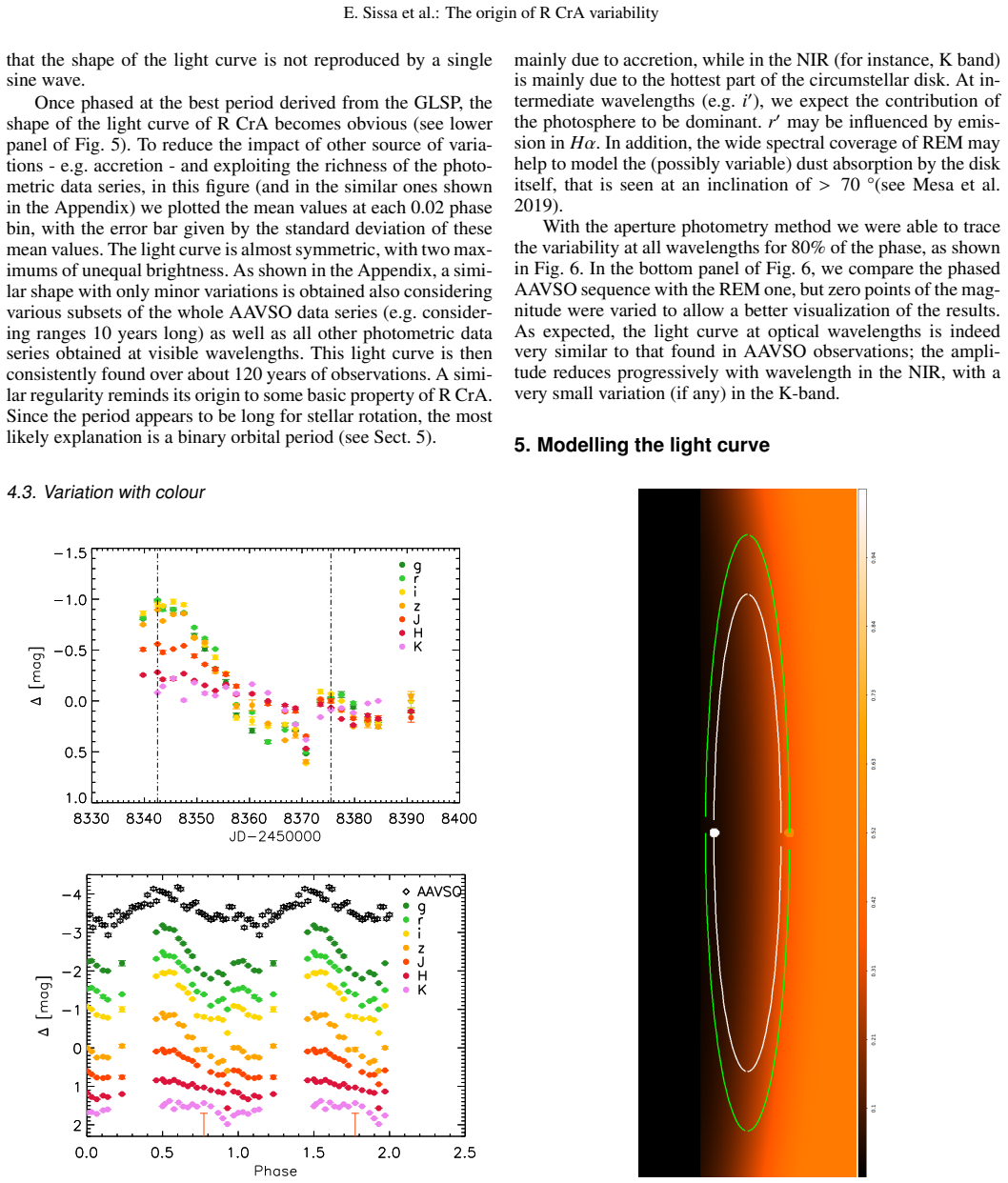
The load-bearing mechanism is a photometric model of a two-star system partially hidden by a circumbinary disk: two point sources in circular Keplerian orbit around a common center of mass, viewed at an assumed inclination of 80°, with extinction described by a Gaussian vertical profile $\exp(-(z/h_0)^2)$, where $h_0$ is the half-thickness of the absorbing slab at the binary's semimajor axis. The two unequal maxima map to the times when each component is farthest from the disk's near side, and the fitted value of $h_0$ controls the amplitude and shape of the curve; its secular increase is the specific evidence for precession. An independent scaling step sets the stellar masses: the absolute magnitude in the 4.6 µm band is taken as a proxy for total stellar luminosity through the calibrated relation $M_V = M_{W2} + 4.45$, equivalent to an inner disk that reprocesses 17% of the stellar light, and this converts photometry into luminosity, mass, and age before the binary split.
What would settle it
Measure the system's radial velocity every few days over one 65.767-day orbit. The model predicts periodic variations of order ±70 km/s, with both components contributing near quadrature; finding no such periodic signal, or a velocity curve whose phase does not match the photometric double maximum at the assumed systemic velocity of $-2$ km/s, would rule out the binary interpretation.
Extended reading notes
Core claim
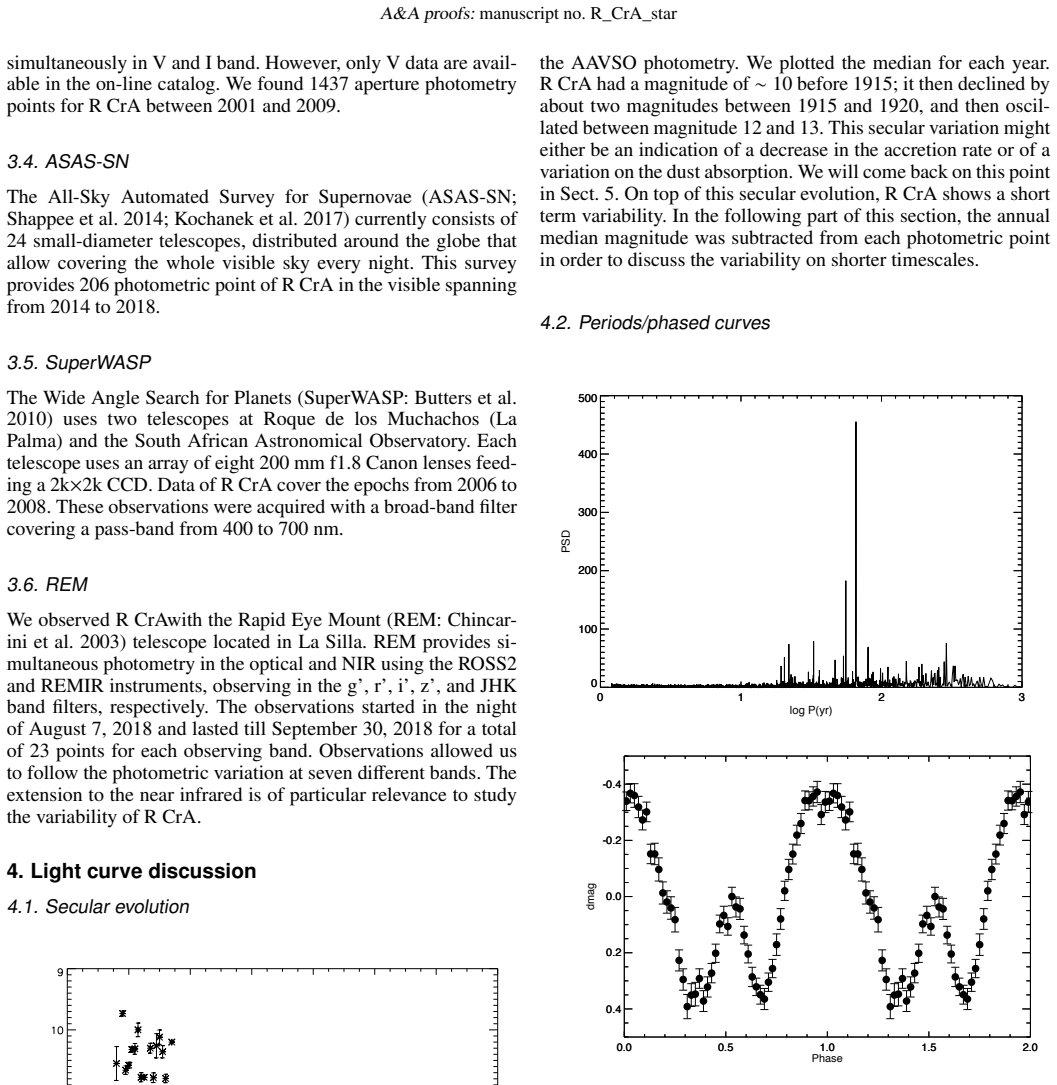
The central claim is that the observed optical light curve of R CrA, with two unequal maxima phased to 65.767±0.007 days, is produced by two stars in a circular Keplerian orbit seen just grazing a co-planar circumbinary disk: as each component moves behind the dusty near side of the disk, its light is attenuated. From the ratio of the two maxima the authors derive a luminosity ratio $L_B/L_A = 0.49\pm0.07$ and, via a pre-main-sequence mass-luminosity relation, a mass ratio of $0.77\pm0.05$. Splitting the single-star mass of $3.5\pm0.5\,M_\odot$ in that ratio gives $M_A = 3.02\pm0.43\,M_\odot$ and $M_B = 2.32\pm0.35\,M_\odot$, a total of $5.34\pm0.8\,M_\odot$, and a binary separation of $0.56$ au. Fitted to light-curve segments spanning 120 years, the same model shows the disk's effective vertical height $h_0$ increasing with time, which the paper reads as a slow increase of extinction caused by precession of the outer disk; from a companion mass of $0.25\,M_\odot$ at about 30 au, the analytic precession period is about 1500 yr and the implied orbital period of that companion is $61\pm4$ yr, consistent with the companion's measured radial velocity. R CrA would therefore be a triple system: a close intermediate-mass binary plus a distant low-mass companion, all surrounded by a circumbinary disk.
Load-bearing premise
The whole luminosity and mass scale - the single-star value near 3.5 solar masses, its split into 3.02 and 2.32 solar masses, the 0.56 au separation, and the 61-year companion period - rests on the assumption that the 4.6 µm brightness of any Herbig AeBe star is a universal proxy for that star's total brightness, with always the same 17% of stellar light reprocessed by the inner disk.
Editorial extensions
If this is right
- The central object of R CrA should be listed as a binary with a 65.767-day period, 0.56 au separation, and total mass of 5.34 solar masses, rather than a single Herbig AeBe star, changing its inferred evolutionary state and disk geometry.
- A radial-velocity campaign across one orbit should reveal variations of order ±70 km/s, with both stellar components contributing near quadrature; the absence of such a signal would falsify the binary interpretation.
- The secular trend in $h_0$ predicts continued slow fading and a measurable change of the disk's effective inclination over the coming decades, consistent with a precession period of about 1500 yr.
- Because the model requires grey extinction (the same $h_0$ in $g'r'i'z'$), the circumbinary dust grains must be larger than a few microns, tying the variability to the high $R_V = 4.7$ reddening toward R CrA.
- The M-dwarf companion's orbit should have a period near 61 yr, so its position angle and radial velocity should continue to change in a way that can be tracked astrometrically.
Reading between the lines
- Inference: if the 4.6 µm luminosity proxy holds for other embedded Herbig AeBe stars, the same two-step method (proxy luminosity, then binary light-curve modeling) could recover masses and multiplicities for objects whose optical photometry is heavily extincted, where single-star mass estimates are usually unreliable.
- Inference: the binary hypothesis predicts a photocenter wobble of a few milliarcseconds on the 65.767-day orbit; precise epoch astrometry over one cycle could confirm the companion even when spectral lines are too blended to decompose.
- Inference: if the precession interpretation is correct, the extinction toward R CrA should oscillate on the roughly 61-yr companion period rather than increase monotonically; the current trend could reverse within a few decades, which would distinguish precession from a true thickening of the disk.
- Inference: systems like R CrA may be common - any Herbig AeBe star with a stable period of tens of days, an unequal double-maximum light curve, and near-constant near-infrared brightness is a candidate grazing circumbinary binary, and the model gives a direct way to search for such objects in long-baseline photometric surveys.
Signed reviews
Editorial analysis
A structured set of objections, weighed in public.
Referee Report
Summary. The paper analyzes archival and new photometric data of the Herbig AeBe star R CrA, spanning more than a century, together with a single-epoch SINFONI spectrum. It derives stellar parameters using a WISE W2-based luminosity proxy with a fixed 17% disk-reprocessed fraction, identifies a stable 65.767-day period in the optical light curve, and interprets the phased light curve as extinction of a close binary by a circumbinary disk viewed at grazing inclination. From this model the authors derive component masses of 3.02 and 2.32 Msun, a total mass of 5.34 Msun, and a 0.56-au separation, and they propose that the secular dimming is caused by precession of a slightly inclined disk driven by an M-dwarf companion, making R CrA a triple system. The single SINFONI radial velocity of the primary is consistent with the model prediction at the observed phase, but no full orbital RV solution is presented.
Significance. If the interpretation holds, this would be a rare and valuable case of a young intermediate-mass binary embedded in a circumbinary disk, with a well-documented century-long photometric record linking binary/dust geometry to secular disk precession. The paper's strengths include the assembly of the long photometric baseline, the stability of the 65.767-day period across many datasets, the simple physical model that reproduces the phased curves, and the explicit prediction of ±70 km/s RV variations that can be tested with future spectroscopy. However, the quantitative masses and the triple-system scenario rest on a series of model assumptions (universal W2 reprocessing fraction, adopted inclination of 80 degrees, mass-luminosity scaling) and on one radial-velocity epoch, so the central claim is not yet dynamically secured.
major comments (4)
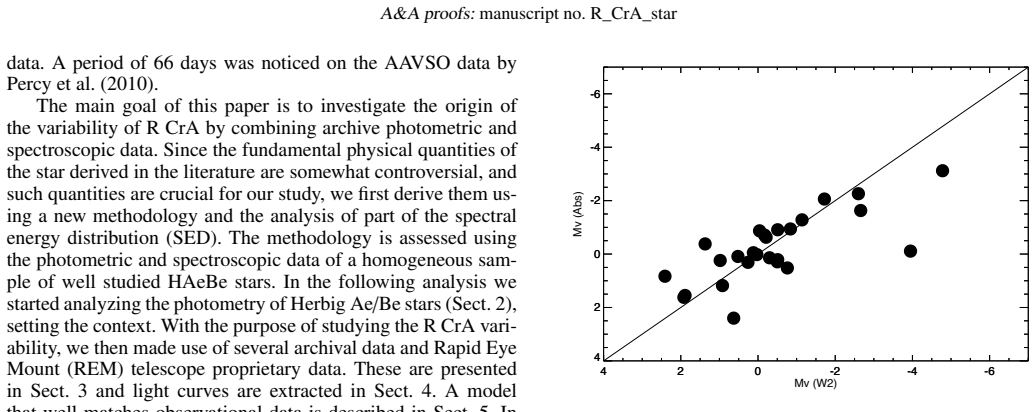
- [Sect. 2, Eq. (1) and Fig. 2] The luminosity of R CrA, and hence every mass quoted in the paper, is derived from the assumption that the WISE W2 flux is a universal proxy for total stellar luminosity with a fixed 17% disk-reprocessed fraction. The agreement between MV(W2) and MV(abs) in Fig. 2 is not an independent validation of this fraction for R CrA, because the dJ disk-contamination correction in Eq. (1) is computed from the same assumed 17% reprocessing. R CrA is also included in the Table 1 sample used to set the MV = MW2 + 4.45 zero point, and the inner disk in a 0.56-au binary or a near-edge-on geometry need not have the same reprocessing fraction as the calibration sample. If the 17% assumption fails for R CrA, the single-star mass 3.5 ± 0.5 Msun, the binary masses 3.02/2.32 Msun, the total mass 5.34 Msun, and the 61-yr companion period all shift, weakening the quantitative anchor of the triple-system interpretation.
- [Sect. 5, Modelling the light curve] The model has an explicit degeneracy between the inclination of the system and the disk scale height h0, and the adopted inclination of 80 degrees is acknowledged in the text as arbitrary. The absence of eclipses only excludes inclinations larger than about 86 degrees, so the specific geometry claim that the orbit is seen at an angle grazing the circumbinary disk is not uniquely determined by the photometry. The paper should state what constraints, if any, actually set the inclination and should present h0 and the derived flaring angle as conditional on this assumption rather than as measured parameters.
- [Sect. 5, masses; Sect. 6, SINFONI radial velocity] The binary masses are not measured dynamically: they are scaled from the single-star mass using the photometric luminosity ratio LB/LA = 0.49 and a pre-main-sequence mass-luminosity relation, and the single SINFONI radial velocity at phase 0.459 is consistent with the model but provides only one point on the orbit. The quoted uncertainties (MA = 3.02 ± 0.43 Msun, MB = 2.32 ± 0.35 Msun) therefore reflect only the propagation of the luminosity error, not the model uncertainty in the mass-luminosity relation or the unresolved degeneracies in the light-curve model. The paper's own call for future RV monitoring underscores that the binary is not yet confirmed by an orbital solution.
- [Sect. 5, final paragraph; Sect. 7] The claimed period of the M-star companion, 61 ± 4 yr, is computed from Kepler's law using the assumed semimajor axis of 27-28 au and the model-dependent total mass of 5.34 Msun, and the statement that this agrees with the short-term oscillations in phase and h0 is circular because the same total mass entered the period calculation. The ~50-yr spacing of the oscillations in Fig. 8 is not established by a periodogram, so the precession/triple-system conclusion should be presented as a tentative scenario until an RV orbit or a measured astrometric period is available. The concluding sentence 'R CrA is then a triple star' overstates the current evidence.
minor comments (4)
- [Sect. 5, figure cross-reference] The text at the end of Sect. 5 refers to 'the short-term oscillation in phase and h0 values shown in Fig. 7', but Fig. 7 is the schematic view of the extinction model; the secular changes are displayed in Fig. 8. Please correct the cross-reference.
- [Sect. 2, Eq. (1)] The quantity dJ is not defined; please state whether it is a magnitude offset, a flux ratio, or a color excess, and give its units.
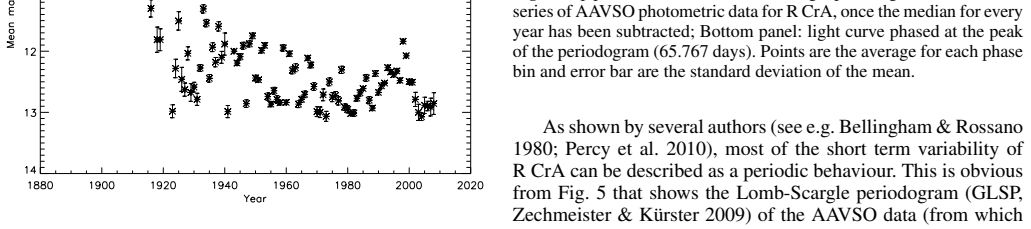
- [Sect. 4.3 / Sect. 5] The statement that the same h0 describes data in all REM bands and hence that the extinction is grey would be more convincing if the per-band fits or a plot of h0 versus wavelength were shown, since h0 is a geometric scale height and its wavelength independence is the key evidence for grey extinction.
- [Table 2] The entry 'Temperature log Teff = 3.98 K' has an inappropriate unit: log Teff is dimensionless when Teff is expressed in kelvin. Please remove the 'K' or clarify the notation.
Circularity Check
The W2-based luminosity scale is partly self-validated: the extinction-corrected cross-check shares the same 0.17 reprocessing fraction, so the binary masses and the 61-yr companion period inherit a circular confidence anchor.
-
fitted input called prediction
[Sect. 2 (Eq. 1 and Fig. 2); binary masses in Sect. 5; 61-yr period in Sect. 5/7]
"With this approach we find that MV = MW2 + 4.45 ... the warm disk re-converts in thermal emission a fraction equal to 0.17 of the total energy emitted by the star. ... [dJ] is derived by fitting data obtained by combining a hot black body (of variable temperature) describing the photospheric spectrum with a cooler one (with temperature of 1500 K) that re-process 17% of the radiation."
The W2-based luminosity (MV W2 = -0.30) uses MV = MW2 + 4.45, which encodes the fitted 0.17 reprocessed fraction. The supposedly independent extinction-based MV abs is derived from V-J colours after correcting J with Eq. (1), computed from the same 0.17 model. The Fig. 2 agreement is thus partly tautological: a wrong 0.17 would move both quantities in a coupled way, so it cannot independently validate the fraction for R CrA. The single-star mass (3.5 Msun), the binary masses (3.02/2.32 Msun), and the 61-yr companion period all scale from this luminosity anchor. The light curve and radial-velocity checks are independent, so circularity is partial.
full rationale
The paper's central new observable is the stable 65.767-day photometric modulation and its century-scale secular evolution; the binary-plus-circumbinary-disk extinction model is a reasonable interpretation of that light curve, and the radial-velocity agreement with the model is an independent consistency check. However, the absolute mass scale of the derived binary is not an independent dynamical measurement: it is anchored to the WISE W2 proxy relation MV = MW2 + 4.45, which assumes a universal 0.17 reprocessed fraction. The extinction-based alternative used to validate the proxy is itself computed with Eq. (1) derived from that same 0.17 assumption, so Fig. 2's good agreement does not independently confirm the luminosity scale for R CrA. The 61-yr M-dwarf period is a Keplerian consequence of the model total mass (5.34 Msun) and the observed companion separation, so its agreement with the vague 50-100-yr oscillation of h0 is a model-consistency check rather than a first-principles prediction. These issues do not make the variability model circular; the light-curve morphology, the 65.767-day period, and the wavelength dependence observed by REM are independent inputs. The circularity is confined to how much independent support the luminosity/mass scale receives, hence a score of 4 rather than higher.
Assumptions & free parameters
free parameters (7)
- MV - MW2 zero-point offset =
4.45 mag
- Disk reprocessed fraction =
0.17
- R_V (total-to-selective extinction ratio) =
4.7
- Inclination of the system =
80 deg
- Disk thickness scale h0 =
0.23 to 0.27 (per epoch)
- Luminosity ratio LB/LA =
0.49 average
- Phase delay =
Small offsets per epoch
assumptions (7)
- domain assumption W2 luminosity is a universal proxy for total stellar luminosity in HAeBe stars with a fixed reprocessed fraction
- domain assumption Inner disk temperature is fixed at 1500 K and disk SED is similar across objects
- ad hoc to paper The 65.767-day period is the orbital period of a circular binary; the binary and disk are coplanar
- ad hoc to paper Disk extinction has a Gaussian vertical profile exp(-(z/h0)^2)
- standard math PMS evolutionary tracks (Pisa group) and Pecaut & Mamajek relations are accurate
- domain assumption Systemic radial velocity is -2 km/s from interstellar K I lines
- domain assumption Reddening law with R_V=4.7 applies to R CrA
invented entities (1)
-
Central close binary components A and B (M_A=3.02 M_sun, M_B=2.32 M_sun)
independent evidence
Cite this review
Pith. "Pith review of The origin of R CrA variability: A complex triple system hosting a disk." pith.science (2026). https://pith.science/paper/HKERP5OB
@misc{pith2026190807256,
  author       = {Pith},
  title        = {Pith review of: The origin of R CrA variability: A complex triple system hosting a disk},
  year         = {2026},
  howpublished = {\url{https://pith.science/paper/HKERP5OB}},
  note         = {Machine review of arXiv:1908.07256}
}
abstract
R~CrA is the brightest member of the Coronet star forming region and it is the closest Herbig AeBe star with a spectrum dominated by emission lines. Its luminosity has been monitored since the end of the 19th century, but the origin of its variability, which shows a stable period of $65.767\pm 0.007$~days, is still unknown. We studied photometric and spectroscopic data for this star to investigate the nature of the variability of R~CrA. We exploited the fact that near infrared luminosity of the Herbig AeBe stars is roughly proportional to the total luminosity of the stars to derive the absorption, and then mass and age of R~CrA. In addition, we model the periodic modulation of the light curve as due to partial attenuation of a central binary by a circumbinary disk. This model reproduces very well the observations. We found that the central object in R~CrA is a very young ($1.5\pm 1.5$~Myr), highly absorbed ($A_V=5.47\pm 0.4$~mag) binary; we obtain masses of $M_A=3.02\pm 0.43$~M$_\odot$ and $M_B=2.32\pm 0.35$~M$_\odot$ for the two components. We propose that the secular decrease of the R~CrA apparent luminosity is due to a progressive increase of the disk absorption. This might be related to precession of a slightly inclined disk caused by the recently discovered M-dwarf companion. Thus, R~CrA may be a triple system hosting a disk.
Figures


Figures from the paper (7 more)


Reference graph
Works this paper leans on
-
[1]
, " * write output.state after.block = add.period write newline
ENTRY address archiveprefix author booktitle chapter edition editor howpublished institution eprint journal key month note number organization pages publisher school series title type volume year label extra.label sort.label short.list INTEGERS output.state before.all mid.sentence after.sentence after.block FUNCTION init.state.consts #0 'before.all := #1 ...
-
[2]
write newline
" write newline "" before.all 'output.state := FUNCTION n.dashify 't := "" t empty not t #1 #1 substring "-" = t #1 #2 substring "--" = not "--" * t #2 global.max substring 't := t #1 #1 substring "-" = "-" * t #2 global.max substring 't := while if t #1 #1 substring * t #2 global.max substring 't := if while FUNCTION word.in bbl.in " " * FUNCTION format....
-
[3]
M., Manara , C
Alcal \'a , J. M., Manara , C. F., Natta , A., et al. 2017, , 600, A20
2017
-
[4]
M., Spezzi , L., Chapman , N., et al
Alcal \'a , J. M., Spezzi , L., Chapman , N., et al. 2008, , 676, 427
work page 2008
-
[5]
Aronow , R. A., Herbst , W., Hughes , A. M., Wilner , D. J., & Winn , J. N. 2018, , 155, 47
work page 2018
-
[6]
Bellingham , J. G. & Rossano , G. S. 1980, , 85, 555
work page 1980
-
[7]
Bessell , M. S. & Brett , J. M. 1988, , 100, 1134
work page 1988
-
[8]
2019, arXiv e-prints [ [arXiv] 1902.04080 ]
Beuzit , J.-L., Vigan , A., Mouillet , D., et al. 2019, arXiv e-prints [ [arXiv] 1902.04080 ]
arXiv 2019
Show all 66 references
-
[9]
A., The , P
Bibo , E. A., The , P. S., & Dawanas , D. N. 1992, , 260, 293
1992
-
[10]
Blondel , P. F. C. & Djie , H. R. E. T. A. 2006, , 456, 1045
2006
-
[11]
2004, The Messenger, 117, 17
Bonnet , H., Abuter , R., Baker , A., et al. 2004, The Messenger, 117, 17
2004
-
[12]
W., West , R
Butters , O. W., West , R. G., Anderson , D. R., et al. 2010, , 520, L10
2010
-
[13]
A., Clayton , G
Cardelli , J. A., Clayton , G. C., & Mathis , J. S. 1989, , 345, 245
1989
-
[14]
2017, in SF2A-2017: Proceedings of the Annual meeting of the French Society of Astronomy and Astrophysics, ed
Chauvin , G., Desidera , S., Lagrange , A.-M., et al. 2017, in SF2A-2017: Proceedings of the Annual meeting of the French Society of Astronomy and Astrophysics, ed. C. Reyl \'e , P. Di Matteo , F. Herpin , E. Lagadec , A. Lan c on , Z. Meliani , & F. Royer , 331--335
2017
-
[15]
H., Pecaut , M., Mamajek , E
Chen , C. H., Pecaut , M., Mamajek , E. E., Su , K. Y. L., & Bitner , M. 2012, , 756, 133
2012
-
[16]
G., Myers , P
Chen , H., Grenfell , T. G., Myers , P. C. , & Hughes , J. D. 1997, , 478, 295
1997
-
[17]
2003, The Messenger, 113, 40
Chincarini , G., Zerbi , F., Antonelli , A., et al. 2003, The Messenger, 113, 40
2003
-
[18]
M., Skrutskie , M
Cutri , R. M., Skrutskie , M. F., van Dyk , S., et al. 2003, VizieR Online Data Catalog, 2246
2003
-
[19]
Cutri , R. M. e. 2013, VizieR Online Data Catalog, 2328
2013
-
[20]
Ducati , J. R. 2002, VizieR Online Data Catalog, 2237
2002
-
[21]
D., Davies , J
Eiroa , C., Oudmaijer , R. D., Davies , J. K., et al. 2002, , 384, 1038
2002
-
[22]
2003, in , Vol
Eisenhauer , F., Abuter , R., Bickert , K., et al. 2003, in , Vol. 4841, Instrument Design and Performance for Optical/Infrared Ground-based Telescopes, ed. M. Iye & A. F. M. Moorwood , 1548--1561
2003
-
[23]
R., Oudmaijer , R
Fairlamb , J. R., Oudmaijer , R. D., Mendigut \' a , I., Ilee , J. D., & van den Ancker , M. E. 2015, , 453, 976
2015
-
[24]
Forbrich , J., Preibisch , T., & Menten , K. M. 2006, , 446, 155
2006
-
[25]
Gaia Collaboration , Brown , A. G. A., Vallenari , A., et al. 2018, , 616, A1
2018
-
[26]
2019, arXiv e-prints, arXiv:1906.06910
Garufi , A., Podio , L., Bacciotti , F., et al. 2019, arXiv e-prints, arXiv:1906.06910
2019 arXiv
-
[27]
Gontcharov , G. A. 2006, Astronomy Letters, 32, 759
2006
-
[28]
O., Corbally , C
Gray , R. O., Corbally , C. J., Garrison , R. F., et al. 2006, , 132, 161
2006
-
[29]
& Persson , S
Hamann , F. & Persson , S. E. 1992, , 82, 285
1992
-
[30]
K., Mattila , K., et al
Harju , J., Haikala , L. K., Mattila , K., et al. 1993, , 278, 569
1993
-
[31]
Herbig , G. H. 1960, , 4, 337
1960
-
[32]
& Shevchenko , V
Herbst , W. & Shevchenko , V. S. 1999, , 118, 1043
1999
-
[33]
2004, , 127, 1682
Hern \'a ndez , J., Calvet , N., Brice \ n o , C., Hartmann , L., & Berlind , P. 2004, , 127, 1682
2004
-
[34]
A., Strom , S
Hillenbrand , L. A., Strom , S. E., Vrba , F. J., & Keene , J. 1992, , 397, 613
1992
-
[35]
A., Aller , K
Johnson , J. A., Aller , K. M., Howard , A. W., & Crepp , J. R. 2010, , 122, 905
2010
-
[36]
Kenyon , S. J. & Hartmann , L. 1987, , 323, 714
1987
-
[37]
S., Shappee , B
Kochanek , C. S., Shappee , B. J., Stanek , K. Z., et al. 2017, , 129, 104502
2017
-
[38]
2010, , 403, 1949
Koen , C., Kilkenny , D., van Wyk , F., & Marang , F. 2010, , 403, 1949
2010
-
[39]
2009, , 508, 787
Kraus , S., Hofmann , K.-H., Malbet , F., et al. 2009, , 508, 787
2009
-
[40]
2017, , 599, A85
Lazareff , B., Berger , J.-P., Kluska , J., et al. 2017, , 599, A85
2017
-
[41]
& Bhatt , H
Manoj , P. & Bhatt , H. C. 2005, , 429, 525
2005
-
[42]
P., Moro-Mart \' n , A., Eiroa , C., et al
Marshall , J. P., Moro-Mart \' n , A., Eiroa , C., et al. 2014, , 565, A15
2014
-
[43]
2008, , 492, 451
Meijer , J., Dominik , C., de Koter , A., et al. 2008, , 492, 451
2008
-
[44]
2008, , 177, 551
Mer \' n , B., J rgensen , J., Spezzi , L., et al. 2008, , 177, 551
2008
-
[45]
2004, , 419, 301
Mer \' n , B., Montesinos , B., Eiroa , C., et al. 2004, , 419, 301
2004
-
[46]
2019, , 624, A4
Mesa , D., Bonnefoy , M., Gratton , R., et al. 2019, , 624, A4
2019
-
[47]
2009, , 495, 901
Montesinos , B., Eiroa , C., Mora , A., & Mer \' n , B. 2009, , 495, 901
2009
-
[48]
& Forbrich , J
Neuh \"a user , R. & Forbrich , J. 2008, in Handbook of Star Forming Regions, Volume II, ed. B. Reipurth , 735
2008
-
[49]
L., De Rosa , R
Nielsen , E. L., De Rosa , R. J., Macintosh , B., et al. 2019, arXiv e-prints [ [arXiv] 1904.05358 ]
2019 arXiv
-
[50]
D., Palacios , J., Eiroa , C., et al
Oudmaijer , R. D., Palacios , J., Eiroa , C., et al. 2001, , 379, 564
2001
-
[51]
Pecaut , M. J. & Mamajek , E. E. 2013, , 208, 9
2013
-
[52]
R., Grynko , S., Seneviratne , R., & Herbst , W
Percy , J. R., Grynko , S., Seneviratne , R., & Herbst , W. 2010, , 122, 753
2010
-
[53]
Perez , M. R. & Grady , C. A. 1997, , 82, 407
1997
-
[54]
1997, , 47, 467
Pojmanski , G. 1997, , 47, 467
1997
-
[55]
2012, , 548, A56
Rigliaco , E., Natta , A., Testi , L., et al. 2012, , 548, A56
2012
-
[56]
J., Prieto , J
Shappee , B. J., Prieto , J. L., Grupe , D., et al. 2014, , 788, 48
2014
-
[57]
F., Cutri , R
Skrutskie , M. F., Cutri , R. M., Stiening , R., et al. 2006, , 131, 1163
2006
-
[58]
2003, , 397, 675
Takami , M., Bailey , J., & Chrysostomou , A. 2003, , 397, 675
2003
-
[59]
The , P. S. 1994, in Astronomical Society of the Pacific Conference Series, Vol. 62, The Nature and Evolutionary Status of Herbig Ae/Be Stars, ed. P. S. The , M. R. Perez , & E. P. J. van den Heuvel , 23
1994
-
[60]
G., & Degl'Innocenti , S
Tognelli , E., Prada Moroni , P. G., & Degl'Innocenti , S. 2011, , 533, A109
2011
-
[61]
E., Waters , L
van der Plas , G., van den Ancker , M. E., Waters , L. B. F. M., & Dominik , C. 2015, , 574, A75
2015
-
[62]
D., Baines , D., Mendigut \' a , I., & P \'e rez-Mart \' nez , R
Vioque , M., Oudmaijer , R. D., Baines , D., Mendigut \' a , I., & P \'e rez-Mart \' nez , R. 2018, , 620, A128
2018
-
[63]
Waelkens , C., Lamers , H. J. G. L. M., Waters , L. B. F. M., et al. 1991, , 242, 433
1991
-
[64]
Waelkens , C., Van Winckel , H., Waters , L. B. F. M., & Bakker , E. J. 1996, , 314, L17
1996
-
[65]
& K \"u rster , M
Zechmeister , M. & K \"u rster , M. 2009, , 496, 577
2009
-
[66]
2019, , 483, 4221
Zhu , Z. 2019, , 483, 4221
2019
Reviewed August 14, 2026 · model on record in the stance chip above.
Discussion (0). Continue with ORCID to comment.