REVIEW 3 major objections 4 minor
An Extended Tutorial and Vocabulary for Relational Language Design in an Era of AI-Assisted Query Generation
T0 review · 3 major / 4 minor · reviewed 2026-08-16 · deepseek-v4-flash
Pith's one-line read Query languages should be compared by the relational patterns they expose, not just by what they can express.
desk verdict A coherent and useful tutorial proposal whose central new vocabulary is only informally pinned down; worth a serious referee, but the 'precise vocabulary' promise needs either tightening or softening. read the letter →
The pith
A machine-rendered reading of the paper's core claim, the machinery that carries it, and where it could break.
The reading
What carries the argument
The load-bearing object is the relational pattern structure $P_e$ of an expression $e$: the abstract way output values are derived from table-reference roles, abstracted from surface syntax, schema names, and semantic conventions. It is made precise operationally by dissociation, which replaces each table-reference occurrence with a distinct relation name so that the roles can vary independently; the dissociated expression's query mapping is the relational pattern denotation. Two expressions are pattern-isomorphic when a bijective alignment of roles and query-relevant attributes makes their dissociated denotations equal on every aligned input under every shared compatible choice of semantic conventions. The framework uses Abstract Relational Calculus (ARC) and Relational Diagrams as reference representations for comparing patterns across notations. This machinery carries the argument because it lets the same 'correlated subcollection summary' be recognized across SQL, Soufflé, different schemas, and different notational styles, and lets semantic conventions be identified as the source of behavioral differences.
What would settle it
A concrete check: take two expressions that the paper's alignment procedure judges pattern-isomorphic; if there exists any compatible semantic convention and any aligned dissociated inputs on which their dissociated denotations differ, then pattern isomorphism as defined fails to be a well-defined equivalence. A complementary experiment: present the same machine-generated query to users in two notations, one that exposes the correlated subcollection pattern and one that buries it under surface syntax; if reading and revision performance does not differ measurably, the claimed cognitive benefit of making patterns explicit is unsupported.
Extended reading notes
Core claim
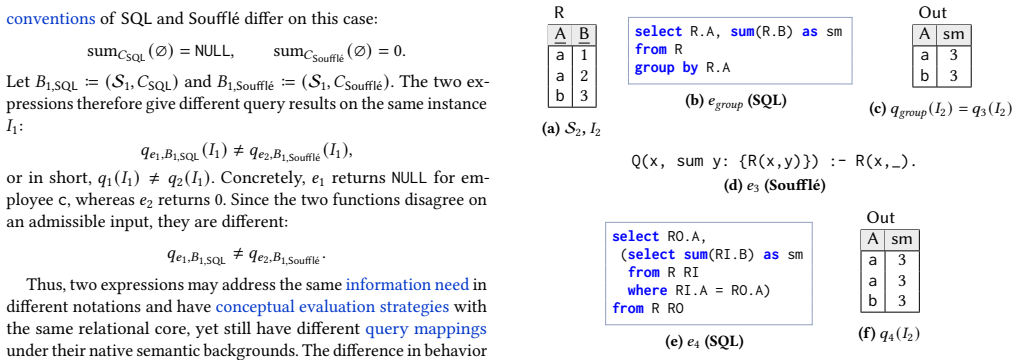
On the paper's own terms, the central discovery is that 'relational pattern structure' is a real, separable layer of a query, independent of surface notation and semantic conventions, and that recognizing this layer resolves debates that otherwise collapse into questions of logical expressiveness. Two queries may share the same information need and the same pattern structure while denoting different query mappings under their native semantic conventions (the SQL NULL versus Soufflé 0 empty-sum case); two queries may have the same query mapping over a schema and yet instantiate different pattern structures (GROUP BY versus a correlated double reference to the same relation). Pattern isomorphism is defined informally via dissociation: rename each table-reference role to a fresh relation name, then align roles across expressions so that the dissociated denotations agree on all aligned inputs under every shared compatible choice of semantic conventions. The paper claims this alignment shows queries as different as an employee-sales aggregation and a grouped self-join over a single relation are instances of one correlated subcollection summary.
Load-bearing premise
The framework rests on the assumption that relational pattern structure is a well-defined, language-independent notion that can be identified across notations; if the informal alignment criterion for pattern isomorphism cannot be made precise, or if pattern structure does not correspond to any real advantage in reading and revising queries, the framework's value collapses.
Editorial extensions
If this is right
- Language design debates should be reframed: expressive power is one axis; pattern structure made explicit and readability and revising support are separate axes.
- Two queries with the same query mapping can still be genuinely different designs, and two queries with different native results can share the same relational pattern; neither observation is a contradiction once semantic conventions are separated.
- For machine-generated queries, the framework gives a vocabulary for asking whether a generated expression exposes the same relational pattern as the user's information need, and for revising it while preserving pattern structure.
- The tutorial extends the framework to recursive and path queries, nested relational data, and languages beyond PTIME, claiming the same pattern-focused comparison applies in those settings.
Reading between the lines
- If relational pattern structure can be given a precise, language-independent definition, a natural next step is automated pattern-preserving query rewriting: transform a query between notations while certifying that the dissociated denotation is unchanged.
- A testable human-factors extension would compare readers' speed and accuracy in revising machine-generated queries under notations that expose the same pattern structure versus notations that obscure it; the framework predicts the exposed-pattern notations win.
- The pattern-isomorphism criterion could serve as a correctness target for LLM query generation: a generated query is faithful not when it produces the same result on one instance but when its dissociated denotation matches the intended pattern under independent role inputs.
- The relational versus graph language divide may be partly a matter of pattern presentation; path queries expressed relationally and graphically could be compared by pattern isomorphism rather than by data model allegiance.
Signed reviews
Editorial analysis
A structured set of objections, weighed in public.
Referee Report
Summary. This PVLDB tutorial proposal extends an earlier SIGMOD 2026 tutorial and argues that relational query languages should be compared not only in expressive power but also in which relational structures they make explicit and how well their notation supports reading and revising queries. It develops a vocabulary that separates information need, query mapping, relational pattern structure, relational pattern denotation, and semantic conventions, using Abstract Relational Calculus (ARC) and Relational Diagrams as reference representations. The tutorial is organized around worked examples: a SQL scalar subquery and a Soufflé rule with different empty-aggregate behavior, a grouped SQL query and its Soufflé/correlated-SQL counterparts, and recursive, nested, and beyond-PTIME extensions. The paper claims that expressions e1 through e4 instantiate the same relational pattern structure, while egroup has a different one, and that differences in query results under native semantics are due to semantic conventions, not pattern structure.
Significance. If the proposed vocabulary were made precise, it would address a real gap: most language comparisons focus on logical expressiveness, whereas the paper targets structural explicitness and readability, which are particularly relevant when queries are generated by machines and inspected by humans. The worked examples are internally consistent and accurate: the SQL/Soufflé empty-aggregate difference is described correctly, the query mappings for egroup and e3 coincide on the constrained schema, and the dissociation/substitution equation is true by construction. The paper also gives a useful map of recent relational, graph, and dataframe languages. Its main weakness is that the central concept of relational pattern isomorphism is only informally defined and the claimed equalities are not derived from it. As a tutorial proposal the lack of a full formalization is understandable, but because the paper explicitly promises a 'precise vocabulary,' this gap directly affects the stated deliverable rather than being a minor presentation issue.
major comments (3)
- [§2, 'Relational pattern structure' and Figure 6] The paper's central classification P_e1=P_e2=P_e3=P_e4 is stated on the basis of 'conceptual evaluation strategies' rather than derived from the informal definition of pattern isomorphism. The definition leaves undefined the notions of 'table-reference role,' 'relational construct,' and 'shared compatible choice of semantic conventions C,' and the paper does not show how the claimed equality follows from that definition. Because the tutorial's stated deliverable is a 'precise vocabulary,' this gap is load-bearing; please provide a formal or at least precisely operational definition, or explicitly reframe these equalities as illustrative judgments rather than as consequences of the definition.
- [§2, pattern-isomorphism definition] The definition quantifies over 'every shared compatible choice of semantic conventions C,' but the only demonstrated equality uses one convention (C_Soufflé for e1 and e2). The paper itself notes that e3 and e4 have different native query mappings and only become equal under a shared C, so without a characterization of which choices of C are 'compatible,' the equivalence relation is not well-defined. Please either characterize the allowed conventions or explain why equality under a representative shared convention is the intended notion and how that supports the 'every' quantification.
- [§2, 'Dissociation and relational pattern denotation'] The definition of pattern isomorphism also depends on 'aligned dissociated inputs' and on the preservation equation q_e,(S2,C)(I2)=q'_e,(S2,C)(I'_2). The paper does not give a general statement of when this preservation holds (e.g., how schema constraints are dropped in the dissociated schema) or how two dissociated schemas with different relation signatures are aligned. Please state this preservation property as a formal lemma with explicit hypotheses, or restrict its use to the specific examples so that the boundary between definition and example is clear.
minor comments (4)
- [§2, paragraph after Figure 2] The phrase 'the same relational core' is used before relational pattern structure is formally introduced; consider flagging this as an intuitive preview to avoid seeming to presuppose the later definition.
- [References] The paper cites Wikipedia for linguistic relativity [74]; a standard scholarly reference would be more appropriate for a published tutorial proposal.
- [§4 'Core concepts'] The list of core concepts and languages is dense; a table mapping each language to the specific concept it illustrates would help readers and attendees navigate the tutorial.
- [Footnote 2 and Section 2] The distinction between 'structural notation' and 'surface notation' is introduced in a footnote but the main text often uses 'notation' loosely; consider using the more specific terms consistently.
Circularity Check
No circularity: the tutorial's vocabulary is self-referential to the author's prior ARC work, but no derivation or prediction reduces to its inputs.
full rationale
The paper is a tutorial proposal rather than a derivation chain. Its central concepts—information need, query mapping, relational pattern structure, pattern denotation, and semantic conventions—are introduced through concrete SQL and Soufflé examples, then used to classify expressions. The claim P_e1 = P_e2 = P_e3 = P_e4 is an expository application of the paper's own informal definition of pattern isomorphism (equality of dissociated denotations under compatible semantic conventions), not a fitted parameter renamed as a prediction. The reliance on the author's Abstract Relational Calculus (ARC) and Relational Diagrams is openly disclosed and functions as a reference representation, not as an unverified uniqueness theorem or a smuggled ansatz. The admitted informality of the pattern-isomorphism definition—'Informally, two expressions are pattern-isomorphic if such a bijective alignment makes their dissociated denotations equal on every aligned dissociated input under every shared compatible choice of semantic conventions'—is a rigor/formalization limitation rather than a circular step: the framework is not proven to be mathematically pinned down, but no result is equivalent to its input by construction, and no benchmark or fitted data is involved. Therefore the circularity score is 0.
Assumptions & free parameters
assumptions (3)
- domain assumption Relational pattern structure is a well-defined, notation-independent abstraction.
- domain assumption Dissociation preserves ordinary query evaluation when roles get the same value.
- ad hoc to paper ARC and Relational Diagrams are adequate reference representations for expressing recurring relational patterns.
Cite this review
Pith. "Pith review of An Extended Tutorial and Vocabulary for Relational Language Design in an Era of AI-Assisted Query Generation." pith.science (2026). https://pith.science/paper/HKKDVPIM
@misc{pith2026260812272,
  author       = {Pith},
  title        = {Pith review of: An Extended Tutorial and Vocabulary for Relational Language Design in an Era of AI-Assisted Query Generation},
  year         = {2026},
  howpublished = {\url{https://pith.science/paper/HKKDVPIM}},
  note         = {Machine review of arXiv:2608.12272}
}
read the original abstract
Relational query languages have been studied and used for more than 50 years, with SQL dominant in practice. Today, queries are increasingly generated by machines and read by humans. At the same time, the landscape also includes dataframe, pipeline, logical, functional, graph, and relational programming notations. These developments invite two related questions beyond expressive power: which relational structures do languages make explicit, and how well can notation support users in reading and revising queries? This 3-hour tutorial extends an earlier SIGMOD'26 tutorial in three directions: recursive and path queries (connecting relational and graph query languages), nested relational data, and relational languages for problems beyond PTIME. Rather than beginning from formal definitions, we start from example queries and compare how different languages express the same intent. To compare recurring structure across notations, we use Abstract Relational Calculus (ARC) and Relational Diagrams as reference representations. From these examples, we develop a vocabulary for relational language design, including information need, query mapping, relational pattern structure, relational pattern denotation, and semantic conventions. Participants will leave with a framework for comparing existing and future relational languages, a precise vocabulary for articulating design trade-offs, and a concrete set of examples connecting classical database languages with alternative proposals.
Figures


Figures from the paper (2 more)


Reviewed August 16, 2026 · model on record in the stance chip above.
Discussion (0). Continue with ORCID to comment.