Modifying causal models to distinguish between transient and lasting causal effects
Pith reviewed 2026-06-29 06:04 UTC · model grok-4.3
The pith
A novel null effect in causal models distinguishes transient from lasting intervention effects in time series.
A machine-rendered reading of the paper's core claim, the machinery that carries it, and where it could break.
Core claim
The paper demonstrates limitations of common causal tools for time varying frameworks and addresses this by proposing a novel version of the null effect designed to distinguish between transient and lasting causal effects, using a system and state based approach to identify causal parameters under equilibrium assumptions.
What carries the argument
The novel version of the null effect, which distinguishes transient and lasting causal effects.
If this is right
- Assumptions about the system's equilibrium allow for more specific causal interpretations and clarify goals of design and analysis.
- The selection of timepoints for measuring the system's states affects the identifiability of causal parameters.
- Standard causal directed acyclic graphs and potential outcomes cannot capture all possible interventions in a time varying framework.
Where Pith is reading between the lines
- This method might apply to longitudinal studies in medicine to determine if treatments have enduring benefits.
- It could connect to control theory by treating equilibrium as a target state for interventions.
- Researchers could test the approach by simulating time series with known transient and permanent effects.
Load-bearing premise
The causal system has a definable equilibrium that interventions can modify in predictable ways.
What would settle it
Finding a time series dataset where the novel null effect cannot reliably separate a transient effect from a lasting one despite known ground truth would challenge the proposal.
Figures
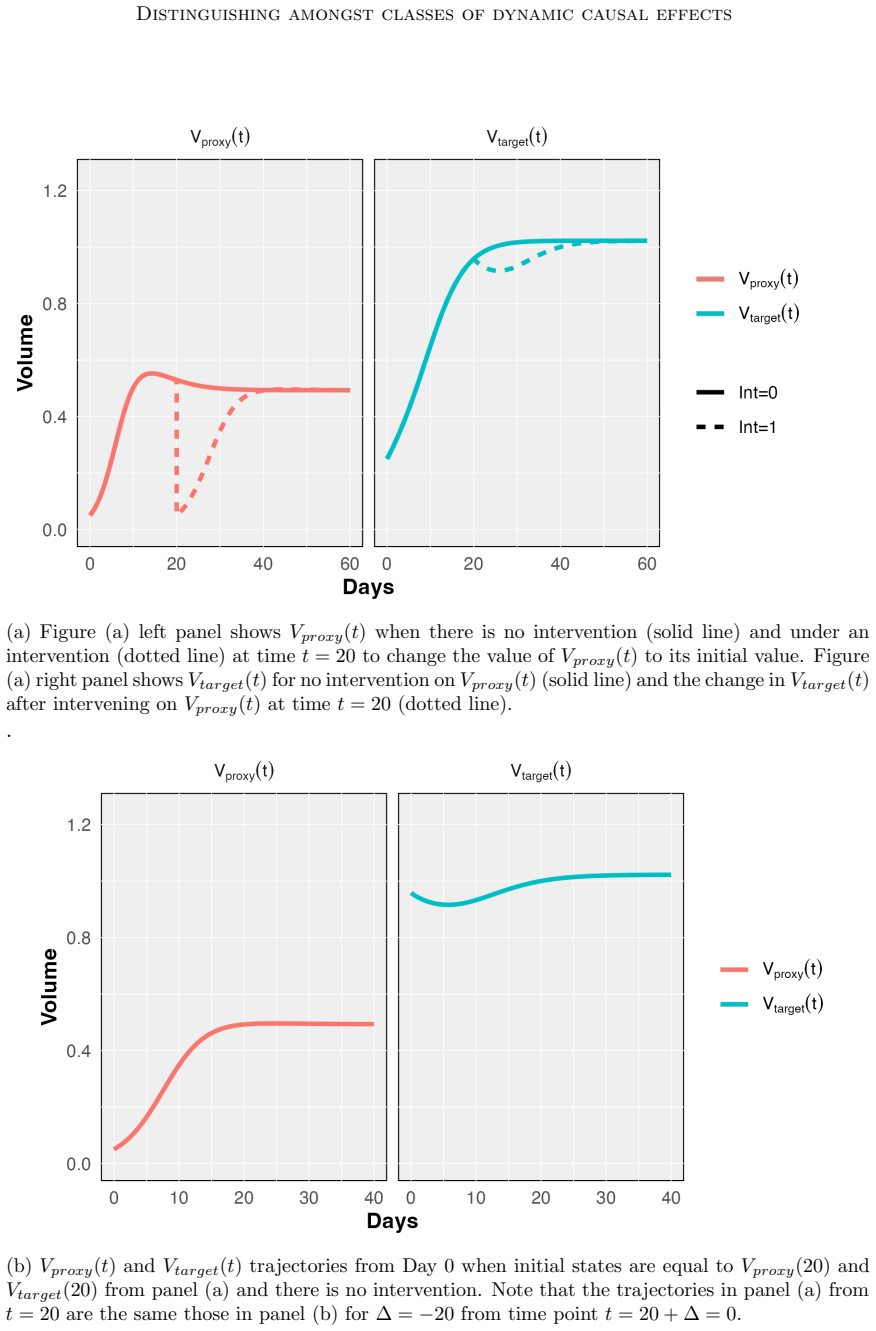
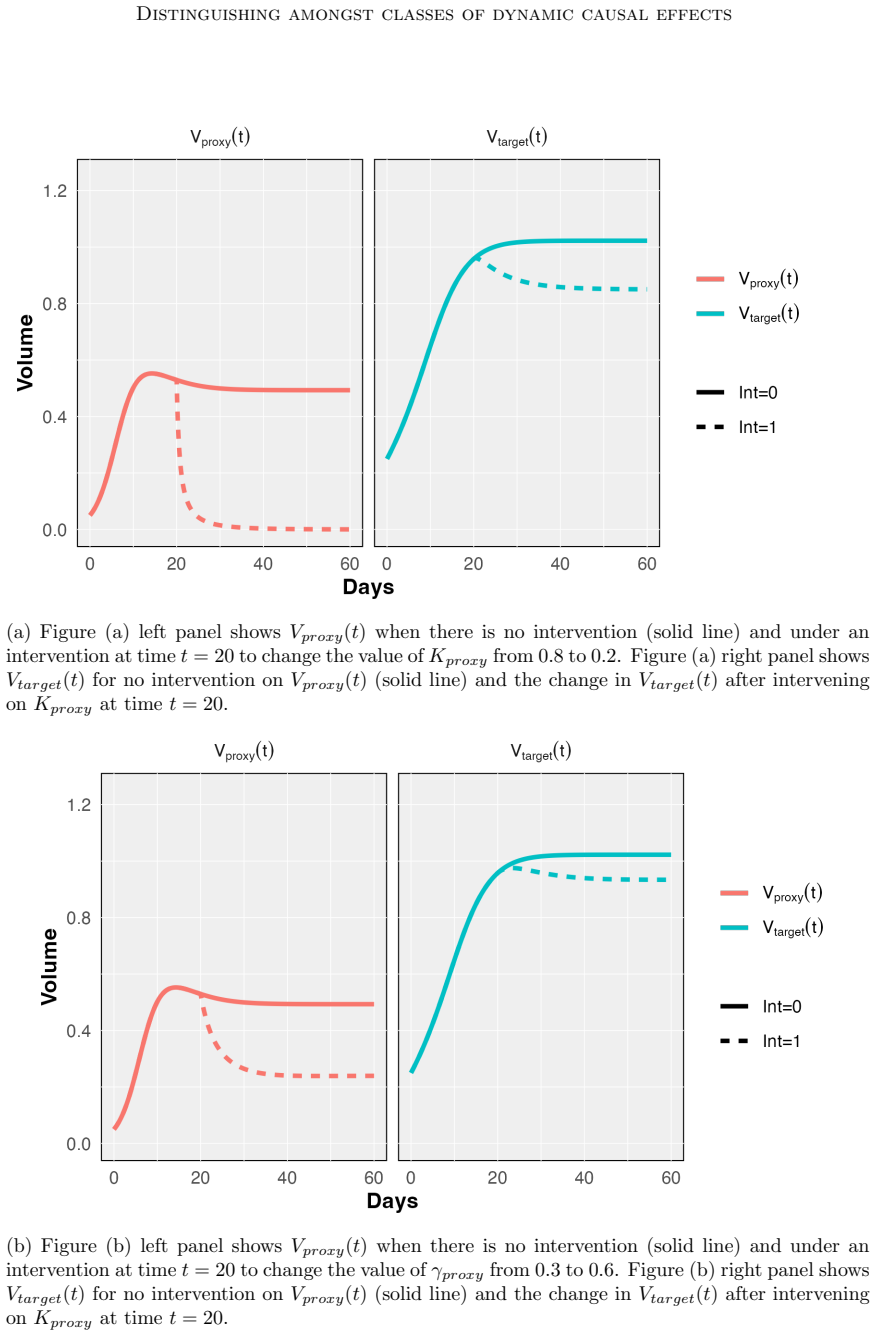
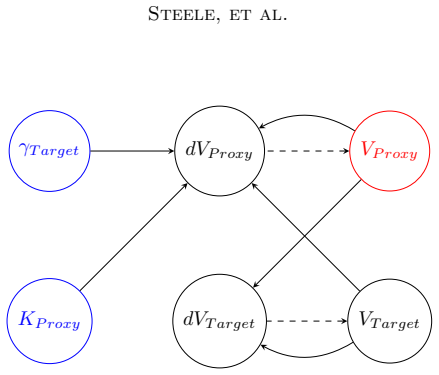
read the original abstract
This paper considers how to classify the effects of interventions in causal models for outcomes and exposures observed over time. First, we demonstrate the limitations of the most common uses of potential outcomes and causal directed acyclic graphs for capturing all possible interventions in a time varying framework, particularly in problems where the key question concerns interventions to maintain or change equilibrium behaviour. Second, we adopt a system and state based approach rather than a measurement-based approach to identify the causal parameters. In particular, we discuss how assumptions about the system's equilibrium and the effects of interventions on that equilibrium can allow for more specific causal interpretations and clarify the goals of design and analysis. Third, we show how the ability to identify the the causal parameters of a time varying system depends on the selection of timepoints for measuring the system's states. We address this by proposing a novel version of the null effect, which is designed to distinguish between transient and lasting causal effects.
Editorial analysis
A structured set of objections, weighed in public.
Referee Report
Summary. The paper argues that standard potential outcomes frameworks and causal DAGs have limitations for classifying intervention effects in time-varying settings, particularly those involving equilibrium behavior. It proposes adopting a system/state-based approach, where assumptions about equilibrium and intervention effects on it enable more specific causal interpretations. Identification of causal parameters is shown to depend on chosen measurement timepoints, which the paper addresses by introducing a novel version of the null effect designed to separate transient from lasting causal effects.
Significance. If the equilibrium-based framing and novel null effect can be shown to support valid distinctions, the work could help clarify goals in longitudinal causal studies where persistence of effects matters (e.g., policy or treatment evaluation). The explicit linkage of identification to timepoint choice and equilibrium assumptions is a useful conceptual contribution, though its strength rests on whether these yield testable or falsifiable improvements over existing methods.
major comments (2)
- [Abstract, third point] Abstract, third point: the novel null effect is offered as the solution to timepoint-dependent identification, yet no definition, formal statement, or proof is supplied showing that this null separates transient from lasting effects once equilibrium assumptions are imposed; without this, the central claim remains unverified.
- [Abstract, second point] Abstract, second point: the assertion that equilibrium assumptions 'allow for more specific causal interpretations' is load-bearing for the system/state approach, but the text provides neither an analytic derivation nor an identification result demonstrating how the state-based framing yields parameters that standard PO/DAG methods cannot; this leaves the claimed advantage conceptual rather than established.
minor comments (1)
- [Abstract] Typo: 'identify the the causal parameters' (repeated 'the').
Simulated Author's Rebuttal
We thank the referee for the detailed and constructive comments. We address each major point below and will revise the manuscript to incorporate the requested formal elements.
read point-by-point responses
-
Referee: [Abstract, third point] Abstract, third point: the novel null effect is offered as the solution to timepoint-dependent identification, yet no definition, formal statement, or proof is supplied showing that this null separates transient from lasting effects once equilibrium assumptions are imposed; without this, the central claim remains unverified.
Authors: We agree that the abstract (and the current text) does not supply an explicit formal definition, statement, or proof of the novel null effect. The manuscript introduces the idea as a way to address timepoint dependence under equilibrium assumptions, but a rigorous demonstration is missing. In revision we will add a dedicated subsection containing the formal definition, the precise statement of the null, and a proof sketch establishing separation of transient versus lasting effects. revision: yes
-
Referee: [Abstract, second point] Abstract, second point: the assertion that equilibrium assumptions 'allow for more specific causal interpretations' is load-bearing for the system/state approach, but the text provides neither an analytic derivation nor an identification result demonstrating how the state-based framing yields parameters that standard PO/DAG methods cannot; this leaves the claimed advantage conceptual rather than established.
Authors: We accept that the claimed advantage is currently supported only by conceptual discussion and illustrative examples rather than a formal derivation or identification result. The manuscript shows limitations of standard frameworks and then adopts the system/state approach, but does not derive the specific parameters that become identifiable only under equilibrium assumptions. We will add an analytic derivation and identification result in the revision to make the advantage rigorous. revision: yes
Circularity Check
No circularity: conceptual proposal independent of its inputs
full rationale
The manuscript is a conceptual paper that identifies limitations in standard potential-outcomes and DAG frameworks for time-varying interventions, then proposes adopting a system/state-based framing plus a novel null effect to separate transient from lasting effects. The abstract and available text contain no equations, no fitted parameters, and no derivations that reduce by construction to the target claim. Equilibrium assumptions are invoked as enabling more specific interpretations, but they are not defined in terms of the novel null nor shown to be equivalent to it. No self-citations appear as load-bearing steps, and the proposal is presented as an independent adjustment rather than a renaming or self-referential fit. The derivation chain is therefore self-contained against external benchmarks.
Axiom & Free-Parameter Ledger
axioms (1)
- domain assumption The system possesses an equilibrium state whose response to intervention can be meaningfully defined and assumed.
invented entities (1)
-
novel version of the null effect
no independent evidence
Reference graph
Works this paper leans on
-
[1]
Dynamic structural causal models.arXiv preprint arXiv:2406.01161,
Philip Boeken and Joris M Mooij. Dynamic structural causal models.arXiv preprint arXiv:2406.01161,
-
[2]
From deterministic odes to dynamic structural causal models
P Rubenstein, S Bongers, B Sch¨ olkopf, and JM Mooij. From deterministic odes to dynamic structural causal models. In34th Conference on Uncertainty in Artificial Intelligence (UAI 2018), pages 114–123. Curran Associates, Inc.,
2018
-
[3]
Doubly-Robust Functional Average Treatment Effect Estimation
Lorenzo Testa, Tobia Boschi, Francesca Chiaromonte, Edward H Kennedy, and Matthew Reimherr. Doubly-robust functional average treatment effect estimation.arXiv preprint arXiv:2501.06024,
work page internal anchor Pith review Pith/arXiv arXiv
discussion (0)
Sign in with ORCID, Apple, or X to comment. Anyone can read and Pith papers without signing in.