Asymptotic dynamics of inhibitory networks for the NNLIF Model in the large-delay limit
Pith reviewed 2026-06-26 23:54 UTC · model grok-4.3
The pith
As delay tends to infinity, inhibitory NNLIF network solutions oscillate between distinct pseudo-equilibria with Cesàro-mean convergence to a limit set by those equilibria.
A machine-rendered reading of the paper's core claim, the machinery that carries it, and where it could break.
Core claim
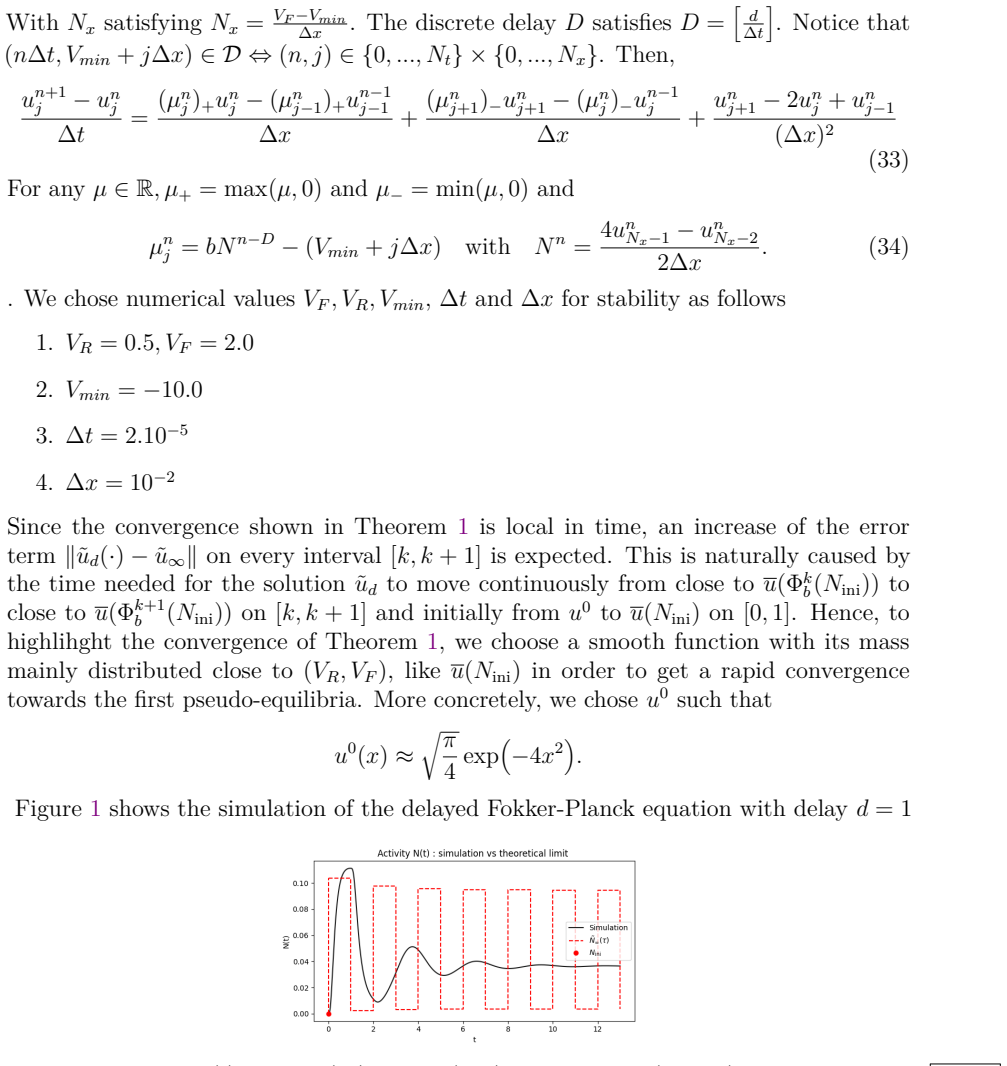
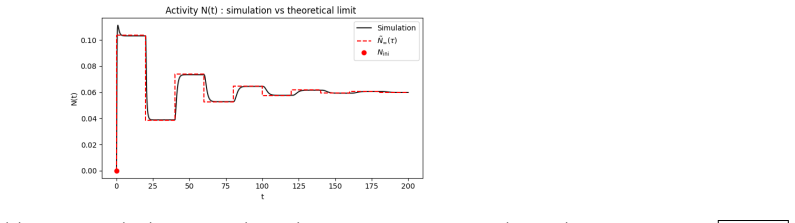
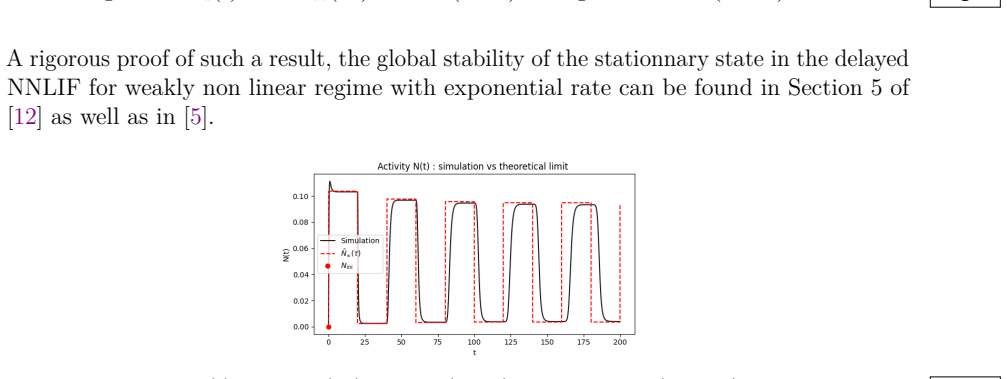
As the delay tends to infinity, solutions of sufficiently inhibitory networks oscillate between distinct pseudo-equilibria over any finite time interval. Employing the Doeblin-Harris method, we rigorously establish a local convergence in the Cesàro mean toward a limit function determined solely by these pseudo-equilibria.
What carries the argument
The Doeblin-Harris method applied to the delayed NNLIF system, which produces Cesàro-mean convergence once the delay is sent to infinity and the network is sufficiently inhibitory.
If this is right
- Network activity is governed by switching among pseudo-equilibria once the delay is large.
- Time averages of the solutions converge locally to a function fixed only by the pseudo-equilibria visited.
- The oscillation and convergence hold uniformly on finite time intervals in the infinite-delay limit.
- The described behavior requires the network to be sufficiently inhibitory.
Where Pith is reading between the lines
- The result supplies a delay-driven mechanism that can produce rhythmic firing in purely inhibitory circuits without external periodic drive.
- Similar large-delay limits could be examined in other neural population models that admit pseudo-equilibria.
- Quantitative error bounds for finite but large delays would turn the limit statement into a practical approximation tool.
Load-bearing premise
The networks must be sufficiently inhibitory and the pseudo-equilibria must exist with the properties needed for the Doeblin-Harris method to apply to the delayed equations.
What would settle it
Numerical integration of the NNLIF equations at successively larger delay values that either confirms or fails to show switching between the predicted pseudo-equilibria together with convergence of the time averages to the claimed limit function.
Figures
read the original abstract
We investigate the impact of large synaptic delays on the emergence of periodic dynamics in inhibitory neuronal networks, within the framework of the NNLIF model. Inspired by the work of [11] where the notion of pseudo-equilibria was introduced and developed, and by our earlier analysis in [14], we show that, as the delay tends to infinity, solutions of sufficitently inhibitory networks oscillate between distinct pseudo-equilibria over any finite time interval. Employing the Doeblin-Harris method, we rigorously establish a local convergence in the Ces{\`a}ro mean toward a limit function determined solely by these pseudo-equilibria.
Editorial analysis
A structured set of objections, weighed in public.
Referee Report
Summary. The paper claims that, as synaptic delay τ tends to infinity, solutions of sufficiently inhibitory NNLIF networks oscillate between distinct pseudo-equilibria over any finite time interval. Employing the Doeblin-Harris method on the delayed system, it establishes local convergence in the Cesàro mean to a limit function determined solely by these pseudo-equilibria, building on the notion introduced in prior references.
Significance. If the Doeblin-Harris application is verified, the result would give a rigorous asymptotic description of periodic dynamics emerging from large delays in inhibitory networks, extending the pseudo-equilibria framework with a probabilistic convergence tool. The explicit use of Cesàro mean convergence provides a concrete, falsifiable prediction for the large-delay regime.
major comments (2)
- [Proof of the main theorem (Doeblin-Harris section)] The application of the Doeblin-Harris theorem requires verifying that the Markov semigroup on the augmented state space L¹(ℝ) × C([−τ,0]; L¹(ℝ)) satisfies uniform minorization and irreducibility conditions independent of τ. The abstract asserts this yields Cesàro convergence, but the infinite-dimensional delay component makes the minorization constant non-obvious; without an explicit check that the constant remains positive in the τ → ∞ limit, the central convergence claim does not follow.
- [Statement of assumptions and main result] The oscillation between pseudo-equilibria in the large-delay limit is asserted for 'sufficiently inhibitory' networks, but the precise quantitative threshold (in terms of the inhibition strength parameter) is not restated from the referenced works [11] and [14]; this condition is load-bearing for the oscillation statement and must be made self-contained.
minor comments (2)
- [Abstract] Abstract contains the typo 'sufficitently' (should be 'sufficiently').
- [Model formulation] The notation for the history segment and the precise function space for the delayed system should be introduced earlier, before the application of Doeblin-Harris, to improve readability.
Simulated Author's Rebuttal
We thank the referee for their careful reading of the manuscript and for providing constructive feedback. We address the major comments point by point below.
read point-by-point responses
-
Referee: [Proof of the main theorem (Doeblin-Harris section)] The application of the Doeblin-Harris theorem requires verifying that the Markov semigroup on the augmented state space L¹(ℝ) × C([−τ,0]; L¹(ℝ)) satisfies uniform minorization and irreducibility conditions independent of τ. The abstract asserts this yields Cesàro convergence, but the infinite-dimensional delay component makes the minorization constant non-obvious; without an explicit check that the constant remains positive in the τ → ∞ limit, the central convergence claim does not follow.
Authors: We thank the referee for highlighting this important point. The proof in Section 3 establishes the required minorization and irreducibility conditions for the Markov semigroup on the augmented state space, with the minorization constant chosen independently of τ by exploiting the uniform positive lower bound on transition probabilities induced by the inhibitory coupling and the firing rate function. This bound holds uniformly because the pseudo-equilibria are attractive in the large-delay regime independently of the precise delay value. To make the uniformity explicit and address the concern about the infinite-dimensional component, we will add a short lemma or remark in the Doeblin-Harris section verifying that the constant remains bounded away from zero as τ → ∞. revision: yes
-
Referee: [Statement of assumptions and main result] The oscillation between pseudo-equilibria in the large-delay limit is asserted for 'sufficiently inhibitory' networks, but the precise quantitative threshold (in terms of the inhibition strength parameter) is not restated from the referenced works [11] and [14]; this condition is load-bearing for the oscillation statement and must be made self-contained.
Authors: The referee is correct that the manuscript should be self-contained on this load-bearing assumption. We will revise the statement of the main result (Theorem 1.1) and the assumptions section to explicitly restate the quantitative threshold on the inhibition strength parameter, quoting the precise range from [11] and [14] for which the oscillation between distinct pseudo-equilibria holds. revision: yes
Circularity Check
Minor self-citation for pseudo-equilibria; central large-delay result independent
specific steps
-
self citation load bearing
[Abstract]
"Inspired by the work of [11] where the notion of pseudo-equilibria was introduced and developed, and by our earlier analysis in [14], we show that, as the delay tends to infinity, solutions of sufficiently inhibitory networks oscillate between distinct pseudo-equilibria over any finite time interval."
The load-bearing objects (pseudo-equilibria) originate in a citation whose authors overlap with the present paper; however the overlap is limited to the definition step and does not propagate into a self-referential reduction of the new large-delay convergence statement.
full rationale
The derivation introduces the large-delay oscillation and Cesàro convergence via Doeblin-Harris on the delayed NNLIF system. Pseudo-equilibria are taken from prior references [11] and [14] (the latter by the same authors), but these serve only as external inputs whose existence and properties are assumed; the new asymptotic statements and convergence proof do not redefine or fit quantities in terms of themselves. No fitted-input-called-prediction, self-definitional, or ansatz-smuggling steps appear. The single self-citation is not load-bearing for the novel limit claim.
Axiom & Free-Parameter Ledger
axioms (2)
- domain assumption The NNLIF model equations and the notion of pseudo-equilibria hold as defined in the referenced works.
- domain assumption The Doeblin-Harris method applies to the delayed NNLIF system under the stated inhibitory conditions.
Reference graph
Works this paper leans on
-
[1]
Ambrogi, Q
E. Ambrogi, Q. He, and D. Salort , Nonlinear stability for a two-dimensional fokker-planck equation with partial diffusion in neuroscience, Nonlinearity, 39 (2026), p. 035013
2026
-
[2]
Brunel and V
N. Brunel and V. Hakim , Fast global oscillations in networks of integrate-and-fire neurons with long firing rates, Neural Computation, 11 (1999), pp. 1621–1671
1999
-
[3]
M. Cáceres, P. Roux, D. Salort, and R. Schneider , Global-in-time classical solutions and qualitative properties for the nnlif neuron model with synaptic delay, arXiv preprint arXiv:1806.01934, (2018)
Pith/arXiv arXiv 2018
-
[4]
Cáceres and R
M. Cáceres and R. Schneider , Analysis and numerical solver for excitatory- inhibitory networks with delay and refractory periods, ESAIM, Math. Model. Numer. Anal., 52 (2018), pp. 1733–1761
2018
-
[5]
M. J. Cáceres, J. A. Cañizo, and A. Ramos-Lora , On the asymptotic behavior of the NNLIF neuron model for general connectivity strength, Commun. Math. Phys., 406 (2025), p. 55. Id/No 115
2025
-
[6]
M. J. Cáceres, J. A. Carrillo, and B. Perthame , Analysis of nonlinear noisy integrate & fire neuron models: blow-up and steady states, J. Math. Neurosci., 1 (2011), pp. Art. 7, 33
2011
-
[7]
M. J. Cáceres and B. Perthame , Beyond blow-up in excitatory integrate and fire neuronal networks: refractory period and spontaneous activity, J. Theoret. Biol., 350 (2014), pp. 81–89
2014
-
[8]
J. A. Carrillo, M. D. M. González, M. P. Gualdani, and M. E. Schonbek , Classical solutions for a nonlinear Fokker-Planck equation arising in computational neuroscience, Commun. Partial Differ. Equations, 38 (2013), pp. 385–409
2013
-
[9]
J. A. Carrillo, B. Perthame, D. Salort, and D. Smets , Qualitative properties of solutions for the noisy integrate and fire model in computational neuroscience, Nonlinearity, 28 (2015), pp. 3365–3388. 28
2015
-
[10]
J. A. Carrillo and P. Roux , Nonlinear partial differential equations in neuro- science: From modeling to mathematical theory, Mathematical Models and Methods in Applied Sciences, 35 (2025), pp. 403–584
2025
-
[11]
M. J. Cáceres, J. A. Cañizo, and A. Ramos-Lora , Sequence of pseudoequilibria describes the long-time behavior of the nonlinear noisy leaky integrate-and-fire model with large delay, 2024. arXiv/2403.00971
arXiv 2024
-
[12]
Ikeda, P
K. Ikeda, P. Roux, D. Salort, and D. Smets , Theoretical study of the emergence of periodic solutions for the inhibitory NNLIF neuron model with synaptic delay, Math. Neurosci. Appl., 2 (2022), pp. Art. No. 4, 37
2022
-
[13]
G. M. Lieberman , Second order parabolic differential equations, Singapore: World Scientific, 1996
1996
-
[14]
Perthame, C
B. Perthame, C. Rieutord, and D. Salort , Strongly nonlinear age-structured equation, time-elapsed model and large delays, J. Math. Biol., 91 (2025), p. 29. Id/No 65
2025
-
[15]
Preprint, arXiv:2601.19282 [math.AP] (2026), 2026
, A Fokker-Planck equation with superlinear drift at infinity for Integrate-and-Fire model. Preprint, arXiv:2601.19282 [math.AP] (2026), 2026
arXiv 2026
-
[16]
Salort and D
D. Salort and D. Smets , Convergence towards equilibrium for a model with partial diffusion, Commun. Partial Differ. Equations, 49 (2024), pp. 410–427. 29
2024
discussion (0)
Sign in with ORCID, Apple, or X to comment. Anyone can read and Pith papers without signing in.