REVIEW 3 major objections 6 minor 122 references
A Spectral Analysis of the Centimeter Regime of Nearby Galaxies: RRLs, Excited OH, and NH$_3$
T0 review · 3 major / 6 minor · reviewed 2026-08-14 · deepseek-v4-flash
Pith's one-line read This paper reports the third and fourth extragalactic detections of OH $J=9/2$ absorption (in NGC 4945 and Circinus) and argues that the excited OH in Circinus is not in Boltzmann equilibrium.
desk verdict Solid cm-wave survey with genuine first detections; the Circinus non-Boltzmann OH claim is heavier than its archival underpinnings can bear. read the letter →
The pith
A machine-rendered reading of the paper's core claim, the machinery that carries it, and where it could break.
The reading
What carries the argument
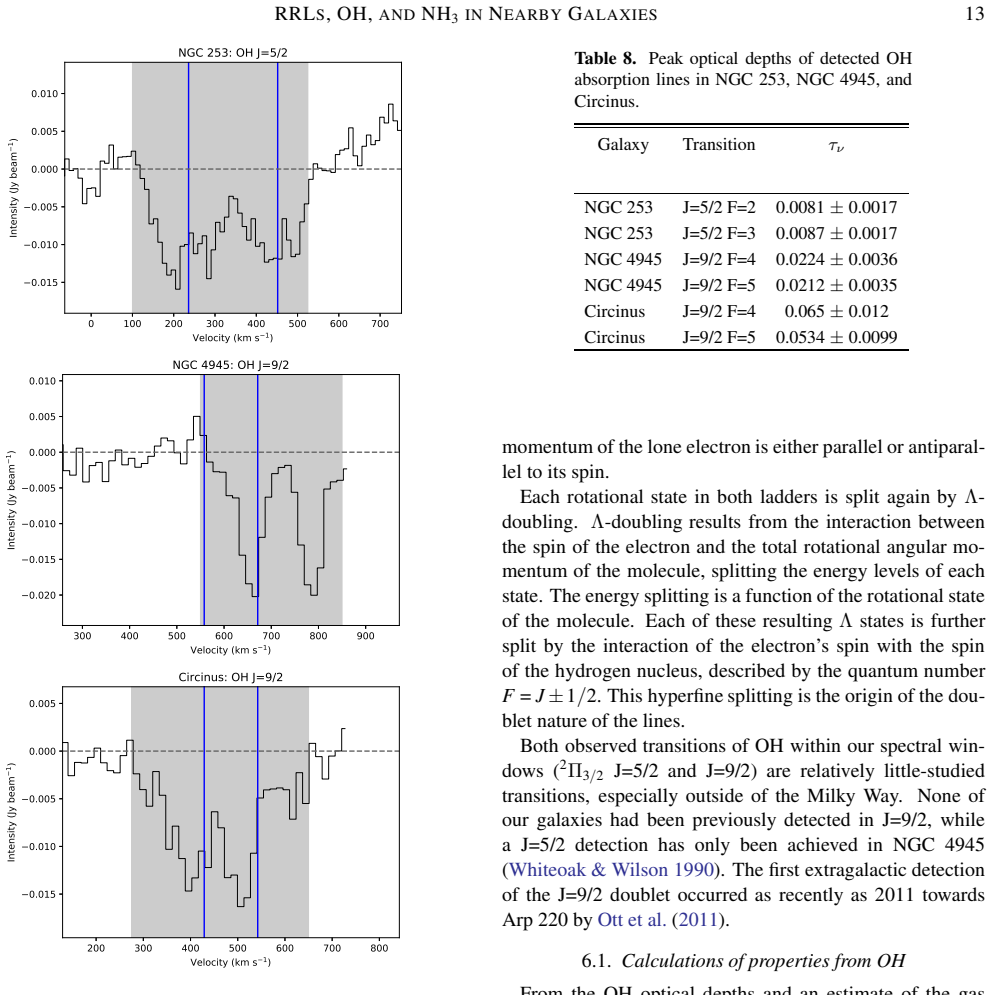
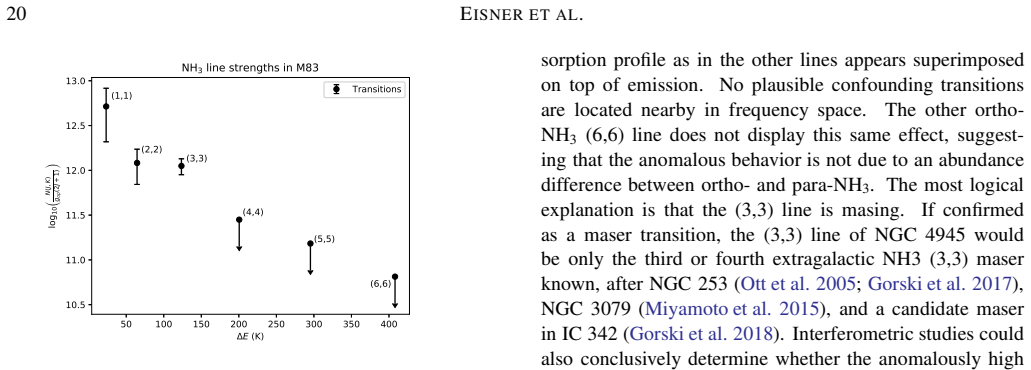
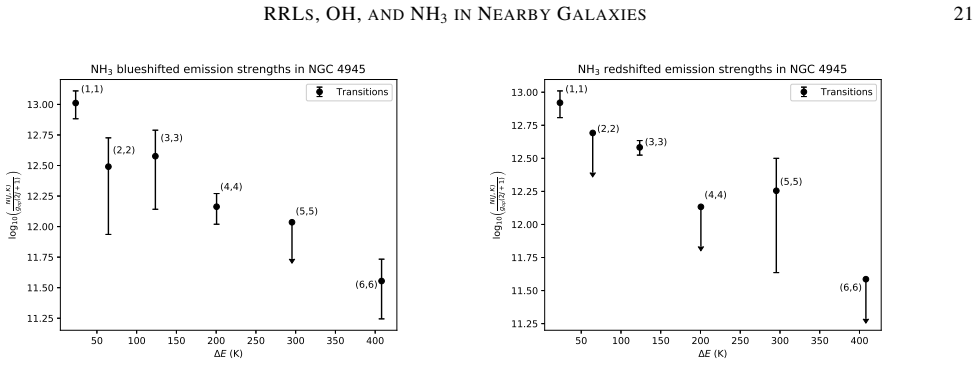
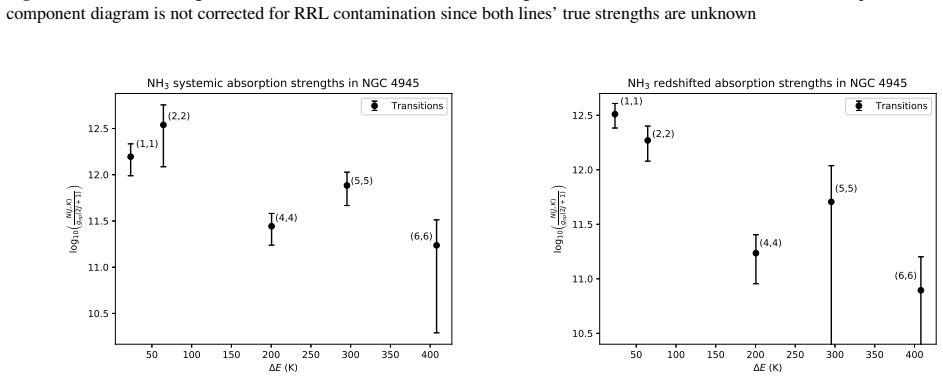
The load-bearing machinery is the Boltzmann-ratio analysis of rotation temperatures, applied to column densities of OH and NH$_3$ levels. For OH, the total column density of a rotational state is built from the two hyperfine components, $N_J = 2N_{l,F=J-1/2} + 2N_{l,F=J+1/2}$, and the rotation temperature is $T_{\rm rot} = (E_u-E_l)/[k\,\ln((2J_u+1)N_{J_l}/((2J_l+1)N_{J_u}))]$. For NH$_3$, equivalent Boltzmann-diagram plots of $\log_{10}[N(J,K)/(g_{op}(2J+1))]$ versus $E/k$ turn temperature into a slope. For the radio recombination lines, the line-to-continuum electron temperature formula $T_e^*$ provides the observed trend that the paper interprets through non-LTE departure coefficients. Comparing hyperfine line ratios (such as F=5 to F=4, expected to be 11/9 under LTE) is the check that keeps the OH analysis anchored.
What would settle it
Re-observe the ground-state OH doublet in Circinus with the same large beam and publish noise-based optical depths and widths; if the $J=3/2$ optical depth is several times larger than the visual estimate, the derived rotation temperature drops far below 2000 K and the non-Boltzmann conclusion is unsupported.
Extended reading notes
Core claim
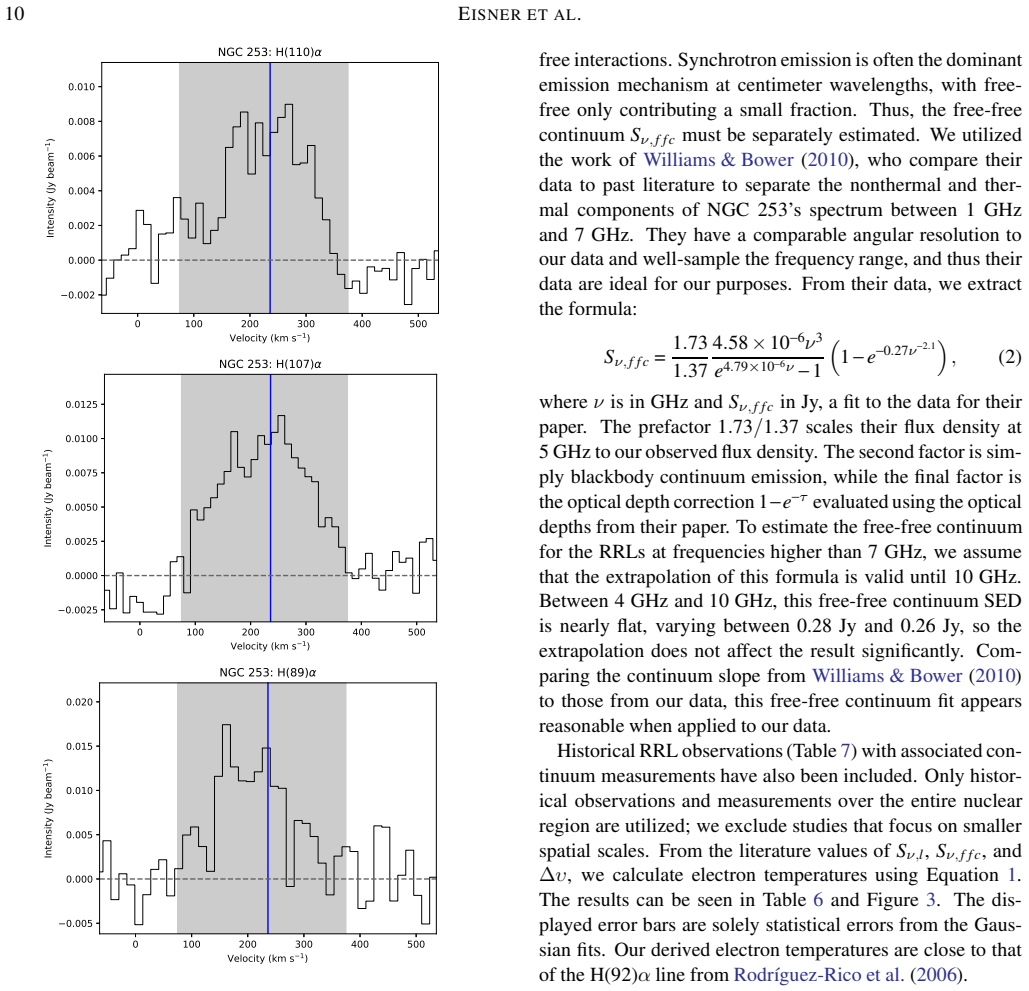
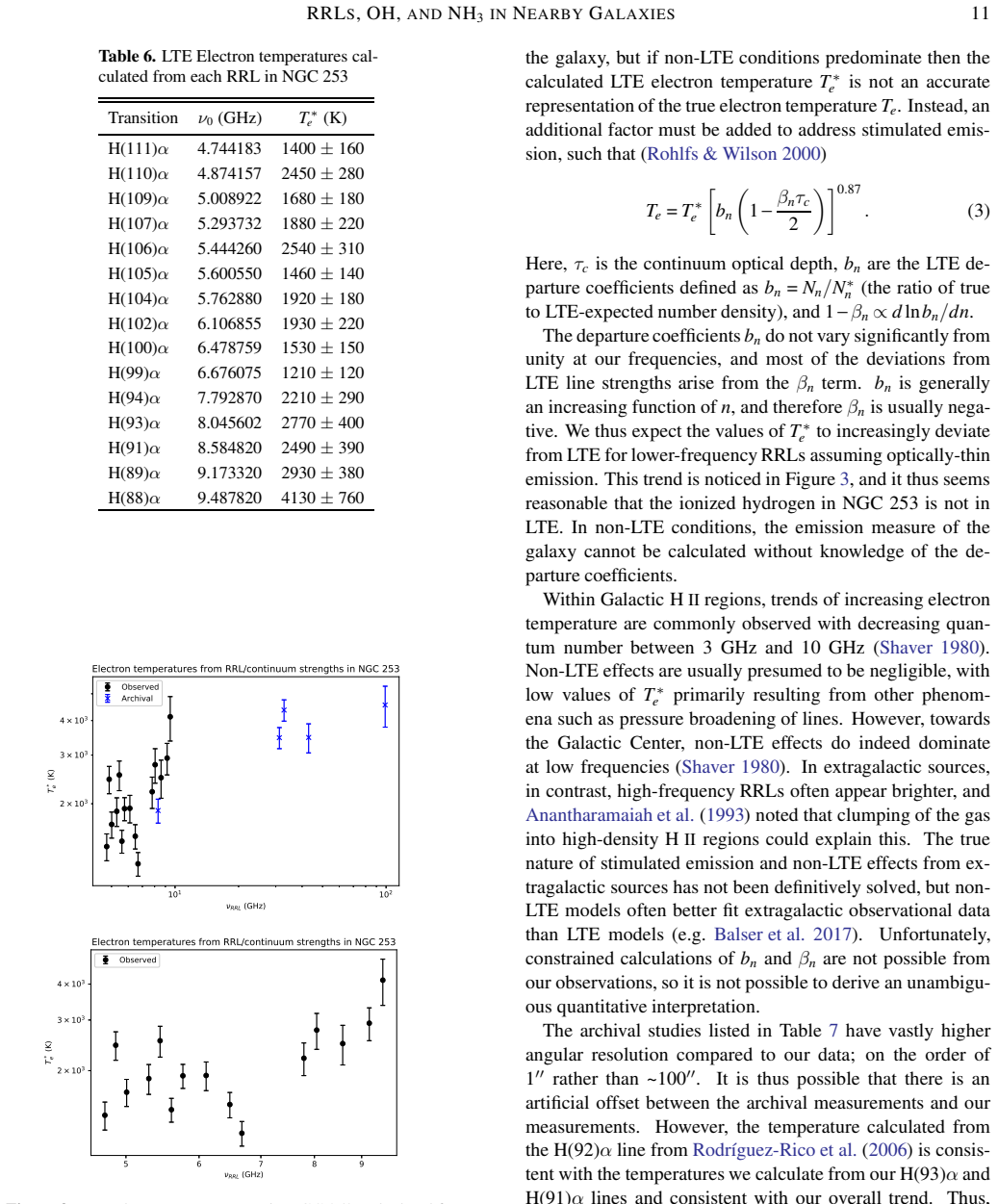
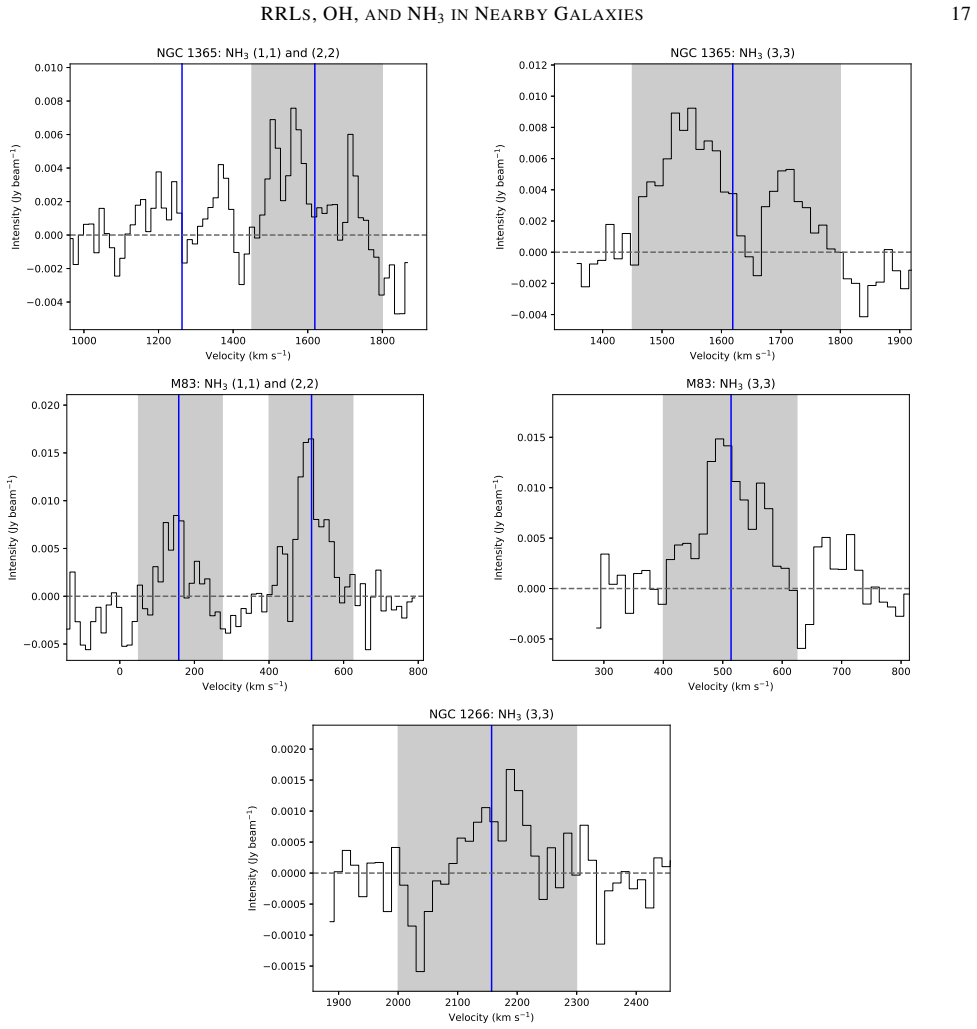
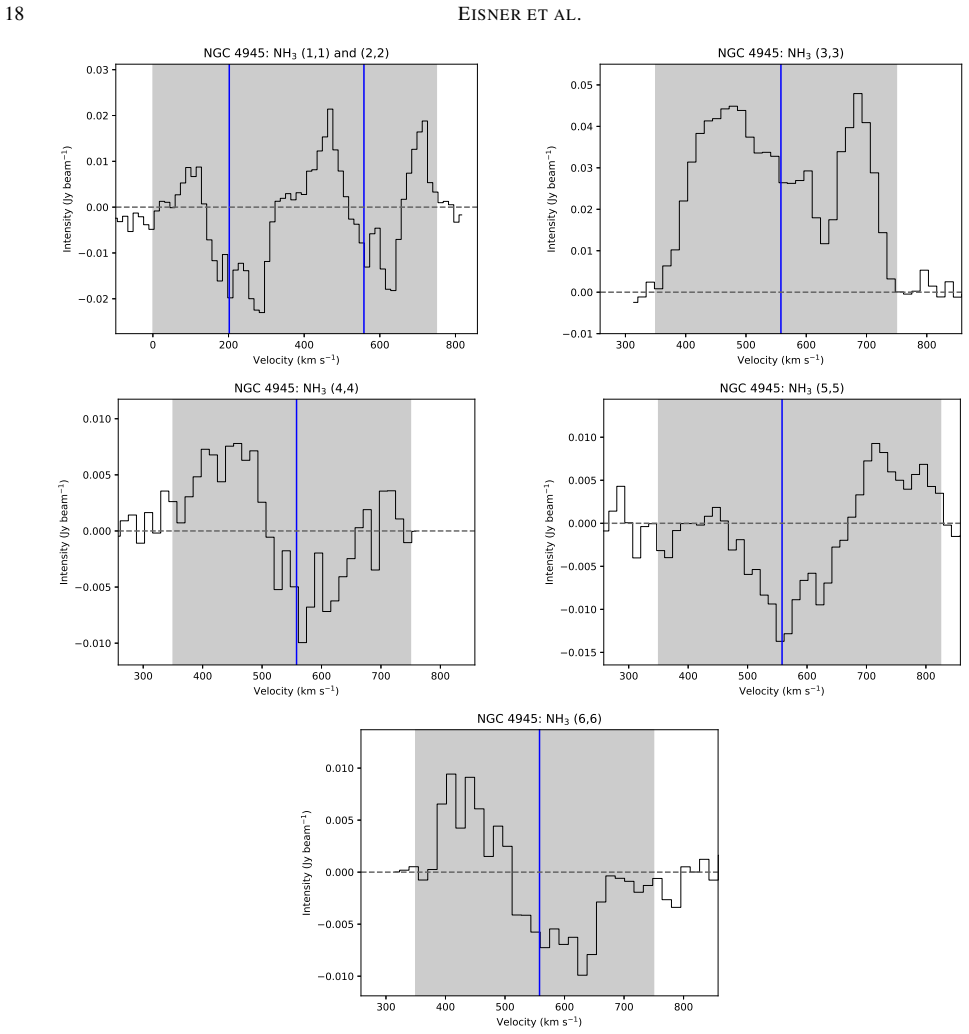
On its own terms, the paper claims that centimeter-wave transitions are not just weak echoes of millimeter lines but carry information about departures from local thermodynamic equilibrium. In NGC 253 all 18 $\mathrm{H}(n)\alpha$ recombination lines within the spectral windows are detected, and the LTE electron temperatures derived from their line-to-free-free ratios rise with frequency; the authors attribute that trend to stimulated emission in the nuclear region rather than a real temperature gradient. In NGC 4945 and Circinus, optically thin OH $^{2}\Pi_{3/2}$ $J=9/2$ absorption is detected with line widths of roughly 50–120 km s$^{-1}$, redshifted by about 100 km s$^{-1}$ in NGC 4945 and blueshifted by about 35 km s$^{-1}$ in Circinus. Comparing the Circinus $J=9/2$ column densities with archival $J=3/2$ data yields a rotation temperature above 2000 K, which the authors call unphysically high and use to argue that the OH populations are not Boltzmann-distributed. The NH$_3$ (1,1) through (6,6) lines in NGC 4945 show a superposition of emission and absorption, with depressed (1,1) and enhanced (5,5) absorption similar to Arp 220, and strong (3,3) emission that may be spatially extended maser activity.
Load-bearing premise
The Circinus rotation temperature rests on older ground-state OH line strengths whose optical depths and widths were estimated visually from published plots and carry no quoted uncertainties, so the 2000 K result depends on numbers the paper did not measure itself.
Editorial extensions
If this is right
- If Circinus's OH populations are genuinely non-Boltzmann, then infrared pumping or another nonthermal process must be acting in its nucleus, and OH column densities derived from any single temperature will be biased.
- If the NH$_3$ absorption anomaly seen in NGC 4945 is the same effect as in Arp 220, then a systematic level-population mechanism rather than calibration shapes ammonia absorption in luminous nuclei.
- If the NGC 253 electron-temperature trend is a non-LTE effect, then single-line cm-wave RRL measurements cannot yield true electron temperatures without knowing the departure coefficients.
- If $J=9/2$ OH appears in two of the nine galaxies surveyed, then this highly excited absorption is likely common in unstudied nearby starbursts.
- If the (3,3) NH$_3$ emission in NGC 4945 is a maser, it would be only the third or fourth extragalactic NH$_3$ (3,3) maser known.
Reading between the lines
- A testable extension of the paper's two-galaxy coincidence between $J=9/2$ OH absorption and luminous H$_2$O megamasers is to search for excited OH in other known H$_2$O megamaser hosts; a positive correlation would tie OH excitation to maser activity rather than to starburst properties alone.
- The shared NH$_3$ anomaly in Arp 220 and NGC 4945 could be probed by radiative-transfer models that pump ammonia inversion levels with a strong infrared field; the paper's own nondetections of nonmetastable lines make overpopulation of nonmetastable states less likely, leaving the pump mechanism open.
- The unidentified 5.737 GHz line in NGC 253 deserves a high-resolution follow-up: if it survives, it adds a new centimeter-wave tracer of the nucleus, and if it does not, the antenna ringing noted in the paper is the likely culprit.
- A systematic multi-line RRL study of NGC 253 with dense frequency coverage could turn the reported temperature trend into a quantitative diagnostic of the clumpiness and radiation field of its nuclear H II regions; the paper provides the anchor data but does not model the departure coefficients.
Signed reviews
Editorial analysis
A structured set of objections, weighed in public.
Referee Report
Summary. This paper reports ATCA 4cm- and 15mm-band spectral line observations of nine nearby star-forming galaxies. The authors detect 18 H(n)α radio recombination lines in NGC 253, excited OH 2Π3/2 absorption toward NGC 253 (J=5/2), NGC 4945 (J=9/2), and Circinus (J=9/2), NH3 (1,1) through (6,6) in NGC 4945 plus NH3 in three other galaxies, and several other molecular lines. Key interpretive claims are an electron-temperature trend with RRL frequency in NGC 253 attributed to non-LTE effects, a rotation temperature in excess of 2000 K for OH in Circinus interpreted as evidence for non-Boltzmann OH level populations, and an NH3 absorption anomaly in NGC 4945 similar to that previously seen in Arp 220.
Significance. If substantiated, these results are valuable: the two J=9/2 OH detections are only the third and fourth extragalactic detections, the 18 RRLs appear to be the largest extragalactic set to date, and the NGC 4945 NH3 anomaly would show that the Arp 220 pattern is not unique. The observational analysis is generally careful, with RMS thresholds, Gaussian fits, and tabulated parameters that support reproducibility. The paper also makes good use of archival data for comparison, though the archival comparison underpinning the Circinus rotation-temperature claim is not accompanied by propagated uncertainties.
major comments (3)
- [6.1.3, Table 10] The >2000 K rotation temperature for Circinus rests on the J=3/2 optical depths and FWHMs from Harnett et al. (1990), which are not published with uncertainties and, as the Table 10 note states, were estimated visually from plots. The note's assertion that the logarithmic dependence in Equation (6) makes these estimates accurate is not a substitute for an uncertainty analysis: for the stated column-density ratio, a factor-of-two change in the archival J=3/2 column density changes Trot by several hundred kelvin and can push it below 2000 K. The authors should re-derive Trot from the original spectra with propagated errors, obtain a new J=3/2 measurement, or explicitly demote this result to a tentative suggestion rather than presenting it as a key finding.
- [6.1, Eqs. (5)-(6)] Equations (5) and (6) assume that a single excitation temperature applies to both Λ-doublet components and, more importantly, that a single rotation temperature connects the J=3/2 and J=9/2 states. If Tex varies with J, the quantity labelled Trot is a weighted mean that is not a physical temperature, and the inference that the OH populations are non-Boltzmann does not follow. The text acknowledges this assumption, but the abstract and conclusions present the >2000 K value without that caveat. The assumption-dependence should be stated in the abstract and in Section 10.
- [7.1, Figure 9] The NH3 absorption optical depths in NGC 4945 are computed under the assumption that the underlying emission is zero, yet the spectra are explicitly described as a 'superposition of emission and absorption' and the (3,3) line has strong emission. If the zero-emission baseline is violated, the relative optical depths entering the Boltzmann diagrams of Figure 9 can be systematically biased, weakening the claimed similarity to Arp 220. A joint emission-plus-absorption fit or an explicit sensitivity test to the baseline assumption is needed before this anomaly is presented as a firm result.
minor comments (6)
- [Title] The draft title contains a spurious space in 'Galax ies'; the final version should read 'Galaxies'.
- [Table 11] The 1σ RMS for the NGC 1808 H(105)α RRL is listed as 15.5 mJy beam^-1, an order of magnitude larger than all neighboring entries; this is likely a typo and should be corrected.
- [Figures 2, 4-6] Several figure axis labels are truncated in the draft (e.g., 'Intensit', 'k s^-1'); the final figures should be regenerated with complete labels.
- [5.1, Eq. (2)] The scaling factor 1.73/1.37 in Equation (2) is introduced without a derivation; a brief statement of how this factor is obtained from the Williams & Bower (2010) data and its uncertainty would improve reproducibility.
- [Table 4] The NGC 4945 NH3 (3,3) row has no fitted parameters; a note explaining why (e.g., the complex profile) would aid the reader.
- [Figure 7 caption] The M83 Boltzmann diagram shows (3,3) and (6,6) points even though they are excluded from the fits; adding a sentence in the caption explaining their exclusion would avoid confusion.
Circularity Check
No circular derivation: the reported detections, line ratios, and derived temperatures are based on new measurements compared with archival values; self-citations serve as context, not as inputs that force the results.
full rationale
The central results are measured quantities: OH J=9/2 optical depths in NGC 4945 and Circinus, NH3 line parameters in NGC 4945, and 18 RRLs in NGC 253. The Circinus rotation temperature is obtained from Equation 6 using new J=9/2 column densities and J=3/2 values from Harnett et al. (1990); the archival values are estimated visually without quoted uncertainties, as acknowledged in the Table 10 note and Section 6.1.3. This is an accuracy and robustness limitation, not a circular step: the temperature is not defined by the new data alone, and no fitted parameter is renamed as a prediction. The NH3 absorption anomaly in NGC 4945 is compared with Arp 220 using Ott et al. (2011) and Zschaechner et al. (2016a), which include a coauthor, but the NGC 4945 measurements are independent, and the comparison is not used to derive those measurements. Similarly, the J=9/2 'third and fourth detection' claim simply counts prior detections and does not use them as a load-bearing uniqueness argument. RRL electron temperatures use an external free-free decomposition from Williams & Bower (2010) scaled to the observed continuum; the line-to-continuum ratio is not forced by that model. No uniqueness theorem, ansatz, or defining relation is imported from prior work in a way that makes the conclusions equivalent to their inputs. Therefore no specific circular reduction can be exhibited, and the appropriate finding is no significant circularity.
Assumptions & free parameters
assumptions (5)
- domain assumption LTE formula for electron temperature (Eq. 1) applies, with |τL - τC| << 1, τC << 1, and N_He/N_H = 0.08.
- domain assumption The Williams and Bower (2010) free-free SED, scaled by the observed 5 GHz flux ratio 1.73/1.37, describes the thermal continuum of NGC253 and extrapolates validly to 10 GHz.
- domain assumption The OH doublet lines are optically thin and share a common excitation temperature, allowing column densities to be summed via Eq. 5.
- domain assumption A single rotation temperature describes the population distribution between OH rotational states with very different energies (Eq. 6), and the archival J=3/2 line parameters used are reliable.
- domain assumption NH3 absorption is optically thin, and ortho (K=3n) and para states cannot be compared directly in Boltzmann diagrams, so (3,3) and (6,6) are excluded from the fits.
Cite this review
Pith. "Pith review of A Spectral Analysis of the Centimeter Regime of Nearby Galaxies: RRLs, Excited OH, and NH$_3$." pith.science (2026). https://pith.science/paper/HLDLRIBX
@misc{pith2026190808839,
  author       = {Pith},
  title        = {Pith review of: A Spectral Analysis of the Centimeter Regime of Nearby Galaxies: RRLs, Excited OH, and NH$_3$},
  year         = {2026},
  howpublished = {\url{https://pith.science/paper/HLDLRIBX}},
  note         = {Machine review of arXiv:1908.08839}
}
abstract
Centimeter-wave transitions are important counterparts to the rotational mm-wave transitions usually observed to study gas in star-forming regions. However, given their relative weakness, these transitions have historically been neglected. We present Australia Telescope Compact Array 4cm- and 15mm-band spectral line observations of nine nearby star-forming galaxies in the H75 array configuration. Thirteen different molecular lines are detected across the sample from OH, NH$_3$, H$_2$O, H$_2$CO, and c-C$_3$H$_2$, as well as 18 radio recombination lines (RRLs) in NGC 253. Excited OH $^2\Pi_{3/2}$ absorption is detected towards NGC 253 (J=5/2), NGC 4945 (J=9/2), and Circinus (J=9/2); the latter two represent only the third and fourth extragalactic J=9/2 detections. These lines in Circinus suggest rotation temperatures in excess of 2000 K, and thus it is likely that the populations of OH rotational states are not governed by a Boltzmann distribution. Circinus's OH lines are blueshifted from the systemic velocity by ~35 km s$^{-1}$, while NGC 4945's are redshifted by ~100 km s$^{-1}$. NGC 4945's OH absorption likely indicates infall onto the nucleus. The NH$_3$ (1,1) through (6,6) lines in NGC 4945 display a superposition of emission and absorption similar to that seen in other dense gas tracers. Strong (3,3) emission points towards maser activity. The relative NH$_3$ absorption strengths in NGC 4945 show similar anomalies as in previous studies of Arp 220 (weak (1,1) and strong (5,5) absorption). A trend towards higher LTE electron temperatures with increasing RRL frequency is present in NGC 253, likely indicative of stimulated emission within the nuclear region.
Figures

Figures from the paper (9 more)


Reference graph
Works this paper leans on
-
[1]
602C `\.=
thebibliography [1] 20pt to REFERENCES 6pt =0pt 10pt plus 3pt =0pt =0pt =1pt plus 1pt =0pt =0pt -12pt =13pt plus 1pt =20pt =13pt plus 1pt \@M =10000 =-1.0em =0pt =0pt 0pt =0pt =1.0em @enumiv\@empty 10000 10000 `\.\@m \@noitemerr \@latex@warning Empty `thebibliography' environment \@ifnextchar \@reference \@latexerr Missing key on reference command Each re...
2017
-
[2]
Aladro, R., Mart \' n, S., Riquelme, D., et al.\ 2015, , 579, A101
2015
-
[3]
M., et al.\ 2011, , 735, 88
Alatalo, K., Blitz, L., Young, L. M., et al.\ 2011, , 735, 88
2011
-
[4]
Alatalo, K., Lacy, M., Lanz, L., et al.\ 2015, , 798, 31
2015
-
[5]
L., P \'e rez, L
ALMA Partnership, Brogan, C. L., P \'e rez, L. M., et al.\ 2015, , 808, L3
2015
-
[6]
R., Zhao, J.-H., Goss, W
Anantharamaiah, K. R., Zhao, J.-H., Goss, W. M., & Viallefond, F.\ 1993, , 419, 585
1993
-
[7]
Ando, R., Nakanishi, K., Kohno, K., et al.\ 2017, , 849, 81
2017
-
[8]
A., et al.\ 2011, , 529, A154
Ao, Y., Henkel, C., Braatz, J. A., et al.\ 2011, , 529, A154
2011
Show all 122 references
-
[9]
M., Sip o cz, B
Astropy Collaboration, Price-Whelan, A. M., Sip o cz, B. M., et al.\ 2018, , 156, 123
2018
-
[10]
A., Haschick, A., & Henkel, C.\ 1992, , 103, 728
Baan, W. A., Haschick, A., & Henkel, C.\ 1992, , 103, 728
1992
-
[11]
S., Wenger, T
Balser, D. S., Wenger, T. V., Goss, W. M., Johnson, K. E., & Kepley, A. A.\ 2017, , 844, 73
2017
-
[12]
A., Jauncey, D
Batchelor, R. A., Jauncey, D. L., & Whiteoak, J. B.\ 1982, , 200, 19p
1982
-
[13]
M., Winnberg, A., & Wilson, T
Baudry, A., Walmsley, C. M., Winnberg, A., & Wilson, T. L.\ 1981, , 102, 287
1981
-
[14]
M.\ 1995, , 298, 905
Baudry, A., & Menten, K. M.\ 1995, , 298, 905
1995
-
[15]
Belloche, A., M \"u ller, H. S. P., Menten, K. M., Schilke, P., & Comito, C.\ 2013, , 559, A47
2013
-
[16]
J., Beswick, R
Bendo, G. J., Beswick, R. J., D'Cruze, M. J., et al.\ 2015, , 450, L80
2015
-
[17]
J., Henkel, C., D'Cruze, M
Bendo, G. J., Henkel, C., D'Cruze, M. J., et al.\ 2016, , 463, 252
2016
-
[18]
D., Warren, S
Bolatto, A. D., Warren, S. R., Leroy, A. K., et al.\ 2013, , 499, 450
2013
-
[19]
D., Wolfire, M., & Leroy, A
Bolatto, A. D., Wolfire, M., & Leroy, A. K.\ 2013, , 51, 207
2013
-
[20]
R., & Staveley-Smith, L.\ 1996, , 463, 60
Bureau, M., Mould, J. R., & Staveley-Smith, L.\ 1996, , 463, 60
1996
-
[21]
Busch, G., Eckart, A., Valencia-S., M., et al.\ 2017, , 598, A55
2017
-
[22]
Cappellari, M., Emsellem, E., Krajnovi \'c , D., et al.\ 2011, , 413, 813
2011
-
[23]
M., Hartmann, D., & Thaddeus, P.\ 2001, , 547, 792
Dame, T. M., Hartmann, D., & Thaddeus, P.\ 2001, , 547, 792
2001
-
[24]
R., Valiron, P., Schilke, P., & Walmsley, C
Danby, G., Flower, D. R., Valiron, P., Schilke, P., & Walmsley, C. M.\ 1988, , 235, 229
1988
-
[25]
G., Jr., et al.\ 1991, Third Reference Catalogue of Bright Galaxies (New York: Springer)
de Vaucouleurs, G., de Vaucouleurs, A., Corwin, H. G., Jr., et al.\ 1991, Third Reference Catalogue of Bright Galaxies (New York: Springer)
1991
-
[26]
Esquej, P., Alonso-Herrero, A., Gonz \'a lez-Mart \' n, O., et al.\ 2014, , 780, 86
2014
-
[27]
S., & Jarrett, T
For, B.-Q., Koribalski, B. S., & Jarrett, T. H.\ 2012, , 425, 1934
2012
-
[28]
T., Seaquist, E
Frayer, D. T., Seaquist, E. R., & Frail, D. A.\ 1998, , 115, 559
1998
-
[29]
F., Baum, S
Gallimore, J. F., Baum, S. A., O'Dea, C. P., Brinks, E., & Pedlar, A.\ 1996, , 462, 740
1996
-
[30]
F., Henkel, C., Baum, S
Gallimore, J. F., Henkel, C., Baum, S. A., et al.\ 2001, , 556, 694
2001
-
[31]
Garc \' a-Burillo, S., Combes, F., Ramos Almeida, C., et al.\ 2016, , 823, L12
2016
-
[32]
Garc \' a-Burillo, S., Combes, F., Usero, A., et al.\ 2014, , 567, A125
2014
-
[33]
Ginsburg, A., & Mirocha, J.\ 2011, ascl, ascl:1109.001
2011
-
[34]
Gooch, R.\ 1996, adass V, 101, 80
1996
-
[35]
A., & Walmsley, C
Gordon, M. A., & Walmsley, C. M.\ 1990, , 365, 606
1990
-
[36]
Gorski, M., Ott, J., Rand, R., et al.\ 2017, , 842, 124
2017
-
[37]
Gorski, M., Ott, J., Rand, R., et al.\ 2018, , 856, 134
2018
-
[38]
D., & Alexander, D
Goulding, A. D., & Alexander, D. M.\ 2009, , 398, 1165
2009
-
[39]
A., Caswell, J
Green, J. A., Caswell, J. L., Fuller, G. A., et al.\ 2008, , 385, 948
2008
-
[40]
J., Booth, R
Greenhill, L. J., Booth, R. S., Ellingsen, S. P., et al.\ 2003, , 590, 162
2003
-
[41]
J., Moran, J
Greenhill, L. J., Moran, J. M., & Herrnstein, J. R.\ 1997, , 481, L23
1997
-
[42]
J., Jiang, D
Greenhill, L. J., Jiang, D. R., Moran, J. M., et al.\ 1995, , 440, 619
1995
-
[43]
Harada, N., Sakamoto, K., Mart \' n, S., et al.\ 2018, , 855, 49
2018
-
[44]
I., Whiteoak, J
Harnett, J. I., Whiteoak, J. B., Reynolds, J. E., Gardnere, F. F., & Tzioumis, A.\ 1990, , 244, 130
1990
-
[45]
Henkel, C., Mauersberger, R., & Schilke, P.\ 1988, , 201, L23
1988
-
[46]
Henkel, C., M \"u hle, S., Bendo, G., et al.\ 2018, , 615, A155
2018
-
[47]
Henkel, C., Wouterloot, J. G. A., & Bally, J.\ 1986, , 155, 193
1986
-
[48]
Ho, P. T. P., & Townes, C. H.\ 1983, , 21, 239
1983
-
[49]
P., Vogeley, M
Huchra, J. P., Vogeley, M. S., & Geller, M. J.\ 1999, , 121, 287
1999
-
[50]
L., Mauersberger, R., et al.\ 1995, , 294, 667
Huettemeister, S., Wilson, T. L., Mauersberger, R., et al.\ 1995, , 294, 667
1995
-
[51]
Hunter, J.D.\ 2007, CSE, 9, 90
2007
-
[52]
Iwasawa, K., Koyama, K., Awaki, H., et al.\ 1993, , 409, 155
1993
-
[53]
Izumi, T., Nakanishi, K., Imanishi, M., & Kohno, K.\ 2016, , 459, 3629
2016
-
[54]
Jiang, X.-J., Wang, J.-Z., Gao, Y., & Gu, Q.-S.\ 2017, , 600, A15
2017
-
[55]
Jim \'e nez-Bail \'o n, E., Santos-Lle \'o , M., Dahlem, M., et al.\ 2005, , 442, 861
2005
-
[56]
D., & Kaisina, E
Karachentsev, I. D., & Kaisina, E. I.\ 2013, , 146, 46
2013
-
[57]
C., & Evans, N
Kennicutt, R. C., & Evans, N. J.\ 2012, , 50, 531
2012
-
[58]
A., Chomiuk, L., Johnson, K
Kepley, A. A., Chomiuk, L., Johnson, K. E., et al.\ 2011, , 739, L24
2011
-
[59]
S., Staveley-Smith, L., Kilborn, V
Koribalski, B. S., Staveley-Smith, L., Kilborn, V. A., et al.\ 2004, , 128, 16
2004
-
[60]
C., Goss, W
Lang, C. C., Goss, W. M., & Morris, M.\ 2001, , 121, 2681
2001
-
[61]
K., Bolatto, A
Leroy, A. K., Bolatto, A. D., Ostriker, E. C., et al.\ 2015, , 801, 25
2015
-
[62]
K., Bolatto, A
Leroy, A. K., Bolatto, A. D., Ostriker, E. C., et al.\ 2018, , 869, 126
2018
-
[63]
Lira, P., Gonzalez-Corvalan, V., Ward, M., & Hoyer, S.\ 2008, , 384, 316
2008
-
[64]
Malizia, A., Bassani, L., Bazzano, A., et al.\ 2012, , 426, 1750
2012
-
[65]
G., Darling, J., Henkel, C., & Menten, K
Mangum, J. G., Darling, J., Henkel, C., & Menten, K. M.\ 2013, , 766, 108
2013
-
[66]
G., Darling, J., Henkel, C., et al.\ 2013, , 779, 33
Mangum, J. G., Darling, J., Henkel, C., et al.\ 2013, , 779, 33
2013
-
[67]
G., Darling, J., Menten, K
Mangum, J. G., Darling, J., Menten, K. M., & Henkel, C.\ 2008, , 673, 832
2008
-
[68]
G., & Shirley, Y
Mangum, J. G., & Shirley, Y. L.\ 2015, , 127, 266
2015
-
[69]
Mart \' n, S., Mauersberger, R., Mart \' n-Pintado, J., Henkel, C., & Garc \' a-Burillo, S.\ 2006, , 164, 450
2006
-
[70]
B., & Hagiwara, Y.\ 2003, , 403, 561
Mauersberger, R., Henkel, C., Wei , A., Peck, A. B., & Hagiwara, Y.\ 2003, , 403, 561
2003
-
[71]
P., Waters, B., Schiebel, D., Young, W., & Golap, K.\ 2007, adass XVI, 376, 127
McMullin, J. P., Waters, B., Schiebel, D., Young, W., & Golap, K.\ 2007, adass XVI, 376, 127
2007
-
[72]
S., & Turner, J
Meier, D. S., & Turner, J. L.\ 2005, , 618, 259
2005
-
[73]
S., Turner, J
Meier, D. S., Turner, J. L., & Schinnerer, E.\ 2011, , 142, 32
2011
-
[74]
S., Walter, F., Bolatto, A
Meier, D. S., Walter, F., Bolatto, A. D., et al.\ 2015, , 801, 63
2015
-
[75]
Miyamoto, Y., Nakai, N., Seta, M., et al.\ 2015, , 67, 5
2015
-
[76]
Moorwood, A. F. M., & Oliva, E.\ 1994, , 429, 602
1994
-
[77]
Nakajima, T., Takano, S., Kohno, K., et al.\ 2015, , 67, 8
2015
-
[78]
Ohyama, Y., Terashima, Y., & Sakamoto, K.\ 2015, , 805, 162
2015
-
[79]
E.\ 2007, A guide to NumPy (Trelgol Publishing)
Oliphant, T. E.\ 2007, A guide to NumPy (Trelgol Publishing)
2007
-
[80]
A., & Wei , A.\ 2011, , 742, 95
Ott, J., Henkel, C., Braatz, J. A., & Wei , A.\ 2011, , 742, 95
2011
-
[81]
Ott, J., Weiss, A., Henkel, C., & Walter, F.\ 2005, , 629, 767
2005
-
[82]
E.\ 2007, CSE, 9, 21
P\'erez, F., & Granger, B. E.\ 2007, CSE, 9, 21
2007
-
[83]
P., G \"u sten, R., Harris, A., et al.\ 2018, , 860, 23
P \'e rez-Beaupuits, J. P., G \"u sten, R., Harris, A., et al.\ 2018, , 860, 23
2018
-
[84]
J., Markwick-Kemper, A., & ALMA Working Group on Spectral Line Frequencies\ 2007, , 39, 132.11
Remijan, A. J., Markwick-Kemper, A., & ALMA Working Group on Spectral Line Frequencies\ 2007, , 39, 132.11
2007
-
[85]
Robinson, B. J. & McGee, R. X.\ 1967, , 5, 183
1967
-
[86]
A., Goss, W
Rodr \' guez-Rico, C. A., Goss, W. M., Zhao, J.-H., G \'o mez, Y., & Anantharamaiah, K. R.\ 2006, , 644, 914
2006
-
[87]
L.\ 2000, Tools of radio astronomy (New York: Springer)
Rohlfs, K., & Wilson, T. L.\ 2000, Tools of radio astronomy (New York: Springer)
2000
-
[88]
L., Goss, W
Roy, A. L., Goss, W. M., & Anantharamaiah, K. R.\ 2008, , 483, 79
2008
-
[89]
L., Goss, W
Roy, A. L., Goss, W. M., Mohan, N. R., & Anantharamaiah, K. R.\ 2005, , 435, 831
2005
-
[90]
L., Oosterloo, T., Goss, W
Roy, A. L., Oosterloo, T., Goss, W. M., & Anantharamaiah, K. R.\ 2010, , 517, A82
2010
-
[91]
Sakamoto, K., Ho, P. T. P., Iono, D., et al.\ 2006, , 636, 685
2006
-
[92]
Sakamoto, K., Aalto, S., Combes, F., Evans, A., & Peck, A.\ 2014, , 797, 90
2014
-
[93]
Salak, D., Nakai, N., Hatakeyama, T., & Miyamoto, Y.\ 2016, , 823, 68
2016
-
[94]
J., Teuben, P
Sault, R. J., Teuben, P. J., & Wright, M. C. H.\ 1995, adass IV, 77, 433
1995
-
[95]
J., Hunter, T
Schilke, P., Benford, D. J., Hunter, T. R., Lis, D. C., & Phillips, T. G.\ 2001, , 132, 281
2001
-
[96]
R., Carlstrom, J
Seaquist, E. R., Carlstrom, J. E., Bryant, P. M., & Bell, M. B.\ 1996, , 465, 691
1996
-
[97]
A.\ 1980, , 90, 34
Shaver, P. A.\ 1980, , 90, 34
1980
-
[98]
O., Murray, C
Sjouwerman, L. O., Murray, C. E., Pihlstr \"o m, Y. M., Fish, V. L., & Araya, E. D.\ 2010, , 724, L158
2010
-
[99]
Stone, M., Veilleux, S., Mel \'e ndez, M., et al.\ 2016, , 826, 111
2016
-
[100]
A., Riffel, R., et al.\ 2012, , 755, 87
Storchi-Bergmann, T., Riffel, R. A., Riffel, R., et al.\ 2012, , 755, 87
2012
-
[101]
W., Bloemen, J
Strong, A. W., Bloemen, J. B. G. M., Dame, T. M., et al.\ 1988, , 207, 1
1988
-
[102]
Surcis, G., Tarchi, A., Henkel, C., et al.\ 2009, , 502, 529
2009
-
[103]
M.\ 2011, , 525, A91
Tarchi, A., Castangia, P., Henkel, C., Surcis, G., & Menten, K. M.\ 2011, , 525, A91
2011
-
[104]
B.\ 1988, Nearby Galaxies Catalog (Cambridge and New York: Cambridge University Press)
Tully, R. B.\ 1988, Nearby Galaxies Catalog (Cambridge and New York: Cambridge University Press)
1988
-
[105]
B., Courtois, H
Tully, R. B., Courtois, H. M., Dolphin, A. E., et al.\ 2013, , 146, 86
2013
-
[106]
B., Rizzi, L., Shaya, E
Tully, R. B., Rizzi, L., Shaya, E. J., et al.\ 2009, , 138, 323
2009
-
[107]
E.\ 1985, , 299, 312
Turner, B. E.\ 1985, , 299, 312
1985
-
[108]
Veilleux, S., & Bland-Hawthorn, J.\ 1997, , 479, L105
1997
-
[109]
Wagner, J.\ 2013, , 560, A12
2013
-
[110]
M., Baudry, A., Guilloteau, S., & Winnberg, A.\ 1986, , 167, 151
Walmsley, C. M., Baudry, A., Guilloteau, S., & Winnberg, A.\ 1986, , 167, 151
1986
-
[111]
M., & Ungerechts, H.\ 1983, , 122, 164
Walmsley, C. M., & Ungerechts, H.\ 1983, , 122, 164
1983
-
[112]
D., Leroy, A
Walter, F., Bolatto, A. D., Leroy, A. K., et al.\ 2017, , 835, 265
2017
-
[113]
Weliachew, L.\ 1971, , 167, L47
1971
-
[114]
B., & Gardner, F
Whiteoak, J. B., & Gardner, F. F.\ 1974, , 15, 211
1974
-
[115]
B., & Gardner, F
Whiteoak, J. B., & Gardner, F. F.\ 1975, , 195, L81
1975
-
[116]
B., & Wilson, W
Whiteoak, J. B., & Wilson, W. E.\ 1990, , 245, 665
1990
-
[117]
K., Migenes, V., & Smidt, J
Wiggins, B. K., Migenes, V., & Smidt, J. M.\ 2016, , 816, 55
2016
-
[118]
Williams, P. K. G., & Bower, G. C.\ 2010, , 710, 1462
2010
-
[119]
R., Goss, W
Zhao, J.-H., Anantharamaiah, K. R., Goss, W. M., & Viallefond, F.\ 1996, , 472, 54
1996
-
[120]
K., Ott, J., Walter, F., et al.\ 2016, , 833, 41
Zschaechner, L. K., Ott, J., Walter, F., et al.\ 2016, , 833, 41
2016
-
[121]
, " * write output.state after.block = add.period write newline
Zschaechner, L. K., Walter, F., Bolatto, A., et al.\ 2016, , 832, 142 Results.tex0000664000000000000000000002471313527520637011762 0ustar rootroot LINES DETECTED Ch4 We detected at least one molecular spectral line in eight of our nine galaxies. No morphological structure is o...
2016
-
[122]
write newline
" write newline "" before.all 'output.state := FUNCTION format.archive archivePrefix empty "" archivePrefix ":" * if FUNCTION format.primaryClass primaryClass empty "" " [" primaryClass * "]" * if FUNCTION format.eprint eprint empty pages empty not booktitle empty not or or ""...
Reviewed August 14, 2026 · model on record in the stance chip above.
Discussion (0). Continue with ORCID to comment.