Network knockoffs: controlling false discovery in dyadic space
Pith reviewed 2026-06-28 21:04 UTC · model grok-4.3
The pith
A new knockoff procedure generates synthetic network features before dyadic analysis to control false discovery rates under topological dependence.
A machine-rendered reading of the paper's core claim, the machinery that carries it, and where it could break.
Core claim
We propose a novel knockoff variable selection procedure that simulates synthetic features directly on the topological network prior to constructing the augmented design matrix in dyadic space. Empirically, our method controls the false discovery rate for both node- and edge-level features, while the Benjamini-Hochberg, Benjamini-Yekutieli, Storey Q-value, data-splitting, and standard knockoff procedures were all anticonservative.
What carries the argument
Network knockoffs that simulate synthetic features on the topological network before dyadic matrix construction.
If this is right
- Controls FDR for node- and edge-level features in network dyadic data.
- Outperforms data-splitting and standard knockoff methods in controlling FDR.
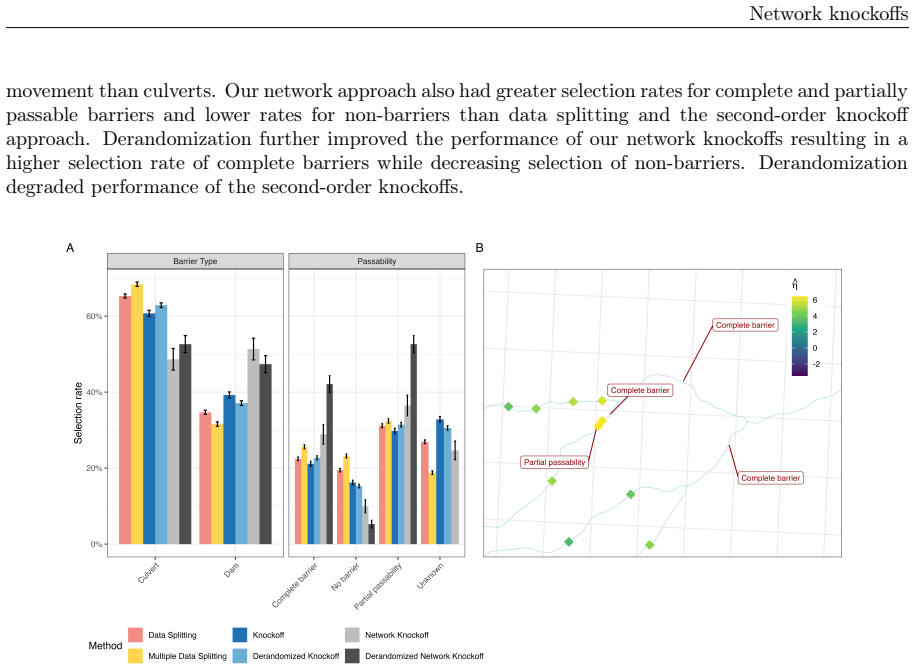
- Selects higher proportion of true barriers in the stream barrier application.
- Applies to phenomena represented as topological networks such as epidemiological or supply chain processes.
Where Pith is reading between the lines
- This approach could be adapted for other forms of dependent data where pairs share structure.
- It may improve reliability in ecological or infrastructure planning by reducing spurious feature selections.
- Testing on larger or more complex networks would reveal scalability.
Load-bearing premise
That simulating knockoffs on the network topology before the dyadic design matrix is enough to produce valid knockoff statistics despite dyad dependence.
What would settle it
Running the method on simulated network data with known true and false features and checking if the proportion of false discoveries exceeds the target rate.
Figures
read the original abstract
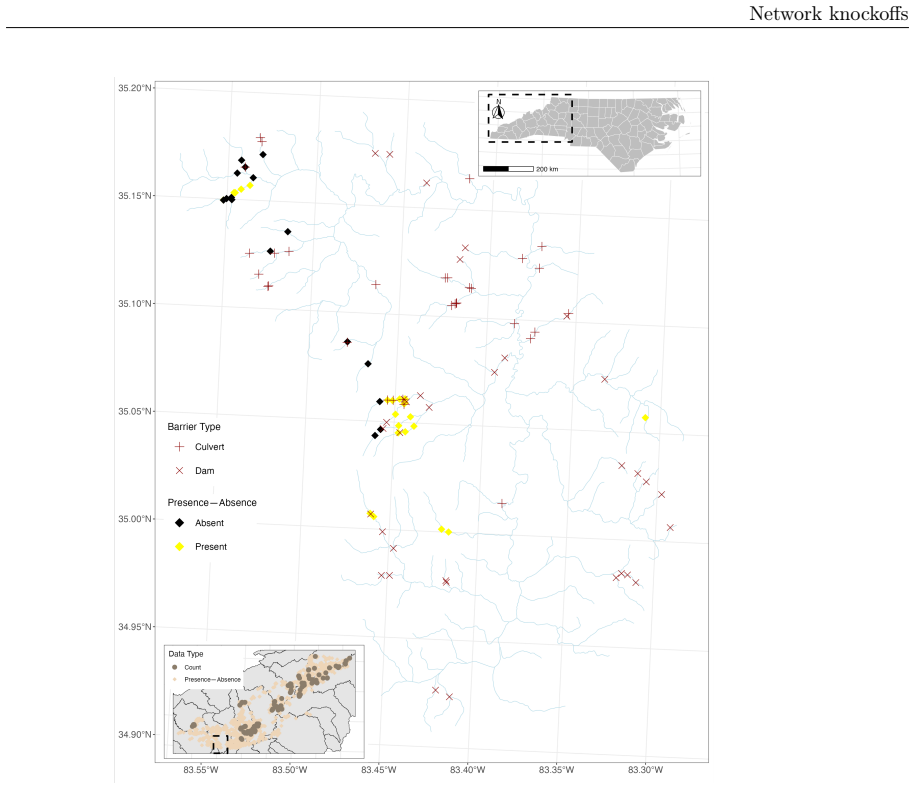
Phenomena such as epidemiological processes, hydrologic systems, social platforms, utility services, and supply chains can be represented as topological networks. A central question about these networks concerns connectivity and the permeability of edges. Dyadic regression and related approaches have been proposed to identify network features associated with pairwise node-level differences. In high-dimensional settings, it is important to control the number of spuriously selected features. However, controlling the false discovery rate for dyadic outcomes is challenging because dependence among dyads invalidates classic asymptotic procedures and complicates standard data splitting and knockoff approaches. We propose a novel knockoff variable selection procedure that simulates synthetic features directly on the topological network prior to constructing the augmented design matrix in dyadic space. Empirically, our method controls the false discovery rate for both node- and edge-level features. The Benjamini-Hochberg, Benjamini-Yekutieli, Storey Q-value, data-splitting, and standard knockoff procedures were all anticonservative. We applied our network knockoffs to assess the impassability of over 1000 stream barriers in North Carolina for Salvelinus fontinalis. Compared to data splitting and traditional knockoff approaches, our proposed approach selected a higher proportion of barriers previously assessed to impede fish movement.
Editorial analysis
A structured set of objections, weighed in public.
Referee Report
Summary. The paper proposes a 'network knockoffs' procedure for FDR control in high-dimensional dyadic regression on topological networks. Knockoffs are generated directly on the network topology before the dyadic design matrix is formed; the resulting procedure is claimed to control FDR for both node- and edge-level features, whereas BH, BY, Storey, data-splitting, and standard knockoffs are anticonservative. The method is illustrated on an application to assessing >1000 stream barriers for fish passage in North Carolina.
Significance. If the procedure can be shown to deliver valid FDR control under the dependence induced by network topology, the contribution would be useful for multiple-testing problems that arise in network epidemiology, hydrology, and ecology. The empirical demonstration that standard knockoff and splitting approaches fail while the proposed method succeeds is potentially valuable, but its weight depends on whether the FDR guarantee can be established beyond the reported simulations.
major comments (2)
- [Abstract / procedure description] Abstract and method description: the central claim is that generating knockoffs on the topological network prior to constructing the dyadic design matrix restores the model-X exchangeability and conditional-independence properties needed for FDR control. No derivation, explicit construction of the conditional distribution, or proof of the required swap property for the resulting dyadic features is supplied; all support is empirical. This is load-bearing for the main result.
- [Simulation study] Empirical section: the manuscript reports that the proposed method controls FDR while competitors do not, yet supplies no simulation design details, number of replicates, network sizes, dependence strengths, or error-bar information that would allow assessment of whether the observed control is robust or an artifact of the chosen generative model.
minor comments (2)
- [Methods] Notation for the dyadic design matrix and the precise mapping from network-level knockoffs to dyadic features should be stated explicitly with an equation or algorithm box.
- [Application] The application section would benefit from a table comparing selected barriers under each method against the ground-truth impassability labels.
Simulated Author's Rebuttal
We thank the referee for their careful and constructive review. We address each major comment below.
read point-by-point responses
-
Referee: [Abstract / procedure description] Abstract and method description: the central claim is that generating knockoffs on the topological network prior to constructing the dyadic design matrix restores the model-X exchangeability and conditional-independence properties needed for FDR control. No derivation, explicit construction of the conditional distribution, or proof of the required swap property for the resulting dyadic features is supplied; all support is empirical. This is load-bearing for the main result.
Authors: We agree that the manuscript would be strengthened by a more explicit account of the construction. In revision we will add a dedicated subsection that defines the network-level knockoff distribution, shows how exchangeability is preserved before the dyadic matrix is formed, and explains why the resulting dyadic features satisfy the conditional-independence property required by the knockoff filter. While a complete non-asymptotic proof for arbitrary network dependence structures lies beyond the present scope, the added exposition will make the procedure and its motivation fully transparent. revision: partial
-
Referee: [Simulation study] Empirical section: the manuscript reports that the proposed method controls FDR while competitors do not, yet supplies no simulation design details, number of replicates, network sizes, dependence strengths, or error-bar information that would allow assessment of whether the observed control is robust or an artifact of the chosen generative model.
Authors: We regret the omission. The revised manuscript will contain a new simulation appendix that fully specifies the generative models (network sizes, edge-probability parameters, dependence strengths), the number of Monte Carlo replicates, and the inclusion of pointwise standard-error bands on all FDR and power plots. revision: yes
Circularity Check
No significant circularity; empirical validation of new procedure
full rationale
The paper proposes a network knockoff generation strategy prior to dyadic matrix construction and reports empirical FDR control. No equations, fitted parameters renamed as predictions, self-definitional steps, or load-bearing self-citations appear in the abstract or described procedure. The central claim rests on simulation results rather than a derivation that reduces to its inputs by construction. This is the expected non-finding for a methods paper whose validity is assessed externally via experiments.
Axiom & Free-Parameter Ledger
Reference graph
Works this paper leans on
-
[1]
Crop Science , volume=
Genomic prediction of breeding values when modeling genotype environment interaction using pedigree and dense molecular markers , author=. Crop Science , volume=. 2012 , publisher=
2012
-
[2]
and Peet, Robert and Dengler, Jürgen and Pärtel, Meelis , year =
Wilson, J. and Peet, Robert and Dengler, Jürgen and Pärtel, Meelis , year =. Plant species richness: the world records , volume =. Journal of Vegetation Science , doi =
-
[3]
Grace and T.M
J.B. Grace and T.M. Anderson and E.W. Seabloom and et al. Integrative modelling reveals mechanisms linking productivity and plant species richness. Nature. 2016
2016
-
[4]
Stevens and N.B
C.J. Stevens and N.B. Dise and J.O. Mountford and D.J. Gowing. Impact of nitrogren deposition on the species richness of grasslands. Science. 2004
2004
-
[5]
Smith and A.K
M.D. Smith and A.K. Knapp. Exotic plant species in a C4-dominated grassland: invasibility, disturbance, and community structure. Oecologia. 1999
1999
-
[6]
Grace and L
J.B. Grace and L. Allain and C. Allen. Factors associated with plant species richness in a coastal tall-grass prairie. Journal of Vegetation Science. 2000
2000
-
[7]
Fynn and C.D
R.W.S. Fynn and C.D. Morris and T.J. Edwards. Effect of burning and mowing on grass and forb diversity in a long‐term grassland experiment. Applied Vegetation Science. 2004
2004
-
[8]
Busso and H.D
C.A. Busso and H.D. Giorgetti and O.A. Montenegro and G.D. Rodriguez. Perennial grass species richness and diversity on Argentine rangelands recovering from disturbance. International Journal of Experimental Biology. 2004
2004
-
[9]
Lader and J.M
P.B. Lader and J.M. Levine. Contrasting relationships between precipitation and species richness in space and time. Oikos. 2007
2007
-
[10]
Rodrigues and L
D. Rodrigues and L. A. Wauters and C. Romeo and V. Mari and D. Preatoni and Mda L. Mathias and G. Tosi and A. Martinoli , title =. Arctic, Antarctic, and Alpine Research , number =
-
[11]
Chavel and Marc J
Emilie E. Chavel and Marc J. Mazerolle and Louis Imbeau and Pierre Drapeau. Comparative evaluation of three sampling methods to estimate detection probability of American red squirrels (Tamiasciurus hudsonicus). Mammalian Biology. 2017
2017
-
[12]
K \'e ry, Mark. and J.A. Royle. Applied Hierarchical Modeling in Ecology: Analysis of distribution, abundance and species richness in R and BUGS. Academic Press. 2012
2012
-
[13]
Royle, J.A. and J.D. Nichols. Estimating abundance from repeated presence-absence data or point counts. Ecology. 2003
2003
-
[14]
Stoklosa, G
Warton, D.I., J. Stoklosa, G. Guillera-Arroita, D.I. MacKenzie, and A.H. Welsh. Graphical diagnostics for occupancy models with imperfect detection. Methods in Ecology and Evolution. 2003
2003
-
[15]
Guillaume and O'Hara, Robert and Ovaskainen, Otso and Taskinen, Sara and Walker, Steven and Hui, Francis , year =
Warton, David and Blanchet, F. Guillaume and O'Hara, Robert and Ovaskainen, Otso and Taskinen, Sara and Walker, Steven and Hui, Francis , year =. So Many Variables: Joint Modeling in Community Ecology , volume =. Trends in Ecology and Evolution
-
[16]
The impact of forest stand structure on red squirrel habitat use , volume =
Flaherty, Silvia and Patenaude, Genevieve and Close, Andrew and Lurz, Peter , year =. The impact of forest stand structure on red squirrel habitat use , volume =
-
[17]
& Meinig, H
Shar, S., Lkhagvasuren, D., Bertolino, S., Henttonen, H., Kryštufek, B. & Meinig, H. , year =
-
[18]
Mammalian responses to changed forest conditions resulting from bark beetle outbreaks in the southern
Ivan, Jacob and Seglund, Amy and Truex, Richard and Newkirk, Eric , year =. Mammalian responses to changed forest conditions resulting from bark beetle outbreaks in the southern. Ecosphere , doi =
-
[19]
Journal of Educational and Behavioral Statistics , volume =
Yeojin Chung and Andrew Gelman and Sophia Rabe-Hesketh and Jingchen Liu and Vincent Dorie , title =. Journal of Educational and Behavioral Statistics , volume =. 2015 , doi =
2015
-
[20]
Plant Ecology , doi =
Guisan, Antoine and Weiss, Stuart and Weiss, Andrew , year =. Plant Ecology , doi =
-
[21]
Making more out of sparse data: hierarchical modeling of species communities , volume =
Otso Ovaskainen and Janne Soininen , journal =. Making more out of sparse data: hierarchical modeling of species communities , volume =
-
[22]
To mix or not to mix: Comparing the predictive performance of mixture models vs
Hui, Francis and Warton, David and Foster, Scott and Dunstan, Piers , year =. To mix or not to mix: Comparing the predictive performance of mixture models vs. separate species distribution models , volume =. Ecology , doi =
-
[23]
Madon, Bénédicte and Warton, David I. and Araújo, Miguel B. , title =. Ecography , volume =. doi:10.1111/j.1600-0587.2013.00127.x , url =
-
[24]
Using latent variable models to identify large networks of species-to-species associations at different spatial scales , volume =
Ovaskainen, Otso and Abrego, Nerea and Halme, Panu and Dunson, David , year =. Using latent variable models to identify large networks of species-to-species associations at different spatial scales , volume =. Methods in Ecology and Evolution , doi =
-
[25]
Using joint species distribution models for evaluating how species‐to‐species associations depend on the environmental context , volume =
Tikhonov, Gleb and Abrego, Nerea and Dunson, David and Ovaskainen, Otso , year =. Using joint species distribution models for evaluating how species‐to‐species associations depend on the environmental context , volume =. Methods in Ecology and Evolution , doi =
-
[26]
Hanks, Ephraim M. and Schliep, Erin M. and Hooten, Mevin B. and Hoeting, Jennifer A. , title =. Environmetrics , volume =. doi:10.1002/env.2331 , url =. https://onlinelibrary.wiley.com/doi/pdf/10.1002/env.2331 , year =
-
[27]
Hoeting and Molly Leecaster and David Bowden , journal =
Jennifer A. Hoeting and Molly Leecaster and David Bowden , journal =. An Improved Model for Spatially Correlated Binary Responses , volume =
-
[28]
Broms, Kristin M. and Hooten, Mevin B. and Fitzpatrick, Ryan M. , title =. Ecology , volume =. doi:10.1890/15-1471.1 , url =. https://esajournals.onlinelibrary.wiley.com/doi/pdf/10.1890/15-1471.1 , year =
-
[29]
Hooten, M. B. and Hobbs, N. T. , title =. Ecological Monographs , volume =. doi:https://doi.org/10.1890/14-0661.1 , url =. https://esajournals.onlinelibrary.wiley.com/doi/pdf/10.1890/14-0661.1 , year =
-
[30]
and Zúñiga Hartley, Alfonso and Carrillo-Percastegui, Samia E
Tobler, Mathias W. and Zúñiga Hartley, Alfonso and Carrillo-Percastegui, Samia E. and Powell, George V. N. , title =. Journal of Applied Ecology , volume =. doi:10.1111/1365-2664.12399 , url =. https://besjournals.onlinelibrary.wiley.com/doi/pdf/10.1111/1365-2664.12399 , year =
-
[31]
and Kéry, Marc and Hui, Francis K
Tobler, Mathias W. and Kéry, Marc and Hui, Francis K. C. and Guillera-Arroita, Gurutzeta and Knaus, Peter and Sattler, Thomas , title =. Ecology , volume =. doi:https://doi.org/10.1002/ecy.2754 , url =. https://esajournals.onlinelibrary.wiley.com/doi/pdf/10.1002/ecy.2754 , year =
-
[32]
Rota, Christopher T. and Ferreira, Marco A. R. and Kays, Roland W. and Forrester, Tavis D. and Kalies, Elizabeth L. and McShea, William J. and Parsons, Arielle W. and Millspaugh, Joshua J. , title =. Methods in Ecology and Evolution , volume =. doi:10.1111/2041-210X.12587 , url =. https://besjournals.onlinelibrary.wiley.com/doi/pdf/10.1111/2041-210X.12587...
-
[33]
, title =
Blecha, Kevin A. , title =. Thesis. Colorado State University, Fort Collins, Colorado, USA , year =
-
[34]
Andrew and Pollock, Kenneth H and Bailey, Larissa L and Hines, James E , year =
MacKenzie, Darryl I and Nichols, James D and Royle, J. Andrew and Pollock, Kenneth H and Bailey, Larissa L and Hines, James E , year =. Occupancy Estimation and Modeling: Inferring Patterns and Dynamics of Species Occurrence , journal =
-
[35]
Environmental Management , year=
Using GIS to Generate Spatially Balanced Random Survey Designs for Natural Resource Applications , author=. Environmental Management , year=
-
[36]
and Clobert, Jean and Anderson, David R
Lebreton, Jean-Dominique and Burnham, Kenneth P. and Clobert, Jean and Anderson, David R. , title =. Ecological Monographs , volume =. doi:10.2307/2937171 , url =
-
[37]
and Berman, M
Baddeley, A. and Berman, M. and Fisher, N.I. and Hardegen, Andrew and Milne, R.K. and Schuhmacher, D. and Shah, R. and Turner, R. , year =. Spatial logistic regression and change-of-support in Poisson point processes , volume =. Electronic Journal of Statistics , doi =
-
[38]
Journal of the Royal Statistical Society: Series B (Statistical Methodology) , volume =
Hughes, John and Haran, Murali , title =. Journal of the Royal Statistical Society: Series B (Statistical Methodology) , volume =. doi:https://doi.org/10.1111/j.1467-9868.2012.01041.x , year =
-
[39]
Hefley, Trevor J and Hooten, Mevin B and Hanks, Ephraim M and Russell, Robin E and Walsh, Daniel P , journal=. The. 2017 , publisher=
2017
-
[40]
James S. Hodges and Brian J. Reich , title =. The American Statistician , volume =. 2010 , publisher =. doi:10.1198/tast.2010.10052 , URL =
-
[41]
and Tenhumberg, Brigitte and Field, Scott A
Tyre, Andrew J. and Tenhumberg, Brigitte and Field, Scott A. and Niejalke, Darren and Parris, Kirsten and Possingham, Hugh P. , title =. Ecological Applications , volume =. doi:https://doi.org/10.1890/02-5078 , url =. https://esajournals.onlinelibrary.wiley.com/doi/pdf/10.1890/02-5078 , year =
-
[42]
Joshua Chi-Chun Chan and Ivan Jeliazkov , journal =. M
-
[43]
Dibner, Reilly R. and Doak, Daniel F. and Murphy, Melanie , title =. Ecology and Evolution , volume =. doi:https://doi.org/10.1002/ece3.3131 , url =. https://onlinelibrary.wiley.com/doi/pdf/10.1002/ece3.3131 , year =
-
[44]
Orrock and John F
John L. Orrock and John F. Pagels and William J. McShea and Elizabeth K. Harper , journal =. Predicting Presence and Abundance of a Small Mammal Species: The Effect of Scale and Resolution , volume =
-
[45]
Filtering processes in the assembly of plant communities:
Cingolani, Ana M and Cabido, Marcelo and Gurvich, Diego E and Renison, Daniel and D. Filtering processes in the assembly of plant communities:. Journal of Vegetation Science , volume=. 2007 , publisher=
2007
-
[46]
and de Valpine, Perry and Punnett, Andrew and Miller, Arden E
Anderson, Marti J. and de Valpine, Perry and Punnett, Andrew and Miller, Arden E. , title =. Ecology and Evolution , volume =. doi:https://doi.org/10.1002/ece3.4948 , url =. https://onlinelibrary.wiley.com/doi/pdf/10.1002/ece3.4948 , year =
-
[47]
Popovic, Gordana C. and Warton, David I. and Thomson, Fiona J. and Hui, Francis K. C. and Moles, Angela T. , title =. Methods in Ecology and Evolution , volume =. doi:https://doi.org/10.1111/2041-210X.13247 , url =. https://besjournals.onlinelibrary.wiley.com/doi/pdf/10.1111/2041-210X.13247 , year =
-
[48]
and Holder, Mark T
Ghosh, Shyamolina and Sheppard, Lawrence W. and Holder, Mark T. and Loecke, Terrance E. and Reid, Philip C. and Bever, James D. and Reuman, Daniel C. , title =. 2019 , doi =. https://www.biorxiv.org/content/early/2019/07/18/650838.full.pdf , journal =
2019
-
[49]
International Journal of Epidemiology , volume =
Clayton, D G and Bernardinelli, L and Montomoli, C , title = ". International Journal of Epidemiology , volume =. 1993 , month =. doi:10.1093/ije/22.6.1193 , url =
-
[50]
The Importance of Scale for Spatial-Confounding Bias and Precision of Spatial Regression Estimators , volume =
Paciorek, Christopher , year =. The Importance of Scale for Spatial-Confounding Bias and Precision of Spatial Regression Estimators , volume =. Statistical Science:
-
[51]
Reich and James S
Brian J. Reich and James S. Hodges and Vesna Zadnik , journal =. Effects of Residual Smoothing on the Posterior of the Fixed Effects in Disease-Mapping Models , volume =
-
[52]
Andrés Houseman and Brent A
E. Andrés Houseman and Brent A. Coull and James P. Shine , journal =. A Nonstationary Negative Binomial Time Series with Time-Dependent Covariates: Enterococcus Counts in
-
[53]
Hastie , journal =
Francesca Dominici and Aidan McDermott and Trevor J. Hastie , journal =. Improved Semiparametric Time Series Models of Air Pollution and Mortality , volume =
-
[54]
R. R. Corbeil and S. R. Searle , journal =. Restricted Maximum Likelihood (REML) Estimation of Variance Components in the Mixed Model , volume =
-
[55]
1959 , publisher=
The Analysis of Variance , author=. 1959 , publisher=
1959
-
[56]
Ecology Letters , volume=
When can the cause of a population decline be determined? , author=. Ecology Letters , volume=. 2016 , publisher=
2016
-
[57]
Statistical Science , year=
Random effects old and new , author=. Statistical Science , year=
-
[58]
Understanding the causes and consequences of animal movement: A cautionary note on fitting and interpreting regression models with time-dependent covariates , journal =
Fieberg, John and Ditmer, Mark and Freckleton, Robert , volume=. Understanding the causes and consequences of animal movement: A cautionary note on fitting and interpreting regression models with time-dependent covariates , journal =. 2012 , publisher=
2012
-
[59]
Specification
Leamer, Edward E , volume=. Specification. 1978 , publisher=
1978
-
[60]
Roberts , title =
Harry V. Roberts , title =. Journal of the American Statistical Association , volume =. 1965 , publisher =
1965
-
[61]
Journal of the Royal Statistical Society: Series C (Applied Statistics) , volume=
A note on the use of principal components in regression , author=. Journal of the Royal Statistical Society: Series C (Applied Statistics) , volume=. 1982 , publisher=
1982
-
[62]
Journal of the Royal Statistical Society: Series C (Applied Statistics) , volume=
Two case studies in the application of principal component analysis , author=. Journal of the Royal Statistical Society: Series C (Applied Statistics) , volume=. 1967 , publisher=
1967
-
[63]
Journal of the American Statistical Association , volume=
A critique of some ridge regression methods , author=. Journal of the American Statistical Association , volume=. 1980 , publisher=
1980
-
[64]
Journal of Applied Meteorology and Climatology , volume=
Regression forecasting of the onset of the Indian summer monsoon with antecedent upper air conditions , author=. Journal of Applied Meteorology and Climatology , volume=
-
[65]
Communications in Statistics-Theory and Methods , volume=
Component selection norms for principal components regression , author=. Communications in Statistics-Theory and Methods , volume=. 1977 , publisher=
1977
-
[66]
Bayesian Logistic Regression with
M. Bayesian Logistic Regression with. cited on , pages=
-
[67]
Artificial Intelligence and Statistics , pages=
Handling sparsity via the horseshoe , author=. Artificial Intelligence and Statistics , pages=. 2009 , organization=
2009
-
[68]
Bayesian inference for logistic models using
Polson, Nicholas G and Scott, James G and Windle, Jesse , journal=. Bayesian inference for logistic models using. 2013 , publisher=
2013
-
[69]
Biometrika , pages=
Fast sampling with Gaussian scale mixture priors in high-dimensional regression , author=. Biometrika , pages=. 2016 , publisher=
2016
-
[70]
Journal of the American Statistical Association , volume=
Bayesian analysis of binary and polychotomous response data , author=. Journal of the American Statistical Association , volume=. 1993 , publisher=
1993
-
[71]
Journal of the Royal Statistical Society: Series B (Statistical Methodology) , volume=
Fast sampling of Gaussian Markov random fields , author=. Journal of the Royal Statistical Society: Series B (Statistical Methodology) , volume=. 2001 , publisher=
2001
-
[72]
Statistics & Probability Letters , volume=
On exact simulation algorithms for some distributions related to Jacobi theta functions , author=. Statistics & Probability Letters , volume=. 2009 , publisher=
2009
-
[73]
Proceedings of the 18th conference on Winter simulation , pages=
Sample-based non-uniform random variate generation , author=. Proceedings of the 18th conference on Winter simulation , pages=
-
[74]
The Annals of Applied Probability , volume=
Weak convergence and optimal scaling of random walk Metropolis algorithms , author=. The Annals of Applied Probability , volume=. 1997 , publisher=
1997
-
[75]
IEEE Signal Processing Letters , volume=
A simple sampler for the horseshoe estimator , author=. IEEE Signal Processing Letters , volume=. 2015 , publisher=
2015
-
[76]
PloS One , volume=
Optimal classifier for imbalanced data using Matthews Correlation Coefficient metric , author=. PloS One , volume=. 2017 , publisher=
2017
-
[77]
Statistical science: a review journal of the Institute of Mathematical Statistics , volume=
Variable selection for nonparametric Gaussian process priors: Models and computational strategies , author=. Statistical science: a review journal of the Institute of Mathematical Statistics , volume=. 2011 , publisher=
2011
-
[78]
Journal of the American Statistical Association , volume=
Bayesian variable selection in linear regression , author=. Journal of the American Statistical Association , volume=. 1988 , publisher=
1988
-
[79]
Statistica sinica , pages=
Approaches for Bayesian variable selection , author=. Statistica sinica , pages=. 1997 , publisher=
1997
-
[80]
Variable selection via
George, Edward I and McCulloch, Robert E , journal=. Variable selection via. 1993 , publisher=
1993
discussion (0)
Sign in with ORCID, Apple, or X to comment. Anyone can read and Pith papers without signing in.