REVIEW 2 major objections 5 minor 1 cited by
Coupling atoms to cavities with narrow linewidth optical transitions: Applications to frequency metrology
T0 review · 2 major / 5 minor · reviewed 2026-08-14 · deepseek-v4-flash
Pith's one-line read Weak, nearly forbidden optical transitions can be turned into strong collective couplings to a cavity, enabling new forms of clock readout, laser stabilization, and superradiant frequency references.
desk verdict A clear, honest tutorial on the author's own cavity-QED work with narrow-line optical transitions; no new science, but a solid pedagogical review that explicitly scopes its claims. read the letter →
The pith
A machine-rendered reading of the paper's core claim, the machinery that carries it, and where it could break.
The reading
What carries the argument
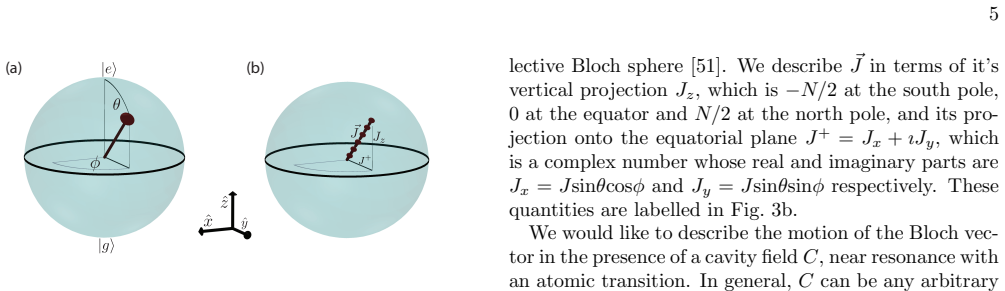
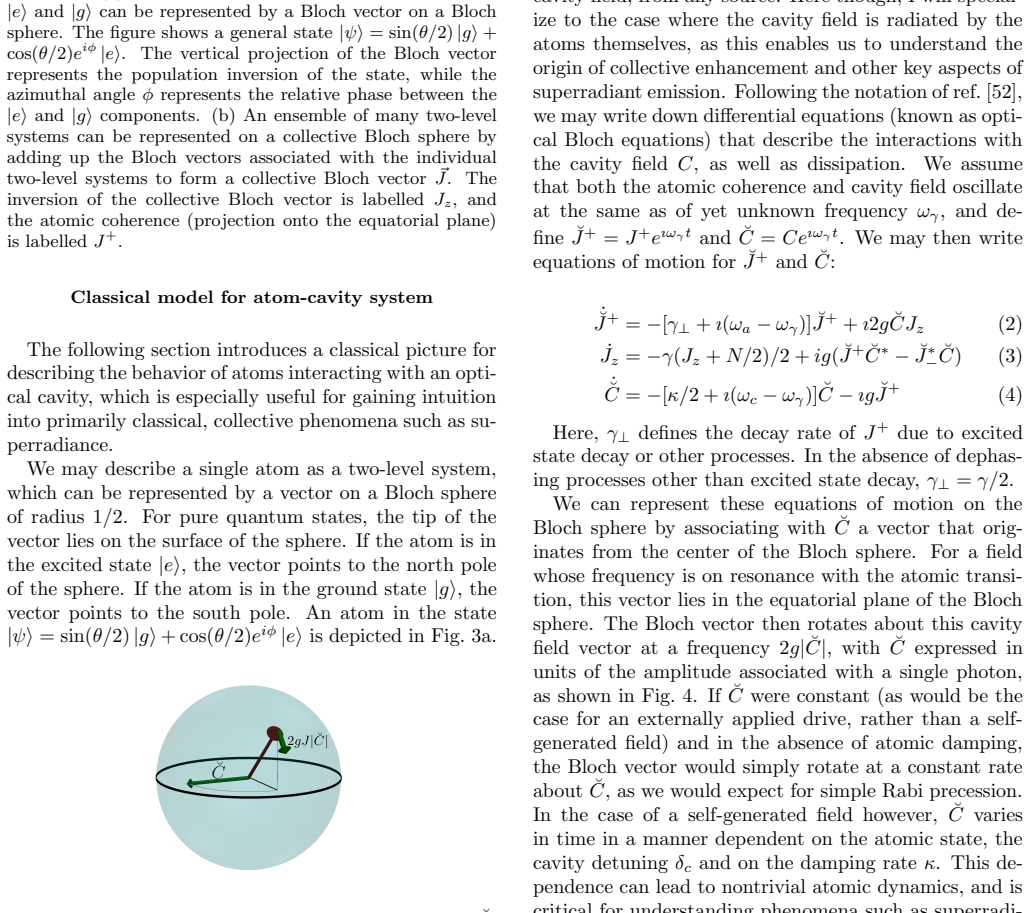
The load-bearing object is the collective Bloch vector $\mathbf{J}$ describing all atoms as one spin, with the cavity field as a rotation axis whose phase relative to the atomic coherence is set by detuning. The optical Bloch equations for $J_+$ and $J_z$, together with the cavity field $C$, generate both superradiant decay and cavity pulling; inhomogeneous coupling is folded in through effective parameters $g' = g/\sqrt{2}$ and $J'_z = N(J_1(\theta)/\theta - J_2(\theta))$. The key identity is that the dipole matrix element cancels from the cooperativity $\eta = 4g^2/\kappa\gamma$, so the transition linewidth matters mainly through $\gamma/\kappa$ and through technical noise sources like Doppler broadening, not through the fundamental coupling strength. This machinery yields a pulling coefficient proportional to the effective inversion and a null at $J'_z = 0$, which is what allows the superradiant output to stay tied to the atomic transition rather than the cavity length.
What would settle it
Reproduce the superradiant frequency measurement with atoms that are not tightly confined along the cavity axis, or with a continuously replenished moving ensemble, and compare the measured pulling coefficient $P = d\omega_\ell/d\delta_c$ and its scaling with inversion to the fixed-phase prediction; a deviation larger than the stated experimental uncertainty would show that the collective-Bloch-vector assumption fails under motion.
Extended reading notes
Core claim
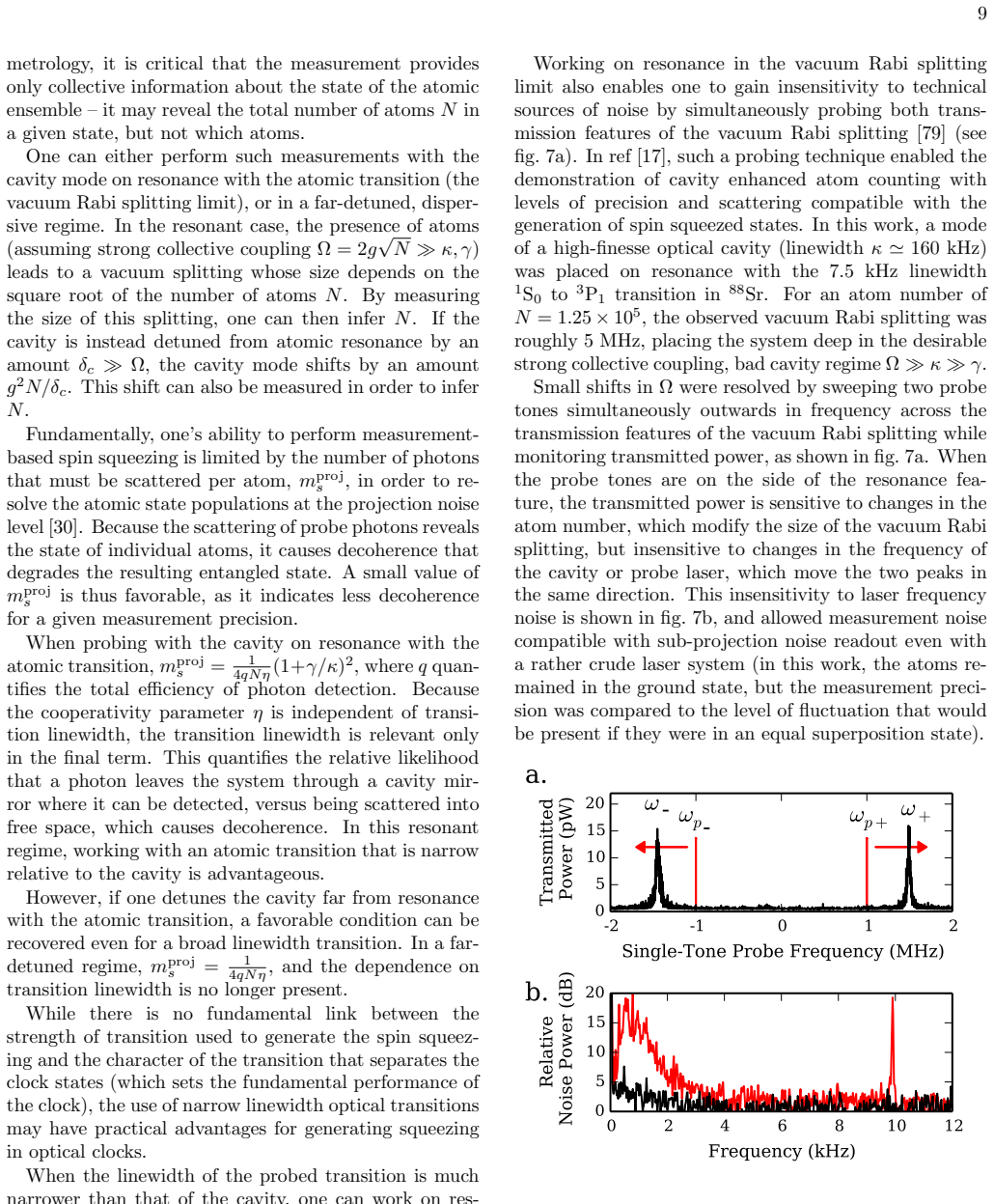
The paper's central claim is that narrow and ultranarrow optical transitions, despite tiny dipole matrix elements, are not a handicap but an advantage for cavity-based frequency metrology once atoms are used collectively. In the cooperativity parameter $\eta = 4g^2/\kappa\gamma$ the dipole element cancels, so a forbidden transition can achieve $N\eta \gg 1$ just like a strong one; what changes is the ratio $\gamma/\kappa$, putting the system in the desired bad-cavity regime where excitations leave as cavity photons rather than free-space scattering. On this basis the tutorial assembles experimental proof: a 5 MHz collective vacuum Rabi splitting on the 7.5 kHz $^{1}S_0$--$^{3}P_1$ transition in $^{88}$Sr, nondestructive atom counting with noise compatible with spin squeezing, cavity-pulling coefficients of order $2\times10^{-6}$ in superradiant pulses from the mHz linewidth clock transition, and $6.7\times10^{-16}$ fractional frequency stability at one second. The author also shows that cavity pulling $P = d\omega_\ell/d\delta_c$ scales linearly with effective inversion $J'_z$ and can be nulled by choosing initial inversion, which is what makes the superradiant source a viable active reference.
Load-bearing premise
The tutorial's predictions assume the atoms do not move during a measurement, so each atom keeps a fixed coupling phase and the ensemble behaves as one collective Bloch vector with effective coupling $g'$ and inversion $J'_z$; if atomic motion or uncontrolled inhomogeneous coupling enters, the low cavity-pulling coefficient and the utility of the superradiant reference would no longer follow.
Editorial extensions
If this is right
- Resonant probing of a narrow line in a cavity can count atoms at the projection-noise limit while scattering far fewer photons than fluorescence, which removes the dead time that currently degrades optical lattice clock stability.
- Two-tone probing of the vacuum Rabi splitting rejects common-mode laser and cavity frequency noise, so sub-projection-noise atom counting works even with a relatively unstable interrogation laser.
- Choosing the initial atomic inversion near zero cancels the time-averaged cavity pulling in superradiant pulses, yielding an active optical reference with a pulling coefficient near $2\times10^{-6}$ and fractional frequency stability of $6.7\times10^{-16}$ at one second.
- Cavity-enhanced spectroscopy on the 7.5 kHz strontium transition can produce a sub-100 kHz feature and, with straightforward improvements, support laser stabilization near the 10 mHz linewidth level.
- Spin squeezing generated on an auxiliary narrow transition or on ground-state Zeeman sublevels can in principle be transferred to the optical clock transition, enabling clock operation below the standard quantum limit.
Reading between the lines
- If continuous repumping and steady-state atom replenishment can be added to the zero-inversion operating point, the superradiant source should approach the stability of today's best optical lattice clocks while sidestepping cavity thermal drift; a testable intermediate step is a quasi-steady-state superradiant laser on the $^{87}$Sr clock transition with repumping.
- The fixed-phase assumption implies that the engineering bottleneck is not the transition's weakness but the trapping geometry: a 3D or tightly confining lattice preserves the collective Bloch vector, whereas a moving beam or shallow trap would require a re-derived inhomogeneous-coupling model and would likely lift the pulling null.
- Because cooperativity is linewidth-independent, the practical edge of narrow transitions is not fundamental: a broad transition probed far off resonance achieves the same measurement scaling, so the choice between the two hinges on technical factors such as mirror coatings, laser noise, and available wavelengths at the transition of interest.
- A clock that combines nondestructive cavity readout with feedback squeezing could operate without dead time and below projection noise simultaneously; demonstrating repeated quantum-nondemolition measurement of the same ensemble with no heating would be the key milestone.
Editorial analysis
A structured set of objections, weighed in public.
Referee Report
Summary. This tutorial reviews the physics of coupling atomic ensembles to optical cavities through narrow and ultranarrow optical transitions, with emphasis on applications to optical frequency metrology. It introduces the Jaynes-Cummings model and its many-atom generalization, defines the strong-coupling and bad-cavity/good-cavity regimes, and presents a classical Bloch-vector model for superradiant emission. The tutorial then surveys three applications: cavity-enhanced laser frequency stabilization using narrow-linewidth transitions (including magnetically induced transparency), nondestructive atom counting and spin squeezing for optical lattice clocks, and superradiant active optical frequency references. The exposition is anchored in recent experiments, mostly from the author's group at JILA, including a 5 MHz collective vacuum Rabi splitting on the 7.5 kHz strontium intercombination line, two-tone probing for reduced sensitivity to laser noise, cavity-pulling measurements on the strontium clock transition, and pulsed superradiance with a pulling coefficient near 2e-6 and a fractional frequency stability of 6.7e-16 at one second. The tutorial closes by identifying continuous operation as a major outstanding challenge for both active references and cavity-enhanced spectroscopy.
Significance. As a pedagogical review, the paper fills a useful niche: it connects the language of cavity QED with the specific scalings relevant to alkaline-earth narrow-linewidth transitions and with concrete metrology applications. Its strengths are the careful delineation of parameter regimes (strong coupling, bad cavity, cooperativity), the explicit identification of where results come from (original papers and theses are cited for detailed derivations), and the honest acknowledgment that the superradiant frequency reference has so far been demonstrated only in pulsed mode, with true steady-state operation remaining an open challenge. The quantitative statements are grounded in published, independently verified measurements. The paper does not claim to present new derivations or new data, so its significance is moderate but real for a tutorial audience; it also usefully highlights where the field's open problems lie.
major comments (2)
- [A brief introduction to atoms in cavities, Eq. (1)] The text states that one replaces J± with creation and annihilation operators via â = J_+/√N and ↠= J_−/√N. With these definitions, the interaction term ℏg√N(â c† + ↠c) in Eq. (1) describes co-creation and co-annihilation of atomic and photonic excitations, not the rotating-wave exchange of excitations. To match the displayed Hamiltonian, the mapping should be reversed (â = J_−/√N and ↠= J_+/√N), or the interaction term should be rewritten accordingly. Because Eq. (1) is the basis for the collective enhancement Ω = 2g√N discussed throughout the tutorial, this notational reversal should be corrected.
- [Abstract and 'Superradiant frequency references'] The abstract states that narrow-linewidth atom-cavity coupling 'enables' high-precision active optical frequency references based on superradiant emission. In the body, the supporting evidence is explicitly pulsed: the pulling coefficient near 2e-6 and the 6.7e-16 stability at one second come from pulsed superradiance on the clock transition, and the text states that true steady-state operation would require a continuous supply of atoms and control of atomic motion, which is an outstanding challenge. The manuscript is internally consistent because it acknowledges these caveats in the relevant section and in the Conclusion, but the abstract should be qualified so that readers do not infer that a continuous active reference has been demonstrated. I recommend adding a phrase such as 'pulsed proof-of-principle demonstrations' in the abstract's statement of this opportunity.
minor comments (5)
- [Throughout] There are several typos that should be corrected: 'these week transitions' should read 'these weak transitions'; 'transtions' should read 'transitions'; 'The remainder if this tutorial' should read 'The remainder of this tutorial'; and 'We can understnd the origin' should read 'We can understand the origin'.
- [Collective enhancement of emission, Eqs. (5)-(10)] The effective parameters g' = g/√2 and J'_z = N(J1(θ)/θ - J2(θ)) are introduced to handle inhomogeneous coupling to the standing-wave cavity mode, but no derivation or quantitative explanation is given in the tutorial. Since these effective parameters are used to interpret the measured pulling coefficient, a short physical explanation or an explicit pointer to the relevant equations in ref. [8] would improve self-containedness.
- [Spin squeezing and nondestructive atom counting] The statement that 'the atoms remained in the ground state' in the two-tone probing demonstration could be clarified: the measurement was performed on a transition between ground-state sublevels, and the precision was referenced to the projection noise expected for an equal superposition. A single explanatory phrase would prevent confusion for readers unfamiliar with the experimental scheme.
- [Laser frequency stabilization using light transmitted through atomic ensembles] The claim that the experimental complexity is 'relatively moderate, potentially enabling deployment outside of research labs' is an assessment not directly supported by a citation in the tutorial. If this claim is retained, adding a reference or a brief justification would be appropriate.
- [Figure 8 and Figure 11] The two Bloch-sphere figures repeat similar information but use different notations (e.g., azimuthal angle φ and cavity-field phase φ_C). A combined figure or a unified notation would make the tutorial easier to follow, though this is a presentation issue only.
Circularity Check
No significant circularity; the tutorial's claims rest on standard derivations and on published measurements that were independently referenced.
full rationale
The paper is a tutorial and review rather than a derivation that fits its own parameters and then presents those fits as predictions. The collective-coupling enhancement leading to Eqs. (5)-(7) is obtained by adiabatically eliminating the cavity field from the standard optical Bloch equations presented in Eqs. (2)-(4), following the linear-response treatment cited as ref. [52]; this is a conventional derivation, not a definitional identity. The central quantitative claims, including the 5 MHz vacuum Rabi splitting, the pulling coefficient near 2e-6, and the 6.7e-16 fractional frequency stability at one second, are quoted from previously published experiments. The text states that the emission frequency was measured relative to a stable reference laser using a heterodyne beat note, and that the absolute frequency was checked against the expected atomic transition frequency and against an optical lattice clock, so the experimental support is external to the tutorial's fitted values. The effective-coupling treatment of inhomogeneous coupling, via g' = g/sqrt(2) and J'_z = N(J1(theta)/theta - J2(theta)), is explicitly described as reproducing the behavior of homogeneous coupling and is used to interpret the measured linear scaling of the pulling coefficient with inversion; the plotted 'predicted' pulling-coefficient curve is qualified by the paper as being valid 'up to an overall scale factor,' making it a consistency check rather than a forced prediction. Footnote 51's condition that atoms do not move around is a stated validity condition for the collective Bloch-vector picture, and the Conclusion explicitly identifies continuous operation as an outstanding challenge; this is acknowledged missing support for an extrapolation, not circularity. Self-citations are frequent, but the load-bearing facts they support were measured against independent references and are not merely restatements of assumptions in this paper. No step of the claimed derivation reduces to its input by construction.
Assumptions & free parameters
assumptions (5)
- domain assumption Two-level atoms with identical coupling g to a single cavity mode; collective enhancement Omega = 2g sqrt(N).
- domain assumption Linearization of collective spin operators (Holstein-Primakoff) for weak probe.
- domain assumption Semiclassical optical Bloch equations with Markovian decay rates gamma and kappa describe the coupled atom-cavity dynamics.
- domain assumption Inhomogeneous coupling to the standing-wave cavity mode can be absorbed into effective parameters g' and J'_z.
- domain assumption Atoms do not move during the relevant timescales, so coupling phases are fixed.
Cite this review
Pith. "Pith review of Coupling atoms to cavities with narrow linewidth optical transitions: Applications to frequency metrology." pith.science (2026). https://pith.science/paper/HOFMQFWK
@misc{pith2026190811442,
  author       = {Pith},
  title        = {Pith review of: Coupling atoms to cavities with narrow linewidth optical transitions: Applications to frequency metrology},
  year         = {2026},
  howpublished = {\url{https://pith.science/paper/HOFMQFWK}},
  note         = {Machine review of arXiv:1908.11442}
}
read the original abstract
Narrow linewidth optical atomic transitions provide a valuable resource for frequency metrology, and form the basis of today's most precise and accurate clocks. Recent experiments have demonstrated that ensembles of atoms can be interfaced with the mode of an optical cavity using such transitions, and that atom-cavity interactions can dominate over decoherence processes even when the atomic transition that mediates the interactions is very weak. This scenario enables new opportunities for optical frequency metrology, including techniques for nondestructive readout and entanglement enhancement for optical lattice clocks, methods for cavity-enhanced laser frequency stabilization, and high-precision active optical frequency references based on superradiant emission. This tutorial provides a pedagogical description of the physics governing atom-cavity coupling with narrow linewidth optical transitions, and describes several examples of applications to optical frequency metrology.
Figures


Figures from the paper (9 more)




Forward citations
Cited by 1 Pith paper
-
An atomic array optical clock with single-atom readout
An optical clock made from a 40-atom strontium tweezer array with single-atom readout reaches 2.5×10^-15/√τ stability and agrees with a detailed Monte Carlo simulation.
Reference graph
Works this paper leans on
-
[1]
Manipulating quantum entanglement with atoms and photons in a cavity,
Jean-Michel Raimond, M Brune, and Serge Haroche, “Manipulating quantum entanglement with atoms and photons in a cavity,” Reviews of Modern Physics 73, 565 (2001)
2001
-
[2]
squeezed
The|0⟩ state is shown, but it does not interact with the horizontally polarized cavity- field. Figure reproduced from ref. [68]. netic field. The following section provides a brief, quali- tative picture of this effect. For detailed and quantitative descriptions, see ref. [68]. In the MIT configuration, the probe light couples the ground state to two opticall...
-
[3]
Deterministic single-photon source for distributed quantum networking,
Axel Kuhn, Markus Hennrich, and Gerhard Rempe, “Deterministic single-photon source for distributed quantum networking,” Phys. Rev. Lett. 89, 067901 (2002)
2002
-
[4]
The quantum internet,
H Jeff Kimble, “The quantum internet,” Nature 453, 1023–1030 (2008)
2008
-
[5]
Tunable cavity optomechanics with ultracold atoms,
Tom P Purdy, DWC Brooks, Thierry Botter, Nathan Brahms, Z-Y Ma, and Dan M Stamper-Kurn, “Tunable cavity optomechanics with ultracold atoms,” Phys. Rev. Lett. 105, 133602 (2010)
2010
-
[6]
Observation of collective friction forces due to spatial self-organization of atoms: from rayleigh to bragg scat- tering,
Adam T Black, Hilton W Chan, and Vladan Vuleti´ c, “Observation of collective friction forces due to spatial self-organization of atoms: from rayleigh to bragg scat- tering,” Phys. Rev. Lett. 91, 203001 (2003)
2003
-
[7]
Photon-mediated spin-exchange dynamics of spin-1 atoms,
Emily J Davis, Gregory Bentsen, Lukas Homeier, Tracy Li, and Monika H Schleier-Smith, “Photon-mediated spin-exchange dynamics of spin-1 atoms,” Phys. Rev. Lett. 122, 010405 (2019)
2019
-
[8]
Dicke quantum phase transition with a superfluid gas in an optical cavity,
Kristian Baumann, Christine Guerlin, Ferdinand Bren- necke, and Tilman Esslinger, “Dicke quantum phase transition with a superfluid gas in an optical cavity,” Nature 464, 1301–1306 (2010)
2010
Show all 104 references
-
[9]
Colloquium: Quantum mat- ter built from nanoscopic lattices of atoms and pho- tons,
DE Chang, JS Douglas, Alejandro Gonz´ alez-Tudela, C- L Hung, and HJ Kimble, “Colloquium: Quantum mat- ter built from nanoscopic lattices of atoms and pho- tons,” Reviews of Modern Physics 90, 031002 (2018)
2018
-
[10]
Cavity-mediated collective spin-exchange interactions in a strontium superradiant laser,
Matthew A Norcia, Robert J Lewis-Swan, Julia RK Cline, Bihui Zhu, Ana M Rey, and James K Thompson, “Cavity-mediated collective spin-exchange interactions in a strontium superradiant laser,” Science 361, 259– 262 (2018)
2018
-
[11]
Strong coupling of a single photon to a superconducting qubit using circuit quantum electro- dynamics,
Andreas Wallraff, David I Schuster, Alexandre Blais, L Frunzio, et al., “Strong coupling of a single photon to a superconducting qubit using circuit quantum electro- dynamics,” Nature 431, 162 (2004)
2004
-
[12]
Efficient source of single pho- tons: a single quantum dot in a micropost microcavity,
Matthew Pelton, Charles Santori, Jelena Vuckovi´ c, Bingyang Zhang, Glenn S Solomon, Jocelyn Plant, and Yoshihisa Yamamoto, “Efficient source of single pho- tons: a single quantum dot in a micropost microcavity,” Phys. Rev. Lett. 89, 233602 (2002)
2002
-
[13]
Atomic source of single photons in the telecom band,
AM Dibos, M Raha, CM Phenicie, and JD Thompson, “Atomic source of single photons in the telecom band,” Phys. Rev. Lett. 120, 243601 (2018)
2018
-
[14]
Trapped atoms in cavity qed: coupling quantized light and matter,
R Miller, TE Northup, KM Birnbaum, ADBA Boca, AD Boozer, and HJ Kimble, “Trapped atoms in cavity qed: coupling quantized light and matter,” Journal of Physics B: Atomic, Molecular and Optical Physics 38, S551 (2005)
2005
-
[15]
Nonlinear 15 spectroscopy of sr atoms in an optical cavity for laser stabilization,
Bjarke TR Christensen, Martin R Henriksen, Stefan A Sch¨ affer, Philip G Westergaard, David Tieri, Jun Ye, Murray J Holland, and Jan W Thomsen, “Nonlinear 15 spectroscopy of sr atoms in an optical cavity for laser stabilization,” Physical Review A 92, 053820 (2015)
2015
-
[16]
Observation of motion- dependent nonlinear dispersion with narrow-linewidth atoms in an optical cavity,
Philip G. Westergaard, Bjarke T. R. Christensen, David Tieri, Rastin Matin, John Cooper, Murray Holland, Jun Ye, and Jan W. Thomsen, “Observation of motion- dependent nonlinear dispersion with narrow-linewidth atoms in an optical cavity,” Phys. Rev. Lett. 114, 093002 (2015)
2015
-
[17]
Strong coupling on a forbidden transition in strontium and non- destructive atom counting,
Matthew A. Norcia and James K. Thompson, “Strong coupling on a forbidden transition in strontium and non- destructive atom counting,” Phys. Rev. A 93, 023804 (2016)
2016
-
[18]
Near-unitary spin squeezing in yb 171,
Boris Braverman, Akio Kawasaki, Edwin Pedrozo- Pe˜ nafiel, Simone Colombo, Chi Shu, Zeyang Li, Enrique Mendez, Megan Yamoah, Leonardo Salvi, Daisuke Aka- matsu, et al. , “Near-unitary spin squeezing in yb 171,” Phys. Rev. Lett. 122, 223203 (2019)
2019
-
[19]
Superradiance on the millihertz linewidth strontium clock transition,
Matthew A Norcia, Matthew N Winchester, Julia RK Cline, and James K Thompson, “Superradiance on the millihertz linewidth strontium clock transition,” Science advances 2, e1601231 (2016)
2016
-
[20]
Superradiant laser with metastable calcium atoms,
T. Laske, H. Winter, and A. Hemmerich, “Superradiant laser with metastable calcium atoms,” arXiv preprint arXiv:1903.10196 (2019)
2019 arXiv
-
[21]
Systematic evaluation of an atomic clock at 2× 10⁻¹⁸ total uncertainty,
T. L. Nicholson, S. L. Campbell, R. B. Hutson, G. E. Marti, B. J. Bloom, R. L. McNally, W. Zhang, M. D. Barrett, M. S. Safronova, G. F. Strouse, W. L. Tew, and J. Ye, “Systematic evaluation of an atomic clock at 2× 10⁻¹⁸ total uncertainty,” Nature Communications 6, 6896 EP – (2015)
2015
-
[22]
Ul- trastable optical clock with two cold-atom ensembles,
Marco Schioppo, Roger C Brown, William F McGrew, N Hinkley, Robert J Fasano, K Beloy, TH Yoon, Gi- anmaria Milani, D Nicolodi, JA Sherman, et al. , “Ul- trastable optical clock with two cold-atom ensembles,” Nature Photonics 11, 48 (2017)
2017
-
[23]
Cryogenic optical lat- tice clocks,
Ichiro Ushijima, Masao Takamoto, Manoj Das, Takuya Ohkubo, and Hidetoshi Katori, “Cryogenic optical lat- tice clocks,” Nature Photonics 9, 185 (2015)
2015
-
[24]
Towards an optical clock for space: Compact, high-performance optical lattice clock based on bosonic atoms,
S. Origlia et al. , “Towards an optical clock for space: Compact, high-performance optical lattice clock based on bosonic atoms,” Phys. Rev. A 98, 053443 (2018)
2018
-
[25]
Interaction between atomic ensembles and optical resonators: Classical descrip- tion,
Haruka Tanji-Suzuki, Ian D Leroux, Monika H Schleier- Smith, Marko Cetina, Andrew T Grier, Jonathan Si- mon, and Vladan Vuleti´ c, “Interaction between atomic ensembles and optical resonators: Classical descrip- tion,” in Advances in atomic, molecular, and optical physics, Vol...
2011
-
[26]
Frequency comparison of two high- accuracy al+ optical clocks,
CW Chou, DB Hume, JCJ Koelemeij, DJ Wineland, and T Rosenband, “Frequency comparison of two high- accuracy al+ optical clocks,” Phys. Rev. Lett. 104, 070802 (2010)
2010
-
[27]
Quantum and atom optics,
Daniel A Steck, “Quantum and atom optics,” Oregon Center for Optics and Department of Physics, Univer- sity of Oregon , 47 (2007)
2007
-
[28]
Serge Haroche and J-M Raimond, Exploring the quan- tum: atoms, cavities, and photons (Oxford university press, 2006)
2006
-
[29]
Inhibited spontaneous emission,
Daniel Kleppner, “Inhibited spontaneous emission,” Phys. Rev. Lett. 47, 233 (1981)
1981
-
[30]
Comparison of quantum and semiclassical radiation theories with ap- plication to the beam maser,
E.T. Jaynes and F.W. Cummings, “Comparison of quantum and semiclassical radiation theories with ap- plication to the beam maser,” Proceedings of the IEEE 51, 89–109 (1963)
1963
-
[31]
Field dependence of the intrinsic domain magnetization of a ferromagnet,
T Holstein and Hl Primakoff, “Field dependence of the intrinsic domain magnetization of a ferromagnet,” Phys- ical Review 58, 1098 (1940)
1940
-
[32]
Cavity- aided nondemolition measurements for atom counting and spin squeezing,
Zilong Chen, Justin G. Bohnet, Joshua M. Weiner, Kevin C. Cox, and James K. Thompson, “Cavity- aided nondemolition measurements for atom counting and spin squeezing,” Phys. Rev. A 89, 043837 (2014)
2014
-
[33]
All- optical routing of single photons by a one-atom switch controlled by a single photon,
Itay Shomroni, Serge Rosenblum, Yulia Lovsky, Orel Bechler, Gabriel Guendelman, and Barak Dayan, “All- optical routing of single photons by a one-atom switch controlled by a single photon,” Science 345, 903–906 (2014)
2014
-
[34]
Normal-mode splitting and linewidth averaging for two-state atoms in an optical cavity,
MG Raizen, RJ Thompson, RJ Brecha, HJ Kimble, and HJ Carmichael, “Normal-mode splitting and linewidth averaging for two-state atoms in an optical cavity,” Phys. Rev. Lett. 63, 240 (1989)
1989
-
[35]
Deterministic generation of single photons from one atom trapped in a cavity,
J McKeever, A Boca, AD Boozer, R Miller, JR Buck, A Kuzmich, and HJ Kimble, “Deterministic generation of single photons from one atom trapped in a cavity,” Science 303, 1992–1994 (2004)
2004
-
[36]
Nanophotonic quantum phase switch with a sin- gle atom,
TG Tiecke, Jeffrey Douglas Thompson, Nathalie Pul- mones de Leon, LR Liu, Vladan Vuleti´ c, and Mikhail D Lukin, “Nanophotonic quantum phase switch with a sin- gle atom,” Nature 508, 241 (2014)
2014
-
[37]
Observation of self-induced rabi oscillations in two-level atoms excited inside a resonant cavity: the ringing regime of superradiance,
Y Kaluzny, P Goy, M Gross, JM Raimond, and S Haroche, “Observation of self-induced rabi oscillations in two-level atoms excited inside a resonant cavity: the ringing regime of superradiance,” Phys. Rev. Lett. 51, 1175 (1983)
1983
-
[38]
Statistics of millimeter-wave photons emitted by a rydberg-atom maser: An experimental study of fluctu- ations in single-mode superradiance,
JM Raimond, P Goy, M Gross, C Fabre, and S Haroche, “Statistics of millimeter-wave photons emitted by a rydberg-atom maser: An experimental study of fluctu- ations in single-mode superradiance,” Phys. Rev. Lett. 49, 1924 (1982)
1982
-
[39]
An elementary quantum network of single atoms in optical cavities,
Stephan Ritter, Christian N¨ olleke, Carolin Hahn, An- dreas Reiserer, Andreas Neuzner, Manuel Uphoff, Mar- tin M¨ ucke, Eden Figueroa, Joerg Bochmann, and Ger- hard Rempe, “An elementary quantum network of single atoms in optical cavities,” Nature 484, 195–200 (2012)
2012
-
[40]
Manipu- lating quantum entanglement with atoms and photons in a cavity,
J. M. Raimond, M. Brune, and S. Haroche, “Manipu- lating quantum entanglement with atoms and photons in a cavity,” Rev. Mod. Phys. 73, 565–582 (2001)
2001
-
[41]
Measurement of ultralow losses in an optical interferometer,
G Rempe, RJ Thompson, H Jeffrey Kimble, and Ramin Lalezari, “Measurement of ultralow losses in an optical interferometer,” Optics letters 17, 363–365 (1992)
1992
-
[42]
Reversible state trans- fer between light and a single trapped atom,
A David Boozer, Andreea Boca, Russell Miller, Tracy E Northup, and H Jeffrey Kimble, “Reversible state trans- fer between light and a single trapped atom,” Phys. Rev. Lett. 98, 193601 (2007)
2007
-
[43]
Measurement noise 100 times lower than the quantum-projection limit using entan- gled atoms,
Onur Hosten, Nils J Engelsen, Rajiv Krishnakumar, and Mark A Kasevich, “Measurement noise 100 times lower than the quantum-projection limit using entan- gled atoms,” Nature 529, 505 (2016)
2016
-
[44]
Entanglement with nega- tive wigner function of almost 3,000 atoms heralded by one photon,
Robert McConnell, Hao Zhang, Jiazhong Hu, Senka ´Cuk, and Vladan Vuleti´ c, “Entanglement with nega- tive wigner function of almost 3,000 atoms heralded by one photon,” Nature 519, 439 (2015)
2015
-
[45]
Implementation of cavity squeezing of a collec- tive atomic spin,
Ian D. Leroux, Monika H. Schleier-Smith, and Vladan Vuleti´ c, “Implementation of cavity squeezing of a collec- tive atomic spin,” Phys. Rev. Lett. 104, 073602 (2010)
2010
-
[46]
Deterministic squeezed states with collective measurements and feedback,
Kevin C Cox, Graham P Greve, Joshua M Weiner, and James K Thompson, “Deterministic squeezed states with collective measurements and feedback,” Phys. Rev. Lett. 116, 093602 (2016)
2016
-
[47]
Long-distance quantum communication with atomic 16 ensembles and linear optics,
L.-M. Duan, M. D. Lukin, J. I. Cirac, and P. Zoller, “Long-distance quantum communication with atomic 16 ensembles and linear optics,” Nature 414, 413–418 (2001)
2001
-
[48]
Deterministic gen- eration of multiparticle entanglement by quantum zeno dynamics,
Giovanni Barontini, Leander Hohmann, Florian Haas, J´ erˆ ome Est` eve, and Jakob Reichel, “Deterministic gen- eration of multiparticle entanglement by quantum zeno dynamics,” Science 349, 1317–1321 (2015)
2015
-
[49]
Prospects for a millihertz-linewidth laser,
D. Meiser, Jun Ye, D. R. Carlson, and M. J. Holland, “Prospects for a millihertz-linewidth laser,” Phys. Rev. Lett. 102, 163601–163604 (2009)
2009
-
[50]
Interfacing collective atomic ex- citations and single photons,
Jonathan Simon, Haruka Tanji, James K Thompson, and Vladan Vuleti´ c, “Interfacing collective atomic ex- citations and single photons,” Physical Review Letters 98, 183601 (2007)
2007
-
[51]
So long as the atoms do not move around, and coherent rotations are only performed using the cavity mode, we can safely ignore this detail
In order to account for the fact that the atoms are lo- cated at different points along the cavity axis, and there- fore experience a different optical phase from the cavity field, we define the phase of each atom’s Bloch vector relative to the phase of the optical field of the res...
-
[52]
Nuclear spin effects in optical lattice clocks,
Martin M Boyd, Tanya Zelevinsky, Andrew D Ludlow, Sebastian Blatt, Thomas Zanon-Willette, Seth M Fore- man, and Jun Ye, “Nuclear spin effects in optical lattice clocks,” Physical Review A 76, 022510 (2007)
2007
-
[53]
Direct link between microwave and optical frequencies with a 300 thz femtosecond laser comb,
Scott A Diddams, David J Jones, Jun Ye, Steven T Cun- diff, John L Hall, Jinendra K Ranka, Robert S Windeler, Ronald Holzwarth, Thomas Udem, and TW H¨ ansch, “Direct link between microwave and optical frequencies with a 300 thz femtosecond laser comb,” Physical Re- view Letters...
2000
-
[54]
Linear- response theory for superradiant lasers,
Justin G Bohnet, Zilong Chen, Joshua M Weiner, Kevin C Cox, and James K Thompson, “Linear- response theory for superradiant lasers,” Physical Re- view A 89, 013806 (2014)
2014
-
[55]
Geodesy and metrology with a transportable optical clock,
Jacopo Grotti, Silvio Koller, Stefan Vogt, Sebastian H¨ afner, Uwe Sterr, Christian Lisdat, Heiner Denker, Christian Voigt, Ludger Timmen, Antoine Rolland, et al. , “Geodesy and metrology with a transportable optical clock,” Nature Physics , 1 (2018)
2018
-
[56]
Generation of ultrastable microwaves via optical frequency division,
Tara M Fortier, Matthew S Kirchner, F Quinlan, J Tay- lor, JC Bergquist, T Rosenband, N Lemke, A Ludlow, Y Jiang, CW Oates, et al. , “Generation of ultrastable microwaves via optical frequency division,” Nature Pho- tonics 5, 425 (2011)
2011
-
[57]
Optical clocks and relativity,
C. W. Chou, D. B. Hume, T. Rosenband, and D. J. Wineland, “Optical clocks and relativity,” Science 329, 1630–1633 (2010)
2010
-
[58]
Optical clock comparison for lorentz symmetry testing
Christian Sanner, Nils Huntemann, Richard Lange, Christian Tamm, Ekkehard Peik, Marianna S Safronova, and Sergey G Porsev, “Optical clock comparison for lorentz symmetry testing.” Nature 567, 204–208 (2019)
2019
-
[59]
Laser phase and frequency stabilization using an optical resonator,
RWP Drever, John L Hall, FV Kowalski, J Hough, GM Ford, AJ Munley, and H Ward, “Laser phase and frequency stabilization using an optical resonator,” Ap- plied Physics B 31, 97–105 (1983)
1983
-
[60]
Searching for dilaton dark matter with atomic clocks,
Asimina Arvanitaki, Junwu Huang, and Ken Van Tilburg, “Searching for dilaton dark matter with atomic clocks,” Phys. Rev. D 91, 015015 (2015)
2015
-
[61]
Thermal-noise limit in the frequency stabilization of lasers with rigid cavities,
Kenji Numata, Amy Kemery, and Jordan Camp, “Thermal-noise limit in the frequency stabilization of lasers with rigid cavities,” Phys. Rev. Lett. 93, 250602 (2004)
2004
-
[62]
1.5µm lasers with sub-10 mhz linewidth,
DG Matei, T Legero, S H¨ afner, Ch Grebing, R Weyrich, W Zhang, L Sonderhouse, JM Robinson, J Ye, F Riehle, et al., “1.5µm lasers with sub-10 mhz linewidth,” Phys. Rev. Lett. 118, 263202 (2017)
2017
-
[63]
Crystalline optical cavity at 4 k with thermal-noise-limited instability and ultralow drift,
John M Robinson, Eric Oelker, William R Milner, Wei Zhang, Thomas Legero, Dan G Matei, Fritz Riehle, Uwe Sterr, and Jun Ye, “Crystalline optical cavity at 4 k with thermal-noise-limited instability and ultralow drift,” Optica 6, 240–243 (2019)
2019
-
[64]
Contri- bution of thermal noise to frequency stability of rigid optical cavity via hertz-linewidth lasers,
Mark Notcutt, Long-Sheng Ma, Andrew D Ludlow, Seth M Foreman, Jun Ye, and John L Hall, “Contri- bution of thermal noise to frequency stability of rigid optical cavity via hertz-linewidth lasers,” Phys. Rev. A 73, 031804 (2006)
2006
-
[65]
Active optical clock,
JingBiao Chen, “Active optical clock,” Chinese Sci. Bull. 54, 348–352 (2009)
2009
-
[66]
Optical atomic clocks,
Andrew D Ludlow, Martin M Boyd, Jun Ye, Ekkehard Peik, and Piet O Schmidt, “Optical atomic clocks,” Reviews of Modern Physics 87, 637 (2015)
2015
-
[67]
Laser stabilization using satu- rated absorption in a cavity-qed system,
DA Tieri, J Cooper, Bjarke TR Christensen, JW Thom- sen, and MJ Holland, “Laser stabilization using satu- rated absorption in a cavity-qed system,” Physical Re- view A 92, 013817 (2015)
2015
-
[68]
A high stability optical frequency reference based on thermal calcium atoms,
Richard W Fox, Jeffrey A Sherman, W Douglas, Ju- dith B Olson, Andrew D Ludlow, and Christopher W Oates, “A high stability optical frequency reference based on thermal calcium atoms,” in Frequency Control Symposium (FCS), 2012 IEEE International (IEEE,
2012
-
[69]
Ob- servation of electromagnetically induced transparency,
K-J Boller, A Imamo˘ glu, and Stephen E Harris, “Ob- servation of electromagnetically induced transparency,” Phys. Rev. Lett. 66, 2593 (1991)
1991
-
[70]
Magnetically in- duced optical transparency on a forbidden transition in strontium for cavity-enhanced spectroscopy,
Matthew N Winchester, Matthew A Norcia, Julia RK Cline, and James K Thompson, “Magnetically in- duced optical transparency on a forbidden transition in strontium for cavity-enhanced spectroscopy,” Phys. Rev. Lett. 118 (2017)
2017
-
[71]
Nondestructive measurement of the transi- tion probability in a Sr optical lattice clock,
J´ erˆ ome Lodewyck, Philip G. Westergaard, and Pierre Lemonde, “Nondestructive measurement of the transi- tion probability in a Sr optical lattice clock,” Phys. Rev. A 79, 061401 (2009)
2009
-
[72]
Local oscillator induced instabilities in trapped ion frequency standards,
G Dick, “Local oscillator induced instabilities in trapped ion frequency standards,” Proc. of Precise Time and Time Interval , 133–147 (1987)
1987
-
[73]
Spin squeezing and reduced quantum noise in spec- troscopy,
DJ Wineland, JJ Bollinger, WM Itano, and FL Moore, “Spin squeezing and reduced quantum noise in spec- troscopy,” Phys. Rev. A 46, R6797–R6800 (1992)
1992
-
[74]
Quantum projection noise: population fluctuations in two-level systems,
WM Itano, JC Bergquist, JJ Bollinger, JM Gilligan, DJ Heinzen, FL Moore, MG Raizen, and DJ Wineland, “Quantum projection noise: population fluctuations in two-level systems,” Phys. Rev. A 47, 3554 (1993)
1993
-
[75]
Squeezing the collective spin of a dilute atomic ensemble by cavity feedback,
Monika H. Schleier-Smith, Ian D. Leroux, and Vladan Vuleti´ c, “Squeezing the collective spin of a dilute atomic ensemble by cavity feedback,” Phys. Rev. A 81, 021804 (2010)
2010
-
[76]
Atomic quantum non-demolition measurements and squeezing,
A. Kuzmich, N. P. Bigelow, and L. Mandel, “Atomic quantum non-demolition measurements and squeezing,” Europhysics Letters 42, 481 (1998)
1998
-
[77]
Magnetic sen- sitivity beyond the projection noise limit by spin squeez- ing,
R. J. Sewell, M. Koschorreck, M. Napolitano, B. Du- bost, N. Behbood, and M. W. Mitchell, “Magnetic sen- sitivity beyond the projection noise limit by spin squeez- ing,” Phys. Rev. Lett. 109, 253605 (2012)
2012
-
[78]
Mesoscopic atomic entanglement for precision measurements beyond the standard quantum limit,
J. Appel, P.J. Windpassinger, D. Oblak, U.B. Hoff, N. Kjærgaard, and E.S. Polzik, “Mesoscopic atomic entanglement for precision measurements beyond the standard quantum limit,” Proc. Natl. Acad. Sci. 106, 10960–10965 (2009)
2009
-
[79]
Conditional spin squeezing of a large ensemble via the vacuum Rabi split- ting,
Zilong Chen, Justin G. Bohnet, Shannon R. Sankar, Ji- ayan Dai, and James K. Thompson, “Conditional spin squeezing of a large ensemble via the vacuum Rabi split- ting,” Phys. Rev. Lett. 106, 133601–133604 (2011)
2011
-
[80]
States of an ensemble of two-level atoms with reduced quantum uncertainty,
Monika H. Schleier-Smith, Ian D. Leroux, and Vladan 17 Vuleti´ c, “States of an ensemble of two-level atoms with reduced quantum uncertainty,” Phys. Rev. Lett. 104, 073604 (2010)
2010
-
[81]
Coherence in spontaneous radiation pro- cesses,
R. H. Dicke, “Coherence in spontaneous radiation pro- cesses,” Phys. Rev. 93, 99 (1954)
1954
-
[82]
Steady-state superra- diance with alkaline-earth-metal atoms,
D. Meiser and M. J. Holland, “Steady-state superra- diance with alkaline-earth-metal atoms,” Phys. Rev. A 81, 033847 (2010)
2010
-
[83]
Observation of dicke superradiance in opti- cally pumped hf gas,
N Skribanowitz, IP Herman, JC MacGillivray, and MS Feld, “Observation of dicke superradiance in opti- cally pumped hf gas,” Phys. Rev. Lett. 30, 309 (1973)
1973
-
[84]
Superradiance: An essay on the theory of collective spontaneous emission,
Michel Gross and Serge Haroche, “Superradiance: An essay on the theory of collective spontaneous emission,” Physics reports 93, 301–396 (1982)
1982
-
[85]
Active and passive sensing of collective atomic coherence in a su- perradiant laser,
Justin G Bohnet, Zilong Chen, Joshua M Weiner, Kevin C Cox, and James K Thompson, “Active and passive sensing of collective atomic coherence in a su- perradiant laser,” Phys. Rev. A 88, 013826 (2013)
2013
-
[86]
A steady-state superradiant laser with less than one intracavity photon,
Justin G Bohnet, Zilong Chen, Joshua M Weiner, Do- minic Meiser, Murray J Holland, and James K Thomp- son, “A steady-state superradiant laser with less than one intracavity photon,” Nature 484, 78–81 (2012)
2012
-
[87]
Lasing on a narrow transition in a cold thermal strontium ensemble,
Stefan A Sch¨ affer, Mikkel Tang, Martin R Henriksen, Asbjørn A Jørgensen, Bjarke TR Christensen, and Jan W Thomsen, “Lasing on a narrow transition in a cold thermal strontium ensemble,” arXiv preprint arXiv:1903.12593 (2019)
2019 arXiv
-
[88]
by applying repump lasers to incoherently return atoms to the excited state and allow for multiple pho- tons to be collected per atom. Due to the abundance of metastable excited states present in fermionic alka- line earth atoms, such repumping schemes have yet to be demonstra...
-
[89]
Relaxation oscillations, stability, and cavity feedback in a superradiant raman laser,
J. G. Bohnet, Z. Chen, J. M. Weiner, K. C. Cox, and J. K. Thompson, “Relaxation oscillations, stability, and cavity feedback in a superradiant raman laser,” Phys. Rev. Lett. 109, 253602–253606 (2012)
2012
-
[90]
Cold- strontium laser in the superradiant crossover regime,
Matthew A. Norcia and James K. Thompson, “Cold- strontium laser in the superradiant crossover regime,” Phys. Rev. X 6, 011025 (2016)
2016
-
[91]
Frequency measurements of superradiance from the strontium clock transition,
Matthew A Norcia, Julia RK Cline, Juan A Muniz, John M Robinson, Ross B Hutson, Akihisa Goban, G Edward Marti, Jun Ye, and James K Thomp- son, “Frequency measurements of superradiance from the strontium clock transition,” Physical Review X 8, 021036 (2018)
2018
-
[92]
New tools for precision measure- ment and quantum science with narrow linewidth opti- cal transitions,
Matthew A. Norcia, “New tools for precision measure- ment and quantum science with narrow linewidth opti- cal transitions,” PhD Thesis (2017)
2017
-
[93]
Orientation-dependent entanglement lifetime in a squeezed atomic clock,
Ian D. Leroux, Monika H. Schleier-Smith, and Vladan Vuleti´ c, “Orientation-dependent entanglement lifetime in a squeezed atomic clock,” Phys. Rev. Lett. 104, 250801 (2010)
2010
-
[94]
Quantum spin dynamics and entan- glement generation with hundreds of trapped ions,
Justin G Bohnet, Brian C Sawyer, Joseph W Britton, Michael L Wall, Ana Maria Rey, Michael Foss-Feig, and John J Bollinger, “Quantum spin dynamics and entan- glement generation with hundreds of trapped ions,” Sci- ence 352, 1297–1301 (2016)
2016
-
[95]
Vacuum spin squeezing,
Jiazhong Hu, Wenlan Chen, Zachary Vendeiro, Alban Urvoy, Boris Braverman, and Vladan Vuleti´ c, “Vacuum spin squeezing,” Physical Review A 96, 050301 (2017)
2017
-
[96]
Ro- bust spin squeezing via photon-mediated interactions on an optical clock transition,
Robert J Lewis-Swan, Matthew A Norcia, Julia RK Cline, James K Thompson, and Ana Maria Rey, “Ro- bust spin squeezing via photon-mediated interactions on an optical clock transition,” Phys. Rev. Lett. 121, 070403 (2018)
2018
-
[97]
High-sensitivity atomic magnetometer unaffected by spin-exchange relaxation,
JC Allred, RN Lyman, TW Kornack, and MV Roma- lis, “High-sensitivity atomic magnetometer unaffected by spin-exchange relaxation,” Physical Review Letters 89, 130801 (2002)
2002
-
[98]
Spa- tial resolution of spin waves in an ultracold gas,
J. M. McGuirk, H. J. Lewandowski, D. M. Harber, T. Nikuni, J. E. Williams, and E. A. Cornell, “Spa- tial resolution of spin waves in an ultracold gas,” Phys. Rev. Lett. 89, 090402 (2002)
2002
-
[99]
Spin self-rephasing and very long coherence times in a trapped atomic ensem- ble,
C. Deutsch, F. Ramirez-Martinez, C. Lacroˆ ute, F. Rein- hard, T. Schneider, J. N. Fuchs, F. Pi´ echon, F. Lalo¨ e, J. Reichel, and P. Rosenbusch, “Spin self-rephasing and very long coherence times in a trapped atomic ensem- ble,” Phys. Rev. Lett. 105, 020401 (2010)
2010
-
[100]
Obser- vation of anomalous spin segregation in a trapped fermi gas,
X. Du, L. Luo, B. Clancy, and J. E. Thomas, “Obser- vation of anomalous spin segregation in a trapped fermi gas,” Phys. Rev. Lett. 101, 150401 (2008)
2008
-
[101]
Ultrastable optical clock with two cold-atom ensembles,
M Schioppo, RC Brown, WF McGrew, N Hinkley, RJ Fasano, K Beloy, TH Yoon, Gianmaria Milani, D Nicolodi, JA Sherman, et al. , “Ultrastable optical clock with two cold-atom ensembles,” Nature Photonics (2016)
2016
-
[102]
Optical clock intercomparison with 6× 10⁻¹⁹ precision in one hour,
E Oelker, RB Hutson, CJ Kennedy, L Sonderhouse, T Bothwell, A Goban, D Kedar, C Sanner, JM Robin- son, GE Marti, et al. , “Optical clock intercomparison with 6× 10⁻¹⁹ precision in one hour,” arXiv preprint arXiv:1902.02741 (2019)
2019 arXiv
-
[103]
Steady-state magneto-optical trap with 100-fold improved phase- space density,
Shayne Bennetts, Chun-Chia Chen, Benjamin Pasquiou, Florian Schreck, et al. , “Steady-state magneto-optical trap with 100-fold improved phase- space density,” Phys. Rev. Lett. 119, 223202 (2017)
2017
-
[104]
Active op- tical frequency standards using cold atoms: perspectives and challenges,
Georgy A Kazakov and Thorsten Schumm, “Active op- tical frequency standards using cold atoms: perspectives and challenges,” in European Frequency and Time Fo- rum (EFTF), 2014 (IEEE, 2014) pp. 411–414
2014
Reviewed August 14, 2026 · model on record in the stance chip above.
Discussion (0). Continue with ORCID to comment.