DEM analysis of the 6 September 2011 large-scale coronal wave
Pith reviewed 2026-06-26 15:26 UTC · model grok-4.3
The pith
The 6 September 2011 coronal wave shows temperature increases exceeding adiabatic compression, suggesting additional heating mechanisms.
A machine-rendered reading of the paper's core claim, the machinery that carries it, and where it could break.
Core claim
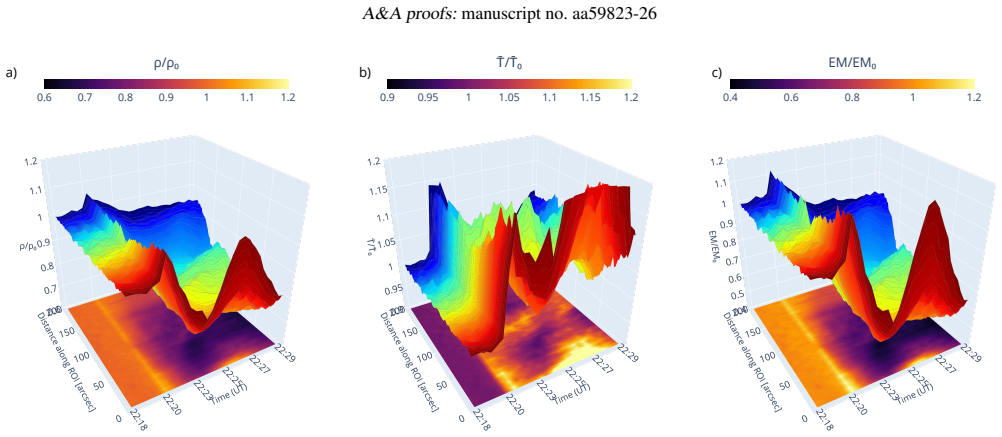
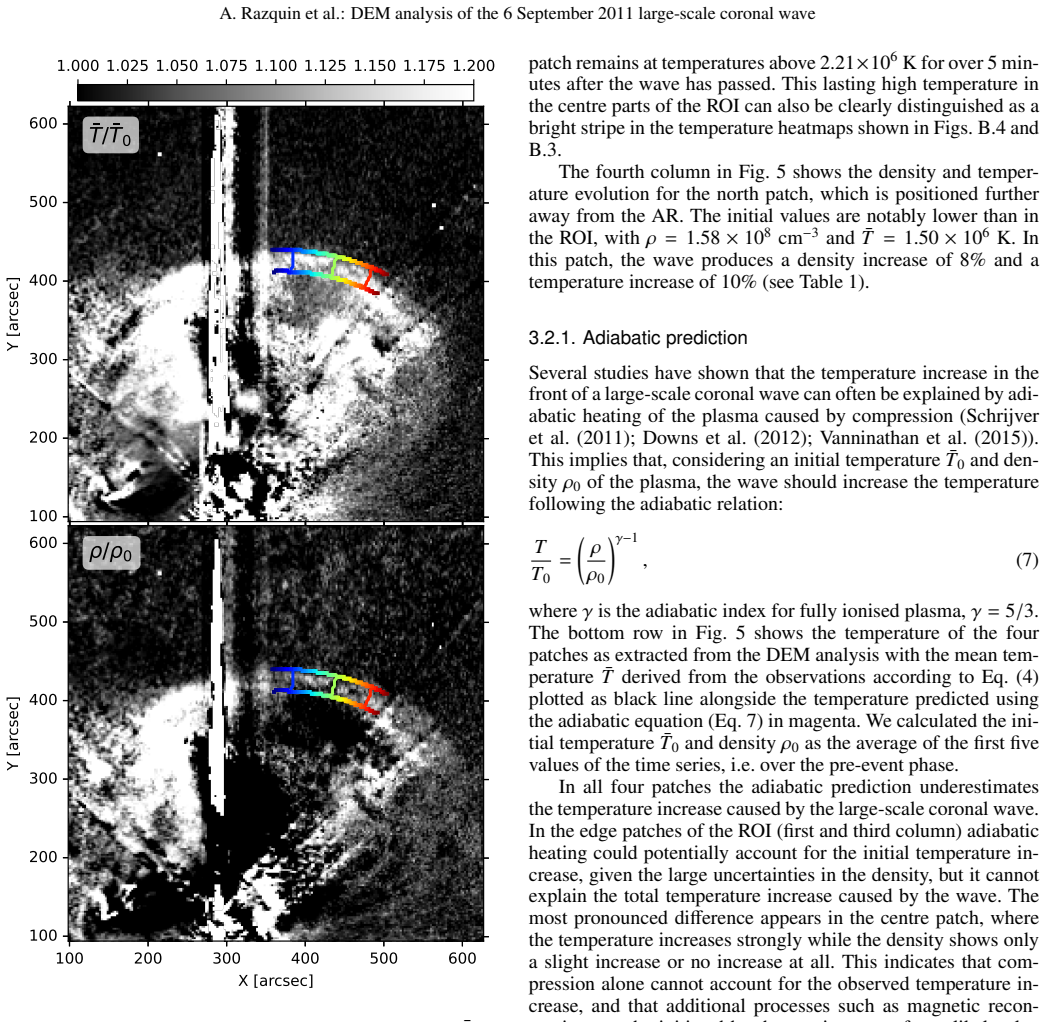
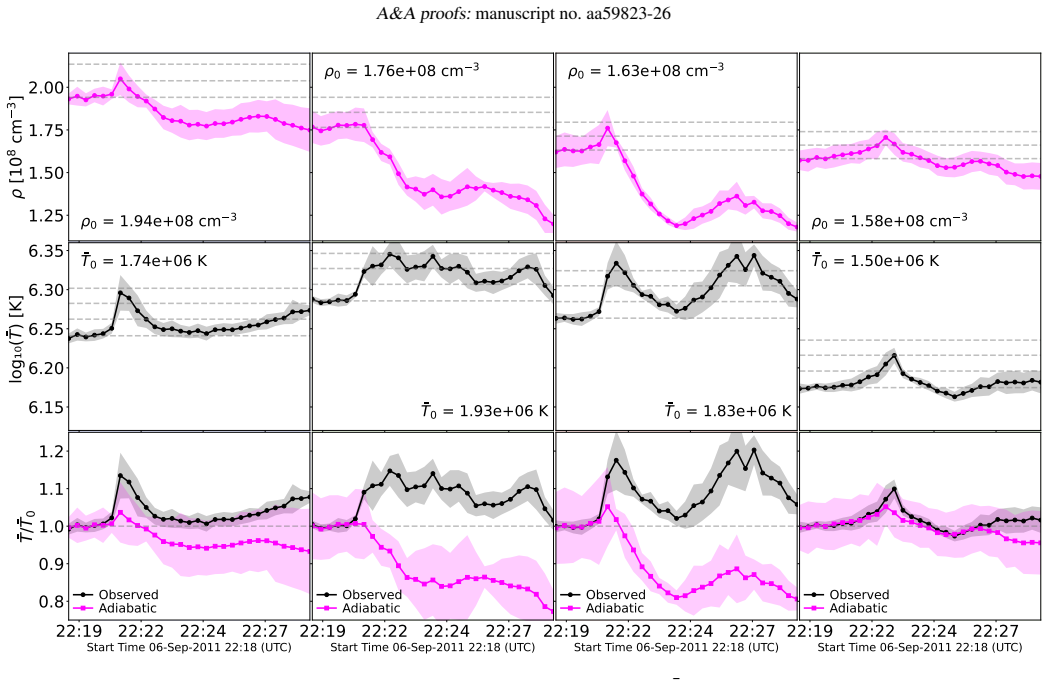
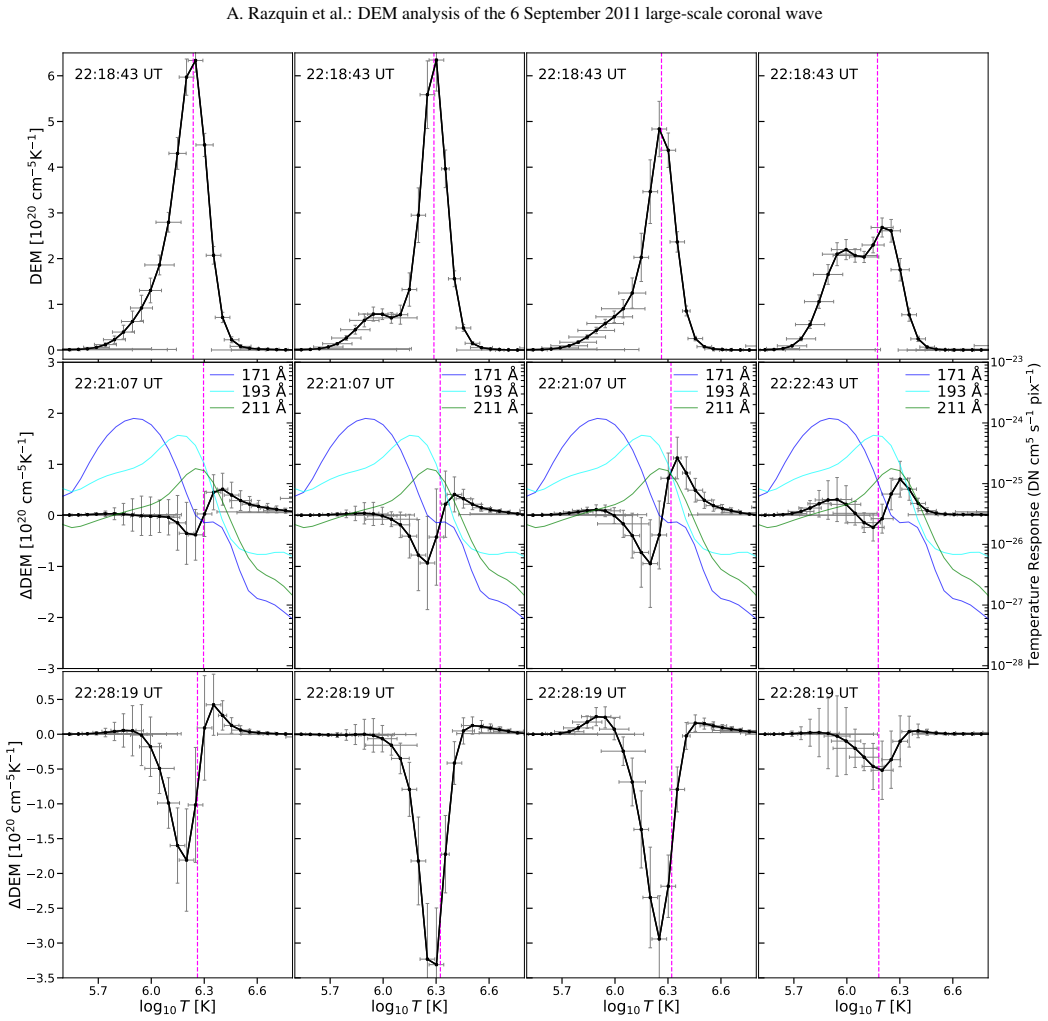
The wave passage causes increases of 6-8% in density and 10-18% in temperature. While the density increase is comparable to earlier reports, the temperature increase exceeds expectations. This indicates that the temperature enhancement cannot be explained by compressional adiabatic heating alone, and instead suggests the presence of additional heating mechanisms, such as magnetic reconnection or wave mode conversion. During the temporary disappearance of the wave, the plasma parameters at the wave front increase, but with a strong spatial variability, with density increases ranging from 1% to 10%. The initial temperature in the affected area is notably higher than typical quiet-Sun regions (
What carries the argument
Differential emission measure (DEM) inversion from SDO/AIA EUV channels to derive local density, temperature, emission measure, and DEM distributions and their temporal evolution.
Load-bearing premise
The DEM inversion from AIA channels accurately recovers the true local density and temperature without major line-of-sight integration biases or contamination from the CME-associated dimming region.
What would settle it
Direct measurements showing that the observed temperature increase exactly matches the adiabatic compression value expected from the measured density increase would falsify the need for additional heating mechanisms.
Figures
read the original abstract
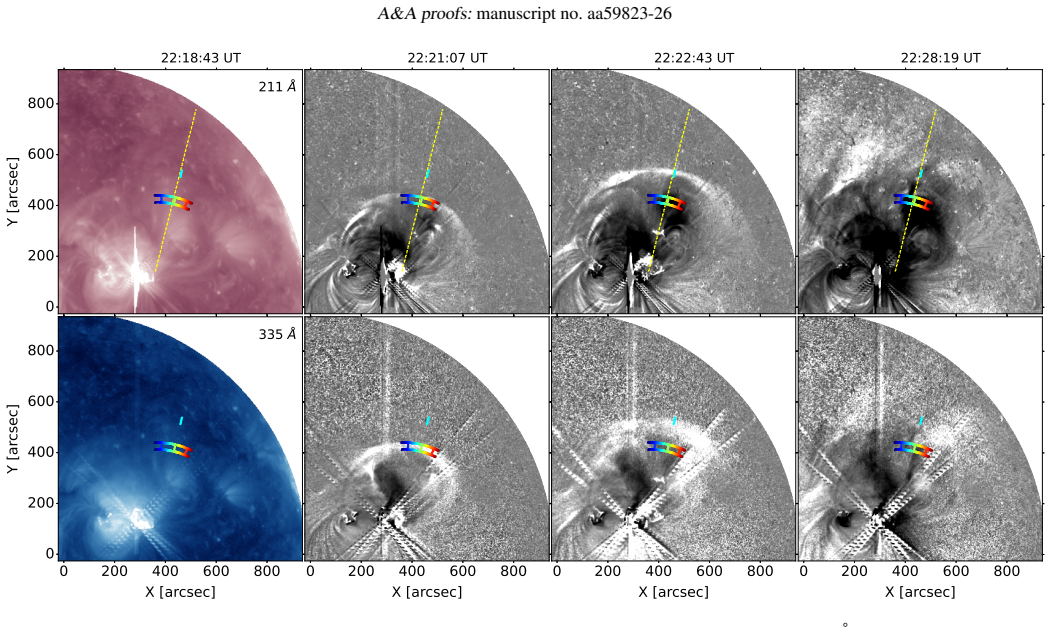
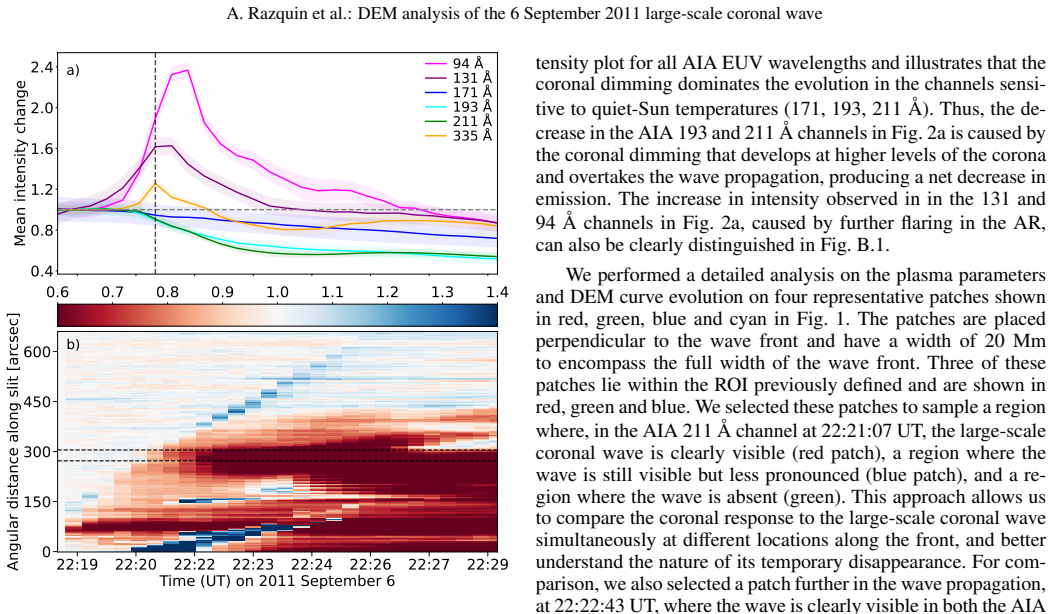
Large-scale coronal waves are globally propagating intensity enhancements in extreme-ultraviolet (EUV) and soft X-ray (SXR) observations, associated with solar flares and coronal mass ejections (CMEs). They are interpreted as low-coronal signatures of a large-amplitude fast magnetosonic wave. On 6 September 2011, a fast (v = 1000 km/s) large-scale coronal wave accompanied an eruptive X2.1 class flare. A segment of the wave front temporarily dissappeared in EUV channels sensitive to quiet-Sun plasma, while it remained visible in higher temperature channels. We apply differential emission measure (DEM) diagnostics to SDO/AIA EUV observations to derive local density, temperature, emission measure, and DEM distributions, and examine their temporal evolution during the wave passage. The wave passage causes increases of 6-8% in density and 10-18% in temperature. While the density increase is comparable to earlier reports, the temperature increase exceeds expectations. This indicates that the temperature enhancement cannot be explained by compressional adiabatic heating alone, and instead suggests the presence of additional heating mechanisms, such as magnetic reconnection or wave mode conversion. During the temporary disappearance of the wave, the plasma parameters at the wave front increase, but with a strong spatial variability, with density increases ranging from 1% to 10%. The initial temperature in the affected area is notably higher than typical quiet-Sun regions (T > 1.7 MK), which allows plasma to be heated beyond the peak response of the AIA 193 and 211 \AA channels. We conclude that the apparent temporary disappearance of the wave front is primarily due to the combined effects in the intensity of the CME-associated coronal dimming following the wave and the wave itself, with heating further reducing its detectability in channels sensitive to quiet-Sun temperatures.
Editorial analysis
A structured set of objections, weighed in public.
Referee Report
Summary. The paper analyzes the 6 September 2011 large-scale coronal wave using differential emission measure (DEM) inversion of SDO/AIA EUV observations. It reports 6-8% density increases and 10-18% temperature increases at the wave front, concludes that the temperature rise exceeds expectations from adiabatic compression alone (suggesting additional heating via reconnection or mode conversion), and attributes the temporary disappearance of the wave in quiet-Sun channels to combined CME dimming and heating effects, noting initial temperatures >1.7 MK.
Significance. If robust, the result would provide direct observational constraints on non-adiabatic heating in fast-mode coronal waves, with implications for coronal energy balance and wave dissipation models. The work leverages public multi-channel AIA data for time-resolved local parameter estimation, which is a methodological strength for this class of event studies.
major comments (2)
- [Abstract] Abstract: The central claim that the observed 10-18% temperature increase indicates additional heating (beyond the ~4-5% expected from adiabatic compression for a 6-8% density rise with γ=5/3) rests on the DEM-derived local T and n values. No quantitative assessment is provided of possible systematic biases in the DEM inversion arising from line-of-sight integration through the overlapping CME-associated dimming region that follows the wave, which the manuscript itself links to the temporary disappearance and which could alter recovered emission measures and temperatures (especially at T>1.7 MK where AIA 193/211 Å responses drop).
- [Abstract] Abstract: The reported percentage changes in density and temperature lack accompanying uncertainty estimates or error bars, making it impossible to evaluate whether the temperature enhancement is statistically distinguishable from the adiabatic expectation or from inversion noise.
minor comments (2)
- The manuscript would benefit from explicit description of the DEM inversion algorithm, temperature binning, and any regularization or background subtraction choices used to derive the local parameters.
- Consider including a brief comparison of the observed wave speed (1000 km/s) with expected fast-mode speeds based on the derived pre-wave densities and temperatures.
Simulated Author's Rebuttal
We thank the referee for their careful and constructive review of our manuscript. We address the two major comments point by point below. Both points identify genuine gaps in the current version, and we will revise the manuscript to address them.
read point-by-point responses
-
Referee: [Abstract] The central claim that the observed 10-18% temperature increase indicates additional heating (beyond the ~4-5% expected from adiabatic compression for a 6-8% density rise with γ=5/3) rests on the DEM-derived local T and n values. No quantitative assessment is provided of possible systematic biases in the DEM inversion arising from line-of-sight integration through the overlapping CME-associated dimming region that follows the wave, which the manuscript itself links to the temporary disappearance and which could alter recovered emission measures and temperatures (especially at T>1.7 MK where AIA 193/211 Å responses drop).
Authors: We agree that no quantitative assessment of line-of-sight biases from the overlapping dimming region is provided, even though the manuscript discusses the dimming's role in the wave's temporary disappearance and notes initial temperatures above 1.7 MK. While our DEM analysis follows established AIA inversion methods and region selection was performed to focus on the wave front, this omission leaves open the possibility of systematic effects on the recovered parameters. In the revised manuscript we will add an explicit discussion of these potential biases, including any feasible tests or sensitivity estimates. revision: yes
-
Referee: [Abstract] The reported percentage changes in density and temperature lack accompanying uncertainty estimates or error bars, making it impossible to evaluate whether the temperature enhancement is statistically distinguishable from the adiabatic expectation or from inversion noise.
Authors: We agree that the absence of uncertainty estimates prevents a proper statistical evaluation of whether the 10-18% temperature rise exceeds the adiabatic expectation. The revised manuscript will include quantified uncertainties (derived from the DEM inversion uncertainties and standard error propagation) on the reported 6-8% density and 10-18% temperature increases, both in the abstract and the main text. revision: yes
Circularity Check
No significant circularity; purely observational DEM analysis with independent data comparison.
full rationale
The paper applies standard DEM inversion techniques to public SDO/AIA EUV observations to measure density and temperature changes during a coronal wave. The central claim compares observed 10-18% temperature rise against adiabatic compression expectations (~4-5% for the measured 6-8% density increase). No equations, parameters, or conclusions reduce to self-definition, fitted inputs renamed as predictions, or load-bearing self-citations. The derivation chain consists of data processing followed by comparison to external theoretical expectations (γ=5/3 adiabatic), which are independent of the present measurements. The reader's assigned score of 2.0 is consistent with this assessment; the skeptic concern addresses potential observational bias (LOS effects) rather than circularity in the logic.
Axiom & Free-Parameter Ledger
axioms (1)
- domain assumption DEM inversion from AIA EUV channels recovers accurate local temperature and density under the assumption of optically thin plasma and known instrument response functions.
Reference graph
Works this paper leans on
-
[1]
2008, , 685, 622
Asai , A., Hara , H., Watanabe , T., et al. 2008, , 685, 622
2008
-
[2]
T., Isobe , H., et al
Asai , A., Ishii , T. T., Isobe , H., et al. 2012, , 745, L18
2012
-
[3]
Aschwanden , M. J. 2005, Physics of the Solar Corona. An Introduction with Problems and Solutions (Springer)
2005
-
[4]
Attrill , G. D. R., Harra , L. K., van Driel-Gesztelyi , L., & D \'e moulin , P. 2007, , 656, L101
2007
-
[5]
2012, , 275, 41
Boerner , P., Edwards , C., Lemen , J., et al. 2012, , 275, 41
2012
-
[6]
F., Joshi , R., Joshi , B., & Schmieder , B
Chandra , R., Chen , P. F., Joshi , R., Joshi , B., & Schmieder , B. 2018, , 863, 101
2018
-
[7]
Chen , P. F. 2016, Geophysical Monograph Series, 216, 381
2016
-
[8]
F., Fang , C., Chandra , R., & Srivastava , A
Chen , P. F., Fang , C., Chandra , R., & Srivastava , A. K. 2016, , 291, 3195
2016
-
[9]
F., Wu , S
Chen , P. F., Wu , S. T., Shibata , K., & Fang , C. 2002, , 572, L99
2002
-
[10]
Chen , P. F. & Wu , Y. 2011, , 732, L20
2011
-
[11]
2012 a , , 745, L5
Cheng , X., Zhang , J., Olmedo , O., et al. 2012 a , , 745, L5
2012
-
[12]
H., & Ding , M
Cheng , X., Zhang , J., Saar , S. H., & Ding , M. D. 2012 b , , 761, 62
2012
-
[13]
P., Young , P
Del Zanna , G., Dere , K. P., Young , P. R., & Landi , E. 2021, , 909, 38
2021
-
[14]
E., Brunaud , J., et al
Delaboudini \`e re , J.-P., Artzner , G. E., Brunaud , J., et al. 1995, , 162, 291
1995
-
[15]
2014, , 289, 2565
Delann \'e e , C., Artzner , G., Schmieder , B., & Parenti , S. 2014, , 289, 2565
2014
-
[16]
& Aulanier , G
Delann \'e e , C. & Aulanier , G. 1999, , 190, 107
1999
-
[17]
Dennis , B. R. & Phillips , K. J. H. 2024, , 299, 48
2024
-
[18]
P., Landi , E., Mason , H
Dere , K. P., Landi , E., Mason , H. E., Monsignori Fossi , B. C., & Young , P. R. 1997, , 125, 149
1997
-
[19]
M., Vanninathan , K., & Magdaleni \'c , J
Dissauer , K., Temmer , M., Veronig , A. M., Vanninathan , K., & Magdaleni \'c , J. 2016, , 830, 92
2016
-
[20]
M., Temmer , M., Podladchikova , T., & Vanninathan , K
Dissauer , K., Veronig , A. M., Temmer , M., Podladchikova , T., & Vanninathan , K. 2018 a , , 855, 137
2018
-
[21]
M., Temmer , M., Podladchikova , T., & Vanninathan , K
Dissauer , K., Veronig , A. M., Temmer , M., Podladchikova , T., & Vanninathan , K. 2018 b , , 863, 169
2018
-
[22]
Domingo , V., Fleck , B., & Poland , A. I. 1995, , 162, 1
1995
-
[23]
I., van der Holst , B., Lugaz , N., & Sokolov , I
Downs , C., Roussev , I. I., van der Holst , B., Lugaz , N., & Sokolov , I. V. 2012, , 750, 134
2012
-
[24]
2002, , 54, 481
Eto , S., Isobe , H., Narukage , N., et al. 2002, , 54, 481
2002
-
[25]
2013, , 765, 37
Feng , L., Wiegelmann , T., Su , Y., et al. 2013, , 765, 37
2013
-
[26]
2020, , 295, 124
Frassati , F., Mancuso , S., & Bemporad , A. 2020, , 295, 124
2020
-
[27]
Gallagher , P. T. & Long , D. M. 2011, , 158, 365
2011
-
[28]
2009, , 691, L123
Gopalswamy , N., Yashiro , S., Temmer , M., et al. 2009, , 691, L123
2009
-
[29]
Hannah , I. G. & Kontar , E. P. 2012, , 539, A146
2012
-
[30]
K., Sterling , A
Harra , L. K., Sterling , A. C., G \"o m \"o ry , P., & Veronig , A. 2011, , 737, L4
2011
-
[31]
S., Acton , L
Hudson , H. S., Acton , L. W., & Freeland , S. L. 1996, , 470, 629
1996
-
[32]
2016, , 591, A141
Janvier , M., Savcheva , A., Pariat , E., et al. 2016, , 591, A141
2016
-
[33]
W., Temmer , M., & Veronig , A
Kienreich , I. W., Temmer , M., & Veronig , A. M. 2009, , 703, L118
2009
-
[34]
Klassen , A., Aurass , H., Mann , G., & Thompson , B. J. 2000, , 141, 357
2000
-
[35]
A., Korreck , K
Kozarev , K. A., Korreck , K. E., Lobzin , V. V., Weber , M. A., & Schwadron , N. A. 2011, , 733, L25
2011
-
[36]
F., Bong , S.-C., & Park , S.-H
Kumar , P., Cho , K.-S., Chen , P. F., Bong , S.-C., & Park , S.-H. 2013, , 282, 523
2013
-
[37]
& Manoharan , P
Kumar , P. & Manoharan , P. K. 2013, , 553, A109
2013
-
[38]
M., Karpen , J
Kumar , P., Nakariakov , V. M., Karpen , J. T., & Cho , K.-S. 2024, Nature Communications, 15, 2667
2024
-
[39]
R., Title , A
Lemen , J. R., Title , A. M., Akin , D. J., et al. 2012, , 275, 17
2012
-
[40]
2025, Science China Physics, Mechanics & Astronomy, 68, 259611
Li, J., Zheng, R., Wang, X., & Chen, Y. 2025, Science China Physics, Mechanics & Astronomy, 68, 259611
2025
-
[41]
W., Guo , J
Li , Y. W., Guo , J. H., Ni , Y. W., Zhang , Z. Y., & Chen , P. F. 2025, , 698, A316
2025
-
[42]
2019, , 870, 15
Liu , R., Wang , Y., Lee , J., & Shen , C. 2019, , 870, 15
2019
-
[43]
& Ofman , L
Liu , W. & Ofman , L. 2014, , 289, 3233
2014
-
[44]
V., et al
Liu , W., Ofman , L., Nitta , N. V., et al. 2012, , 753, 52
2012
-
[45]
M., Bloomfield , D
Long , D. M., Bloomfield , D. S., Chen , P. F., et al. 2017, , 292, 7
2017
-
[46]
M., DeLuca , E
Long , D. M., DeLuca , E. E., & Gallagher , P. T. 2011, , 741, L21
2011
-
[47]
C., Golub , L., et al
Ma , S., Raymond , J. C., Golub , L., et al. 2011, , 738, 160
2011
-
[48]
Mann , G., Aurass , H., Klassen , A., Estel , C., & Thompson , B. J. 1999, in ESA Special Publication, Vol. 446, 8th SOHO Workshop: Plasma Dynamics and Diagnostics in the Solar Transition Region and Corona, ed. J. C. Vial & B. Kaldeich-Sch \"u , 477
1999
-
[49]
& Veronig , A
Mann , G. & Veronig , A. M. 2023, , 676, A144
2023
-
[50]
Moreton , G. E. & Ramsey , H. E. 1960, , 72, 357
1960
-
[51]
1997, , 175, 571
Moses , D., Clette , F., Delaboudini \`e re , J.-P., et al. 1997, , 175, 571
1997
-
[52]
M., Kienreich , I
Muhr , N., Veronig , A. M., Kienreich , I. W., Temmer , M., & Vr s nak , B. 2011, , 739, 89
2011
-
[53]
M., Kienreich , I
Muhr , N., Veronig , A. M., Kienreich , I. W., et al. 2014, , 289, 4563
2014
-
[54]
V., Liu , W., Gopalswamy , N., & Yashiro , S
Nitta , N. V., Liu , W., Gopalswamy , N., & Yashiro , S. 2014, , 289, 4589
2014
-
[55]
V., Schrijver , C
Nitta , N. V., Schrijver , C. J., Title , A. M., & Liu , W. 2013, , 776, 58
2013
-
[56]
J., Nakai , H., Keiyama , A., et al
Okamoto , T. J., Nakai , H., Keiyama , A., et al. 2004, , 608, 1124
2004
-
[57]
2012, , 756, 143
Olmedo , O., Vourlidas , A., Zhang , J., & Cheng , X. 2012, , 756, 143
2012
-
[58]
& Vourlidas , A
Patsourakos , S. & Vourlidas , A. 2012, , 281, 187
2012
-
[59]
M., Stenborg , G., & Thernisien , A
Patsourakos , S., Vourlidas , A., Wang , Y. M., Stenborg , G., & Thernisien , A. 2009, , 259, 49
2009
-
[60]
D., Thompson , B
Pesnell , W. D., Thompson , B. J., & Chamberlin , P. C. 2012, , 275, 3
2012
-
[61]
& Berghmans , D
Podladchikova , O. & Berghmans , D. 2005, , 228, 265
2005
-
[62]
M., Dissauer , K., Temmer , M., & Podladchikova , O
Podladchikova , T., Veronig , A. M., Dissauer , K., Temmer , M., & Podladchikova , O. 2019, , 877, 68
2019
-
[63]
2020, , 903, 129
Prasad , A., Dissauer , K., Hu , Q., et al. 2020, , 903, 129
2020
-
[64]
M., Dickson , E
Purkhart , S., Veronig , A. M., Dickson , E. C. M., et al. 2023, , 679, A99
2023
-
[65]
N., Jiang , L
Qu , Z. N., Jiang , L. Q., & Chen , S. L. 2017, , 851, 41
2017
-
[66]
M., & Barnes , G
Razquin , A., Dissauer , K., Veronig , A. M., & Barnes , G. 2026, , 708, A292
2026
-
[67]
J., Aulanier , G., Title , A
Schrijver , C. J., Aulanier , G., Title , A. M., Pariat , E., & Delann \'e e , C. 2011, , 738, 167
2011
-
[68]
J., Title , A
Schrijver , C. J., Title , A. M., Yeates , A. R., & DeRosa , M. L. 2013, , 773, 93
2013
-
[69]
T., et al
Shen , Y., Ichimoto , K., Ishii , T. T., et al. 2014, , 786, 151
2014
-
[70]
& Liu , Y
Shen , Y. & Liu , Y. 2012, , 754, 7
2012
-
[71]
2013, , 773, L33
Shen , Y., Liu , Y., Su , J., et al. 2013, , 773, L33
2013
-
[72]
Stansby, D., Yeates, A., & Badman, S. T. 2020, Journal of Open Source Software, 5, 2732
2020
-
[73]
Sterling , A. C. & Hudson , H. S. 1997, , 491, L55
1997
-
[74]
J., Gurman , J
Thompson , B. J., Gurman , J. B., Neupert , W. M., et al. 1999, , 517, L151
1999
-
[75]
J., Plunkett , S
Thompson , B. J., Plunkett , S. P., Gurman , J. B., et al. 1998, , 25, 2465
1998
-
[76]
& Raouafi , N.-E
Tripathi , D. & Raouafi , N.-E. 2007, , 473, 951
2007
-
[77]
1968, , 4, 30
Uchida , Y. 1968, , 4, 30
1968
-
[78]
M., Dissauer , K., et al
Vanninathan , K., Veronig , A. M., Dissauer , K., et al. 2015, , 812, 173
2015
-
[79]
M., Dissauer , K., & Temmer , M
Vanninathan , K., Veronig , A. M., Dissauer , K., & Temmer , M. 2018, , 857, 62
2018
-
[80]
M., Dissauer , K., Kliem , B., et al
Veronig , A. M., Dissauer , K., Kliem , B., et al. 2025, Living Reviews in Solar Physics, 22, 2
2025
discussion (0)
Sign in with ORCID, Apple, or X to comment. Anyone can read and Pith papers without signing in.