REVIEW 3 major objections 5 minor 112 references
CORN -- Chronometers of Relic Nature I: The first estimate of the expansion rate of the Universe using compact relic galaxies
T0 review · 3 major / 5 minor · reviewed 2026-08-14 · deepseek-v4-flash
Pith's one-line read This paper reports the first cosmic-chronometer measurement of the Hubble parameter using relic galaxies, $H(z=0.15)=85.0\pm51.5\,[\mathrm{stat}]\,^{+10.2}_{-8.9}\,[\mathrm{sys}]$ km/s/Mpc, and argues that this tracer class cuts the…
desk verdict First H(z) from relic galaxies: a genuinely new tracer with honest error bars, but the SSP-only Dn4000-age calibration makes the headline systematic budget a promise rather than a demonstrated fact. read the letter →
The pith
A machine-rendered reading of the paper's core claim, the machinery that carries it, and where it could break.
The reading
What carries the argument
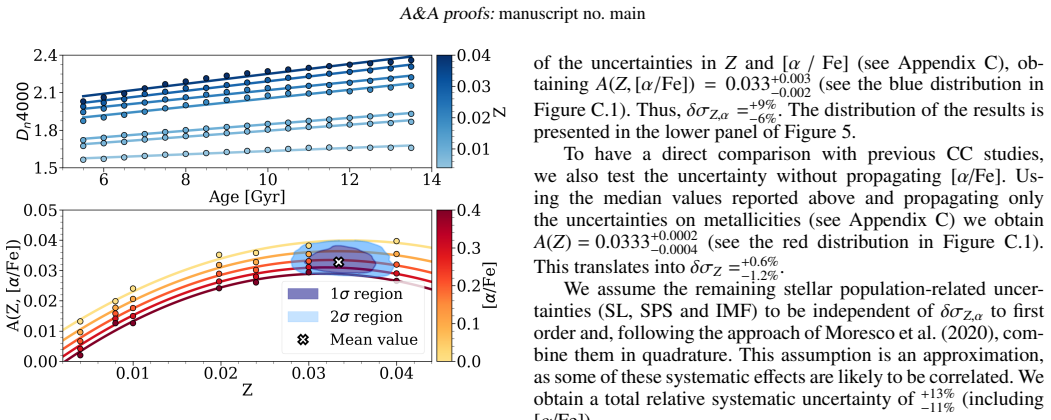
The load-bearing object is the 4000 Å break index $D_{n}4000$ together with the calibration slope $A\equiv dD_{n}4000/dt$. The index is the ratio of continuum flux in the red bandpass 4000–4100 Å to the blue bandpass 3850–3950 Å, and it grows as a stellar population ages. The paper assumes a linear relation $D_{n}4000=A(Z,[\alpha/\mathrm{Fe}],M)\times\mathrm{age}+B$, so that the cosmic-chronometer identity $H(z)=-(1/(1+z))\,dz/dt$ becomes $H(z)=-(1/(1+z))\,A\,dz/dD_{n}4000$. The slope $A$ is measured from MILES/BaSTI single-stellar-population models as a function of metallicity and $\alpha$ enhancement; the degree-of-relicness selection is what makes it plausible to apply one SSP-calibrated $A$ to every galaxy.
What would settle it
Re-fit the same 189 relic spectra allowing composite star-formation histories (for example a few percent of young stars or a spread in metallicity) and compare the resulting $D_{n}4000$–age slope with the MILES single-burst value; if $H(z=0.15)$ shifts by more than the quoted $^{+10.2}_{-8.9}$ km/s/Mpc systematic, the single-population calibration is falsified. A complementary check is to compare this measurement with an independent, higher-precision $H(z\approx0.15)$ from another tracer.
Extended reading notes
Core claim
Using 189 ultra-compact massive galaxies selected by a high degree of relicness in $0.07\le z\le0.22$, the paper finds $\frac{dD_{n}4000}{dz}=-0.33\pm0.19\,[\mathrm{fit}]\,\pm0.07\,[\mathrm{bin}]$. Combined with the MILES single-stellar-population calibration $A\equiv \frac{dD_{n}4000}{dt}\simeq0.033$ Gyr$^{-1}$ (with $A$ depending on metallicity $Z$ and $[\alpha/\mathrm{Fe}]$), this gives the first relic-based Hubble parameter, $H(z=0.15)=85.0\pm51.5\,[\mathrm{stat}]\,^{+10.2}_{-8.9}\,[\mathrm{sys}]$ km/s/Mpc. The central discovery is not the precision of this number but the structure of its error budget: because the relic sample's metallicities sit near the turnover of the $A(Z)$ relation, metallicity contributes at most 1.2 percent, and because the sample is old and homogeneous, star-formation-history systematics are assumed subdominant. The dominant stellar-population systematic is $\alpha$-element enhancement, contributing roughly 9 percent and raising the total systematic from 8.7 to 13 percent when propagated.
Load-bearing premise
The measurement rests on treating each relic galaxy as a single stellar population: the models say how $D_{n}4000$ changes with age for one simple burst, and Section 4.3 explicitly does not test how a composite stellar population or a small admixture of younger stars would change that slope.
Editorial extensions
If this is right
- Relic-based chronometers can reach a total systematic budget of about 13 percent with fewer than 200 galaxies, and about 8.7 percent if alpha-enhancement is treated as in earlier studies, making them competitive with the tightest current cosmic-chronometer analyses.
- Future $D_{n}4000$ chronometer analyses should propagate $[\alpha/\mathrm{Fe}]$ explicitly; in the high-metallicity regime alpha-enhancement, not metallicity, is the leading stellar-population systematic, so fixed-$[\alpha/\mathrm{Fe}]$ analyses underestimate their errors by roughly 4 percentage points.
- The statistical uncertainty, not the astrophysical systematics, now limits the relic-chronometer method, so the error bar should shrink roughly as the inverse square root of the number of confirmed relics as larger spectroscopic samples arrive.
- Because the relic sample sits at the turnover of the $A(Z)$ relation, further restricting the metallicity range of a chronometer sample is a direct way to suppress the metallicity systematic toward the sub-percent level.
Reading between the lines
- The paper leaves implicit that the turnover structure of $A(Z)$ is a selection principle: any chronometer tracer population whose metallicity can be measured and selected around the turnover would inherit the same suppression of the metallicity systematic, not only relics.
- If the $[\alpha/\mathrm{Fe}]$ sensitivity found here holds up, earlier cosmic-chronometer measurements that assumed fixed $[\alpha/\mathrm{Fe}]$ may need larger error bars, with the largest shifts in the most metal-rich, high-mass galaxy samples—the samples most relevant at low redshift where the Hubble tension lives.
- A testable extension would be to fit composite stellar populations to the same 189 relics; if the effective $D_{n}4000$–age slope moves by more than the quoted systematic when a few percent of younger stars are allowed, a composite-population correction term would be needed before relic chronometers reach their promised precision.
Editorial analysis
A structured set of objections, weighed in public.
Referee Report
Summary. The paper presents the first cosmic-chronometer estimate of H(z) using ultra-compact massive 'relic' galaxies. From 189 E-INSPIRE galaxies with 0.07≤z≤0.22 selected by their degree of relicness, the authors measure the redshift evolution of the D_n4000 index and calibrate the D_n4000–age slope A using MILES/BaSTI SSP models, explicitly propagating metallicity and α-element-enhancement uncertainties. They report H(z=0.15)=85.0±51.5 (stat) +10.2/−8.9 (sys) km/s/Mpc, with a systematic budget of about 13% (8.7% if [α/Fe] is not propagated), and argue that relic selection reduces SFH- and metallicity-related systematics compared with standard CC tracers. The statistical uncertainty dominates and the result is consistent with Planck and with previous CC measurements. The paper is framed as a proof of concept for relic-based chronometers.
Significance. If the result holds, the paper makes a useful proof-of-concept contribution: it introduces relic galaxies as CC tracers, explicitly quantifies the [α/Fe] contribution to the D_n4000 systematic budget, and provides several robustness tests (bin-size dependence, cosmology dependence of DoR, overlap with traditional CC selection). The paper is also transparent in stating that composite stellar populations are not modelled in the calibration. However, the headline conclusion that relic selection reduces astrophysical systematics rests on the validity of the SSP-based slope A; this is currently an untested assumption, and the composite-population issue must be addressed before the quoted systematic budget can be taken at face value. The measurement itself is honestly reported and the statistical error dominates, so the main scientific claim is modest and defensible conditional on that test.
major comments (3)
- [Section 4.3, Eq. (3), Fig. 5] The calibration slope A is computed from MILES SSP models only, and the text explicitly states that the impact of composite stellar populations on the D_n4000–age slope is not studied. The DoR selection does not guarantee single-burst populations: the final sample has median f_Mstar(tBB=3)=0.95±0.05, and the DoR>0.4 threshold formally allows more extended assembly histories. Because D_n4000 is a flux-weighted index, a few percent of younger stars can shift the effective slope A_eff relative to the SSP value by more than the quoted δσ_Z,α≈9%; through Eq. (4) this shifts H(z) by an amount that can exceed the quoted +10.2/−8.9 systematic uncertainty (a 20% change in A corresponds to roughly 17 km/s/Mpc). This is load-bearing for the claim of reduced astrophysical systematics. I request a quantitative test, for example using the E-INSPIRE pPXF-reconstructed SFHs to build composite-model D_n4000–age relations, or two-component models with 1–5% mass in a younger secondary component, and propagation of A_eff through Eq. (7).
- [Section 4.3, Section 4.4] The MILES grid has only [α/Fe]=0.0 and 0.4, and the spectra are linearly interpolated to obtain intermediate values. Because the final sample has median [α/Fe]≈0.20, both the central value A=0.033 and the α-driven systematic δσ_α≈9% depend on this interpolation, whose error is not included in the budget. The paper acknowledges the approximation, but for the claimed 'major role of α-enhancement' to be quantitatively reliable, the authors should either demonstrate that the interpolation is accurate using a different SPS grid or add an interpolation-uncertainty term to the systematic budget.
- [Section 4.4] The total systematic budget combines δσ_SPS=5.5%, δσ_IMF=1%, and δσ_SL=7% adopted from Moresco et al. with the relic-specific Z and [α/Fe] terms. These literature values were derived for standard passive galaxy samples and may not hold in the high-metallicity, high-[α/Fe] regime of relics; moreover, the same MILES/E-MILES model family is used both for the pPXF stellar-population parameters and for the A calibration, so the adopted 'independent' SPS/SL terms may double-count or miss shared model errors. The authors should justify the transfer of these values to relics or re-estimate at least the largest term (SL) using the actual model family and redshift range.
minor comments (5)
- [Abstract vs. Eq. (7)] The abstract quotes H(z=0.15)=85±53 km/s/Mpc, while Eq. (7) gives 85.0±51.5 (stat) +10.2/−8.9 (sys); please state explicitly how the total uncertainty in the abstract is formed (presumably quadrature of stat and sys).
- [Section 4.4 and Section 6] The total systematic uncertainty is reported as +13/−11% in Section 4.4 and as ≤12.5% in Section 6; use a consistent rounding and sign convention.
- [Section 4.2, Eq. (6)] Eq. (6) reports separate fit and binning uncertainties, but the text then quotes σ_stat=0.2 without stating the combination rule; please specify how these two terms are combined.
- [Figure 3 caption] 'restrframe' should be 'rest-frame'.
- [Section 2.2] The sentence 'By allowing sources with poorly constrained DoR, we are losing the most important constraint on the age' is unclear; please specify the exact effect of the σ_DoR cut on the sample, e.g., how many galaxies are removed and how the D_n4000–z slope changes when the cut is relaxed.
Circularity Check
No significant circularity: the H(z) estimate combines an observed Dn4000-redshift slope with an independent MILES SSP calibration; no fitted parameter is renamed as a prediction.
full rationale
The derivation chain is explicit and non-circular. H(z) is computed from Eq. 4, H(z) = -1/(1+z) A dz/dDn4000, where A = dDn4000/dt is calibrated from MILES SSP models (Sec. 4.3) and dDn4000/dz = -0.33 +/- 0.19 is measured directly from the 189 relic-galaxy spectra (Eq. 6). The resulting Eq. 7 is then compared with external Planck and previous CC data, so the central value is not anchored to a benchmark. Self-citations to E-INSPIRE (Mills et al. 2025; Rosen et al. 2026) supply the sample and stellar parameters, but these are input data, not quantities derived from H(z). The acknowledged omission of composite-stellar-population effects on the Dn4000-age slope (Sec. 4.3: 'we do not study the impact of composite stellar populations on the Dn4000-age slope') is a modeling limitation that could bias the SSP calibration, but it is not a circular reduction: the paper does not fit A to the same data it then predicts. The [alpha/Fe] linear-interpolation ansatz is justified partly by self-citations, but it is a stated approximation with an explicit caveat, and its effect is propagated into the quoted systematics rather than hidden. Therefore no load-bearing step reduces to its own input; the central claim has independent observational content.
Assumptions & free parameters
free parameters (5)
- DoR selection threshold =
0.4
- sigma_DoR threshold =
0.2
- Redshift and mass selection cuts =
0.07 <= z <= 0.22, log Mstar >= 10.8
- Dn4000-age slope A =
0.033 +0.003/-0.002
- Number of galaxies per redshift bin =
8
assumptions (6)
- domain assumption The FLRW metric is valid, so H(z) = -1/(1+z) dz/dt (Eq. 1).
- domain assumption Dn4000 depends linearly on stellar age over the relevant range (Eq. 3).
- ad hoc to paper Relic galaxies are treated as single stellar populations; composite stellar populations are not modeled in the Dn4000-age calibration.
- ad hoc to paper The [alpha/Fe] dependence of MILES models is linear between [alpha/Fe]=0.0 and 0.4.
- domain assumption The literature systematic uncertainties SPS=5.5%, IMF<1%, SL=7% are applicable and independent of the Z/[alpha/Fe] uncertainty.
- domain assumption pPXF stellar population parameters (Z, [alpha/Fe], SFH) from E-INSPIRE catalogues based on E-MILES models are accurate inputs.
Cite this review
Pith. "Pith review of CORN -- Chronometers of Relic Nature I: The first estimate of the expansion rate of the Universe using compact relic galaxies." pith.science (2026). https://pith.science/paper/HPCDWUXM
@misc{pith2026260810163,
  author       = {Pith},
  title        = {Pith review of: CORN -- Chronometers of Relic Nature I: The first estimate of the expansion rate of the Universe using compact relic galaxies},
  year         = {2026},
  howpublished = {\url{https://pith.science/paper/HPCDWUXM}},
  note         = {Machine review of arXiv:2608.10163}
}
read the original abstract
Measuring the expansion rate of the Universe is a central challenge in cosmology. Independent and robust methods are essential to validate existing measurements and assess potential systematic effects. We employ the cosmic chronometer (CC) approach, which uses the differential age evolution of quiescent galaxies to measure the Hubble parameter H(z) without assuming an underlying cosmological model. In contrast to previous CC studies, we restrict our analysis to relics -- ultra compact massive galaxies (UCMGs) hosting the oldest stellar populations -- thereby minimising uncertainties related to star formation history and merger history. We select a sample of 189 relic galaxies in the redshift range 0.07< z <0.22 from the E-INSPIRE UCMGs catalogue. Using the D_n4000 spectral index of relic galaxies and its redshift evolution, combined with MILES stellar population synthesis models, we derive the differential age relation required to infer H(z). We account not only for metallicity effects but also for the impact of alpha-element enhancement, which has not been explicitly propagated into the systematic uncertainty budget of the D_n4000 cosmic chronometer method. We obtain an independent measurement of H(z=0.15) = 85\pm53 km/s/Mpc. The total uncertainty is dominated by statistical limitations. The systematic component is 13% (8.7% when alpha-enrichment is not propagated), among the tightest estimates in current CC studies. We find that alpha-enrichment plays a major role in the systematic error budget, particularly in the high metallicity regime, and must be properly accounted for in future analyses. We demonstrate the proof of concept that relic galaxies provide a promising pathway to reduce systematic uncertainties in the CC method. The statistical uncertainties, which dominate the error budget, can be significantly reduced by the increase of data volume expected during the next years.
Figures


Figures from the paper (2 more)

Reference graph
Works this paper leans on
-
[1]
The formation history of elliptical galaxies. , keywords =. doi:10.1111/j.1365-2966.2005.09879.x , archivePrefix =. astro-ph/0509725 , primaryClass =
arXiv 2005
-
[2]
Evolution of Galaxies and Stellar Populations , year = 1977, editor =
Mergers and Some Consequences. Evolution of Galaxies and Stellar Populations , year = 1977, editor =
1977
-
[3]
, archivePrefix = "arXiv", eprint =
Red Nuggets at High Redshift: Structural Evolution of Quiescent Galaxies Over 10 Gyr of Cosmic History. , archivePrefix = "arXiv", eprint =. doi:10.1088/2041-8205/739/2/L44 , adsurl =
-
[4]
, archivePrefix = "arXiv", eprint =
Discovery of Nine Intermediate-redshift Compact Quiescent Galaxies in the Sloan Digital Sky Survey. , archivePrefix = "arXiv", eprint =. doi:10.1088/2041-8205/775/2/L48 , adsurl =
-
[5]
In pursuit of giants. II. Evolution of dusty quiescent galaxies over the last six billion years from the hCOSMOS survey. , keywords =. doi:10.1051/0004-6361/202346066 , archivePrefix =. 2304.05842 , primaryClass =
-
[6]
Indicators of star formation: 4000 A break and Balmer lines. , keywords =. doi:10.48550/arXiv.astro-ph/9703067 , archivePrefix =. astro-ph/9703067 , primaryClass =
-
[7]
, archivePrefix = "arXiv", eprint =
The Number Density of Quiescent Compact Galaxies at Intermediate Redshift. , archivePrefix = "arXiv", eprint =. doi:10.1088/0004-637X/793/1/39 , adsurl =
-
[8]
The Environment of Massive Quiescent Compact Galaxies at 0.1 < z < 0.4 in the COSMOS Field. , keywords =. doi:10.1088/0004-637X/815/2/104 , archivePrefix =. 1508.03346 , primaryClass =
Show all 112 references
-
[9]
The Number Density
Quiescent Compact Galaxies at Intermediate Redshift in the COSMOS Field. The Number Density. , archivePrefix = "arXiv", eprint =. doi:10.1088/0004-637X/806/2/158 , adsurl =
-
[10]
Planck 2015 results. XIII. Cosmological parameters. , keywords =. doi:10.1051/0004-6361/201525830 , archivePrefix =. 1502.01589 , primaryClass =
2015 arXiv
-
[11]
From dynamical models of integral-field stellar kinematics out to five effective radii
The massive relic galaxy NGC 1277 is dark matter deficient. From dynamical models of integral-field stellar kinematics out to five effective radii. , keywords =. doi:10.1051/0004-6361/202346291 , archivePrefix =. 2303.11360 , primaryClass =
-
[12]
, keywords =
When relics were made: vigorous stellar rotation and low dark matter content in the massive ultra-compact galaxy GS-9209 at z = 4.66. , keywords =. doi:10.1093/mnras/stag210 , archivePrefix =. 2505.06349 , primaryClass =
-
[13]
Bridging the gap with the local Universe: stellar population of a statistical sample of ultra-compact massive galaxies at z < 0.3
E-INSPIRE ─ I. Bridging the gap with the local Universe: stellar population of a statistical sample of ultra-compact massive galaxies at z < 0.3. , keywords =. doi:10.1093/mnras/staf516 , archivePrefix =. 2501.16126 , primaryClass =
-
[14]
, keywords =
Galaxy and Mass Assembly (GAMA): Accurate number densities and environments of massive ultra-compact galaxies at 0.02 < z < 0.3. , keywords =. doi:10.1051/0004-6361/201833785 , archivePrefix =. 1807.02534 , primaryClass =
-
[15]
, keywords =
Two new confirmed massive relic galaxies: red nuggets in the present-day Universe. , keywords =. doi:10.1093/mnras/stx171 , archivePrefix =. 1701.05197 , primaryClass =
-
[16]
, keywords =
Parametric Recovery of Line-of-Sight Velocity Distributions from Absorption-Line Spectra of Galaxies via Penalized Likelihood. , keywords =. doi:10.1086/381875 , archivePrefix =. astro-ph/0312201 , primaryClass =
-
[17]
, keywords =
Improving the full spectrum fitting method: accurate convolution with Gauss-Hermite functions. , keywords =. doi:10.1093/mnras/stw3020 , archivePrefix =. 1607.08538 , primaryClass =
-
[18]
, keywords =
Full spectrum fitting with photometry in PPXF: stellar population versus dynamical masses, non-parametric star formation history and metallicity for 3200 LEGA-C galaxies at redshift z 0.8. , keywords =. doi:10.1093/mnras/stad2597 , archivePrefix =. 2208.14974 , primaryClass =
-
[19]
, keywords =
UV-extended E-MILES stellar population models: young components in massive early-type galaxies. , keywords =. doi:10.1093/mnras/stw2231 , archivePrefix =. 1612.01187 , primaryClass =
-
[20]
, keywords =
Improved constraints on the expansion rate of the Universe up to z -0.5ex 1.1 from the spectroscopic evolution of cosmic chronometers. , keywords =. doi:10.1088/1475-7516/2012/08/006 , archivePrefix =. 1201.3609 , primaryClass =
2012 arXiv
-
[21]
, keywords =
Raising the bar: new constraints on the Hubble parameter with cosmic chronometers at z -0.5ex 2. , keywords =. doi:10.1093/mnrasl/slv037 , archivePrefix =. 1503.01116 , primaryClass =
-
[22]
, keywords =
An independent estimate of H(z) at z = 0.5 from the stellar ages of brightest cluster galaxies. , keywords =. doi:10.1093/mnras/staf915 , archivePrefix =. 2506.03836 , primaryClass =
-
[23]
, keywords =
The nature and evolution of early massive quenched galaxies in the SIMBA-C simulation. , keywords =. doi:10.1093/mnras/staf132 , archivePrefix =. 2402.08729 , primaryClass =
-
[24]
, keywords =
Rejuvenation in z 0.8 Quiescent Galaxies in LEGA-C. , keywords =. doi:10.3847/1538-4357/ab164d , archivePrefix =. 1905.07541 , primaryClass =
1905 arXiv
-
[25]
Finding relics from wide-sky multi-band surveys: A proof-of-concept machine learning regression algorithm , year =
E-INSPIRE - II. Finding relics from wide-sky multi-band surveys: A proof-of-concept machine learning regression algorithm , year =
-
[26]
, keywords =
CANDELS: The Progenitors of Compact Quiescent Galaxies at z -0.5ex 2. , keywords =. doi:10.1088/0004-637X/765/2/104 , archivePrefix =. 1206.5000 , primaryClass =
-
[27]
, keywords =
Challenges for CDM: An update. , keywords =. doi:10.1016/j.newar.2022.101659 , archivePrefix =. 2105.05208 , primaryClass =
2022
-
[28]
, keywords =
A buyer's guide to the Hubble constant. , keywords =. doi:10.1007/s00159-021-00137-4 , archivePrefix =. 2109.01161 , primaryClass =
-
[29]
, keywords =
The trouble with H _ 0. , keywords =. doi:10.1088/1475-7516/2016/10/019 , archivePrefix =. 1607.05617 , primaryClass =
2016 arXiv
-
[30]
, keywords =
Nine-year Wilkinson Microwave Anisotropy Probe (WMAP) Observations: Cosmological Parameter Results. , keywords =. doi:10.1088/0067-0049/208/2/19 , archivePrefix =. 1212.5226 , primaryClass =
-
[31]
, keywords =
Toward a Better Understanding of Cosmic Chronometers: A New Measurement of H(z) at z 0.7. , keywords =. doi:10.3847/2041-8213/ac3fb2 , archivePrefix =. 2110.04304 , primaryClass =
-
[32]
, keywords =
New Observational H(z) Data from Full-spectrum Fitting of Cosmic Chronometers in the LEGA-C Survey. , keywords =. doi:10.3847/1538-4365/acbc77 , archivePrefix =. 2205.05701 , primaryClass =
-
[33]
, keywords =
Age-dating luminous red galaxies observed with the Southern African Large Telescope. , keywords =. doi:10.1093/mnras/stx301 , archivePrefix =. 1702.00418 , primaryClass =
-
[34]
2018 , month =
Michele Moresco and Raul Jimenez and Licia Verde and Lucia Pozzetti and Andrea Cimatti and Annalisa Citro , title =. 2018 , month =. Arxiv:1804.05864v2 , journal =
2018 arXiv
-
[35]
, keywords =
Stellar Population Inference with Prospector. , keywords =. doi:10.3847/1538-4365/abef67 , archivePrefix =. 2012.01426 , primaryClass =
2012 arXiv
-
[36]
, keywords =
Inferring the star formation histories of massive quiescent galaxies with BAGPIPES: evidence for multiple quenching mechanisms. , keywords =. doi:10.1093/mnras/sty2169 , archivePrefix =. 1712.04452 , primaryClass =
-
[37]
Setting the Stage for Cosmic Chronometers. II. Impact of Stellar Population Synthesis Models Systematics and Full Covariance Matrix. , keywords =. doi:10.3847/1538-4357/ab9eb0 , archivePrefix =. 2003.07362 , primaryClass =
2003 arXiv
-
[38]
, keywords =
A massive, dead disk galaxy in the early Universe. , keywords =. doi:10.1038/nature22388 , archivePrefix =. 1706.07030 , primaryClass =
-
[40]
, keywords =
A Census of Star Formation Histories of Massive Galaxies at 0.6 < z < 1 from Spectrophotometric Modeling Using Bagpipes and Prospector. , keywords =. doi:10.3847/1538-4357/ad0c4e , archivePrefix =. 2307.03725 , primaryClass =
-
[41]
, keywords =
SIMBA: Cosmological simulations with black hole growth and feedback. , keywords =. doi:10.1093/mnras/stz937 , archivePrefix =. 1901.10203 , primaryClass =
1901 arXiv
-
[42]
, keywords =
The VLT LEGA-C Spectroscopic Survey: The Physics of Galaxies at a Lookback Time of 7 Gyr. , keywords =. doi:10.3847/0067-0049/223/2/29 , archivePrefix =. 1603.05479 , primaryClass =
-
[43]
, keywords =
MUFASA: galaxy formation simulations with meshless hydrodynamics. , keywords =. doi:10.1093/mnras/stw1862 , archivePrefix =. 1604.01418 , primaryClass =
-
[44]
, keywords =
Measuring the expansion history of the Universe with DESI cosmic chronometers. , keywords =. doi:10.1093/mnras/staf1939 , archivePrefix =. 2511.02730 , primaryClass =
-
[45]
, keywords =
Cosmic chronometers with galaxy clusters: A new avenue for multi-probe cosmology. , keywords =. doi:10.1051/0004-6361/202558259 , archivePrefix =. 2512.02109 , primaryClass =
-
[46]
Research in Astronomy and Astrophysics , keywords =
Four new observational H(z) data from luminous red galaxies in the Sloan Digital Sky Survey data release seven. Research in Astronomy and Astrophysics , keywords =. doi:10.1088/1674-4527/14/10/002 , archivePrefix =. 1207.4541 , primaryClass =
-
[47]
, keywords =
Constraining the expansion rate of the Universe using low-redshift ellipticals as cosmic chronometers. , keywords =. doi:10.1088/1475-7516/2011/03/045 , archivePrefix =. 1010.0831 , primaryClass =
2011 arXiv
-
[48]
, keywords =
The Epochs of Early-Type Galaxy Formation as a Function of Environment. , keywords =. doi:10.1086/426932 , archivePrefix =. astro-ph/0410209 , primaryClass =
-
[49]
, keywords =
NGC 1277: A Massive Compact Relic Galaxy in the Nearby Universe. , keywords =. doi:10.1088/2041-8205/780/2/L20 , archivePrefix =. 1310.6367 , primaryClass =
-
[50]
, keywords =
A 6\. , keywords =. doi:10.1088/1475-7516/2016/05/014 , archivePrefix =. 1601.01701 , primaryClass =
2016 arXiv
-
[51]
A catalogue of ultra-compact massive galaxies outside the local Universe and their degree of relicness
INSPIRE: INvestigating Stellar Population In RElics - V. A catalogue of ultra-compact massive galaxies outside the local Universe and their degree of relicness. , keywords =. doi:10.1093/mnras/stad3703 , archivePrefix =. 2309.12966 , primaryClass =
-
[52]
, keywords =
A population of red candidate massive galaxies 600 Myr after the Big Bang. , keywords =. doi:10.1038/s41586-023-05786-2 , archivePrefix =. 2207.12446 , primaryClass =
-
[53]
, keywords =
Dust Attenuation Curves in the Local Universe: Demographics and New Laws for Star-forming Galaxies and High-redshift Analogs. , keywords =. doi:10.3847/1538-4357/aabf3c , archivePrefix =. 1804.05850 , primaryClass =
-
[54]
, keywords =
Compact galaxies and the size-mass galaxy distribution from a colour-selected sample at 0.04 < z < 0.15 supplemented by ugrizYJHK photometric redshifts. , keywords =. doi:10.1093/mnras/staa3327 , archivePrefix =. 2008.09625 , primaryClass =
2008 arXiv
-
[55]
INSPIRE: INvestigating Stellar Population In RElics. I. Survey presentation and pilot study. , keywords =. doi:10.1051/0004-6361/202038936 , archivePrefix =. 2011.05347 , primaryClass =
2011 arXiv
-
[56]
, keywords =
Differential Galaxy Evolution in Cluster and Field Galaxies at z -0.5ex 0.3. , keywords =. doi:10.1086/308056 , archivePrefix =. astro-ph/9906470 , primaryClass =
-
[57]
Spectral evolution of galaxies. I. Early-type systems. , keywords =. doi:10.1086/161352 , adsurl =
-
[58]
Scaled-solar and -enhanced models
Evolutionary stellar population synthesis with MILES - II. Scaled-solar and -enhanced models. , keywords =. doi:10.1093/mnras/stv151 , archivePrefix =. 1504.08032 , primaryClass =
-
[59]
, keywords =
Constraints on the Equation of State of Dark Energy and the Hubble Constant from Stellar Ages and the Cosmic Microwave Background. , keywords =. doi:10.1086/376595 , archivePrefix =. astro-ph/0302560 , primaryClass =
-
[60]
, keywords =
Constraints on the redshift dependence of the dark energy potential. , keywords =. doi:10.1103/PhysRevD.71.123001 , archivePrefix =. astro-ph/0412269 , primaryClass =
-
[61]
I: H(z) measurements
Cosmic chronometers: constraining the equation of state of dark energy. I: H(z) measurements. , keywords =. doi:10.1088/1475-7516/2010/02/008 , archivePrefix =. 0907.3149 , primaryClass =
2010 arXiv
-
[62]
Astronomical Data Analysis Software and Systems XVII , year = 2008, editor =
DER\_SNR: A Simple & General Spectroscopic Signal-to-Noise Measurement Algorithm. Astronomical Data Analysis Software and Systems XVII , year = 2008, editor =
2008
-
[63]
INSPIRE: INvestigating Stellar Population In RElics. II. First data release (DR1). , keywords =. doi:10.1051/0004-6361/202140856 , archivePrefix =. 2103.12086 , primaryClass =
-
[64]
Linking high-z red nuggets and local relics
The first catalogue of spectroscopically confirmed red nuggets at z 0.7 from the VIPERS survey. Linking high-z red nuggets and local relics. , keywords =. doi:10.1051/0004-6361/202243616 , archivePrefix =. 2208.04601 , primaryClass =
-
[65]
Full spectroscopic data and auxiliary information release (PDR-2)
The VIMOS Public Extragalactic Redshift Survey (VIPERS). Full spectroscopic data and auxiliary information release (PDR-2). , keywords =. doi:10.1051/0004-6361/201630114 , archivePrefix =. 1611.07048 , primaryClass =
-
[66]
, keywords =
The Sloan Digital Sky Survey: Technical Summary. , keywords =. doi:10.1086/301513 , archivePrefix =. astro-ph/0006396 , primaryClass =
-
[67]
, keywords =
The 16th Data Release of the Sloan Digital Sky Surveys: First Release from the APOGEE-2 Southern Survey and Full Release of eBOSS Spectra. , keywords =. doi:10.3847/1538-4365/ab929e , archivePrefix =. 1912.02905 , primaryClass =
1912
-
[68]
Instrument Design and Performance for Optical/Infrared Ground-based Telescopes , year = 2003, editor =
Commissioning and performances of the VLT-VIMOS instrument. Instrument Design and Performance for Optical/Infrared Ground-based Telescopes , year = 2003, editor =. doi:10.1117/12.460959 , adsurl =
2003 doi
-
[70]
, keywords =
Superdense Massive Galaxies in the Nearby Universe. , keywords =. doi:10.1088/0004-637X/692/2/L118 , archivePrefix =. 0901.1032 , primaryClass =
-
[71]
The coevolution of galaxy morphology and colour to z 1
The VIMOS Public Extragalactic Redshift Survey (VIPERS). The coevolution of galaxy morphology and colour to z 1. , keywords =. doi:10.1051/0004-6361/201628953 , archivePrefix =. 1605.05502 , primaryClass =
-
[72]
, keywords =
Detailed Structural Decomposition of Galaxy Images. , keywords =. doi:10.1086/340952 , archivePrefix =. astro-ph/0204182 , primaryClass =
-
[73]
, keywords =
CIGALE: a python Code Investigating GALaxy Emission. , keywords =. doi:10.1051/0004-6361/201834156 , archivePrefix =. 1811.03094 , primaryClass =
-
[74]
, keywords =
The Eighteenth Data Release of the Sloan Digital Sky Surveys: Targeting and First Spectra from SDSS-V. , keywords =. doi:10.3847/1538-4365/acda98 , archivePrefix =. 2301.07688 , primaryClass =
-
[75]
, keywords =
Third data release of the Hyper Suprime-Cam Subaru Strategic Program. , keywords =. doi:10.1093/pasj/psab122 , archivePrefix =. 2108.13045 , primaryClass =
-
[76]
, keywords =
The Growth of Massive Galaxies Since z = 2. , keywords =. doi:10.1088/0004-637X/709/2/1018 , archivePrefix =. 0912.0514 , primaryClass =
-
[77]
, keywords =
The Two Phases of Galaxy Formation. , keywords =. doi:10.1088/0004-637X/725/2/2312 , archivePrefix =. 1010.1381 , primaryClass =
-
[78]
, keywords =
Relic galaxy analogues in TNG50 simulation: the formation pathways of surviving red nuggets in a cosmological simulation. , keywords =. doi:10.1093/mnras/stac187 , archivePrefix =. 2112.12846 , primaryClass =
-
[79]
, keywords =
Compaction and quenching of high-z galaxies in cosmological simulations: blue and red nuggets. , keywords =. doi:10.1093/mnras/stv740 , archivePrefix =. 1412.4783 , primaryClass =
-
[80]
, keywords =
Minor Mergers and the Size Evolution of Elliptical Galaxies. , keywords =. doi:10.1088/0004-637X/699/2/L178 , archivePrefix =. 0903.1636 , primaryClass =
-
[81]
Planck 2018 results. VI. Cosmological parameters. , keywords =. doi:10.1051/0004-6361/201833910 , archivePrefix =. 1807.06209 , primaryClass =
2018 arXiv
-
[82]
, keywords =
A Direct Empirical Proof of the Existence of Dark Matter. , keywords =. doi:10.1086/508162 , archivePrefix =. astro-ph/0608407 , primaryClass =
-
[83]
Reviews of Modern Physics , keywords =
History of dark matter. Reviews of Modern Physics , keywords =. doi:10.1103/RevModPhys.90.045002 , archivePrefix =. 1605.04909 , primaryClass =
-
[84]
, keywords =
Comprehensive Stellar Population Models and the Disentanglement of Age and Metallicity Effects. , keywords =. doi:10.1086/192096 , adsurl =
-
[85]
, keywords =
Better age estimation using ultraviolet-optical colours: breaking the age-metallicity degeneracy. , keywords =. doi:10.1111/j.1745-3933.2007.00370.x , archivePrefix =. astro-ph/0601050 , primaryClass =
2007
-
[86]
, keywords =
Constraints on galaxy formation from alpha-enhancement in luminous elliptical galaxies. , keywords =. doi:10.1046/j.1365-8711.1999.02138.x , archivePrefix =. astro-ph/9809261 , primaryClass =
1999
-
[87]
, keywords =
The Supernova Delay Time Distribution in Galaxy Clusters and Implications for Type-Ia Progenitors and Metal Enrichment. , keywords =. doi:10.1088/0004-637X/722/2/1879 , archivePrefix =. 1006.3576 , primaryClass =
-
[88]
[ /Fe] relation?
Abundance patterns in early-type galaxies: is there a ``knee'' in the [Fe/H] vs. [ /Fe] relation?. , keywords =. doi:10.1051/0004-6361/201525924 , archivePrefix =. 1508.05103 , primaryClass =
-
[89]
, keywords =
Environment and self-regulation in galaxy formation. , keywords =. doi:10.1111/j.1365-2966.2010.16427.x , archivePrefix =. 0912.0259 , primaryClass =
2010
-
[90]
, keywords =
The clustering of galaxies in the completed SDSS-III Baryon Oscillation Spectroscopic Survey: cosmological analysis of the DR12 galaxy sample. , keywords =. doi:10.1093/mnras/stx721 , archivePrefix =. 1607.03155 , primaryClass =
-
[91]
Classical and Quantum Gravity , keywords =
In the realm of the Hubble tension-a review of solutions. Classical and Quantum Gravity , keywords =. doi:10.1088/1361-6382/ac086d , archivePrefix =. 2103.01183 , primaryClass =
-
[92]
Universe , keywords =
Hubble Tension: The Evidence of New Physics. Universe , keywords =. doi:10.3390/universe9020094 , archivePrefix =. 2302.05709 , primaryClass =
-
[93]
Nature Astronomy , keywords =
Tensions between the early and late Universe. Nature Astronomy , keywords =. doi:10.1038/s41550-019-0902-0 , archivePrefix =. 1907.10625 , primaryClass =
1907 arXiv
-
[94]
DESI DR2 results. II. Measurements of baryon acoustic oscillations and cosmological constraints. , keywords =. doi:10.1103/tr6y-kpc6 , archivePrefix =. 2503.14738 , primaryClass =
-
[95]
Living Reviews in Relativity , keywords =
Unveiling the Universe with emerging cosmological probes. Living Reviews in Relativity , keywords =. doi:10.1007/s41114-022-00040-z , archivePrefix =. 2201.07241 , primaryClass =
-
[96]
, keywords =
Constraining Cosmological Parameters Based on Relative Galaxy Ages. , keywords =. doi:10.1086/340549 , archivePrefix =. astro-ph/0106145 , primaryClass =
- [97]
-
[98]
, keywords =
Seven-year Wilkinson Microwave Anisotropy Probe (WMAP) Observations: Cosmological Interpretation. , keywords =. doi:10.1088/0067-0049/192/2/18 , archivePrefix =. 1001.4538 , primaryClass =
-
[99]
, keywords =
Three-Year Wilkinson Microwave Anisotropy Probe (WMAP) Observations: Implications for Cosmology. , keywords =. doi:10.1086/513700 , archivePrefix =. astro-ph/0603449 , primaryClass =
-
[100]
, keywords =
Cosmography via stellar archaeology of low-redshift early-type galaxies from SDSS. , keywords =. doi:10.1051/0004-6361/202555727 , archivePrefix =. 2509.04224 , primaryClass =
-
[101]
, keywords =
A new measurement of the expansion history of the Universe at z = 1.26 with cosmic chronometers in VANDELS. , keywords =. doi:10.1051/0004-6361/202346992 , archivePrefix =. 2305.16387 , primaryClass =
-
[102]
, keywords =
Detection of Quiescent Galaxies in a Bicolor Sequence from Z = 0-2. , keywords =. doi:10.1088/0004-637X/691/2/1879 , archivePrefix =. 0806.0625 , primaryClass =
-
[103]
Explanatory Supplement to the WISE All-Sky Data Release Products
- [104]
-
[105]
2018", month =
dustmaps: A Python interface for maps of interstellar dust. The Journal of Open Source Software , year = "2018", month = "Jun", volume =. doi:10.21105/joss.00695 , adsurl =
2018 doi
-
[106]
, keywords =
EAZY: A Fast, Public Photometric Redshift Code. , keywords =. doi:10.1086/591786 , archivePrefix =. 0807.1533 , primaryClass =
-
[107]
, keywords =
The zCOSMOS redshift survey: the three-dimensional classification cube and bimodality in galaxy physical properties. , keywords =. doi:10.1051/0004-6361:200810520 , archivePrefix =. 0810.2245 , primaryClass =
-
[108]
, keywords =
Spectral classification and composites of galaxies in LAMOST DR4. , keywords =. doi:10.1093/mnras/stx2798 , archivePrefix =. 1710.10611 , primaryClass =
-
[109]
, keywords =
Understanding Galaxy Evolution Through Emission Lines. , keywords =. doi:10.1146/annurev-astro-081817-051832 , archivePrefix =. 1910.09730 , primaryClass =
1910 arXiv
-
[110]
, keywords =
Evolution of Galaxies in Clusters. , keywords =. doi:10.1086/174584 , archivePrefix =. astro-ph/9402063 , primaryClass =
-
[111]
, keywords =
Heterogeneity of inverted calcium II H:K ratio cluster galaxies. , keywords =. doi:10.1093/mnras/stz2549 , archivePrefix =. 1909.04956 , primaryClass =
1909 arXiv
-
[112]
, keywords =
Spectral anomalies in the Hyades and Pleiades and in field stars with active chromospheres. , keywords =. doi:10.1086/113618 , adsurl =
-
[113]
, keywords =
H and H Absorption Features in Stars and Stellar Populations. , keywords =. doi:10.1086/313021 , adsurl =
-
[114]
, keywords =
New H(z) Measurement at Redshift = 0.12 with DESI Data Release 1. , keywords =. doi:10.3847/1538-4357/ae610a , archivePrefix =. 2601.07345 , primaryClass =
Reviewed August 14, 2026 · model on record in the stance chip above.
Discussion (0). Continue with ORCID to comment.