REVIEW 4 major objections 5 minor 2 cited by
Edge-transitive cubic graphs: Cataloguing and Enumeration
T0 review · 4 major / 5 minor · reviewed 2026-08-09 · deepseek-v4-flash
Pith's one-line read The paper completes the census of connected finite cubic edge-transitive graphs up to 10,000 vertices — exactly 4,858 of them — and proves that all 22 symmetry types occur infinitely often.
desk verdict A major census and structural analysis of cubic edge-transitive graphs, with the completeness claims resting on reproducible-but-not-yet-reproduced Magma computations. read the letter →
The pith
A machine-rendered reading of the paper's core claim, the machinery that carries it, and where it could break.
The reading
What carries the argument
The load-bearing object is the classification of finite simple amalgams of index $(3,3)$ and $(3,2)$: triples $(A,B,C)$ with $C=A\cap B$ and with $|A:C|=3$ and $|B:C|=3$ or $2$, arising as vertex- and edge-stabiliser triples in an edge-transitive group acting on a cubic graph. Exactly 22 isomorphism classes exist — the seven Djoković–Miller and fifteen Goldschmidt amalgams — and every discrete edge-transitive subgroup of $\mathrm{Aut}(T_3)$ is an amalgamated free product $A\ast_C B$ of one of these triples. The census uses the resulting finite presentations as universal groups: finding all cubic edge-transitive graphs of order at most $m$ is equivalent to finding all normal subgroups of index up to $cm$ in these presentations. For the infinitude and enumeration theorems, the second mechanism is regular covering projection combined with normal growth: a lifting theorem says a prescribed automorphism group can be made the full automorphism group of a finite $p$-fold regular cover, and the lower $p$-central series of a free subgroup of rank $\ge2$ supplies the $n^{a\log n}$ lower bound, with a p-group enumeration bound supplying $n^{b\log n}$ from above.
What would settle it
Re-run the exhaustive normal-subgroup search with an independent implementation, using the 22 presentations (including the corrected $G_3$ relator), build all quotient graphs, and compare against the 4,858 graphs stored in the online census [14]; any connected cubic edge-transitive graph on at most 10,000 vertices that is missing from or extra to that list refutes Theorem 1.
Extended reading notes
Core claim
The central claim is that the classification of edge-transitive cubic graphs by 22 amalgam types can be pushed to a complete computational census up to order 10,000. By the Bass–Serre correspondence, every finite connected cubic edge-transitive graph $\Gamma$ with edge-transitive automorphism group $G$ is a quotient $T_3/N$ of the infinite cubic tree $T_3$ by a normal free subgroup $N$ of one of the 22 finitely presented universal groups $\widetilde G$, with $\widetilde G/N\cong G$. The paper computes all normal subgroups up to the required index in these 22 presentations, adding perfect-group and simple-quotient arguments for the three hardest types $G_4^1$, $G_5$ and $G_5^1$, and constructs and validates the resulting graphs. This yields Theorem 1's census of 4,858 graphs, Theorem 4's inclusion diagram of the 22 types, Theorem 6's infinite families of strong realisations of each type, and Theorem 7's $n^{\Theta(\log n)}$ growth theorem for each type's counting function $f_{\mathcal C}(n)$.
Load-bearing premise
The completeness of the census depends on the assumption that the normal-subgroup searches and the supplementary simple-quotient arguments for $G_4^1$, $G_5$ and $G_5^1$, run on the 22 finitely presented groups with the corrected relator for $G_3$, find every relevant normal subgroup up to the stated index bounds; no independently checkable scripts are supplied.
Editorial extensions
If this is right
- Because the 4,858 graphs are stored as explicit sparse6 files at [14], conjectures about cubic edge-transitive graphs can be tested on the complete set of orders up to 10,000 rather than on smaller incomplete lists.
- A hamiltonicity check of the census shows that every graph in the list except the Petersen graph (order 10) and the Coxeter graph (order 28) is Hamiltonian, so all the rest have at least a Hamiltonian path.
- Corollary 5: if a finite cubic graph admits a semisymmetric automorphism group of any of the types $G_2$, $G_2^j$ for $j=1,\ldots,4$, $G_4$, $G_4^1$, $G_5$ or $G_5^1$, then the graph is genuinely semisymmetric rather than arc-transitive.
- Theorem 6: for each of the 22 amalgam types there is an infinite family of finite cubic edge-transitive graphs whose full automorphism group has exactly that type.
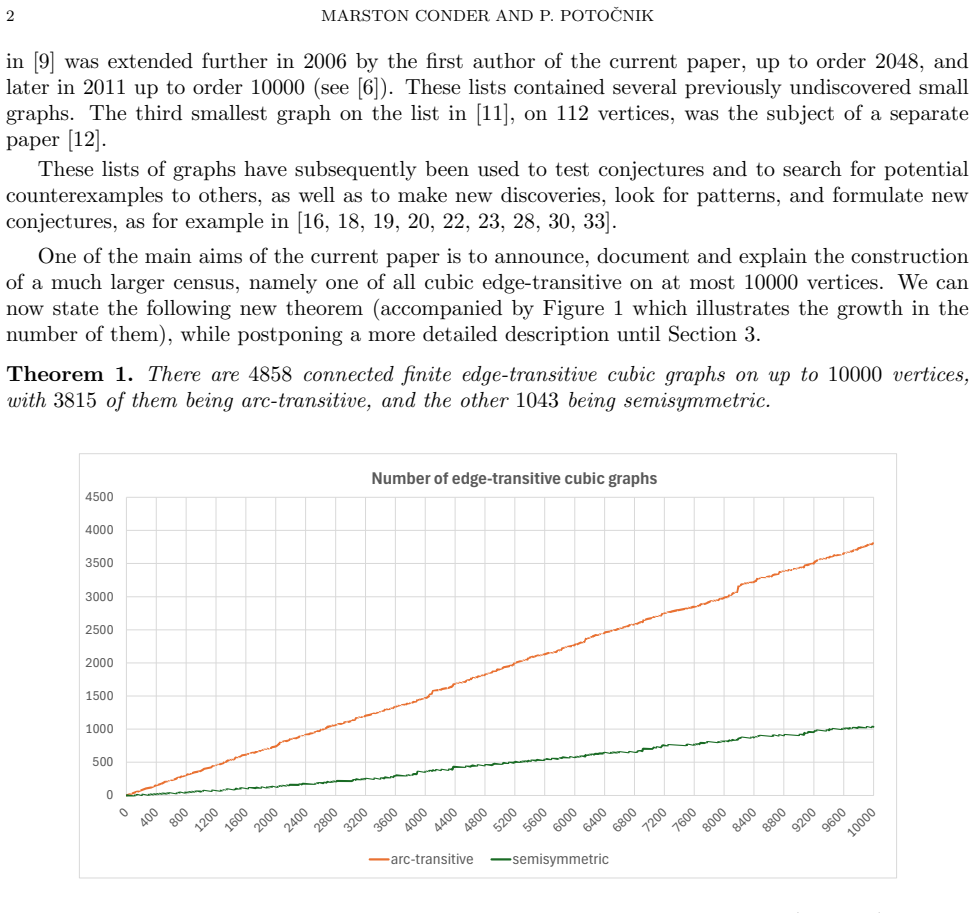
- Theorem 7: for each type $\mathcal C$, the counting function $f_{\mathcal C}(n)$ satisfies $n^{a\log n}\le f_{\mathcal C}(n)\le n^{b\log n}$ for all sufficiently large $n$, so the near-linear growth visible in the data up to 10,000 does not reflect the true asymptotic behaviour.
Reading between the lines
- An independent audit of the 22 presentations, re-deriving them from the listed stabiliser orders and local transitivity pairs, would test both the corrected $G_3$ relator and the reproducibility of the census without relying on the same code base.
- Because the paper notes that the set of orders of such graphs has natural density 0, a natural quantitative next step is to count, for each type, how many integers $n\le x$ actually occur as graph orders, and compare that count with the $n^{O(\log n)}$ growth of the number of graphs.
- The same combination of a universal tree quotient description with regular covering lifts and normal-growth bounds should transfer to other fixed valencies, offering a general warning that small-order data understate the abundance of highly symmetric graphs.
- The corrected $G_3$ presentation (the relator $cdydy$ rather than $cdyd$) suggests checking whether other published presentations of these amalgams contain similar transcription errors; one systematic way is to verify that each presentation's stabiliser orders and $(s_u,s_v)$ pairs match the paper's table.
Editorial analysis
A structured set of objections, weighed in public.
Referee Report
Summary. The paper announces and documents a computational census of all finite connected cubic edge-transitive graphs on at most 10000 vertices: Theorem 1 states there are 4858 such graphs, 3815 arc-transitive and 1043 semisymmetric. The method is Bass-Serre reduction of edge-transitive actions to normal subgroups of 22 finitely presented group representatives of the Djokovič-Miller and Goldschmidt amalgams, followed by Magma computations with LowIndexNormalSubgroups for all but the three largest Goldschmidt types, which receive special quotient arguments in Section 3. The paper also determines inclusions among the 22 amalgam types (Theorem 4), exhibits examples and smallest examples of each type (Section 4), proves that each type has infinitely many strong realizations (Theorem 6 via Theorem 9), and proves that for each type the counting function f_C(n) grows like n^{Θ(log n)} (Theorem 7, developed in Section 6 as Theorems 10-12 and Remark 13).
Significance. If the census of Theorem 1 is complete, the paper provides a valuable and widely usable resource: the online data at [14] extend the Foster/Conder-Dobcsányi lists by an order of magnitude, and the breakdown by Djokovič-Miller and Goldschmidt type allows fine-grained testing of conjectures. The inclusion diagram of Theorem 4 is a useful structural summary. The asymptotic result of Theorem 7 is significant: it shows that, in contrast to the impression given by small-order data, each of the 22 types has super-polynomial growth, and the proof via normal p-subgroups of the universal groups is conceptually clean. The paper is also commendably concrete in giving finite presentations of all 22 groups, explicit inclusions, and examples of small graphs for most types. However, the central completeness claim is computer-assisted, and the manuscript provides no scripts, logs, or machine-checkable code artifacts for the Magma searches; this limits independent verification of the census and is the main obstacle to accepting the paper as it stands.
major comments (4)
- [Section 3, Theorem 1] The exhaustiveness of the census in Theorem 1 rests on the claim that LowIndexNormalSubgroups, applied to the seven Djokovič-Miller groups and the thirteen smaller Goldschmidt groups, returns every relevant normal subgroup up to the stated index bounds. The paper says only that 'an improved version of the LowIndexNormalSubgroups command' was used, with no code, scripts, log files, or even a precise statement of the modified algorithm and parameters. This is load-bearing: if any normal subgroup was missed in these searches, the totals 3815, 1043, and 4858 would be wrong. I ask that the authors provide reproducible computational artifacts (e.g., Magma scripts and outputs, or a detailed pseudocode description sufficient for independent reimplementation) and archive them with the paper. Without such evidence, the completeness claim cannot be checked from the manuscript alone.
- [Section 3, paragraph on G1_4] The step 'since this group G has a unique subgroup of index 2, isomorphic to the group H considered above for G4, it follows that G has at most two proper normal subgroups of index up to 960000' is not justified as written. If M is a normal subgroup of G not contained in H, then M∩H is normal in H with index [H : M∩H] = [G : M] ≤ 960000, which can exceed the 480000 bound used for the LowIndexNormalSubgroups computation on H. The argument must explicitly rule out normal subgroups M not contained in H, for example by noting that in that case G/M is a perfect quotient of H and hence would have a nonabelian simple quotient of order at most 960000, contradicting the stated output of SimpleQuotientProcess for G. This is a necessary step for the conclusion and should be spelled out.
- [Section 3, paragraph on G1_5] The analogous reduction for G1_5 is also compressed: since G1_5 has a unique index-2 subgroup isomorphic to G5, a normal subgroup M of the G1_5 group not contained in this index-2 subgroup would give a quotient of G5 of order up to 1920000, i.e., beyond the 960000 range analyzed for G5. To reach the stated conclusion that there is exactly one edge-transitive graph of type G1_5 up to order 10000, the authors need to justify that no such M exists, using the stated absence of nonabelian simple quotients of G1_5 up to 1920000 together with perfectness of G5. As it stands, the phrase 'it follows' skips a load-bearing argument.
- [Section 6, Theorem 12 proof] In the final sentence of the proof, the inequality direction is wrong. The proof has established that |N*_n| is bounded above by the number of regular coverings whose automorphism group is the lift of G, and that |N*_n| is of type n^{log n}; therefore the number of such coverings is at least n^{a log n}, not at most. The sentence says 'the number of these coverings is at most n^{a log n}', which contradicts the stated theorem and the preceding inequality. This is a local typo, but since it appears in the proof of a main theorem it should be corrected.
minor comments (5)
- [Section 6, Theorem 12 proof] The rank of the free group F is stated to equal |V(Γ)| − |E(Γ)| + 1, but for a connected graph the correct first Betti number is |E(Γ)| − |V(Γ)| + 1. The displayed formula should be corrected; the error does not affect the argument once the correct rank is used.
- [Section 2, type G3] For the G3 amalgam, C is listed as ⟨c,d,e⟩, but the presentation has no generator e. It should be C = ⟨c,d⟩ ≅ D4.
- [Section 2, introductory paragraph] There is a duplicated reference error: 'the seven isomorphism classes of finite simple amalgams of index (3,2) were determined by Djoković and Miller in [24] in [17]'; delete '[24]'.
- [Section 6, Theorem 10 proof] The sentence citing [29, Lemma 1] says the constant c depends on 'G/F_i', but the representation being considered is of G/F (since F_i/F_{i+1} is central in F/F_{i+1}). The notation should be made consistent.
- [Introduction] Minor typos include 'the are no other examples' in the paragraph after Theorem 4, and the phrase 'complementing what is already known' in the abstract is slightly awkward but not misleading.
Circularity Check
No significant circularity: the enumeration is an exhaustive computation and the supporting theorems are imported from independent external sources.
full rationale
The paper's main claim (Theorem 1) is not derived by fitting a parameter to the claimed totals. Theorem 3 reduces the enumeration to a normal-subgroup search in the 22 universal groups via Bass-Serre theory, using the external classifications of Tutte, Djokovic-Miller and Goldschmidt. Section 3 then describes Magma's LowIndexNormalSubgroups searches and, for the three groups beyond Magma's index limit, explicit quotient arguments involving PSU(3,3), PSL(3,5), M12, and a Schur-cover check. None of these steps defines its output in terms of the theorem's conclusion; they are computational searches whose exhaustiveness is an assumption about Magma, not a circular reduction. Theorem 6 and Theorem 9 invoke the lifting theorem of Potocnik-Spiga ([31]); although one author overlaps, the cited theorem is a published result with hypotheses independent of the present conclusion and is applied as a black box, so it counts as independent support rather than a load-bearing self-citation. Theorem 10 and Corollary 11 are explicitly said to follow from Muller-Schlage-Puchta [29] and Lubotzky [25], and the proof sketch is self-contained after that. The corrected G3 relator (cdydy) is a typographical correction, not a redefinition of the target. No prediction in the paper reduces by construction to an input, and no fitted value is renamed as a prediction. The only real weakness is reproducibility (no Magma scripts or log files are provided), which is a correctness and verifiability issue outside the definition of circularity used here.
Assumptions & free parameters
assumptions (6)
- standard math Bass-Serre theory correspondence between finite simple amalgams of index (3,3) or (3,2) and the 22 conjugacy classes of discrete edge-transitive subgroups of Aut(T3)
- domain assumption Tutte's and Goldschmidt's bounds and classifications for cubic edge-transitive group actions
- domain assumption Correctness of the 22 finite presentations, including the corrected G3 relator cdydy
- domain assumption Correctness of Magma implementations of LowIndexNormalSubgroups, SimpleQuotientProcess, Homomorphisms, and AutomorphismGroup
- domain assumption Potocnik-Spiga [31, Theorem 6] on lifting a prescribed group as the full automorphism group along a regular p-covering
- standard math Muller-Schlage-Puchta [29, Theorem 1 and Lemma 1], Lubotzky's bound on d-generated groups, and Bryant-Kovacs/Witt rank formulas
Cite this review
Pith. "Pith review of Edge-transitive cubic graphs: Cataloguing and Enumeration." pith.science (2026). https://pith.science/paper/HPEL2UDP
@misc{pith2026250202250,
  author       = {Pith},
  title        = {Pith review of: Edge-transitive cubic graphs: Cataloguing and Enumeration},
  year         = {2026},
  howpublished = {\url{https://pith.science/paper/HPEL2UDP}},
  note         = {Machine review of arXiv:2502.02250}
}
abstract
This paper deals with finite cubic ($3$-regular) graphs whose automorphism group acts transitively on the edges of the graph. Such graphs split into two broad classes, namely arc-transitive and semisymmetric cubic graphs, and then these divide respectively into $7$ types (according to a classification by Djokovi\'c and Miller (1980)) and $15$ types (according to a classification by Goldschmidt(1980)), in terms of certain group amalgams. Such graphs of small order were previously known up to orders $2048$ and $768$, respectively, and we have extended each of the two lists of all such graphs up to order $10000$. Before describing how we did that, we carry out an analysis of the $22$ amalgams, to show which of the finitely-presented groups associated with the $15$ Goldschmidt amalgams can be faithfully embedded in one or more of the other $21$ (as subgroups of finite index), complementing what is already known about such embeddings of the $7$ Djokovi\'c-Miller groups in each other. We also give an example of a graph of each of the $22$ types, and in most cases, describe the smallest such graph, and we then use regular coverings to prove that there are infinitely many examples of each type. Finally, we discuss the asymptotic enumeration of the graph orders, proving that if $f_{\mathcal C}(n)$ is the number of cubic edge-transitive graphs of type ${\mathcal C}$ on at most $n$ vertices, then there exist positive real constants $a$ and $b$ and a positive integer $n_0$ such that $n^{a \log(n)} \le f_{\mathcal C}(n) \le n^{b \log(n)}$ for all $\ n\ge n_0$.
Figures


Figures from the paper (1 more)

Forward citations
Cited by 2 Pith papers
-
Infinitely many counterexamples to a conjecture of Lov\'asz
The line hypergraphs of generalized Petersen graphs GP(5k+11,2) form infinitely many counterexamples to Lovász's conjecture for r=3, and several quartic graphs give counterexamples for r=4.
-
Computer-assisted graph theory: a survey
Computer-assisted graph theory is surveyed, and two small computational results are added: i(5) <= 8/28 and non-planarity of the sequence 73517.
Reference graph
Works this paper leans on
-
[14]
M. Conder and P. Potoˇ cnik,Online census of cubic edge-transitive graphs , created May 2024, accessed 20 January 2025, https://fostercensus.graphsym.net
work page 2024
-
[1]
Baumslag, On the residual finiteness of generalised free products of nilpotent groups, Trans
G. Baumslag, On the residual finiteness of generalised free products of nilpotent groups, Trans. Amer. Math. Soc. 106 (1963), 193–209
work page 1963
-
[2]
S.R. Blackburn, P.M. Neumann, and G. Venkataraman, Enumeration of Finite Groups , Cambridge Tracts in Math- ematics 173, Cambridge University Press, 2007
work page 2007
- [3]
-
[4]
R.M. Bryant and L.G. Kov´ acs, Lie representations and groups of prime power order, J. London Math. Soc. (2) 17 (1978), 415–421
work page 1978
-
[5]
Bouwer (ed.), The Foster Census , Charles Babbage Research Centre, Winnipeg, 1988
I.Z. Bouwer (ed.), The Foster Census , Charles Babbage Research Centre, Winnipeg, 1988
work page 1988
-
[6]
M. Conder, Trivalent (cubic) symmetric graphs on up to 10000 vertices , created 2011, accessed 20 January 2025, https://www.math.auckland.ac.nz/~conder/symmcubic10000list.txt
work page 2011
-
[7]
M. Conder, Summary of all semi-symmetric cubic graphs on up to 10000 vertices , created May 2018, accessed 20 January 2025, https://www.math.auckland.ac.nz/~conder/SemisymmCubic10000.txt
work page 2018
Show all 36 references
-
[8]
Conder, The smallest symmetric cubic graphs with given type, J
M.D.E. Conder, The smallest symmetric cubic graphs with given type, J. Algebra 569 (2021), 643–657
2021
-
[9]
Conder and P
M.D.E. Conder and P. Dobcs´ anyi, Trivalent symmetric graphs on up to 768 vertices, J. Combin. Math. Combin. Comput. 40 (2002), 41–63
2002
-
[10]
Conder and P
M.D.E. Conder and P. Lorimer, Automorphism groups of symmetric graphs of valency 3, J. Combin. Theory Ser. B 47 (1989), 60–72
1989
-
[11]
Conder, A
M.D.E. Conder, A. Malniˇ c, D. Maruˇ siˇ c and P. Potoˇ cnik, A census of semisymmetric cubic graphs on up to 768 vertices, J. Algebraic Combin. 23 (2006), 255–294
2006
-
[12]
Conder, A
M.D.E. Conder, A. Malniˇ c, D. Maruˇ siˇ c, T. Pisanski and P. Potoˇ cnik, The edge-transitive but not vertex-transitive cubic graph on 112 vertices, J. Graph Theory 50 (2005), 25–42
2005
-
[13]
Conder and R
M. Conder and R. Nedela, A refined classification of symmetric cubic graphs, J. Algebra 322 (2009), 722–740
2009
-
[15]
Conder, G
M.D.E. Conder, G. Verret and D. Young, Density of quotient orders in groups and applications to locally-transitive graphs, arXiv:2410.17828, https://arxiv.org/pdf/2410.17828
-
[16]
Dalf´ o, E.R
C. Dalf´ o, E.R. van Dam, M.A. Fiol, E. Garriga and B.L. Gorissen, On almost distance-regular graphs, J. Combin. Theory Ser. A 118 (2011), 1094–1113
2011
-
[17]
D. ˇZ. Djokovi´ c and G.L. Miller, Regular groups of automorphisms of cubic graphs, J. Combin. Theory Ser. B 29 (1980) 195–230
1980
-
[18]
Feng and J.H
Y-Q. Feng and J.H. Kwak, Cubic symmetric graphs of order a small number times a prime or a prime square, J. Combin. Theory Ser. B 97 (2007), 627–646
2007
-
[19]
Feng and J-X
Y-Q. Feng and J-X. Zhou, Semisymmetric graphs, Discrete Math. 308 (2008), 4031–4035
2008
-
[20]
Fern´ andez and A
B. Fern´ andez and A. Hujdurovi´ c, On some problems regarding distance-balanced graphs,European J. Combin. 106 (2022), Paper no. 103593, 14 pp
2022
-
[21]
Folkman, Regular line-symmetric graphs, J
J. Folkman, Regular line-symmetric graphs, J. Combin. Theory 3 (1967), 215–232
1967
-
[22]
Frelih and K
B. Frelih and K. Kutnar, Classification of cubic symmetric tetracirculants and pentacirculants, European J. Combin. 34 (2013), 169–194
2013
-
[23]
Fuhlbr¨ uck, J
F. Fuhlbr¨ uck, J. K¨ obler, I. Ponomarenko and O. Verbitsky, The Weisfeiler-Leman algorithm and recognition of graph properties, Theoret. Comput. Sci. 895 (2021), 96–114
2021
-
[24]
Goldschmidt, Automorphisms of trivalent graphs, Ann
D. Goldschmidt, Automorphisms of trivalent graphs, Ann. Math. 111 (1980), 377–406
1980
-
[25]
Lubotzky, Enumerating boundedly generated finite groups, J
A. Lubotzky, Enumerating boundedly generated finite groups, J. Algebra 238 (2001), 194–99
2001
-
[26]
B. D. McKay, https://users.cecs.anu.edu.au/~bdm/data/formats.html, accessed January 5th, 2025
2025
-
[27]
B. D. McKay, A. Piperno, Practical Graph Isomorphism, II, J. Symbolic Comp. 60 (2014), 94–112
2014
-
[28]
Monson and A.I
B. Monson and A.I. Weiss, Medial layer graphs of equivelar 4-polytopes, European J. Combin. 28 (2007), 43–60
2007
-
[29]
T. W. M¨ uller and J.-C. Schlage-Puchta, Normal growth of large groups, II, Arch. Math. 84 (2005), 289–291. 28 MARSTON CONDER AND P. POTO ˇCNIK
2005
-
[30]
Parker, Semisymmetric cubic graphs of twice odd order, European J
C.W. Parker, Semisymmetric cubic graphs of twice odd order, European J. Combin. 28 (2007), 572–591
2007
-
[31]
Potoˇ cnik and P
P. Potoˇ cnik and P. Spiga, Lifting a prescribed group of automorphisms of graphs, Proc. Amer. Math. Soc. 147 (2019), 3787–3796
2019
-
[32]
Potoˇ cnik, P
P. Potoˇ cnik, P. Spiga, and G. Verret, Asymptotic enumeration of vertex-transitive graphs of fixed valency,J. Combin. Theory Ser. B 122 (2017), 221–240
2017
-
[33]
Potoˇ cnik, P
P. Potoˇ cnik, P. Spiga and G. Verret, Cubic vertex-transitive graphs on up to 1280 vertices,J. Symbolic Comput. 50 (2013), 465–477
2013
-
[34]
Tutte, A family of cubical graphs, Math
W.T. Tutte, A family of cubical graphs, Math. Proc. Cambridge Phil. Soc. 43 (1947), 459–474
1947
-
[35]
Tutte, Connectivity in Graphs , University of Toronto Press, Toronto (1966)
W.T. Tutte, Connectivity in Graphs , University of Toronto Press, Toronto (1966)
1966
-
[36]
Witt, Treue Darstellung Liescher Ringe, J
E. Witt, Treue Darstellung Liescher Ringe, J. Reine Angew. Math. 177 (1937), 152–160. Marston Conder, Department of Mathematics, University of Auckland, 38 Princes Street, Auckland 1010, New Zealand Email address : m.conder@auckland.ac.nz Primoˇz Potoˇcnik, F aculty of Mathema...
1937
Reviewed August 9, 2026 · model on record in the stance chip above.
Discussion (0). Continue with ORCID to comment.