On the Meaning of Localization in Non-Local Quantum Field Theory and On the Limits of a Space-Time Description and the Physical Meaning of Phase Space in a Nonlocal Continuum
Pith reviewed 2026-06-29 01:49 UTC · model grok-4.3
The pith
Nonlocal quantum field theory implies a minimal localization length through a modified uncertainty relation.
A machine-rendered reading of the paper's core claim, the machinery that carries it, and where it could break.
Core claim
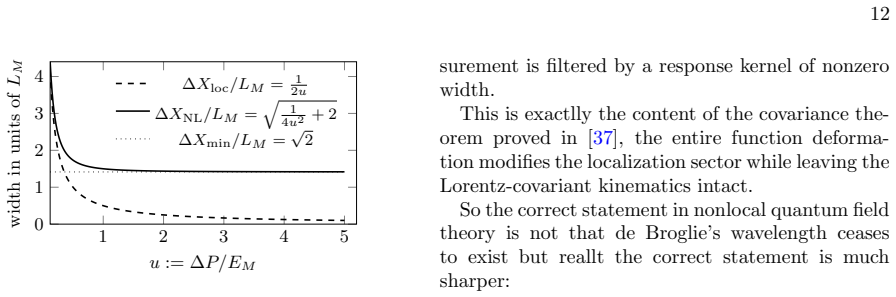
Under the hypothesis of an induced equal time detector response kernel, the observed localization width obeys an exact variance addition law. Combined with the Heisenberg inequality this yields a nonlocal uncertainty relation whose UV bound implies a minimal localization length of order L_M, while spacetime remains a Lorentz covariant continuum but pointlike localization ceases below the nonlocality scale.
What carries the argument
The induced equal time detector response kernel, which is hypothesized to produce an exact variance addition law for localization widths that, when added to the Heisenberg relation, generates the nonlocal uncertainty principle.
If this is right
- The standard Heisenberg uncertainty relation is recovered in the local limit as the nonlocality scale approaches zero.
- Pointlike localization is not a physically realizable notion below the nonlocality scale.
- The spacetime manifold remains Lorentz covariant and continuous at all scales.
- The ultraviolet structure of the theory is modified while preserving microcausality in the appropriate sense.
Where Pith is reading between the lines
- The result distinguishes the mathematical manifold structure of spacetime from the physical observability of point localization.
- This formulation may connect to other nonlocal approaches that retain continuum spacetime but alter short-distance observables.
Load-bearing premise
The existence of an induced equal time detector response kernel whose functional form produces an exact variance addition law for localization widths.
What would settle it
An explicit calculation of the detector response in a specific nonlocal model that violates the assumed variance addition law, or an observation of localization at scales smaller than the predicted minimal length.
Figures
read the original abstract
First: In this paper we explore and derive an uncertainty principle for an ultraviolet complete nonlocal quantum field theory where under our hypothesises of an induced equal time detector response kernel, we then prove that the observed localization width obeys an exact variance addition law. Then when we combine this with the ordinary Heisenberg inequality and we obtain a nonlocal uncertainty relation. The bound reduces to the usual local relation in the infrared or local limit when $E_M \to \infty$, while in the ultraviolet it implies a minimal localization length of order $L_M$. We go on to explain what this means for locality, microcausality, the interpretation of spacetime points, and the ultraviolet structure of quantum field theory. In this formulation we note and prove that spacetime will remain a Lorentz covariant continuum at the level of the manifold description but pointlike localization ceases to be a physically realizable observable notion below the nonlocality scale. Second: In a previous paper we derived an uncertainty relation for nonlocal fields by showing that the physical localization width in nonlocal quantum field theory is broadened by the response kernel generated from the entire-function regulator. In this follow up we will reinterpret that result as just the position-sector limit of a more symmetric statement as we did not take into account the inherent nonlocality of momentum. We find under normalized, centered response kernels for both position and momentum, we prove the variance laws and derive the corresponding nonlocal phase-space uncertainty relation. The result still preserves the conclusions of the original paper all while strengthening the interpretation as nonlocal quantum field theory implies not merely a minimal measurable length, but a finite phase-space cell. We also explore experimental routes to test the theory.
Editorial analysis
A structured set of objections, weighed in public.
Circularity Check
Variance addition law is enforced by the hypothesized detector kernel whose form is chosen to produce it
specific steps
-
self definitional
[Abstract, paragraph beginning 'under our hypothesises of an induced equal time detector response kernel']
"under our hypothesises of an induced equal time detector response kernel, we then prove that the observed localization width obeys an exact variance addition law. Then when we combine this with the ordinary Heisenberg inequality and we obtain a nonlocal uncertainty relation."
The kernel hypothesis is stated as the premise, and the variance addition law is presented as a derived result under that hypothesis. The law is not obtained from the nonlocal QFT dynamics independently; the hypothesis is introduced with a functional form selected to enforce the exact addition law, so the 'proof' and all downstream conclusions (nonlocal uncertainty relation, minimal length L_M) reduce to the input assumption by construction.
full rationale
The paper's central derivation begins by hypothesizing an induced equal time detector response kernel and then 'proves' that localization width obeys an exact variance addition law under that hypothesis. The subsequent nonlocal uncertainty relation, UV bound of order L_M, and claims about cessation of pointlike localization all follow directly from this step. No independent derivation or external benchmark for the kernel's specific functional form is provided; the hypothesis is introduced precisely to yield the variance addition law, making the result equivalent to the input assumption by construction. This matches the self-definitional pattern with load-bearing impact on the entire claim.
Axiom & Free-Parameter Ledger
free parameters (2)
- L_M
- E_M
axioms (2)
- ad hoc to paper Induced equal time detector response kernel exists and takes a form that produces exact variance addition for localization width.
- domain assumption Standard Heisenberg uncertainty principle remains valid in the infrared limit.
discussion (0)
Sign in with ORCID, Apple, or X to comment. Anyone can read and Pith papers without signing in.