The SU(N) Holstein Model
Pith reviewed 2026-06-25 21:42 UTC · model grok-4.3
The pith
The SU(3) Holstein model has a charge density wave critical temperature up to twice that of the SU(2) case.
A machine-rendered reading of the paper's core claim, the machinery that carries it, and where it could break.
Core claim
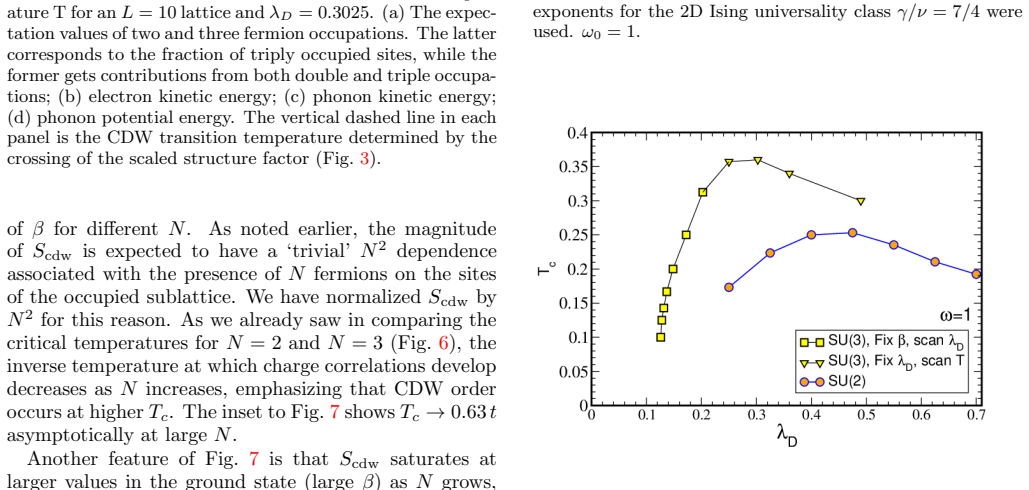
At half filling the SU(N) Holstein Hamiltonian develops an insulating charge density wave phase at low temperatures in which empty sites alternate with sites occupied by N fermions. Determinant quantum Monte Carlo simulations determine the N=3 phase diagram in the temperature versus electron-phonon coupling plane, revealing that the critical temperature can reach twice the maximum value found for N=2.
What carries the argument
Determinant Quantum Monte Carlo simulations of the SU(N) Holstein Hamiltonian in which N fermionic species couple to a single local phonon mode.
If this is right
- The critical temperature Tc for the CDW transition increases with N.
- The N=3 CDW phase diagram is mapped in the T-alpha plane at fixed omega0 and half filling.
- The N dependence of Tc is obtained for fixed omega0 and alpha.
- The model exhibits an insulating CDW phase at low T for general N.
Where Pith is reading between the lines
- Results from this model could inform the design of cold atom experiments realizing SU(N) symmetries.
- Higher Tc for larger N might allow observation of the CDW phase in regimes where N=2 is inaccessible.
- Similar enhancements might appear in other electron-phonon models with extended symmetry.
Load-bearing premise
The determinant Quantum Monte Carlo algorithm remains free of severe sign problems and converges reliably at the temperatures and couplings needed for N greater than 2.
What would settle it
A calculation showing that the sign problem becomes severe at the couplings where Tc is claimed to be high for N=3 would falsify the reliability of the reported phase diagram.
Figures
read the original abstract
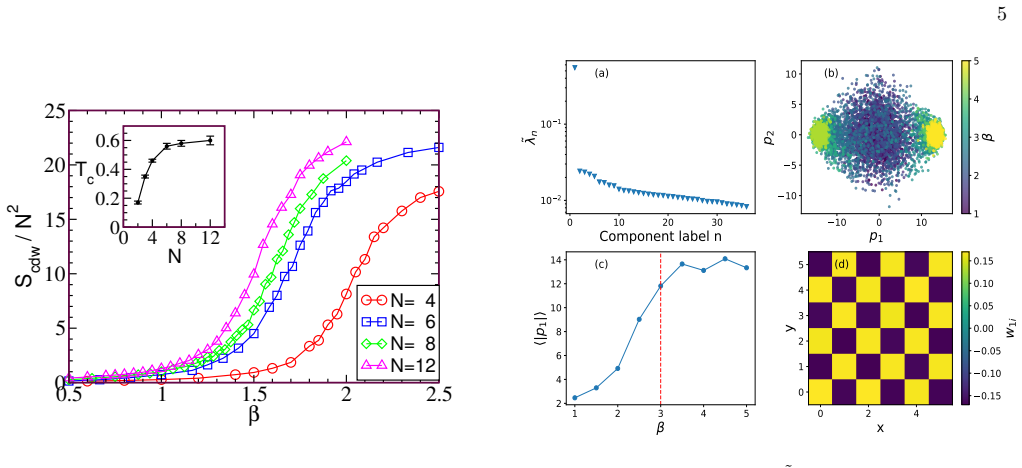
From the condensed matter physics perspective, the most natural single orbital tight-binding Hamiltonians, and hence the most widely studied, contain two fermionic species, corresponding to spin up and spin down electrons. In cold atom systems, however, SU(N) symmetry, in which $N > 2$ fermionic species reside within a single band, also occurs. In order to understand such experiments, the SU(N) Hubbard model has been increasingly studied. Here we present determinant Quantum Monte Carlo simulations of the SU(N) {\it Holstein} Hamiltonian, in which $N$ fermionic species couple to a single local phonon mode. We show that at half filling it has an insulating charge density wave phase (CDW) at low temperatures, in which empty sites alternate with sites with $N$ particles. We determine the $N=3$ CDW phase diagram in the temperature, $T$, versus electron-phonon coupling, $\alpha$, plane at fixed phonon frequency $\omega_0$ and half-filling $\rho=1.5$. The critical temperature $T_c$ for $N=3$ can be as high as twice the maximum attainable for $N=2$. We also obtain the $N$ dependence of $T_c$ for a representative, fixed, $\omega_0$ and $\alpha$.
Editorial analysis
A structured set of objections, weighed in public.
Referee Report
Summary. The manuscript presents determinant quantum Monte Carlo (DQMC) simulations of the SU(N) Holstein model with N fermionic species coupled to a local phonon mode. At half-filling it identifies an insulating charge-density-wave (CDW) phase in which empty sites alternate with sites occupied by N particles. For N=3 the authors map the CDW phase boundary in the T–α plane at fixed ω₀ and ρ=1.5, reporting that the maximum critical temperature is up to twice the largest value obtained for N=2; they also show the N-dependence of Tc at representative fixed parameters.
Significance. If the numerical results are robust, the work provides the first non-perturbative phase diagram for the SU(N) Holstein model and demonstrates that increasing the number of fermionic flavors can substantially raise the CDW transition temperature. This is directly relevant to cold-atom realizations of SU(N) symmetry and supplies a concrete, falsifiable prediction for how Tc scales with N. The use of unbiased DQMC constitutes a clear methodological strength.
major comments (2)
- [Results section (phase-diagram figures)] Results section (phase-diagram figures): the reported Tc values for N=3 and N=2 are given without error bars, without finite-size scaling analysis, and without a description of the observable or fitting procedure used to locate the transition. Because the central claim is that Tc(N=3) reaches twice the N=2 maximum, the absence of these controls makes the quantitative comparison impossible to assess.
- [Methods section] Methods section: although DQMC is applied for N=3, there is no tabulation or plot of the average sign as a function of temperature or coupling in the vicinity of the reported Tc. Given that the sign problem is the reader’s weakest assumption, explicit evidence that the sign remains manageable at the temperatures and α values used to extract Tc is required to support the N=3 results.
minor comments (2)
- [Abstract] The abstract states ρ=1.5 for N=3; a brief sentence clarifying that this corresponds to half-filling (one particle per flavor on average) would aid readers unfamiliar with SU(N) conventions.
- [Figure captions] Figure captions should explicitly state the system sizes employed and whether any extrapolation in linear size was performed.
Simulated Author's Rebuttal
We thank the referee for their positive evaluation of the significance of our work on the SU(N) Holstein model and for the constructive comments on the presentation of the numerical results. We address each major comment below and outline the revisions that will be made to the manuscript.
read point-by-point responses
-
Referee: Results section (phase-diagram figures): the reported Tc values for N=3 and N=2 are given without error bars, without finite-size scaling analysis, and without a description of the observable or fitting procedure used to locate the transition. Because the central claim is that Tc(N=3) reaches twice the N=2 maximum, the absence of these controls makes the quantitative comparison impossible to assess.
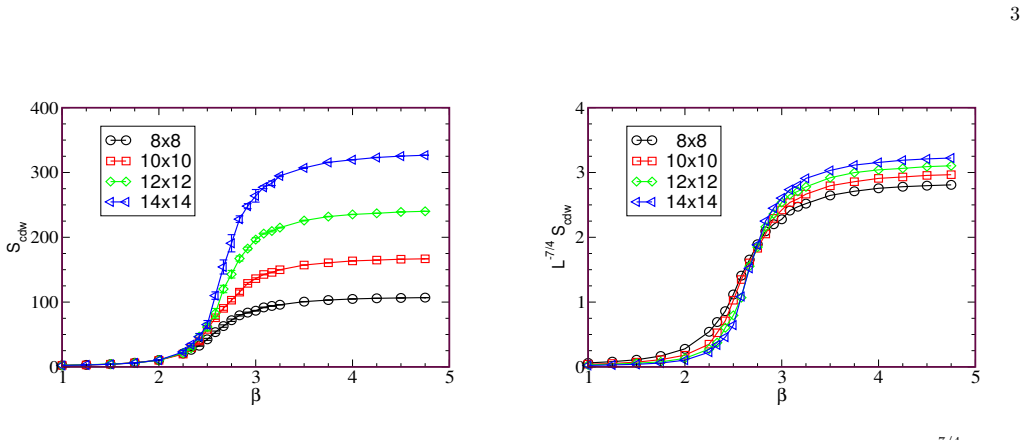
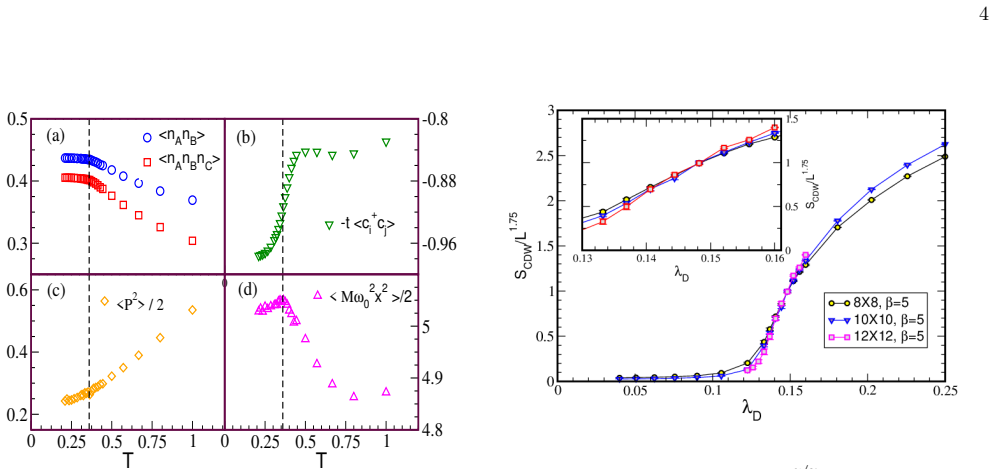
Authors: We agree that the quantitative comparison of Tc(N=3) and Tc(N=2) requires explicit error bars, finite-size scaling, and a clear description of the extraction method. In the revised manuscript we will add these elements: we will specify that Tc is determined from the crossing of the finite-size scaled CDW structure factor, describe the fitting procedure used to locate the transition, and include error bars on all reported Tc values. Additional runs on larger lattices have been performed to enable this analysis. revision: yes
-
Referee: Methods section: although DQMC is applied for N=3, there is no tabulation or plot of the average sign as a function of temperature or coupling in the vicinity of the reported Tc. Given that the sign problem is the reader’s weakest assumption, explicit evidence that the sign remains manageable at the temperatures and α values used to extract Tc is required to support the N=3 results.
Authors: We acknowledge that explicit documentation of the average sign is necessary to support the reliability of the N=3 data. In the revised Methods section we will include a plot (or table) of the average sign versus temperature and α in the vicinity of the reported Tc values. Our simulations show that the sign remains close to one throughout the relevant regime, as expected from particle-hole symmetry at half filling. revision: yes
Circularity Check
No significant circularity
full rationale
This is a numerical simulation paper using determinant Quantum Monte Carlo to compute phase diagrams and critical temperatures Tc for the SU(N) Holstein model at half-filling. The reported Tc values and N-dependence are obtained directly from the simulations rather than from any analytical derivation chain, fitted parameters renamed as predictions, or self-citation load-bearing steps. No equations or claims reduce the results to inputs by construction, and the method is standard and externally verifiable.
Axiom & Free-Parameter Ledger
free parameters (2)
- electron-phonon coupling alpha
- phonon frequency omega0
axioms (1)
- domain assumption The SU(N) Holstein Hamiltonian accurately represents the physics of cold-atom systems with N fermionic species in a single band.
Reference graph
Works this paper leans on
-
[1]
We report results in terms of the dimensionless couplingλ D ≡α 2/(W ω 2 0), where the non-interacting bandwidthW= 8t, and will focus mostly on the caseN= 3
for any temperature on a bipartite lattice. We report results in terms of the dimensionless couplingλ D ≡α 2/(W ω 2 0), where the non-interacting bandwidthW= 8t, and will focus mostly on the caseN= 3. We choose our units by settingM= 1 andt= 1. We will explore the properties of Eq. 1 with deter- minant Quantum Monte Carlo (DQMC)[47–49]. In this method, th...
-
[2]
The plateau inρindicates the presence of an incom- pressible insulating CDW phase
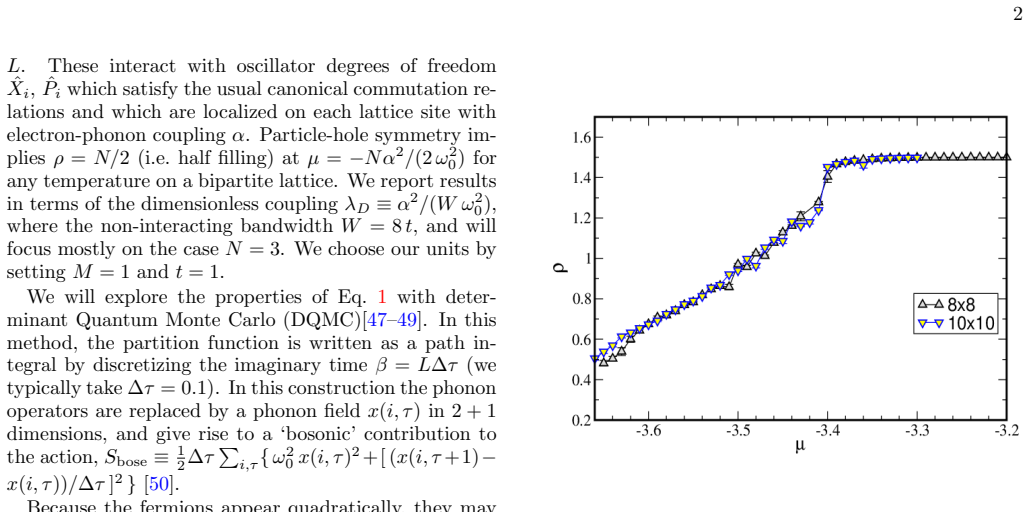
=−3 for the current parameter values. The plateau inρindicates the presence of an incom- pressible insulating CDW phase. The gap is symmetric with respect toµ=−3 and is therefore ∆∼0.8t. We note a small discontinuous jump inρas the system approaches half filling. This indicates a first order transition and is similar to that observed in the case of two fe...
-
[3]
Read and D
N. Read and D. M. Newns, A new functional integral formalism for the degenerate Anderson model, Journal of Physics C: Solid State Physics16, L1055 (1983)
1983
-
[4]
Affleck, Large-Nlimit of SU(N) quantum “spin” chains, Phys
I. Affleck, Large-Nlimit of SU(N) quantum “spin” chains, Phys. Rev. Lett.54, 966 (1985)
1985
-
[5]
Bickers, Review of techniques in the large-Nex- pansion for dilute magnetic alloys, Reviews of Modern Physics59, 845 (1987)
N. Bickers, Review of techniques in the large-Nex- pansion for dilute magnetic alloys, Reviews of Modern Physics59, 845 (1987)
1987
-
[6]
Affleck and J
I. Affleck and J. B. Marston, Large-Nlimit of the Heisenberg-Hubbard model: Implications for high-T c superconductors, Phys. Rev. B37, 3774 (1988)
1988
-
[8]
Read and S
N. Read and S. Sachdev, Some features of the phase diagram of the square lattice SU(N) antiferromagnet, Nucl. Phys.316, 609 (1989)
1989
-
[9]
Wu, Hidden symmetry and quantum phases in spin- 3/2 cold atomic systems, Modern Physics Letters B20, 1707 (2006)
C. Wu, Hidden symmetry and quantum phases in spin- 3/2 cold atomic systems, Modern Physics Letters B20, 1707 (2006)
2006
-
[10]
Auerbach,Interacting electrons and quantum mag- netism(Springer Science & Business Media, 2012)
A. Auerbach,Interacting electrons and quantum mag- netism(Springer Science & Business Media, 2012)
2012
-
[11]
T. A. T´ oth, A. M. L¨ auchli, F. Mila, and K. Penc, Three- sublattice ordering of the SU(3) Heisenberg model of three-flavor fermions on the square and cubic lattices, Phys. Rev. Lett.105, 265301 (2010)
2010
-
[12]
Bauer, P
B. Bauer, P. Corboz, A. M. L¨ auchli, L. Messio, K. Penc, M. Troyer, and F. Mila, Three-sublattice order in the SU(3) Heisenberg model on the square and triangular lattice, Phys. Rev. B85, 125116 (2012)
2012
-
[13]
Nataf and F
P. Nataf and F. Mila, Exact diagonalization of Heisen- berg SU(N) models, Phys. Rev. Lett.113, 127204 (2014)
2014
-
[14]
Corboz, A
P. Corboz, A. M. L¨ auchli, K. Penc, M. Troyer, and F. Mila, Simultaneous dimerization and SU(4) symme- try breaking of 4-color fermions on the square lattice, Phys. Rev. Lett.107, 215301 (2011)
2011
-
[15]
Hermele and V
M. Hermele and V. Gurarie, Topological liquids and va- lence cluster states in two-dimensional SU(N) magnets, Phys. Rev. B84, 174441 (2011)
2011
-
[16]
Romen and A
C. Romen and A. M. L¨ auchli, Structure of spin corre- lations in high-temperature SU(N) quantum magnets, Phys. Rev. Research2, 043009 (2020)
2020
-
[17]
Yamamoto, C
D. Yamamoto, C. Suzuki, G. Marmorini, S. Okazaki, and N. Furukawa, Quantum and thermal phase transi- tions of the triangular SU(3) Heisenberg model under magnetic fields, Phys. Rev. Lett.125, 057204 (2020)
2020
-
[18]
M. A. Cazalilla, A. Ho, and M. Ueda, Ultracold gases of ytterbium: ferromagnetism and Mott states in an SU(6) Fermi system, New Journal of Physics11, 103033 (2009)
2009
-
[19]
A. V. Gorshkov, M. Hermele, V. Gurarie, C. Xu, P. S. Julienne, J. Ye, P. Zoller, E. Demler, M. D. Lukin, and A. Rey, Two-orbital SU(N) magnetism with ultracold alkaline-earth atoms, Nature Physics6, 289 (2010)
2010
-
[20]
M. A. Cazalilla and A. M. Rey, Ultracold fermi gases with emergent SU(N) symmetry, Reports on Progress in Physics77, 124401 (2014)
2014
-
[21]
C. Wu, J. Hu, and S. Zhang, Exact SO(5) symmetry in the spin-3/2 fermionic system, Phys. Rev. Lett.91, 186402 (2003)
2003
-
[22]
Honerkamp and W
C. Honerkamp and W. Hofstetter, Ultracold fermions and the SU(N) Hubbard model, Phys. Rev. Lett.92, 170403 (2004). 7
2004
-
[23]
A. V. Gorshkov, M. Hermele, V. Gurarie, C. Xu, P. S. Julienne, J. Ye, P. Zoller, E. Demler, M. D. Lukin, and A. M. Rey, Two-orbital SU(N) magnetism with ultra- cold alkaline-earth atoms, Nat. Phys.6, 289 (2010)
2010
-
[24]
S. Taie, R. Yamazaki, S. Sugawa, and Y. Takahashi, An SU(6) Mott insulator of an atomic Fermi gas realized by large-spin Pomeranchuk cooling, Nature Physics8, 825 (2012)
2012
-
[25]
Pagano, M
G. Pagano, M. Mancini, G. Cappellini, P. Lombardi, F. Sch¨ afer, H. Hu, X.-J. Liu, J. Catani, C. Sias, M. In- guscio,et al., A one-dimensional liquid of fermions with tunable spin, Nature Physics10, 198 (2014)
2014
-
[26]
Hofrichter, L
C. Hofrichter, L. Riegger, F. Scazza, M. H¨ ofer, D. R. Fernandes, I. Bloch, and S. F¨ olling, Direct probing of the Mott crossover in the SU(N) Fermi-Hubbard model, Phys. Rev. X6, 021030 (2016)
2016
-
[27]
S. Taie, E. Ibarra-Garcia-Padilla, N. Nishizawa, Y. Takasu, Y. Kuno, H.-T. Wei, R. T. Scalettar, K. R. A. Hazzard, and Y. Takahashi, Observation of an- tiferromagnetic correlations in an ultracold SU(N) Hub- bard model, Nat. Phys.18, 1356 (2022)
2022
-
[28]
D. Tusi, L. Franchi, L. F. Livi, K. Baumann, D. Bene- dicto Orenes, L. Del Re, R. E. Barfknecht, T.-W. Zhou, M. Inguscio, G. Cappellini,et al., Flavour-selective lo- calization in interacting lattice fermions, Nature Physics 18, 1201 (2022)
2022
-
[29]
Pasqualetti, O
G. Pasqualetti, O. Bettermann, N. Darkwah Oppong, E. Ibarra-Garc´ ıa-Padilla, S. Dasgupta, R. T. Scalet- tar, K. R. A. Hazzard, I. Bloch, and S. F¨ olling, Equa- tion of state and thermometry of the 2D SU(N) Fermi- Hubbard model, Phys. Rev. Lett.132, 083401 (2024)
2024
-
[30]
Das Sarma, X
S. Das Sarma, X. Wang, and S. Yang, Hubbard model description of silicon spin qubits: Charge stability dia- gram and tunnel coupling in Si double quantum dots, Physical Review B—Condensed Matter and Materials Physics83, 235314 (2011)
2011
-
[31]
Salfi, J
J. Salfi, J. Mol, R. Rahman, G. Klimeck, M. Simmons, L. Hollenberg, and S. Rogge, Quantum simulation of the Hubbard model with dopant atoms in silicon, Nature communications7, 11342 (2016)
2016
-
[32]
X. Wang, E. Khatami, F. Fei, J. Wyrick, P. Namboodiri, R. Kashid, A. F. Rigosi, G. Bryant, and R. Silver, Ex- perimental realization of an extended Fermi-Hubbard model using a 2D lattice of dopant-based quantum dots, Nature Communications13, 6824 (2022)
2022
-
[33]
Liu and J
Y. Liu and J. Luo, Zoo of silicon-based quantum bits, The Innovation3(2022)
2022
-
[34]
W. Wang, J. D. Rooney, and H. Jiang, Efficient charac- terization of a double quantum dot using the Hubbard model, Journal of Applied Physics136(2024)
2024
-
[35]
Ibarra-Garc´ ıa-Padilla, C
E. Ibarra-Garc´ ıa-Padilla, C. Feng, G. Pasqualetti, S. F¨ olling, R. T. Scalettar, E. Khatami, and K. R. A. Hazzard, Metal-insulator transition and magnetism of SU(3) fermions in the square lattice, Phys. Rev. A108, 053312 (2023)
2023
-
[36]
C. Feng, E. Ibarra-Garc´ ıa-Padilla, K. R. A. Hazzard, R. Scalettar, S. Zhang, and E. Vitali, Metal-insulator transition and quantum magnetism in the SU(3) Fermi- Hubbard model, Phys. Rev. Res.5, 043267 (2023)
2023
-
[37]
E. Loh, J. Gubernatis, R. Scalettar, S. White, D. Scalapino, and R. Sugar, Sign problem in the numer- ical simulation of many-electron systems, Phys. Rev. B 41, 9301 (1990)
1990
-
[38]
Troyer and U.-J
M. Troyer and U.-J. Wiese, Computational complex- ity and fundamental limitations to fermionic quantum Monte Carlo simulations, Phys. Rev. Lett.94, 170201 (2005)
2005
-
[39]
Mondaini, S
R. Mondaini, S. Tarat, and R. T. Scalettar, Quantum critical points and the sign problem, Science375, 418 (2022)
2022
-
[40]
Holstein, Studies of polaron motion: Part i
T. Holstein, Studies of polaron motion: Part i. the molecular-crystal model, Annals of Physics8, 325 (1959)
1959
-
[41]
N. D. Mermin and H. Wagner, Absence of ferro- magnetism or antiferromagnetism in one- or two- dimensional isotropic Heisenberg models, Phys. Rev. Lett.17, 1133 (1966)
1966
-
[42]
Wang, Discovering phase transitions with unsuper- vised learning, Phys
L. Wang, Discovering phase transitions with unsuper- vised learning, Phys. Rev. B94, 195105 (2016)
2016
-
[43]
W. Hu, R. R. P. Singh, and R. T. Scalettar, Discov- ering phases, phase transitions, and crossovers through unsupervised machine learning: A critical examination, Phys. Rev. E95, 062122 (2017)
2017
-
[44]
Carrasquilla and R
J. Carrasquilla and R. G. Melko, Machine learning phases of matter, Nat. Phys.13, 431 (2017)
2017
-
[45]
N. C. Costa, W. Hu, Z. Bai, R. T. Scalettar, and R. R. Singh, Principal component analysis for fermionic crit- ical points, Physical Review B96, 195138 (2017)
2017
-
[46]
Ch’Ng, J
K. Ch’Ng, J. Carrasquilla, R. G. Melko, and E. Khatami, Machine learning phases of strongly cor- related fermions, Physical Review X7, 031038 (2017)
2017
-
[47]
X.-Y. Dong, F. Pollmann, and X.-F. Zhang, Machine learning of quantum phase transitions, Physical Review B99, 121104 (2019)
2019
-
[48]
Johnston, E
S. Johnston, E. Khatami, and R. Scalettar, A perspec- tive on machine learning and data science for strongly correlated electron problems, Carbon Trends9, 100231 (2022)
2022
-
[49]
Blankenbecler, D
R. Blankenbecler, D. J. Scalapino, and R. L. Sugar, Monte Carlo calculations of coupled boson-fermion sys- tems. I, Phys. Rev. D24, 2278 (1981)
1981
-
[50]
White, D
S. White, D. Scalapino, R. Sugar, E. Loh, J. Guber- natis, and R. Scalettar, Numerical study of the two- dimensional Hubbard model, Phys. Rev. B40, 506 (1989)
1989
-
[51]
Cohen-Stead, O
B. Cohen-Stead, O. Bradley, C. Miles, G. Batrouni, R. Scalettar, and K. Barros, Fast and scalable quan- tum Monte Carlo simulations of electron-phonon mod- els, Phys. Rev. E105, 065302 (2022)
2022
-
[52]
Creutz and B
M. Creutz and B. Freedman, A statistical approach to quantum mechanics, Annals of Physics132, 427 (1981)
1981
-
[53]
Bradley, G
O. Bradley, G. G. Batrouni, and R. T. Scalettar, Super- conductivity and charge density wave order in the two- dimensional Holstein model, Phys. Rev. B103, 235104 (2021)
2021
-
[54]
Scalettar, N
R. Scalettar, N. Bickers, and D. Scalapino, Competition of pairing and Peierls–charge-density-wave correlations in a two-dimensional electron-phonon model, Phys. Rev. B40, 197 (1989)
1989
-
[55]
Marsiglio, Pairing and charge-density-wave correla- tions in the Holstein model at half-filling, Phys
F. Marsiglio, Pairing and charge-density-wave correla- tions in the Holstein model at half-filling, Phys. Rev. B 42, 2416 (1990)
1990
-
[56]
Veki´ c, R
M. Veki´ c, R. Noack, and S. White, Charge-density waves versus superconductivity in the Holstein model with next-nearest-neighbor hopping, Phys. Rev. B46, 271 (1992)
1992
-
[57]
Freericks, M
J. Freericks, M. Jarrell, and D. Scalapino, Holstein model in infinite dimensions, Phys. Rev. B48, 6302 8 (1993)
1993
-
[58]
Li and S
S. Li and S. Johnston, The effects of non-linear electron- phonon interactions on superconductivity and charge- density-wave correlations, EPL (Europhysics Letters) 109, 27007 (2015)
2015
-
[59]
S. Li, E. A. Nowadnick, and S. Johnston, Quasiparticle properties of the nonlinear Holstein model at finite dop- ing and temperature, Phys. Rev. B92, 064301 (2015)
2015
-
[60]
Weber and M
M. Weber and M. Hohenadler, Two-dimensional Holstein-Hubbard model: Critical temperature, Ising universality, and bipolaron liquid, Phys. Rev. B98, 085405 (2018)
2018
-
[61]
N. C. Costa, T. Blommel, W.-T. Chiu, G. Batrouni, and R. T. Scalettar, Phonon dispersion and the competition between pairing and charge order, Phys. Rev. Lett.120, 187003 (2018)
2018
-
[62]
Esterlis, B
I. Esterlis, B. Nosarzewski, E. W. Huang, B. Moritz, T. P. Devereaux, D. J. Scalapino, and S. A. Kivelson, Breakdown of the Migdal-Eliashberg theory: A deter- minant quantum Monte Carlo study, Phys. Rev. B97, 140501 (2018)
2018
-
[63]
Hohenadler and G
M. Hohenadler and G. Batrouni, Dominant charge den- sity wave correlations in the Holstein model on the half- filled square lattice, Phys. Rev. B100, 165114 (2019)
2019
-
[64]
C. Chen, X. Y. Xu, Z. Y. Meng, and M. Hohenadler, Charge-density-wave transitions of Dirac fermions cou- pled to phonons, Phys. Rev. Lett.122, 077601 (2019)
2019
-
[65]
Zhang, W.-T
Y.-X. Zhang, W.-T. Chiu, N. Costa, G. Batrouni, and R. Scalettar, Charge order in the Holstein model on a honeycomb lattice, Phys. Rev. Lett.122, 077602 (2019)
2019
-
[66]
Cohen-Stead, K
B. Cohen-Stead, K. Barros, Z. Meng, C. Chen, R. T. Scalettar, and G. G. Batrouni, Langevin simulations of the half-filled cubic Holstein model, Phys. Rev. B102, 161108 (2020)
2020
-
[67]
C. Feng, H. Guo, and R. T. Scalettar, Charge den- sity waves on a half-filled decorated honeycomb lattice, Phys. Rev. B101, 205103 (2020)
2020
-
[68]
Feng and R
C. Feng and R. T. Scalettar, Interplay of flat electronic bands with Holstein phonons, Phys. Rev. B102, 235152 (2020)
2020
-
[69]
P. M. Dee, J. Coulter, K. G. Kleiner, and S. Johnston, Relative importance of nonlinear electron-phonon cou- pling and vertex corrections in the Holstein model, Com- munications Physics3, 1 (2020)
2020
-
[70]
Nosarzewski, E
B. Nosarzewski, E. W. Huang, P. M. Dee, I. Esterlis, B. Moritz, S. A. Kivelson, S. Johnston, and T. P. De- vereaux, Superconductivity, charge density waves, and bipolarons in the Holstein model, Phys. Rev. B103, 235156 (2021)
2021
-
[71]
Zhang, C
Y. Zhang, C. Feng, R. Mondaini, G. G. Batrouni, and R. T. Scalettar, Charge singlets and orbital-selective charge density wave transitions, Phys. Rev. B106, 115120 (2022)
2022
-
[72]
M. V. Ara´ ujo, J. P. de Lima, S. Sorella, and N. C. Costa, Two-dimensionalt-t ′ Holstein model, Phys. Rev. B105, 165103 (2022)
2022
-
[73]
A. T. Ly, B. Cohen-Stead, S. M. Costa, and S. John- ston, Comparative study of the superconductivity in the Holstein and optical Su-Schrieffer-Heeger models, Phys. Rev. B108, 184501 (2023)
2023
-
[74]
Kvande, C
C. Kvande, C. Feng, F. H´ ebert, G. G. Batrouni, and R. T. Scalettar, Enhancement of charge density wave correlations in a Holstein model with an anharmonic phonon potential, Phys. Rev. B108, 075119 (2023)
2023
-
[75]
J. Sous, M. Chakraborty, R. V. Krems, and M. Berciu, Light bipolarons stabilized by Peierls electron-phonon coupling, Phys. Rev. Lett.121, 247001 (2018)
2018
-
[76]
Li and S
S. Li and S. Johnston, Quantum Monte Carlo study of lattice polarons in the two-dimensional three-orbital Su–Schrieffer–Heeger model, npj Quantum Materials5, 40 (2020)
2020
-
[77]
Paiva, R
T. Paiva, R. Scalettar, C. Huscroft, and A. McMa- han, Signatures of spin and charge energy scales in the local moment and specific heat of the half-filled two- dimensional Hubbard model, Physical Review B63, 125116 (2001)
2001
-
[78]
Sch¨ afer, N
T. Sch¨ afer, N. Wentzell, F.ˇSimkovic, Y.-Y. He, C. Hille, M. Klett, C. J. Eckhardt, B. Arzhang, V. Harkov, F. m. c.-M. Le R´ egent, A. Kirsch, Y. Wang, A. J. Kim, E. Kozik, E. A. Stepanov, A. Kauch, S. Andergassen, P. Hansmann, D. Rohe, Y. M. Vilk, J. P. F. LeBlanc, S. Zhang, A.-M. S. Tremblay, M. Ferrero, O. Parcollet, and A. Georges, Tracking the foot...
2021
-
[79]
C. Feng, T. Hartke, Y.-Y. He, B. Oreg, C. Turnbaugh, N. Jia, M. Zwierlein, and S. Zhang, In search of exotic pairing in the Hubbard model: many-body computation and quantum gas microscopy (2025), arXiv:2509.02688 [cond-mat.quant-gas]
arXiv 2025
-
[80]
Zhang, W.-T
Y.-X. Zhang, W.-T. Chiu, N. C. Costa, G. G. Batrouni, and R. T. Scalettar, Charge order in the Holstein model on a honeycomb lattice, Phys. Rev. Lett.122, 077602 (2019)
2019
-
[81]
G. Issa, O. Bradley, E. Khatami, and R. Scalettar, Learning by confusion: The phase diagram of the Hol- stein model, Physical Review B111, 155140 (2025)
2025
discussion (0)
Sign in with ORCID, Apple, or X to comment. Anyone can read and Pith papers without signing in.