REVIEW 4 major objections 9 minor 173 references
$\partial^2 ( \mathrm{TO} ) $: A Dual Topological Derivative-Based Enriched Topology Optimization for Fracture Mitigation in 3-D Brittle Solids
T0 review · 4 major / 9 minor · reviewed 2026-07-30 · grok-4.5
Pith's one-line read A single uncracked 3-D analysis plus dual topological derivatives can drive topology optimization that lowers energy release rates along the entire boundary of brittle solids.
desk verdict Solid 3-D methods extension of Zhang et al. 2022: dual topological derivatives + IGFEM give a usable fracture-mitigation TO pipeline, with one real open question on whether the constant-H ERR surrogate stays faithful on curved evolving boundaries. read the letter →
The pith
A machine-rendered reading of the paper's core claim, the machinery that carries it, and where it could break.
The reading
What carries the argument
∂²(TO): the dual use of three-dimensional topological derivatives—once to nucleate holes, once to convert recovered uncracked stresses into energy-release rates of virtual half-penny cracks at enriched boundary nodes—feeding a p-mean objective on a level-set geometry analyzed by IGFEM.
What would settle it
Re-analyze any optimized geometry with explicit finite cracks of realistic size placed at the high-ERR sites predicted by the topological-derivative formula; if the true energy-release rates or crack paths differ sharply from the surrogate ranking, or if a stress-only redesign of equal volume outperforms it under the same fracture test, the central claim fails.
Extended reading notes
Core claim
Dual topological derivatives, paired with interface-enriched finite-element analysis and non-local stress recovery, let a designer evaluate and minimize energy release rates along the entire free boundary of a three-dimensional brittle solid from one analysis of the uncracked geometry, while the same derivatives nucleate holes so that topology and shape evolve together.
Load-bearing premise
Tiny half-penny cracks whose energy-release rates are read from the stress of the uncracked body at boundary nodes remain a faithful, optimizable stand-in for real fracture risk as the three-dimensional design changes.
Editorial extensions
If this is right
- Fracture-aware three-dimensional topology optimization can run on fixed structured meshes without remeshing cracked configurations.
- Hole nucleation and boundary motion can be driven by the same asymptotic quantity, reducing dependence on a pre-seeded initial design.
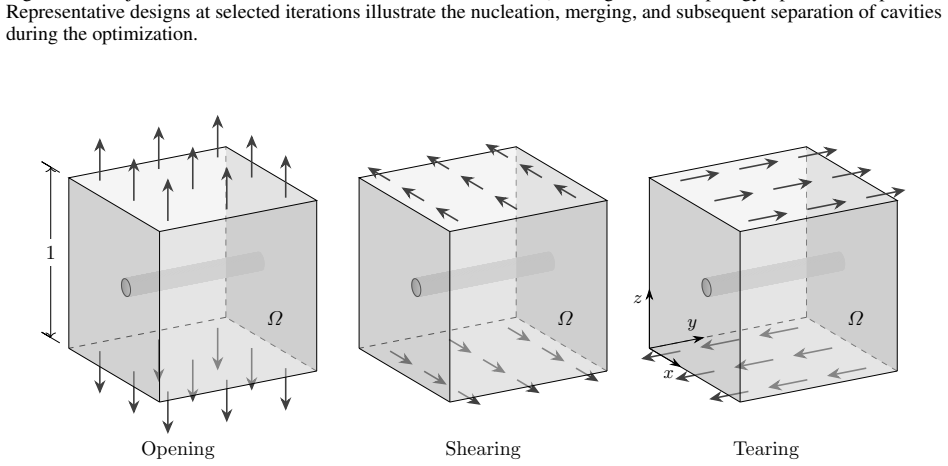
- Mode-I, II and III cavity problems yield distinct optimal void shapes (elongated, rotated/separated, wavy), showing the objective distinguishes fracture mechanisms.
- On the classical L-bracket the method automatically rounds the re-entrant corner and inserts interior voids while lowering peak boundary energy-release rate.
Reading between the lines
- If the asymptotic surrogate remains accurate under moderate mesh coarsening, the same pipeline could be embedded in real-time design loops for additively manufactured brittle parts.
- The dual-derivative idea may transfer to other local failure indicators (fatigue, corrosion) that admit topological expansions, not only brittle fracture.
- Persistent stress over-estimation in slender cut elements, noted by the authors, suggests that further enrichment or cut-element stabilization could tighten the gap between surrogate and true ERR.
Signed reviews
Editorial analysis
A structured set of objections, weighed in public.
Referee Report
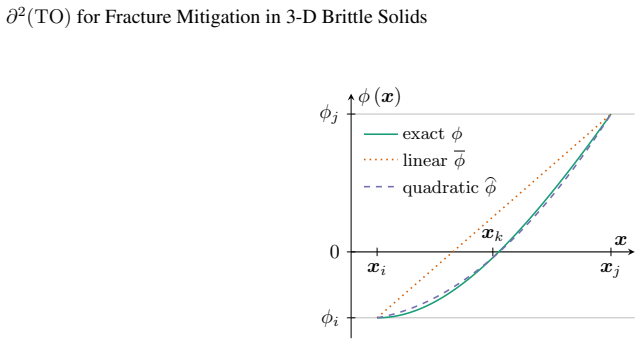
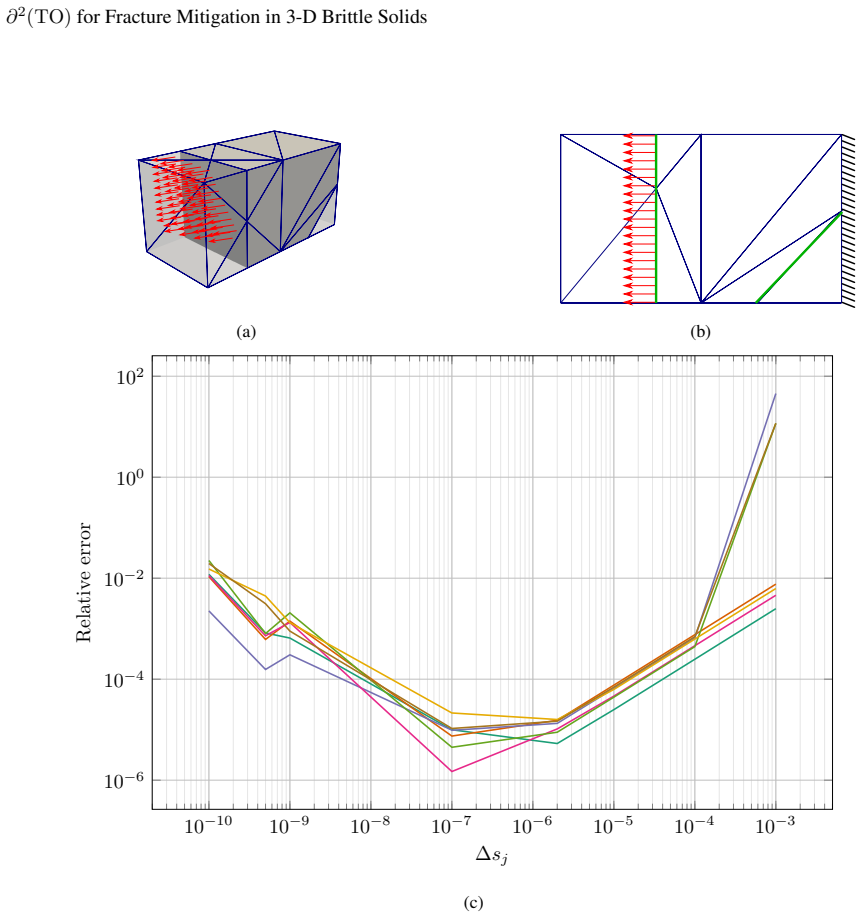
Summary. The manuscript presents a 3-D topology optimization framework for fracture mitigation in brittle solids. The design is described by an RBF-parameterized level set function (with a new quadratic interpolation of the zero contour and a PDE-free re-initialization), analyzed with the interface-enriched generalized finite element method (IGFEM) on fixed structured meshes. Topological derivatives are used twice: (i) a Garreau-type asymptotic expression drives hole nucleation, and (ii) the small-crack asymptotic formulas of Alidoost et al. (2020) are used to evaluate energy release rates (ERRs) for virtual half penny-shaped cracks at every enriched boundary node, from a single analysis of the uncracked geometry. Crack orientation follows a maximum-hoop-stress criterion; stresses entering the ERR evaluation are obtained via a 3-D SIP stress-recovery procedure; boundary ERRs are aggregated with a p-mean (p=8) objective; and full adjoint sensitivities are derived and verified against finite differences (App. H). Three examples are shown: a triaxially loaded cube (shape, then topology optimization), mode I/II/III cavity tailoring, and an immersed 3-D L-bracket.
Significance. If the surrogate ERR evaluation is trustworthy, this is a significant contribution: it is, to my knowledge, the first 3-D fracture-aware topology optimization that evaluates ERRs at all boundary sites from a single uncracked analysis, avoiding per-crack-configuration solves, and the first to combine this with topological-derivative hole nucleation (removing the pre-seeded-hole limitation of Zhang et al. 2022). The manuscript ships several concrete strengths: a complete, finite-difference-verified adjoint sensitivity derivation for a nontrivial chain (quadratic LSF intersection, surface normals, principal-direction rotation, SIP-recovered stresses), a demonstrated ablation showing that both quadratic LSF interpolation and re-initialization are needed for the sphere benchmark (Fig. 9), and examples whose qualitative behavior matches fracture-mechanics intuition (near-sphere under triaxial tension, 45° alignment under shear, re-entrant corner rounding). The examples are reproducible in principle from the stated parameters. The load-bearing question is whether the constant weight-function ERR surrogate remains accurate on the evolving, curved, slender geometries the optimizer produces
major comments (4)
- [§3.2, Eqs. (30)–(34); App. B] The central claim — that ERRs faithful enough to steer optimization are obtained from one uncracked analysis via K = H σ′ — rests on a weight-function matrix H calibrated once, on a single cuboidal specimen with a penny-shaped crack under three load cases (App. B, Fig. 15), and then applied pointwise at every enriched node in all examples. The small-crack asymptotics (Alidoost et al. 2020) require the crack to be small relative to both the local stress-gradient length scale and the local surface radius of curvature. Neither condition is checked anywhere in the paper, and both are most likely violated exactly where the objective is most sensitive: with p=8 the p-mean is dominated by the hottest sites, which are stress concentrations (steep stress gradients over the crack radius ε = 1% of characteristic size) and, mid-optimization, sharp transient features — the authors themselves report s
- [§3.2 and App. C, Eq. (34)/(59); App. F] Only configurations with K_I > 0 are retained in the ERR evaluation and aggregation (stated after Eq. (33) and again at the end of App. C). This truncation makes each G_i a nonsmooth function of the design variables at the surface K_I = 0: the objective in Eq. (29) is then only piecewise differentiable, and the adjoint derivation in App. F (Eqs. (79)–(80)) treats G_i as smooth everywhere. Since enriched nodes continually cross the K_I = 0 threshold as the boundary evolves, the authors should (a) state how the K_I > 0 filter is implemented in the sensitivity chain (subgradient, smooth clamp, or exclusion with a vanishing-contribution argument), and (b) confirm that the finite-difference verification in App. H exercises at least one design variable whose perturbation moves a node across the K_I = 0 boundary; as presented, Fig. 19 does not indicate whether this regime is covered.
- [§4.1, Fig. 8] The triaxial-cube example is described as verifying the formulation, but the check is qualitative: convergence to a near-sphere (r_x=0.443, r_y=0.435, r_z=0.429) and a uniform ERR distribution are compared against physical expectation, not against any independent fracture calculation. Since this is the paper's only 'verification' example for the ERR surrogate, and the exact solution for the optimal cavity under hydrostatic tension is known to be a sphere, the example verifies the optimization machinery but not the fracture quantities. A quantitative benchmark — e.g., comparing the surrogate G field on the optimized sphere against explicitly cracked analyses at several boundary sites — would substantially strengthen the paper and is the natural companion to the validation requested in the first comment.
- [§4.4, Fig. 14] The L-bracket is the paper's flagship demonstration on a 'complex engineering structure', yet the fracture interpretation is problematic as presented. The objective is lower in early iterations than at convergence, which the text attributes to the volume constraint only being satisfied after iteration 80 — i.e., the low early values occur at infeasible, bulkier designs. The headline comparison (initial vs. final ERR fields, bottom of Fig. 14) therefore compares designs at different volumes, and the claim of improved fracture resistance conflates material removal with corner rounding. The authors should report the peak/p-mean ERR trajectory restricted to feasible iterates, and ideally compare the final design against a volume-matched un-optimized L-bracket (sharp corner, same V_s) so that the fracture benefit of the optimization itself is isolated. In addition, the discretization has only
minor comments (9)
- [§3 (heading)] The section heading '3 Examples of citations, figures, tables, references' is a leftover template title and does not describe the content (topology description, problem formulation, stress recovery, sensitivities). Please rename.
- [§2.2, penultimate paragraph] Typo: 'Furthre details' → 'Further details'. Also 'a multi-point constraint system is setup' → 'is set up'.
- [§4.4] Typo: 'Wee see that the hole nucleation procedure...' → 'We see...'. Also 'This rounding continuous progressively' → 'continues'.
- [§3.5 and references] The citations 'osh [2004]' and 'Andrew [2000]' appear garbled: the former is presumably Osher & Fedkiw (the 2004 Appl. Mech. Rev. entry in the bibliography is a review of their book), and Andrew [2000] is a book review of Sethian's monograph. Please cite the primary sources.
- [Eq. (38)] The parenthesization in the first line of Eq. (38) is garbled ('∂(KU)/∂s_j − ) ) ∂F/∂s_j )'), apparently from a line-break artifact. Please reformat.
- [§3.2, Eq. (29)] The number of enriched nodes |ι_w| changes from iteration to iteration as the interface sweeps the mesh, so the p-mean normalization changes with the design. A sentence clarifying that this poses no issue for the per-iteration MMA treatment (and whether it contributes to the observed objective oscillations) would help the reader.
- [§4, parameters] The crack radius ε = 1% of characteristic size, the nucleation threshold ϕ < −4h, the 5-iteration nucleation cadence, and the per-example move limits and regularization schedules (§4.3) constitute a sizable heuristic set. The authors acknowledge this in §5, but a short sensitivity study on at least ε (does the ranking of candidate sites, not just the scale of G, depend on it?) would be valuable.
- [App. H, Fig. 19c] The caption reports 'close agreement' but gives no quantitative statement (e.g., minimum relative error achieved and the step size at which it occurs). Please state the best relative error and discuss the upturn/plateau at small Δs_j.
- [§4.2, Fig. 10] The reported improvement from shape to topology optimization (0.0358 → 0.0286) is at fixed volume constraint; please state explicitly whether the three-cavity final design and the single-cavity design are compared at the same V_s, since cavity nucleation transiently changes the solid volume.
Circularity Check
No significant circularity: fracture objective is a defined LEFM/TD surrogate minimized numerically; results are not forced by fit or self-definition.
full rationale
This is a methods/optimization paper. The objective Φ is the p-mean of boundary energy release rates G_i (Eq. 29), with each G obtained from recovered uncracked stresses via the 3-D topological-derivative ERR formulas for half penny-shaped cracks (Eqs. 30–34), orientation by maximum hoop stress, and KI>0 filtering. Minimizing that scalar under a volume constraint is ordinary gradient-based TO; the reported designs (near-spherical cavity, multi-cavity cube, mode I/II/III cavities, L-bracket) are numerical outcomes of that minimization, not quantities forced to equal a fitted target or redefined as their own inputs. Weight matrix H is computed once offline from cracked/uncracked FEA of a cuboidal specimen (Appendix B) and then held fixed—a modeling calibration, not a fit to the optimization examples that is later called a prediction. Dual use of topological derivatives (Garreau-type nucleation vs. Alidoost-type ERR) applies two distinct asymptotic formulas for two purposes; neither is defined in terms of the optimized designs. Self-citations (Zhang et al. 2022 2-D precursor, IGFEM/SIP prior work) supply tools being extended to 3-D dual-TD TO; they do not load-bear a uniqueness claim that forbids alternatives or smuggle an ansatz that is the result. Analytical sensitivities are cross-checked by finite differences (Appendix H). Validity concerns about constant-H asymptotics on curved/evolving boundaries are assumption/correctness issues, not circularity. Derivation chain is self-contained: define surrogate → differentiate → optimize → show Φ and peak G drop on benchmarks.
Assumptions & free parameters
free parameters (7)
- crack radius ε =
1% of domain size
- p-mean exponent p =
8
- void Young’s modulus Ev =
1e-6 (Es=1)
- hole nucleation threshold and frequency =
ϕ<-4h; every 5 iters
- RBF support radius and grid spacing =
support = 2× spacing
- MMA move limits and LSF regularization schedule =
example-dependent
- volume constraint continuation (L-bracket) =
0.7/0.6/0.5/0.4 at iters 0/40/60/80
assumptions (7)
- domain assumption Linear isotropic elastostatics with void as weak elastic phase; small-strain Hooke law.
- domain assumption LEFM energy release rate for small half penny-shaped surface cracks is accurately given by the 3-D topological derivative / weight-function relation of Alidoost et al. when ε is small.
- domain assumption Cracks nucleate perpendicular to the solid–void interface at enriched nodes; remaining orientation maximizes hoop stress (adapted Erdogan–Sih); only KI>0 configurations enter the objective.
- ad hoc to paper p-mean of nodal boundary ERRs is a suitable differentiable surrogate for minimizing fracture risk over the free surface under a volume constraint.
- domain assumption Garreau et al. 3-D Neumann topological derivative plus ϕ<-4h admissibility adequately decides beneficial finite hole nucleation sites during optimization.
- domain assumption SIP non-local quadratic stress recovery on element patches yields stresses accurate enough for sensitive ERR estimates in cut enriched elements.
- domain assumption Compactly supported Wendland RBF level-set with box constraints on coefficients and occasional geometric re-distance preserves a valid optimizable geometry.
invented entities (1)
-
∂²(TO) dual topological-derivative enriched TO framework
Cite this review
Pith. "Pith review of $\partial^2 ( \mathrm{TO} ) $: A Dual Topological Derivative-Based Enriched Topology Optimization for Fracture Mitigation in 3-D Brittle Solids." pith.science (2026). https://pith.science/paper/HQKK6LSL
@misc{pith2026260723525,
  author       = {Pith},
  title        = {Pith review of: $\partial^2 ( \mathrmTO ) $: A Dual Topological Derivative-Based Enriched Topology Optimization for Fracture Mitigation in 3-D Brittle Solids},
  year         = {2026},
  howpublished = {\url{https://pith.science/paper/HQKK6LSL}},
  note         = {Machine review of arXiv:2607.23525}
}
abstract
We propose a fracture-mitigation topology optimization framework for 3-D brittle solids. The topology is described by a level set function parameterized by radial basis functions, and the structural response is computed using an interface-enriched finite element formulation. Dual topological derivatives serve two purposes. First, they are used to nucleate holes within the solid during the optimization process. Second, they are used to evaluate energy release rates (ERRs) along the entire boundary, requiring only the stress field from a single enriched finite element analysis of the uncracked geometry. For this purpose, penny-shaped cracks are assumed to nucleate using the maximum hoop stress criterion, at the locations of enriched nodes introduced along the boundary for accurate finite element analysis. Because ERR estimates depend sensitively on stress accuracy, we compute a nodal stress field using a non-local stress-recovery procedure. The topology optimization objective aggregates the boundary ERRs using a $p$-mean function. Three-dimensional numerical examples, including the commonly studied L-bracket benchmark problem, demonstrate the capability of the proposed framework.
Figures


Figures from the paper (16 more)




Reference graph
Works this paper leans on
-
[1]
Computer Methods in Applied Mechanics and Engineering , title =
Keller, Daniel and. Computer Methods in Applied Mechanics and Engineering , title =
-
[2]
An interface-enriched generalized FEM for problems with discontinuous gradient fields , url =
Soghrati, Soheil and Arag. An interface-enriched generalized FEM for problems with discontinuous gradient fields , url =. International Journal for Numerical Methods in Engineering , keywords =. 2012 , bdsk-url-1 =. doi:https://doi.org/10.1002/nme.3273 , eprint =
-
[3]
James and Haim Waisman , date-added =
Kai A. James and Haim Waisman , date-added =. Failure mitigation in optimal topology design using a coupled nonlinear continuum damage model , url =. Computer Methods in Applied Mechanics and Engineering , keywords =. 2014 , bdsk-url-1 =. doi:https://doi.org/10.1016/j.cma.2013.10.022 , issn =
-
[4]
Kujawski, D. , booktitle =. Estimations of Stress Intensity Factors for Small Cracks at Notches , ty =. Fatigue & Fracture of Engineering Materials & Structures , journal1 =. 1991 , year1 =. doi:https://doi.org/10.1111/j.1460-2695.1991.tb00005.x , isbn =
arXiv 1991
-
[5]
Das, R. and Jones, R. and Xie, Y. M. , da =. Design of structures for optimal static strength using ESO , ty =. Engineering Failure Analysis , keywords =. 2005 , bdsk-url-1 =. doi:https://doi.org/10.1016/j.engfailanal.2004.05.002 , isbn =
-
[6]
Jones, R. and Atluri, S. N. and Pitt, S. and Williams, J. F. , da =. Developments in the analysis of interacting cracks , ty =. Engineering Failure Analysis , number =. 1995 , bdsk-url-1 =. doi:https://doi.org/10.1016/1350-6307(95)00021-5 , isbn =
-
[7]
Structural optimisation with fracture strength constraints , ty =
Jones, R and Chaperon, P and Heller, M , da =. Structural optimisation with fracture strength constraints , ty =. Engineering Fracture Mechanics , keywords =. 2002 , bdsk-url-1 =. doi:https://doi.org/10.1016/S0013-7944(02)00006-1 , isbn =
-
[8]
van den Boom, S. J. and Zhang, J. and van Keulen, F. and Arag. An interface-enriched generalized finite element method for level set-based topology optimization , url =. Structural and Multidisciplinary Optimization , number =. 2021 , bdsk-url-1 =. doi:10.1007/s00158-020-02682-5 , id =
Show all 173 references
-
[9]
Topology optimization using PETSc: An easy-to-use, fully parallel, open source topology optimization framework , volume =
Aage, Niels and Andreassen, Erik and Lazarov, Boyan Stefanov , journal =. Topology optimization using PETSc: An easy-to-use, fully parallel, open source topology optimization framework , volume =
-
[10]
Giga-voxel computational morphogenesis for structural design , volume =
Aage, Niels and Andreassen, Erik and Lazarov, Boyan S and Sigmund, Ole , journal =. Giga-voxel computational morphogenesis for structural design , volume =
-
[11]
Review of corrosion fatigue in offshore structures: Present status and challenges in the offshore wind sector , volume =
Adedipe, Oyewole and Brennan, Feargal and Kolios, Athanasios , journal =. Review of corrosion fatigue in offshore structures: Present status and challenges in the offshore wind sector , volume =
-
[12]
Topology optimization of pressure dependent elastoplastic energy absorbing structures with material damage constraints , volume =
Alberdi, Ryan and Khandelwal, Kapil , journal =. Topology optimization of pressure dependent elastoplastic energy absorbing structures with material damage constraints , volume =
-
[13]
Energy Release Rate Approximation for Small Surface Cracks in Three-Dimensional Domains Using the Topological Derivative , volume =
Alidoost, Kazem and Feng, Meng and Geubelle, Philippe H and Tortorelli, Daniel A , journal =. Energy Release Rate Approximation for Small Surface Cracks in Three-Dimensional Domains Using the Topological Derivative , volume =
-
[14]
Fracture-based shape optimization built upon the topological derivative , volume =
Alidoost, Kazem and Fernandez, Felipe and Geubelle, Philippe H and Tortorelli, Daniel A , journal =. Fracture-based shape optimization built upon the topological derivative , volume =
-
[15]
A level-set method for shape optimization , volume =
Allaire, Gr. A level-set method for shape optimization , volume =. Comptes Rendus Mathematique , number =
-
[16]
Level set methods and dynamic implicit surfaces , volume =. Appl. Mech. Rev. , number =
-
[17]
A structural optimization method based on the level set method using a new geometry-based re-initialization scheme , volume =
Yamasaki, Shintaro and Nishiwaki, Shinji and Yamada, Takayuki and Izui, Kazuhiro and Yoshimura, Masataka , journal =. A structural optimization method based on the level set method using a new geometry-based re-initialization scheme , volume =
-
[18]
Andrew, Alex M , journal =. LEVEL SET METHODS AND FAST MARCHING METHODS: EVOLVING INTERFACES IN COMPUTATIONAL GEOMETRY, FLUID MECHANICS, COMPUTER VISION, AND MATERIALS SCIENCE, by JA Sethian, Cambridge University Press, Cambridge, UK, 2nd edn. 1999 (first published 1996 as Lev...
1999
-
[19]
Structural optimization using sensitivity analysis and a level-set method , volume =
Allaire, Gr. Structural optimization using sensitivity analysis and a level-set method , volume =. Journal of computational physics , number =
-
[20]
Level-set methods for structural topology optimization: a review , volume =
Van Dijk, Nico P and Maute, Kurt and Langelaar, Matthijs and Van Keulen, Fred , journal =. Level-set methods for structural topology optimization: a review , volume =
-
[21]
OptiStruct User's Manual 2021 , year =
Altair , publisher =. OptiStruct User's Manual 2021 , year =
2021
-
[22]
Topological optimization of structures subject to von Mises stress constraints , volume =
Amstutz, Samuel and Novotny, Antonio A , journal =. Topological optimization of structures subject to von Mises stress constraints , volume =
-
[23]
Topological derivative-based topology optimization of structures subject to Drucker--Prager stress constraints , volume =
Amstutz, Samuel and Novotny, AA and de Souza Neto, EA , journal =. Topological derivative-based topology optimization of structures subject to Drucker--Prager stress constraints , volume =
-
[24]
Reinforcement layout design for concrete structures based on continuum damage and truss topology optimization , volume =
Amir, Oded and Sigmund, Ole , journal =. Reinforcement layout design for concrete structures based on continuum damage and truss topology optimization , volume =
-
[25]
A topology optimization procedure for reinforced concrete structures , volume =
Amir, Oded , journal =. A topology optimization procedure for reinforced concrete structures , volume =
-
[26]
The topological asymptotic for PDE systems: the elasticity case , volume =
Garreau, St. The topological asymptotic for PDE systems: the elasticity case , volume =. SIAM journal on control and optimization , number =
-
[27]
ANSYS Mechanical APDL Fracture Analysis Guide 2021 R2 , year =
ANSYS , publisher =. ANSYS Mechanical APDL Fracture Analysis Guide 2021 R2 , year =
2021
-
[28]
Fracture mechanics: fundamentals and applications , year =
Anderson, Ted L , publisher =. Fracture mechanics: fundamentals and applications , year =
-
[29]
On the stability and interpolating properties of the hierarchical interface-enriched finite element method , volume =
Arag. On the stability and interpolating properties of the hierarchical interface-enriched finite element method , volume =. Computer Methods in Applied Mechanics and Engineering , pages =
-
[30]
Fundamentals of enriched finite element methods , year =
Arag. Fundamentals of enriched finite element methods , year =
-
[31]
Closing the gap towards super-long suspension bridges using computational morphogenesis , volume =
Baandrup, Mads and Sigmund, Ole and Polk, Henrik and Aage, Niels , journal =. Closing the gap towards super-long suspension bridges using computational morphogenesis , volume =
-
[32]
PETSc users manual , year =
Balay, Satish and Abhyankar, Shrirang and Adams, Mark and Brown, Jed and Brune, Peter and Buschelman, Kris and Dalcin, Lisandro and Dener, Alp and Eijkhout, Victor and Gropp, W and others , publisher =. PETSc users manual , year =
-
[33]
Multi-material topology optimization design for continuum structures with crack patterns , volume =
Banh, Thanh T and Lee, Dongkyu , journal =. Multi-material topology optimization design for continuum structures with crack patterns , volume =
-
[34]
Stress intensity factors for an inclined edge crack in a semiplane , volume =
Beghini, Marco and Bertini, Leonardo and Fontanari, V , journal =. Stress intensity factors for an inclined edge crack in a semiplane , volume =
-
[35]
Corrosion challenges towards a sustainable society , year =
Bender, Roman and F. Corrosion challenges towards a sustainable society , year =. Materials and Corrosion , publisher =
-
[36]
Generating optimal topologies in structural design using a homogenization method , volume =
Bends. Generating optimal topologies in structural design using a homogenization method , volume =. Computer methods in applied mechanics and engineering , number =
-
[37]
A method for treating damage related criteria in optimal topology design of continuum structures , volume =
Bends. A method for treating damage related criteria in optimal topology design of continuum structures , volume =. Structural optimization , number =
-
[38]
Optimal shape design as a material distribution problem , volume =
Bends. Optimal shape design as a material distribution problem , volume =. Structural optimization , number =
-
[39]
Topology optimization: theory, methods, and applications , year =
Bendsoe, Martin Philip and Sigmund, Ole , publisher =. Topology optimization: theory, methods, and applications , year =
-
[40]
Derivative recovery and a posteriori error estimate for extended finite elements , volume =
Bordas, St. Derivative recovery and a posteriori error estimate for extended finite elements , volume =. Computer Methods in Applied Mechanics and Engineering , number =
-
[41]
Design-dependent loads in topology optimization , volume =
Bourdin, Blaise and Chambolle, Antonin , journal =. Design-dependent loads in topology optimization , volume =
-
[42]
Elementary engineering fracture mechanics , year =
Broek, David , publisher =. Elementary engineering fracture mechanics , year =
-
[43]
Topology optimization for minimum weight with compliance and stress constraints , volume =
Bruggi, Matteo and Duysinx, Pierre , journal =. Topology optimization for minimum weight with compliance and stress constraints , volume =
-
[44]
A stress--based approach to the optimal design of structures with unilateral behavior of material or supports , volume =
Bruggi, Matteo and Duysinx, Pierre , journal =. A stress--based approach to the optimal design of structures with unilateral behavior of material or supports , volume =
-
[45]
Fracture resistance via topology optimization , volume =
Challis, Vivien J and Roberts, Anthony P and Wilkins, Andrew H , journal =. Fracture resistance via topology optimization , volume =
-
[46]
Variational Methods in Elasticity and Plasticity
Chan, ASL , journal =. Variational Methods in Elasticity and Plasticity. K. Washizu. Pergamon, Oxford, 1968. 350 pp. Illustrated. 120s. , volume =
1968
-
[47]
Fatigue-resistance topology optimization of continuum structure by penalizing the cumulative fatigue damage , volume =
Chen, Zhuo and Long, Kai and Wen, Pin and Nouman, Saeed , journal =. Fatigue-resistance topology optimization of continuum structure by penalizing the cumulative fatigue damage , volume =
-
[48]
Controlling the maximum first principal stress in topology optimization , volume =
Chen, Anbang and Cai, Kun and Zhao, Zi-Long and Zhou, Yiyi and Xia, Liang and Xie, Yi Min , journal =. Controlling the maximum first principal stress in topology optimization , volume =
-
[49]
FEM-DBEM approach to analyse crack scenarios in a baffle cooling pipe undergoing heat flux from the plasma , volume =
Citarella, R and Giannella, V and Lepore, MA and Fellinger, J , journal =. FEM-DBEM approach to analyse crack scenarios in a baffle cooling pipe undergoing heat flux from the plasma , volume =
-
[50]
Topology optimization of particle-matrix composites for optimal fracture resistance taking into account interfacial damage , volume =
Da, Daicong and Yvonnet, Julien and Xia, Liang and Li, Guangyao , journal =. Topology optimization of particle-matrix composites for optimal fracture resistance taking into account interfacial damage , volume =
-
[51]
Topology optimization for maximizing the fracture resistance of periodic quasi-brittle composites structures , volume =
Da, Daicong and Yvonnet, Julien , journal =. Topology optimization for maximizing the fracture resistance of periodic quasi-brittle composites structures , volume =
-
[52]
Local versus global stress constraint strategies in topology optimization: A comparative study , year =
da Silva, Gustavo Assis and Aage, Niels and Beck, Andr. Local versus global stress constraint strategies in topology optimization: A comparative study , year =. International Journal for Numerical Methods in Engineering , publisher =
-
[53]
Structural topology optimization with predetermined breaking points , volume =
da Silva, Gustavo Assis and Beck, Andr. Structural topology optimization with predetermined breaking points , volume =. Computer Methods in Applied Mechanics and Engineering , pages =
-
[54]
Fatigue resistance of welded joints in aluminium high-speed craft: a total stress concept , year =
Den Besten, J H , journal =. Fatigue resistance of welded joints in aluminium high-speed craft: a total stress concept , year =
-
[55]
Fatigue resistance of welded joints in aluminium high-speed craft: a total stress concept , year =
den Besten, J H , publisher =. Fatigue resistance of welded joints in aluminium high-speed craft: a total stress concept , year =
-
[56]
An efficient 146-line 3D sensitivity analysis code of stress-based topology optimization written in MATLAB , year =
Deng, Hao and Vulimiri, Praveen S and To, Albert C , journal =. An efficient 146-line 3D sensitivity analysis code of stress-based topology optimization written in MATLAB , year =
-
[57]
Topology optimization of structures undergoing brittle fracture , volume =
Desai, Jeet and Allaire, Gr. Topology optimization of structures undergoing brittle fracture , volume =. Journal of Computational Physics , pages =
-
[58]
Structural optimization using topological and shape sensitivity via a level set method , volume =
Allaire, Gr. Structural optimization using topological and shape sensitivity via a level set method , volume =. Control and cybernetics , number =
-
[59]
PZ: An object oriented environment for scientific programming , volume =
Devloo, Philippe Remy Bernard , journal =. PZ: An object oriented environment for scientific programming , volume =
-
[60]
Applications of the Green function for a half circular crack , volume =
Dhondt, Guido , journal =. Applications of the Green function for a half circular crack , volume =
-
[61]
Optimal material layout for 3D elastic structures , volume =
Diaz, A and Lipton, R , journal =. Optimal material layout for 3D elastic structures , volume =
-
[62]
New developments in handling stress constraints in optimal material distribution , year =
Duysinx, Pierre and Sigmund, Ole , booktitle =. New developments in handling stress constraints in optimal material distribution , year =
-
[63]
Topology optimization of continuum structures with local stress constraints , volume =
Duysinx, Pierre and Bends. Topology optimization of continuum structures with local stress constraints , volume =. International journal for numerical methods in engineering , number =
-
[64]
Topology and generalized shape optimization: Why stress constraints are so important? , volume =
Duysinx, Pierre and Van Miegroet, Laurent and Lemaire, Etienne and Br. Topology and generalized shape optimization: Why stress constraints are so important? , volume =. International Journal for Simulation and Multidisciplinary Design Optimization , number =
-
[65]
Learning from failure: development and discussion of a database of structural failures , year =
Epp, Peter Yvon , school =. Learning from failure: development and discussion of a database of structural failures , year =
-
[66]
Erdogan, Fazil and Sih, GC , title =
-
[67]
Evolutionary topology optimization of continuum structures with stress constraints , volume =
Fan, Zhao and Xia, Liang and Lai, Wuxing and Xia, Qi and Shi, Tielin , journal =. Evolutionary topology optimization of continuum structures with stress constraints , volume =
-
[68]
Bolted joint behavior of hybrid composites , year =
Feng, Ng Lin and Malingam, Sivakumar Dhar and Irulappasamy, Siva , booktitle =. Bolted joint behavior of hybrid composites , year =
-
[69]
Revisiting brittle fracture as an energy minimization problem , volume =
Francfort, Gilles A and Marigo, J-J , journal =. Revisiting brittle fracture as an energy minimization problem , volume =
-
[70]
Three-dimensional stress-based topology optimization using SIMP method , volume =
Gebremedhen, Hailu Shimels and Woldemicahel, Dereje Engida and Hashim, Fakheruldin M , journal =. Three-dimensional stress-based topology optimization using SIMP method , volume =
-
[71]
Giraldo-Londo. A unified approach for topology optimization with local stress constraints considering various failure criteria: von Mises, Drucker--Prager, Tresca, Mohr--Coulomb, Bresler--Pister and Willam--Warnke , volume =. Proceedings of the Royal Society A , number =
-
[72]
Local stress constraints in topology optimization of structures subjected to arbitrary dynamic loads: a stress aggregation-free approach , year =
Giraldo-Londo. Local stress constraints in topology optimization of structures subjected to arbitrary dynamic loads: a stress aggregation-free approach , year =. Structural and Multidisciplinary Optimization , pages =
-
[73]
Griffith, Alan Arnold , journal =. VI. The phenomena of rupture and flow in solids , volume =
-
[74]
Optimization of composite fracture properties: method, validation, and applications , volume =
Gu, Grace X and Dimas, Leon and Qin, Zhao and Buehler, Markus J , journal =. Optimization of composite fracture properties: method, validation, and applications , volume =
-
[75]
Gu, Grace X and Wettermark, Susan and Buehler, Markus J , journal =
-
[76]
Doing topology optimization explicitly and geometrically---a new moving morphable components based framework , volume =
Guo, Xu and Zhang, Weisheng and Zhong, Wenliang , journal =. Doing topology optimization explicitly and geometrically---a new moving morphable components based framework , volume =
-
[77]
Multi-material topology optimization of structures with discontinuities using Peridynamics , volume =
Habibian, Anahita and Sohouli, Abdolrasoul and Kefal, Adnan and Nadler, Ben and Yildiz, Mehmet and Suleman, Afzal , journal =. Multi-material topology optimization of structures with discontinuities using Peridynamics , volume =
-
[78]
Stress intensity factor analysis of elliptical corner cracks in mechanical joints by weight function method , volume =
Heo, Sung Pil and Yang, Won Ho , journal =. Stress intensity factor analysis of elliptical corner cracks in mechanical joints by weight function method , volume =
-
[79]
Stress constrained topology optimization , volume =
Holmberg, Erik and Torstenfelt, Bo and Klarbring, Anders , journal =. Stress constrained topology optimization , volume =
-
[80]
Fracture strength topology optimization of structural specific position using a bi-directional evolutionary structural optimization method , volume =
Hu, Jie and Yao, Song and Gan, Ning and Xiong, Yulin and Chen, Xing , journal =. Fracture strength topology optimization of structural specific position using a bi-directional evolutionary structural optimization method , volume =
-
[81]
Fracture of brittle and quasi-brittle materials in compression: A review of the current state of knowledge and a different approach , volume =
Iskander, Mina and Shrive, Nigel , journal =. Fracture of brittle and quasi-brittle materials in compression: A review of the current state of knowledge and a different approach , volume =
-
[82]
Topology optimization of structures under variable loading using a damage superposition approach , volume =
James, Kai A and Waisman, Haim , journal =. Topology optimization of structures under variable loading using a damage superposition approach , volume =
-
[83]
Topology optimization considering static failure theories for ductile and brittle materials , volume =
Jeong, Seung Hyun and Park, Seon Ho and Choi, Dong-Hoon and Yoon, Gil Ho , journal =. Topology optimization considering static failure theories for ductile and brittle materials , volume =
-
[84]
Toward a stress-based topology optimization procedure with indirect calculation of internal finite element information , volume =
Jeong, Seung Hyun and Park, Seon Ho and Choi, Dong-Hoon and Yoon, Gil Ho , journal =. Toward a stress-based topology optimization procedure with indirect calculation of internal finite element information , volume =
-
[85]
Approximate stress intensity factors for a semi-circular crack in an arbitrary structure under arbitrary mode I loading , volume =
Kaklar, Javad Alizadeh and Googarchin, Hamed Saeidi , journal =. Approximate stress intensity factors for a semi-circular crack in an arbitrary structure under arbitrary mode I loading , volume =
-
[86]
Topology optimization considering fracture mechanics behaviors at specified locations , volume =
Kang, Zhan and Pai, Liu and Li, Ming , journal =. Topology optimization considering fracture mechanics behaviors at specified locations , volume =
-
[87]
Journal of the Mechanics and Physics of Solids , pages=
Designing 2D cellular materials for brittle fracture initiation resistance via topology optimization , author=. Journal of the Mechanics and Physics of Solids , pages=. 2026 , publisher=
2026
-
[88]
Topology optimization of cracked structures using peridynamics , volume =
Kefal, Adnan and Sohouli, Abdolrasoul and Oterkus, Erkan and Yildiz, Mehmet and Suleman, Afzal , journal =. Topology optimization of cracked structures using peridynamics , volume =
-
[89]
Minimizing crack energy release rate by topology optimization , volume =
Klarbring, Anders and Torstenfelt, Bo and Edlund, Ulf and Schmidt, Peter and Simonsson, Kjell and Ansell, H , journal =. Minimizing crack energy release rate by topology optimization , volume =
-
[90]
Computer Methods in Applied Mechanics and Engineering , volume=
A topology optimization method based on the level set method incorporating a fictitious interface energy , author=. Computer Methods in Applied Mechanics and Engineering , volume=. 2010 , publisher=
2010
-
[91]
Systematic control design by optimizing a vector performance index , year =
Kreisselmeier, G and Steinhauser, R , booktitle =. Systematic control design by optimizing a vector performance index , year =
-
[92]
Thermally induced stress intensity factor of a semi-circular surface crack in a half-space , volume =
Kuo, An-Yu and Tang, SS and Yu, TP , journal =. Thermally induced stress intensity factor of a semi-circular surface crack in a half-space , volume =
-
[93]
Comparative Study of Peridynamics and Finite Element Method for Practical Modeling of Cracks in Topology Optimization , volume =
Lahe Motlagh, Peyman and Kefal, Adnan , journal =. Comparative Study of Peridynamics and Finite Element Method for Practical Modeling of Cracks in Topology Optimization , volume =
-
[94]
A two-dimensional ordinary, state-based peridynamic model for linearly elastic solids , volume =
Le, QV and Chan, WanKan and Schwartz, Justin , journal =. A two-dimensional ordinary, state-based peridynamic model for linearly elastic solids , volume =
-
[95]
Part-circular surface cracks in round bars under tension, bending and twisting , volume =
Levan, Anh and Royer, Jean , journal =. Part-circular surface cracks in round bars under tension, bending and twisting , volume =
-
[96]
Topology optimization of energy absorbing structures with maximum damage constraint , volume =
Li, Lei and Zhang, Guodong and Khandelwal, Kapil , journal =. Topology optimization of energy absorbing structures with maximum damage constraint , volume =
-
[97]
Failure resistant topology optimization of structures using nonlocal elastoplastic-damage model , volume =
Li, Lei and Zhang, Guodong and Khandelwal, Kapil , journal =. Failure resistant topology optimization of structures using nonlocal elastoplastic-damage model , volume =
-
[98]
A SIMP-Phase field topology optimization framework to maximize quasi-brittle fracture resistance of 2D and 3D composites , volume =
Li, Pengfei and Wu, Yi and Yvonnet, Julien , journal =. A SIMP-Phase field topology optimization framework to maximize quasi-brittle fracture resistance of 2D and 3D composites , volume =
-
[99]
Efficient and accurate stress recovery procedure and a posteriori error estimator for the stable generalized/extended finite element method , volume =
Lins, Rafael and Proen. Efficient and accurate stress recovery procedure and a posteriori error estimator for the stable generalized/extended finite element method , volume =. International Journal for Numerical Methods in Engineering , number =
-
[100]
Eighty years of the finite element method: Birth, evolution, and future , volume =
Liu, Wing Kam and Li, Shaofan and Park, Harold S , journal =. Eighty years of the finite element method: Birth, evolution, and future , volume =
-
[101]
Topology optimization of continuum structures with Drucker--Prager yield stress constraints , volume =
Luo, Yangjun and Kang, Zhan , journal =. Topology optimization of continuum structures with Drucker--Prager yield stress constraints , volume =
-
[102]
Matrix differential calculus with applications in statistics and econometrics , year =
Magnus, Jan R and Neudecker, Heinz , publisher =. Matrix differential calculus with applications in statistics and econometrics , year =
-
[103]
A displacement correlation method for stress intensity factor extraction from 3D fractures in anisotropic materials , volume =
Mazurowski, B and O'Hara, P and Gupta, P and Duarte, CA , journal =. A displacement correlation method for stress intensity factor extraction from 3D fractures in anisotropic materials , volume =
-
[104]
A phase field model for rate-independent crack propagation: Robust algorithmic implementation based on operator splits , volume =
Miehe, Christian and Hofacker, Martina and Welschinger, Fabian , journal =. A phase field model for rate-independent crack propagation: Robust algorithmic implementation based on operator splits , volume =
-
[105]
Some aspects of the genesis of structures , volume =
Mlejnek, HP , journal =. Some aspects of the genesis of structures , volume =
-
[106]
Fractography with the SEM (failure analysis) , volume =
Moeser, Martin , journal =. Fractography with the SEM (failure analysis) , volume =
-
[107]
Stress intensity factor analyses of three-dimensional interface cracks using tetrahedral finite elements , volume =
Nagai, Masaki and Ikeda, Toru and Miyazaki, Noriyuki , journal =. Stress intensity factor analyses of three-dimensional interface cracks using tetrahedral finite elements , volume =
-
[108]
Antisymmetrical 3-D stress field near the crack front of a thin elastic plate , volume =
Nakamura, T and Parks, DM , journal =. Antisymmetrical 3-D stress field near the crack front of a thin elastic plate , volume =
-
[109]
Corrosion in marine and offshore steel structures: Classification and overview , volume =
Nassar, Nour Eldeen Abo , journal =. Corrosion in marine and offshore steel structures: Classification and overview , volume =
-
[110]
An empirical stress-intensity factor equation for the surface crack , volume =
Newman Jr, JC and Raju, IS , journal =. An empirical stress-intensity factor equation for the surface crack , volume =
-
[111]
Variational approach to relaxed topological optimization: Closed form solutions for structural problems in a sequential pseudo-time framework , volume =
Oliver, Javier and Yago, D and Cante, Juan and Lloberas-Valls, Oriol , journal =. Variational approach to relaxed topological optimization: Closed form solutions for structural problems in a sequential pseudo-time framework , volume =
-
[112]
Fronts propagating with curvature-dependent speed: Algorithms based on Hamilton-Jacobi formulations , volume =
Osher, Stanley and Sethian, James A , journal =. Fronts propagating with curvature-dependent speed: Algorithms based on Hamilton-Jacobi formulations , volume =
-
[113]
Parallel computing in topology optimization of structures with stress constraints , volume =
Paris, J and Colominas, I and Navarrina, F and Casteleiro, M , journal =. Parallel computing in topology optimization of structures with stress constraints , volume =
-
[114]
A stress improvement procedure , volume =
Payen, Daniel Jose and Bathe, Klaus-J. A stress improvement procedure , volume =. Computers & structures , pages =
-
[115]
Crack paths , year =
Pook, Les P , publisher =. Crack paths , year =
-
[116]
State-of-the-art review on extended stress intensity factor concepts , volume =
Radaj, D , journal =. State-of-the-art review on extended stress intensity factor concepts , volume =
-
[117]
Empirical solutions for stress intensity factors of a surface crack in a solid cylinder under pure torsion , volume =
Ramezani, MK and Purbolaksono, Judha and Andriyana, Andri and Ramesh, Singh and Putra, Ichsan Setya , journal =. Empirical solutions for stress intensity factors of a surface crack in a solid cylinder under pure torsion , volume =
-
[118]
A path independent integral and the approximate analysis of strain concentration by notches and cracks , volume =
Rice, James R , journal =. A path independent integral and the approximate analysis of strain concentration by notches and cracks , volume =
-
[119]
Dask: Parallel computation with blocked algorithms and task scheduling , volume =
Rocklin, Matthew , booktitle =. Dask: Parallel computation with blocked algorithms and task scheduling , volume =
-
[120]
Fracture and fatigue control in structures: Applications of fracture mechanics , year =
Rolfe, Stanley Theodore and Barsom, John M , publisher =. Fracture and fatigue control in structures: Applications of fracture mechanics , year =
-
[121]
Topology optimization for brittle fracture resistance , volume =
Russ, Jonathan B and Waisman, Haim , journal =. Topology optimization for brittle fracture resistance , volume =
-
[122]
A novel topology optimization formulation for enhancing fracture resistance with a single quasi-brittle material , volume =
Russ, Jonathan B and Waisman, Haim , journal =. A novel topology optimization formulation for enhancing fracture resistance with a single quasi-brittle material , volume =
-
[123]
Optimization of carbon black polymer composite microstructure for rupture resistance , volume =
San, Bingbing and Waisman, Haim , journal =. Optimization of carbon black polymer composite microstructure for rupture resistance , volume =
-
[124]
Adams and Jed Brown and Peter Brune and Kris Buschelman and Lisandro Dalcin and Alp Dener and Victor Eijkhout and William D
Satish Balay and Shrirang Abhyankar and Mark F. Adams and Jed Brown and Peter Brune and Kris Buschelman and Lisandro Dalcin and Alp Dener and Victor Eijkhout and William D. Gropp and Dinesh Kaushik and Matthew G. Knepley and Dave A. May and Lois Curfman McInnes and Richard Tra...
-
[125]
Fatigue of structures and materials , year =
Schijve, Jaap , publisher =. Fatigue of structures and materials , year =
-
[126]
Recent developments in the commercial implementation of topology optimization , year =
Schramm, Uwe and Zhou, Ming , booktitle =. Recent developments in the commercial implementation of topology optimization , year =
-
[127]
Topology optimization with local stress constraints: a stress aggregation-free approach , volume =
Senhora, Fernando V and Giraldo-Londono, Oliver and Menezes, Ivan FM and Paulino, Glaucio H , journal =. Topology optimization with local stress constraints: a stress aggregation-free approach , volume =
-
[128]
Level set methods and fast marching methods: evolving interfaces in computational geometry, fluid mechanics, computer vision, and materials science , volume =
Sethian, James Albert , publisher =. Level set methods and fast marching methods: evolving interfaces in computational geometry, fluid mechanics, computer vision, and materials science , volume =
-
[129]
Structural boundary design via level set and immersed interface methods , volume =
Sethian, James A and Wiegmann, Andreas , journal =. Structural boundary design via level set and immersed interface methods , volume =
-
[130]
An improved stress recovery technique for low-order 3D finite elements , volume =
Sharma, Rahul and Zhang, Jian and Langelaar, Matthijs and van Keulen, Fred and Arag. An improved stress recovery technique for low-order 3D finite elements , volume =. International Journal for Numerical Methods in Engineering , number =
-
[131]
Fine surface finish of a hardened stainless steel using a new burnishing tool , volume =
Shiou, Fang-Jung and Huang, Shih-Ju and Shih, Albert J and Zhu, Jiang and Yoshino, Masahiko , journal =. Fine surface finish of a hardened stainless steel using a new burnishing tool , volume =
-
[132]
The topology optimization design for cracked structures , volume =
Shobeiri, Vahid , journal =. The topology optimization design for cracked structures , volume =
-
[133]
Topology optimization approaches , volume =
Sigmund, Ole and Maute, Kurt , journal =. Topology optimization approaches , volume =
-
[134]
EML webinar overview: Topology Optimization---Status and Perspectives , volume =
Sigmund, Ole , journal =. EML webinar overview: Topology Optimization---Status and Perspectives , volume =
-
[135]
Energy release rate approximation for small surface-breaking cracks using the topological derivative , volume =
Silva, Mariana and Geubelle, Philippe H and Tortorelli, Daniel A , journal =. Energy release rate approximation for small surface-breaking cracks using the topological derivative , volume =
-
[136]
Stress intensity factors for semicircular cracks: Part 2---Semi-infinite solid , volume =
Smith, FW and Emery, AF and Kobayashi, AS , journal =. Stress intensity factors for semicircular cracks: Part 2---Semi-infinite solid , volume =
-
[137]
Relationship between manufacturing defects and fatigue properties of additive manufactured austenitic stainless steel , volume =
Smith, Thale R and Sugar, Joshua D and Schoenung, Julie M and San Marchi, Chris , journal =. Relationship between manufacturing defects and fatigue properties of additive manufactured austenitic stainless steel , volume =
-
[138]
A 3D interface-enriched generalized finite element method for weakly discontinuous problems with complex internal geometries , volume =
Soghrati, Soheil and Geubelle, Philippe H , journal =. A 3D interface-enriched generalized finite element method for weakly discontinuous problems with complex internal geometries , volume =
-
[139]
Continuous density-based topology optimization of cracked structures using peridynamics , volume =
Sohouli, A and Kefal, Adnan and Abdelhamid, Ahmed and Yildiz, M and Suleman, Afzal , journal =. Continuous density-based topology optimization of cracked structures using peridynamics , volume =
-
[140]
Mechanics of Materials , year =
Sun, Xunfang and Fang, Xiaoshu and Guan, Laitai , publisher =. Mechanics of Materials , year =
-
[141]
Generalized layout optimization of three-dimensional shell structures , year =
Suzuki, Katsuyuki and Kikuchi, Noboru , booktitle =. Generalized layout optimization of three-dimensional shell structures , year =
-
[142]
The method of moving asymptotes---a new method for structural optimization , volume =
Svanberg, Krister , journal =. The method of moving asymptotes---a new method for structural optimization , volume =
-
[143]
Manufacturing process selection handbook , year =
Swift, KG and Booker, JD , publisher =. Manufacturing process selection handbook , year =
-
[144]
The analysis of cracks handbook , volume =
Tada, Hiroshi and Paris, P and Irwin, G , publisher =. The analysis of cracks handbook , volume =
-
[145]
Shape and topology optimization based on the phase field method and sensitivity analysis , volume =
Takezawa, Akihiro and Nishiwaki, Shinji and Kitamura, Mitsuru , journal =. Shape and topology optimization based on the phase field method and sensitivity analysis , volume =
-
[146]
A stable interface-enriched formulation for immersed domains with strong enforcement of essential boundary conditions , volume =
van den Boom, Sanne J and Zhang, Jian and van Keulen, Fred and Arag. A stable interface-enriched formulation for immersed domains with strong enforcement of essential boundary conditions , volume =. International Journal for Numerical Methods in Engineering , number =
-
[147]
Common case studies of marine structural failures , year =
Vukeli. Common case studies of marine structural failures , year =. Failure Analysis and Prevention. InTech , pages =
-
[148]
An interface-enriched generalized finite element method for level set-based topology optimization , volume =
van den Boom, Sanne J and Zhang, Jian and van Keulen, Fred and Arag. An interface-enriched generalized finite element method for level set-based topology optimization , volume =. Structural and Multidisciplinary Optimization , number =
-
[149]
A level set method for structural topology optimization , volume =
Wang, Michael Yu and Wang, Xiaoming and Guo, Dongming , journal =. A level set method for structural topology optimization , volume =
-
[150]
Synthesis of shape and topology of multi-material structures with a phase-field method , volume =
Wang, Michael Yu and Zhou, Shiwei , journal =. Synthesis of shape and topology of multi-material structures with a phase-field method , volume =
-
[151]
Radial basis functions and level set method for structural topology optimization , volume =
Wang, Shengyin and Wang, Michael Yu , journal =. Radial basis functions and level set method for structural topology optimization , volume =
-
[152]
A comparative study of numerical modelling techniques for the fracture of brittle materials with specific reference to glass , volume =
Wang, Xing-er and Yang, Jian and Liu, Qing-feng and Zhang, Yang-mei and Zhao, Chenjun , journal =. A comparative study of numerical modelling techniques for the fracture of brittle materials with specific reference to glass , volume =
-
[153]
Heaviside projection--based aggregation in stress-constrained topology optimization , volume =
Wang, Cunfu and Qian, Xiaoping , journal =. Heaviside projection--based aggregation in stress-constrained topology optimization , volume =
-
[154]
An efficient multi-resolution topology optimization scheme for stiffness maximization and stress minimization , volume =
Wang, Hongxin and Liu, Jie and Wen, Guilin , journal =. An efficient multi-resolution topology optimization scheme for stiffness maximization and stress minimization , volume =
-
[155]
Piecewise polynomial, positive definite and compactly supported radial functions of minimal degree , volume =
Wendland, Holger , journal =. Piecewise polynomial, positive definite and compactly supported radial functions of minimal degree , volume =
-
[156]
An enhanced greedy algorithm for failure resistant material design with application to composite delamination , year =
Weng, Huanbo and Xu, Yangjian and Chen, Junjun and Ruan, Hongshi and Nan, Chenyu and Liang, Lihua and Ju, Xiaozhe , journal =. An enhanced greedy algorithm for failure resistant material design with application to composite delamination , year =
-
[157]
Phase-field modeling of fracture , volume =
Wu, Jian-Ying and Nguyen, Vinh Phu and Nguyen, Chi Thanh and Sutula, Danas and Sinaie, Sina and Bordas, St. Phase-field modeling of fracture , volume =. Advances in Applied Mechanics , pages =
-
[158]
Level-set topology optimization for maximizing fracture resistance of brittle materials using phase-field fracture model , volume =
Wu, Chi and Fang, Jianguang and Zhou, Shiwei and Zhang, Zhongpu and Sun, Guangyong and Steven, Grant P and Li, Qing , journal =. Level-set topology optimization for maximizing fracture resistance of brittle materials using phase-field fracture model , volume =
-
[159]
A path-dependent level set topology optimization with fracture criterion , volume =
Wu, Chi and Fang, Jianguang and Zhou, Shiwei and Zhang, Zhongpu and Sun, Guangyong and Steven, Grant P and Li, Qing , journal =. A path-dependent level set topology optimization with fracture criterion , volume =
-
[160]
Topology optimization for maximizing the fracture resistance of quasi-brittle composites , volume =
Xia, Liang and Da, Daicong and Yvonnet, Julien , journal =. Topology optimization for maximizing the fracture resistance of quasi-brittle composites , volume =
-
[161]
Basic evolutionary structural optimization , year =
Xie, Yi Min and Steven, Grant P , booktitle =. Basic evolutionary structural optimization , year =
-
[162]
Topology optimization methods for 3D structural problems: a comparative study , volume =
Yago, Daniel and Cante, Juan and Lloberas-Valls, Oriol and Oliver, Javier , journal =. Topology optimization methods for 3D structural problems: a comparative study , volume =
-
[163]
Stress-based topology optimization , volume =
Yang, RJ and Chen, CJ , journal =. Stress-based topology optimization , volume =
-
[164]
Bidirectional evolutionary method for stiffness optimization , volume =
Yang, XY and Xie, YM and Steven, GP and Querin, OM , journal =. Bidirectional evolutionary method for stiffness optimization , volume =
-
[165]
Brittle and ductile failure constraints of stress-based topology optimization method for fluid--structure interactions , volume =
Yoon, Gil Ho , journal =. Brittle and ductile failure constraints of stress-based topology optimization method for fluid--structure interactions , volume =
-
[166]
Python parallel programming cookbook , year =
Zaccone, Giancarlo , publisher =. Python parallel programming cookbook , year =
-
[167]
Technical problem identification for the failures of the liberty ships , volume =
Zhang, Wei , journal =. Technical problem identification for the failures of the liberty ships , volume =
-
[168]
A moving morphable void (MMV)-based explicit approach for topology optimization considering stress constraints , volume =
Zhang, Weisheng and Li, Dong and Zhou, Jianhua and Du, Zongliang and Li, Baojun and Guo, Xu , journal =. A moving morphable void (MMV)-based explicit approach for topology optimization considering stress constraints , volume =
-
[169]
IGFEM-based shape sensitivity analysis of the transverse failure of a composite laminate , volume =
Zhang, Xiang and Brandyberry, David R and Geubelle, Philippe H , journal =. IGFEM-based shape sensitivity analysis of the transverse failure of a composite laminate , volume =
-
[170]
A stable discontinuity-enriched finite element method for 3-D problems containing weak and strong discontinuities , volume =
Zhang, Jian and van den Boom, Sanne J and van Keulen, Fred and Arag. A stable discontinuity-enriched finite element method for 3-D problems containing weak and strong discontinuities , volume =. Computer Methods in Applied Mechanics and Engineering , pages =
-
[171]
On Tailoring Fracture Resistance of Brittle Structures: A Level set Interface-enriched Topology Optimization Approach , volume =
Jian Zhang and van Keulen, Fred and Arag. On Tailoring Fracture Resistance of Brittle Structures: A Level set Interface-enriched Topology Optimization Approach , volume =. Computer Methods in Applied Mechanics and Engineering , pages =
-
[172]
An improved stress recovery technique for the unfitted finite element analysis of discontinuous gradient fields , volume =
Zhang, Jian and Arag. An improved stress recovery technique for the unfitted finite element analysis of discontinuous gradient fields , volume =. International Journal for Numerical Methods in Engineering , number =
-
[173]
Cheng, G. D. and Guo, X. , doi =. Structural Optimization , number =. 1997 , bdsk-url-1 =
1997
Reviewed July 30, 2026 · model on record in the stance chip above.
Discussion (0). Continue with ORCID to comment.