REVIEW 4 major objections 4 minor 6 references
Analyzing Commodity Futures Using Factor State-Space Models with Wishart Stochastic Volatility
T0 review · 4 major / 4 minor · reviewed 2026-08-14 · deepseek-v4-flash
Pith's one-line read The paper claims that a four-factor Svensson state-space model with Wishart stochastic volatility parsimoniously captures crude-oil futures term structure dynamics and forecasts them competitively.
desk verdict Solid methods paper whose abstract overstates forecast performance; the model and MCMC are worth serious review. read the letter →
The pith
A machine-rendered reading of the paper's core claim, the machinery that carries it, and where it could break.
The reading
What carries the argument
The central object is the Wishart stochastic-volatility process for the precision matrix $H_t$ of the latent factor innovations: $H_t$ evolves as a scaled singular-Beta transformation of $H_{t-1}$, making the conditional covariance matrix of the factors dynamic while keeping the model parsimonious. The load-bearing identity is the Gaussian–Wishart conjugacy property, which gives the conditional posterior of $H_t$ as a shifted rank-one singular Wishart distribution and turns the integrated likelihood for the factors into a product of multivariate Student-$t$ densities whose scale matrices follow an exponentially weighted moving average. That closed-form structure is what the MCMC algorithm uses: a collapsed Gibbs sampler draws the factors and decay parameters in one block via a sparse precision sampler, and the precisions and their degrees of freedom in another block, so no particle filter or numerical integration over the states is needed.
What would settle it
Fit the same 4F-SV model to the same 24 WTI futures series with an unrestricted factor VAR (or a mean-reverting specification) and compare one-day-ahead log-predictive likelihoods over the two out-of-sample windows; a material gain from relaxation would refute the random-walk restriction on which the central forecast comparison depends.
Extended reading notes
Core claim
On the paper's own terms, the discovery is that a dynamic factor state-space model for commodity futures term structures should be built from the Svensson four-factor curve — level, slope, and two curvatures — with a Wishart multivariate stochastic-volatility process governing the factor innovations. Estimating this model on daily WTI crude-oil futures prices, the paper finds the two curvature factors are empirically distinct, with loading maxima around 500 and 114 days to maturity, and that both the fourth factor and the stochastic-volatility component improve fit and forecasts relative to the three-factor alternatives. The model also produces well-calibrated one-day-ahead variance forecasts: predictive Pearson residuals under the 4F-SV specification have standard deviations near one, while models without stochastic volatility overdisperse, particularly in the 2008 crisis window. Point forecasts are effectively tied with a per-contract random walk, and the value added of the stochastic-volatility factor shows up clearly in value-at-risk forecasts for an equally weighted portfolio.
Load-bearing premise
The whole argument rests on the assumption, adopted after an exploratory check that is not reported, that the four latent factors follow independent random walks with no mean reversion and no cross-factor feedback; if the true factor dynamics pull back toward a mean or interact, the model's forecasts and uncertainty bands would be misspecified.
Editorial extensions
If this is right
- The 4F-SV specification becomes a candidate default for modelling commodity futures term structures: in both in-sample periods it has the lowest DIC, and in both out-of-sample windows the highest log-predictive likelihood among the four factor specifications considered.
- Daily Bayesian re-estimation is feasible in practice, since one full Gibbs cycle takes roughly 0.5 seconds; this makes sequential density forecasts and VaR updates a routine computation.
- Because factor loadings depend on time to maturity, the model automatically reproduces the level and volatility jumps seen when perpetual contracts roll over, removing a data artifact that otherwise needs ad hoc handling.
- Value-at-risk forecasts from the 4F-SV version pass unconditional-coverage, independence, and conditional-coverage tests at the 1% significance level for an equally weighted 24-contract portfolio at 1%, 5%, and 10% VaR levels, while models without stochastic volatility systematically under-predict risk during the 2008 crisis.
- One-day-ahead point forecasts from all factor specifications effectively match a per-contract random walk, so the practical gains from the model lie in variance forecasting and risk measurement rather than in beating the random walk on prices.
Reading between the lines
- Beyond the paper: the same closed-form MCMC machinery should transfer to other commodity complexes once deterministic seasonal components are added to the factor dynamics; the authors mention exploratory success with cotton futures, but systematic out-of-sample evidence on seasonality is not yet provided.
- Beyond the paper: the diagonal random-walk restriction means the model cannot represent mean reversion in the factors; testing an unrestricted or mean-reverting factor VAR on the same data would reveal whether the variance forecasts are systematically misspecified at longer horizons.
- Beyond the paper: the EWMA form of the one-step-ahead covariance recursion suggests a direct connection to RiskMetrics-style variance forecasting, which could make the model attractive as a Bayesian upgrade of standard risk-management systems.
- Beyond the paper: the second curvature factor's estimated peak near 114 days to maturity is specific to crude-oil market dynamics; applying the 4F-SV model to other commodities would show whether a second curvature factor is a general feature or an oil-market artifact.
Signed reviews
Editorial analysis
A structured set of objections, weighed in public.
Referee Report
Summary. The paper proposes factor state-space models for commodity futures term structures, combining dynamic Nelson-Siegel and Svensson loadings with a Wishart stochastic volatility process for the factor innovations. The authors develop a collapsed Gibbs sampler that exploits Gaussian-Wishart conjugacy, report that a full Gibbs cycle for the 4-factor model takes about 0.5 seconds, and apply the framework to 24 daily WTI futures price series. In-sample model comparison by DIC favors the 4-factor Svensson specification with Wishart volatility. Out-of-sample results include log-predictive likelihoods, predictive Pearson residual diagnostics, RMSFE comparisons against per-contract random walks, and Kupiec/Christoffersen tests for VaR forecasts on equally weighted and bull-spread portfolios. The abstract claims that the 4-factor model has good out-of-sample forecast performance, but the paper's own point-forecast and VaR tables provide only partial support for that claim.
Significance. The paper's main constructive contribution is computational: the proposed MCMC scheme has closed-form full conditionals for all latent states, is easy to implement, and is fast enough for daily out-of-sample updating. The empirical study is also genuinely predictive: the log-predictive likelihood and VaR tests are computed from data up to time t, and the point forecasts are compared with a random-walk benchmark. The DIC evidence in Table 1 consistently favors the 4F-SV specification. However, the headline claim of 'good out-of-sample forecast performance' is not established by the reported results: the factor models are dominated by the random walk in every reported RMSFE comparison, and the preferred model's 10% VaR for the bull-spread portfolio fails conditional coverage in both windows. The contribution is therefore better described as a computationally tractable and flexible density-forecasting model with a mixed empirical record, rather than a model with demonstrated superior point or interval forecasts.
major comments (4)
- [Abstract; Section 5.2.1, Table 4] The abstract's claim of 'good out-of-sample forecast performance' is not supported by the point forecasts in Table 4, where in both out-of-sample windows and for every maturity group all four factor-SSM specifications have larger RMSFE than the independent per-contract random walk. The text calls these differences immaterial, but no Diebold-Mariano or equivalent test is reported, so this assertion is not established. In addition, the log-predictive likelihood gains in Table 2 are computed only among the four factor-SSM specifications, not against a random-walk predictive density, so they do not justify an absolute statement of good forecast performance.
- [Section 5.2.2, Table 6; Conclusions] The 4F-SV model's 10% VaR for the bull-spread portfolio fails the conditional coverage test in both forecast windows (p=0.00 in 2008 and p=0.01 in 2015-16), with serial dependence in the 2008 window and under-coverage (hit rate 0.05 versus nominal 0.10) in 2015-16. The conclusions state that the model contributes to the 'ability to predict the value-at-risk of portfolios', but the VaR evidence is portfolio-dependent and should be restricted to the equally weighted portfolio and the levels at which the tests are passed.
- [Section 3.3] The restriction Phi = I_m is load-bearing for the model's forecast distribution and uncertainty quantification, since it fixes the latent factors to a diagonal random walk. Its only justification in the paper is an 'initial explorative analysis' that is not reported. The authors should either report that evidence, estimate Phi as a free parameter, or at minimum discuss the sensitivity of the forecast and VaR results to this restriction.
- [Section 5.2.1, Table 3; Abstract] Even for the preferred 4F-SV model, the Ljung-Box tests on squared predictive residuals are significant at the 5% level for several medium- and long-maturity contracts in the 2008 window, with p-values around 0.01-0.04. The abstract's statement that the model provides a good representation of 'serial correlation in ... volatility' is therefore too strong and should be qualified, as the text itself acknowledges these difficulties.
minor comments (4)
- [Introduction; Section 3.2; Conclusions] There are several typos: 'aproach', 'ablility', 'marcoeconomic', 'Hautch and Ou' (for Hautsch and Ou), and 'Sevensson' should be corrected.
- [References; Section 3.1] The text uses both 'Grønberg und Lunde' and 'Grønberg and Lunde'; the spelling should be standardized to match the reference list.
- [Figure 1] The lower panel of Figure 1 plots the posterior means of the four factors, but the individual series are not labeled; add a legend identifying beta_1t through beta_4t.
- [Section 4.3; Appendix A3] The main text does not report the Monte Carlo sample size M used to approximate the predictive density and the VaR quantiles; state this value for reproducibility.
Circularity Check
No circularity: the out-of-sample forecasts are genuine and benchmarked externally; the only self-citation is background and not load-bearing.
full rationale
The derivation chain is self-contained. The proposed factor state-space model is specified in Section 3 (Eqs. 3-7), and the Wishart stochastic-volatility likelihood results are imported from Uhlig (1994) and Windle and Carvalho (2014), both external published sources rather than the authors' own prior work. The posterior and MCMC derivation in Section 4 and Appendices A1-A3 analytically integrates the Gaussian-Wishart conjugate structure, with the integrated likelihood formula derived explicitly in Appendix A1 instead of being assumed. The out-of-sample evaluation in Section 5.2 uses recursively updated one-step-ahead predictions with a genuine in-sample/out-of-sample split, and compares point forecasts to independent random walks (Table 4), extracted-factor VARs (Section 5.2.2), and standard VaR coverage tests. These are not in-sample fits renamed as predictions. The only author self-citation, Oglend and Kleppe (2019), appears in the introduction as background on a competing storage-based modelling approach and does not supply any of the identifying assumptions or forecasting machinery. The random-walk restriction Phi = I_m, justified by an unreported exploratory analysis, is a modeling assumption rather than a fitted output; while its evidence base is thin, it is not circular. The abstract's claim of good out-of-sample forecast performance is arguably overstated given Table 4 shows random-walk RMSFEs are lower and Table 6 shows the 4F-SV fails the 10% bull-spread conditional-coverage test, but that is an evidentiary and correctness concern, not circularity.
Assumptions & free parameters
free parameters (7)
- lambda_1 =
≈ 0.0036 (4F-SV, second sample period, posterior mean)
- lambda_2 =
≈ 0.0158 (4F-SV, second sample period)
- sigma_y =
≈ 0.00316 (4F-SV, second sample period)
- alpha =
Posterior means in Table 1, e.g., alpha_1 x 100 ≈ 0.015 for 4F-SV second sample
- nu =
≈ 23.97 (4F-SV, second sample period)
- beta_0 =
Not reported explicitly; estimated
- Sigma_0 =
0.12 I_m (fixed)
assumptions (6)
- domain assumption The term structure of commodity futures prices can be represented by a linear combination of a constant, a slope loading, and one or two curvature loadings with exponential decay (Nelson-Siegel/Svensson form).
- domain assumption The latent factors evolve as a Gaussian vector autoregression with a Wishart stochastic volatility process for the innovations, including the transition (6) and the parameter restriction (9).
- ad hoc to paper The factor dynamics are a diagonal random walk, Phi = I_m.
- domain assumption Measurement errors epsilon_t are i.i.d. N(0, sigma_y^2 I_N), independent of the state innovations.
- standard math The Wishart-Gaussian conjugacy and singular-beta results of Uhlig (1994) and Windle and Carvalho (2014) apply to this state-space model.
- domain assumption The daily log-prices of the 24 perpetual contracts, constructed by rolling over at month-end, are adequately modeled as a continuous multivariate time series with maturities that change deterministically.
Cite this review
Pith. "Pith review of Analyzing Commodity Futures Using Factor State-Space Models with Wishart Stochastic Volatility." pith.science (2026). https://pith.science/paper/HQW73DOI
@misc{pith2026190807798,
  author       = {Pith},
  title        = {Pith review of: Analyzing Commodity Futures Using Factor State-Space Models with Wishart Stochastic Volatility},
  year         = {2026},
  howpublished = {\url{https://pith.science/paper/HQW73DOI}},
  note         = {Machine review of arXiv:1908.07798}
}
read the original abstract
We propose a factor state-space approach with stochastic volatility to model and forecast the term structure of future contracts on commodities. Our approach builds upon the dynamic 3-factor Nelson-Siegel model and its 4-factor Svensson extension and assumes for the latent level, slope and curvature factors a Gaussian vector autoregression with a multivariate Wishart stochastic volatility process. Exploiting the conjugacy of the Wishart and the Gaussian distribution, we develop a computationally fast and easy to implement MCMC algorithm for the Bayesian posterior analysis. An empirical application to daily prices for contracts on crude oil with stipulated delivery dates ranging from one to 24 months ahead show that the estimated 4-factor Svensson model with two curvature factors provides a good parsimonious representation of the serial correlation in the individual prices and their volatility. It also shows that this model has a good out-of-sample forecast performance.
Figures

Figures from the paper (2 more)

Reference graph
Works this paper leans on
-
[1]
An overview of existing methods and recent advances in sequential Monte Carlo
Cappé, O., Godsill, S.J., and Moulines, E., 2007. An overview of existing methods and recent advances in sequential Monte Carlo. Proceedings of the IEEE 95, 899-924
work page 2007
-
[2]
Doucet, A., and Johansen, A.M. (2009). A tutorial on particle filtering and smoothing: Fifteen years later. In: Crisan, D., Rozovskii, B. (eds), The Oxford Handbook of Nonlinear Filtering. Oxford University Press, 656-704
work page 2009
-
[3]
A novel approach to non-linear and non- Gaussian Bayesian state estimation
Gordon, N.J., Salmond, D.J., and Smith, A.F.M., 1993. A novel approach to non-linear and non- Gaussian Bayesian state estimation. IEEE Proceedings F 140, 107-113
work page 1993
-
[4]
Gupta, A.K., and Nagar, D.K., 2000. Matrix Variate Distributions. Chapman & Hall/CRC, Boca Raton
work page 2000
-
[5]
Monte Carlo Statistical Methods
Robert, C.P., and Casella, G., 2004. Monte Carlo Statistical Methods. Springer, New York
work page 2004
-
[6]
A tractable state-space model for symmetric positive-definite matrices
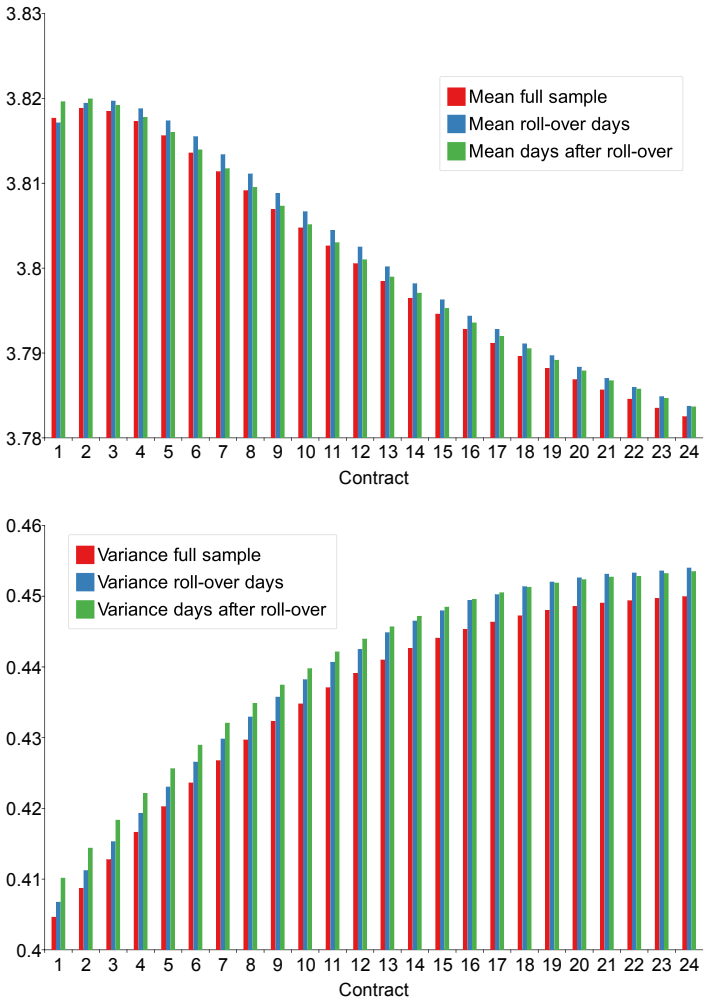
Windle, J., and Carvalho, C.M., 2014. A tractable state-space model for symmetric positive-definite matrices. Bayesian Analysis 9, 759-792. 39 Estimated average price level trading day t 0 10 20 30 40 50 3.78 3.79 3.8 3.81 3.82 3.83 Estimated price variation trading day t 0 10 20 30 40 50 0.4 0.41 0.42 0.43 0.44 0.45 0.46 Figure 5: Estimated average level ...
work page 2014
Reviewed August 14, 2026 · model on record in the stance chip above.
Discussion (0). Continue with ORCID to comment.