REVIEW 3 major objections 5 minor 49 references
A nonparametric Bayesian approach to the rare type match problem
T0 review · 3 major / 5 minor · reviewed 2026-08-14 · deepseek-v4-flash
Pith's one-line read For a rare type match, the likelihood ratio reduces to a two-parameter quotient, giving about 40,000 support for the prosecution on European Y-STR data.
desk verdict A clean and honest derivation of a new closed-form LR for the rare type match, but the headline number rests on the controversial assumption that profile labels are uninformative, and the validation is in-sample. read the letter →
The pith
A machine-rendered reading of the paper's core claim, the machinery that carries it, and where it could break.
The reading
What carries the argument
The load-bearing object is the two-parameter Poisson Dirichlet distribution $\mathrm{PD}(\alpha,\theta)$ over ranked population proportions, a distribution on ordered infinite lists of frequencies with power-law tails. Its Chinese restaurant representation makes prediction simple: a new customer (DNA type) occupies a new table with probability $(\theta+k\alpha)/(n+\theta)$ and joins an existing table of size $n_i$ with probability $(n_i-\alpha)/(n+\theta)$. This yields the one-step probabilities (10) and (11), and the sufficiency property from Zabell (2005) ensures that new-type and old-type probabilities depend only on counts, which is what allows the profiles to be reduced to partitions. The Pitman sampling formula (8) is the likelihood that lets the parameters $\alpha$ and $\theta$ be estimated from the database by maximum likelihood.
What would settle it
Simulate a Y-STR population under a known mutation and inheritance model that produces close relatives, then for many rare matches compare the likelihood ratio computed from the full labelled profiles with the value from equation (13); if the two diverge systematically, the reduction to partitions loses information and Assumption 2 fails.
Extended reading notes
Core claim
The central claim is equation (13): in a rare type match, the likelihood ratio is approximately $\mathrm{LR}=(n+1+\theta_{\mathrm{MLE}})/(1-\alpha_{\mathrm{MLE}})$. The derivation starts from the two-parameter Poisson Dirichlet model and the reduction of data to partitions: prosecution and defence agree on the distribution of the database enlarged by the suspect's new profile, and disagree only on whether the crime stain joins that profile's class. Under the defence the joining probability is $(1-\alpha)/(n+1+\theta)$; under the prosecution it is 1. Averaging over the posterior distribution of $(\alpha,\theta)$ and then replacing that expectation by the plug-in maximum likelihood values is justified empirically by the near-Gaussian, symmetric log-likelihood around the MLE. Applied to the 7-locus European Y-STR subset with $\alpha_{\mathrm{MLE}}=0.51$ and $\theta_{\mathrm{MLE}}=216$, the paper obtains $\log_{10}\mathrm{LR}=4.59$, about 40,000 in favour of the prosecution.
Load-bearing premise
The load-bearing premise is Assumption 2, that the names of DNA profiles contain no relevant information; if Y-STR profile similarity signals shared ancestry, then the simple quotient (13) is the likelihood ratio for the reduced partition data, not for the full genetic evidence, and the 40,000 figure could misstate the weight of the match.
Editorial extensions
If this is right
- A forensic analyst facing a rare Y-STR match can compute the likelihood ratio directly from $n$ and the fitted $(\alpha,\theta)$, without modelling the allele structure; on the European Y-STR data this gives $\log_{10}\mathrm{LR}=4.59$.
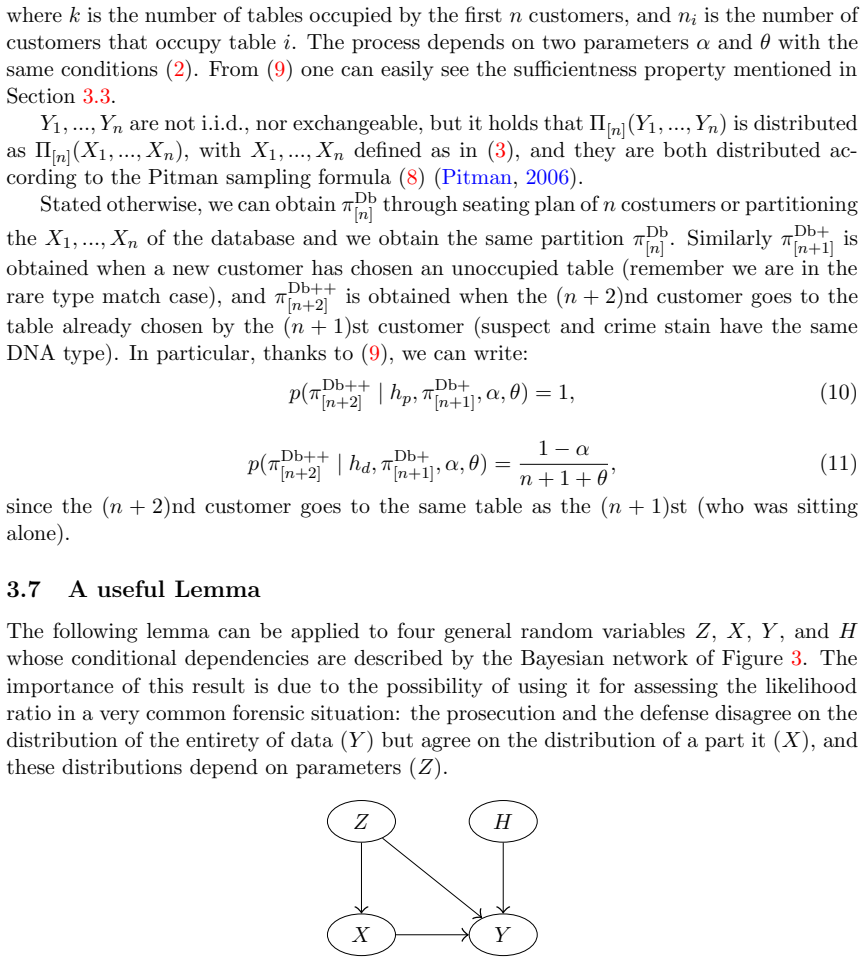
- In simulation using a Dutch subpopulation of size 2037, the plug-in approximation tracks the true partition-based likelihood ratio: the difference $\log_{10}\mathrm{LR}-\log_{10}\mathrm{LR}|p$ has standard deviation about 0.126 and stays between -0.146 and 0.381 in the cases studied.
- The method transfers to any categorical forensic characteristic whose type frequencies show power-law behaviour, such as shoe marks or glass fragments, for which the rare type match problem also arises.
- The paper does not claim the plug-in approximation is safe for small reference databases: it explicitly notes that the Gaussian shape underlying (13) is not empirically supported for samples of size 100, so such cases require exact posterior computation rather than the simple formula.
Reading between the lines
- A direct consequence of Assumption 2 is that equation (13) is the likelihood ratio for the partition evidence only; if closeness between Y-STR profiles reflects shared ancestry, a richer summary such as counts of one-step neighbours would be expected to change the LR, and that change is a measurable test of the assumption.
- The formula can be read as a two-parameter Good-Turing correction: the unseen matching type is assigned a positive probability derived from $(\alpha,\theta)$ rather than zero, so comparing (13) with classical Good-Turing estimates on the same database would be a natural external check that the paper does not perform.
- A hold-out calibration exercise (fit $(\alpha,\theta)$ on one part of the European database, predict rare-match LR on another) would test whether the fitted power-law prior is predictively accurate, not just descriptive of the full database.
- A genealogy-aware simulation with father-son mutation could quantify how much of the evidence is lost by discarding profile labels; the paper's own Diff1 only measures the gap between the plug-in LR and the partition-based ideal LR|p, not the gap to the full-data likelihood ratio.
Signed reviews
Editorial analysis
A structured set of objections, weighed in public.
Referee Report
Summary. The paper proposes a Bayesian nonparametric method for the rare type match problem in forensic DNA casework. The model assigns a two-parameter Poisson-Dirichlet prior to the ranked population proportions of DNA types and, under Assumption 2, discards the names of the types so that the data reduce to a random partition. Using the Chinese restaurant representation and a Bayesian network lemma, the authors derive a simple likelihood-ratio formula, Eq. (13), of the form LR ≈ (n + 1 + θ_MLE)/(1 − α_MLE), where α_MLE and θ_MLE are maximum-likelihood estimates of the Poisson-Dirichlet parameters. Applied to a European YHRD database of 18,925 Y-STR profiles, the formula gives log10 LR = 4.59. The paper also reports a simulation study on Dutch population data to compare the Bayesian LR with the 'true' LR obtained when the population proportions are known.
Significance. If its assumptions held, the paper would make a significant contribution: it connects nonparametric species-sampling theory to forensic likelihood ratios and yields an unusually simple, interpretable formula that could be applied by practitioners. The mathematical derivation of the LR identity from the Pitman sampling formula and the Bayesian network lemma is clean and correct within the stated model, and the paper is honest about several limitations, including the acknowledged controversy over discarding the genetic structure of Y-STR profiles. However, the practical significance for real Y-STR casework is not established because the key reduction to partitions and the empirical-Bayes plug-in are not validated against data or models that use the full genetic information.
major comments (3)
- [Section 3.2, Assumption 2; Section 2.2] Assumption 2 is load-bearing, and the paper provides no sensitivity analysis for it. The reduction of Y-STR profiles to equality classes removes the allele-distance information on which relatedness inference relies; the paper itself cites Andersen and Balding (2017) as finding that 95% of matching Y-STR profiles are separated by only 50–100 meioses and that relatedness is a very influential factor. Equation (13) is therefore the likelihood ratio for the reduced partition π[n+2], not for the full genetic evidence (E,B), and the headline log10 LR = 4.59 would not be the likelihood ratio for the observed Y-STR evidence if Assumption 2 fails. The statement 'we believe in the accuracy of our method' does not quantify the gap. The manuscript should either provide a formal or empirical comparison with methods that use the full genetic structure (e.g., Discrete Laplace or models based on Andersen and Balding's approach) or explicitly restrict the claim to the reduced data and warn practitioners against interpreting Eq. (13) as the likelihood ratio for full Y-STR evidence.
- [Section 5.4, Tables 1 and 2] The simulation study is in-sample and cannot validate the method for real applications. The Dutch population is used both to estimate α_MLE and θ_MLE and to define the 'true' population proportions p for generating rare type match cases; the resulting Diff1 and Diff2 therefore measure error only within the assumed Poisson-Dirichlet model class on the same data that produced the parameter estimates. This does not assess the discrepancy between the partition-based likelihood ratio and the likelihood ratio for the full genetic evidence. Moreover, the text explicitly states that the Gaussian shape justifying approximation (13) is 'not empirically supported for small databases of size n = 100', even though the simulation study uses samples of size n = 100. The empirical support for Eq. (13) as a general approximation is thus weaker than the paper's main text suggests.
- [Section 5.2, Eq. (13) and Figure 6] The empirical-Bayes approximation E[(1−A)/(n+1+Θ) | π[n+1]] ≈ (1−α_MLE)/(n+1+θ_MLE) is justified only by the visual Gaussian symmetry of one observed log-likelihood (Figure 6). The text itself says 'one could safely make this approximation if one believed that this symmetry would also be true in the real data situation at hand', which is a conditional belief statement rather than a demonstrated property. No sensitivity analysis is given for the choice of hyperprior, and no measure is provided for how far the posterior mean can be from the mode in realistic settings. Since Eq. (13) is the central practical result, the paper needs either a more principled justification of the plug-in approximation, a sensitivity analysis over plausible hyperpriors, or an explicit statement that the approximation is heuristic and may be unreliable outside the specific database analyzed.
minor comments (5)
- [Section 4] The definition of Φ in the sentence preceding Eq. (13) is garbled: the printed expression 'Φ = n 1−A n + 1 + Θ' lacks parentheses and appears to include an unexplained factor n. It should be written unambiguously, e.g., Φ = (1−A)/(n+1+Θ), with the relation to LR = 1/E(Φ) made explicit.
- [Section 5.3 and 5.4] The name 'Metropolis Hashting' appears in two places and should be 'Metropolis-Hastings'.
- [Table 2] The caption of Table 2 refers to 'Diff1, Diff2, and Diff3', but only Diff1 and Diff2 are defined in Section 5.4; this is a typographical error.
- [Section 5.3] The notation πn+1 is used both for a partition of the integer n+1 and for the partition of the enlarged database, which is confusing given the earlier distinction between partitions of [n] and partitions of n. Please use distinct notation.
- [Section 3.3] The phrase 'sufficientness property' should be 'sufficiency property'.
Circularity Check
No significant circularity: the likelihood-ratio formula follows from the stated Pitman/Chinese-restaurant model, and the MLE plug-in is presented as an explicit approximation rather than as a prediction forced by the fit.
full rationale
The central derivation is self-contained. Equations (10) and (11) are the Chinese-restaurant transition probabilities for the two-parameter Poisson-Dirichlet prior, and the likelihood ratio formula (13) is obtained by applying Corollary 3.1 and then replacing a posterior expectation by its MLE plug-in. This is an explicit empirical-Bayes approximation, not a quantity that equals the fitted parameters by construction: the quoted result is a ratio involving n, alpha_MLE, and theta_MLE, and it is not merely a restatement of the data or of the fitted values. The paper is also transparent that Assumption 2 reduces the evidence to a partition, so the computed LR is the LR for D = pi[n+2], and any gap between that and the full Y-STR evidence is a stated modeling limitation rather than a circular derivation. Self-citations to Cereda (2017a,b) and Anevski et al. (2017) are contextual or algorithmic and are not load-bearing; the Pitman sampling formula and the two-parameter Poisson-Dirichlet distribution are external mathematical results. The in-sample fitting of alpha and theta to the YHRD database and subsequent plug-in is empirical Bayes, which may weaken extrapolation, but it does not make the derived likelihood ratio an input of the model. No circular step can be exhibited by the paper's own equations.
Assumptions & free parameters
free parameters (3)
- alpha (discount parameter of PD prior) =
0.51 (European YHRD), 0.62 (Dutch)
- theta (concentration parameter of PD prior) =
216 (European YHRD), 22 (Dutch)
- finite truncation length m for population vector p
assumptions (8)
- domain assumption There are infinitely many different DNA types in Nature (Assumption 1, Section 3.2).
- ad hoc to paper The names of DNA types carry no relevant information, so data reduce to a partition of equality classes (Assumption 2, Section 3.2).
- domain assumption The reference database is a random sample from the population of potential perpetrators (Section 3.4, eq. (3)).
- domain assumption The ranked population proportions follow a two-parameter Poisson Dirichlet distribution (Section 3.3).
- ad hoc to paper The posterior expectation of Phi = n(1-A)/(n+1+Theta) can be replaced by its MLE plug-in (Section 5.2, eq. (13)).
- standard math The Pitman sampling formula (8) and the sufficiency property of the PD model (Section 3.5).
- standard math Lemma 3.1 and Corollary 3.1 on likelihood factorization in Bayesian networks (Section 3.7).
- domain assumption The Metropolis-Hastings chain for the latent map chi converges to the target distribution (Section 5.3).
Cite this review
Pith. "Pith review of A nonparametric Bayesian approach to the rare type match problem." pith.science (2026). https://pith.science/paper/HRKJMBZA
@misc{pith2026190802954,
  author       = {Pith},
  title        = {Pith review of: A nonparametric Bayesian approach to the rare type match problem},
  year         = {2026},
  howpublished = {\url{https://pith.science/paper/HRKJMBZA}},
  note         = {Machine review of arXiv:1908.02954}
}
read the original abstract
The "rare type match problem" is the situation in which the suspect's DNA profile, matching the DNA profile of the crime stain, is not in the database of reference. The evaluation of this match in the light of the two competing hypotheses (the crime stain has been left by the suspect or by another person) is based on the calculation of the likelihood ratio and depends on the population proportions of the DNA profiles, that are unknown. We propose a Bayesian nonparametric method that uses a two-parameter Poisson Dirichlet distribution as a prior over the ranked population proportions, and discards the information about the names of the different DNA profiles. This fits very well the data coming from European Y-STR DNA profiles, and the calculation of the likelihood ratio becomes quite simple thanks to a justified Empirical Bayes approach.
Figures


Figures from the paper (6 more)


Reference graph
Works this paper leans on
-
[1]
Robertson, B.; Vignaux, G.A. Interpreting Evidence: Evaluating Forensic Science in the Courtroom ; John Wiley & Sons : Chichester, 1995
work page 1995
-
[2]
Evett, I.; Weir, B. Interpreting DNA evidence: Statistical Genetics for Forensic Scientists ; Sinauer Associates: Sunderland, 1998
work page 1998
-
[3]
Aitken, C.; Taroni, F. Statistics and the Evaluation of Evidence for Forensics Scientists ; John Wiley & Sons: Chichester, 2004
work page 2004
-
[4]
Weight-of-evidence for Forensic DNA Profiles ; John Wiley & Sons : Chichester, 2005
Balding, D. Weight-of-evidence for Forensic DNA Profiles ; John Wiley & Sons : Chichester, 2005
work page 2005
-
[5]
Taroni, F.; Aitken, C.; Garbolino, P.; Biedermann, A. Bayesian Networks and Probabilistic Inference in Forensic Science ; John Wiley & Sons: Chichester, 2006
work page 2006
-
[6]
Bayesian approach to LR in case of rare type match
Cereda, G. Bayesian approach to LR in case of rare type match. Statistica Neerlandica 2017 , 71 , 141--164
work page 2017
-
[7]
Impact of model choice on LR assessment in case of rare haplotype match (frequentist approach)
Cereda, G. Impact of model choice on LR assessment in case of rare haplotype match (frequentist approach). Scandinavian Journal of Statistics 2017 , 44 , 230--248
work page 2017
-
[8]
Fundamental problem of forensic mathematics -- The evidential value of a rare haplotype
Brenner, C.H. Fundamental problem of forensic mathematics -- The evidential value of a rare haplotype . Forensic Science International: Genetics 2010 , 4 , 281--291
work page 2010
Show all 49 references
-
[9]
An investigation of the potential of DIP-STR markers for DNA mixture analyses
Cereda, G.; Biedermann, A.; Hall, D.; Taroni, F. An investigation of the potential of DIP-STR markers for DNA mixture analyses. Forensic Science International: Genetics 2014 , 11 , 229--240
2014
-
[10]
Essai Philosophique sur les Probabilites ; Mme
Laplace, P. Essai Philosophique sur les Probabilites ; Mme. Ve Courcier: Paris, 1814
-
[11]
The performance of universal coding
Krichevsky, R.; Trofimov, V. The performance of universal coding. IEEE Transactions on Information Theory 1981 , 27 , 199--207
1981
-
[12]
What's wrong with adding one? Corpus-Based Research into Language
Gale, W.A.; Church, K.W. What's wrong with adding one? Corpus-Based Research into Language. Rodolpi , 1994
1994
-
[13]
The population frequencies of species and the estimation of population parameters
Good, I. The population frequencies of species and the estimation of population parameters . Biometrika 1953 , 40 , 237--264
1953
-
[14]
On Modeling Profiles Instead of Values
Orlitsky, A.; Santhanam, N.P.; Viswanathan, K.; Zhang, J. On Modeling Profiles Instead of Values . Uncertainty in Artificial Intelligence , 2004 , pp. 426--435
2004
-
[15]
E stimating a probability mass function with unknown labels
Anevski, D.; Gill, R.D.; Zohren, S. E stimating a probability mass function with unknown labels. Annals of Statistics 2017 , in Press
2017
-
[16]
Nonparametric B ayes estimation of the probability of discovering a new species
Tiwari, R.C.; Tripathi, R.C. Nonparametric B ayes estimation of the probability of discovering a new species. Communications in statistics: Theory and methods 1989 , A18 , 877--895
1989
-
[17]
Bayesian nonparametric estimation of the probability of discovering new species
Lijoi, A.; Mena, R.H.; Pruenster, I. Bayesian nonparametric estimation of the probability of discovering new species . Biometrika 2007 , 94 , 769--786
2007
-
[18]
Are G ibbs-Type Priors the Most Natural Generalization of the D irichlet P rocess
De Blasi, P.; Favaro, S.; Lijoi, A.; Mena, R.H.; Pruenster, I.; Ruggiero, M. Are G ibbs-Type Priors the Most Natural Generalization of the D irichlet P rocess. IEEE Transactions on Patterns Analysis ans Machine Intelligence 2015 , 37 , 212--229
2015
-
[19]
Bayesian nonparametric inference for species variety with a two parameter Poisson-Dirichlet process prior
Favaro, S.; Lijoi, A.; Mena, R.H.; Pruenster, I. Bayesian nonparametric inference for species variety with a two parameter Poisson-Dirichlet process prior. Journal of the Royal Statistical Society: Series B (Methodological) 2009 , 71 , 993--1008
2009
-
[20]
B ayesian nonparametric inference for discovery probabilities: credible intervals and large sample asymptotics
Arbel, J.; Favaro, S.; Nipoti, B.; Teh, Y.W. B ayesian nonparametric inference for discovery probabilities: credible intervals and large sample asymptotics. Statistica Sinica 2017 , 27 , 839--859
2017
-
[21]
R ediscovery of G ood- T uring estimators via B ayesian nonparametrics
Favaro, S.; Nipoti, B.; Teh, Y.W. R ediscovery of G ood- T uring estimators via B ayesian nonparametrics. Biometrics 2016 , 72 , 136--145
2016
-
[22]
Hierarchical D irichlet processes
Teh, Y.W.; Jordan, M.I.; Beal, M.J.; Blei, D.M. Hierarchical D irichlet processes. Journal of the American Statistical Association 2006 , 101 , 1566--1581
2006
-
[23]
Power laws, Pareto distributions and Zipf's law
Newman, M. Power laws, Pareto distributions and Zipf's law . Contemporary P hysics 2005 , 46 , 323--351
2005
-
[24]
No shortcut solutions to the problem of Y-STR match probability calculation
Caliebe, A.; Jochens, A.; Willuweit, S.; Roewer, L.; Krawczak, M. No shortcut solutions to the problem of Y-STR match probability calculation. Forensic Science International: Genetics 2015 , 15 , 69--75
2015
-
[25]
Modelling the dependence structure of Y-STR haplotypes using graphical models
Andersen, M.M.; Curran, J.M.; de Zoete, J.; D., T.; Buckleton, J. Modelling the dependence structure of Y-STR haplotypes using graphical models. Forensic Science International: Genetics 2018 , 37 , 29--36
2018
-
[26]
Estimation of Y haplotype frequencies with lower order dependencies
Andersen, M.M.; Caliebe, A.; K, K.; M., K.; N., V.; Curran, J.M. Estimation of Y haplotype frequencies with lower order dependencies. Forensic Science International: Genetics 2019
2019
-
[27]
DNA profile match probability calculation: how to allow for population stratification, relatedness, database selection and single bands
Balding, D.J.; Nichols, R.A. DNA profile match probability calculation: how to allow for population stratification, relatedness, database selection and single bands . Forensic Science International 1994 , 64 , 125--140
1994
-
[28]
How convincing is a matching Y-chromosome profile? PLOS Genetics 2017 , 13 , 1--16
Andersen, M.M.; Balding, D.J. How convincing is a matching Y-chromosome profile? PLOS Genetics 2017 , 13 , 1--16
2017
-
[29]
Y-profile evidence: Close paternal relatives and mixtures
Andersen, M.M.; Balding, D.J. Y-profile evidence: Close paternal relatives and mixtures. Forensic Science International: Genetics 2019 , 38 , 48 -- 53
2019
-
[30]
Estimating Haplotype Frequency and Coverage of Databases
Egeland, T.; Salas, A. Estimating Haplotype Frequency and Coverage of Databases. PLoS ONE 2008 , 3 , e3988--e3988
2008
-
[31]
Y chromosome STR typing in crime casework
Roewer, L. Y chromosome STR typing in crime casework. Forensic Science, Medicine, and Pathology 2009 , 5 , 77--84
2009
-
[32]
The interpretation of lineage markers in forensic DNA testing
Buckleton, J.; Krawczak, M.; Weir, B. The interpretation of lineage markers in forensic DNA testing. Forensic Science International: Genetics 2011 , 5 , 78--83
2011
-
[33]
Y-STR Frequency Surveying Method: A critical reappraisal
Willuweit, S.; Caliebe, A.; Andersen, M.M.; Roewer, L. Y-STR Frequency Surveying Method: A critical reappraisal. Forensic Science International: Genetics 2011 , 5 , 84--90
2011
-
[34]
Inferences from DNA data: population histories, evolutionary processes and forensic match probabilities
Wilson, I.J.; Weale, M.E.; Balding, D.J. Inferences from DNA data: population histories, evolutionary processes and forensic match probabilities. Journal of the Royal Statistical Society: Series A (Statistics in Society) 2003 , 166 , 155--188
2003
-
[35]
The discrete Laplace exponential family and estimation of Y-STR haplotype frequencies
Andersen, M.M.; Eriksen, P.S.; Morling, N. The discrete Laplace exponential family and estimation of Y-STR haplotype frequencies . Journal of Theoretical Biology 2013 , 329 , 39--51
2013
-
[36]
Y chromosome haplotype reference database (YHRD): Update
Willuweit, S.; Roewer, L. Y chromosome haplotype reference database (YHRD): Update . Forensic Science International: Genetics 2007 , 1 , 83--87
2007
-
[37]
a ler, G.; Wiest, T.; Berger, B.; Niederst \
Purps, J.; Siegert, S.; Willuweit, S.; Nagy, M.; Alves, C.; Salazar, R.; Angustia, S.M.T.; Santos, L.H.; Anslinger, K.; Bayer, B.; Ayub, Q.; Wei, W.; Xue, Y.; Tyler-Smith, C.; Bafalluy, M.B.; Mart \' nez-Jarreta, B.; Egyed, B.; Balitzki, B.; Tschumi, S.; Ballard, D.; Court, D....
2014
-
[38]
THE NUMBER OF ALLELES THAT CAN BE MAINTAINED IN A FINITE POPULATION
Kimura, M. THE NUMBER OF ALLELES THAT CAN BE MAINTAINED IN A FINITE POPULATION. G enetics 1964 , 49 , 725--738
1964
-
[39]
Bayesian Nonparametrics ; Cambridge University Press: Cambridge, 2010
Hjort, N.; Holmes, C.; M \"u ller, P.; Walker, S. Bayesian Nonparametrics ; Cambridge University Press: Cambridge, 2010
2010
-
[40]
Fundamentals of Nonparametric Bayesian Inference ; Cambridge University Press, 2017
Ghosal, S.; Van der Vaart, A. Fundamentals of Nonparametric Bayesian Inference ; Cambridge University Press, 2017
2017
-
[41]
The two-parameter Poisson-Dirichlet distribution derived from a stable subordinator
Pitman, J.; Yor, M. The two-parameter Poisson-Dirichlet distribution derived from a stable subordinator . Annals of Probability 1997 , 25 , 855--900
1997
-
[42]
The Poisson-Dirichlet Distribution and Related Topics: Models and Asymptotic Behaviors ; Springer: Berlin, 2010
Feng, S. The Poisson-Dirichlet Distribution and Related Topics: Models and Asymptotic Behaviors ; Springer: Berlin, 2010
2010
-
[43]
A B ayesian view of the P oisson- D irichlet process
Buntine, W.; Hutter, M. A B ayesian view of the P oisson- D irichlet process. arXiv:1007.0296, 2012
2012 arXiv
-
[44]
Combinatorial Stochastic Processes ; \'E cole D' \'E t \'e de Probabilit \'e s de Saint-Flour XXXII - 2002, Springer: Berlin, 2006
Pitman, J. Combinatorial Stochastic Processes ; \'E cole D' \'E t \'e de Probabilit \'e s de Saint-Flour XXXII - 2002, Springer: Berlin, 2006
2002
-
[45]
243--274
Zabell, S.L., The Continuum of Inductive Methods Revisited; Cambridge Studies in Probability, Induction and Decision Theory, Cambridge University Press, 2005; pp. 243--274
2005
-
[46]
The two-parameter generalization of E wens' random partition structure
Pitman, J. The two-parameter generalization of E wens' random partition structure. Technical report 345, Department of Statistics U.C. Berkeley CA, 1992
1992
-
[47]
Exchangeable and partially exchangeable random partitions
Pitman, J. Exchangeable and partially exchangeable random partitions. Probability Theory and Related Fields 1995 , 102 , 145--158
1995
-
[48]
Exchangeability and Related Topics ; Vol
Aldous, D.J. Exchangeability and Related Topics ; Vol. 1117, \'E cole D' \'E t \'e de Probabilit \'e s de Saint-Flour , Springer-Verlag: New York, 1985
1985
-
[49]
Information-Theoretical Assessment of the Performance of Likelihood Ratio Computation Methods
Ramos, D.; Gonzales-Rodriguez, J.; Zadora, G.; Aitken, C. Information-Theoretical Assessment of the Performance of Likelihood Ratio Computation Methods. Journal of Forensic Sciences 2013 , 58 , 1503--1517
2013
Reviewed August 14, 2026 · model on record in the stance chip above.
Discussion (0). Continue with ORCID to comment.