Denoising Neural Reranker for Recommender Systems
Pith reviewed 2026-05-21 22:32 UTC · model grok-4.3
The pith
Retriever scores can be denoised by an adversarial reranker to align with user feedback in multi-stage recommenders.
A machine-rendered reading of the paper's core claim, the machinery that carries it, and where it could break.
Core claim
The reranking task under the two-stage framework is naturally a noise reduction problem on the retriever scores. Following this notion, an adversarial framework DNR is derived that associates the denoising reranker with a carefully designed noise generation module. The resulting DNR solution extends the conventional score error minimization loss with a denoising objective that aims to denoise the noisy retriever scores to align with the user feedback, an adversarial retriever score generation objective that improves the exploration in the retriever score space, and a distribution regularization term that aims to align the distribution of generated noisy retriever scores with the real ones.
What carries the argument
DNR adversarial framework that pairs a denoising reranker with a noise generation module to model and remove noise from retriever scores.
If this is right
- Denoised retriever scores align more closely with observed user feedback.
- Adversarial generation improves coverage of the retriever score space during training.
- Distribution regularization keeps generated noise statistically similar to real retriever outputs.
- Overall reranking quality improves on both public benchmarks and live industrial traffic.
Where Pith is reading between the lines
- The same denoising pattern could apply to two-stage pipelines outside recommenders, such as web search or advertising ranking.
- Treating initial scores as noisy signals might reduce the frequency of full retriever retraining cycles.
- The noise model could be tested on datasets that vary the strength of correlation between retriever scores and user clicks.
Load-bearing premise
Retriever scores are informative but noisy signals whose distribution can be adversarially modeled and denoised to align with user feedback without introducing new biases or requiring changes to the upstream retriever.
What would settle it
Experiments on the three public datasets or the industrial system in which DNR produces no measurable improvement over standard rerankers or in which the denoised scores correlate no better with user feedback than the original retriever scores.
Figures


read the original abstract
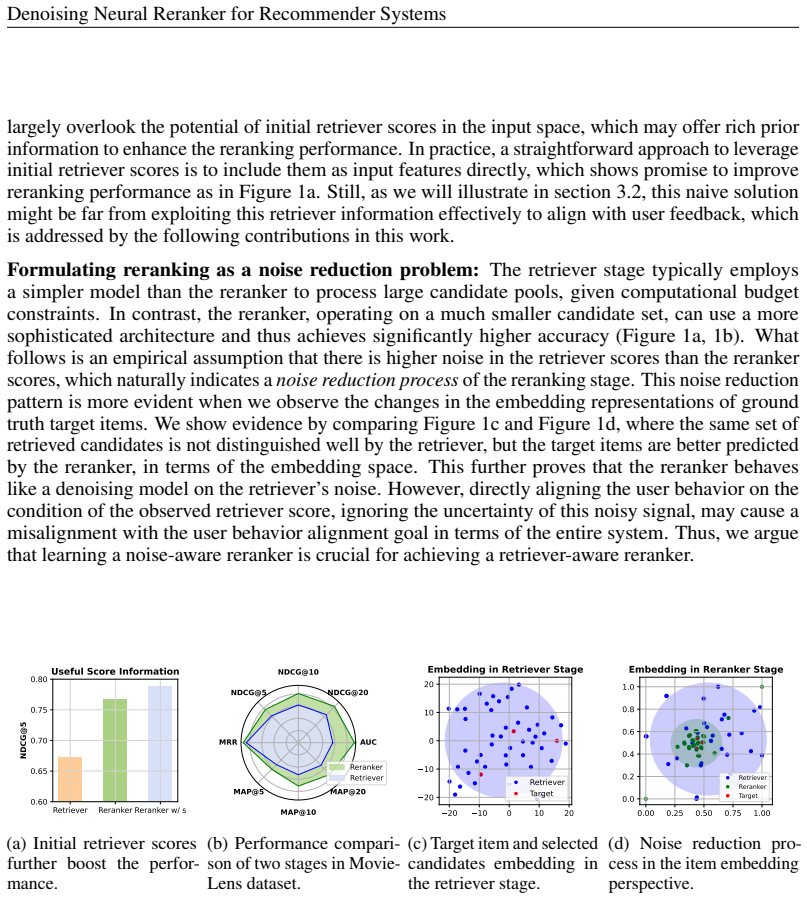
For multi-stage recommenders in industry, a user request would first trigger a simple and efficient retriever module that selects and ranks a list of relevant items, then the recommender calls a slower but more sophisticated reranking model that refines the item list exposure to the user. To consistently optimize the two-stage retrieval reranking framework, most efforts have focused on learning reranker-aware retrievers. In contrast, there has been limited work on how to achieve a retriever-aware reranker. In this work, we provide evidence that the retriever scores from the previous stage are informative signals that have been underexplored. Specifically, we first empirically show that the reranking task under the two-stage framework is naturally a noise reduction problem on the retriever scores, and theoretically show the limitations of naive utilization techniques of the retriever scores. Following this notion, we derive an adversarial framework DNR that associates the denoising reranker with a carefully designed noise generation module. The resulting DNR solution extends the conventional score error minimization loss with three augmented objectives, including: 1) a denoising objective that aims to denoise the noisy retriever scores to align with the user feedback; 2) an adversarial retriever score generation objective that improves the exploration in the retriever score space; and 3) a distribution regularization term that aims to align the distribution of generated noisy retriever scores with the real ones. We conduct extensive experiments on three public datasets and an industrial recommender system, together with analytical support, to validate the effectiveness of the proposed DNR.
Editorial analysis
A structured set of objections, weighed in public.
Referee Report
Summary. The manuscript proposes a Denoising Neural Reranker (DNR) for two-stage recommender systems. It empirically and theoretically frames the reranking task as a noise reduction problem on retriever scores, highlights limitations of naive score utilization, and introduces an adversarial framework with a noise generation module. The framework augments the standard loss with a denoising objective to align denoised scores with user feedback, an adversarial generation objective for exploration in score space, and a distribution regularizer to match real retriever score distributions. Experiments on public and industrial datasets support the approach.
Significance. If the central claims hold, this could advance retriever-aware reranking in industrial systems by better leveraging existing retriever scores through denoising rather than retraining the retriever. The adversarial setup with multiple objectives offers a novel way to handle noisy signals in ranking. The empirical validation on both public benchmarks and an industrial system is a positive feature, but significance is limited by the absence of detailed derivations for the theoretical limitations and interaction among the three augmented objectives.
major comments (3)
- Abstract: the claim that reranking is 'naturally a noise reduction problem on the retriever scores' and the theoretical demonstration of limitations of naive utilization techniques are asserted without derivation details or equations, which is load-bearing for motivating the DNR framework and its three augmented objectives.
- Abstract: the three augmented objectives (denoising loss, adversarial retriever score generation, distribution regularizer) are introduced at a high level with no explicit equations showing how they are combined with the conventional score error minimization loss or whether any are tautological by construction; this prevents verification that the framework improves alignment to user feedback rather than merely fitting observed retriever scores.
- Abstract: the noise model assumes retriever scores are informative but noisy signals whose distribution can be adversarially modeled and denoised; however, because scores are observed only on the retriever's already-selected top-k set, the distribution is conditioned on the retriever's ranking decisions, and nothing in the described construction enforces that generated noise respects the same conditioning or that denoising recovers relevance outside the candidate pool.
minor comments (2)
- Experiments: no error-bar information, variance across runs, or statistical significance tests are mentioned for the reported gains on the three public datasets and industrial system.
- Abstract: the description of how the denoising, adversarial, and regularization objectives interact during training (or whether post-hoc tuning was applied) is absent and should be clarified for reproducibility.
Simulated Author's Rebuttal
We thank the referee for the detailed and constructive comments on our manuscript. We address each major comment point by point below, with clear indications of planned revisions where appropriate.
read point-by-point responses
-
Referee: Abstract: the claim that reranking is 'naturally a noise reduction problem on the retriever scores' and the theoretical demonstration of limitations of naive utilization techniques are asserted without derivation details or equations, which is load-bearing for motivating the DNR framework and its three augmented objectives.
Authors: We agree that the abstract presents these foundational claims concisely without full derivations, which limits immediate verifiability. Section 3.1 of the manuscript provides the empirical evidence via score distribution analysis and noise characterization on public datasets, while Section 3.2 derives the limitations of naive score utilization through a formal decomposition showing bias and variance issues. We will revise the abstract to include a brief reference to the key theoretical insight (e.g., the expected error bound under naive fusion) and add a pointer to the relevant sections and equations. revision: yes
-
Referee: Abstract: the three augmented objectives (denoising loss, adversarial retriever score generation, distribution regularizer) are introduced at a high level with no explicit equations showing how they are combined with the conventional score error minimization loss or whether any are tautological by construction; this prevents verification that the framework improves alignment to user feedback rather than merely fitting observed retriever scores.
Authors: The abstract summarizes the objectives at a high level due to length constraints. The full manuscript defines the combined objective explicitly in Equation (7) of Section 4.3 as L = L_SEM + λ1 L_denoise + λ2 L_adv + λ3 L_reg, where L_SEM is the standard score error minimization loss. Ablation experiments in Section 6.3 confirm that the augmented terms improve alignment with user feedback beyond fitting retriever scores alone, as measured by ranking metrics on held-out interactions. We will add a compact statement of the combined loss to the abstract to address this directly. revision: yes
-
Referee: Abstract: the noise model assumes retriever scores are informative but noisy signals whose distribution can be adversarially modeled and denoised; however, because scores are observed only on the retriever's already-selected top-k set, the distribution is conditioned on the retriever's ranking decisions, and nothing in the described construction enforces that generated noise respects the same conditioning or that denoising recovers relevance outside the candidate pool.
Authors: This is a substantive point on the problem scope. Our framework is designed for the reranking stage and operates strictly within the retriever's top-k candidate pool; the noise generation module is trained adversarially to match the empirical distribution of observed retriever scores conditioned on that pool. The denoising objective refines scores to better match user feedback within the same pool. We do not claim recovery of relevance outside the candidate set, as that falls to the upstream retriever. We will add explicit discussion of this conditioning and scope limitation in the revised introduction and method sections, along with a note on how the adversarial module respects the observed top-k distribution. revision: partial
Circularity Check
Derivation is self-contained; no reductions to inputs by construction
full rationale
The paper motivates the DNR framework via an empirical demonstration that reranking constitutes a noise-reduction task on retriever scores, followed by a theoretical analysis of limitations in naive score-utilization methods. It then explicitly augments a conventional score-error-minimization loss with three new objectives (denoising alignment to user feedback, adversarial retriever-score generation for exploration, and distribution regularization). These objectives are introduced as modeling extensions rather than quantities that reduce to the original retriever scores or fitted parameters by definition. No self-citations, uniqueness theorems, or ansatzes from prior author work are invoked to force the framework, and the central claim remains an independent proposal grounded in the observed phenomenon rather than a tautological restatement of its inputs.
Axiom & Free-Parameter Ledger
Forward citations
Cited by 1 Pith paper
-
From Local Indices to Global Identifiers: Generative Reranking for Recommender Systems via Global Action Space
GloRank reformulates list-wise reranking as token generation over a global item identifier space, using supervised pre-training followed by reinforcement learning to maximize list-wise utility and outperforming baseli...
Reference graph
Works this paper leans on
-
[1]
Association for Computing Machinery. ISBN 9781450356572. doi: 10.1145/3209978.3209985. URL https://doi.org/10.1145/3209978.3209985. Jaime Carbonell and Jade Goldstein. The use of mmr, diversity-based reranking for reordering documents and producing summaries. InProceedings of the 21st Annual International ACM SIGIR Conference on Research and Development i...
-
[2]
The use of mmr, diversity-based reranking for reordering documents and producing summaries
Association for Computing Machinery. ISBN 1581130155. doi: 10.1145/290941.291025. URLhttps://doi.org/10.1145/290941.291025. Paul Covington, Jay Adams, and Emre Sargin. Deep neural networks for youtube recommendations. In Shilad Sen, Werner Geyer, Jill Freyne, and Pablo Castells (eds.),Proceedings of the 10th ACM Conference on Recommender Systems, Boston, ...
-
[3]
URL https://doi.org/10.1145/ 2959100.2959190
doi: 10.1145/2959100.2959190. URL https://doi.org/10.1145/ 2959100.2959190. Jiaxin Deng, Shiyao Wang, Kuo Cai, Lejian Ren, Qigen Hu, Weifeng Ding, Qiang Luo, and Guorui Zhou. Onerec: Unifying retrieve and rank with generative recommender and iterative preference alignment.CoRR, abs/2502.18965,
-
[4]
OneRec: Unifying Retrieve and Rank with Generative Recommender and Iterative Preference Alignment
doi: 10.48550/ARXIV .2502.18965. URL https: //doi.org/10.48550/arXiv.2502.18965. Luke Gallagher, Ruey-Cheng Chen, Roi Blanco, and J. Shane Culpepper. Joint optimization of cascade ranking models. InProceedings of the Twelfth ACM International Conference on Web Search and Data Mining, WSDM ’19, pp. 15–23, New York, NY , USA,
work page internal anchor Pith review Pith/arXiv arXiv doi:10.48550/arxiv
-
[5]
Association for Computing Machinery. ISBN 9781450359405. doi: 10.1145/3289600.3290986. URL https://doi.org/10.1145/3289600.3290986. F. Maxwell Harper and Joseph A. Konstan. The movielens datasets: History and context.ACM Trans. Interact. Intell. Syst., 5(4):19:1–19:19,
-
[6]
Denoising diffusion probabilistic models
Jonathan Ho, Ajay Jain, and Pieter Abbeel. Denoising diffusion probabilistic models. In Hugo Larochelle, Marc’Aurelio Ranzato, Raia Hadsell, Maria-Florina Balcan, and Hsuan- Tien Lin (eds.),Advances in Neural Information Processing Systems 33: Annual Con- ference on Neural Information Processing Systems 2020, NeurIPS 2020, December 6-12, 2020, virtual,
work page 2020
-
[7]
URL https://proceedings.neurips.cc/paper/2020/hash/ 4c5bcfec8584af0d967f1ab10179ca4b-Abstract.html. Guangda Huzhang, Zhen-Jia Pang, Yongqing Gao, Yawen Liu, Weijie Shen, Wen-Ji Zhou, Qianying Lin, Qing Da, Anxiang Zeng, Han Yu, Yang Yu, and Zhi-Hua Zhou. Aliexpress learning-to-rank: Maximizing online model performance without going online.IEEE Trans. Know...
work page 2020
-
[8]
Association for Computing Machinery. ISBN 9781605580852. doi: 10.1145/1367497.1367552. URL https://doi.org/10.1145/ 1367497.1367552. Wang-Cheng Kang and Julian J. McAuley. Self-attentive sequential recommendation. InICDM, pp. 197–206. IEEE Computer Society,
-
[9]
Diederik P. Kingma and Max Welling. Auto-encoding variational bayes. In Yoshua Bengio and Yann LeCun (eds.),2nd International Conference on Learning Representations, ICLR 2014, Banff, AB, Canada, April 14-16, 2014, Conference Track Proceedings,
work page 2014
-
[10]
Auto-Encoding Variational Bayes
URL http: //arxiv.org/abs/1312.6114. Yehuda Koren, Robert M. Bell, and Chris V olinsky. Matrix factorization techniques for recommender systems.Computer, 42(8):30–37,
work page internal anchor Pith review Pith/arXiv arXiv
-
[11]
Discrete conditional diffusion for reranking in recommendation
Xiao Lin, Xiaokai Chen, Chenyang Wang, Hantao Shu, Linfeng Song, Biao Li, and Peng Jiang. Discrete conditional diffusion for reranking in recommendation. InCompanion Proceedings of the ACM Web Conference 2024, WWW ’24, pp. 161–169, New York, NY , USA,
work page 2024
-
[12]
Association for Computing Machinery. ISBN 9798400701726. doi: 10.1145/3589335.3648313. URL https://doi.org/10.1145/3589335.3648313. Qi Liu, Kai Zheng, Rui Huang, Wuchao Li, Kuo Cai, Yuan Chai, Yanan Niu, Yiqun Hui, Bing Han, Na Mou, Hongning Wang, Wentian Bao, Yun En Yu, Guorui Zhou, Han Li, Yang Song, Defu Lian, and Kun Gai. Recflow: An industrial full f...
-
[13]
Association for Computing Machinery. ISBN 9781450392785. doi: 10.1145/3523227.3547369. URL https://doi.org/10.1145/ 3523227.3547369. Daniel Lowd and Christopher Meek. Adversarial learning. InKDD, pp. 641–647. ACM,
-
[14]
Association for Computing Machinery. ISBN 9781450362436. doi: 10.1145/3298689. 3347000. URLhttps://doi.org/10.1145/3298689.3347000. 12 Denoising Neural Reranker for Recommender Systems Jiarui Qin, Jiachen Zhu, Bo Chen, Zhirong Liu, Weiwen Liu, Ruiming Tang, Rui Zhang, Yong Yu, and Weinan Zhang. Rankflow: Joint optimization of multi-stage cascade ranking s...
-
[15]
Association for Computing Machinery. ISBN 9781450387323. doi: 10.1145/3477495.3532050. URLhttps://doi.org/10.1145/3477495.3532050. Yuxin Ren, Qiya Yang, Yichun Wu, Wei Xu, Yalong Wang, and Zhiqiang Zhang. Non-autoregressive generative models for reranking recommendation. InProceedings of the 30th ACM SIGKDD Conference on Knowledge Discovery and Data Minin...
-
[16]
Association for Computing Machinery. ISBN 9798400704901. doi: 10.1145/3637528. 3671645. URLhttps://doi.org/10.1145/3637528.3671645. Francesco Ricci, Lior Rokach, and Bracha Shapira.Recommender Systems: Techniques, Ap- plications, and Challenges, pp. 1–35. Springer US, New York, NY ,
-
[17]
doi: 10.1007/978-1-0716-2197-4_1
ISBN 978-1- 0716-2197-4. doi: 10.1007/978-1-0716-2197-4_1. URL https://doi.org/10.1007/ 978-1-0716-2197-4_1. Xiaowen Shi, Fan Yang, Ze Wang, Xiaoxu Wu, Muzhi Guan, Guogang Liao, Wang Yongkang, Xingxing Wang, and Dong Wang. Pier: Permutation-level interest-based end-to-end re-ranking framework in e-commerce. InProceedings of the 29th ACM SIGKDD Conference ...
-
[18]
Association for Computing Machinery. ISBN 9798400701030. doi: 10.1145/3580305.3599886. URL https://doi.org/10.1145/3580305.3599886. David Silver, Guy Lever, Nicolas Heess, Thomas Degris, Daan Wierstra, and Martin A. Riedmiller. Deterministic policy gradient algorithms. InProceedings of the 31th International Conference on Machine Learning, ICML 2014, Beij...
-
[19]
Association for Computing Machinery. ISBN 9781450350228. doi: 10.1145/3077136.3080786. URLhttps://doi.org/10.1145/3077136.3080786. Lidan Wang, Jimmy Lin, and Donald Metzler. A cascade ranking model for efficient ranked retrieval. InProceedings of the 34th International ACM SIGIR Conference on Research and Development in Information Retrieval, SIGIR ’11, p...
-
[20]
Association for Computing Machinery. ISBN 9781450307574. doi: 10.1145/2009916.2009934. URLhttps://doi.org/10.1145/2009916.2009934. Yunjia Xi, Weiwen Liu, Jieming Zhu, Xilong Zhao, Xinyi Dai, Ruiming Tang, Weinan Zhang, Rui Zhang, and Yong Yu. Multi-level interaction reranking with user behavior history. InSIGIR, pp. 1336–1346. ACM,
-
[21]
Full stage learning to rank: A unified framework for multi-stage systems
Kai Zheng, Haijun Zhao, Rui Huang, Beichuan Zhang, Na Mou, Yanan Niu, Yang Song, Hongning Wang, and Kun Gai. Full stage learning to rank: A unified framework for multi-stage systems. InProceedings of the ACM Web Conference 2024, WWW ’24, pp. 3621–3631, New York, NY , USA,
work page 2024
-
[22]
Association for Computing Machinery. ISBN 9798400701719. doi: 10.1145/3589334. 3645523. URLhttps://doi.org/10.1145/3589334.3645523. Tao Zhuang, Wenwu Ou, and Zhirong Wang. Globally optimized mutual influence aware ranking in e-commerce search. InIJCAI, pp. 3725–3731. ijcai.org,
-
[23]
14 Denoising Neural Reranker for Recommender Systems A NOTATIONS symbol description u user request information including profile features and interaction history x random variables of retriever scores on the candidate item set z random variables of user feedback on the candidate item set xu,z u observed retriever scores and user feedback in data x′ u the ...
work page 2014
-
[24]
D.3 BASELINES We detail the compared baselines of our main experiments in the following, including traditional recommenders, list-refinement methods, generator-evaluator methods, and diffusion-based methods. Traditional Recommenders:predict the scores of candidate items and rank them accordingly. • SASRec Kang & McAuley (2018) proposes a self-attention ba...
work page 2018
-
[25]
We can see that, in our scenario, watch-time and share-rate are slightly negatively impacted, while like-rate and comment-rate are slightly positively impacted, indicating a potential trade-off between metrics. In general, the impact on all other metrics is not statistically significant, indicating the effectiveness of our method. metric performance boost...
work page 2019
discussion (0)
Sign in with ORCID, Apple, or X to comment. Anyone can read and Pith papers without signing in.