REVIEW 3 major objections 5 minor 1 cited by
Dynamical Systematics for Time Delay Lenses and the Impact on the Hubble Constant
T0 review · 3 major / 5 minor · reviewed 2026-08-03 · deepseek-v4-flash
Pith's one-line read This paper argues that the systematic uncertainties in measuring lens-galaxy velocity dispersions, not statistical noise, set the real floor on time-delay measurements of the Hubble constant, with biases in H0 typically exceeding the 2% pre
desk verdict A careful, transparent systematics study that makes a convincing broad case that kinematic modeling choices can break the 2% H0 budget; treat Table 2 as an illustrative warning, not exact corrections. read the letter →
The pith
A machine-rendered reading of the paper's core claim, the machinery that carries it, and where it could break.
The reading
What carries the argument
The driving mechanism is the sensitivity relation ΔH/H0 ∝ Δσ²/σ², which converts every fractional kinematic error into a proportional error in H0. The population-level machinery is the marginalization identity for a shared anisotropy radius: with N independent lenses the systematic variance shrinks as (σ_H² + α²σ_a²)/N, but with a homogeneous population it becomes σ_H²/N + α²σ_a², so the anisotropy contribution never averages away. The numerical work uses spherical Jeans models with a Hernquist stellar tracer inside a singular-isothermal-sphere mass distribution to compute how each systematic shifts the predicted velocity dispersion.
What would settle it
Measure the fourth Gauss–Hermite moment h4 of the eight lens galaxies; if early-type lenses have h4 near the typical 0.01–0.04 seen in local ellipticals, the claim that Osipkov-Merritt models underestimate anisotropy systematics is supported, and if h4 is near zero the up-to-18% anisotropy shifts are overestimated. Alternatively, compare measured dispersions of the same lenses fitted with Gaussian versus double-Moffat PSFs: the predicted 2–6% shifts, and the larger 5–40% shifts from light-profile choices, should appear in the data.
Extended reading notes
Core claim
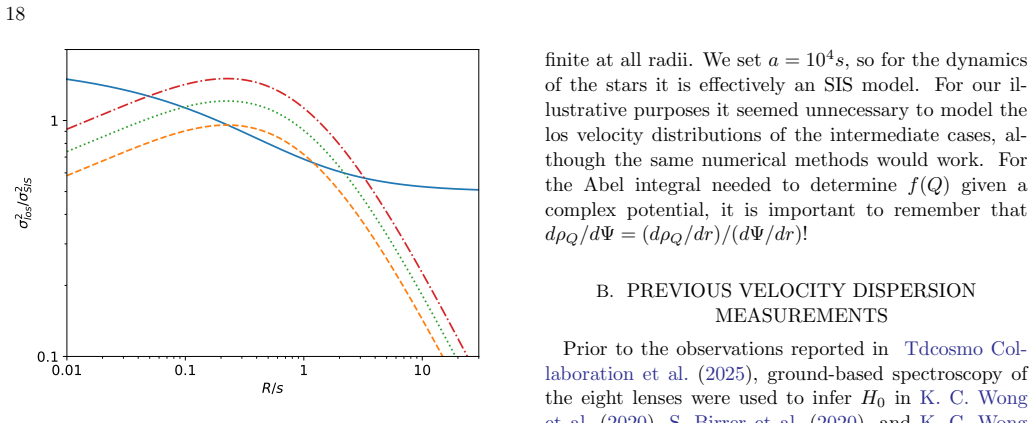
The central claim is that most systematic errors in the kinematic measurements of the eight time-delay lenses can bias H0 by more than 2%, with some per-lens fractional changes in σ² reaching 40%. Specifically: a 10% error in PSF FWHM causes 0.2–2.6% changes; replacing a Gaussian PSF with Moffat wings causes up to 2–6%; the difference between the measured dispersion and the true mean-square velocity can be 2–8%; anisotropy model choice causes up to 5–18% shifts, with the commonly used Osipkov-Merritt model failing to produce h4 values typical of early-type galaxies; and changing the assumed stellar light profile from Hernquist to a Sérsic n=2 profile raises the predicted dispersion by 5–40%.
Load-bearing premise
The numerical amplitudes are computed with a spherical singular-isothermal-sphere mass distribution and a spherical Hernquist stellar tracer; if real lens mass distributions are power-law, composite, or triaxial, the percentages in Table 2 could change materially, even though the qualitative conclusion would likely survive — as the paper itself notes when discussing the nonphysical behavior of the SIS potential at the center.
Editorial extensions
If this is right
- A 1% bias in the squared velocity dispersion produces roughly a 1% bias in H0 for a typical lens, so kinematics must be known to better than 1% in σ (2% in σ²) to reach the 2% H0 target.
- PSF FWHM must be measured to better than 10% accuracy; otherwise seeing errors alone can exceed the 2% budget.
- If early-type galaxies are dynamically homogeneous, the uncertainty from the anisotropy radius does not decrease with sample size, so combining more lenses cannot cure this systematic.
- Measured dispersions must be corrected to true mean-square velocities using h4 or full velocity distributions; for radially anisotropic galaxies this raises v_rms relative to σ*, typically shifting inferred H0 upward.
- Using the real photometric profile (e.g., Sérsic n≈2) instead of the Hernquist profile changes predicted dispersions by up to 40% for some lenses, biasing H0 in either direction depending on the true profile.
Reading between the lines
- A testable prediction of the homogeneity argument is that velocity-dispersion offsets between different template stars should be systematically correlated across early-type lenses of similar redshift; re-fitting archival spectra with matched templates and checking for lens-to-lens correlation would test this directly.
- The numerical magnitudes in Table 2 rest on SIS plus spherical Hernquist models; applying the same systematics to the newer double-Sérsic, power-law, or composite mass models would likely change the numbers but not the qualitative conclusion that systematics exceed the 2% budget.
- The population-level marginalization logic also applies to template-star choice and light-profile choice: posterior distributions should be computed for each global model assumption and then marginalized over assumptions, rather than averaging per-lens shifts.
- The same homogeneous-population reasoning used here has been applied in cluster cosmology to model mass–richness relations; borrowing those correlation-marginalization tools could handle partially correlated lens populations.
Editorial analysis
A structured set of objections, weighed in public.
Referee Report
Summary. This paper assembles a systematic-error budget for the stellar dynamical constraints used in time-delay cosmography, applied to the eight lenses in the TDCOSMO/H0LiCOW joint analyses. Working mostly with spherical SIS total-mass models and Hernquist stellar tracers, the authors compute fractional biases in the squared velocity dispersion from PSF width and shape, aperture miscentering, the difference between the measured Gaussian dispersion and the Jeans rms velocity, the choice of orbital anisotropy, and the assumed stellar light profile. They conclude that most of these effects exceed the 2% σ² budget required for a 2% H0 measurement, and they argue that because early-type galaxies form a fairly homogeneous population, nuisance parameters such as the anisotropy radius must be marginalized globally rather than independently per lens. The paper also derives a population-weighted Jeans equation for mixed stellar populations and uses it to argue that the photometric profile entering dynamical models should be weighted by line equivalent width, not by broad-band flux.
Significance. If the quantitative conclusions hold, this is a useful and timely cautionary analysis for the TDCOSMO program. The paper is transparent about its approximations, provides analytic Jeans solutions and Monte Carlo line-of-sight velocity distributions, and makes a falsifiable point that Osipkov-Merritt models fail to reproduce the h4 values observed in early-type galaxies. The strongest contribution is the systematic side-by-side comparison in Tables 2 and 5, which gives the community a concrete checklist of where the 2% budget is violated. The population-level homogeneity argument in §5, though in need of empirical calibration, is conceptually important and could affect how future lens samples are averaged. The main weakness is that the quantitative amplitudes are computed for idealized spherical SIS/Hernquist models and are not propagated through an H0 posterior, so the mapping from Δσ²/σ² to ΔH0/H0 remains schematic.
major comments (3)
- [§2.1–§2.3, Table 2, Eq. (1)] The quantitative core of the paper, Table 2, is computed for a spherical SIS total mass distribution and a Hernquist tracer with s=0.55 R_e q^{1/2}. The authors state in §2.1 that this is for simplicity and due to unavailability of the TDCOSMO double-Sérsic parameters, and §2.2 notes that the SIS potential produces 'nonphysical behavior at the center' that affects the NIRSpec comparisons. Since the actual TDCOSMO mass models are power-law or composite and often triaxial, the amplitudes in Table 2, especially the Sérsic n=2 rows (up to +40%) and Cuddeford rows (up to +18%), are model-dependent. The mapping to H0 is made only through the SIS-based sensitivity ψ of Eq. (1), not through an H0 posterior. The broad claim that systematics exceed 2% is likely robust because several independent effects already exceed 2% under the stated assumptions, but the quantitative amplitudes are not yet ful
- [§2.2, Fig. 4, Table 2] The double-Moffat entry for RX J1131 observed with NIRSpec has a positive sign only because, as the authors write, the changes in the numerator and denominator are affected by 'the nonphysical behavior at the center from using an SIS potential.' This is an artifact of the model, not a physical PSF effect. Reporting it in Table 2 without a caveat overstates the certainty of that particular systematic. The same inverted trends for other NIRSpec systems are flagged in the text, so the table should either recompute these entries with a cored or power-law potential or mark them as model-dependent.
- [§5, Eqs. (15)–(19)] The formal argument that a dynamically homogeneous population prevents the anisotropy radius uncertainty from averaging down with N is mathematically correct for a single shared r_a/s with a fixed Gaussian prior. However, the paper does not provide an empirical estimate of the correlation scale for r_a/s, stellar-template offsets, or light-profile choice across the lens sample. Early-type galaxies have mass and redshift trends, which the paper acknowledges, so the shared-value case is an upper limit. A partially correlated model, e.g. a correlation coefficient between lens-to-lens values, would interpolate between Eq. (17) and Eq. (19). The phrase 'must be marginalized over the lens sample as a whole' overstates the case as written; the homogeneous limit should be framed as one end of a correlation model, ideally quantified with simple test cases.
minor comments (5)
- [§5, text near Eq. (15)] The Gaussian prior is written as P(r_a) ∝ exp(−r_a/2σ_a²), which is an exponential, not a Gaussian. It should read exp(−r_a²/(2σ_a²)). The analytic marginalizations in Eqs. (17) and (19) rely on a true Gaussian prior, so this typo should be corrected.
- [Table 1] The RX J1131−1231 row is ambiguous: the seeing and aperture entries '0.15/0.96π×0.955 2' need a clearer layout specifying which values apply to the NIRSpec and KCWI observations. Also state explicitly that all FWHM and aperture values are in arcseconds.
- [§2.3, Figs. 5–6] The Monte Carlo distributions use 10^9 particles and show residual shot noise. Since some reported differences are only 0.7–1.6%, a quantitative estimate of the Monte Carlo noise floor would help the reader judge which entries in the velocity-DF rows of Table 2 are significant.
- [§2.2] The paper says LSF-related systematic errors were considered but are negligible compared with other sources, but no calculation is shown. Given that template/LSF issues are known to be non-negligible in some dispersion measurements, one sentence summarizing the magnitude or a pointer to the relevant check would be useful.
- [Fig. 9 caption] The caption says the weighted mean temperature is 'B-band luminosity weighted,' but the text says this is roughly the rest wavelength range usually modeled. Clarify whether the weight is a B-band filter or the actual spectral window used in the dispersion fits, since the two need not be identical.
Circularity Check
No significant circularity: systematic shifts are forward-modeled; self-citations are contextual, not load-bearing.
full rationale
The paper's central quantitative output (Table 2) lists fractional changes in squared velocity dispersion computed by forward modeling: Jeans-equation solutions for specified mass/light/anisotropy models, Gaussian/Moffat PSF convolution, aperture averaging (Eq. 6), Monte-Carlo line-of-sight velocity distributions, and Sersic/Hernquist/Jaffe tracer comparisons. No H0 value is fit or predicted from these shifts; the mapping to H0 uses a toy-model sensitivity defined in Eq. 1, whose values are derived from the Appendix A Hernquist/SIS model, not from the target cosmological parameter. Section 5's population-homogeneity argument is an analytic marginalization calculation (Eqs. 15-19): if a single r_a/s is shared, its uncertainty cannot average down; this is a statistical consequence, not a fitted prediction. Self-citations (Kochanek 2002, 2006, 2020, 2021) establish the mass-sheet/xi-kappa_E degeneracy and prior accuracy estimates, but the paper's own amplitudes do not reduce to those citations. Assumptions of spherical SIS/Hernquist models are explicit and are flagged as producing 'nonphysical behavior at the center'; this is a modeling limitation, not circularity. No load-bearing step reduces by construction to its inputs. Score 2 reflects minor, non-load-bearing self-citations rather than circular derivation.
Assumptions & free parameters
free parameters (6)
- Hernquist scale radius s = 0.55 Re q^{1/2} =
per lens in Table 1 (0.147-1.127 arcsec)
- constant anisotropy beta =
scanned 0 to 1
- Osipkov-Merritt anisotropy radius ra/s =
1, 3, 10
- Cuddeford central anisotropy beta0 =
0.1, 0.3, 0.5 at ra/s=1
- Moffat PSF parameters =
single eta=4; double 80% eta=7 + 20% eta=2
- Sersic index n for photometric comparison =
n=2,3,4 and Jaffe
assumptions (6)
- domain assumption Spherical, non-rotating lens galaxy for dynamical modeling.
- domain assumption SIS total mass profile for the systematic calculations.
- domain assumption Early-type lens galaxies form a homogeneous population in dynamics and stellar populations.
- standard math Measured Gaussian width sigma* differs from vrms, with the offset set by Gauss-Hermite h4.
- ad hoc to paper Mixed stellar populations each satisfy the Jeans equation, and a single Gaussian absorption line can model the weighting.
- standard math H0 scales as H0 proportional to 1 - kappa_E and kappa_SIS = 1/2.
Cite this review
Pith. "Pith review of Dynamical Systematics for Time Delay Lenses and the Impact on the Hubble Constant." pith.science (2026). https://pith.science/paper/HUZVU663
@misc{pith2026260203934,
  author       = {Pith},
  title        = {Pith review of: Dynamical Systematics for Time Delay Lenses and the Impact on the Hubble Constant},
  year         = {2026},
  howpublished = {\url{https://pith.science/paper/HUZVU663}},
  note         = {Machine review of arXiv:2602.03934}
}
abstract
While time-delay lenses can independently probe $H_0$, the estimates are degenerate with the convergence of the lens near the Einstein radius. Velocity dispersions, $\sigma$, can be used to break the degeneracy, with uncertainties $\Delta H/H_0 \propto \Delta\sigma^2/\sigma^2$ ultimately limited by systematic uncertainties in the kinematic measurements - measuring $H_0$ to 2\% requires $\Delta\sigma^2/\sigma^2 < 2\%$. Here we explore a broad range of potential systematic uncertainties affecting eight time-delay lenses used in cosmological analyses. We find that: (1) The characterization of the PSF in both absolute scale and shape is important, with biases in $\Delta\sigma^2/\sigma^2$ up to $1$-$5\%$ for ground-based observations. Small miscenterings of the lens are less important. (2) The difference between the measured velocity dispersion and the mean square velocity needed for the Jeans equations is important, with up to $\Delta\sigma^2/\sigma^2 \sim 2$-$6\%$. (3) The choice of anisotropy models is important with maximum changes of $\Delta\sigma^2/\sigma^2 \sim2$-$18\%$. Biases may be minimized by using models that reproduce the $h_4$ velocity moments typical of early-type galaxies. (4) Small differences between the true stellar mass distribution and the model light profile matter ($\Delta\sigma^2/\sigma^2 \sim 1$-$10\%$), with radial color gradients further complicating the problem. The Jeans equations for mixed stellar populations imply that the correct profile is a population line equivalent width weighting corresponding to no broad band filter profile. Finally, the homogeneity of the early-type galaxy population means that many dynamically related parameters must be marginalized over the lens sample as a whole and not over individual lenses.
Figures


Figures from the paper (9 more)




Forward citations
Cited by 1 Pith paper
-
Disentangling the dark and stellar mass through precise lens modelling of the JWST observation of lensed quasar WFI2033--4723
Composite time-delay lens modelling of JWST WFI2033–4723 yields intermediate stellar IMF normalisation and a steep gNFW inner slope γ_in≃1.3 that is robust to the choice of external cosmology.
Reference graph
Works this paper leans on
-
[1]
Agnello, A., Sonnenfeld, A., Suyu, S. H., et al. 2016, MNRAS, 458, 3830, doi: 10.1093/mnras/stw529
-
[2]
Arnold, J. A., Romanowsky, A. J., Brodie, J. P., et al. 2014, ApJ, 791, 80, doi: 10.1088/0004-637X/791/2/80
-
[3]
Auger, M. W., Treu, T., Bolton, A. S., et al. 2010, ApJ, 724, 511, doi: 10.1088/0004-637X/724/1/511
-
[4]
2002, A&A, 393, 485, doi: 10.1051/0004-6361:20021064
Baes, M., & Dejonghe, H. 2002, A&A, 393, 485, doi: 10.1051/0004-6361:20021064
-
[5]
Bernardi, M., Sheth, R. K., Annis, J., et al. 2003, AJ, 125, 1882, doi: 10.1086/367795
-
[6]
Binney, J., & Mamon, G. A. 1982, MNRAS, 200, 361, doi: 10.1093/mnras/200.2.361
-
[7]
2021, A&A, 649, A61, doi: 10.1051/0004-6361/202039179
Birrer, S., & Treu, T. 2021, A&A, 649, A61, doi: 10.1051/0004-6361/202039179
-
[8]
Birrer, S., Shajib, A. J., Galan, A., et al. 2020, A&A, 643, A165, doi: 10.1051/0004-6361/202038861
Show all 67 references
-
[9]
S., Brownstein, J
Bolton, A. S., Brownstein, J. R., Kochanek, C. S., et al. 2012, ApJ, 757, 82, doi: 10.1088/0004-637X/757/1/82
2012 doi
-
[10]
J., Lin, H., Rusu, C
Buckley-Geer, E. J., Lin, H., Rusu, C. E., et al. 2020, MNRAS, 498, 3241, doi: 10.1093/mnras/staa2563
2020 doi
-
[11]
C.-F., Fassnacht, C
Chen, G. C.-F., Fassnacht, C. D., Suyu, S. H., et al. 2019, MNRAS, 490, 1743, doi: 10.1093/mnras/stz2547
2019 doi
-
[12]
2019, MNRAS, 488, 4779, doi: 10.1093/mnras/stz1949
Costanzi, M., Rozo, E., Simet, M., et al. 2019, MNRAS, 488, 4779, doi: 10.1093/mnras/stz1949
2019 doi
-
[13]
1991, MNRAS, 253, 414, doi: 10.1093/mnras/253.3.414 de Vaucouleurs, G
Cuddeford, P. 1991, MNRAS, 253, 414, doi: 10.1093/mnras/253.3.414 de Vaucouleurs, G. 1948, Annales d’Astrophysique, 11, 247
1991 doi
-
[14]
1987, MNRAS, 224, 13, doi: 10.1093/mnras/224.1.13
Dejonghe, H. 1987, MNRAS, 224, 13, doi: 10.1093/mnras/224.1.13
1987 doi
-
[15]
1992, ApJ, 391, 531, doi: 10.1086/171368
Dejonghe, H., & Merritt, D. 1992, ApJ, 391, 531, doi: 10.1086/171368
1992 doi
-
[16]
A., et al
Dekel, A., Stoehr, F., Mamon, G. A., et al. 2005, Nature, 437, 707, doi: 10.1038/nature03970 D’Eugenio, F., van der Wel, A., Piotrowska, J. M., et al. 2023, MNRAS, 525, 2789, doi: 10.1093/mnras/stad800
2005 doi
-
[17]
F., et al
Emsellem, E., Cappellari, M., Peletier, R. F., et al. 2004, MNRAS, 352, 721, doi: 10.1111/j.1365-2966.2004.07948.x Falc´ on-Barroso, J., S´ anchez-Bl´ azquez, P., Vazdekis, A., et al. 2011, A&A, 532, A95, doi: 10.1051/0004-6361/201116842
2004
-
[18]
D., et al
Gavazzi, R., Treu, T., Rhodes, J. D., et al. 2007, ApJ, 667, 176, doi: 10.1086/519237
2007 doi
-
[19]
P., & Bender, R
Gerhard, O., Kronawitter, A., Saglia, R. P., & Bender, R. 2001, AJ, 121, 1936, doi: 10.1086/319940
2001 doi
-
[20]
Gerhard, O. E. 1993, MNRAS, 265, 213, doi: 10.1093/mnras/265.1.213
1993 doi
-
[21]
V., Falco, E
Gorenstein, M. V., Falco, E. E., & Shapiro, I. I. 1988, ApJ, 327, 693, doi: 10.1086/166226 23
1988 doi
- [22]
-
[23]
1990, ApJ, 356, 359, doi: 10.1086/168845
Hernquist, L. 1990, ApJ, 356, 359, doi: 10.1086/168845
1990 doi
-
[24]
2026, A&A, 705, A150, doi: 10.1051/0004-6361/202554337
Huang, X.-Y., Birrer, S., Cappellari, M., et al. 2026, A&A, 705, A150, doi: 10.1051/0004-6361/202554337
2026 doi
-
[25]
1983, MNRAS, 202, 995, doi: 10.1093/mnras/202.4.995
Jaffe, W. 1983, MNRAS, 202, 995, doi: 10.1093/mnras/202.4.995
1983 doi
-
[26]
P., H¨ außler, B., et al
Kennedy, R., Bamford, S. P., H¨ außler, B., et al. 2016, A&A, 593, A84, doi: 10.1051/0004-6361/201628715
2016 doi
-
[27]
King, I. R. 1971, PASP, 83, 199, doi: 10.1086/129100
1971 doi
-
[28]
J., et al
Knabel, S., Mozumdar, P., Shajib, A. J., et al. 2025, A&A, 703, A117, doi: 10.1051/0004-6361/202554229
2025 doi
-
[29]
Kochanek, C. S. 2002, ApJ, 578, 25, doi: 10.1086/342476
2002 doi
-
[30]
Kochanek, C. S. 2006, in Saas-Fee Advanced Course 33: Gravitational Lensing: Strong, Weak and Micro, ed. G. Meylan, P. Jetzer, P. North, P. Schneider, C. S. Kochanek, & J. Wambsganss, 91–268
2006
-
[31]
Kochanek, C. S. 2020, MNRAS, 493, 1725, doi: 10.1093/mnras/staa344
2020 doi
-
[32]
Kochanek, C. S. 2021, MNRAS, 501, 5021, doi: 10.1093/mnras/staa4033
2021 doi
-
[33]
Koopmans, L. V. E., Treu, T., Fassnacht, C. D., Blandford, R. D., & Surpi, G. 2003, ApJ, 599, 70, doi: 10.1086/379226
2003 doi
-
[34]
Koopmans, L. V. E., Bolton, A., Treu, T., et al. 2009, ApJL, 703, L51, doi: 10.1088/0004-637X/703/1/L51
2009 doi
-
[36]
J., Shu, Y., & Li, R
Liang, Y., Xu, D., Shajib, A. J., Shu, Y., & Li, R. 2025a, arXiv e-prints, arXiv:2511.12013, doi: 10.48550/arXiv.2511.12013
-
[37]
2025b, MNRAS, 536, 2672, doi: 10.1093/mnras/stae2744
Liang, Y., Xu, D., Sluse, D., Sonnenfeld, A., & Shu, Y. 2025b, MNRAS, 536, 2672, doi: 10.1093/mnras/stae2744
-
[38]
A., & Lokas, E
Mamon, G. A., & Lokas, E. L. 2005, MNRAS, 363, 705, doi: 10.1111/j.1365-2966.2005.09400.x
2005
-
[39]
1985, AJ, 90, 1027, doi: 10.1086/113810
Merritt, D. 1985, AJ, 90, 1027, doi: 10.1086/113810
1985 doi
-
[40]
1987, ApJ, 313, 121, doi: 10.1086/164953
Merritt, D. 1987, ApJ, 313, 121, doi: 10.1086/164953
1987 doi
-
[41]
1993, ApJ, 413, 79, doi: 10.1086/172979
Merritt, D. 1993, ApJ, 413, 79, doi: 10.1086/172979
1993 doi
-
[42]
1997, ApJ, 490, 136, doi: 10.1086/304864
Meza, A., & Zamorano, N. 1997, ApJ, 490, 136, doi: 10.1086/304864
1997 doi
-
[43]
2020, A&A, 639, A101, doi: 10.1051/0004-6361/201937351
Millon, M., Galan, A., Courbin, F., et al. 2020, A&A, 639, A101, doi: 10.1051/0004-6361/201937351
2020 doi
-
[44]
Moffat, A. F. J. 1969, A&A, 3, 455
1969
-
[46]
Osipkov, L. P. 1979, Pisma v Astronomicheskii Zhurnal, 5, 77
1979
-
[47]
F., Davies, R
Peletier, R. F., Davies, R. L., Illingworth, G. D., Davis, L. E., & Cawson, M. 1990, AJ, 100, 1091, doi: 10.1086/115582
1990 doi
-
[48]
1996, PASP, 108, 699, doi: 10.1086/133788
Racine, R. 1996, PASP, 108, 699, doi: 10.1086/133788
1996 doi
-
[49]
J., & Kochanek, C
Romanowsky, A. J., & Kochanek, C. S. 1999, ApJ, 516, 18, doi: 10.1086/307077
1999 doi
-
[50]
Rusin, D., & Kochanek, C. S. 2005, ApJ, 623, 666, doi: 10.1086/427908
2005 doi
-
[51]
E., Wong, K
Rusu, C. E., Wong, K. C., Bonvin, V., et al. 2020, MNRAS, 498, 1440, doi: 10.1093/mnras/stz3451 S´ anchez-Bl´ azquez, P., Peletier, R. F., Jim´ enez-Vicente, J., et al. 2006, MNRAS, 371, 703, doi: 10.1111/j.1365-2966.2006.10699.x
2020
-
[52]
2013, A&A, 559, A37, doi: 10.1051/0004-6361/201321882 S´ ersic, J
Schneider, P., & Sluse, D. 2013, A&A, 559, A37, doi: 10.1051/0004-6361/201321882 S´ ersic, J. L. 1968, Atlas de Galaxias Australes
2013 doi
-
[53]
J., Birrer, S., Treu, T., et al
Shajib, A. J., Birrer, S., Treu, T., et al. 2020, MNRAS, 494, 6072, doi: 10.1093/mnras/staa828
2020 doi
-
[54]
J., Mozumdar, P., Chen, G
Shajib, A. J., Mozumdar, P., Chen, G. C.-F., et al. 2023, A&A, 673, A9, doi: 10.1051/0004-6361/202345878
2023 doi
-
[55]
2018, MNRAS, 474, 4648, doi: 10.1093/mnras/stx3105
Sonnenfeld, A. 2018, MNRAS, 474, 4648, doi: 10.1093/mnras/stx3105
2018 doi
-
[56]
H., Marshall, P
Suyu, S. H., Marshall, P. J., Auger, M. W., et al. 2010, ApJ, 711, 201, doi: 10.1088/0004-637X/711/1/201
2010 doi
-
[57]
H., Marshall, P
Suyu, S. H., Marshall, P. J., Blandford, R. D., et al. 2009, ApJ, 691, 277, doi: 10.1088/0004-637X/691/1/277
2009 doi
-
[58]
H., Auger, M
Suyu, S. H., Auger, M. W., Hilbert, S., et al. 2013, ApJ, 766, 70, doi: 10.1088/0004-637X/766/2/70 Tdcosmo Collaboration, Birrer, S., Buckley-Geer, E. J., et al. 2025, A&A, 704, A63, doi: 10.1051/0004-6361/202555801
2013 doi
-
[59]
Tonry, J. L. 1983, ApJ, 266, 58, doi: 10.1086/160758
1983 doi
-
[60]
Tonry, J. L. 1998, AJ, 115, 1, doi: 10.1086/300170
1998 doi
-
[61]
Moustakas, L. A. 2006, ApJ, 640, 662, doi: 10.1086/500124
2006 doi
-
[62]
Treu, T., & Koopmans, L. V. E. 2002, MNRAS, 337, L6, doi: 10.1046/j.1365-8711.2002.06107.x
2002
-
[63]
A., Singh, H
Valdes, F., Gupta, R., Rose, J. A., Singh, H. P., & Bell, D. J. 2004, ApJS, 152, 251, doi: 10.1086/386343 van der Marel, R. P., & Franx, M. 1993, ApJ, 407, 525, doi: 10.1086/172534
2004 doi
-
[64]
2017, MNRAS, 464, 356, doi: 10.1093/mnras/stw2330 24
Veale, M., Ma, C.-P., Thomas, J., et al. 2017, MNRAS, 464, 356, doi: 10.1093/mnras/stw2330 24
2017 doi
-
[65]
2018, A&A, 617, A140, doi: 10.1051/0004-6361/201732240
Wertz, O., Orthen, B., & Schneider, P. 2018, A&A, 617, A140, doi: 10.1051/0004-6361/201732240
2018 doi
-
[66]
2013, MNRAS, 434, 1576, doi: 10.1093/mnras/stt1113
Wojtak, R., Gottl¨ ober, S., & Klypin, A. 2013, MNRAS, 434, 1576, doi: 10.1093/mnras/stt1113
2013 doi
-
[67]
C., Suyu, S
Wong, K. C., Suyu, S. H., Auger, M. W., et al. 2017, MNRAS, 465, 4895, doi: 10.1093/mnras/stw3077
2017 doi
-
[68]
C., Suyu, S
Wong, K. C., Suyu, S. H., Chen, G. C.-F., et al. 2020, MNRAS, 498, 1420, doi: 10.1093/mnras/stz3094
2020 doi
-
[69]
C., Dux, F., Shajib, A
Wong, K. C., Dux, F., Shajib, A. J., et al. 2024, A&A, 689, A168, doi: 10.1051/0004-6361/202450979
2024 doi
Reviewed August 3, 2026 · model on record in the stance chip above.
Discussion (0). Continue with ORCID to comment.