REVIEW 3 major objections 6 minor 18 references
Urban RIS-Assisted HAP Networks: Performance Analysis Using Stochastic Geometry
T0 review · 3 major / 6 minor · reviewed 2026-08-15 · deepseek-v4-flash
Pith's one-line read An urban HAP-RIS network's SIR can be approximated by a generalized Beta prime distribution, yielding closed-form coverage and capacity expressions.
desk verdict A readable extension of the authors' own HAP-RIS work, but Eq. (21) mis-specifies the second moment of the interference for a Poisson count, so the closed forms as published are wrong until fixed. read the letter →
The pith
A machine-rendered reading of the paper's core claim, the machinery that carries it, and where it could break.
The reading
What carries the argument
The central object is the generalized Beta prime distribution, the distribution of the ratio of two independent Gamma variables. The machinery is moment matching: for the desired signal term and the interference term, the paper sets the Gamma shape and scale parameters from the mean and variance of each term. The moments of the fading amplitudes come from the Rician moment formula, while the moments of the distances come from the visible-HAP distance PDF, the nearest-visible-RIS distance PDF, and the nearest-HAP distance PDF. These four parameters feed the Beta-prime CDF and PDF, which in turn yield closed-form coverage probability and ergodic capacity. The identifying maneuver is to avoid the Laplace transform of the interference and to let the ratio distribution carry all the spatial randomness of the network.
What would settle it
Run the Section V Monte Carlo setup with lambda_HAP = 5e-6 per square meter, lambda_RIS = 50e-6 per square meter, lambda_B = 100e-6 per square meter, H_HAP = 50 km, H_RIS = 50 m, L = 256, and Rician K = 1, then compute the empirical SIR distribution from many independent spatial realizations. If the Kolmogorov-Smirnov distance between that empirical CDF and the Beta-prime CDF in Eq. (22) is large, or if the fitted parameters alpha_D and beta_D change when the visible-HAP cutoff omega_h is chosen differently, then the closed-form approximation is not self-contained. The same experiment with low blockage density would test whether the blockage-mitigates-interference conclusion reverses when the desired link is more frequently obstructed.
Extended reading notes
Core claim
The paper's central discovery is that the SIR of a user served by the nearest high-altitude platform through the nearest visible reconfigurable intelligent surface, with interference from the other visible HAPs, can be treated as a generalized Beta prime random variable. Writing the desired signal power as N and the interference power as D, the paper approximates each by a Gamma distribution with shape and scale parameters obtained by matching the first two moments, so that SIR follows the generalized Beta prime distribution. All moment ingredients, including Rician fading moments, visible-HAP distance moments, nearest-visible-RIS distance moments, and nearest-HAP distance moments, are expressed in closed form, and the resulting Beta-prime CDF and PDF are integrated in Theorem 1 for coverage probability and Theorem 2 for ergodic capacity. This replaces the usual Laplace-transform route, which has no closed form, with a four-parameter fit that the paper validates against Monte Carlo simulation.
Load-bearing premise
The load-bearing premise is that the horizontal distance to visible interfering HAPs is known and bounded by a finite cutoff omega_h in Lemma 1; if that cutoff is not actually specified or is inconsistent with the infinite-plane mean number of visible HAPs used elsewhere, the interference-moment calculations and every closed-form performance expression inherit that ambiguity.
Editorial extensions
If this is right
- Coverage probability and ergodic capacity can be evaluated as closed-form expressions for any parameter set, so system-level sweeps over densities, heights, and reflector counts require no simulation.
- Denser HAP deployment degrades performance because it raises the mean number of visible interferers, a direct prediction of the model feeding into the interference moments.
- Denser RIS deployment improves performance only up to a saturation point, because the benefit comes from shortening the nearest-visible-RIS distance and additional RISs add no interference of their own.
- Buildings, while they block the direct HAP-user path, also block interfering HAPs; in the regimes studied, higher blockage density and larger buildings increase coverage.
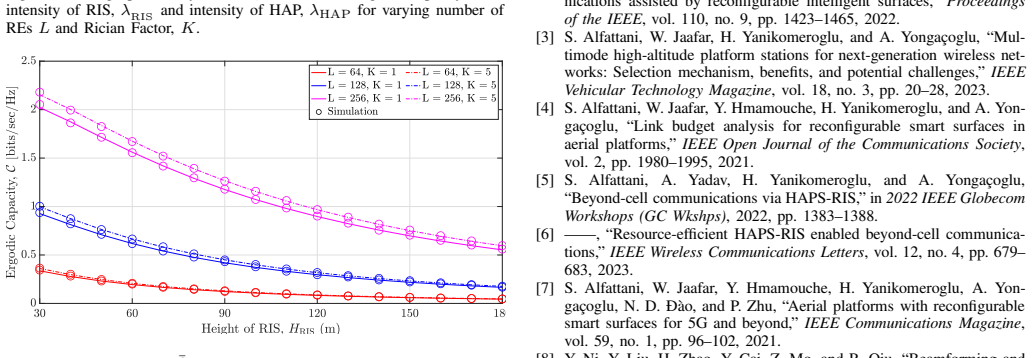
- Raising the RIS height lengthens the RIS-user path and lowers ergodic capacity, so low RIS placement is preferred whenever blockage permits.
Reading between the lines
- The argument's structure does not depend on HAPs specifically: any interference-limited network whose desired and interfering powers can be moment-matched as Gamma variables would inherit the same Beta-prime CDF and capacity formulas, so the method should transfer to other aerial or terrestrial RIS deployments.
- Because the blockage model enters only through the mean number of visible HAPs and the visibility probability, the 'blockages are helpful' conclusion is strongest in interference-limited regimes and could reverse when the desired link itself is frequently blocked; that conditional reading is not spelled out in the paper.
- A testable extension is to compare the Beta-prime fit not only on the bulk of the SIR distribution but on tail outage probabilities, since second-moment matching protects the center of the distribution more than the extreme tail; if the tail matters, a higher-order moment match or a different ratio distribution may be needed.
Signed reviews
Editorial analysis
A structured set of objections, weighed in public.
Referee Report
Summary. This paper develops a stochastic-geometry model of an urban RIS-assisted HAP network in which a ground user is served by the nearest HAP through the nearest visible RIS, and interference comes from other visible HAPs. Building blockages are modeled via a Boolean scheme. To avoid the Laplace transform, the numerator and denominator of the SIR are approximated as Gamma random variables using second-moment matching, which leads to a generalized Beta prime approximation for the SIR. The paper derives closed-form expressions for coverage probability (Theorem 1) and ergodic capacity (Theorem 2), and reports Monte Carlo validation for a range of system parameters.
Significance. The paper targets a relevant and timely scenario, and the idea of bypassing Laplace transforms via moment-matched Gamma approximations is potentially useful. I credit the authors for a physically parameterized model with no curve fitting: the Beta prime parameters are computed from the system's statistical moments, and the qualitative conclusions (blockages can help by suppressing interference, HAP densification hurts, RIS densification eventually saturates) are plausible and worth reporting. However, the mathematical core has correctness issues that affect the closed forms, so the contribution as currently presented cannot be accepted; the path to a publishable version is clear.
major comments (3)
- [III-B, Eq. (21)] The second moment of the interference power A_D is computed in Eq. (21) using E[A_D^2] = M_vis E[|h_i|^4] E[R_h^{-2*epsilon_h}] + M_vis(M_vis-1) (E[|h_i|^2])^2 (E[R_h^{-epsilon_h}])^2. This is the second moment of a sum with a fixed number of terms. For the nonhomogeneous PPP Phi_LOS in Section II-C, the number of visible HAPs is Poisson with mean M_vis, so the correct identity is E[A_D^2] = M_vis E[|h_i|^4] E[R_h^{-2*epsilon_h}] + M_vis^2 (E[|h_i|^2])^2 (E[R_h^{-epsilon_h}])^2. Consequently, the variance in Eq. (19) is underestimated (the term M_vis (E[X])^2 is subtracted instead of zero), alpha_D is overestimated, and the error propagates through Eq. (16) into Theorem 1 and Theorem 2. The authors should replace M_vis(M_vis-1) with M_vis^2 and re-derive the numerical results.
- [III-A, Lemma 1 and Eq. (10)] The PDF of the visible-HAP horizontal distance is normalized over the finite interval [0, omega_h] in Eq. (6), but omega_h is not defined in terms of the system parameters; the only statement is the vague inequality 'omega_h >= sqrt(2 exp(-rho))/zeta' in Lemma 1. Meanwhile, Eq. (2) gives M_vis as the mean number of visible HAPs over the infinite plane. These two choices are inconsistent unless the finite truncation is reflected in M_vis. Since the denominator moments in Eq. (10) depend on omega_h, all subsequent alpha_D, beta_D, Theorem 1, and Theorem 2 inherit this ambiguity. The authors must define omega_h (e.g., set omega_h = infinity, or derive it from the visibility model) and make M_vis consistent.
- [III-A and III-B, Eq. (18)] The interference moments use the unconditional visible-HAP distance distribution from Lemma 1, but the serving HAP is the nearest HAP of the PPP Phi. Thus all interfering HAPs are at horizontal distances no smaller than the serving HAP's horizontal distance, and the interference point process is Phi with the nearest point removed (a Palm distribution). The distance PDF in Lemma 1 is not conditioned on this exclusion, and the independence of N and D assumed in Section III-B is not justified. This is a load-bearing simplification: the reported numerical agreement should be re-examined once the moments are computed under the correct conditioning.
minor comments (6)
- [Section II-A] In the parameter list, 'mu_RIS' appears to be a typo; it should be 'lambda_RIS' to match the notation used elsewhere in the paper.
- [Eq. (8)] The support of f_{omega_h,any}(w_h) is written as '0 <= omega_h <= infinity'; it should be '0 <= w_h <= omega_h' to be consistent with the normalization in Eq. (9).
- [Lemma 1] The statement 'omega_h >= sqrt(2 exp(-rho))/zeta is the horizontal length of the link [14, Theorem 7]' is unclear; reference [14] concerns the ratio of gamma variates and does not define a physical link length. Please provide an explicit definition of omega_h.
- [Eq. (13)] The term '(zeta)2' should be 'zeta^2'.
- [Theorem 2] The regularized hypergeometric functions 2F1_tilde and 3F2_tilde are used without definition; a definition or a standard reference should be provided.
- [Section V] The Monte Carlo simulation procedure is not described in detail (e.g., simulation region, number of trials, realization of the Boolean blockage model). A precise description is needed to reproduce the validation, especially given the theoretical concerns above.
Circularity Check
No significant circularity: SIR parameters are computed from physical moments and validated against independent Monte Carlo simulation; self-citations are supporting, not load-bearing-by-construction.
full rationale
The paper's central derivation approximates the SIR as a generalized Beta prime distribution with shape parameters alpha_N, alpha_D, beta_N, beta_D obtained by gamma moment-matching (Eqs. (16)-(21)) from analytically computed physical moments of fading and geometry. No parameter is fitted to the Monte Carlo data; the Beta-prime form is justified as the ratio of two gamma approximants, and the resulting closed forms are benchmarked against independent simulation in Figs. 2-6. This is an approximation, not a definitional prediction. The distance-distribution results cited from the authors' prior work [10] and the generic capacity integral in [18] are supporting inputs with stated models and do not already contain the paper's Beta-prime coverage/capacity result; self-citation is therefore not load-bearing in a circular sense. The proof of Theorem 2 is deferred to [18], but this is an omitted-detail/correctness concern rather than circularity. Separately, Eq. (21) applies a deterministic-count second-moment identity to a Poisson sum (the honest PPP identity would use Mvis^2 for the E[N(N-1)] term), and the truncation radius omega_h in Lemma 1/Eq. (10) is never specified; these are mathematical-consistency issues that could affect the closed forms, but they do not make the derivation circular.
Assumptions & free parameters
free parameters (1)
- omega_h (upper integration limit for visible HAP distances)
assumptions (5)
- domain assumption Visible HAP process is a thinned PPP with visibility probability PLoS(wh) = exp(-(zeta*wh + rho)) depending only on horizontal distance wh
- domain assumption HAPo-RIS horizontal distance equals the distance from the user to the nearest HAP in the PPP
- ad hoc to paper Numerator and denominator of the SIR are independent and each Gamma-distributed with matching first two moments
- domain assumption Interference from other HAPs through RISs is negligible
- standard math Rician fading moment formula Eq. (5) is valid for all links
Cite this review
Pith. "Pith review of Urban RIS-Assisted HAP Networks: Performance Analysis Using Stochastic Geometry." pith.science (2026). https://pith.science/paper/HVYUJBDT
@misc{pith2026250615338,
  author       = {Pith},
  title        = {Pith review of: Urban RIS-Assisted HAP Networks: Performance Analysis Using Stochastic Geometry},
  year         = {2026},
  howpublished = {\url{https://pith.science/paper/HVYUJBDT}},
  note         = {Machine review of arXiv:2506.15338}
}
read the original abstract
This paper studies a high-altitude platform (HAP) network supported by reconfigurable intelligent surfaces (RISs). The practical irregular placement of HAPs and RISs is modeled using homogeneous Poisson point processes, while buildings that cause blockages in urban areas are modeled as a Boolean scheme of rectangles. We introduce a novel approach to characterize the statistical channel based on generalized Beta prime distribution. Analytical expressions for coverage probability and ergodic capacity in an interference-limited system are derived and validated through Monte Carlo simulations. The findings show notable performance improvements and reveal the impact of various system parameters, including blockages effect which contribute in mitigating interference from the other visible HAPs. This proposed system could enhance connectivity and enable effective data offloading in urban environments.
Figures


Figures from the paper (3 more)


Reference graph
Works this paper leans on
-
[18]
I. M. Tanash and T. Riihonen, “Tight logarithmic approx imations and bounds for generic capacity integrals and their applicatio ns to statistical analysis of wireless systems,” IEEE Trans. Commun. , vol. 70, no. 10, pp. 6456–6470, 2022
work page 2022
-
[1]
Un- leashing 3D connectivity in beyond 5G networks with reconfig urable intelligent surfaces,
J. He, A. Fakhreddine, A. S. de Sena, Y . Tian, and M. Debbah , “Un- leashing 3D connectivity in beyond 5G networks with reconfig urable intelligent surfaces,” in 2023 57th Asilomar Conference on Signals, Systems, and Computers , 2023, pp. 106–110
work page 2023
-
[2]
Nonterres trial commu- nications assisted by reconfigurable intelligent surfaces ,
J. Y e, J. Qiao, A. Kammoun, and M.-S. Alouini, “Nonterres trial commu- nications assisted by reconfigurable intelligent surfaces ,” Proceedings of the IEEE , vol. 110, no. 9, pp. 1423–1465, 2022
work page 2022
-
[3]
S. Alfattani, W. Jaafar, H. Y anikomeroglu, and A. Y ongaç oglu, “Mul- timode high-altitude platform stations for next-generati on wireless net- works: Selection mechanism, benefits, and potential challe nges,” IEEE V ehicular Technology Magazine, vol. 18, no. 3, pp. 20–28, 2023
work page 2023
-
[4]
Link budget analysis for reconfigurable smart sur faces in aerial platforms,
S. Alfattani, W. Jaafar, Y . Hmamouche, H. Y anikomeroglu, and A. Y on- gaçoglu, “Link budget analysis for reconfigurable smart sur faces in aerial platforms,” IEEE Open Journal of the Communications Society , vol. 2, pp. 1980–1995, 2021
work page 1980
-
[5]
Beyond-cell communications via HAPS-RIS,
S. Alfattani, A. Y adav, H. Y anikomeroglu, and A. Y ongaço glu, “Beyond-cell communications via HAPS-RIS,” in 2022 IEEE Globecom W orkshops (GC Wkshps), 2022, pp. 1383–1388
work page 2022
-
[6]
Resource-efficient HAPS-RIS enabled beyond-cell c ommunica- tions,
——, “Resource-efficient HAPS-RIS enabled beyond-cell c ommunica- tions,” IEEE Wireless Communications Letters , vol. 12, no. 4, pp. 679– 683, 2023
work page 2023
-
[7]
Aerial platforms with reconfi gurable smart surfaces for 5G and beyond,
S. Alfattani, W. Jaafar, Y . Hmamouche, H. Y anikomeroglu , A. Y on- gaçoglu, N. D. Ðào, and P . Zhu, “Aerial platforms with reconfi gurable smart surfaces for 5G and beyond,” IEEE Communications Magazine , vol. 59, no. 1, pp. 96–102, 2021
work page 2021
Show all 18 references
-
[8]
Beamformi ng and interference cancellation for RIS-assisted HAP-D2D commu nication systems,
Y . Ni, Y . Liu, H. Zhao, Y . Cai, Z. Mo, and R. Qiu, “Beamformi ng and interference cancellation for RIS-assisted HAP-D2D commu nication systems,” in 2023 IEEE Globecom W orkshops (GC Wkshps) , 2023, pp. 153–159
2023
-
[9]
A sim ula- tion framework for cooperative reconfigurable intelligent surface-based systems,
N. Simmons, J. W. Browning, S. L. Cotton, P . C. Sofotasios , D. Morales-Jimenez, M. Matthaiou, and M. A. B. Abbasi, “A sim ula- tion framework for cooperative reconfigurable intelligent surface-based systems,” IEEE Transactions on Communications , vol. 72, no. 1, pp. 480–495, 2024
2024
-
[10]
Enhancing HAP networks with reconfigurable intelligent surfaces,
I. M. Tanash, A. K. Dwivedi, F. R. Maleki, and T. Riihonen , “Enhancing HAP networks with reconfigurable intelligent surfaces,” in Proc. 6th International Conference on Communications, Signal Proce ssing, and their Applications (ICCSPA) , 2024
2024
-
[11]
Analysis of blockage ef fects on urban cellular networks,
T. Bai, R. V aze, and R. W. Heath, “Analysis of blockage ef fects on urban cellular networks,” IEEE Transactions on Wireless Communications , vol. 13, no. 9, pp. 5070–5083, 2014
2014
-
[12]
Performance analysis of ur ban satellite-terrestrial networks with 3D blockage effects: A stochastic geometry approach,
I. M. Tanash and R. Wichman, “Performance analysis of ur ban satellite-terrestrial networks with 3D blockage effects: A stochastic geometry approach,” TechRxiv, May 2024. [Online]. Available: http://dx.doi.org/10.36227/techrxiv.171709777.76962976/v1
2024
-
[13]
On the product of two κ-µ random variables and its application to double and composite fadin g channels,
N. Bhargav and Y . J. Chun, “On the product of two κ-µ random variables and its application to double and composite fadin g channels,” IEEE Trans. Wireless Commun. , vol. 17, no. 4, pp. 2457–2470, Apr. 2018
2018
-
[14]
Distribut ion of the ratio of Gamma variates,
K. O. Bowman, L. R. Shenton, and P . C. Gailey, “Distribut ion of the ratio of Gamma variates,” Communications in Statistics-Simulation and Computation, vol. 27, no. 1, pp. 1–19, 1998
1998
-
[15]
Gradshteyn and I
I. Gradshteyn and I. Ryzhik, Table of integrals, series, and products , 7th ed. Elsevier/Academic Press, 2007
2007
-
[16]
Primak, Stochastic Methods and Their Applications to Communica- tions: Stochastic Differential Equations Approach
S. Primak, Stochastic Methods and Their Applications to Communica- tions: Stochastic Differential Equations Approach . Wiley, 2004
2004
-
[17]
A generalized beta prime distribution as the ratio probabi lity density function for change detection between two SAR intensity ima ges with different number of looks,
G. Gallardo i Peres, J. Dall, P . J. Mason, R. Ghail, and S. Hensley, “A generalized beta prime distribution as the ratio probabi lity density function for change detection between two SAR intensity ima ges with different number of looks,” IEEE Transactions on Geoscience and R...
2024
Reviewed August 15, 2026 · model on record in the stance chip above.
Discussion (0). Continue with ORCID to comment.