REVIEW 3 major objections 5 minor 45 references
Multi-phase competition in quantum $XY$ pyrochlore antiferromagnet CdYb$_{2}$Se$_{4}$: zero and applied magnetic field study
T0 review · 3 major / 5 minor · reviewed 2026-08-14 · deepseek-v4-flash
Pith's one-line read The paper argues that a 3-tesla field switches CdYb2Se4 from an XY antiferromagnet to a splayed ferromagnet.
desk verdict Solid experimental study of a Yb spinel with a new field-induced crossover, but the exchange parameter fit is underdetermined and the phase-boundary claim should be read as plausible, not proven. read the letter →
The pith
A machine-rendered reading of the paper's core claim, the machinery that carries it, and where it could break.
The reading
What carries the argument
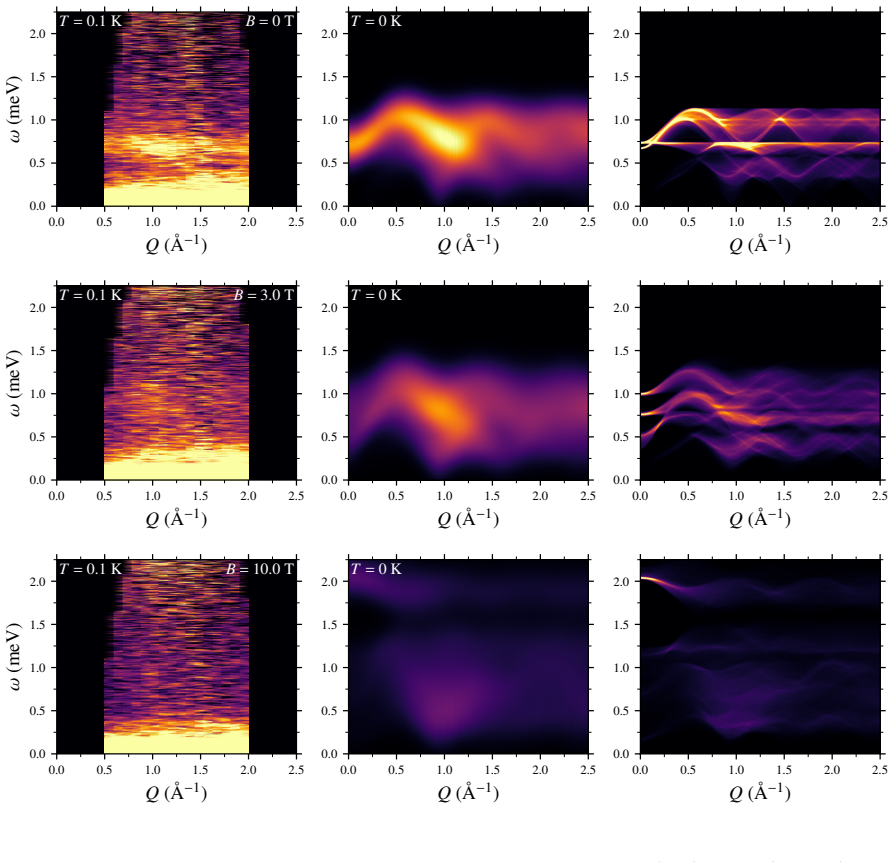
The load-bearing object is the nearest-neighbour anisotropic exchange Hamiltonian for effective $S=1/2$ Kramers doublets on the pyrochlore lattice, $H=\sum_{\langle ij\rangle} S_i^\top J_{ij} S_j - \mu_B B \cdot \sum_i g_i S_i$, with four couplings: Heisenberg $J$, Kitaev $K$, symmetric off-diagonal $\Gamma$, and Dzyaloshinskii-Moriya $D$. The paper's quantitative conclusions rest on a powder-averaging procedure (Eqs. (7) and (8)) in which, for each sampled field direction, only wave-vectors perpendicular to the field contribute to the computed Bragg and inelastic intensities. Within that scheme, $D/J=-0.3$ is fixed by the position of the flat band at 0.72 meV, while $K/J=\Gamma/J=-0.07$ is tuned to the field dependence of the (002) and (111) Bragg peaks; the resulting spectrum is computed in linear spin-wave theory and broadened to match the experimental resolution.
What would settle it
A single-crystal neutron diffraction experiment in an applied field could settle the claim without powder averaging: the model predicts a crossover in the Bragg intensities near 2-3 T and a specific angle-dependent evolution of the $\Gamma_5\to\Gamma_9$ conversion. If the observed crossover field, moment directions, or the disappearance of the 0.72 meV band above 3 T disagreed with the calculated powder-averaged spectra for $K/J=\Gamma/J=-0.07$, $D/J=-0.3$, the parameter set and the claimed proximity to the phase boundary would be ruled out.
Extended reading notes
Core claim
The paper reports that CdYb2Se4 orders below $T_N = 1.8$ K into a $\Gamma_5$ antiferromagnetic state with an ordered moment of $0.634(5)\,\mu_B$/Yb, much smaller than the single-ion value of $1.37\,\mu_B$, and that a field near $B_c=3$ T converts this into a $\Gamma_9$ splayed ferromagnet whose ferromagnetic component reaches $0.94(1)\,\mu_B$/Yb at 5 T. The zero-field inelastic spectrum shows a weakly dispersive band at $\hbar\omega\approx0.72$ meV that disappears above 3 T. The authors attribute this behaviour to an effective nearest-neighbour anisotropic exchange model with $J\sim7$ K, $K/J=\Gamma/J=-0.07$, and $D/J=-0.3$, which places the material close to the $\Gamma_5$/splayed-ferromagnet phase boundary. They further show that the field dependence of the magnetic Bragg intensities and the disappearance of the 0.72 meV band follow from the same model once powder averaging over field orientations is accounted for.
Load-bearing premise
The modelling stands on the assumption that the powder-averaged neutron intensities are faithfully represented by wave-vectors perpendicular to the field for each sampled field direction, and that the crystal-field parameters are accurate enough to constrain the anisotropic $g$-tensor; the paper itself notes that the crystal-field parameter space is wide and the ground-state doublet composition is not unambiguous.
Editorial extensions
If this is right
- At zero field, the ground state is a $\Gamma_5$ XY antiferromagnet with a strongly reduced ordered moment, consistent with strong quantum fluctuations.
- A field of about 3 T (lower at elevated temperature) drives a crossover to a $\Gamma_9$ splayed ice-like ferromagnet, and the $\Gamma_5$ Bragg contribution vanishes at $B_c$.
- The 0.72 meV excitation band, present at zero field, weakens with field and vanishes above 3 T, providing a direct spectroscopic marker of the phase competition.
- The estimated exchanges $K/J=\Gamma/J=-0.07$, $D/J=-0.3$ with $J\sim7$ K place CdYb2Se4 in the same region of the phase diagram as the ytterbium pyrochlores.
- Quantum (or other) order-by-disorder is expected to select one of the degenerate $\Gamma_5$ states, likely $\psi_3$, although powder data cannot distinguish $\psi_2$ from $\psi_3$.
Reading between the lines
- If the model is right, CdYb2Se4 is a tunable laboratory for order-by-disorder: single-crystal scattering should reveal which $\Gamma_5$ state (likely $\psi_3$) is selected and whether the selection changes under field.
- The discrepancy between the zero-field ordered moment (0.63 $\mu_B$) and the single-ion expectation (1.37 $\mu_B$) may quantify quantum fluctuations near the phase boundary; a similar reduction is expected in the spin correlations, which could be searched for in diffuse scattering.
- The same parameter-extraction scheme could be applied to other $T$Yb$_2X_4$ spinels to map how the $\Gamma_5$/splayed-ferromagnet boundary shifts with the crystal-field $g$-tensor, providing a chemical series in which to test the universality of the Yb-pyrochlore physics.
Signed reviews
Editorial analysis
A structured set of objections, weighed in public.
Referee Report
Summary. The paper reports a combined experimental and modeling study of the spinel CdYb2Se4, a pyrochlore-like magnet of Yb3+ ions. High-energy inelastic neutron scattering is used to determine crystal-electric-field (CEF) parameters, yielding a well-isolated ground doublet with a weakly Ising character (g||=3.67, g⊥=2.11). Powder neutron diffraction at 0.45 K identifies zero-field k=0 magnetic order in the Γ5 irreducible representation (ψ2/ψ3), and shows that an applied field drives a crossover near Bc=3 T to a Γ9 splayed ferromagnet. Low-energy inelastic neutron scattering reveals a weakly dispersive magnetic band near 0.72 meV that weakens with field and vanishes above 3 T. The authors model the low-energy physics with a nearest-neighbour anisotropic exchange Hamiltonian for effective S=1/2 Kramers doublets, fitting J, D, K, and Γ. They conclude that the estimated exchanges place CdYb2Se4 close to the phase boundary between the Γ5 and splayed-ferromagnet states, analogous to the Yb pyrochlores.
Significance. The experimental characterization is a valuable contribution: the identification of the Γ5 zero-field state and the Γ9 splayed ferromagnet at high field is directly supported by Rietveld refinements, including a March preferred-orientation model, and the 0.72 meV magnetic band is clearly observed in the inelastic data. The work extends the study of frustrated XY pyrochlore magnets to the spinel structure and suggests a new material for exploring Γ5/SF competition. However, the central quantitative claim of proximity to the Γ5/splayed-ferromagnet phase boundary is not established by the data: the exchange parameters are fitted to the same spectra and intensities that are later shown as agreement, and the CEF parameter space—and hence the g-tensor entering the Zeeman term—is admitted to be non-unique. The paper is strongest as an experimental report; the theoretical interpretation is plausible but underconstrained.
major comments (3)
- [§IV.B.2, Eq. (4)] The exchange parameters in Eq. (4) are fitted to the same data that are later presented as agreement: D/J=-0.3 is fixed by the position of the intensity maximum in the zero-field inelastic spectrum, and K/J=Γ/J=-0.07 is tuned to the field dependence of the (200) and (111) Bragg intensities. The subsequent matching of the calculated spectra and intensities is therefore a consistency check, not an independent test of the model. Since the claimed proximity to the Γ5/splayed-ferromagnet phase boundary rests entirely on these fitted values, the central claim is underconstrained by the data.
- [§IV.A and §IV.B.2] The authors state in §IV.A that the CEF parameter space fitting the INS data is 'rather wide' and that the ground-doublet composition is not unambiguous; they further state in §IV.B.2 that 'a quantitative agreement between theory and experiment should not be expected.' Because the Zeeman term in Eq. (2) and the field-driven crossover depend on the g-tensor derived from this CEF fit, the exchange ratios in Eq. (4) are not uniquely pinned. The proximity to the Γ5/SF phase boundary is thus one particular point in a degenerate parameter region rather than an established result; the authors should either demonstrate robustness of the phase-boundary claim to variations in the CEF parameters or re-frame the claim as a plausible interpretation.
- [§IV.B.2] The determination of K/J and Γ/J is qualitative: K and Γ are assumed equal, the fit targets 'qualitatively' the field dependence of the upturns in two Bragg peaks, and the low-field absolute intensities are explicitly inconsistent with the model. This does not yield a quantitative estimate of the exchange parameters or their uncertainties. The authors should show how the deduced phase-boundary proximity depends on the K=Γ assumption and on the fitted g-factors, or soften the conclusion accordingly.
minor comments (5)
- [Abstract] The abstract uses the undefined macro '\CYS'; it should read 'CdYb2Se4' explicitly.
- [Table II caption] The word 'neiboughring' in the caption should be 'neighboring'.
- [§IV.B.2, Eqs. (7)-(8)] The unit-vector notation in the powder-averaging integrals is not defined; please define \hat{B} and \hat{Q} explicitly and mention that the average over \hat{B} corresponds to averaging over crystallite orientations in a powder.
- [Figure 7] The figure caption does not label the left, middle, and right panels; please add panel labels for clarity.
- [§V Outlook] The sentence 'R=Yb, Er and B = Sn, Ti, Ge' appears to mix the rare-earth site and the B site; it should be clarified, since for Yb2B2O7 the rare earth is fixed to Yb and B is the non-magnetic cation.
Circularity Check
The zero-field and field-dependent 'agreements' of the exchange model are the fitting criteria themselves: D/J is fixed to the 0.72 meV spectral maximum and K/J=Gamma/J to the (002)/(111) intensity upturns, so the later 'matches' are by construction.
-
fitted input called prediction
[Section IV.B.2, paragraph determining D/J and inelastic comparison after Eq. (8)]
"We find that the position of the intensity maximum (as seen experimentally) corresponds to a flat band that is directly tuned by the strength of the DM interaction. From this observation, we find that a DM interaction of D/J∼−0.3 best reproduces the zero-field experimental inelastic spectrum ... The spectra contain a broad maximum near Q∼1 Å and ω∼0.7 meV (used to fix D/J =−0.3) which matches well the experimental spectra presented in Fig. 7 (left panel)."
D/J is fixed to the measured zero-field spectrum: the paper states that the intensity maximum corresponds to a flat band directly tuned by the DM interaction, and that D/J=-0.3 'best reproduces' that spectrum. The later statement that the model's zero-field spectrum 'matches well' is therefore an evaluation of the same observable used as the fitting target. The zero-field spectrum is not an independent test of D/J; the only independent checks would be field-dependent or other un-fitted features, which are described only qualitatively.
-
fitted input called prediction
[Section IV.B.2, paragraph 'Determining the values of K and Γ' and Bragg comparison after Eq. (8)]
"We have fixed K = Γ and tuned this common value to capture qualitatively the field dependence of the magnetic Bragg intensities; specifically the matching of the field dependence of the upturns in the [200] and [111] intensities. From these considerations we choose K/J = Γ/J =−0.07 ... The qualitative features of the Bragg evolution are captured by the theoretical calculation."
The symmetric exchanges are tuned so that the calculated field dependence of the (002) and (111) Bragg peaks matches the measured upturns. The conclusion that the model 'captures' the Bragg evolution is a restatement of this tuning condition. The paper also disclaims quantitative agreement and says low-field intensity ratios are not captured, so the claimed agreement is exactly the qualitative match used to fix K/J=Γ/J=-0.07. The field-induced crossover is thus encoded in the parameters rather than independently predicted.
1 more flagged steps
-
fitted input called prediction
[Section IV.B.2, paragraph on determining exchanges; zero-field ground-state statement]
"Since a Γ5 ground state is found experimentally, we assume that (K + Γ) < 0 and thus such a state is chosen at the classical level ... At zero field the model results in the Γ5 ground state, as is obtained in the experiment."
The inequality K+Γ<0 is imposed because the experiment already shows a Γ5 ground state. Reporting later that the model 'results in the Γ5 ground state' verifies the imposed constraint, not an independent outcome. This does not invalidate the experimental identification of Γ5 order, but the model's zero-field ground state cannot be cited as independent support for the model.
full rationale
The paper's central quantitative claim, that CdYb2Se4 sits close to the Γ5/splayed-ferromagnet phase boundary with parameters K/J=Γ/J=-0.07 and D/J=-0.3, is obtained by fitting those parameters to the same data later presented as agreement: D/J is chosen to reproduce the 0.72 meV zero-field spectral maximum, and K=Γ is tuned to reproduce the field dependence of the (002) and (111) Bragg intensities. The subsequent statements that the model 'matches well' or 'captures' these features are therefore by construction rather than independent predictions. I did not count the self-citations to Refs. 8 and 17 as circular per se, because they motivate a parameter regime but the numerical values come from the data fits. The admitted non-uniqueness of the CEF parameters and g-factors is a serious underdetermination concern, but it is a robustness/correctness issue rather than a formal circularity. The experimental observations themselves—Γ5 order at zero field, a crossover near 3 T, and the 0.72 meV band—are independent data; the circularity lies in presenting the fitted model's reproduction of those exact observables as validation.
Assumptions & free parameters
free parameters (6)
- CEF parameters B2_0, B4_0, B4_3, B6_0, B6_3, B6_6 =
-0.397, 0.026, 0.531, 0.0001, -0.005, 0.003 meV
- Heisenberg exchange J =
~7 K
- DM exchange D/J =
-0.3
- Kitaev exchange K/J =
-0.07
- Symmetric exchange Γ/J =
-0.07
- Preferred-orientation texture parameter G (March function) =
not quoted
assumptions (5)
- domain assumption The low-energy magnetic degrees of freedom are effective S=1/2 Kramers doublets on the pyrochlore lattice, with the excited CEF levels split off by about 30 meV.
- domain assumption The nearest-neighbour anisotropic exchange model of Eq. (2) with parameters J, K, Γ, D captures the physics of CdYb2Se4.
- domain assumption The exchange parameters lie in the regime J>0, J≳|D|≫K,Γ, as expected from the super-exchange framework of Ref. 8.
- domain assumption The zero-field ordered state can be treated as a classical k=0 state within the Γ5 manifold, and linear spin-wave theory around this state is valid.
- domain assumption The powder-averaging expressions of Eqs. (7) and (8), which restrict to Q perpendicular to the field for each sampled field direction, adequately represent the measured field-dependent intensities.
Cite this review
Pith. "Pith review of Multi-phase competition in quantum $XY$ pyrochlore antiferromagnet CdYb$_{2}$Se$_{4}$: zero and applied magnetic field study." pith.science (2026). https://pith.science/paper/HW7EMFJB
@misc{pith2026190809510,
  author       = {Pith},
  title        = {Pith review of: Multi-phase competition in quantum $XY$ pyrochlore antiferromagnet CdYb$_2$Se$_4$: zero and applied magnetic field study},
  year         = {2026},
  howpublished = {\url{https://pith.science/paper/HW7EMFJB}},
  note         = {Machine review of arXiv:1908.09510}
}
abstract
We study magnetic behaviour of the Yb$^{3+}$ ions on a frustrated pyrochlore lattice in the spinel {\CYS}. The crystal-electric field parameters deduced from high-energy inelastic neutron scattering reveal well-isolated ytterbium ground state doublet with a weakly Ising character. Magnetic order studied by powder neutron diffraction evolves from the $XY$-type antiferromagnetic $\Gamma_5$ state to a splayed ice-like ferromagnet (both with k=0) in applied magnetic field with $B_c$=3 T. Low-energy inelastic neutron scattering identifies weakly dispersive magnetic bands around 0.72 meV starting at $\mid\bf{Q}\mid$ = 1.1 \AA$^{-1}$~ at zero field, which diminish with field and vanish above 3 T. We explain the observed magnetic behaviour in framework of the nearest-neighbour anisotropic exchange model for effective $S=1/2$ Kramers doublets on the pyrochlore lattice. The estimated exchanges position the {\CYS} spinel close to the phase boundary between the $\Gamma_5$ and splayed ferromagnet states, similar to the Yb-pyrochlores suggesting an important role of the competition between these phases.
Figures


Figures from the paper (4 more)


Reference graph
Works this paper leans on
-
[1]
J. S. Gardner, M. J. P. Gingras, J. E. Greedan, Rev. Mod. Phys. 82 , 53 (2010)
work page 2010
-
[2]
A. M. Hallas, J. Gaudet, B. D. Gaulin, Annu. Rev. Condens. Matter Phys 9 , 105 (2018)
work page 2018
-
[3]
J. G. Rau, M. J. P. Gingras, Annu. Rev. Condens. Matter Phys 10 , 357 (2019)
work page 2019
- [4]
-
[5]
R. Sibille, N. Gauthier, H. Yan, M.-C. Hatnean, J. Ollivier, B. Winn, U. Filges, G. Balakrishnan, M. Kenzelmann, N. Shannon, T. Fennell, Nature Physics 14 , 711 (2018)
work page 2018
- [6]
-
[7]
M. J. P. Gingras, P. A. McClarty, Rep. Prog. Phys. 77 , 056501 (2014)
work page 2014
-
[8]
J. G. Rau, M. J. P. Gingras, Phys. Rev. B 98 , 054408 (2018)
work page 2018
Show all 45 references
-
[9]
G. C. Lau, R. S. Freitas, B. G. Ueland, P. Schiffer, R. J. Cava, Phys. Rev. B 72 , 054411 (2005)
2005
-
[10]
J. D. M. Champion, M. J. Harris, P. C. W. Holdsworth, A. S. Wills, G. Balakrishnan, S. T. Bramwell, E. C i z m\' a r, T. Fennell, J. S. Gardner, J. Lago, D. F. McMorrow, M. Orend\' a c , A. Orend\' a c ov\' a , D. McK. Paul, R. I. Smith, M. T. F. Telling, and A. Wildes, Phys. ...
2003
-
[11]
J. Lago, I. Z ivkovi\' c , B. Z. Malkin , J. R. Fernandez, P. Ghigna, P. Dalmas de R\' e otier, A. Yaouanc, T. Rojo Phys. Rev. Lett. 104 , 247203 (2010)
2010
-
[12]
S. Gao, O. Zaharko, V. Tsurkan, L. Prodan, E. Riordan, J. Lago, B. F k, A. R. Wildes, M. M. Koza, C. Ritter, P. Fouquet, L. Keller, E. Can \'e vet, M. Medarde, J. Blomgren, C. Johansson, S. R. Giblin, S. Vrtnik, J. Luzar, A. Loidl, C. R\"uegg, T. Fennell, Phys. Rev. Lett. 120 ...
2018
-
[13]
T. Higo, K. Iritani, M. Halim, W. Higemoto, T. U. Ito, K. Kuga, K. Kimura, S. Nakatsuji, Phys. Rev. B 95 , 174443 (2017)
2017
-
[14]
Dalmas de R\' e otier, C
P. Dalmas de R\' e otier, C. Marin, A. Yaouanc, C. Ritter, A. Maisuradze, B. Roessli, A. Bertin, P. J. Baker, A. Amato, Phys. Rev. B 96 , 134403 (2017)
2017
-
[15]
J. G. Rau, S. Petit, M. J. P. Gingras, Phys. Rev. B 93 , 184408 (2016)
2016
-
[16]
HallasARCMP, Rau2019, Reotier2017
The possible magnetic orders on the pyrochlore lattice are summarised in numerous publications, see for example Refs. HallasARCMP, Rau2019, Reotier2017
-
[17]
J. G. Rau, L. S. Wu, A. F. May, L. Poudel, B. Winn, V. O. Garlea, A. Huq, P. Whitfield, A: E. Taylor, M. D. Lumsden, M. J. P. Gingras, A. D. Christianson, Phys. Rev. Lett. 116 , 257204 (2016)
2016
-
[18]
R. I. Bewley, T. Guidi, S. M. Bennington, Notiziario Neutroni e Luce di Sincrotrone 14 , 22 (2009)
2009
-
[19]
Rotter, J
M. Rotter, J. Mag. Magn. Mater. 272-276, E481 (2004)
2004
-
[20]
Rodr\' i guez-Carvajal, Phys
J. Rodr\' i guez-Carvajal, Phys. B: Condens. Matt. 192 , 55 (1993)
1993
-
[21]
Petrenko, M
O. Petrenko, M. R. Lees, G. Balakrishnan, Eur. Phys. J. B 86, 416 (2013)
2013
-
[22]
R\' e otier et al
We observed also an additional peak which can be indexed as ( ) of . R\' e otier et al. Reotier2017 attributed it to an impurity. Indeed, this is probably the (0 0 ) magnetic peak of Yb _2 O _2 Se, which orders at T _N =2.65 K with the wave vector (0 0 )
-
[23]
Le SAFiCF
D. Le SAFiCF. URL http://www.yocto.me/work/saficf/index.html
-
[24]
Mirebeau, A
I. Mirebeau, A. Apetrei, J. Rodr\' i guez-Carvajal, P. Bonville, A. Forget, D. Colson, V. Glazkov, J. P. Sanchez, O. Isnard, E. Suard, Phys. Rev. Lett. 94 , 246402 (2005)
2005
-
[25]
S. H. Curnoe, Phys. Rev. B 78 , 094418 (2008)
2008
-
[26]
K. A. Ross, L. Savary, B.D. Gaulin, L. Balents, Phys. Rev. X 1 , 1021002 (2011)
2011
-
[27]
M. E. Zhitomirsky, M.V. Gvozdikova, P. C.W. Holdsworth, R. Moessner, Phys. Rev. Lett. 109, 077204 (2012)
2012
-
[28]
Savary, K
L. Savary, K. A. Ross, B. D. Gaulin, J. P. C. Ruff, L. Balents, Phys. Rev. Lett. 109 , 167201 (2012)
2012
-
[29]
A. W. C. Wong, Z. Hao, M. J. P. Gingras, Phys. Rev. B 88 , 144402 (2013)
2013
-
[30]
P. A. McClarty, P. Stasiak, M. J. P. Gingras, Phys. Rev. B 89 , 024425 (2014)
2014
-
[31]
Andreanov, P
A. Andreanov, P. A. McClarty, Phys. Rev. B 91 , 064401 (2015)
2015
-
[32]
V. S. Maryasin and M. E. Zhitomirsky, Phys. Rev. B 90, 094412 (2014)
2014
-
[33]
Lhotel, J
E. Lhotel, J. Robert, E. Ressouche, F. Damay, I. Mirebeau, J. Ollivier, H. Mutka, P. Dalmas de R\' e otier, A. Yaouanc, C. Marin, C. Decorse, S. Petit, Phys. Rev. B 95 , 134426 (2017)
2017
-
[34]
Poole, A
A. Poole, A. S. Wills, E. Leli\' e vre-Berna, J. Phys. : Condens. Matt. 19 , 452201 (2007)
2007
-
[35]
K. A. Ross, Y. Qiu, J. R. D. Copley, H. A. Dabkowska, B. D. Gaulin, Phys. Rev. Lett. 112 , 057201 (2014)
2014
-
[36]
Petit, J
S. Petit, J. Robert, S. Guitteny, P. Bonville, C. Decorse, J. Ollivier, H. Mutka, M. J. P. Gingras, I. Mirebeau, Phys. Rev. B 90, 060410(R) (2014)
2014
-
[37]
J. D. Thompson, P. A. McClarty, D. Prabhakaran, I. Cabrera, T. Guidi, R. Coldea, Phys. Rev. Lett. 119 , 057203 (2017)
2017
-
[38]
K. A. Ross, J. P. C. Ruff, C. P. Adams, J. S. Gardner, H. A. Dabkowska, Y. Qiu, J. R. D. Copley, B. D. Gaulin, Phys. Rev. Lett. 103 , 227202 (2009)
2009
-
[39]
Chang, S
L.-J. Chang, S. Onoda, Y. Su, Y.-J. Kao, K.-D. Tsuei, Y. Yasui, K. Kakurai, M. R. Lees, Nature Comm. 3 , 992 (2012)
2012
-
[40]
Robert, E
J. Robert, E. Lhotel, G. Remenyi, S. Sahling, I. Mirebeau, C. Decorse, B. Canals, S. Petit, Phys. Rev. B 92 , 064425 (2015)
2015
-
[41]
Gaudet, K
J. Gaudet, K. A. Ross, E. Kermarrec, N. P. Butch, G. Ehlers, H. A. Dabkowska, B. D. Gaulin, Phys. Rev. B 93 , 064406 (2016)
2016
-
[42]
H. Yan, O. Benton, L. Jaubert, N. Shannon, Phys. Rev. B 95 , 094422 (2017)
2017
-
[43]
Jaubert, O
L. Jaubert, O. Benton, J. G. Rau, J. Oitmaa, R. R. P. Singh, N. Shannon, M. J. P. Gingras, Phys. Rev. Lett. 115 , 267208 (2015)
2015
-
[44]
Yaouanc, P
A. Yaouanc, P. Dalmas de R\' e otier, L. Keller, B. Roessli, A. Forget, J. Phys.: Condens. Matter. 28 , 426002 (2016)
2016
-
[45]
A. M. Hallas, J. Gaudet, N. P. Butch, M. Tachibana, R. S. Freitas, G. M. Luke, C. R. Wiebe, B. D. Gaulin, Phys. Rev. B 93 , 100403(R) (2016)
2016
Reviewed August 14, 2026 · model on record in the stance chip above.
Discussion (0). Continue with ORCID to comment.