REVIEW 3 major objections 5 minor 202 references
A Pairwise Differencing Distribution Regression Approach for Network Models
T0 review · 3 major / 5 minor · reviewed 2026-08-06 · deepseek-v4-flash
Pith's one-line read The paper develops a distribution regression estimator for dyadic networks that differences out two-way fixed effects by conditioning on quadruples of nodes, remaining valid under sparsity and enabling simultaneous inference across…
desk verdict Fix the conditioning event in Eq. (4) and pin down Assumption 4.1, and this is a solid joint-inference extension of the Charbonneau-Jochmans CMLE; as written it is not ready. read the letter →
The pith
A machine-rendered reading of the paper's core claim, the machinery that carries it, and where it could break.
The reading
What carries the argument
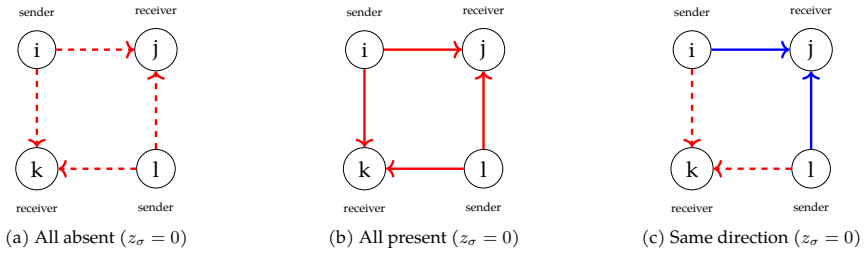
The load-bearing object is the informative quadruple: an ordered set of two senders and two receivers in which each node's binarized outcome varies across its two links, coded by $z_\sigma = ((\tilde{y}_{ij}-\tilde{y}_{ik})-(\tilde{y}_{lj}-\tilde{y}_{lk}))/2 \in \{-1,1\}$, with pairwise-differenced covariates $r_\sigma = (x_{ij}-x_{ik})-(x_{lj}-x_{lk})$. Conditional on $z_\sigma \in \{-1,1\}$, the logistic structure gives $\Pr(z_\sigma=1) = \Lambda(r_\sigma' \theta_{y,0})$, so the fixed effects are differenced out and estimation reduces to a standard logit on these transformed quadruples. For joint inference, the machinery is the blockwise score-rate matrix $D_{n,y} = \mathrm{diag}((n^6 p_{n,y_k})^{1/2} I_p)$, which normalizes each threshold's score covariance by its own informativeness rate so that no restriction is placed on how convergence rates compare across thresholds.
What would settle it
A direct check is to simulate the model with two thresholds separated by a shrinking gap, for example empirical quantiles $\tau$ and $\tau+\delta_n$ with $\delta_n \to 0$, and compute the smallest eigenvalue of the block-normalized score covariance; if it collapses to zero while pointwise rate conditions still hold, the joint nondegeneracy assumption is violated. A second check is to run the estimator at the 99th percentile in samples of size $n=157$, where the paper's own right-tail condition $\sqrt{n}(1-q_{n,y}) \to \infty$ is not met, and examine whether the sup-t bands still achieve nominal coverage.
Extended reading notes
Core claim
The central claim is that the structural parameter path $\theta_0(y)$ is identified and estimable pointwise at each threshold by applying conditional maximum likelihood to the binarized outcome $\tilde{y}_{ij,y} = 1\{y_{ij} \le y\}$. Under the logistic link, conditioning on the events that each node in an ordered quadruple has exactly one link present and one absent makes the probability of observing one of the two informative configurations equal to $\Lambda(((x_{ij}-x_{ik})-(x_{lj}-x_{lk}))'\theta_{y,0})$, with fixed effects entirely absent. The paper proves consistency and asymptotic normality for each fixed threshold under sparsity, with rate $(n(n-1)p_{n,y})^{-1/2}$, and its main new result, Theorem 3, gives a joint Gaussian approximation: after each threshold block is normalized by its own score-rate matrix, the coordinatewise studentized estimates are approximately $N(0, P_{n,y})$ with a correlation matrix that may vary with $n$. This delivers sup-t confidence bands that cover the entire coefficient path and a sup-t equality test that controls family-wise error.
Load-bearing premise
The load-bearing premise is that, after each threshold block is rescaled by its own rate, the joint covariance of the score vectors stays bounded away from singularity; if the chosen thresholds are so close together that their binarized outcomes almost coincide, this condition fails and the joint inference breaks down.
Editorial extensions
If this is right
- Applied researchers can estimate distributional effects in dyadic data without assuming link probabilities are bounded away from zero or one, so sparse networks and extreme quantiles are no longer out of reach.
- Simultaneous sup-t bands provide valid joint coverage even when convergence rates differ across thresholds, while pointwise intervals interpreted jointly under-cover.
- The Wald test of coefficient equality can over-reject as the number of thresholds grows; the sup-t test keeps size near nominal and locates where the differences arise.
- Ratios of estimated coefficients at a given threshold can be interpreted as ratios of partial derivatives of the conditional quantile function, giving economic objects such as distance-equivalent trade barriers even though fixed effects are not estimated.
- The framework transfers from trade to other dyadic settings—migration, investment, patent flows—where sparse networks and mass at zero are common.
Reading between the lines
- Beyond the paper: when thresholds are chosen adaptively from the data, the requirement that they be separated enough to keep the joint covariance nondegenerate suggests a practical rule—space thresholds so each interval contains a non-negligible fraction of observations—which the paper states as a caution but does not formalize.
- Beyond the paper: the right-tail estimability condition implies that claims about the very far tail, such as the 99th percentile with hundreds of nodes, should be read as design-dependent; a researcher with about 150 nodes may need to stop at lower quantiles or use a bootstrap calibration to check coverage.
- Beyond the paper: the ratio interpretation for gravity could be turned into a policy metric, for instance the distance-equivalent value of a visa waiver or a free-trade agreement, a use the paper mentions for migration but does not develop.
- Beyond the paper: because the estimator discards all non-informative quadruples, it loses efficiency relative to bias correction in dense regions; an open, testable extension is a hybrid that uses bias-corrected estimates in dense parts of the distribution and conditional likelihood in the tails, with a smooth transition.
Editorial analysis
A structured set of objections, weighed in public.
Referee Report
Summary. The paper develops a distribution regression model for directed dyadic networks with two-way fixed effects that vary by threshold. The outcome is binarized at each threshold and estimated by the conditional maximum likelihood estimator of Charbonneau (2017) and Jochmans (2018), which conditions on informative quadruples to eliminate fixed effects. Pointwise asymptotic theory is adapted from Jochmans; the main new contribution is Theorem 3, a joint Gaussian approximation for the studentized estimator across a finite set of thresholds with threshold-specific convergence rates, used to build sup-t simultaneous confidence bands and equality tests. The paper reports Monte Carlo evidence and applies the method to bilateral trade data, finding heterogeneous coefficients across the distribution.
Significance. If the results hold, the paper fills a genuine gap: distribution regression with two-way fixed effects in sparse networks, and joint inference across thresholds with different rates, is a useful extension beyond single-threshold network formation models. The paper is careful to separate pointwise results from the joint approximation and to state assumptions explicitly; the Monte Carlo is calibrated to the application and the proofs are detailed. The main value is the sup-t construction with a correlation matrix allowed to vary with n. However, the central conditioning event in Eq. (4) is internally inconsistent as written, and the joint nondegeneracy assumption is not verified in the empirical grid, so the current version does not support the main claims.
major comments (3)
- [Section 2.2, Eq. (4)] The conditioning events are internally inconsistent. Let a=tilde y_ij,y, b=tilde y_ik,y, c=tilde y_lj,y, d=tilde y_lk,y. The stated set {a+b=1, c+d=1, a+d=1} has exactly two solutions, (a,b,c,d)=(1,0,1,0) and (0,1,0,1); in both cases z_sigma=((a-b)-(c-d))/2=0. Hence no quadruple satisfying the stated events is informative, and the conditional probability in Eq. (4) is not the logistic form claimed. Figure 1(a), with a=1,d=1, violates a+d=1. The correct conditioning set should include a column-sum condition such as a+c=1 (equivalently b+d=1), not a+d=1. Because Eq. (5), Lemma 2, the score in Section 3, and all subsequent proofs build on this conditioning, the estimator and all theorems are as yet undefined.
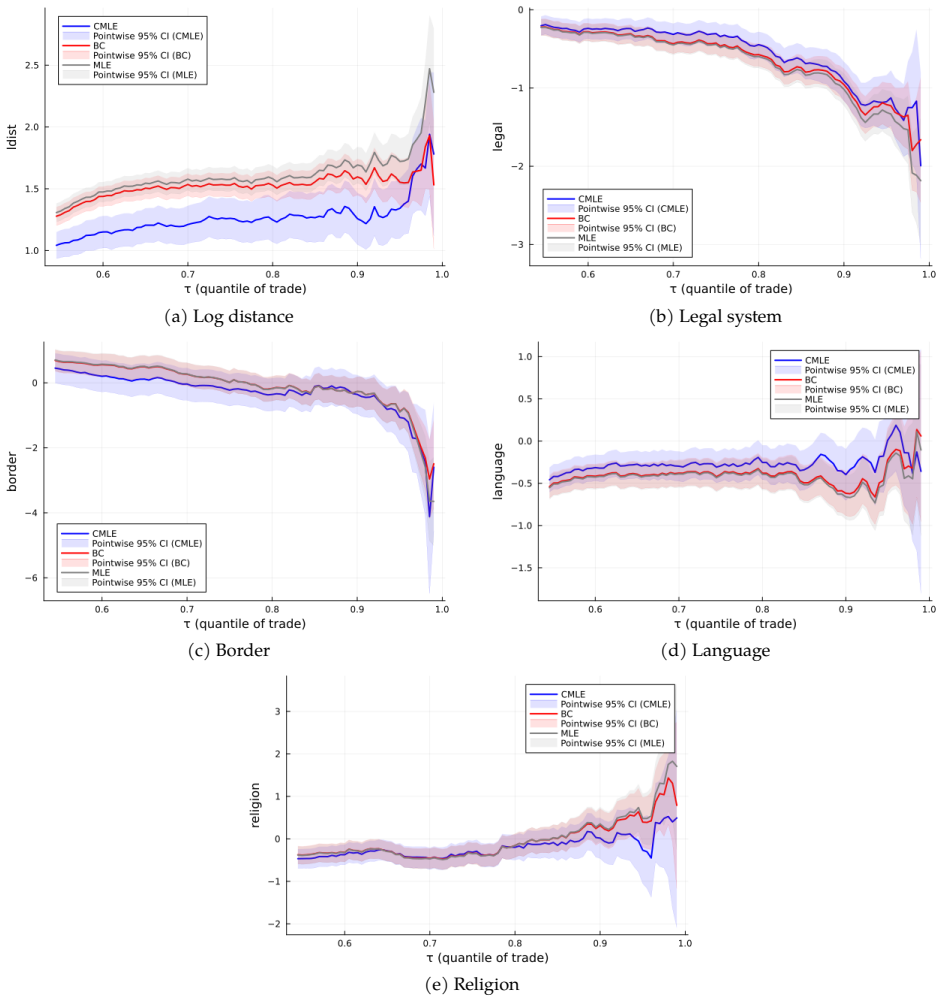
- [Section 4.1, Assumption 4.1 and Sections 5-6] The joint nondegeneracy condition is high-level, and the paper itself states that it fails when thresholds are close enough that the binary indicators nearly coincide. In the application, thresholds are empirical quantiles spaced 0.005 apart (Section 6, Table 3, K between 82 and 90), and with n=157 adjacent indicators differ for only about 122 of 24,492 dyads, so the block-normalized score covariance can be very close to singular. No eigenvalue diagnostics for P_n,y are reported in the Monte Carlo or the application. Since Theorem 3(i) and the sup-t critical values in Algorithm 1 rely on a nondegenerate estimated correlation matrix, the empirical bands in Figure 6 and Table 3 are not supported by the stated assumptions. Please either provide primitive conditions on the threshold grid that guarantee Assumption 4.1, or report the empirical eigenvalues of P_n,y and show they are bounded away from zero for all included thresholds.
- [Section 3.1 and Section 6] The theory is stated for a fixed finite collection of thresholds y, with the right-tail estimability condition sqrt(n)(1-q_n,y) -> infinity. The application and simulation designs instead use sample empirical quantiles, with thresholds up to tau=0.99; for n=157, sqrt(n)(1-q) is about 0.125 at the 99th percentile, which is far from the divergence required, and the paper provides no finite-sample diagnostics showing that the normal approximation works in this regime. Moreover, empirical quantiles are data-dependent, and the paper does not explain how the fixed-threshold theory applies to them. This affects the pointwise standard errors in the upper tail and the sup-t bands in Table 3. Please either extend the theory to data-dependent thresholds, or make explicit that thresholds are treated as fixed and discuss the finite-sample consequences of the tail condition.
minor comments (5)
- [Abstract and Section 3] The phrase 'asymptotically unbiased' is stronger than what Theorem 2 establishes; the theorem proves consistency and asymptotic normality with a rate depending on p_n,y. Consider using 'consistent' or 'asymptotically unbiased to first order'.
- [Section 5.1] The text contains an empty placeholder 'Appendix...' when referring to additional Monte Carlo results; this should be filled in with the relevant appendix or supplemental section.
- [Figure 7 caption] The caption should state the units of the vertical axis and define the differencing interval more explicitly (for example, 'theta_n,d(tau) - theta_n,d(tau-0.20)').
- [Section 6] The sample size n=157 and the number of dyads (24,492) are central to interpreting K=82-90 in Table 3; consider stating these figures in the main text rather than only in the Supplemental Appendix.
- [Algorithm 1] Drawing from Omega_n,d and standardizing is equivalent to drawing from the implied correlation matrix P_n,d; drawing from P_n,d directly would be numerically more stable near singularity and would make the standardization step unnecessary.
Circularity Check
No significant circularity: pointwise theory is adapted from Jochmans (2018) with independent proofs, and the joint distribution is derived from primitive score and projection arguments rather than assumed.
full rationale
The derivation chain is self-contained against external benchmarks. Pointwise consistency and asymptotic normality (Theorems 1-2) are adapted from Jochmans (2018) rather than assumed: the paper restates the estimator of Charbonneau (2017), proves sufficiency (Lemma 1) and the conditional-logit form (Lemma 2) for its quadruple conditioning, and Appendix C carries out the projection, conditional CLT, Hessian, and variance-order steps with explicit rates. The joint result (Theorem 3) is derived in Appendix E from primitive stacked score and projection arguments, with Assumption 4.1 serving as a stated high-level nondegeneracy condition; it is not a restatement of the conclusion, and the correlation matrix is allowed to vary with n rather than being fixed by fiat. The sup-t bands and equality tests are applications of Montiel Olea and Plagborg-Moller (2019) to the Gaussian approximation, so no fitted input is relabeled as a prediction. The Monte Carlo DGP calibrates true parameters to MLE estimates from the trade data, but this calibration is an evaluation device and does not enter the theoretical claims. Concerns that Assumption 4.1 may fail for 0.005-spaced thresholds with n=157 are about the realism of the maintained assumptions, not about circularity; no load-bearing step reduces by construction to its own input.
Assumptions & free parameters
assumptions (7)
- domain assumption The link function Lambda is the logistic CDF (Equation 1).
- domain assumption The errors epsilon_ij,y are i.i.d. Logistic(0,1) across dyads at each threshold, independent of covariates and fixed effects, with cross-threshold dependence allowed.
- domain assumption The fixed effects enter additively as alpha_i,y + gamma_j,y and can vary freely across thresholds.
- domain assumption Assumption 3.1: the n nodes are sampled independently.
- domain assumption Assumption 3.4: n p_{n,y} -> infinity and the normalized expected Hessian has full rank.
- ad hoc to paper Assumptions 3.6 and 4.1: eigenvalue floors on the dyad-clustered score outer-product and its block-normalized joint version.
- standard math Assumptions 3.2, 3.3 and 3.5: compact parameter space and bounded second and sixth moments of covariates.
Cite this review
Pith. "Pith review of A Pairwise Differencing Distribution Regression Approach for Network Models." pith.science (2026). https://pith.science/paper/HY6QVUGJ
@misc{pith2026260804983,
  author       = {Pith},
  title        = {Pith review of: A Pairwise Differencing Distribution Regression Approach for Network Models},
  year         = {2026},
  howpublished = {\url{https://pith.science/paper/HY6QVUGJ}},
  note         = {Machine review of arXiv:2608.04983}
}
read the original abstract
I develop an estimation and inference framework for distribution regression in dyadic network settings with two-way fixed effects that vary across thresholds of the outcome. I show that identification of the structural parameters is achieved through binarization of the outcome at each threshold, and estimate the model by conditional maximum likelihood, which "differences out" the fixed effects and circumvents the incidental parameter problem. The estimator remains asymptotically unbiased under sparsity, whether from the network structure or binarization at extreme thresholds. The second novelty is to establish the joint asymptotic distribution of the estimators across multiple thresholds with different convergence rates, and to develop simultaneous confidence bands and tests for equality of coefficients across thresholds. Monte Carlo simulations confirm small bias, valid inference, and correct simultaneous coverage under sparsity. An application to bilateral trade finds that coefficients vary substantially across the distribution, with equality rejected for key trade barriers.
Figures


Figures from the paper (20 more)




Reference graph
Works this paper leans on
-
[1]
Shaping the World Economy; Suggestions for an International Economic Policy , author =
-
[2]
American Economic Review , volume=
Gravity with gravitas: A solution to the border puzzle , author=. American Economic Review , volume=
-
[3]
Probability Theory and Related Fields , volume =
Chernozhukov, Victor and Chetverikov, Denis and Kato, Kengo , title =. Probability Theory and Related Fields , volume =. 2015 , doi =
2015
-
[4]
Journal of Political Economy , volume=
Production networks, geography, and firm performance , author=. Journal of Political Economy , volume=. 2019 , publisher=
2019
-
[5]
Journal of Political Economy , volume=
The origins of firm heterogeneity: A production network approach , author=. Journal of Political Economy , volume=. 2022 , publisher=
2022
-
[6]
Journal of Economic Perspectives , volume=
From micro to macro via production networks , author=. Journal of Economic Perspectives , volume=. 2014 , publisher=
2014
-
[7]
Functional Differencing in Networks , author=. Revue. 2024 , publisher=
2024
-
[8]
Review of International Economics , volume=
Quantile Gravity: Economic Integration Agreements, Least Traded Goods, and Less Developed Economies , author=. Review of International Economics , volume=. 2025 , publisher=
2025
Show all 202 references
-
[10]
Available at SSRN 2988698 , year=
Semiparametric estimation in network formation models with homophily and degree heterogeneity , author=. Available at SSRN 2988698 , year=
-
[11]
Journal of Econometrics , volume=
A jackknife bias correction for nonlinear network data models with fixed effects , author=. Journal of Econometrics , volume=. 2026 , publisher=
2026
-
[12]
Econometrica , pages=
Maximum likelihood estimation of misspecified models , author=. Econometrica , pages=. 1982 , publisher=
1982
-
[13]
2025 , school=
Essays on Econometrics: Sparsity, Duration, and Binomial Panel Data Models , author=. 2025 , school=
2025
-
[16]
Econometrica , volume=
Bounds on parameters in panel dynamic discrete choice models , author=. Econometrica , volume=. 2006 , publisher=
2006
-
[17]
Econometrica , volume=
Average and quantile effects in nonseparable panel models , author=. Econometrica , volume=. 2013 , publisher=
2013
-
[19]
Journal of the American Statistical Association , volume=
Uniform inference for kernel density estimators with dyadic data , author=. Journal of the American Statistical Association , volume=. 2024 , publisher=
2024
-
[20]
The Annals of Statistics , volume=
Empirical process results for exchangeable arrays , author=. The Annals of Statistics , volume=. 2021 , publisher=
2021
-
[21]
Review of Economics and Statistics , pages=
Identification of average marginal effects in fixed effects dynamic discrete choice models , author=. Review of Economics and Statistics , pages=. 2024 , publisher=
2024
-
[22]
2025 , institution=
Identification and estimation of average causal effects in fixed effects logit models , author=. 2025 , institution=
2025
-
[23]
2024 , institution=
Identification of Dynamic Panel Logit Models with Fixed Effects , author=. 2024 , institution=
2024
-
[27]
Empirical Economics , volume=
Estimation of structural gravity quantile regression models , author=. Empirical Economics , volume=. 2016 , publisher=
2016
-
[28]
arXiv preprint arXiv:2505.10814 , year=
Distribution Regression with Censored Selection , author=. arXiv preprint arXiv:2505.10814 , year=
-
[29]
Journal of Political Economy , volume=
Distribution regression with sample selection and uk wage decomposition , author=. Journal of Political Economy , volume=. 2025 , publisher=
2025
-
[30]
2005 , publisher=
Testing statistical hypotheses , author=. 2005 , publisher=
2005
-
[31]
The Annals of Statistics , pages=
Asymptotics in directed exponential random graph models with an increasing bi-degree sequence , author=. The Annals of Statistics , pages=. 2016 , publisher=
2016
-
[32]
Journal of International Economics , pages=
The tails of gravity: Using expectiles to quantify the trade-margins effects of economic integration agreements , author=. Journal of International Economics , pages=. 2025 , publisher=
2025
-
[33]
Journal of the American Statistical Association , volume=
Exact and approximate stepdown methods for multiple hypothesis testing , author=. Journal of the American Statistical Association , volume=. 2005 , publisher=
2005
-
[34]
Journal of Applied Econometrics , volume=
Simultaneous confidence bands: Theory, implementation, and an application to SVARs , author=. Journal of Applied Econometrics , volume=. 2019 , publisher=
2019
-
[35]
Journal of Econometrics , volume=
Efficient minimum distance estimation with multiple rates of convergence , author=. Journal of Econometrics , volume=. 2012 , publisher=
2012
-
[36]
Quantitative Economics , volume=
Fixed-effects binary choice models with three or more periods , author=. Quantitative Economics , volume=. 2023 , publisher=
2023
-
[37]
The Quarterly Journal of Economics , volume=
Estimating trade flows: Trading partners and trading volumes , author=. The Quarterly Journal of Economics , volume=. 2008 , publisher=
2008
-
[38]
Econometrica , volume=
Sample selection as a specification error , author=. Econometrica , volume=
-
[39]
The Review of Economics and Statistics , volume=
The log of gravity , author=. The Review of Economics and Statistics , volume=. 2006 , publisher=
2006
-
[40]
Journal of Econometrics , volume=
Individual and time effects in nonlinear panel models with large N, T , author=. Journal of Econometrics , volume=. 2016 , publisher=
2016
-
[41]
Review of Economics and Statistics , volume=
Two-way models for gravity , author=. Review of Economics and Statistics , volume=. 2017 , publisher=
2017
-
[42]
Journal of econometrics , volume=
Multiplicative-error models with sample selection , author=. Journal of econometrics , volume=. 2015 , publisher=
2015
-
[43]
The American economic review , volume=
A theoretical foundation for the gravity equation , author=. The American economic review , volume=. 1979 , publisher=
1979
-
[44]
Cambridge Working Papers in Economics , year=
Modified-likelihood estimation of fixed-effect models for dyadic data , author=. Cambridge Working Papers in Economics , year=
-
[45]
Econometrica , pages=
Consistent estimates based on partially consistent observations , author=. Econometrica , pages=. 1948 , publisher=
1948
-
[46]
The Econometrics Journal , volume=
Multiple fixed effects in binary response panel data models , author=. The Econometrics Journal , volume=. 2017 , publisher=
2017
-
[47]
Econometric Society Monographs , volume=
Understanding bias in nonlinear panel models: Some recent developments , author=. Econometric Society Monographs , volume=. 2007 , publisher=
2007
-
[48]
Handbook of econometrics , volume=
Panel data models: some recent developments , author=. Handbook of econometrics , volume=. 2001 , publisher=
2001
-
[49]
Econometrica: Journal of the Econometric Society , pages=
Generalized econometric models with selectivity , author=. Econometrica: Journal of the Econometric Society , pages=. 1983 , publisher=
1983
-
[50]
Journal of political economy , volume=
Increasing returns and economic geography , author=. Journal of political economy , volume=. 1991 , publisher=
1991
-
[51]
Econometrica , volume=
An econometric model of network formation with degree heterogeneity , author=. Econometrica , volume=. 2017 , publisher=
2017
-
[52]
Review of Economics and Statistics , volume=
An empirical model of dyadic link formation in a network with unobserved heterogeneity , author=. Review of Economics and Statistics , volume=. 2019 , publisher=
2019
-
[53]
2016 , publisher=
Estimating fixed effects logit models with large panel data , author=. 2016 , publisher=
2016
-
[54]
The robustness of conditional logit for binary response panel data models with serial correlation , author=. August. US Bureau of Labor Statistics Working Paper , volume=
-
[55]
Journal of Business & Economic Statistics , volume=
Semiparametric analysis of network formation , author=. Journal of Business & Economic Statistics , volume=. 2018 , publisher=
2018
-
[56]
Journal of Econometrics , volume=
Semiparametric estimation of censored selection models with a nonparametric selection mechanism , author=. Journal of Econometrics , volume=. 1993 , publisher=
1993
-
[57]
Econometrica: Journal of the Econometric Society , pages=
Estimation of a panel data sample selection model , author=. Econometrica: Journal of the Econometric Society , pages=. 1997 , publisher=
1997
-
[58]
The Econometric Analysis of Network Data , pages=
Dyadic regression , author=. The Econometric Analysis of Network Data , pages=. 2020 , publisher=
2020
-
[59]
Probabilistic models for some intelligence and attainment tests
Studies in mathematical psychology: I. Probabilistic models for some intelligence and attainment tests. , author=. 1960 , publisher=
1960
-
[60]
Working Papers 431, Universita' Politecnica delle Marche (I), Dipartimento di Scienze Economiche e Sociali
Partial effects estimation for fixed-effects logit panel data models , author=. Working Papers 431, Universita' Politecnica delle Marche (I), Dipartimento di Scienze Economiche e Sociali. , year=
-
[61]
Available at SSRN 3074193 , year=
Estimating Fixed Effects: Perfect Prediction and Bias in Binary Response Panel Models, with an Application to the Hospital Readmissions Reduction Program , author=. Available at SSRN 3074193 , year=
-
[62]
Cambridge: Cambridge , volume=
Qualitative and limited dependent variable models in econometrics , author=. Cambridge: Cambridge , volume=
-
[63]
Advances in econometrics: Fifth world congress , volume=
Kernel estimators of regression functions , author=. Advances in econometrics: Fifth world congress , volume=. 1987 , organization=
1987
-
[64]
2009 , publisher=
Approximation theorems of mathematical statistics , author=. 2009 , publisher=
2009
-
[65]
Breakthroughs in statistics , pages=
A class of statistics with asymptotically normal distribution , author=. Breakthroughs in statistics , pages=. 1992 , publisher=
1992
-
[66]
Duke Mathematical Journal , volume=
The central limit theorem for dependent random variables , author=. Duke Mathematical Journal , volume=. 1948 , publisher=
1948
-
[67]
Annals of the Institute of Statistical Mathematics , volume=
Conditional independence, conditional mixing and conditional association , author=. Annals of the Institute of Statistical Mathematics , volume=. 2009 , publisher=
2009
-
[68]
Annals of Statistics , volume=
Subsampling bootstrap of count features of networks , author=. Annals of Statistics , volume=. 2015 , publisher=
2015
-
[69]
arXiv preprint arXiv:1412.5647 , year=
Nonlinear panel models with interactive effects , author=. arXiv preprint arXiv:1412.5647 , year=
-
[70]
Journal of the American Statistical Association , volume=
Inference in linear regression models with many covariates and heteroscedasticity , author=. Journal of the American Statistical Association , volume=. 2018 , publisher=
2018
-
[71]
Review of Economics and Statistics , volume=
Estimation and inference for linear models with two-way fixed effects and sparsely matched data , author=. Review of Economics and Statistics , volume=. 2020 , publisher=
2020
-
[72]
Network Science , volume=
Diffusion and contagion in networks with heterogeneous agents and homophily , author=. Network Science , volume=. 2013 , publisher=
2013
-
[73]
2000 , publisher=
Asymptotic statistics , author=. 2000 , publisher=
2000
-
[74]
2019 , institution=
Network data , author=. 2019 , institution=
2019
-
[75]
2016 , institution=
Lecture 1: Conditionally-independent dyad models , author=. 2016 , institution=
2016
-
[76]
Probability and Game Theory, Papers in Honor of David Blackwell, Institute of Mathematical Statistics Lecture Notes-Monograph Series , volume=
U-statistics , author=. Probability and Game Theory, Papers in Honor of David Blackwell, Institute of Mathematical Statistics Lecture Notes-Monograph Series , volume=
-
[77]
Journal of Business & Economic Statistics , volume=
Inference with dyadic data: Asymptotic behavior of the dyadic-robust t-statistic , author=. Journal of Business & Economic Statistics , volume=. 2019 , publisher=
2019
-
[78]
Econometrica , volume=
Fixed-Effect Regressions on Network Data , author=. Econometrica , volume=. 2019 , publisher=
2019
-
[79]
ArXiv eprints, New York University , year=
Bootstrap with cluster-dependence in two or more dimensions , author=. ArXiv eprints, New York University , year=
-
[80]
Semiparametric estimation of bivariate latent variable models , author=
-
[81]
Econometrica: Journal of the Econometric Society , pages=
Semiparametric analysis of random effects linear models from binary panel data , author=. Econometrica: Journal of the Econometric Society , pages=. 1987 , publisher=
1987
-
[82]
Journal of Econometrics , volume=
Pairwise difference estimators of censored and truncated regression models , author=. Journal of Econometrics , volume=. 1994 , publisher=
1994
-
[83]
Pairwise difference estimators for nonlinear models , author=
-
[84]
The Econometrics Journal , volume=
Simpler bootstrap estimation of the asymptotic variance of U-statistic-based estimators , author=. The Econometrics Journal , volume=. 2018 , publisher=
2018
-
[85]
2020 , publisher=
Three Essays on Unobserved Heterogeneity in Panel and Network Data Models , author=. 2020 , publisher=
2020
-
[86]
Nonparametric and semiparametric methods in econometrics and statistics , pages=
Distribution-free estimator of a regression model with sample selectivity , author=. Nonparametric and semiparametric methods in econometrics and statistics , pages=. 1991 , publisher=
1991
-
[87]
Nonparametric and semiparametric methods in econometrics and statistics , volume=
Semiparametric estimation of a regression model with sample selectivity , author=. Nonparametric and semiparametric methods in econometrics and statistics , volume=. 1991 , publisher=
1991
-
[88]
The Econometrics Journal , volume=
Two-step series estimation of sample selection models , author=. The Econometrics Journal , volume=. 2009 , publisher=
2009
-
[89]
Econometrica: Journal of the Econometric Society , pages=
Distribution-free maximum likelihood estimator of the binary choice model , author=. Econometrica: Journal of the Econometric Society , pages=. 1983 , publisher=
1983
-
[90]
Econometrica: Journal of the Econometric Society , pages=
An efficient semiparametric estimator for binary response models , author=. Econometrica: Journal of the Econometric Society , pages=. 1993 , publisher=
1993
-
[91]
Econometrica: Journal of the Econometric Society , pages=
Semiparametric estimation of index coefficients , author=. Econometrica: Journal of the Econometric Society , pages=. 1989 , publisher=
1989
-
[92]
1986 , publisher=
Semiparametric estimation of weighted average derivatives , author=. 1986 , publisher=
1986
-
[93]
Journal of Econometrics , volume=
Non-parametric analysis of a generalized regression model: the maximum rank correlation estimator , author=. Journal of Econometrics , volume=. 1987 , publisher=
1987
-
[94]
Journal of Econometrics , volume=
Network and panel quantile effects via distribution regression , author=. Journal of Econometrics , volume=. 2024 , publisher=
2024
-
[95]
The Annals of Probability , pages=
Some limit theorems for empirical processes , author=. The Annals of Probability , pages=. 1984 , publisher=
1984
-
[96]
Stochastic Processes and their Applications , volume=
Empirical and multiplier bootstraps for suprema of empirical processes of increasing complexity, and related Gaussian couplings , author=. Stochastic Processes and their Applications , volume=. 2016 , publisher=
2016
-
[97]
Journal of Multivariate Analysis , volume=
Quantile regression for longitudinal data , author=. Journal of Multivariate Analysis , volume=. 2004 , publisher=
2004
-
[98]
Economics Letters , volume=
The incidental parameter problem in a non-differentiable panel data model , author=. Economics Letters , volume=. 2009 , publisher=
2009
-
[99]
2015 , institution=
Quantile regression with panel data , author=. 2015 , institution=
2015
-
[100]
Duke University , year=
A semiparametric network formation model with multiple linear fixed effects , author=. Duke University , year=
-
[101]
Journal of Econometrics , volume=
Nonparametric identification in index models of link formation , author=. Journal of Econometrics , volume=. 2020 , publisher=
2020
-
[102]
Journal of the American Statistical Association , volume=
Statistical inference in a directed network model with covariates , author=. Journal of the American Statistical Association , volume=. 2019 , publisher=
2019
-
[103]
Annual Review of Economics , volume=
Econometric models of network formation , author=. Annual Review of Economics , volume=. 2020 , publisher=
2020
-
[104]
quantile regression , author=
Distributional vs. quantile regression , author=. 2013 , publisher=
2013
-
[105]
Journal of political Economy , volume=
Wage inequality and the rise in returns to skill , author=. Journal of political Economy , volume=. 1993 , publisher=
1993
-
[106]
1995 , publisher=
Labor market institutions and the distribution of wages, 1973-1992: A semiparametric approach , author=. 1995 , publisher=
1973
-
[107]
Handbook of labor economics , volume=
Decomposition methods in economics , author=. Handbook of labor economics , volume=. 2011 , publisher=
2011
-
[108]
Journal of the American Statistical Association , volume=
The conditional distribution of excess returns: An empirical analysis , author=. Journal of the American Statistical Association , volume=. 1995 , publisher=
1995
-
[109]
Essays in econometrics , author=
-
[110]
Department of Economics, Princeton University , year=
Identification and estimation of network models with nonparametric unobserved heterogeneity , author=. Department of Economics, Princeton University , year=
-
[112]
2020 , institution=
Sparse network asymptotics for logistic regression , author=. 2020 , institution=
2020
-
[113]
Computational statistics & data analysis , volume=
On estimating conditional quantiles and distribution functions , author=. Computational statistics & data analysis , volume=. 2002 , publisher=
2002
-
[114]
Oxford bulletin of economics and statistics , volume=
Trading partners and trading volumes: implementing the Helpman--Melitz--Rubinstein model empirically , author=. Oxford bulletin of economics and statistics , volume=. 2015 , publisher=
2015
-
[115]
Applied Economics , volume=
Estimating gravity equation models in the presence of sample selection and heteroscedasticity , author=. Applied Economics , volume=. 2014 , publisher=
2014
-
[116]
2008 , publisher=
Estimating the gravity model when zero trade flows are frequent , author=. 2008 , publisher=
2008
-
[117]
Available at SSRN 2398292 , year=
Panel data gravity models of international trade , author=. Available at SSRN 2398292 , year=
-
[118]
Econometrica , volume=
Jackknife and analytical bias reduction for nonlinear panel models , author=. Econometrica , volume=. 2004 , publisher=
2004
-
[119]
The Review of Economic Studies , volume=
Split-panel jackknife estimation of fixed-effect models , author=. The Review of Economic Studies , volume=. 2015 , publisher=
2015
-
[120]
Journal of Development Economics , volume=
The formation of risk sharing networks , author=. Journal of Development Economics , volume=. 2007 , publisher=
2007
-
[121]
Science , volume=
The diffusion of microfinance , author=. Science , volume=. 2013 , publisher=
2013
-
[122]
American Economic Review , volume=
New trade models, same old gains? , author=. American Economic Review , volume=. 2012 , publisher=
2012
-
[123]
American Economic Review , volume=
New trade models, new welfare implications , author=. American Economic Review , volume=. 2015 , publisher=
2015
-
[124]
The Economic Journal , volume=
Gravity and heterogeneous trade cost elasticities , author=. The Economic Journal , volume=. 2022 , publisher=
2022
-
[125]
Econometrica , volume=
Inference on counterfactual distributions , author=. Econometrica , volume=. 2013 , publisher=
2013
-
[126]
2023 , institution=
Firm export dynamics in interdependent markets , author=. 2023 , institution=
2023
-
[127]
Econometrica , volume=
A distributional framework for matched employer employee data , author=. Econometrica , volume=. 2019 , publisher=
2019
-
[128]
Econometrica , volume=
Binary response models for panel data: Identification and information , author=. Econometrica , volume=. 2010 , publisher=
2010
-
[129]
volume 4 of Handbook of Econometrics , author=
Chapter 36 large sample estimation and hypothesis testing. volume 4 of Handbook of Econometrics , author=. Elsevier , volume=
-
[130]
European economic review , volume=
Does a currency union affect trade? The time-series evidence , author=. European economic review , volume=. 2002 , publisher=
2002
-
[131]
Economic policy , volume=
One money, one market: the effect of common currencies on trade , author=. Economic policy , volume=. 2000 , publisher=
2000
-
[132]
Journal of Econometrics , volume=
Quantile regression for dynamic panel data with fixed effects , author=. Journal of Econometrics , volume=. 2011 , publisher=
2011
-
[133]
Journal of Econometrics , volume=
Quantile regression with censoring and endogeneity , author=. Journal of Econometrics , volume=. 2015 , publisher=
2015
-
[134]
Journal of International Economics , volume=
From micro to macro: Demand, supply, and heterogeneity in the trade elasticity , author=. Journal of International Economics , volume=. 2017 , publisher=
2017
-
[135]
The Economic Journal , volume=
Gravity without apology: the science of elasticities, distance and trade , author=. The Economic Journal , volume=. 2020 , publisher=
2020
-
[136]
Journal of Business & Economic Statistics , volume=
The effects of birth inputs on birthweight: evidence from quantile estimation on panel data , author=. Journal of Business & Economic Statistics , volume=. 2008 , publisher=
2008
-
[137]
Journal of Economic Behavior & Organization , volume=
A panel data model for subjective information on household income growth , author=. Journal of Economic Behavior & Organization , volume=. 1999 , publisher=
1999
-
[138]
Journal of the Royal Statistical Society Series A: Statistics in Society , volume=
Consistent estimation of the fixed effects ordered logit model , author=. Journal of the Royal Statistical Society Series A: Statistics in Society , volume=. 2015 , publisher=
2015
-
[139]
Review of Economics and Statistics , volume=
Estimation in the fixed-effects ordered logit model , author=. Review of Economics and Statistics , volume=. 2017 , publisher=
2017
-
[140]
Annual Review of Economics , volume=
The gravity model , author=. Annual Review of Economics , volume=. 2011 , publisher=
2011
-
[141]
The World Economy , volume=
A practitioners’ guide to gravity models of international migration , author=. The World Economy , volume=. 2016 , publisher=
2016
-
[142]
Journal of Development Economics , volume=
Income maximization and the selection and sorting of international migrants , author=. Journal of Development Economics , volume=. 2011 , publisher=
2011
-
[143]
Journal of International Economics , volume=
International trade without CES: Estimating translog gravity , author=. Journal of International Economics , volume=. 2013 , publisher=
2013
-
[144]
Migration Studies , volume=
The effect of income and immigration policies on international migration , author=. Migration Studies , volume=. 2013 , publisher=
2013
-
[145]
Abrevaya, J. and C. M. Dahl (2008): The effects of birth inputs on birthweight: evidence from quantile estimation on panel data, Journal of Business & Economic Statistics, 26, 379--397
2008
-
[146]
Aguirregabiria, V. and J. M. Carro (2024): Identification of average marginal effects in fixed effects dynamic discrete choice models, Review of Economics and Statistics, 1--46
2024
-
[147]
Castro-Vincenzi, S
Alfaro-Urena, A., J. Castro-Vincenzi, S. Fanelli, and E. Morales (2023): Firm export dynamics in interdependent markets, Tech. rep., National Bureau of Economic Research
2023
-
[148]
Anderson, J. E. (2011): The gravity model, Annual Review of Economics, 3, 133--160
2011
-
[149]
Anderson, J. E. and E. Van Wincoop (2003): Gravity with gravitas: A solution to the border puzzle, American Economic Review, 93, 170--192
2003
-
[150]
Arellano, M. and B. Honor \'e (2001): Panel data models: some recent developments, in Handbook of econometrics, Elsevier, vol. 5, 3229--3296
2001
-
[151]
Costinot, and A
Arkolakis, C., A. Costinot, and A. Rodr \' guez-Clare (2012): New trade models, same old gains? American Economic Review, 102, 94--130
2012
-
[152]
Baetschmann, G., K. E. Staub, and R. Winkelmann (2015): Consistent estimation of the fixed effects ordered logit model, Journal of the Royal Statistical Society Series A: Statistics in Society, 178, 685--703
2015
-
[153]
Baltagi, B. H. and P. Egger (2016): Estimation of structural gravity quantile regression models, Empirical Economics, 50, 5--15
2016
-
[154]
Mayer, and M
Bas, M., T. Mayer, and M. Thoenig (2017): From micro to macro: Demand, supply, and heterogeneity in the trade elasticity, Journal of International Economics, 108, 1--19
2017
-
[155]
Bertoli, and J
Beine, M., S. Bertoli, and J. Fern \'a ndez-Huertas Moraga (2016): A practitioners’ guide to gravity models of international migration, The World Economy, 39, 496--512
2016
-
[156]
Bergstrand, J. H. and M. W. Clance (2025): Quantile Gravity: Economic Integration Agreements, Least Traded Goods, and Less Developed Economies, Review of International Economics, 33, 951--987
2025
-
[157]
Bergstrand, J. H., M. W. Clance, and J. S. Silva (2025): The tails of gravity: Using expectiles to quantify the trade-margins effects of economic integration agreements, Journal of International Economics, 104145
2025
-
[158]
Bernard, A. B., E. Dhyne, G. Magerman, K. Manova, and A. Moxnes (2022): The origins of firm heterogeneity: A production network approach, Journal of Political Economy, 130, 1765--1804
2022
-
[159]
Bonhomme, S. and K. Dano (2024): Functional Differencing in Networks, Revue \'e conomique , 75, 147--175
2024
-
[160]
Lamadon, and E
Bonhomme, S., T. Lamadon, and E. Manresa (2019): A distributional framework for matched employer employee data, Econometrica, 87, 699--739
2019
-
[161]
Loh, and C
Botosaru, I., I. Loh, and C. Muris (2024): An adversarial approach to identification, arXiv preprint arXiv:2411.04239
2024 arXiv
-
[162]
Candelaria, L. E. (2020): A semiparametric network formation model with unobserved linear heterogeneity, arXiv preprint arXiv:2007.05403
2020 arXiv
-
[163]
Mr \'a zov \'a , and J
Carr \`e re, C., M. Mr \'a zov \'a , and J. P. Neary (2020): Gravity without apology: the science of elasticities, distance and trade, The Economic Journal, 130, 880--910
2020
-
[164]
Cattaneo, M. D., Y. Feng, and W. G. Underwood (2024): Uniform inference for kernel density estimators with dyadic data, Journal of the American Statistical Association, 119, 2695--2708
2024
-
[165]
(2010): Binary response models for panel data: Identification and information, Econometrica, 78, 159--168
Chamberlain, G. (2010): Binary response models for panel data: Identification and information, Econometrica, 78, 159--168
2010
-
[166]
Charbonneau, K. B. (2017): Multiple fixed effects in binary response panel data models, The Econometrics Journal, 20, S1--S13
2017
-
[167]
Chetverikov, and K
Chernozhukov, V., D. Chetverikov, and K. Kato (2015): Comparison and Anti-Concentration Bounds for Maxima of G aussian Random Vectors, Probability Theory and Related Fields, 162, 47--70
2015
-
[168]
Fern \'a ndez-Val, J
Chernozhukov, V., I. Fern \'a ndez-Val, J. Hahn, and W. Newey (2013 a ): Average and quantile effects in nonseparable panel models, Econometrica, 81, 535--580
2013
-
[169]
Fern \'a ndez-Val, and B
Chernozhukov, V., I. Fern \'a ndez-Val, and B. Melly (2013 b ): Inference on counterfactual distributions, Econometrica, 81, 2205--2268
2013
-
[170]
Fernandez-Val, and M
Chernozhukov, V., I. Fernandez-Val, and M. Weidner (2024): Network and panel quantile effects via distribution regression, Journal of Econometrics, 240, 105009
2024
-
[171]
Dano, K., B. E. Honor \'e , and M. Weidner (2025): Binary choice logit models with general fixed effects for panel and network data, arXiv preprint arXiv:2508.11556
2025 arXiv
-
[172]
Das, M. and A. Van Soest (1999): A panel data model for subjective information on household income growth, Journal of Economic Behavior & Organization, 40, 409--426
1999
-
[173]
D'Haultf uille, and L
Davezies, L., X. D'Haultf uille, and L. Laage (2025): Identification and estimation of average causal effects in fixed effects logit models, Tech. rep., Center for Research in Economics and Statistics
2025
-
[174]
D'Haultf uille, and M
Davezies, L., X. D'Haultf uille, and M. Mugnier (2023): Fixed-effects binary choice models with three or more periods, Quantitative Economics, 14, 1105--1132
2023
-
[175]
D’Haultf uille, and Y
Davezies, L., X. D’Haultf uille, and Y. Guyonvarch (2021): Empirical process results for exchangeable arrays, The Annals of Statistics, 49, 845--862
2021
-
[176]
Dobronyi, C., J. Gu, T. M. Russell, et al. (2024): Identification of Dynamic Panel Logit Models with Fixed Effects, Tech. rep., arXiv. org
2024
-
[177]
(2019): An empirical model of dyadic link formation in a network with unobserved heterogeneity, Review of Economics and Statistics, 101, 763--776
Dzemski, A. (2019): An empirical model of dyadic link formation in a network with unobserved heterogeneity, Review of Economics and Statistics, 101, 763--776
2019
-
[178]
Fafchamps, M. and F. Gubert (2007): The formation of risk sharing networks, Journal of Development Economics, 83, 326--350
2007
-
[179]
Fern \'a ndez-Val, I. and M. Weidner (2016): Individual and time effects in nonlinear panel models with large N, T, Journal of Econometrics, 192, 291--312
2016
-
[180]
Foresi, S. and F. Peracchi (1995): The conditional distribution of excess returns: An empirical analysis, Journal of the American Statistical Association, 90, 451--466
1995
-
[181]
Gao, W. Y. (2020): Nonparametric identification in index models of link formation, Journal of Econometrics, 215, 399--413
2020
-
[182]
Graham, B. S. (2017): An econometric model of network formation with degree heterogeneity, Econometrica, 85, 1033--1063
2017
-
[183]
--- -.1pt --- -.1pt --- (2020): Dyadic regression, in The Econometric Analysis of Network Data, Elsevier, 23--40
2020
-
[184]
Grogger, J. and G. H. Hanson (2011): Income maximization and the selection and sorting of international migrants, Journal of Development Economics, 95, 42--57
2011
-
[185]
Melitz, and Y
Helpman, E., M. Melitz, and Y. Rubinstein (2008): Estimating trade flows: Trading partners and trading volumes, The Quarterly Journal of Economics, 123, 441--487
2008
-
[186]
Honor \'e , B. E. and E. Tamer (2006): Bounds on parameters in panel dynamic discrete choice models, Econometrica, 74, 611--629
2006
-
[187]
Hughes, D. W. (2026): A jackknife bias correction for nonlinear network data models with fixed effects, Journal of Econometrics, 253, 106130
2026
-
[188]
(2018): Semiparametric analysis of network formation, Journal of Business & Economic Statistics, 36, 705--713
Jochmans, K. (2018): Semiparametric analysis of network formation, Journal of Business & Economic Statistics, 36, 705--713
2018
-
[189]
(1997): Estimation of a panel data sample selection model, Econometrica: Journal of the Econometric Society, 1335--1364
Kyriazidou, E. (1997): Estimation of a panel data sample selection model, Econometrica: Journal of the Econometric Society, 1335--1364
1997
-
[190]
Melitz, M. J. and S. J. Redding (2015): New trade models, new welfare implications, American Economic Review, 105, 1105--1146
2015
-
[191]
Montiel Olea, J. L. and M. Plagborg-M ller (2019): Simultaneous confidence bands: Theory, implementation, and an application to SVARs, Journal of Applied Econometrics, 34, 1--17
2019
-
[192]
(2017): Estimation in the fixed-effects ordered logit model, Review of Economics and Statistics, 99, 465--477
Muris, C. (2017): Estimation in the fixed-effects ordered logit model, Review of Economics and Statistics, 99, 465--477
2017
-
[193]
Muris, C. and C. Pakel (2025): Triadic network formation, arXiv preprint arXiv:2509.26420
2025
-
[194]
Pakel, and Q
Muris, C., C. Pakel, and Q. Zhang (2025): Dyadic data with ordered outcome variables, arXiv preprint arXiv:2507.16689
2025 arXiv
-
[195]
Newey, W. K. and D. McFadden (1994): Chapter 36 large sample estimation and hypothesis testing. volume 4 of Handbook of Econometrics, vol. 12, 2111--2245
1994
-
[196]
Neyman, J. and E. L. Scott (1948): Consistent estimates based on partially consistent observations, Econometrica, 1--32
1948
-
[197]
(2013): International trade without CES: Estimating translog gravity, Journal of International Economics, 89, 271--282
Novy, D. (2013): International trade without CES: Estimating translog gravity, Journal of International Economics, 89, 271--282
2013
-
[198]
Ortega, F. and G. Peri (2013): The effect of income and immigration policies on international migration, Migration Studies, 1, 47--74
2013
-
[199]
Pakel, C. and M. Weidner (2023): Bounds on average effects in discrete choice panel data models, arXiv preprint arXiv:2309.09299
2023
-
[200]
Rao, B. P. (2009): Conditional independence, conditional mixing and conditional association, Annals of the Institute of Statistical Mathematics, 61, 441--460
2009
-
[201]
(1960): Studies in mathematical psychology: I
Rasch, G. (1960): Studies in mathematical psychology: I. Probabilistic models for some intelligence and attainment tests., Nielsen & Lydiche
1960
-
[202]
Roelsgaard, S. T. (2025): Essays on Econometrics: Sparsity, Duration, and Binomial Panel Data Models, Ph.D. thesis, Princeton University
2025
-
[203]
(2024): Dyadic Regression with Sample Selection, arXiv preprint arXiv:2405.17787
Sakamoto, K. (2024): Dyadic Regression with Sample Selection, arXiv preprint arXiv:2405.17787
2024
-
[204]
Serfling, R. J. (2009): Approximation theorems of mathematical statistics, vol. 162, John Wiley & Sons
2009
-
[205]
Silva, J. S. and S. Tenreyro (2006): The log of gravity, The Review of Economics and Statistics, 88, 641--658
2006
-
[206]
(2017): Semiparametric estimation in network formation models with homophily and degree heterogeneity, Available at SSRN 2988698
Toth, P. (2017): Semiparametric estimation in network formation models with homophily and degree heterogeneity, Available at SSRN 2988698
2017
-
[207]
Van der Vaart, A. W. (2000): Asymptotic statistics, vol. 3, Cambridge university press
2000
-
[208]
(1982): Maximum likelihood estimation of misspecified models, Econometrica, 1--25
White, H. (1982): Maximum likelihood estimation of misspecified models, Econometrica, 1--25
1982
-
[209]
Jiang, S
Yan, T., B. Jiang, S. E. Fienberg, and C. Leng (2019): Statistical inference in a directed network model with covariates, Journal of the American Statistical Association, 114, 857--868
2019
-
[210]
(2026): Identification and estimation of network models with nonparametric unobserved heterogeneity, arXiv preprint arXiv:2602.06885
Zeleneev, A. (2026): Identification and estimation of network models with nonparametric unobserved heterogeneity, arXiv preprint arXiv:2602.06885
2026
Reviewed August 6, 2026 · model on record in the stance chip above.
Discussion (0). Continue with ORCID to comment.