REVIEW 3 major objections 4 minor 2 cited by
A polarized view of the young Pulsar Wind Nebula 3C 58 with IXPE
T0 review · 3 major / 4 minor · reviewed 2026-08-16 · deepseek-v4-flash
Pith's one-line read The young pulsar wind nebula 3C 58 shows 22 percent X-ray polarization, implying a nearly ordered toroidal magnetic field that contradicts turbulence simulations.
desk verdict First IXPE polarization measurement of 3C 58 gives a robust ~22% ordered-field detection, though the polarized solar background and super-limit model parameters mean the near-limit intrinsic polarization claim needs caveats. read the letter →
The pith
A machine-rendered reading of the paper's core claim, the machinery that carries it, and where it could break.
The reading
What carries the argument
The central object is the X-ray polarization vector of the inner nebula, expressed through the normalized Stokes parameters $Q/I$ and $U/I$ and converted to a polarization degree and angle. Three independent analysis pipelines agree: an aperture-based polarimetric extraction, forward-folding spectral-polarimetric fits, and a simultaneous-fit procedure that uses an archival high-resolution X-ray template to separate pulsar and nebula light. The interpretive engine is aperture dilution modeling: synthetic images of uniformly polarized torus models embedded in less polarized nebular emission are convolved with the instrument response and compared with the observed decrease of polarization degree with aperture radius, yielding the intrinsic torus polarization.
What would settle it
Re-observe 3C 58 with IXPE in a solar-quiet window and extract the polarization in the same 40-arcsecond aperture using a background region adjacent to the nebula rather than beyond 120 arcseconds; if the background-subtracted polarization degree falls below about 15 percent or the angle shifts by more than 10 degrees, the high polarization is an artifact of the polarized flare background. A direct measurement of the background polarization within 40 arcseconds of the pulsar that differs from the outer-field value by more than a few percent would also falsify the central claim.
Extended reading notes
Core claim
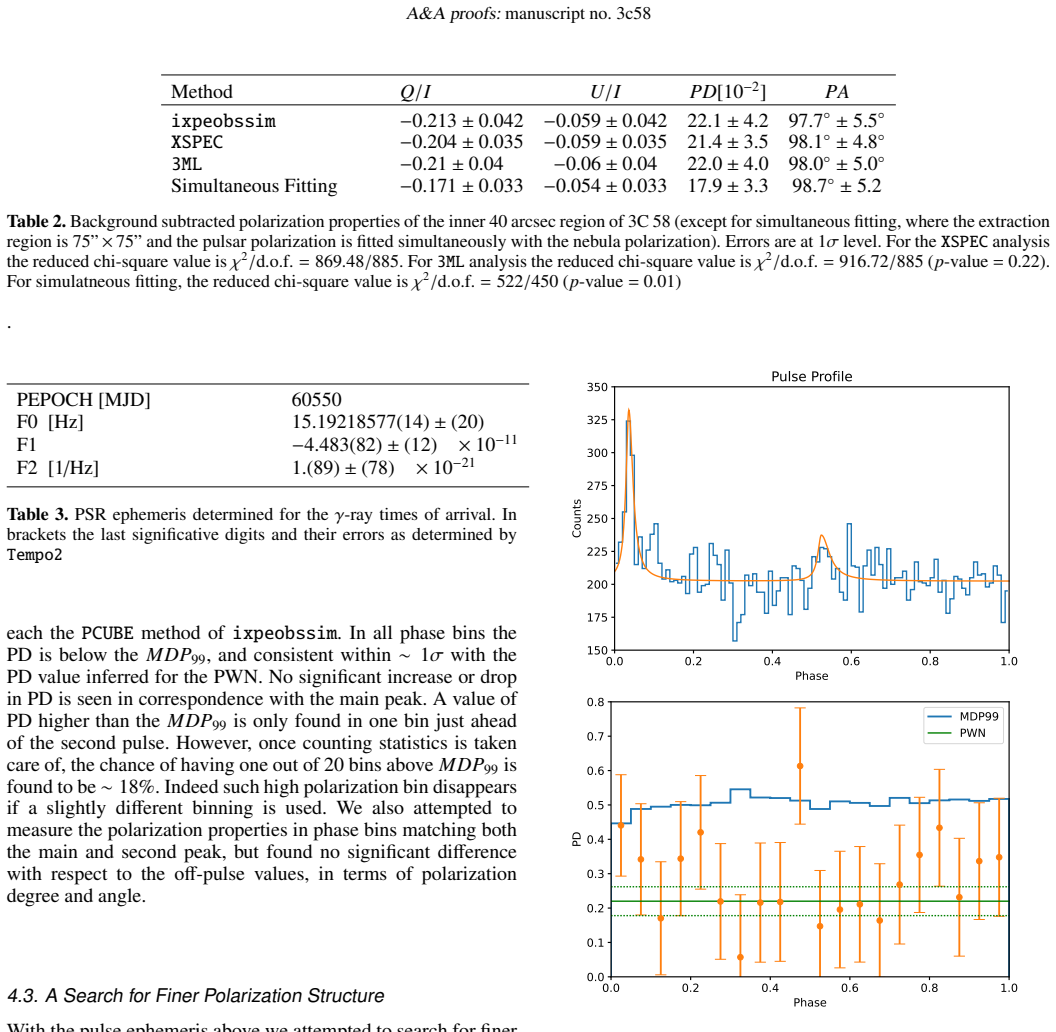
Using three independent analysis pipelines, the paper measures a background-subtracted polarization degree of $21.4\pm3.5\%$ to $22.1\pm4.2\%$ at a polarization angle of $97.7^\circ$ to $98.1^\circ$ for the 40-arcsecond region around the pulsar. Because the X-ray torus is much smaller than the instrument point-spread function, the observed polarization is diluted by surrounding less-polarized nebular emission; modeling the aperture trend implies an intrinsic torus polarization of about $55\%$ to $75\%$, approaching or exceeding the nominal $\sim70\%$ synchrotron ceiling. The position angle, roughly east-west in electric vector, translates to a magnetic field along the north-south torus axis, consistent with a toroidal field seen nearly edge-on. The paper detects no significant polarization from the pulsar itself, and it reports that the background during these observations was polarized by solar flares, requiring specialized de-flaring and background subtraction.
Load-bearing premise
The load-bearing assumption is that the polarized background measured more than 120 arcseconds from the pulsar ($6.8\%\pm1.4\%$ after de-flaring) is the same underneath the source aperture; the nebula is faint enough that an unmodeled variation in that background could shift the reported 22 percent polarization.
Editorial extensions
If this is right
- If the measurement stands, the magnetic field in the inner region of 3C 58 is highly ordered and mostly toroidal, with turbulence far weaker than current multidimensional simulations of pulsar wind nebulae predict.
- The inferred intrinsic torus polarization of 50 to 75 percent means the X-ray synchrotron-emitting electrons radiate in a nearly uniform field, placing a direct constraint on magnetic fluctuations in the acceleration zone.
- Together with measurements of the Crab, Vela, and MSH 15-52, the result supports a common picture: young pulsar wind nebulae are highly polarized in their inner cores.
- The polarized solar-flare background found here implies that future observations of faint, extended sources during solar maximum must model background polarization rather than assume it is unpolarized.
- The non-detection of pulsar polarization means the pulsar's X-ray emission contributes little polarized flux at current sensitivity, so it does not bias the nebular measurement.
Reading between the lines
- If 3C 58's age is closer to the pulsar's characteristic age than to the historical supernova of 1181, the low turbulence could mean turbulence develops with nebular age, possibly tied to the Rayleigh-Taylor instability; this would make 3C 58 a young, ordered system rather than an old, disrupted one.
- Because polarization measures anisotropy rather than the total disorder of the field, an anisotropic turbulence stretched along the torus could mimic an ordered field; future multi-wavelength or higher-resolution polarization maps could test this alternative.
- The aperture-dependent polarization curve offers a way to map the size of the ordered-field region; a deeper observation or a future X-ray polarimeter with a sharper point-spread function could directly resolve the torus and confirm the near-limit intrinsic polarization.
- The de-flaring method used here could be applied to other X-ray polarimetry targets observed during solar flares, and the reported background polarization values provide a template for systematic corrections.
Signed reviews
Editorial analysis
A structured set of objections, weighed in public.
Referee Report
Summary. The paper presents IXPE X-ray polarimetry of the young pulsar wind nebula 3C 58, observed during a period of strong solar activity. The authors characterize a polarized solar-flare background using events at radii >120 arcsec, apply aggressive track cuts and deflaring, and then measure the polarization of the central 40-arcsec region with three independent tools (ixpeobssim PCUBE, XSPEC, and 3ML), obtaining PD ≈ 21–22% at PA ≈ 97–98°. They also search for pulsar phase-resolved polarization, perform a spatially binned simultaneous fit to image the nebular field, and model the aperture-size dependence of the PD with inner and extended torus scenarios. The central conclusion is that the inner nebula has a highly ordered toroidal magnetic field with low turbulence, in tension with some multidimensional simulations. The measurement is direct, but its accuracy depends critically on the subtraction of a polarized background whose spatial uniformity is not demonstrated.
Significance. If robust, this measurement is a valuable addition to IXPE's young-PWN sample and strengthens the evidence for ordered magnetic fields in the inner regions of PWNe. The use of three independent reduction and analysis chains is a clear strength, as is the unusually detailed characterization of the polarized solar-flare background and the use of public IXPE and Chandra data. The JVLA radio polarization comparison adds multi-wavelength context. However, the quantitative inference that the intrinsic polarization approaches the synchrotron limit is model dependent and is not fully supported by the presented aperture-trend fits. The main value of the paper is the directly measured integrated polarization and the qualitative ordered-field interpretation, provided the background systematics are adequately bounded.
major comments (3)
- [Section 3, Tables 1 and 2] The background polarization subtraction is the most fragile premise of the central measurement. The background Stokes vector is measured only from events at r>120 arcsec from the pulsar (Table 1: TOT_df PD=6.8%±1.4%, PA=-6.1°±5.9°, with DU-to-DU values from 4.1% to 10.8%), and the text states that continuous low-level flaring in the first segment could not be excised by count-rate cuts. All three extraction methods in Section 4.1 use outer-field background regions, so their mutual agreement does not independently validate the background assumption. A simple estimate shows the sensitivity: with Q_s=-0.213, U_s=-0.059 and background q_b=+0.0665, u_b=-0.0144, a mismatch of δ=±0.2 in the background-to-source count ratio changes PD from 22.1% to 17.4% or 29.1%, both well outside the quoted 1σ errors. I request an explicit systematic-error analysis that allows the background Stokes vector or normalization to vary, for example using annular background regions just outside the aperture, per-DU background fits, or nuisance parameters in the spectropolarimetric fit, and a statement of how the 22% result changes under those variations.
- [Section 4.4, Figure 4] Cases A and B require an inner-torus intrinsic PD of 75%±5%, which is above the approximately 70% synchrotron maximum, and the paper states that all modeled aperture trends fall more steeply than the data. The abstract's wording that the intrinsic polarization is 'possibly approaching the theoretical limit' is therefore not supported by the quantitative model: the preferred model exceeds the limit, and the model-data disagreement means the fitted intrinsic values are not reliable. The authors should either include projection, PSF, and geometric depolarization effects explicitly and refit, or restrict the quantitative conclusions to the directly measured integrated PD and the qualitative ordered-field interpretation. As written, the near-limit intrinsic-polarization claim needs revision.
- [Section 4.4] The comparison between the X-ray and radio polarization maps uses a simulation that applies the radio PD map to the Chandra X-ray image, and the conclusion that the extended X-ray nebula has a PD 'a factor 2-to-3 higher' than the radio-set values is stated without a propagation of the radio map uncertainties or a sensitivity study. Because this factor is used to support the interpretation of a highly ordered interior field, please provide at least a rough uncertainty estimate for this comparison or soften the quantitative claim accordingly.
minor comments (4)
- [Throughout] Please correct typographical errors: 'ChamdraSNR' in the footnote on page 2, 'polrization' in Section 3, and 'meausre' in Section 4.2.
- [Table 3] The formatting of the F2 row appears corrupted ('1 .(89)± (78) × 10^-21' and units '1 /Hz'); the units should be s^-2 or Hz/s, and the entries should be formatted consistently with F0 and F1.
- [Figure 4] The lower panel of Figure 4 is difficult to read because the model curves are identified only by caption text; please add a legend with line styles or colors and ensure the styles are distinguishable in black-and-white printing.
- [Abstract and Section 5] The word 'confirm' in the abstract is too strong for a single-object measurement with a non-standard background correction; 'support' or 'are consistent with' would be more appropriate given the systematic uncertainties discussed in the paper.
Circularity Check
No circularity: the 22% polarization is a direct Stokes measurement, and the torus-polarization model values are fitted to the observed aperture trend rather than presented as independent predictions.
full rationale
The paper's central claim is an empirical X-ray polarization measurement of 3C 58 with IXPE. The reported PD ≈ 22% and PA ≈ 98° are obtained by direct Stokes I, Q, U analysis in three independent pipelines (ixpeobssim PCUBE, XSPEC, and 3ML), with values that agree at the 1σ level. There is no derivation in which the output quantity is defined in terms of the input quantity or in which a fitted parameter is renamed as a prediction. The aperture-trend models in Sec. 4.4 are explicitly used in the reverse sense: the paper states that cases A and B 'require an inner torus with an intrinsic PD≈75%±5% in order to match the high polarization found by IXPE,' which is a fitting of model parameters to data, not a claim that the model predicts the observed polarization. The comparison of the measured aperture trend with the radio-polarization-based simulated trend is a consistency check, not a circular reduction. Self-citations (e.g., Bucciantini et al. 2023a for polarization leakage, Wong et al. 2023 for the simultaneous-fitting procedure, and prior IXPE PWN papers for comparison of polarization levels) are methodological or contextual references; none is invoked as a uniqueness theorem or as the sole justification for the central measurement. The background polarization is measured empirically in an outer region and subtracted; whether that background Stokes vector is representative of the source aperture is a legitimate systematic concern, but it is an observational assumption, not a self-referential derivation. The paper also explicitly acknowledges interpretational limits, noting that polarization is not a direct measure of magnetic-field organization. Thus the derivation chain is self-contained with respect to circularity, and the correct score is 0.
Assumptions & free parameters
free parameters (4)
- Intrinsic PD of inner torus (models A/B) =
75% ± 5%
- Intrinsic PD of extended torus (model C) =
55% ± 5%
- Intrinsic PD of extended torus with radio nebula (model D) =
50% ± 5%
- Gaussian blur sigma for on-axis PSF =
12 arcsec
assumptions (6)
- domain assumption X-ray emission is synchrotron radiation from a power-law electron population, with a theoretical maximum polarization of about 70 percent.
- domain assumption The JVLA radio polarization map represents the magnetic field orientation of the X-ray nebula.
- domain assumption The Chandra-derived nebular template and the Kuiper et al. (2010) pulsar model correctly represent the spatial and phase distribution of IXPE counts.
- domain assumption After de-flaring and background subtraction, the residual polarized background is negligible or exactly canceled.
- domain assumption IXPE calibration and polarization leakage corrections are valid at the roughly 2 arcminute off-axis position of 3C 58.
- domain assumption Thermal X-ray emission contributes less than 5 percent of the counts in the central 40 arcsecond region.
Cite this review
Pith. "Pith review of A polarized view of the young Pulsar Wind Nebula 3C 58 with IXPE." pith.science (2026). https://pith.science/paper/HYFKYRI7
@misc{pith2026250420534,
  author       = {Pith},
  title        = {Pith review of: A polarized view of the young Pulsar Wind Nebula 3C 58 with IXPE},
  year         = {2026},
  howpublished = {\url{https://pith.science/paper/HYFKYRI7}},
  note         = {Machine review of arXiv:2504.20534}
}
read the original abstract
Pulsar Wind nebulae (PWNe), are among the most efficient particle accelerators in the Universe, however understanding the physical conditions and the magnetic geometry in their inner region has always proved elusive. X-ray polarization provides now a unique opportunity to investigate the magnetic field structure and turbulence properties close to where high energy particles are accelerated. Here we report on the recent X-ray polarization measurement of the PWN 3C 58 by the International X-ray Polarimeter Explorer (IXPE). 3C 58 is a young system displaying a characteristic jet-torus structure which, unlike other PWNe, is seen almost edge on. This nebula shows a high level of integrated polarization ~ 22% at an angle ~ 97deg, with an implied magnetic field oriented parallel to the major axis of the inner torus, suggesting a toroidal magnetic geometry with little turbulence in the interior, and an intrinsic level of polarization possibly approaching the theoretical limit for synchrotron emission. No significant detection of a polarized signal from the associated pulsar was found. These results confirm that the internal structure of young PWNe is far less turbulent than previously predicted, and at odds with multidimensional numerical simulations.
Figures


Figures from the paper (4 more)



Forward citations
Cited by 2 Pith papers
-
Polarized multiwavelength emission from pulsar wind - accretion disk interaction in a transitional millisecond pulsar
Polarized X-ray and optical emission from PSR J1023+0038 are aligned and match the pulsed flux spectrum, pointing to synchrotron radiation at a pulsar wind-disk shock as the emission mechanism.
-
The hitchhiker's guide to the IXPE data analysis
A user-oriented guide that collects best practices, data formats, and analysis strategies for extracting polarimetric information from IXPE observations.
Reference graph
Works this paper leans on
-
[1]
A., Ackermann, M., Ajello, M., et al
Abdo, A. A., Ackermann, M., Ajello, M., et al. 2009, ApJ, 699, L102 Aleksi´c, J., Ansoldi, S., Antonelli, L. A., et al. 2014, A&A, 567, L8
work page 2009
-
[2]
Becker, R. H., Helfand, D. J., & Szymkowiak, A. E. 1982, ApJ, 255, 557
work page 1982
-
[3]
Bietenholz, M. F. 2006, ApJ, 645, 1180
work page 2006
- [4]
-
[5]
Bocchino, F., Warwick, R. S., Marty, P., et al. 2001, A&A, 369, 1078
work page 2001
-
[6]
2023, Physical Review Research, 5, 023194
Bresci, V ., Lemoine, M., & Gremillet, L. 2023, Physical Review Research, 5, 023194
work page 2023
-
[7]
2011, MNRAS, 410, 381
Bucciantini, N., Arons, J., & Amato, E. 2011, MNRAS, 410, 381
2011
-
[8]
Camilo, F., Stairs, I. H., Lorimer, D. R., et al. 2002, ApJ, 571, L41 CASA Team, Bean, B., Bhatnagar, S., et al. 2022, PASP, 134, 114501
work page 2002
Show all 53 references
-
[9]
2019, in Supernova Remnants: An Odyssey in Space after Stellar Death II, 161
Castelletti, G. 2019, in Supernova Remnants: An Odyssey in Space after Stellar Death II, 161
2019
-
[10]
Chevalier, R. A. 2005, ApJ, 619, 839
2005
-
[11]
Davelaar, J., Smith, A., & Becker, R. H. 1986, ApJ, 300, L59 Di Marco, A., Soffitta, P., Costa, E., et al. 2023, AJ, 165, 143
1986
-
[12]
Dinsmore, J. T. & Romani, R. W. 2024, ApJ, 962, 183
2024
-
[13]
T., Swartz, D., et al
Ehlert, S., Chen, C. T., Swartz, D., et al. 2022, MNRAS, 515, 5185
2022
-
[14]
2008, ApJS, 174, 379
Fesen, R., Rudie, G., Hurford, A., & Soto, A. 2008, ApJS, 174, 379
2008
-
[15]
V ., Helfand, D
Gotthelf, E. V ., Helfand, D. J., & Newburgh, L. 2007, ApJ, 654, 267
2007
-
[16]
J., Baker, J
Green, A. J., Baker, J. R., & Landecker, T. L. 1975, A&A, 44, 187
1975
-
[17]
Hanser, F. A. & Sellers, F. B. 1996, in Society of Photo-Optical Instrumentation Engineers (SPIE) Conference Series, V ol. 2812, GOES-8 and Beyond, ed. E. R. Washwell, 344–352
1996
-
[18]
B., Edwards, R
Hobbs, G. B., Edwards, R. T., & Manchester, R. N. 2006, MNRAS, 369, 655
2006
-
[19]
Kim, M. & An, H. 2021, Journal of Korean Astronomical Society, 54, 1
2021
-
[20]
2019, Journal of Korean Astronomical Society, 52, 173
Kim, S., Park, J., & An, H. 2019, Journal of Korean Astronomical Society, 52, 173
2019
-
[21]
2013, A&A, 560, A18
Kothes, R. 2013, A&A, 560, A18
2013
-
[22]
O., et al
Kuiper, L., Hermsen, W., Urama, J. O., et al. 2010, A&A, 515, A34
2010
-
[23]
F., Lin, T
Li, J., Torres, D. F., Lin, T. T., et al. 2018, ApJ, 858, 84 Article number, page 8 of 9 N. Bucciantini et al.: IXPE view of 3C 58
2018
-
[24]
A., Ransom, S
Livingstone, M. A., Ransom, S. M., Camilo, F., et al. 2009, ApJ, 706, 1163
2009
-
[25]
2017, MNRAS, 472, 2926
Lu, F.-W., Gao, Q.-G., Zhu, B.-T., & Zhang, L. 2017, MNRAS, 472, 2926
2017
-
[26]
P., Collins, S., et al
Moran, P., Mignani, R. P., Collins, S., et al. 2013, MNRAS, 436, 401
2013
-
[27]
S., Slane, P
Murray, S. S., Slane, P. O., Seward, F. D., Ransom, S. M., & Gaensler, B. M. 2002, ApJ, 568, 226
2002
-
[28]
& Romani, R
Ng, C.-Y . & Romani, R. W. 2004, ApJ, 601, 479
2004
-
[29]
J., Acero, F., & Mori, K
Picquenot, A., Williams, B. J., Acero, F., & Mori, K. 2024, A&A, 683, A197
2024
-
[30]
2002, in Neutron Stars, Pulsars, and Supernova Remnants, ed
Reich, W. 2002, in Neutron Stars, Pulsars, and Supernova Remnants, ed. W. Becker, H. Lesch, & J. Trümper, 1
2002
-
[31]
Reynolds, S. P. & Aller, H. D. 1988, ApJ, 327, 845
1988
-
[32]
A., Lykou, F., et al
Ritter, A., Parker, Q. A., Lykou, F., et al. 2021, ApJ, 918, L33
2021
-
[33]
A., Goss, W
Roberts, D. A., Goss, W. M., Kalberla, P. M. W., Herbstmeier, U., & Schwarz, U. J. 1993, A&A, 274, 427
1993
-
[34]
W., Wong, J., Di Lalla, N., et al
Romani, R. W., Wong, J., Di Lalla, N., et al. 2023, ApJ, 957, 23
2023
-
[35]
Schaefer, B. E. 2023, MNRAS, 523, 3885
2023
-
[36]
& Neustroev, V
Shearer, A. & Neustroev, V . V . 2008, MNRAS, 390, 235
2008
-
[37]
A., Lundqvist, N., Lundqvist, P., Sollerman, J., & Zyuzin, D
Shibanov, Y . A., Lundqvist, N., Lundqvist, P., Sollerman, J., & Zyuzin, D. 2008, A&A, 486, 273
2008
-
[38]
J., Reynolds, S
Slane, P., Helfand, D. J., Reynolds, S. P., et al. 2008, ApJ, 676, L33
2008
-
[39]
J., van der Swaluw, E., & Murray, S
Slane, P., Helfand, D. J., van der Swaluw, E., & Murray, S. S. 2004, ApJ, 616, 403
2004
-
[40]
O., Helfand, D
Slane, P. O., Helfand, D. J., & Murray, S. S. 2002, ApJ, 571, L45
2002
-
[41]
Stephenson, F. R. & Green, D. A. 2002, International Series in Astronomy and Astrophysics, 5
2002
-
[42]
H., Reich, P., Reich, W., et al
Sun, X. H., Reich, P., Reich, W., et al. 2011, A&A, 536, A83
2011
-
[43]
O., Kinugasa, K., Hashimotodani, K., & Tsunemi, H
Torii, K., Slane, P. O., Kinugasa, K., Hashimotodani, K., & Tsunemi, H. 2000, PASJ, 52, 875
2000
-
[44]
F., Cillis, A
Torres, D. F., Cillis, A. N., & Martín Rodriguez, J. 2013, ApJ, 763, L4
2013
-
[45]
J., Younk, P., et al
Vianello, G., Lauer, R. J., Younk, P., et al. 2015, arXiv e-prints, arXiv:1507.08343
2015 arXiv
-
[46]
C., Soffitta, P., Baldini, L., et al
Weisskopf, M. C., Soffitta, P., Baldini, L., et al. 2022, Journal of Astronomical
2022
-
[47]
2000, ApJ, 542, 914
Wilms, J., Allen, A., & McCray, R. 2000, ApJ, 542, 914
2000
-
[48]
Wilson, A. S. & Weiler, K. W. 1976, A&A, 49, 357
1976
-
[49]
2024, ApJ, 973, 172
Wong, J., Mizuno, T., Bucciantini, N., et al. 2024, ApJ, 973, 172
2024
-
[50]
W., & Dinsmore, J
Wong, J., Romani, R. W., & Dinsmore, J. T. 2023, ApJ, 953, 28
2023
-
[51]
2022, Nature, 612, 658
Xie, F., Di Marco, A., La Monaca, F., et al. 2022, Nature, 612, 658
2022
-
[52]
M., Manchester, R
Yao, J. M., Manchester, R. N., & Wang, N. 2017, ApJ, 835, 29
2017
-
[53]
R., Uzdensky, D
Zhdankin, V ., Werner, G. R., Uzdensky, D. A., & Begelman, M. C. 2017, Phys. Rev. Lett., 118, 055103 Article number, page 9 of 9
2017
Reviewed August 16, 2026 · model on record in the stance chip above.
Discussion (0). Continue with ORCID to comment.