REVIEW 4 major objections 5 minor 51 references
Microgravity-assisted off-axis spin vortex in a $^{87}$Rb dipolar spinor Bose-Einstein condensate
T0 review · 4 major / 5 minor · reviewed 2026-08-15 · deepseek-v4-flash
Pith's one-line read In a pancake rubidium condensate, microgravity deforms the optical-plug spin vortex into an off-axis state before a critical acceleration switches it to a single-mode spin state.
desk verdict Solid specialized numerical result with an under-specified setup and an over-optimistic 'microgravity' label; worth refereeing once the atom number and numerics are stated. read the letter →
The pith
A machine-rendered reading of the paper's core claim, the machinery that carries it, and where it could break.
The reading
What carries the argument
The central object is the off-axis spin vortex (OSV): a polar-core vortex whose core sits at the optical plug but whose phase is no longer linear in the azimuthal angle. The argument is carried by the toy-model energy difference between the SMA and OSV states, $$\$\Delta$ E = -\frac{c_{\mathrm{dd}}N}{8\pi\$sigma^{3}$} I_{\mathrm{dd}} + \frac{c_{\mathrm{dd}}N b'^2}{128\pi\$sigma^{3}$} A_{\mathrm{dd}} + \frac{\$hbar^{2}$\sqrt{1-b'^2}}{4M\$sigma^{2}$},$$ where $b'\propto a$ measures the microgravity-induced density asymmetry $n(\phi)=(N/2\pi\sigma)(1-b'\cos\phi)$, and $I_{\mathrm{dd}},A_{\mathrm{dd}}$ are positive dipolar integrals cut off at the mean interparticle angle $\phi_c=2\pi/N$. Negative $\Delta E$ selects the OSV and yields the window $\xi_{\mathrm{dd}}<\sigma<\sigma_c$, while the contour equation gives $d\sigma/db'$ and hence the shape of the phase boundary near $a=0$. In the numerics, the load-bearing diagnostics are the winding numbers of $\theta_{\pm1}$, the mean angular momenta $L_m$, and the dipolar and azimuthal-kinetic energies $E'_{\mathrm{dd}}$ and $T_\phi$, all of which jump at the transition.
What would settle it
Repeat the ground-state Gross-Pitaevskii calculation at $\sigma=9a_r$, $U_0=120\hbar\omega_0$ with an explicitly specified total atom number $N$ (for example $10^5$ and $10^6$) and with two different dipolar truncation lengths; if the phase at $a=0.1g$ no longer shows $\pm1$ winding around the plug, or if the transition at $a_c=0.1625g$ moves by more than the numerical uncertainty, the central quantitative claim fails. Experimentally, one can image the $m=\pm1$ phases and spin density in the $z=0$ plane while ramping $a$ from $0$ to $0.3g$ and check whether a circulating spin texture exists below but not above a critical value.
Extended reading notes
Core claim
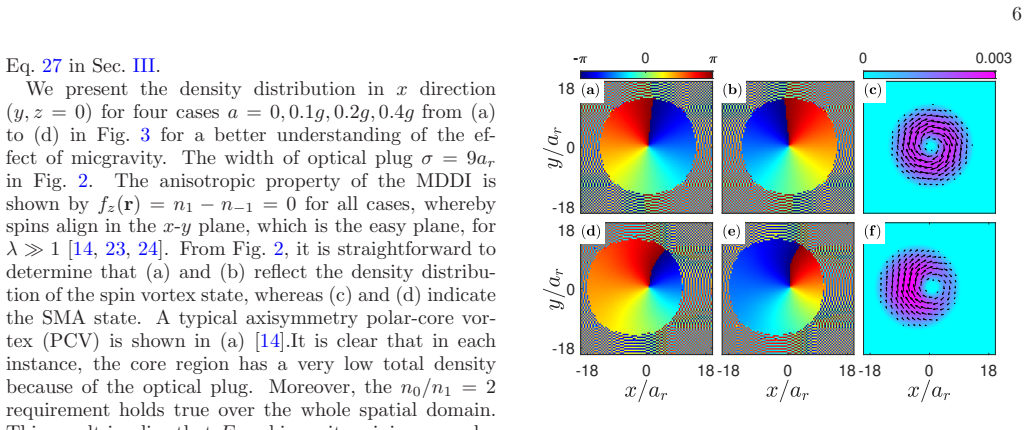
For a pancake $^{87}\mathrm{Rb}$ spin-1 dipolar condensate containing a Gaussian optical plug, a microgravity acceleration along $x$ does not immediately destroy the polar-core spin vortex; instead the ground state becomes an off-axis spin vortex (OSV). In this state the three spin components keep the fully polarized density ratio $n_1:n_0:n_{-1}=1:2:1$, the phases of the $|\pm1\rangle$ components still wind by $\pm1$ around the optical plug, but the winding is nonuniform: $\theta_{\pm1}(\phi)$ is not linear in the azimuthal angle. As a result the spin-density pattern is a closed, non-axisymmetric circulation centered on the displaced vortex core, the dipolar energy $E'_{\mathrm{dd}}$ acquires a finite value, and the mean angular momentum $L_{\pm1}$ is no longer $\mp1$. Above a critical acceleration, numerically $a_c=0.1625g$ at plug width $\sigma=9a_r$ and intensity $U_0=120\hbar\omega_0$, the ground state becomes the single-mode (SMA) state with uniform spin direction and zero winding. The full phase diagram in $(a,\sigma)$ shows the OSV window narrowing with increasing $a$, bounded below by the dipole healing length and above by a plug width $\sigma_c$ that decreases with $a$; the transition is driven by competition between dipolar energy and azimuthal kinetic energy.
Load-bearing premise
The load-bearing premise is that the one-dimensional ring picture with a Thomas-Fermi density and a dipolar cutoff set by the atom number $N$ adequately represents the three-dimensional pancake condensate, so the computed phase boundary and critical acceleration survive when $N$ and the dipolar truncation are chosen differently.
Editorial extensions
If this is right
- At fixed plug width, increasing microgravity first deforms the axisymmetric polar-core vortex into an OSV and then, at $a_c=0.1625g$ for $\sigma=9a_r$, triggers a phase transition to the SMA state, with abrupt changes in winding number, $L_m$, $E'_{\mathrm{dd}}$, and $T_\phi$.
- There is a second threshold $a_o=0.225g$ where the optical plug lies outside the condensate; between $a_c$ and $a_o$ the plug is still surrounded by BEC yet the ground state is already SMA, so microgravity only narrows, never widens, the spin-vortex region.
- The OSV is a stable ground state, not a transient dynamical state, so microgravity offers a controlled environment for preparing persistent topological spin textures with non-integer angular momentum.
- Because the phase boundary depends monotonically on $a$, locating the transition in an experiment or simulation gives a direct measure of the residual acceleration, as the paper states.
- Smaller optical-plug width and smaller acceleration favor the OSV, so the spin-vortex window can be tuned by choosing $\sigma$ and by operating in microgravity rather than at $1g$.
Reading between the lines
- The toy model's cutoff $r_c=2\pi\sigma/N$ makes the existence window explicitly $N$-dependent; a testable consequence is that reducing the atom number at fixed $a,\sigma$ should shrink or eliminate the OSV, something the paper does not compute.
- Because $L_{\pm1}$ becomes a non-integer continuous function of $a$ in the OSV phase, the transition could be used as a sensor principle: measuring angular momentum near the critical point gives a sensitive readout of acceleration gradients, going beyond the paper's qualitative microgravity-measurement suggestion.
- The easy-plane condition $\lambda\gg1$ keeps the spin texture in the $x$-$y$ plane; for shallower pancake traps or different dipolar species the OSV may acquire an out-of-plane component or give way to a different texture, an extension the paper leaves unexamined.
Signed reviews
Editorial analysis
A structured set of objections, weighed in public.
Referee Report
Summary. The paper studies a pancake-shaped dipolar spin-1 87Rb BEC in a harmonic trap with an optical plug, under a constant linear acceleration along the x-axis. Using a one-dimensional-ring toy model and numerical Gross-Pitaevskii simulations, it claims that in a microgravity environment the ground state can be an off-axis spin vortex (OSV), and that increasing the acceleration drives a phase transition to a single-mode (SMA) state. The authors present a phase diagram in the (a, σ) plane, characterize the OSV winding numbers and phase profiles, and identify a critical acceleration a_c = 0.1625g at σ = 9 a_r.
Significance. If correct, the result adds a new stable non-axisymmetric spin texture—an off-axis spin vortex—to the family of dipolar spinor BEC ground states, and it proposes a gravity-driven phase transition that could serve as a gravity-sensing mechanism. The toy model is transparent, and the numerical GPE results independently support the main qualitative picture: the spin-density winding around the optical plug is topological, and the phase φ_{-1} develops nonlinear azimuthal dependence with increasing a. However, the quantitative phase diagram depends on parameters that are not all stated (atomic number, numerical cutoffs), and the naming of the acceleration range as 'microgravity' is misleading. The paper's originality lies in connecting an external linear potential to a spin-texture transition, and the GPE simulations provide concrete evidence for the phase boundary.
major comments (4)
- [Sec. IV (numerical method) and Appendix A] The total atom number N is never stated, although the GPE normalization is ∫|ψ|²d³r = N and the toy model depends on N through b′ = 2πσ²Ma/(Nc₀) and the cutoff angle φ_c = 2π/N. As a consequence, the phase boundary in Fig. 2 and the critical acceleration a_c = 0.1625g in Fig. 6 are functions of an unspecified parameter. Please state N explicitly and, if possible, show how the phase diagram changes with N. Also report the numerical grid spacing, spatial domain, and dipolar truncation radius/cutoff used in the FFT/truncation method, together with a convergence test demonstrating that the phase boundary is stable.
- [Sec. III, Eqs. (18)–(20), and Appendix A] The velocity and phase ansatz are internally inconsistent. For a stationary ring with density n(φ) ∝ (1 − b′ cosφ), the continuity equation (16) gives n(φ)w(φ) = constant, and the correct solution is w_{±1} = ±√(1 − b′²)/(1 − b′ cosφ). Expanding Eq. (19) as printed and integrating then gives φ_{±1} = ∓(φ + b′ sinφ) + const, not ∓(φ − b′ sinφ) as written in Eq. (20) and Eq. (A3). The printed ansatz does not satisfy the continuity equation. Please correct the sign and verify that the Edd integrals in Eq. (A8) and the final ΔE in Eq. (21) are unchanged; if the sign error is only in the presentation, the derivation should still be made explicit.
- [Title, Abstract, Sec. I, and Sec. IV] The accelerations used in the simulations, a = 0.1g–0.5g with a_c = 0.1625g, are not 'microgravity' in the standard sense; residual accelerations in low Earth orbit are typically ≤10⁻³g, and drop-tower or space experiments operate at far smaller values. The demonstrated off-axis structure appears at fractions of g, not in the microgravity regime, and the a→0 limit returns to an axisymmetric polar-core vortex. Please reframe the claim as 'reduced gravity' or, alternatively, extend the simulations to the actual microgravity range and discuss the OSV shift there. As written, the title and abstract overstate the regime that is studied.
- [Sec. IV, Fig. 2 and Fig. 6] The phase diagram includes a region (above the red dashed line) in which the optical plug is described as 'outside' the BEC, yet the state is still labeled a spin vortex. The text says that when the plug is outside, a spin vortex encircling the plug cannot exist, so the labeling in Fig. 2 is confusing. Please define exactly what the winding is around in that regime and how the 'inside/outside' criterion (1% of maximum density) was applied to each point of the phase diagram. This is necessary for the reader to interpret the cyan region.
minor comments (5)
- [References] Reference [6] is incomplete and appears as '(????)'; it must be fixed before publication.
- [Sec. IV, Fig. 2 caption] The text contains 'Fig. reffig:pd', which is a broken LaTeX reference; please correct it to a proper citation.
- [Throughout] There are many typos and grammatical errors (e.g., 'gorund', 'micgravity', 'represt', 'obatined', 'nececcery', 'intrinc', 'satisfy' and 'reffig'). A thorough proofread is needed.
- [Sec. III, Eq. (27)] In Eq. (27), the symbols A and C are introduced but not defined; please either define them in the text or give the explicit constant determined by the initial condition.
- [Sec. IV, Fig. 2 insets] The insets show spin-density vectors but do not indicate the direction of the microgravity (x-axis) with an arrow; adding an arrow would help the reader connect the density asymmetry to the spin texture.
Circularity Check
No significant circularity: the numerical GPE solution and the analytic toy model are independent, and the self-citation [13] is not load-bearing.
full rationale
The derivation is self-contained. The central claim—that microgravity acceleration a drives a transition from an off-axis spin vortex (OSV) to a single-mode (SMA) state—is obtained by numerically solving the coupled Gross-Pitaevskii equations (Eq. 5) with the full dipolar term, without fitting any parameter to force the phase boundary. The analytic toy model in Sec. III (Eqs. 10–23) uses explicit Thomas-Fermi density and phase ansatze and computes the energy difference ΔE from those expressions; its qualitative conclusion (smaller a and σ favor the OSV ground state) is derived from the energy balance, not inserted as an input. The numerical phase diagrams in Figs. 2 and 6 are independent calculations that confirm the toy model. The self-citation to [13] is used only for the zero-gravity baseline mechanism and the E'_dd/E''_dd decomposition, and the present paper separately reproduces the a = 0 polar-core vortex in its own numerics; thus this citation is not load-bearing for the microgravity-driven transition. No fitted parameter is renamed as a prediction, and no uniqueness theorem from the authors' prior work is invoked to forbid alternatives. The off-axis character follows directly from the explicitly imposed linear potential Max in Eq. (3), but the nontrivial content—that a topologically nontrivial spin vortex survives as a stable ground state and then undergoes a phase transition with increasing a—is computed rather than assumed. The concerns about unspecified atom number N, dipolar truncation details, and the use of 0.1–0.5g rather than true microgravity are reproducibility and regime issues, not circularity.
Assumptions & free parameters
free parameters (2)
- Total atom number N
- Optical plug intensity U0 =
120 E0
assumptions (6)
- domain assumption Mean-field Gross-Pitaevskii theory accurately describes the 87Rb dipolar spinor condensate.
- domain assumption Thomas-Fermi approximation for the ring density, ignoring kinetic and spin interaction contributions to the density.
- ad hoc to paper The optical plug is strong and wide enough so the BEC forms a one-dimensional ring of radius sigma.
- domain assumption The dipolar interaction is regularized with a truncation length rc = 2*pi*sigma/N, the mean interatomic distance.
- domain assumption The spin state remains fully polarized, |f|/n = 1, with phase relation phi_1 + phi_-1 - 2*phi_0 = 0 in both SMA and OSV.
- domain assumption Microgravity is a constant linear potential along x and does not deform the harmonic trap.
Cite this review
Pith. "Pith review of Microgravity-assisted off-axis spin vortex in a $^{87}$Rb dipolar spinor Bose-Einstein condensate." pith.science (2026). https://pith.science/paper/HZ7QQM47
@misc{pith2026250615389,
  author       = {Pith},
  title        = {Pith review of: Microgravity-assisted off-axis spin vortex in a $^87$Rb dipolar spinor Bose-Einstein condensate},
  year         = {2026},
  howpublished = {\url{https://pith.science/paper/HZ7QQM47}},
  note         = {Machine review of arXiv:2506.15389}
}
abstract
The generation of the ground state of a spin vortex in a $^{87}$Rb Bose-Einstein condensate with the assistance of an optical plug has been studied. However, gravity is everywhere, and this potential linear dependence on the spatial position will destroy the axisymmetric structure of the system with the optical plug. In this case, the question of whether the spin vortex ground state still exists remains unresolved. The present study aims to explore the impact of microgravity on the formation of the spin vortex state with the assistance of an optical plug. To this end, a simple model has been employed to provide a comprehensive understanding of the phenomenon. The Gross-Pitaevskii equations are solved by setting the optical plug intensity, adjusting the optical plug width, and adjusting the microgravity strength. This process results in the phase diagram for the single-mode state and spin vortex state. Under microgravity situations, we observe an off-axis structure of the spin vortex state. Our calculations offer a reliable approach to generating spin vortex states in a microgravity environment.
Figures


Figures from the paper (1 more)

Reference graph
Works this paper leans on
-
[6]
Similar to E′ dd, the abrupt occur in Tϕ of Fig
Although the finite value E′ dd in two states, the abrupt occur during the phase transition. Similar to E′ dd, the abrupt occur in Tϕ of Fig. 6, indi- cating a phase transition. The red dashed line represents a critical point ao = 0 .225g where the optical plug is located on the boundary of BEC. The area a > ao rep- resents the ”outside” situation, while t...
-
[1]
In this section, a toy model is employed to eval- uate the effect of microgravity
[ 34]. In this section, a toy model is employed to eval- uate the effect of microgravity. In this study, we consider a special case, U0 and σ are sufficiently large to ensure the entire BEC is a cyclic with the radius σ, one-dimensional case. The energy dif- ference between the SMA and PCV states with micro- gravity is obtained to specify the effect of microg...
-
[2]
The blue dash line represent the position of optical plug. In fact, the presence of the optical plug at point P2 “outside” the BEC implies the impossibility of the formation of a spin vortex around the plug. As can be seen in the Fig. 2, in the ground state of point P2, the optical plug is indeed “outside” of the BEC. However, we require a more precise ma...
-
[3]
D. Gu´ ery-Odelin, J. S¨ oding, P. Desbiolles, and J. Dal- ibard, Opt. Express 2, 323 (1998)
work page 1998
-
[4]
The θ1 is positive linear dependent on ϕ, and the jumping point is 1, hence the winding number is +1
Except for the phase jump point(from π to −π),θ−1 has a linear relationship with the azimuth angleϕ. The θ1 is positive linear dependent on ϕ, and the jumping point is 1, hence the winding number is +1. The blue dashed line and green dotted line show the ground states for a = 0.1g,σ = 4ar and a = 0.25g,σ = 4ar, re- spectively. These are OSV states, whose ...
- [5]
- [7]
-
[8]
A. E. Leanhardt, T. A. Pasquini, M. Saba, A. Schirotzek, Y.-i. Shin, D. Kielpinski, D. E. Pritchard, and W. Ket- terle, Science 301, 1513 (2003)
work page 2003
Show all 51 references
-
[9]
Becker, M
D. Becker, M. D. Lachmann, S. T. Seidel, H. Ahlers, A. N. Dinkelaker, and J. G. et al., Nature(London) 562, 391 (2018)
2018
-
[10]
Comparat, A
D. Comparat, A. Fioretti, G. Stern, E. Dimova, B. L. Tolra, and P. Pillet, Phys. Rev. A 73, 043410 (2006)
2006
-
[11]
R. A. Carollo, D. C. Aveline, B. Rhyno, S. Vishveshwara, C. Lannert, and J. D. Murphree et al., Nature 606, 281 (2022)
2022
-
[12]
S. C. et al., C. R. Acad. Sci. Paris. IV 2, 1313 (2001), ISSN 1296-2147
2001
-
[13]
S.-Y. e. a. Dai, Chin. Phys. B 30, 013701 (2021), ISSN 1674-1056
2021
-
[14]
Schkolnik, D
V. Schkolnik, D. Budker, O. Fartmann, V. Flambaum, L. Hollberg, and T. K. et al., Quantum Sci. Technol. 8, 014003 (2022)
2022
-
[15]
M¨ untinga, H
H. M¨ untinga, H. Ahlers, M. Krutzik, A. Wenzlawski, S. Arnold, D. Becker, and K. Bongs et al., Phys. Rev. Lett. 110, 093602 (2013)
2013
-
[16]
H. Tang, P. Du, L. Jing, S. Yi, and W. Zhang, Phys. Rev. A 105, 063324 (2022)
2022
-
[17]
Yi and H
S. Yi and H. Pu, Phys. Rev. Lett. 97, 020401 (2006)
2006
-
[18]
Kawaguchi, H
Y. Kawaguchi, H. Saito, and M. Ueda, Phys. Rev. Lett. 97, 130404 (2006)
2006
-
[19]
Sadler, J
L. Sadler, J. Higbie, S. Leslie, M. Vengalattore, and D. Stamper-Kurn, Nature(London) 443, 312 (2006)
2006
-
[20]
S. Yi, ¨O. E. M¨ ustecaplıo˘ glu, C. P. Sun, and L. You, Phys. Rev. A 66, 011601(R) (2002)
2002
-
[21]
L. A. Williamson and P. B. Blakie, Phys. Rev. A 94, 063615 (2016)
2016
-
[22]
K. B. Davis, M. O. Mewes, M. R. Andrews, N. J. van Druten, D. S. Durfee, D. M. Kurn, and W. Ketterle, Phys. Rev. Lett. 75, 3969 (1995)
1995
-
[23]
T. W. Neely, E. C. Samson, A. S. Bradley, M. J. Davis, and B. P. Anderson, Phys. Rev. Lett. 104, 160401 (2010)
2010
-
[24]
H. Fu, M. Li, B. Gao, and Y. Wang, Phys. Lett. A 308, 471 (2003)
2003
-
[25]
S. Yi, L. You, and H. Pu, Phys. Rev. Lett. 93, 040403 (2004)
2004
-
[26]
Kawaguchi, H
Y. Kawaguchi, H. Saito, K. Kudo, and M. Ueda, Phys. Rev. A 82, 043627 (2010)
2010
-
[27]
Yi and H
S. Yi and H. Pu, Phys. Rev. A 73, 023602 (2006)
2006
-
[28]
Lahaye, C
T. Lahaye, C. Menotti, L. Santos, M. Lewenstein, and T. Pfau, Rep. Prog. Phys. 72, 126401 (2009)
2009
-
[29]
Kawaguchi and M
Y. Kawaguchi and M. Ueda, Phys. Rep. 520, 253 (2012)
2012
-
[30]
T. Li, S. Yi, and Y. Zhang, Phys. Rev. A 93, 053602 (2016)
2016
-
[31]
S.-X. Deng, T. Shi, and S. Yi, Phys. Rev. A 102, 013305 (2020)
2020
-
[32]
Vengalattore, S
M. Vengalattore, S. R. Leslie, J. Guzman, and D. M. Stamper-Kurn, Phys. Rev. Lett. 100, 170403 (2008)
2008
-
[33]
J. A. M. Huhtam¨ aki, M. Takahashi, T. P. Simula, T. Mizushima, and K. Machida, Phys. Rev. A 81, 063623 (2010)
2010
-
[34]
Saito, Y
H. Saito, Y. Kawaguchi, and M. Ueda, Phys. Rev. Lett. 96, 065302 (2006)
2006
-
[35]
Schmied, T
C.-M. Schmied, T. Gasenzer, and P. B. Blakie, Phys. Rev. A 100, 033603 (2019)
2019
-
[36]
L. A. Williamson and P. B. Blakie, Phys. Rev. Research 3, 013154 (2021)
2021
-
[37]
Ueda, Fundamentals and new frontiers of Bose- Einstein condensation (World Scientific, Singapore, 2010)
M. Ueda, Fundamentals and new frontiers of Bose- Einstein condensation (World Scientific, Singapore, 2010)
2010
-
[38]
C. J. Pethick and H. Smith, Bose–Einstein condensation in dilute gases (Cambridge university press, 2008)
2008
-
[39]
H. Pu, C. K. Law, S. Raghavan, J. H. Eberly, and N. P. Bigelow, Phys. Rev. A 60, 1463 (1999)
1999
-
[40]
Griesmaier, J
A. Griesmaier, J. Werner, S. Hensler, J. Stuhler, and T. Pfau, Phys. Rev. Lett. 94, 160401 (2005)
2005
-
[41]
Zhang, S
W. Zhang, S. Yi, and L. You, New Journal of Physics 5, 77 (2003)
2003
-
[42]
Isoshima, K
T. Isoshima, K. Machida, and T. Ohmi, J. Phys. Soc. Jpn. 70, 1604 (2001)
2001
-
[43]
D. M. Jezek, P. Capuzzi, and H. M. Cataldo, J. Phys. B: At. Mol. Opt. Phys. 41, 045304 (2008)
2008
-
[44]
Yuce and Z
C. Yuce and Z. Oztas, J. Phys. B: At. Mol. Opt. Phys. 43, 135301 (2010)
2010
-
[45]
Yuce, The European Physical Journal D 61, 695 (2011)
C. Yuce, The European Physical Journal D 61, 695 (2011)
2011
-
[46]
D. E. Sheehy and L. Radzihovsky, Phys. Rev. A 70, 063620 (2004)
2004
-
[47]
Yi and L
S. Yi and L. You, Phys. Rev. A 63, 053607 (2001)
2001
-
[48]
W. Bao, D. Jaksch, and P. A. Markowich, J. Comput. Phys. 187, 318 (2003)
2003
-
[49]
T. Shi, E. Demler, and J. I. Cirac, Ann. Phys. 390, 245 (2018)
2018
-
[50]
G´ oral and L
K. G´ oral and L. Santos, Phys. Rev. A 66, 023613 (2002)
2002
-
[51]
Ronen, D
S. Ronen, D. C. E. Bortolotti, and J. L. Bohn, Phys. Rev. A 74, 013623 (2006)
2006
Reviewed August 15, 2026 · model on record in the stance chip above.
Discussion (0). Continue with ORCID to comment.