REVIEW 4 major objections 4 minor 38 references
Motional Sideband Asymmetry of a Nanoparticle Optically Levitated in Free Space
T0 review · 4 major / 4 minor · reviewed 2026-08-14 · deepseek-v4-flash
Pith's one-line read A 136 nm silica nanoparticle, optically levitated in free space and cooled by active feedback, shows an asymmetry between its Stokes and anti-Stokes motional sidebands that corresponds to a mean phonon occupation of $\bar{n}=4$.
desk verdict Credible first sideband-asymmetry readout in a cavity-free levitated nanoparticle (nbar=4), but the abstract oversells 'ground state' and the noise-floor subtraction needs quantitative backup. read the letter →
The pith
A machine-rendered reading of the paper's core claim, the machinery that carries it, and where it could break.
The reading
What carries the argument
The load-bearing piece is ratio-symmetric sideband thermometry. The heterodyne detector records Stokes and anti-Stokes sidebands simultaneously; the asymmetry $R_-=\int \tilde S_{zz}^{\rm het,r} df / \int \tilde S_{zz}^{\rm het,l} df$ equals $R_{\rm TF}\,\bar{n}/(\bar{n}+1)$, where $R_{\rm TF}$ is the ratio of the detector transfer function at the two sideband frequencies. Measuring the same ratio with the local-oscillator shift reversed, $R_+=R_{\rm TF}(\bar{n}+1)/\bar{n}$, lets the transfer function cancel in the geometric mean, leaving the phonon occupation directly. The cooling side uses the homodyne backscattered signal, differentiated and applied as a Coulomb force on the charged particle; parametric feedback on the transverse modes prevents nonlinear cross-coupling into the axial mode.
What would settle it
Measure the same sideband ratio at a range of local-oscillator offsets (for example $\pm0.5$, $\pm1$, and $\pm2$ MHz) and at a range of feedback gains; if the extracted $\bar{n}$ varies systematically with either, the cancellation of the transfer-function ratio or the flat noise-floor assumption is failing. A direct classical control is to repeat the protocol with the particle thermalized at 10 mbar, where $\bar{n}\gg1$ and the asymmetry should vanish; any residual asymmetry of the size seen at $\bar{n}=4$ would reveal a detection artifact rather than a quantum effect.
Extended reading notes
Core claim
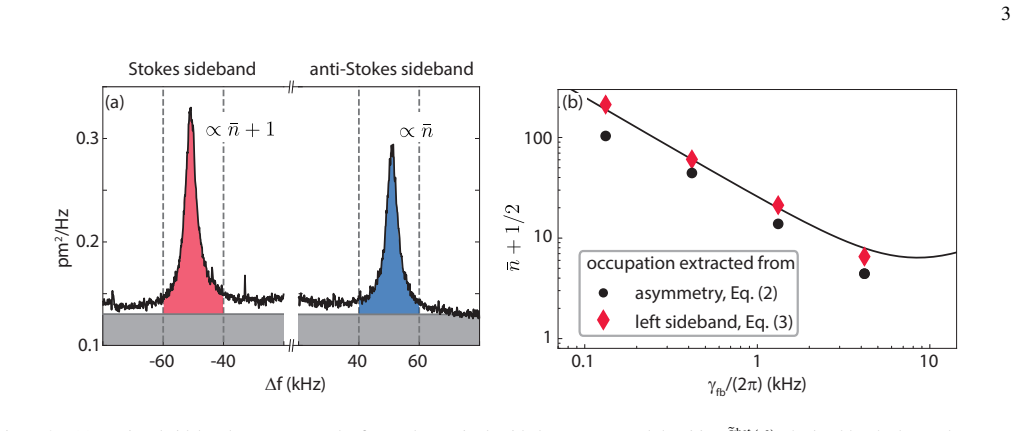
The central claim is that the Stokes/anti-Stokes sideband asymmetry, long used in cavity optomechanics and molecular Raman scattering, survives in a single-beam optical dipole trap with no cavity. The authors measure the backscattered heterodyne spectrum of a 136 nm silica particle trapped at $7.5\times10^{-9}$ mbar and feedback-cooled along its axial mode at $\Omega_z=2\pi\times50$ kHz. With a feedback gain of $\gamma_{\rm fb}=2\pi\times4$ kHz, the left sideband (Stokes, phonon creation) carries more power than the right sideband (anti-Stokes, phonon annihilation). Swapping the heterodyne local-oscillator shift from $-1$ MHz to $+1$ MHz flips which sideband is which; taking the ratio of the measured asymmetries cancels the classical transfer-function ratio and yields $\sqrt{R_-/R_+}=\bar{n}/(\bar{n}+1)$, giving $\bar{n}=4$. This is a signature that the oscillator's energy is measured relative to the quantum $\hbar\Omega_z$, not relative to $k_BT$.
Load-bearing premise
The extraction of $\bar{n}$ rests on the assumption that swapping the heterodyne local-oscillator shift from $-1$ MHz to $+1$ MHz leaves the detector's frequency response unchanged, so that the transfer-function ratio cancels in the measured asymmetry; it also assumes the technical noise floor is flat enough across the sidebands to be subtracted before integrating.
Editorial extensions
If this is right
- If $\bar{n}=4$ is correct, a feedback-cooled levitated particle in free space has reached the quantum edge: zero-point motion is about 11% of the total axial energy, with no cryostat and no cavity.
- The same ratio-swap protocol gives a transfer-function-free thermometer for any oscillator where Stokes and anti-Stokes sidebands can be resolved, so it can be reused in future levitated and trapped-ion setups.
- Reducing technical laser noise toward the shot-noise limit and lowering pressure by an order of magnitude should, by the paper's own model, cool the axial mode below one phonon.
- Cavity-free operation removes the cavity-response time constraint, making fast pulse sequences and spatially and temporally controlled trapping potentials viable for quantum control.
- Agreement between sideband thermometry and a classically calibrated energy measurement cross-checks the absolute energy scale, but the asymmetry method is the one that carries the quantum calibration.
Reading between the lines
- A testable extension would be to apply the swap-and-average ratio protocol at several local-oscillator offsets; if the extracted $\bar{n}$ varies systematically with offset, the assumed cancellation of the detector transfer function is incomplete.
- The strongest experimental check would be a shot-noise-limited repetition: since the paper's noise floor is technical laser noise, a quantum-limited readout would either reproduce $\bar{n}=4$ or reveal that part of the asymmetry was an artifact of the noise subtraction.
- If confirmed at higher cooling gains, this cavity-free platform could probe decoherence and collapse models at masses near a femtogram, a regime that cavity-based ground-state demonstrations do not access.
- The paper establishes a threshold crossed at $\bar{n}=4$ rather than a ground state; the next direct corollary is whether the same platform can reach $\bar{n}<1$, where the asymmetry becomes dramatic and the zero-point contribution dominates.
Signed reviews
Editorial analysis
A structured set of objections, weighed in public.
Referee Report
Summary. The paper reports a measurement of the Stokes/anti-Stokes sideband asymmetry in the heterodyne spectrum of a 136 nm silica nanoparticle optically levitated in vacuum and cooled by active feedback. From the asymmetry, using Eq. (2), the authors infer a mean phonon occupation nbar = 4 for the z-axis center-of-mass mode at a feedback gain of 2 pi x 4 kHz. They also present a classical calibration of the sideband power (Eq. (3)) and a parameter-free cold-damped-oscillator model as cross-checks. The manuscript claims that this is the first observation of a motional sideband asymmetry in a levitated mechanical oscillator without an optical cavity and without cryogenic precooling, marking a transition from a classical to a quantum-dominated regime for the particle's motion.
Significance. If the result holds, it is an important milestone in levitated optomechanics: it extends sideband thermometry to a free-space, cavity-free levitated nanoparticle and demonstrates that active feedback cooling can bring a mesoscopic mechanical oscillator close enough to the quantum regime that zero-point motion contributes measurably to the scattered-light spectrum. The paper's strengths are that the central nbar value is extracted from an externally established quantum-optics formula rather than from a fitted model, that the detection transfer function is addressed by swapping the heterodyne local-oscillator shift, and that two independent-looking cross-checks are provided. The main weaknesses are the absence of a quantitative uncertainty budget and the sensitivity of the central result to the technical-noise-floor subtraction and to the assumed invariance of the transfer function under the local-oscillator swap.
major comments (4)
- [Results, Eq. (2) and Fig. 2(a)] The central value nbar = 4 rests on subtracting a single constant technical-noise floor before integrating each sideband. At nbar = 4 the ideal sideband ratio is only 0.8, so a baseline error of a few percent of the integrated sideband power can shift the inferred occupation by a factor of order two. The manuscript describes the noise floor as 'approximately constant' and states that a comparison at different laser intensity noise levels was made, but no quantitative data are shown on the flatness or stability of the baseline, nor is there a sensitivity analysis of how nbar changes under plausible baseline variations. Please provide a quantitative uncertainty analysis for the baseline subtraction, and, if possible, an independent estimate of the noise floor from spectra taken without the particle or from out-of-band frequency regions.
- [Results, Eq. (2)] The cancellation of the detection transfer function assumes that the ratio R_TF is identical for the two local-oscillator configurations (−1 MHz and +1 MHz). If the detector gain, electronic response, or interference conditions change when the local-oscillator shift is switched, the asymmetry R+ in Eq. (2) would retain a residual classical factor. The paper does not report a measurement of the transfer function at the two LO settings. Please present a calibration of R_TF over the relevant frequency range or demonstrate explicitly that swapping the LO shift reverses the sideband ratio as expected at a fixed mechanical occupation.
- [Results, Fig. 2(b)] The two cross-checks do not independently validate the asymmetry-based thermometer. Equation (3) integrates the same recorded sideband with the same baseline subtraction as Eq. (2), and the cold-damped-oscillator model is calibrated using the classical energy calibration constant c; neither check probes the relative weights of the Stokes and anti-Stokes sidebands. The agreement between the red diamonds and the black line confirms the classical calibration procedure, but it does not by itself rule out a baseline-induced bias in the black circles obtained from Eq. (2). A more convincing test would be to vary nbar over a wider range and verify the predicted functional dependence of the sideband ratio on nbar.
- [Results] The reported occupation numbers are shown with error bars smaller than the symbol size, but no systematic uncertainty budget is given. The dominant systematic uncertainties for nbar = 4 are the noise-floor subtraction, the transfer-function ratio, the integration range, and the possible drift of the calibration constant c. Please provide an explicit uncertainty budget that lists how nbar changes under each of these systematic effects, including the uncertainty on the claim that the asymmetry is quantum in origin rather than a detection artifact.
minor comments (4)
- [Abstract and Discussion] The phrase 'a signature of the particle's quantum ground state of motion' is stronger than the data support; at nbar = 4 the oscillator is not in its ground state, and the observed asymmetry is a signature of quantum zero-point motion rather than ground-state occupation. Please rephrase to avoid overstatement.
- [Fig. 2(b)] The horizontal axis is labeled as feedback gain in kHz, but the axis range and the meaning of the black solid line (the parameter-free model of Ref. 31) should be clarified in the caption, particularly that the line is not a fit.
- [Eq. (1)] The definitions of R− and R+ should explicitly state that in the −1 MHz configuration the left/right sidebands are Stokes/anti-Stokes, while in the +1 MHz configuration the assignment is reversed; this is described in the text but should be stated alongside the equations for clarity.
- [Results] The sentence about excluding laser intensity noise by comparing measurements at different intensity-noise levels is not supported by any displayed data; a supplementary figure or a quantitative description of the range of noise levels tested would make this check verifiable.
Circularity Check
No significant circularity: the nbar=4 claim follows from a direct measured sideband ratio using an external quantum-optics formula, with self-citations used only as experimental tools.
full rationale
The central inference, nbar=4, is derived from Eq. (2) using the measured sideband asymmetries R- and R+ taken with swapped heterodyne LO shifts. Eq. (2) is the standard detailed-balance relation sqrt(R-/R+)=nbar/(nbar+1) from Clerk et al. (Ref. 4), an external result, and the paper explicitly cancels the classical transfer-function ratio RTF by taking the ratio of R- to R+. No parameter is fitted to the target quantity; nbar is solved algebraically from two direct spectral integrals. The cross-checks are not assumed inputs to this derivation: Eq. (3) uses a classical calibration at 10 mbar from a prior methods paper (Ref. 32) as an independent energy scale, and the cold-damped-oscillator model follows Ref. 31 as a parameter-free comparison. The self-citations (Refs. 30-32) concern detection geometry, feedback cooling models, and pressure calibration; none of them is the source of the sideband-asymmetry formula or the value nbar=4. The main experimental risk identified by a skeptical reader is the subtraction of a constant technical-noise floor before integrating the sidebands; that is a systematic measurement concern, not a circular derivation, because the noise floor is an experimental baseline rather than a fitted parameter renamed as a prediction. Accordingly, no circular reduction can be exhibited, and the paper is self-contained against the external sideband-thermometry formula for its central result.
Assumptions & free parameters
free parameters (1)
- Classical calibration constant c =
not stated in paper (determined at 10 mbar, room temperature)
assumptions (4)
- standard math Sideband asymmetry ratio of a thermal oscillator equals nbar/(nbar+1), as derived by Clerk et al.
- domain assumption The oscillator is in a thermal state under cold damping, so the sideband ratio is determined solely by nbar.
- domain assumption The detector transfer-function ratio R_TF is identical for the two heterodyne configurations (-1 MHz and +1 MHz), so swapping cancels it.
- domain assumption The noise floor is approximately constant under the sidebands and can be subtracted before integration.
Cite this review
Pith. "Pith review of Motional Sideband Asymmetry of a Nanoparticle Optically Levitated in Free Space." pith.science (2026). https://pith.science/paper/I3ED56LX
@misc{pith2026190805079,
  author       = {Pith},
  title        = {Pith review of: Motional Sideband Asymmetry of a Nanoparticle Optically Levitated in Free Space},
  year         = {2026},
  howpublished = {\url{https://pith.science/paper/I3ED56LX}},
  note         = {Machine review of arXiv:1908.05079}
}
abstract
The hallmark of quantum physics is Planck's constant $h$, whose finite value entails the quantization that gave the theory its name. The finite value of $h$ gives rise to inevitable zero-point fluctuations even at vanishing temperature. The zero-point fluctuation of mechanical motion becomes smaller with growing mass of an object, making it challenging to observe at macroscopic scales. Here, we transition a dielectric particle with a diameter of 136 nm from the classical realm to the regime where its zero-point motion emerges as a sizeable contribution to its energy. To this end, we optically trap the particle at ambient temperature in ultrahigh vacuum and apply active feedback cooling to its center-of-mass motion. We measure an asymmetry between the Stokes and anti-Stokes sidebands of photons scattered by the levitated particle, which is a signature of the particle's quantum ground state of motion.
Figures

Reference graph
Works this paper leans on
- [1]
-
[2]
Heisenberg, Zeitschrift für Physik 33, 879 (1925)
W. Heisenberg, Zeitschrift für Physik 33, 879 (1925)
work page 1925
-
[3]
C. Cohen-Tannoudji, B. Diu, and F. Laloe, Quantum Mechan- ics, Quantum Mechanics No. v. 1 (Wiley, 1991)
work page 1991
-
[4]
A. A. Clerk, M. H. Devoret, S. M. Girvin, F. Marquardt, and R. J. Schoelkopf, Rev. Mod. Phys. 82, 1155 (2010)
2010
-
[5]
B. J. Kip and R. J. Meier, Applied Spectroscopy44, 707 (1990)
work page 1990
-
[6]
J. B. Cui, K. Amtmann, J. Ristein, and L. Ley, Journal of Ap- plied Physics 83, 7929 (1998)
work page 1998
-
[7]
A. Ukil, H. Braendle, and P. Krippner, IEEE Sensors Journal 12, 885 (2012)
work page 2012
-
[8]
Diedrich, J
F. Diedrich, J. C. Bergquist, W. M. Itano, and D. J. Wineland, Phys. Rev. Lett. 62, 403 (1989)
1989
Show all 38 references
-
[9]
P. S. Jessen, C. Gerz, P. D. Lett, W. D. Phillips, S. L. Rolston, R. J. C. Spreeuw, and C. I. Westbrook, Phys. Rev. Lett. 69, 49 (1992)
1992
-
[10]
Monroe, D
C. Monroe, D. M. Meekhof, B. E. King, S. R. Jefferts, W. M. Itano, D. J. Wineland, and P. Gould, Phys. Rev. Lett. 75, 4011 (1995)
1995
-
[11]
A. D. O’Connell, M. Hofheinz, M. Ansmann, R. C. Bialczak, M. Lenander, E. Lucero, M. Neeley, D. Sank, H. Wang, M. Wei- des, J. Wenner, J. M. Martinis, and A. N. Cleland, Nature 464, 697–703 (2010)
2010
-
[12]
V . B. Braginskii and A. B. Manukin, Measurement of weak forces in physics experiments / V . B. Braginsky and A. B. Manukin ; edited by David H. Douglass (University of Chicago Press Chicago, 1977)
1977
-
[13]
C. M. Caves, K. S. Thorne, R. W. P. Drever, V . D. Sandberg, and M. Zimmermann, Rev. Mod. Phys. 52, 341 (1980)
1980
-
[14]
V . B. Braginsky and F. Y . Khalili, Quantum Measurement (Cambridge University Press, Cambridge, 1992)
1992
-
[15]
A. H. Safavi-Naeini, J. Chan, J. T. Hill, T. P. M. Alegre, A. Krause, and O. Painter, Phys. Rev. Lett.108, 033602 (2012)
2012
-
[16]
A. J. Weinstein, C. U. Lei, E. E. Wollman, J. Suh, A. Metel- mann, A. A. Clerk, and K. C. Schwab, Phys. Rev. X 4, 041003 (2014)
2014
-
[17]
T. P. Purdy, P.-L. Yu, N. S. Kampel, R. W. Peterson, K. Cicak, R. W. Simmonds, and C. A. Regal, Phys. Rev. A92, 031802(R) (2015)
2015
-
[18]
Underwood, D
M. Underwood, D. Mason, D. Lee, H. Xu, L. Jiang, A. B. Shkarin, K. Børkje, S. M. Girvin, and J. G. E. Harris, Phys. Rev. A 92, 061801(R) (2015)
2015
-
[19]
Sudhir, D
V . Sudhir, D. J. Wilson, R. Schilling, H. Schütz, S. A. Fedorov, A. H. Ghadimi, A. Nunnenkamp, and T. J. Kippenberg, Phys. Rev. X 7, 011001 (2017)
2017
-
[20]
J. D. Teufel, T. Donner, D. Li, J. W. Harlow, M. S. Allman, K. Cicak, A. J. Sirois, J. D. Whittaker, K. W. Lehnert, and R. W. Simmonds, Nature 475, 359 (2011)
2011
-
[21]
J. Chan, T. P. M. Alegre, A. H. Safavi-Naeini, J. T. Hill, A. Krause, S. Gröblacher, M. Aspelmeyer, and O. Painter, Na- ture 478, 89–92 (2011)
2011
-
[22]
Rossi, D
M. Rossi, D. Mason, J. Chen, Y . Tsaturyan, and A. Schliesser, Nature 563, 53–58 (2018)
2018
-
[23]
Aspelmeyer, T
M. Aspelmeyer, T. J. Kippenberg, and F. Marquardt, Rev. Mod. Phys. 86, 1391 (2014)
2014
-
[24]
F. Y . Khalili, H. Miao, H. Yang, A. H. Safavi-Naeini, O. Painter, and Y . Chen, Phys. Rev. A86, 033840 (2012)
2012
-
[25]
Ashkin and J
A. Ashkin and J. M. Dziedzic, Appl. Phys. Lett. 30, 202 (1977)
1977
-
[26]
D. E. Chang, C. A. Regal, S. B. Papp, D. J. Wilson, J. Ye, O. Painter, H. J. Kimble, and P. Zoller, Proc. Natl. Acad. Sci. USA 107, 1005 (2010)
2010
-
[27]
Romero-Isart, A
O. Romero-Isart, A. C. Pflanzer, F. Blaser, R. Kaltenbaek, N. Kiesel, M. Aspelmeyer, and J. I. Cirac, Phys. Rev. Lett. 107, 020405 (2011)
2011
-
[28]
Gieseler, B
J. Gieseler, B. Deutsch, R. Quidant, and L. Novotny, Phys. Rev. Lett. 109, 103603 (2012)
2012
-
[29]
V . Jain, J. Gieseler, C. Moritz, C. Dellago, R. Quidant, and L. Novotny, Phys. Rev. Lett.116, 243601 (2016)
2016
-
[30]
Tebbenjohanns, M
F. Tebbenjohanns, M. Frimmer, and L. Novotny, Phys. Rev. A 100, 043821 (2019)
2019
-
[31]
Tebbenjohanns, M
F. Tebbenjohanns, M. Frimmer, A. Militaru, V . Jain, and L. Novotny, Phys. Rev. Lett.122, 223601 (2019)
2019
-
[32]
Hebestreit, M
E. Hebestreit, M. Frimmer, R. Reimann, C. Dellago, F. Ricci, and L. Novotny, Rev. Sci. Instr.89, 033111 (2018)
2018
-
[33]
A. M. Jayich, J. C. Sankey, K. Børkje, D. Lee, C. Yang, M. Un- derwood, L. Childress, A. Petrenko, S. M. Girvin, and J. G. E. Harris, New Journal of Physics 14, 115018 (2012)
2012
-
[34]
We define our power spectral densities according to ⟨ z2⟩ =∫∞ 0 df ˜Szz(f) = ∫∞ −∞ dΩSzz(Ω)
-
[35]
Poggio, C
M. Poggio, C. L. Degen, H. J. Mamin, and D. Rugar, Phys. Rev. Lett. 99, 017201 (2007)
2007
-
[36]
A. A. Geraci, S. B. Papp, and J. Kitching, Phys. Rev. Lett. 105, 101101 (2010)
2010
-
[37]
Arvanitaki and A
A. Arvanitaki and A. A. Geraci, Phys. Rev. Lett. 110, 071105 (2013)
2013
-
[38]
M. R. Vanner, I. Pikovski, G. D. Cole, M. S. Kim, ˇC. Brukner, K. Hammerer, G. J. Milburn, and M. Aspelmeyer, Proceedings of the National Academy of Sciences 108, 16182 (2011)
2011
Reviewed August 14, 2026 · model on record in the stance chip above.
Discussion (0). Continue with ORCID to comment.