REVIEW 2 major objections 3 minor 9 references
Preservation of log-concavity on gamma polynomials
T0 review · 2 major / 3 minor · reviewed 2026-08-07 · deepseek-v4-flash
Pith's one-line read Log-concave gamma-polynomial forces log-concave polynomial
desk verdict The result is plausible and the reduction is elegant, but the path-counting proof of the central inequality has a real double-counting error for r<i, so the paper needs major revision before acceptance. read the letter →
The pith
A machine-rendered reading of the paper's core claim, the machinery that carries it, and where it could break.
The reading
What carries the argument
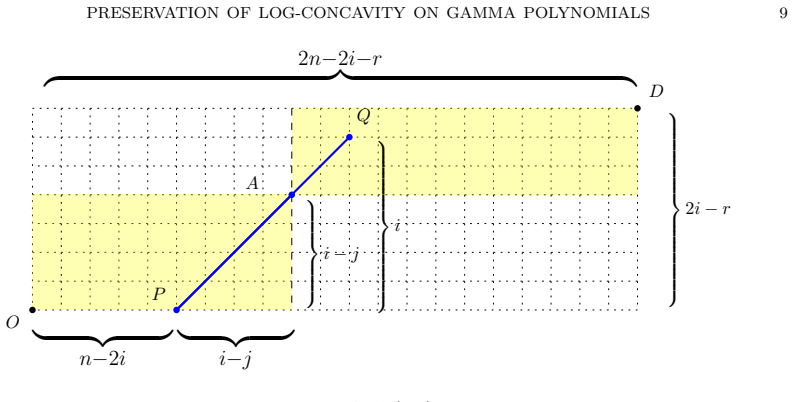
The gamma-basis expression $h(x)=\sum_{j=0}^{\lfloor n/2\rfloor}\gamma_j x^j(1+x)^{n-2j}$ is the setting; the sequence $\gamma_0,\ldots,\gamma_{\lfloor n/2\rfloor}$ is the gamma-polynomial. The proof's load-bearing identity is inequality (4.2): for fixed $n$, $i$, and $r$, the sum of products of binomial coefficients $\binom{n-2j}{i-j}\binom{n-2k}{i-k}$ over $j+k=r$ is at least the corresponding sum with $i-1$ and $i+1$ in place of $i$. This is proved by double-counting north-east lattice paths from $O$ to $D$ through two diagonal segments, $PQ$ and $P'Q'$. The key step is Claim 4.5, where a 180-degree rotation about the center of the rectangle spanned by two lattice points is an involution that sends intersections with one segment to intersections with the other, preserving the total count; this makes the difference between the two sides a manifestly nonnegative sum.
What would settle it
The theorem would be false if one could exhibit a symmetric polynomial with log-concave, zero-free gamma-polynomial whose coefficient sequence fails log-concavity. Since the proof reduces the theorem to inequality (4.2), a direct check of that finite binomial inequality for any concrete tuple $(n,i,r)$ — for instance by computer for small values — would settle the proof's correctness; a single failing tuple would locate the error precisely.
Extended reading notes
Core claim
The central claim is Theorem 1.3: log-concavity of the gamma-polynomial, together with absence of internal zeros, is inherited by the original symmetric polynomial. Since a log-concave sequence without internal zeros is automatically unimodal, the theorem supplies a new sufficient condition for unimodality that applies whenever gamma-positivity can be certified in the stronger log-concave form. The paper also notes that the converse is false, through an example from the ultra-log-concave setting. The proof is elementary in spirit but relies on a delicate lattice-path bijection, and in Lorentzian terminology it establishes that the operator sending gamma-coefficients to $h$ preserves the denormalized Lorentzian property.
Load-bearing premise
The proof's load-bearing premise is that the 180-degree rotation in Claim 4.5 is a true involution on lattice paths between any two eligible points and that it exactly swaps the number of intersections with the two segments; if that geometric bijection fails, the nonnegativity of the anti-diagonal sums — and hence the whole theorem — is unsupported.
Editorial extensions
If this is right
- Any symmetric polynomial whose gamma-polynomial is log-concave and zero-free is now known to be log-concave, hence unimodal.
- The result completes a chain of transfer theorems: real-rootedness, ultra log-concavity, and now ordinary log-concavity, each passing from gamma-polynomial to polynomial.
- In Lorentzian terms, the gamma-to-$h$ operator preserves the denormalized Lorentzian property, which is notable because denormalized Lorentzian polynomials lack the closure under nonnegative changes of variables that makes the Lorentzian case easy.
- The binomial inequality (4.2) stands on its own as a combinatorial identity, with the proof giving a positive expression for the difference between its two sides.
Reading between the lines
- The geometric involution behind Claim 4.5 may generalize to other pairs of line segments or higher-dimensional settings, since it is a purely positional bijection rather than an algebraic identity.
- A computational search over small $n$, $i$, $r$ could independently verify inequality (4.2); although the paper proves it, such a check would be a cheap way to build confidence in any implementation that relies on the theorem.
- The manifestly positive decomposition of the difference in (4.2) might yield quantitative lower bounds on the log-concavity margins for concrete families, which would be a testable extension for classes such as $h$-vectors of polytopes.
Signed reviews
Editorial analysis
A structured set of objections, weighed in public.
Referee Report
Summary. The paper studies the question, raised by Brändén, Ferroni, and Jochemko, whether log-concavity of the γ-polynomial of a symmetric polynomial h implies log-concavity of h. The main theorem (Theorem 1.3) asserts this implication, together with preservation of the no-internal-zeros property. The proof is elementary and divides into three parts: an explicit formula for the coefficients c^{(i)}_{jk} of h_i^2-h_{i-1}h_{i+1} in the monomial basis of the γ variables (Lemma 3.1); a sign-structure lemma (Lemma 3.3) showing that negative coefficients on each anti-diagonal can only occur as a final block; and a reduction to a binomial inequality (Theorem 4.3), which is attacked by a lattice-path double-counting and injection argument. If the proof of Theorem 4.3 is repaired, the paper would answer the motivating question and provide a self-contained combinatorial proof.
Significance. If correct, Theorem 1.3 is a natural and valuable completion of the known hierarchy: it extends the Brändén–Gal real-rootedness theorem and the ultra-log-concavity theorem of Brändén–Ferroni–Jochemko to ordinary log-concavity, using elementary methods. The paper is clearly written and includes instructive examples (Examples 2.3, 3.4, 4.6) and a self-contained derivation of the necessary binomial inequality. However, the current proof of Theorem 4.3 contains a double-counting error that is load-bearing: the lattice-path computation proves a different inequality than (4.2), so the main theorem is not established as written. The defect appears local and repairable, so the paper merits a major revision rather than rejection.
major comments (2)
- [Section 4, Theorem 4.3, display before Figure 1] The asserted equality LHS = sum_{A∈PQ∩Z^2} #{paths O→A} #{paths A→D} is false when r<i. For A=(n-i-j,i-j) with j∈{0,...,i}, the product equals the summand of (4.2) only for k=r-j≥0. When j>r, the point A is still on PQ but the product equals C(n-2j,i-j) C(n-2r+2j,i-r+j), which is not a term of the LHS of (4.2). For example, n=8, i=3, r=2 has LHS=224+225+224=673, while the sum over all four lattice points of PQ includes the extra j=3 term C(2,0)C(10,4)=210, giving 883. Since equations (4.3)–(4.5) are derived from this equality, they concern a modified left-hand side and do not prove (4.2). The gap occurs exactly in the range r<i, which is needed in Theorem 4.2, so Theorem 1.3 is not established as written.
- [Section 4, Claim 4.5] The rotation by 180 degrees about the center of the rectangle spanned by R and R′ maps a path from R to R′ to a path from R′ to R; to obtain an involution on paths from R to R′ one must also reverse the direction of traversal. This reversal is implicit in Figure 3 and in the equality of intersection counts, but it should be stated explicitly. This is a local correction, but it is needed for the cancellation leading to (4.5).
minor comments (3)
- [Lemma 4.1] The first displayed summation in the proof of Lemma 4.1 should start at i=0, not i=1, since the subsequent identity includes the term a_0 b_0.
- [Remark 4.7] The displayed identity in Remark 4.7 has garbled notation: the summation should be over j,k with j+k=r and the coefficient should read c^{(i)}_{j,k}.
- [Example 4.6] The caption of Figure 4 states that there are 15 contributing paths; the reader would benefit from a brief explanation of how this number is obtained from the formula in (4.5).
Circularity Check
No circularity: the proof of Theorem 1.3 is self-contained and does not reduce to its inputs.
full rationale
The derivation of Theorem 1.3 does not rely on the conclusion or on fitting. The gamma coefficients are defined from the symmetric polynomial h by the unique expansion h(x)=Σ γ_i x^i(1+x)^{n-2i}, and the theorem proves an implication about log-concavity. The proof is elementary and independent: Lemma 2.2 restates log-concavity as ratio inequalities; Lemma 3.1 computes the coefficients c^{(i)}_{jk} directly from (2.1); Lemma 3.3 analyzes their signs; Lemma 4.1 is a summation lemma; and the crucial nonnegativity is proved in Theorem 4.3 by a lattice-path double-counting injection (Claims 4.4 and 4.5). Previous results (Brändén–Gal and BFJ24) are cited only as motivation or context, not as load-bearing steps. No parameter is fitted, no prediction is renamed output, and no uniqueness theorem is imported from the authors' prior work. Even if the path-counting argument had an error, that would be a correctness issue, not circularity. Accordingly the paper merits score 0.
Assumptions & free parameters
assumptions (3)
- standard math Binomial coefficients of the form C(m, t) form a log-concave sequence for fixed m.
- standard math The number of NE lattice paths from (a,b) to (c,d) is C(c+d-a-b, d-b).
- standard math The gamma-basis expansion of a symmetric polynomial is unique and given by h(x) = sum_j gamma_j x^j (1+x)^(n-2j).
Cite this review
Pith. "Pith review of Preservation of log-concavity on gamma polynomials." pith.science (2026). https://pith.science/paper/I3SZ6PGS
@misc{pith2026250208948,
  author       = {Pith},
  title        = {Pith review of: Preservation of log-concavity on gamma polynomials},
  year         = {2026},
  howpublished = {\url{https://pith.science/paper/I3SZ6PGS}},
  note         = {Machine review of arXiv:2502.08948}
}
abstract
Every symmetric polynomial $h(x)$ with center of symmetry $n/2$ can be expressed as a linear combination in the basis $x^i(1+x)^{n-2i}$. The $\gamma$-polynomial of $h(x)$, which we denote $\gamma_h(x)$, records the coefficients of this linear combination. Two decades ago, Br\"and\'en and Gal independently showed that if $\gamma_h(x)$ has nonpositive real roots only, then so does $h(x)$. More recently, Br\"and\'en, Ferroni, and Jochemko proved using Lorentzian polynomials that if $\gamma_h(x)$ is ultra log-concave, then so is $h(x)$, and they raised the question of whether a similar statement can be proved for the usual notion of log-concavity. The purpose of this article is to show that the answer to the question of Br\"and\'en, Ferroni, and Jochemko is affirmative. One of the crucial ingredients of the proof is an inequality involving binomial numbers that we establish via a path-counting argument.
Figures


Figures from the paper (1 more)

Reference graph
Works this paper leans on
-
[1]
Athanasiadis, Gamma-positivity in combinatorics and geometry, S\' e m
Christos A. Athanasiadis, Gamma-positivity in combinatorics and geometry, S\' e m. Lothar. Combin. 77 ([2016--2018]), Art. B77i, 64. 3878174
work page 2016
- [2]
-
[3]
Petter Br \"a nd \'e n and June Huh, Lorentzian polynomials, Ann. of Math. (2) 192 (2020), no. 3, 821--891. 4172622
work page 2020
-
[4]
Petter Br \"a nd \'e n, Sign-graded posets, unimodality of W -polynomials and the C harney- D avis conjecture , Electron. J. Combin. 11 (2006), no. 2, Research Paper 9, 15. 2120105
work page 2006
-
[5]
Petter Br \"a n d \'e n, Unimodality, log-concavity, real-rootedness and beyond, Handbook of enumerative combinatorics, Discrete Math. Appl. (Boca Raton), CRC Press, Boca Raton, FL, 2015, pp. 437--483. 3409348
work page 2015
-
[6]
Francesco Brenti, Log-concave and unimodal sequences in algebra, combinatorics, and geometry: an update, Jerusalem combinatorics '93, Contemp. Math., vol. 178, Amer. Math. Soc., Providence, RI, 1994, pp. 71--89. 1310575
work page 1994
-
[7]
Gal, Real root conjecture fails for five- and higher-dimensional spheres, Discrete Comput
\'S wiatoslaw R. Gal, Real root conjecture fails for five- and higher-dimensional spheres, Discrete Comput. Geom. 34 (2005), no. 2, 269--284. 2155722
work page 2005
-
[8]
Richard P. Stanley, Log-concave and unimodal sequences in algebra, combinatorics, and geometry, Graph theory and its applications: E ast and W est ( J inan, 1986), Ann. New York Acad. Sci., vol. 576, New York Acad. Sci., New York, 1989, pp. 500--535. 1110850
work page 1986
Show all 9 references
-
[9]
Wilf, generatingfunctionology, second ed., Academic Press, Inc., Boston, MA, 1994
Herbert S. Wilf, generatingfunctionology, second ed., Academic Press, Inc., Boston, MA, 1994. 1277813
1994
Reviewed August 7, 2026 · model on record in the stance chip above.
Discussion (0). Continue with ORCID to comment.