REVIEW 3 major objections 4 minor 36 references
Single-shot carrier-envelope-phase measurement in ambient air
T0 review · 3 major / 4 minor · reviewed 2026-08-14 · deepseek-v4-flash
Pith's one-line read A compact three-electrode device measures the carrier-envelope phase of individual few-cycle laser pulses in ordinary air, with about 200 mrad precision.
desk verdict Compact single-shot CEP meter in air, with real data but an internal calibration that limits the absolute-accuracy claim. read the letter →
The pith
A machine-rendered reading of the paper's core claim, the machinery that carries it, and where it could break.
The reading
What carries the argument
The load-bearing object is the circular-polarization phase meter: a scheme in which circularly polarized few-cycle pulses are focused into a medium, and the CEP is read from the angular direction of the electrons or currents they release, because the direction of maximum electric field is tied to the carrier phase. In this implementation the medium is ambient air between two tip electrodes and a planar ground electrode, and the readout is the transient current into each tip, amplified and boxcar-integrated. The 90-degree spacing of the tips converts the CEP-dependent current direction into a two-channel phase representation, and the nonlinear mapping from polar angle to CEP is handled by a rebinning calibration rather than by assuming a linear response. This geometric current-direction encoding is what lets the device avoid vacuum and time-of-flight detection while retaining single-shot sensitivity.
What would settle it
Record the same pulse train with this air-plasma phase meter and an independent single-shot phase reference, such as a stereo-ATI or f-2f tagger, and compare shot-by-shot phases over a scan with a deliberately non-uniform CEP dwell time; a systematic disagreement that grows as the CEP distribution becomes non-uniform would show that the rebinning calibration is the weak point. Alternatively, hold the CEP fixed and check whether the retrieved phase remains constant when the stretcher is moved through a range that preserves the CEP but changes dispersion.
Extended reading notes
Core claim
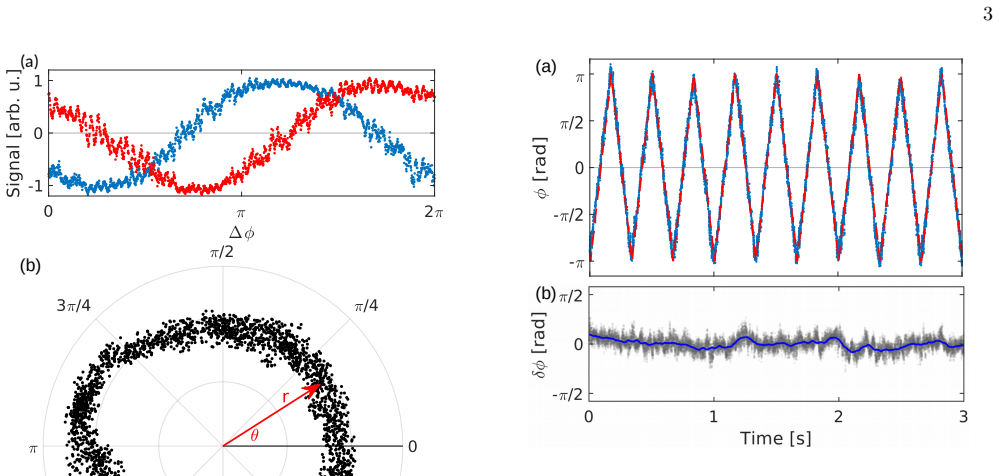
The central claim is that the circular-polarization phase-meter idea, previously realized with photoelectron detection, can be implemented as a bare current measurement in ambient air. For a circularly polarized few-cycle pulse, ionization is most likely when the field is strongest, and the freed electrons' drift direction is set by the field at that instant, so the direction of the resulting photocurrent rotates with the CEP. Placing two tip electrodes and a ground electrode around the focus turns this direction into two measurable charges $Q_1$ and $Q_2$; their polar angle $\theta=\mathrm{atan2}(Q_2,Q_1)$ is a monotonic function of the CEP. The paper calibrates this function by scanning the CEP with a moving stretcher and assuming a uniform CEP distribution, then retrieves single-shot phases with an upper-limit precision of about 206 mrad, comparable to the stereo-ATI phase meter. It further claims the same measurement also carries pulse-duration information, becomes more sensitive for shorter pulses, and is limited in speed only by amplifier bandwidth rather than by a time-of-flight measurement.
Load-bearing premise
The calibration assumes that every CEP value is equally likely during the scan and that the nominal phase is known from the stretcher dispersion alone; if either condition fails, the mapping from measured polar angle to CEP becomes biased.
Editorial extensions
If this is right
- Single-shot CEP tagging at 100 kHz is within reach with commercial integrators, and MHz rates are plausible with better shielding and tighter focusing.
- The same cm-scale, ambient-air setup could replace ultra-high-vacuum stereo-ATI apparatuses in experiments that only need CEP tagging rather than electron spectra.
- Because the signal does not rely on recollision, the scheme should extend to longer wavelengths where stereo-ATI is suppressed by the steep wavelength scaling of recollision.
- The retrieved signals also depend on pulse duration, so the device naturally doubles as a pulse-length monitor while measuring CEP.
Reading between the lines
- If the uniform-CEP calibration is valid, the same rebinning procedure could be applied to a source whose CEP fluctuates randomly, turning the device into a self-calibrating single-shot tagger that never needs a deliberate 0-to-2π scan.
- A direct head-to-head against an f-2f or stereo-ATI phase meter on the same shots would separate the device's own noise from calibration bias; the paper's 200 mrad figure is an upper limit relative to a nominal stretcher phase, not an absolute reference.
- The scheme's sensitivity to pulse duration suggests it could be used as a feedback sensor for compression, since insertion of dispersive glass shifts both the measured phase and the signal amplitude in a predictable way.
- Extending to mid-infrared drivers will require checking that the current direction remains a faithful CEP readout when the ionization dynamics changes with wavelength, but the absence of recollision removes the main known obstacle.
Signed reviews
Editorial analysis
A structured set of objections, weighed in public.
Referee Report
Summary. The paper reports a compact, single-shot carrier-envelope-phase (CEP) meter based on the CEP-dependent photocurrents generated when circularly polarized few-cycle pulses are focused in ambient air between three electrodes. The charge signals Q1 and Q2 from two tips show a CEP-dependent oscillation with a measured phase shift of about 92 degrees, close to the ideal 90 degrees. A parametric plot of Q1 and Q2 yields a polar angle that is mapped to CEP using a sorting/rebinning procedure, and the precision is estimated by comparing the retrieved CEP with a nominal CEP inferred from the dispersion introduced in the stretcher. The authors report single-shot precision of about 200 mrad (206, 211, and 356 mrad for different acquisition times) and argue that the technique can operate at repetition rates well above 100 kHz and at longer wavelengths, offering a simpler alternative to stereo-ATI phase meters.
Significance. If the central claim is established, this is a useful and conceptually important result: a centimeter-scale, ambient-air, single-shot CEP meter with precision comparable to that of the stereo-ATI phase meter would be an enabling tool for attosecond and strong-field experiments. The experimental data clearly show a CEP-dependent signal with the expected quadrature phase relation, and the device concept is appealingly simple. However, the claimed precision is not yet independently validated: the calibration and the precision estimate both rely on the same assumed linear CEP scan, and no external phase reference is used. The paper would be significantly strengthened by a comparison against an established CEP measurement technique or by a controlled injection of a known phase offset.
major comments (3)
- [RESULTS, calibration procedure] The sorting-based calibration function φ(θ) is constructed by assuming that all CEP values are equally probable during the scan, as stated in the text: 'The latter relies on the assumption that all CEP values are equally probable within the CEP scan.' This assumption is load-bearing for the entire measurement, but it is not independently verified. If the actual CEP scan is nonlinear or has an unknown offset, the sorting procedure will impose a uniform distribution and introduce a systematic distortion in φ(θ). The paper states that the condition is 'well fulfilled,' but no quantitative check (e.g., comparison with an independent phase measurement or a characterization of the stretcher nonlinearity) is provided. This should be addressed with an independent calibration or a sensitivity analysis.
- [RESULTS, Fig. 3 and precision estimate] The precision estimate is circular: the retrieved CEP is compared to a nominal CEP inferred from the same stretcher dispersion that was used to generate the assumed linear scan. Any systematic error in the dispersion-to-CEP relation, such as nonlinearity, drift, or a constant offset, is indistinguishable from meter noise in this comparison. Therefore the quoted 206, 211, and 356 mrad values should be regarded as estimates of the deviation from the assumed nominal ramp, not as upper limits on the CEP measurement uncertainty. The paper should either provide an independent phase reference (e.g., a stereo-ATI phase meter, an f-2f interferometer, or a calibrated phase step) or clearly re-state the precision claim as conditional on the nominal ramp being correct.
- [RESULTS, uncertainty statements] The relationship between the 'lower limit' dr/r = 0.107 rad and the 'upper limit' of 206 mrad is not explained. If dr/r is a lower limit on the CEP uncertainty, the factor-of-two gap to the upper limit is not accounted for; conversely, if dr/r is a measure of radial noise only, its connection to the angular (CEP) uncertainty should be stated explicitly. Without this reconciliation, the reader cannot assess whether the quoted 200 mrad precision is dominated by statistical noise, systematic distortions, or the calibration procedure.
minor comments (4)
- [Introduction] There is a typo: 'above threshold ionizatin' should be 'above-threshold ionization.'
- [RESULTS, Fig. 2 caption] The caption states 'The standard deviation dr of the radius' but does not define the normalization; the text later uses dr/r, so the caption should be consistent and state that the lower limit is dr/r.
- [RESULTS, precision values] The terms 'lower limit' and 'upper limit' are used without a formal definition. It would be clearer to state that dr/r is a statistical lower bound from the parametric-plot radius, and that the 206/211/356 mrad values are root-mean-square deviations from the nominal ramp, not rigorous uncertainty bounds.
- [RESULTS, calibration function] The description of the rebinning procedure is brief; a short equation or a step-by-step explanation of how the sorted polar angles are mapped to the linear CEP interval would improve reproducibility.
Circularity Check
The 200-mrad precision claim is self-referential: the sort-and-map calibration forces the retrieved CEP to match the same linear nominal ramp used for validation.
-
fitted input called prediction
[RESULTS (page 3, calibration paragraph and Fig. 3 description)]
"The latter relies on the assumption that all CEP values are equally probable within the CEP scan, which is well fulfilled in the present experiment. The dependence of the CEP on the polar angle is then simply obtained by sorting the polar angles in ascending order over the range of the scan and mapping them onto a linear CEP interval from −π to π."
The calibration function φ(θ) is built by sorting the measured polar angles of the very same CEP scan and assigning them a uniform phase ramp from −π to π. The precision is then estimated by comparing the retrieved CEP to the 'nominal' value inferred from the stretcher dispersion, i.e., to the same linear ramp that the calibration already assumes. For a monotonic θ(CEP) relation, the sorted-rank mapping makes the retrieved CEP track the assumed triangular ramp by construction; any nonlinearity or non-uniformity of the real CEP scan is absorbed into the calibration. The standard deviation of the retrieved-minus-nominal difference therefore measures only sorting jitter and noise, not agreement with an independent CEP reference.
full rationale
The core device concept is not circular: the CEP-dependent direction of photoelectron emission in circularly polarized fields is a physical effect, and the single-shot current detection in ambient air is a genuine experimental demonstration. The central quantitative claim, however, is calibrated and validated against the same assumed CEP ramp. The rebinning procedure sorts polar angles and maps them onto a linear CEP interval, explicitly assuming all CEP values are equally probable during the scan. The 'nominal' CEP used for the precision estimate is the same linear/triangular ramp inferred from stretcher dispersion. Since the retrieval map is constructed from that ramp, the agreement between retrieved and nominal CEP is forced by construction, leaving only rank-order jitter as the residual. No independent CEP reference (e.g., f-2f tagging or an external phase meter) is used to break this self-reference. The paper does call the result an 'upper limit' and states the uniform-CEP assumption, which is transparent, but that does not remove the circularity of the precision estimate. Self-citations such as [30] are not load-bearing here: the physical principle is prior work, not an unverified theorem imported to forbid alternatives. Overall, the demonstration has independent content, but the headline precision number reduces to the calibration assumption, warranting a partial-circularity score of 6.
Assumptions & free parameters
free parameters (2)
- Signal offset and normalization for Q1 and Q2 =
computed from CEP-averaged values
- Calibration function phi(theta) =
obtained by sorting polar angles and mapping onto a linear CEP interval
assumptions (5)
- domain assumption For circularly polarized few-cycle pulses, the preferred electron emission direction coincides with the CEP up to a constant offset.
- domain assumption The drift momentum of electrons ionized in a circularly polarized field is perpendicular to the direction of the maximum electric field when Coulomb interaction is neglected.
- domain assumption The photocurrents I1 and I2 measured at the two tips faithfully represent the direction of the transient current vector.
- ad hoc to paper The CEP values are uniformly distributed during the calibration scan.
- domain assumption The nominal CEP is linearly related to the dispersion introduced in the stretcher.
Cite this review
Pith. "Pith review of Single-shot carrier-envelope-phase measurement in ambient air." pith.science (2026). https://pith.science/paper/I4JI6EVP
@misc{pith2026190807481,
  author       = {Pith},
  title        = {Pith review of: Single-shot carrier-envelope-phase measurement in ambient air},
  year         = {2026},
  howpublished = {\url{https://pith.science/paper/I4JI6EVP}},
  note         = {Machine review of arXiv:1908.07481}
}
read the original abstract
The ability to measure and control the carrier envelope phase (CEP) of few-cycle laser pulses is of paramount importance for both frequency metrology and attosecond science. Here, we present a phase meter relying on the CEP-dependent photocurrents induced by circularly polarized few-cycle pulses focused between electrodes in ambient air. The new device facilitates compact single-shot, CEP measurements under ambient conditions and promises CEP tagging at repetition rates orders of magnitude higher than most conventional CEP detection schemes as well as straightforward implementation at longer wavelengths.
Figures


Figures from the paper (1 more)

Reference graph
Works this paper leans on
-
[1]
Com- pression of high-energy laser pulses below 5 fs,
M. Nisoli, S. De Silvestri, O. Svelto, R. Szipöcs, K. Fer- encz, Ch. Spielmann, S. Sartania, and F. Krausz, “Com- pression of high-energy laser pulses below 5 fs,” Optics Letters 22, 522–524 (1997)
work page 1997
-
[2]
Generation of carrier- envelope-phase-stable 2-cycle 740-µj pulses at 2.1-µm car- rier wavelength,
Xun Gu, Gilad Marcus, Yunpei Deng, Thomas Met- zger, Catherine Teisset, Nobuhisa Ishii, Takao Fuji, An- drius Baltuska, Rytis Butkus, Volodymyr Pervak, Hideki Ishizuki, Takunori Taira, Takayoshi Kobayashi, Reinhard Kienberger, and Ferenc Krausz, “Generation of carrier- envelope-phase-stable 2-cycle 740-µj pulses at 2.1-µm car- rier wavelength,” Optics Exp...
work page 2009
-
[3]
Attosecond control of electronic processes by intense light fields,
A. Baltuška, Th. Udem, M. Uiberacker, M. Hentschel, E. Goulielmakis, Ch. Gohle, R. Holzwarth, V. S. Yakovlev, A. Scrinzi, T. W. Hänsch, and F. Krausz, “Attosecond control of electronic processes by intense light fields,” Nature 421, 611–615 (2003)
work page 2003
-
[4]
Optical fre- quency synthesizer for precision spectroscopy,
R. Holzwarth, Th. Udem, T. W. Hänsch, J. C. Knight, W. J. Wadsworth, and P. St. J. Russell, “Optical fre- quency synthesizer for precision spectroscopy,” Physical Review Letters 85, 2264–2267 (2000)
work page 2000
-
[5]
Measuring the frequency of light with mode-locked lasers
J. Reichert, R. Holzwarth, T. Udem, and T. W. Hänsch, “Measuring the frequency of light with mode-locked lasers.” Optics Communications 172, 59–68 (1999)
work page 1999
-
[6]
H. R. Telle, G. Steinmeyer, A. E. Dunlop, J. Stenger, D.H. Sutter, and U. Keller, “Carrier-envelope offset phase control: A novel concept for absolute optical frequency measurement and ultrashort pulse generation,” Applied Physics B 69, 327–332 (1999)
work page 1999
-
[7]
Route to phase control of ultrashort light pulses,
L. Xu, Ch. Spielmann, A. Poppe, T. Brabec, F. Krausz, and T. W. Hänsch, “Route to phase control of ultrashort light pulses,” Optics Letters21, 2008–2010 (1996). 5
work page 1996
-
[8]
Approaching the limits of carrier-envelope phase stability in a millijoule-class am- plifier,
Fabian Lücking, Vincent Crozatier, Nicolas Forget, An- dreas Assion, and Ferenc Krausz, “Approaching the limits of carrier-envelope phase stability in a millijoule-class am- plifier,” Optics Letters39, 3884–3887 (2014)
work page 2014
Show all 36 references
-
[9]
Single-shot carrier-envelope-phase tagging using an f–2f interferometer and a phase meter: a com- parison,
Xiaoming Ren, A. M. Summers, Kanaka Raju Pandiri, Aram Vajdi, Varun Makhija, C. W. Fehrenbach, Nora G. Kling, K. J. Betsch, Z. Wang, M. F. Kling, K. D. Carnes, I. Ben-Itzhak, Carlos Trallero-Herrero, and Vinod Ku- marappan, “Single-shot carrier-envelope-phase tagging using an ...
2017
-
[10]
Single-shot cep drift measurement at arbitrary repetition rate based on dispersive fourier transform,
Máté Kurucz, Szabolcs Tóth, Roland Flender, Ludovít Haizer, Bálint Kiss, Benjamin Persielle, and Eric Cormier, “Single-shot cep drift measurement at arbitrary repetition rate based on dispersive fourier transform,” Optics Ex- press 27, 13387–13399 (2019)
2019
-
[11]
Determining the absolute carrier phase of a few-cycle laser pulse,
P. Dietrich, F. Krausz, and P. B. Corkum, “Determining the absolute carrier phase of a few-cycle laser pulse,” Optics Letters 25, 16–18 (2000)
2000
-
[12]
Absolute-phase phenomena in photoionization with few- cycle laser pulses,
G. G. Paulus, F. Grasbon, H. Walther, P. Villoresi, M. Nisoli, S. Stagira, E. Priori, and S. De Silvestri, “Absolute-phase phenomena in photoionization with few- cycle laser pulses,” Nature414, 182–184 (2001)
2001
-
[13]
Measure- ment of the phase of few-cycle laser pulses,
G. G. Paulus, F. Lindner, H. Walther, A. Baltuška, E. Goulielmakis, M. Lezius, and F. Krausz, “Measure- ment of the phase of few-cycle laser pulses,” Physical Review Letters 91, 253004 (2003)
2003
-
[14]
Single-shot carrier-envelope phase measurement of few- cycle laser pulses,
T. Wittmann, B. Horvath, W. Helml, M. G. Schätzel, X. Gu, A. L. Cavalieri, G. G. Paulus, and R. Kienberger, “Single-shot carrier-envelope phase measurement of few- cycle laser pulses,” Nature Physics5, 357–362 (2009)
2009
-
[15]
Continuous every-single-shot carrier-envelope phase measurement and control at 100 khz,
Dominik Hoff, Federico J. Furch, Tobias Witting, Klaus Rühle, DanielAdolph, A.MaxSayler, Marc J.J.Vrakking, Gerhard G. Paulus, and Claus Peter Schulz, “Continuous every-single-shot carrier-envelope phase measurement and control at 100 khz,” Optics Letters43, 3850–3853 (2018)
2018
-
[16]
Attosecond tracing of correlated electron-emission in non-sequential double ionization,
Boris Bergues, Matthias Kübel, Nora G. Johnson, Bet- tina Fischer, Nicolas Camus, Kelsie J. Betsch, Oliver Herrwerth, Arne Senftleben, A. Max Sayler, Tim Rathje, Thomas Pfeifer, Itzik Ben-Itzhak, Robert R. Jones, Ger- hard G. Paulus, Ferenc Krausz, Robert Moshammer, Joachim Ul...
2012
-
[17]
Laser-subcycle control of sequential double- ionization dynamics of helium,
Markus S. Schöffler, Xinhua Xie, Philipp Wustelt, Max Möller, Stefan Roither, Daniil Kartashov, A. Max Sayler, Andrius Baltuska, Gerhard G. Paulus, and Markus Kitzler, “Laser-subcycle control of sequential double- ionization dynamics of helium,” Physical Review A93, 063421 (2016)
2016
-
[18]
Single-cycle non-sequential double ioniza- tion,
B. Bergues, M. Kübel, N. G. Kling, C. Burger, and M. F. Kling, “Single-cycle non-sequential double ioniza- tion,” IEEE Journal of Selected Topics in Quantum Elec- tronics 21, 1–9 (2015)
2015
-
[19]
Com- plete characterization of single-cycle double ionization of argon from the nonsequential to the sequential ionization regime,
M. Kübel, C. Burger, Nora G. Kling, T. Pischke, L. Beau- fore, I. Ben-Itzhak, G. G. Paulus, J. Ullrich, T. Pfeifer, R. Moshammer, M. F. Kling, and B. Bergues, “Com- plete characterization of single-cycle double ionization of argon from the nonsequential to the sequential ioniz...
2016
-
[20]
Subfemtosecond steering of hydrocarbon deprotonation through superposition of vi- brational modes,
A. S. Alnaser, M. Kübel, R. Siemering, B. Bergues, Nora G. Kling, K. J. Betsch, Y. Deng, J. Schmidt, Z. A. Alahmed, A. M. Azzeer, J. Ullrich, I. Ben-Itzhak, R. Moshammer, U. Kleineberg, F. Krausz, R. de Vivie- Riedle, and M. F. Kling, “Subfemtosecond steering of hydrocarbon de...
2014
-
[21]
Carrier-envelope-phase dependence of asymmetric cd bond breaking in c2d2 in an intense few-cycle laser field,
Shun Miura, Toshiaki Ando, Kazuki Ootaka, Atsushi Iwasaki, Huailiang Xu, Tomoya Okino, Kaoru Ya- manouchi, Dominik Hoff, Tim Rathje, Gerhard G. Paulus, Markus Kitzler, Andrius Baltuška, Giuseppe Sansone, and Mauro Nisoli, “Carrier-envelope-phase dependence of asymmetric cd bond...
2014
-
[22]
Steering proton migration in hydrocarbons using intense few-cycle laser fields,
M. Kübel, R. Siemering, C. Burger, Nora G. Kling, H. Li, A. S. Alnaser, B. Bergues, S. Zherebtsov, A. M. Azzeer, I. Ben-Itzhak, R. Moshammer, R. de Vivie-Riedle, and M. F. Kling, “Steering proton migration in hydrocarbons using intense few-cycle laser fields,” Physical Review L...
2016
-
[23]
Single-shot velocity-map imag- ing of attosecond light-field control at kilohertz rate,
F. Süßmann, S. Zherebtsov, J. Plenge, Nora G. John- son, M. Kübel, A. M. Sayler, V. Mondes, C. Graf, E. Rühl, G. G. Paulus, D. Schmischke, P. Swrschek, and M. F. Kling, “Single-shot velocity-map imag- ing of attosecond light-field control at kilohertz rate,” Review of Scientific...
2011 doi
-
[24]
Field propagation- induced directionality of carrier-envelope phase-controlled photoemission from nanospheres,
F. Süßmann, L. Seiffert, S. Zherebtsov, V. Mondes, J. Stierle, M. Arbeiter, J. Plenge, P. Rupp, C. Peltz, A. Kessel, S. A. Trushin, B. Ahn, D. Kim, C. Graf, E. Rühl, M. F. Kling, and T. Fennel, “Field propagation- induced directionality of carrier-envelope phase-controlled phot...
2015
-
[25]
Spectral interferometry with waveform- dependent relativistic high-order harmonics from plasma surfaces,
Dmitrii Kormin, Antonin Borot, Guangjin Ma, William Dallari, Boris Bergues, Márk Aladi, István B. Földes, and Laszlo Veisz, “Spectral interferometry with waveform- dependent relativistic high-order harmonics from plasma surfaces,” Nature Communications9, 4992 (2018)
2018
-
[26]
Relativistic few-cycle pulses with high contrast from picosecond-pumped opcpa,
Alexander Kessel, Vyacheslav E. Leshchenko, Olga Jahn, Mathias Krüger, Andreas Münzer, Alexander Schwarz, Vladimir Pervak, Michael Trubetskov, Sergei A. Trushin, Ferenc Krausz, Zsuzsanna Major, and Stefan Karsch, “Relativistic few-cycle pulses with high contrast from picosecon...
2018
-
[27]
Scaling of wave-packet dynamics in an intense midinfrared field,
J. Tate, T. Auguste, H. G. Muller, P. Salières, P. Agostini, and L. F. DiMauro, “Scaling of wave-packet dynamics in an intense midinfrared field,” Physical Review Letters98, 013901 (2007)
2007
-
[28]
Optical-field-induced current in dielectrics,
Agustin Schiffrin, Tim Paasch-Colberg, Nicholas Karpow- icz, Vadym Apalkov, Daniel Gerster, Sascha Mühlbrandt, Michael Korbman, Joachim Reichert, Martin Schultze, Simon Holzner, Johannes V. Barth, Reinhard Kienberger, Ralph Ernstorfer, Vladislav S. Yakovlev, Mark I. Stock- man,...
2012
-
[29]
Solid-state light-phase detector,
Tim Paasch-Colberg, Agustin Schiffrin, Nicholas Kar- powicz, Stanislav Kruchinin, Özge Saglam, Sabine Keiber, Olga Razskazovskaya, Sascha Mühlbrandt, Ali Alnaser, Matthias Kübel, Vadym Apalkov, Daniel Ger- ster, Joachim Reichert, Tibor Wittmann, Johannes V. Barth, Mark I. Stock...
2014
-
[30]
The circular-polarization phase-meter,
Boris Bergues, “The circular-polarization phase-meter,” Optics Express 20, 25317–25324 (2012)
2012
-
[31]
Determination of the absolute carrier-envelope phase by angle-resolved photoelectron spectra of ar by intense circularly polarized few-cycle pulses,
Shinichi Fukahori, Toshiaki Ando, Shun Miura, Reika Kanya, Kaoru Yamanouchi, Tim Rathje, and Gerhard G. Paulus, “Determination of the absolute carrier-envelope phase by angle-resolved photoelectron spectra of ar by intense circularly polarized few-cycle pulses,” Physical Revie...
2017
-
[32]
Direct in-situ single-shot measurements of the absolute carrier- envelope phases of ultrashort pulses,
Duke A. Debrah, Gabriel A. Stewart, Gihan Basnayake, John W. G. Tisch, Suk Kyoung Lee, and Wen Li, “Direct in-situ single-shot measurements of the absolute carrier- envelope phases of ultrashort pulses,” Opt. Lett.44, 3582– 3585 (2019)
2019
-
[33]
Determination of the carrier- envelope phase of few-cycle laser pulses with terahertz- emission spectroscopy,
Markus Kreß, Torsten Löffler, Mark D. Thomson, Rein- hard Dörner, Hartmut Gimpel, Karl Zrost, Thorsten Er- gler, Robert Moshammer, Uwe Morgner, Joachim Ullrich, and Hartmut G. Roskos, “Determination of the carrier- envelope phase of few-cycle laser pulses with terahertz- emissio...
2006
-
[34]
Coherent polarization control of terahertz waves gener- ated from two-color laser-induced gas plasma,
Jianming Dai, Nicholas Karpowicz, and X.-C. Zhang, “Coherent polarization control of terahertz waves gener- ated from two-color laser-induced gas plasma,” Physical Review Letters 103, 023001 (2009)
2009
-
[35]
Characterizing the polarity of a few-cycle infrared laser pulse,
Y. Bai, C. Li, P. Liu, R. X. Li, R. J. Xu, H. Yang, Z. N. Zeng, H. H. Lu, G. Y. Hu, A. L. Lei, Y. X. Leng, and Z. Z. Xu, “Characterizing the polarity of a few-cycle infrared laser pulse,” Applied Physics B106, 45–49 (2012)
2012
-
[36]
Carrier-envelope-phase tagging in mea- surements with long acquisition times,
M. Kübel, K. J. Betsch, Nora G. Johnson, U. Kleineberg, R. Moshammer, J. Ullrich, G. G. Paulus, M. F. Kling, and B. Bergues, “Carrier-envelope-phase tagging in mea- surements with long acquisition times,” New Journal of Physics 14, 093027 (2012)
2012
Reviewed August 14, 2026 · model on record in the stance chip above.
Discussion (0). Continue with ORCID to comment.