Testing k-submodularity
Pith reviewed 2026-06-30 03:23 UTC · model grok-4.3
The pith
Every bounded k-submodular function is close to a junta on the hypergrid, allowing constant-query testers in the ℓ_p regime.
A machine-rendered reading of the paper's core claim, the machinery that carries it, and where it could break.
Core claim
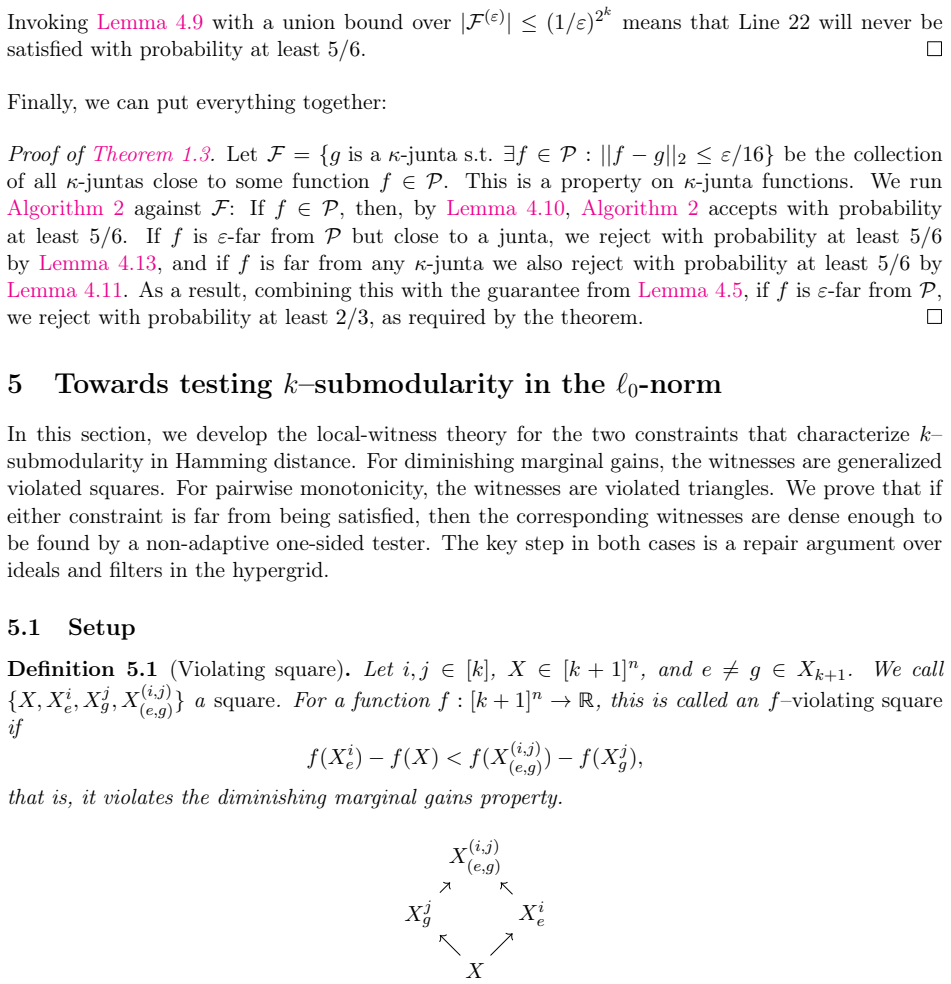
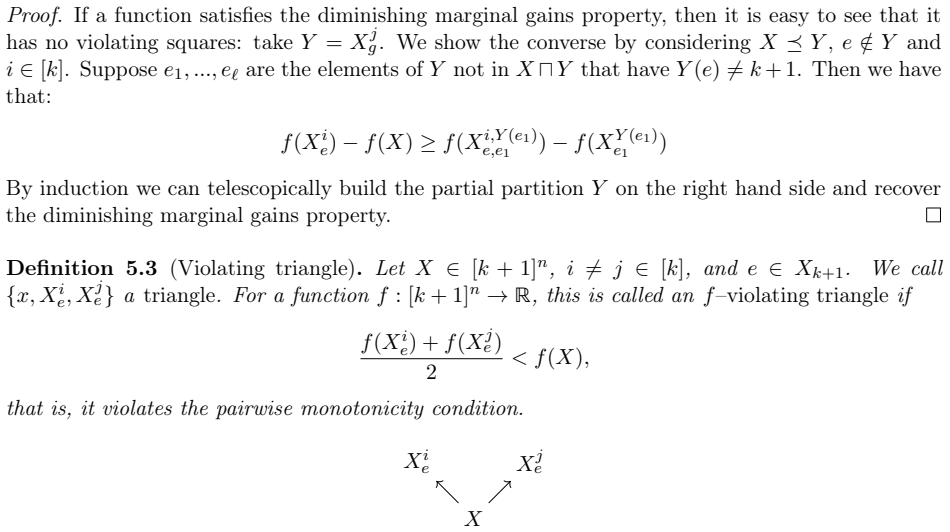
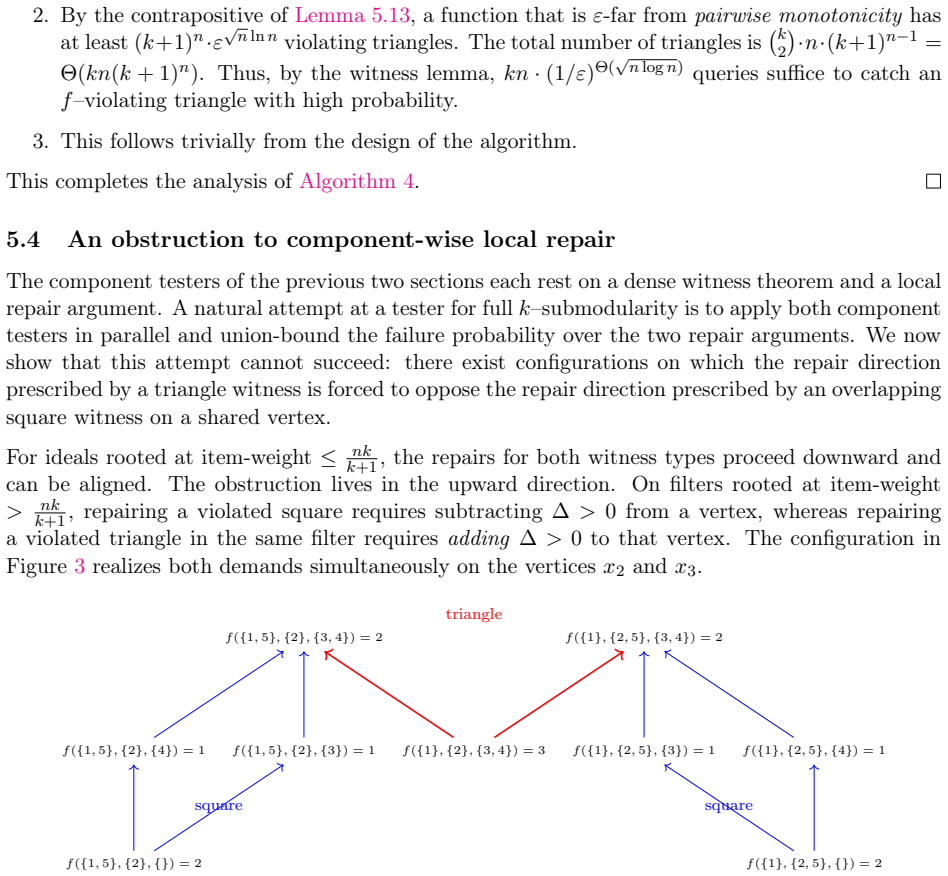
In the ℓ_p regime for p ≥ 1, every bounded k-submodular function is close to a junta on the hypergrid. This, combined with an implicit-learning tester, yields a constant-query tester for k-submodularity. For Hamming distance, density theorems are proved for violated squares and triangles using repairs on filters and ideals, but a configuration shows opposition preventing a combined tester.
What carries the argument
Junta closeness on the hypergrid for the ℓ_p regime, together with repair operations on filters and ideals of partial partitions to prove density for the two witness types.
If this is right
- Constant-query testing becomes possible for k-submodularity under ℓ_p distances.
- Non-adaptive one-sided sub-exponential-query testers exist for the diminishing-returns component and the pairwise-monotonicity component separately under Hamming distance.
- An adaptive tester exists for monotone k-submodularity on bounded-range functions via pseudo-DNF representation and hypergrid learning.
- The structural tools developed for partial partitions may transfer to testing other properties on product domains.
Where Pith is reading between the lines
- The identified repair conflict implies that a tester for the full k-submodularity property under Hamming distance likely requires a different method or higher query complexity than the separate components.
- The hypergrid junta result may generalize to testing other diminishing-returns-type properties over product spaces with similar distance measures.
- The sharp difference between ℓ_p and Hamming regimes indicates that metric choice can determine whether local witnesses for higher-order submodularity can be combined or must be handled apart.
Load-bearing premise
The assumption that repair operations on filters and ideals of partial partitions can establish density theorems for both witness types while preserving the ability to combine them or at least test components independently.
What would settle it
A concrete bounded k-submodular function on the hypergrid whose distance to every junta exceeds the bound claimed in the ℓ_p analysis would falsify the constant-query tester.
Figures
read the original abstract
We initiate the study of property testing for $k$-submodular functions, a higher-dimensional analogue of submodular functions defined on partial partitions of a ground set. While $k$-submodularity retains the diminishing-returns flavor of ordinary submodularity, it also introduces a pairwise monotonicity constraint comparing competing assignments of the same element. This additional local structure makes the testing problem qualitatively different from the classical case. Our results show a sharp contrast between distance regimes. In the $\ell_p$ regime for $p \geq 1$, we prove that every bounded $k$-submodular function is close to a junta on the hypergrid. Combined with an implicit-learning tester for hypergrid domains, this yields a constant-query tester for $k$-submodularity. In the Hamming distance regime, $k$-submodularity admits two qualitatively different local witnesses -- violated squares for diminishing marginal gains, and violated triangles for pairwise-monotonicity failures -- and the latter has no counterpart at $k=1$. We prove density theorems for both witness types via repair on filters and ideals of partial partitions, yielding non-adaptive, one-sided sub-exponential-query testers for the two component properties of $k$-submodularity. We then exhibit a configuration in which the two repair directions are forced into opposition on a shared vertex, identifying a structural barrier to combining these into a tester for the full property. Finally, for bounded-range functions, we give an adaptive tester for monotone $k$-submodularity via a pseudo-DNF representation and learning on the hypergrid. Several of the structural and learning tools developed here may be useful for testing other properties over product domains.
Editorial analysis
A structured set of objections, weighed in public.
Referee Report
Summary. The manuscript initiates the study of property testing for k-submodular functions on hypergrids. In the ℓ_p regime (p ≥ 1), it proves every bounded k-submodular function is close to a junta, yielding a constant-query tester via implicit learning. In the Hamming regime, it proves density theorems for violated squares (diminishing returns) and violated triangles (pairwise monotonicity) via repair operations on filters and ideals of partial partitions, giving non-adaptive one-sided sub-exponential testers for the two component properties, while exhibiting a structural barrier preventing their combination into a tester for the full property. It also gives an adaptive tester for monotone k-submodularity via pseudo-DNF representation and hypergrid learning. Several structural and learning tools are developed that may apply to other product-domain properties.
Significance. If the results hold, the work makes a substantial contribution by initiating testing for this higher-dimensional generalization of submodularity and demonstrating a sharp contrast between distance regimes due to the additional pairwise monotonicity constraint. The junta-closeness result, the density theorems via repair on partial partitions, and the explicit structural barrier are all load-bearing and provide falsifiable predictions through the described testers. The tools developed here receive explicit credit as potentially reusable for other properties over product domains.
minor comments (2)
- The abstract is information-dense; expanding the high-level description of how the pseudo-DNF representation enables the adaptive monotone tester would improve accessibility without altering technical content.
- In the Hamming-distance discussion, the derivation of sub-exponential query complexity from the density theorems for the two witness types could be stated more explicitly (e.g., how the repair operations translate into query bounds).
Simulated Author's Rebuttal
We thank the referee for their positive assessment of the manuscript, accurate summary of the results, and recommendation for minor revision. The report correctly identifies the key contributions, including the junta-closeness result in the ℓ_p regime, the density theorems via repair operations in the Hamming regime, the structural barrier, and the potential reusability of the tools. No specific major comments are listed in the report.
Circularity Check
No significant circularity; derivation is self-contained
full rationale
The paper establishes new junta approximation results for bounded k-submodular functions on the hypergrid in the ℓ_p regime, combined with standard implicit-learning testers, and proves density theorems for local witnesses (violated squares and triangles) via repair operations on filters and ideals of partial partitions. These steps rely on first-principles structural arguments in property testing over product domains, with explicit separation of Hamming and ℓ_p regimes and acknowledgment of a structural barrier to combining testers. No load-bearing step reduces by definition, fitted input, or self-citation chain to the target claim; the central results introduce independent content beyond inputs.
Axiom & Free-Parameter Ledger
axioms (1)
- standard math Standard definitions and properties of partial partitions, hypergrids, and the diminishing-returns plus pairwise-monotonicity constraints that define k-submodularity.
Reference graph
Works this paper leans on
-
[1]
Algorithmica , volume=
Is submodularity testable? , author=. Algorithmica , volume=. 2014 , publisher=
2014
-
[2]
SIAM Journal on Computing , volume=
On testing convexity and submodularity , author=. SIAM Journal on Computing , volume=. 2003 , publisher=
2003
-
[3]
Testing submodularity and other properties of valuation functions
Testing submodularity and other properties of valuation functions , author=. arXiv preprint arXiv:1611.07879 , year=
work page internal anchor Pith review Pith/arXiv arXiv
-
[4]
SIAM Journal on Discrete Mathematics , volume=
Recognizing coverage functions , author=. SIAM Journal on Discrete Mathematics , volume=. 2015 , publisher=
2015
-
[5]
Random Structures & Algorithms , year=
Isoperimetric inequalities for real-valued functions with applications to monotonicity testing , author=. Random Structures & Algorithms , year=
-
[6]
ACM Transactions on Algorithms (TALG) , volume=
Maximizing k-submodular functions and beyond , author=. ACM Transactions on Algorithms (TALG) , volume=. 2016 , publisher=
2016
-
[7]
SIAM Journal on Computing , volume=
Optimal bounds on approximation of submodular and XOS functions by juntas , author=. SIAM Journal on Computing , volume=. 2016 , publisher=
2016
-
[8]
Random Structures & Algorithms , volume=
Covering minimum spanning trees of random subgraphs , author=. Random Structures & Algorithms , volume=. 2006 , publisher=
2006
-
[9]
Summer school on machine learning , pages=
Concentration inequalities , author=. Summer school on machine learning , pages=. 2003 , publisher=
2003
-
[10]
Foundations and Trends
Learning with submodular functions: A convex optimization perspective , author=. Foundations and Trends. 2013 , publisher=
2013
-
[11]
, author=
Submodular function maximization. , author=. Tractability , volume=
-
[12]
Mathematical Programming , volume=
Submodular function minimization , author=. Mathematical Programming , volume=. 2008 , publisher=
2008
-
[13]
Advances in Neural Information Processing Systems , volume=
Monotone k-submodular function maximization with size constraints , author=. Advances in Neural Information Processing Systems , volume=
-
[14]
European Symposium on Algorithms , pages=
Online stochastic packing applied to display ad allocation , author=. European Symposium on Algorithms , pages=. 2010 , organization=
2010
-
[15]
International Conference on Machine Learning , pages=
Streaming algorithm for monotone k-submodular maximization with cardinality constraints , author=. International Conference on Machine Learning , pages=. 2022 , organization=
2022
-
[16]
Journal of the ACM (JACM) , volume=
Property testing and its connection to learning and approximation , author=. Journal of the ACM (JACM) , volume=. 1998 , publisher=
1998
-
[17]
International Symposium on Algorithms and Computation , pages=
Application of M-convex submodular flow problem to mathematical economics , author=. International Symposium on Algorithms and Computation , pages=. 2001 , organization=
2001
-
[18]
2005 , publisher=
Submodular functions and optimization , author=. 2005 , publisher=
2005
-
[19]
2012 IEEE 53rd Annual Symposium on Foundations of Computer Science , pages=
Partially symmetric functions are efficiently isomorphism-testable , author=. 2012 IEEE 53rd Annual Symposium on Foundations of Computer Science , pages=. 2012 , organization=
2012
-
[20]
O'Donnell, Analysis of Boolean Functions
Analysis of boolean functions , author=. arXiv preprint arXiv:2105.10386 , year=
-
[21]
Sofya Raskhodnikova and Grigory Yaroslavtsev , editor =. Learning pseudo-Boolean. Proceedings of the Twenty-Fourth Annual. 2013 , url =. doi:10.1137/1.9781611973105.98 , timestamp =
-
[22]
Submodular functions and convexity
Lov \'a sz, L. Submodular functions and convexity. Mathematical Programming The State of the Art: Bonn 1982. 1983. doi:10.1007/978-3-642-68874-4_10
-
[23]
Paul Beame , title =
-
[24]
Yishay Mansour , title =. J. Comput. Syst. Sci. , volume =. 1995 , url =. doi:10.1006/JCSS.1995.1043 , timestamp =
-
[25]
Eyal Kushilevitz and Yishay Mansour , title =. 1993 , url =. doi:10.1137/0222080 , timestamp =
-
[26]
2025 , url =
Sofya Raskhodnikova , title =. 2025 , url =
2025
discussion (0)
Sign in with ORCID, Apple, or X to comment. Anyone can read and Pith papers without signing in.