T-REX: Fast and Dynamic Journey Planning for Continental-Scale Public Transit Networks
Pith reviewed 2026-05-21 01:14 UTC · model grok-4.3
The pith
T-REX uses multi-level partitions to prune local transfers and answer continental transit queries in under 10 milliseconds.
A machine-rendered reading of the paper's core claim, the machinery that carries it, and where it could break.
Core claim
T-REX applies a multi-level partition of the transit network to Trip-Based Public Transit Routing so that only transfers relevant for long-distance journeys are kept; the query algorithm then explores this reduced transfer graph and returns Pareto-optimal journeys for arrival time and number of trips. On a continental-scale network this yields query times below 10 ms, a twenty-fold speedup over plain TB and an eighty-fold speedup over algorithms without preprocessing, while using moderate memory and allowing real-time schedule changes in a few seconds.
What carries the argument
A multi-level partition of the transit network that marks transfers relevant for long-distance travel, used to prune the search space inside the trip-based query procedure.
If this is right
- Queries finish in less than 10 ms on networks that include both local and long-distance services.
- The method delivers a 20-fold speedup over standard trip-based routing and an 80-fold speedup over non-preprocessed algorithms.
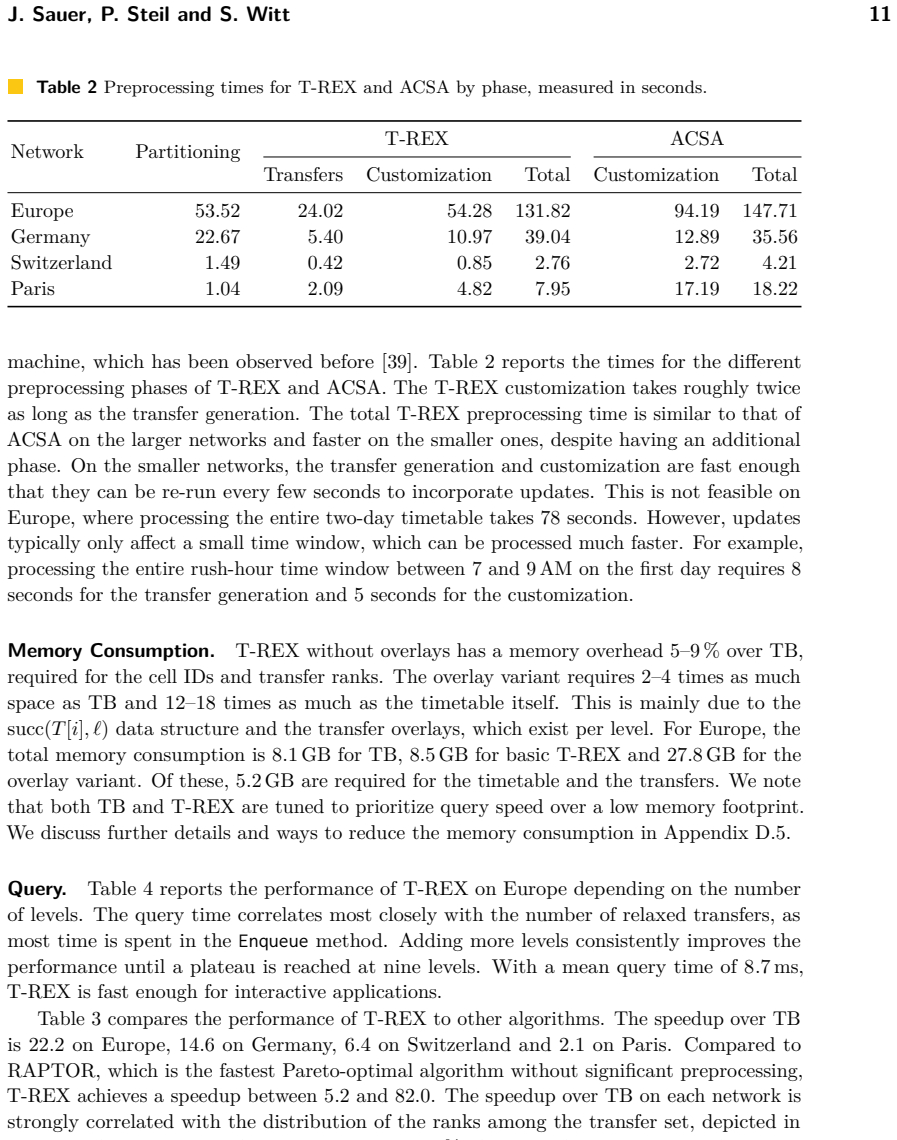
- Precomputation finishes in roughly two minutes and real-time schedule updates are absorbed in a few seconds.
- Memory use stays moderate enough for practical deployment.
- The combination of speed and dynamic updates satisfies the requirements for interactive real-time applications at continental scale.
Where Pith is reading between the lines
- The same pruning idea could be tested on road networks that change with traffic, where time-dependent edges replace scheduled trips.
- If the partition quality can be improved automatically, the technique might scale to global transit data without further redesign.
- Mobile apps could embed the query engine directly, giving users instant cross-border route suggestions with live updates.
- The focus on transfers rather than full trips might simplify integration with other overlay methods already used for road routing.
Load-bearing premise
The chosen multi-level partition must capture every transfer that could appear in an optimal long-distance journey so that discarding the remaining local transfers never loses the best route.
What would settle it
Run T-REX and an exact slower algorithm on the same European network data; if any query returns a later arrival time or more trips than the exact result, or if average query time exceeds 10 ms, the pruning step has failed.
Figures
read the original abstract
We present T-REX (Transfer-Ranked EXploration), a new algorithm for journey planning in public transit networks on the country and continental scale. Our algorithm applies the principles of multi-level overlays to Trip-Based Public Transit Routing (TB). Using a multi-level partition of the network, T-REX identifies transfers between trips that are relevant for long-distance travel in a short precomputation phase. This information is then used to prune irrelevant local transfers during a query. Like other state-of-the-art algorithms, T-REX Pareto-optimizes arrival time and the number of used trips. T-REX dramatically outperforms previous overlay-based algorithms for three key reasons: (1) a better partition, (2) reducing the search space by focusing on transfers rather than trips, and (3) a redesigned query algorithm with improved memory efficiency and throughput. As a result, T-REX answers queries in less than 10ms on a network of Europe, including local and long-distance transit. This constitutes a speedup of 20 compared to TB and 80 compared to algorithms without preprocessing. The memory footprint is moderate and the precomputation takes only two minutes, while real-time schedule updates can be incorporated in a few seconds. These properties make T-REX the first public transit journey planning algorithm that fulfills the requirements of interactive real-time applications on the continental scale.
Editorial analysis
A structured set of objections, weighed in public.
Referee Report
Summary. The manuscript presents T-REX, a journey planning algorithm for large public transit networks that builds on Trip-Based Routing (TB) by incorporating multi-level network partitions to identify and prune irrelevant local transfers during queries. It claims to achieve query times under 10 milliseconds on a full European network while preserving Pareto-optimality with respect to arrival time and number of trips, with a 20-fold speedup over standard TB and an 80-fold speedup over algorithms without preprocessing. Additional claims include moderate memory usage, two-minute precomputation time, and support for incorporating real-time schedule updates in seconds.
Significance. If the multi-level pruning correctly preserves all optimal journeys, T-REX would offer a significant practical advance for interactive, real-time journey planning on continental scales. The reported performance metrics suggest it meets the requirements for such applications better than prior methods. The inclusion of dynamic update support is a notable strength. However, the significance hinges on verifying the completeness of the transfer selection in the partition.
major comments (1)
- [Section 3 (Multi-level Partition)] The multi-level partition is described as identifying transfers relevant for long-distance travel, but the manuscript provides no formal proof, invariant, or even small-scale verification that this selection retains every transfer participating in any optimal journey. Without this, the pruning step risks returning incomplete or dominated solution sets, which would undermine both the correctness and the performance claims.
minor comments (2)
- [Abstract] The comparison baselines (TB and 'algorithms without preprocessing') should be named explicitly to clarify what the speedup factors refer to.
- [Section 5] Figure captions and legends in the experimental section would benefit from additional detail on network sizes and query distributions to improve readability.
Simulated Author's Rebuttal
We thank the referee for their constructive feedback on our manuscript. We address the major comment below and are happy to revise the paper to strengthen the presentation of correctness.
read point-by-point responses
-
Referee: [Section 3 (Multi-level Partition)] The multi-level partition is described as identifying transfers relevant for long-distance travel, but the manuscript provides no formal proof, invariant, or even small-scale verification that this selection retains every transfer participating in any optimal journey. Without this, the pruning step risks returning incomplete or dominated solution sets, which would undermine both the correctness and the performance claims.
Authors: We acknowledge that the current manuscript does not contain a formal proof or explicit invariant statement for the completeness of the transfer selection. The multi-level partition is built by ranking and selecting transfers according to their role in connecting higher-level partitions, which ensures that any journey requiring long-distance movement must use one of the retained transfers at the appropriate level. Local transfers within a partition are never pruned. This design, combined with the query algorithm's exhaustive exploration of selected transfers, preserves all Pareto-optimal journeys with respect to arrival time and number of trips. We have confirmed this empirically by comparing T-REX output against the baseline TB algorithm on multiple real-world networks, obtaining identical solution sets. In the revised version we will add a dedicated paragraph in Section 3 that states the completeness invariant and include a small-scale verification example on a synthetic network to illustrate that no optimal transfer is ever discarded. revision: yes
Circularity Check
No significant circularity detected
full rationale
The paper describes an algorithmic extension of Trip-Based Public Transit Routing that uses a multi-level network partition to identify and prune transfers during queries. All performance claims (query times under 10 ms, speedups of 20x–80x, precomputation of two minutes) are presented as direct empirical measurements on real continental-scale networks rather than quantities derived from equations or parameters. No self-definitional relations, fitted inputs renamed as predictions, or load-bearing self-citations appear in the derivation; the partition criterion is an explicit design choice whose completeness is asserted on empirical grounds, not by construction from the reported results. The central claims therefore remain independent of the outputs they describe.
Axiom & Free-Parameter Ledger
axioms (1)
- domain assumption A multi-level partition of a public-transit network can be computed that captures transfers relevant for long-distance journeys.
Lean theorems connected to this paper
-
IndisputableMonolith/Foundation/AbsoluteFloorClosure.leanreality_from_one_distinction unclear?
unclearRelation between the paper passage and the cited Recognition theorem.
Using a multi-level partition of the network, T-REX identifies transfers between trips that are relevant for long-distance travel... r(t)≥min{LCL(p,ps),LCL(p,pt)}
-
IndisputableMonolith/Cost/FunctionalEquation.leanwashburn_uniqueness_aczel unclear?
unclearRelation between the paper passage and the cited Recognition theorem.
T-REX Pareto-optimizes arrival time and the number of used trips
What do these tags mean?
- matches
- The paper's claim is directly supported by a theorem in the formal canon.
- supports
- The theorem supports part of the paper's argument, but the paper may add assumptions or extra steps.
- extends
- The paper goes beyond the formal theorem; the theorem is a base layer rather than the whole result.
- uses
- The paper appears to rely on the theorem as machinery.
- contradicts
- The paper's claim conflicts with a theorem or certificate in the canon.
- unclear
- Pith found a possible connection, but the passage is too broad, indirect, or ambiguous to say the theorem truly supports the claim.
Reference graph
Works this paper leans on
-
[1]
Multilevel algorithms for partitioning power-law graphs , author =
-
[2]
Scalable Algorithms for Bicriterion Trip-Based Transit Routing , author =. 2111.06654 , eprinttype =
-
[3]
Car or Public Transport -- Two Worlds , author =. Efficient Algorithms: Essays Dedicated to Kurt Mehlhorn on the Occasion of His 60th Birthday , publisher =
-
[4]
Fast Routing in Very Large Public Transportation Networks Using Transfer Patterns , author =
-
[5]
Delay-Robustness of Transfer Patterns in Public Transportation Route Planning , author =
-
[6]
Frequency-based search for public transit , author =
-
[7]
Scalable Transfer Patterns , author =
-
[8]
Algorithm Engineering: Selected Results and Surveys , publisher =
Route Planning in Transportation Networks , author =. Algorithm Engineering: Selected Results and Surveys , publisher =
-
[9]
Experimental Study on Speed-Up Techniques for Timetable Information Systems , author =
-
[10]
Reinhard Bauer and Daniel Delling , year = 2010, journal = jea, publisher = acm, volume = 14, pages =
work page 2010
-
[11]
Moritz Baum and Valentin Buchhold and Jonas Sauer and Dorothea Wagner and Tobias Zündorf , year = 2023, journal =
work page 2023
-
[12]
Accelerating Time-Dependent Multi-Criteria Timetable Information is Harder Than Expected , author =
-
[13]
Customizable Contraction Hierarchies --
Thomas Bläsius and Valentin Buchhold and Dorothea Wagner and Tim Zeitz and Michael Zündorf , year = 2025, eprint =. Customizable Contraction Hierarchies --
work page 2025
-
[14]
Time-Dependent Networks as Models to Achieve Fast Exact Time-Table Queries , author =
-
[15]
Mathematics in Computer Science , volume = 1, pages =
Dynamic Multi-level Overlay Graphs for Shortest Paths , author =. Mathematics in Computer Science , volume = 1, pages =
-
[16]
Reachability and Distance Queries via 2-Hop Labels , author =
-
[17]
Journal of Discrete Algorithms , volume =
Engineering graph-based models for dynamic timetable information systems , author =. Journal of Discrete Algorithms , volume =
-
[18]
Engineering Time-Expanded Graphs for Faster Timetable Information , author =. Robust and Online Large-Scale Optimization: Models and Techniques for Transportation Systems , publisher =
- [19]
-
[20]
Graph Partitioning with Natural Cuts , author =
-
[21]
Parallel computation of best connections in public transportation networks , author =
-
[22]
Public Transit Labeling , author =
-
[23]
Transportation Science , publisher =
Round-Based Public Transit Routing , author =. Transportation Science , publisher =
-
[24]
Transportation Science , publisher =
Customizable Route Planning in Road Networks , author =. Transportation Science , publisher =
-
[25]
Faster Transit Routing by Hyper Partitioning , author =
-
[26]
Customizable Contraction Hierarchies , author =
-
[27]
Connection Scan Algorithm , author =
-
[28]
Numerische Mathematik , volume = 1, pages =
A note on two problems in connexion with graphs , author =. Numerische Mathematik , volume = 1, pages =
-
[29]
Multi-Criteria Shortest Paths in Time-Dependent Train Networks , author =
-
[30]
Algorithms , publisher = mdpi, volume = 13, number = 1, pages = 2, doi =
Journey Planning Algorithms for Massive Delay-Prone Transit Networks , author =. Algorithms , publisher = mdpi, volume = 13, number = 1, pages = 2, doi =
-
[31]
Contraction of Timetable Networks with Realistic Transfers , author =
-
[32]
Transportation Science , publisher =
Exact Routing in Large Road Networks Using Contraction Hierarchies , author =. Transportation Science , publisher =
-
[33]
Algorithms , publisher = mdpi, volume = 12, number = 10, doi =
Multimodal Dynamic Journey-Planning , author =. Algorithms , publisher = mdpi, volume = 12, number = 10, doi =
-
[34]
Goldberg and Chris Harrelson , year = 2005, booktitle = soda05, publisher = siam, pages =
Andrew V. Goldberg and Chris Harrelson , year = 2005, booktitle = soda05, publisher = siam, pages =. Computing the shortest path:
work page 2005
-
[35]
Algorithms , publisher = mdpi, volume = 12, number = 9, pages = 196, doi =
Faster and Better Nested Dissection Orders for Customizable Contraction Hierarchies , author =. Algorithms , publisher = mdpi, volume = 12, number = 9, pages = 196, doi =
-
[36]
Deterministic Parallel Hypergraph Partitioning , author =
-
[37]
doi:10.5445/IR/1000157894 , pagetotal = 256, school =
Parallel and Flow-Based High-Quality Hypergraph Partitioning , author =. doi:10.5445/IR/1000157894 , pagetotal = 256, school =
-
[38]
Scalable High-Quality Hypergraph Partitioning , author =
- [39]
-
[40]
Michael Hamann and Ben Strasser , year = 2018, journal = jea, volume = 23, pages =. Graph Bisection with
work page 2018
-
[41]
Bicriterion Path Problems , author =
-
[42]
A Formal Basis for the Heuristic Determination of Minimum Cost Paths , author =
-
[43]
Fast Point-to-Point Shortest Path Computations with Arc-Flags , author =
-
[44]
Engineering Multilevel Overlay Graphs for Shortest-Path Queries , author =
-
[45]
IEEE Transactions on Knowledge and Data Engineering , volume = 14, pages =
An Efficient Path Computation Model for Hierarchically Structured Topographical Road Maps , author =. IEEE Transactions on Knowledge and Data Engineering , volume = 14, pages =
-
[46]
Spyros Kontogiannis and Paraskevi-Maria-Malevi Machaira and Andreas Paraskevopoulos and Christos Zaroliagis , year = 2022, booktitle = atmos22, publisher = dagstuhl, series = oasics, volume = 106, pages =. REX:
work page 2022
-
[47]
An Experimental Evaluation of Point-to-Point Shortest Path Calculation on Road Networks with Precalculated Edge-Flags , author =
-
[48]
Faster Preprocessing for the Trip-Based Public Transit Routing Algorithm , author =
-
[49]
Parallel Unconstrained Local Search for Partitioning Irregular Graphs , author =
-
[50]
Rolf H. Möhring and Heiko Schilling and Birk Schütz and Dorothea Wagner and Thomas Willhalm , year = 2006, journal = jea, publisher = acm, volume = 11, number =. Partitioning Graphs to Speedup
work page 2006
-
[51]
Finding All Attractive Train Connections by Multi-Criteria
Matthias Müller. Finding All Attractive Train Connections by Multi-Criteria. Algorithmic Methods for Railway Optimization , publisher =
-
[52]
Robust and Online Large-Scale Optimization , publisher =
Efficient Timetable Information in the Presence of Delays , author =. Robust and Online Large-Scale Optimization , publisher =
-
[53]
Efficient Models for Timetable Information in Public Transportation Systems , author =
-
[54]
Distributed Evolutionary Graph Partitioning , author =
-
[55]
Peter Sanders and Christian Schulz , year = 2013, booktitle = sea13, publisher =. Think Locally, Act Globally:
work page 2013
-
[56]
doi:10.5445/IR/1000173225 , language =
Closing the Performance Gap Between Multimodal and Public Transit Journey Planning , author =. doi:10.5445/IR/1000173225 , language =
-
[57]
Frank Schulz and Dorothea Wagner and Karsten Weihe , year = 2000, journal = jea, volume = 5, pages = 12, doi =. Dijkstra's Algorithm On-Line:
work page 2000
-
[58]
Using Multi-Level Graphs for Timetable Information in Railway Systems , author =
-
[59]
On Balanced Separators in Road Networks , author =
-
[60]
k-way Hypergraph Partitioning via n-Level Recursive Bisection , author =
-
[61]
Patrick Steil , year = 2023, eprint =. Optimal
work page 2023
-
[62]
A Multilevel Design for Scalable
Patrick Steil , year = 2025, publisher =. A Multilevel Design for Scalable. doi:10.5445/IR/1000190843 , pagetotal = 90, school =
-
[63]
Nature , volume = 393, number = 6684, pages =
Collective dynamics of `small-world' networks , author =. Nature , volume = 393, number = 6684, pages =
-
[64]
Trip-Based Public Transit Routing , author =
-
[65]
Trip-Based Public Transit Routing Using Condensed Search Trees , author =
-
[66]
Sascha Witt , year = 2021, eprint =. Extending the Time Horizon:
work page 2021
-
[67]
doi:10.5281/zenodo.19697732 , url =
Sauer, Jonas and Steil, Patrick and Witt, Sascha , title =. doi:10.5281/zenodo.19697732 , url =
discussion (0)
Sign in with ORCID, Apple, or X to comment. Anyone can read and Pith papers without signing in.