REVIEW 4 major objections 6 minor 154 references
Constrain magnetar parameters by taking into account the evolutionary effects of radius and moment of inertia with \emph{Swift}/XRT data
T0 review · 4 major / 6 minor · reviewed 2026-08-06 · deepseek-v4-flash
Pith's one-line read Neglecting how a neutron star's radius and inertia shrink as it spins down biases gamma-ray-burst magnetar parameters by 20–50%.
desk verdict Careful and transparent, but the central 'R/I' claim collapses to I-only under the paper's own mu-conservation assumption; the numbers may survive a rewrite, the framing should not. read the letter →
The pith
A machine-rendered reading of the paper's core claim, the machinery that carries it, and where it could break.
The reading
What carries the argument
The load-bearing object is the piecewise power-law ansatz for neutron-star radius and moment of inertia during spin-down, $R\simeq R_0(\Omega/\Omega_k)^m$ and $I\simeq I_0(\Omega/\Omega_k)^k$ for $\Omega_1<\Omega<\Omega_k$, with the indices, critical velocities, and reference values imported from general-relativistic rotating-star models. Combined with the assumption that the magnetic dipole moment $\mu\equiv B_p R^3$ is conserved, this converts the standard dipole-plus-gravitational-wave spin-down law into a modified law whose plateau luminosity decays with new temporal slopes controlled by the index $k$. This machinery is what turns the observed plateau break time and luminosity into corrected values of $B_p$, $P_0$, and $\epsilon$, and it is what generates the new light-curve segments seen in the model fits.
What would settle it
Simulate plateau light curves with a constant radius and moment of inertia, fit them with the evolving R/I model, and check whether the recovered B_p, P_0, and ϵ show the claimed systematic 20–50% offsets; if the recovery is unbiased, the reported bias is an artifact of the model choice rather than a real evolutionary effect.
Extended reading notes
Core claim
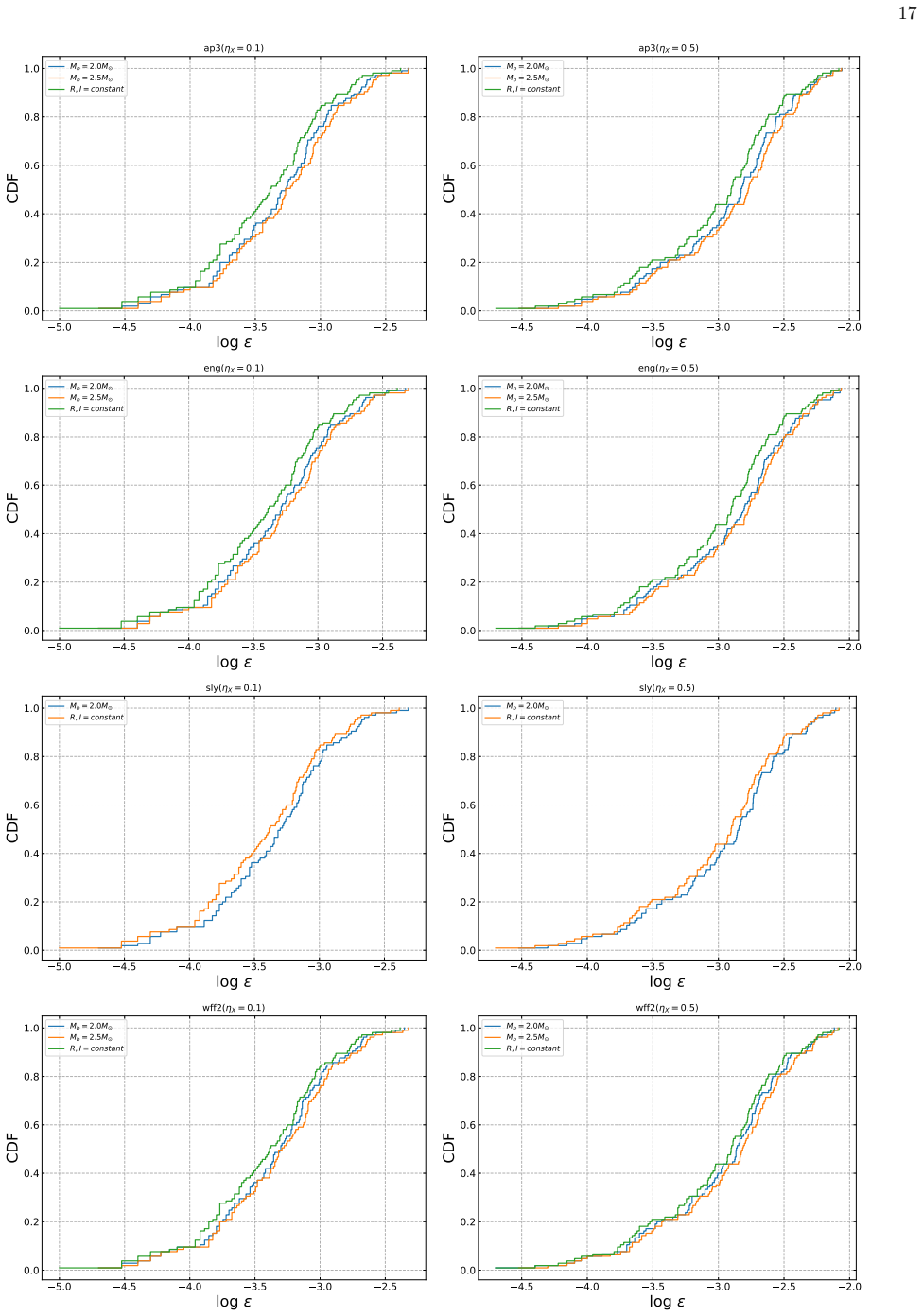
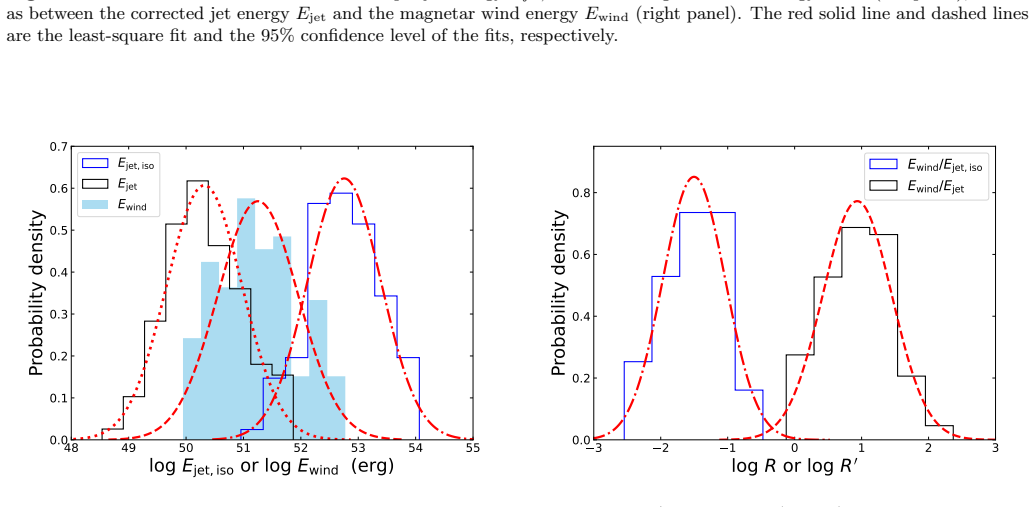
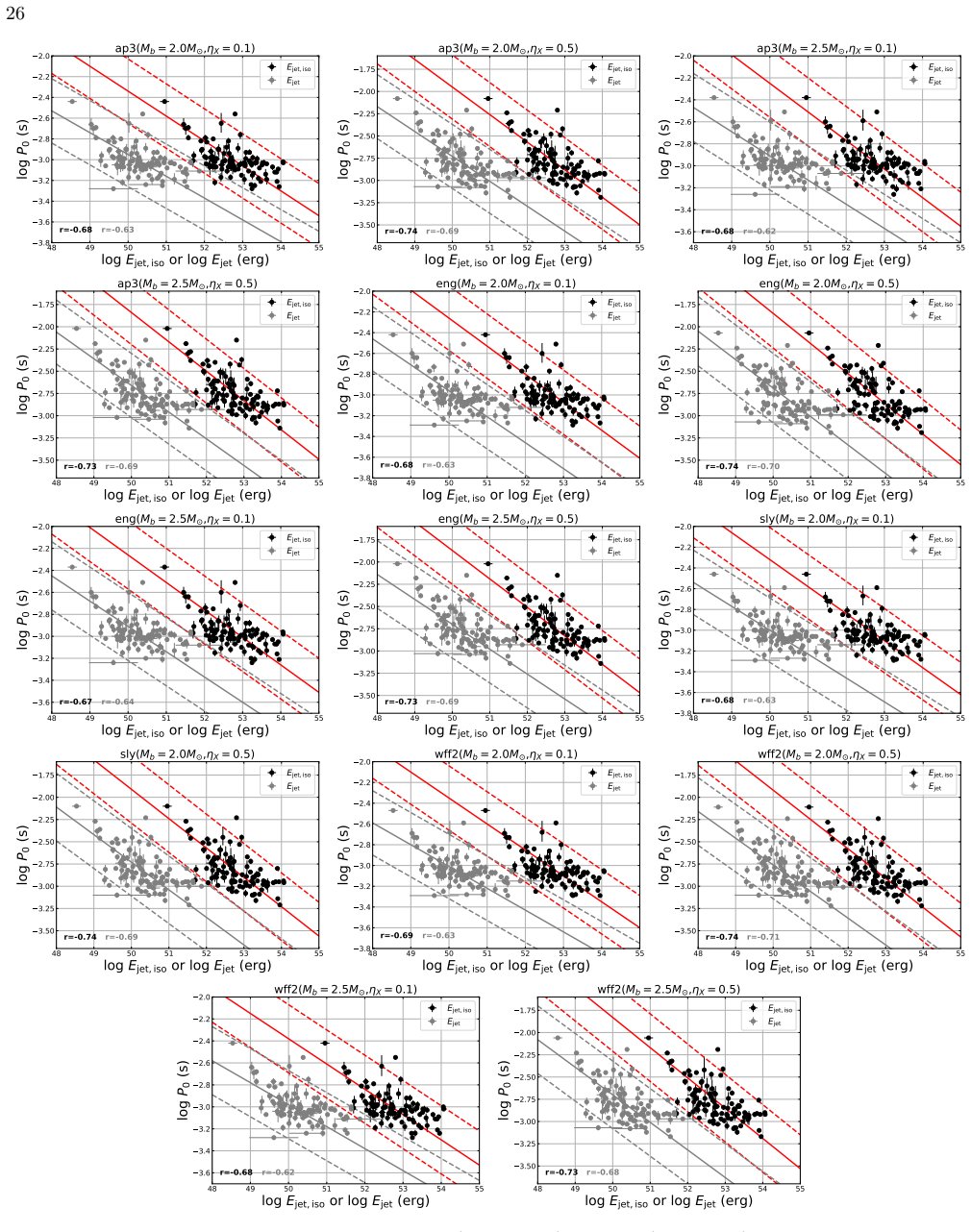
The paper argues that the radius R and moment of inertia I of a newborn millisecond magnetar shrink appreciably as it spins down, and that analyses which take R and I as fixed constants misestimate the dipole field B_p, initial spin period P_0, and ellipticity ϵ inferred from GRB X-ray plateaus. Averaging over four equations of state, two baryon masses, and two radiative efficiencies, constant-R/I fits overestimate log B_p by roughly 0.17 dex (a factor near 1.5), underestimate P_0 by roughly 0.26 ms (a factor near 0.7), and leave ϵ essentially unchanged; individual scenarios show systematic biases of 20% to 50%. The paper also reports sample-wide power-law correlations, $\epsilon\propto P_0^{1.57\pm0.22}$, $\epsilon\propto B_p^{0.97\pm0.13}$, and $B_p\propto P_0^{1.30\pm0.16}$, together with anticorrelations of $P_0$, $B_p$, and $\epsilon$ with jet energy, and interprets these as indicating that the ellipticity originates from magnetically induced distortion while the observed spin period is an equilibrium period set by magnetar–disk interaction rather than the birth spin.
Load-bearing premise
The entire size and even the sign of the claimed bias rests on the assumed piecewise power-law curves for radius and moment of inertia versus spin rate, and on the assumption that the magnetic dipole moment $B_pR^{3}$ stays fixed while the neutron star spins down.
Editorial extensions
If this is right
- All previously published magnetar parameters for plateau GRBs that assumed constant R and I should be revised, with systematically lower B_p and higher P_0.
- The reported universal correlations connect the central engine's spin, field, and ellipticity to jet energetics: faster-spinning, lower-field, less-deformed magnetars tend to power more energetic jets.
- The inferred ellipticity-scale with both B_p and P_0 implies that gravitational-wave emission is significant only for the fastest-spinning remnants, sharpening the target list for aLIGO and the Einstein Telescope.
- On the current sample, magnetar dipole radiation would be detected by EP/WXT in about 30% of cases, by EP/FXT in about 81%, and by SVOM/MXT in about 40%.
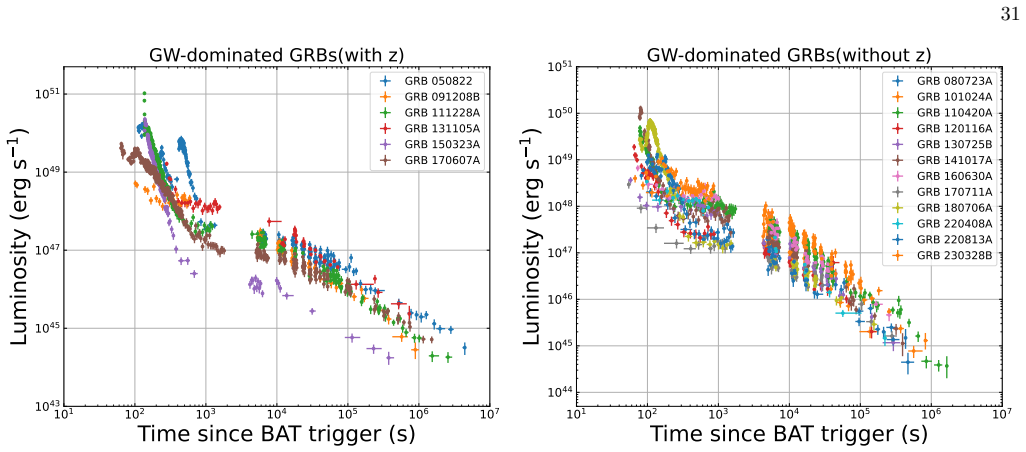
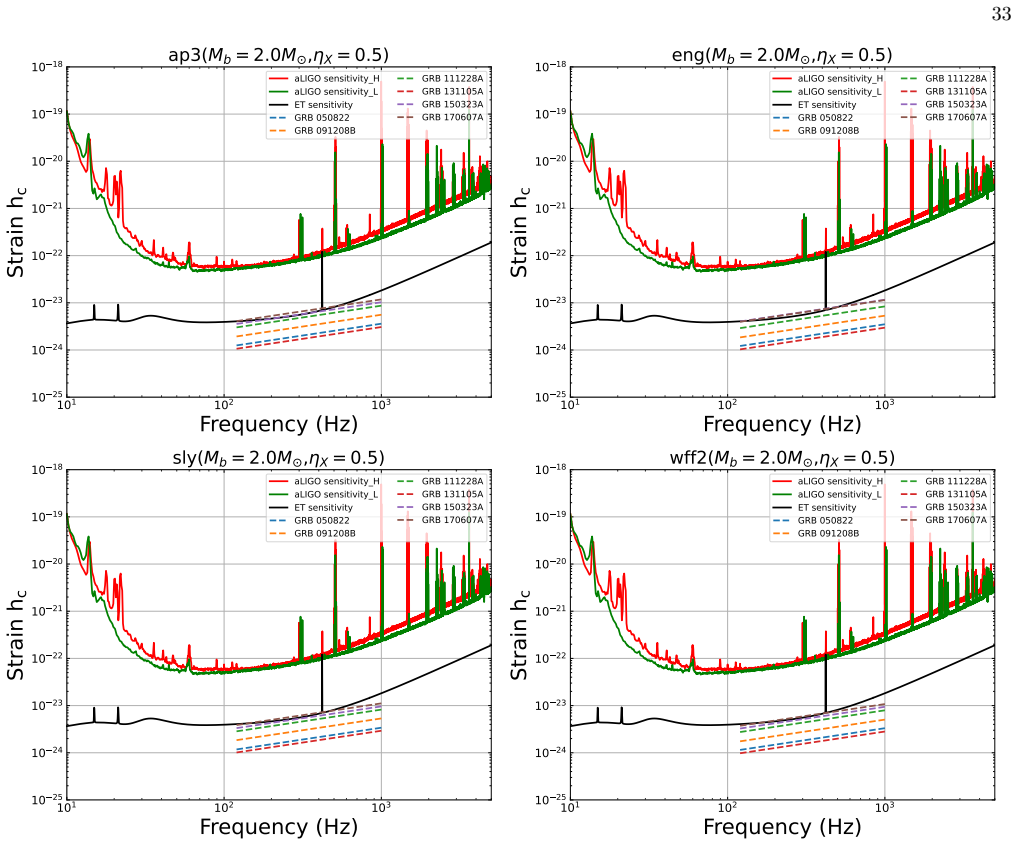
- Gravitational waves from the GW-dominated remnants with measured redshifts are below advanced-LIGO sensitivity, and only GRBs 150323A and 170607A reach Einstein Telescope sensitivity.
- The correlations imply that the measured P_0 may not be the true birth spin but an equilibrium period from magnetar–disk interaction, which changes how P_0 should be interpreted in progenitor models.
Reading between the lines
- Because the fitted parameters are adjusted to reproduce the same plateau luminosity and break time, part of the reported 20–50% offset could be absorbed by the fitting degeneracy between B_p, P_0, and ϵ; a posterior predictive check on simulated light curves would separate the physical bias from the model-induced shift.
- If future observations show that B_p, rather than the magnetic dipole moment B_pR^3, stays fixed while the magnetar spins down, the size and direction of the derived parameter biases would change, potentially weakening the claimed universal correlations.
- Since 62 of the 105 GRBs lack a measured redshift and are assigned z = 1, distance errors could smear the jet-energy correlations; a redshift-complete sample from upcoming missions would provide a sharper test of the reported scaling laws.
- The two events predicted to be detectable by the Einstein Telescope offer a concrete observational route: a non-detection of GW emission from GRBs 150323A or 170607A at ET sensitivity would place an upper bound on the ellipticity that either supports or conflicts with the high-ϵ required by the magnetar interpretation.
Editorial analysis
A structured set of objections, weighed in public.
Referee Report
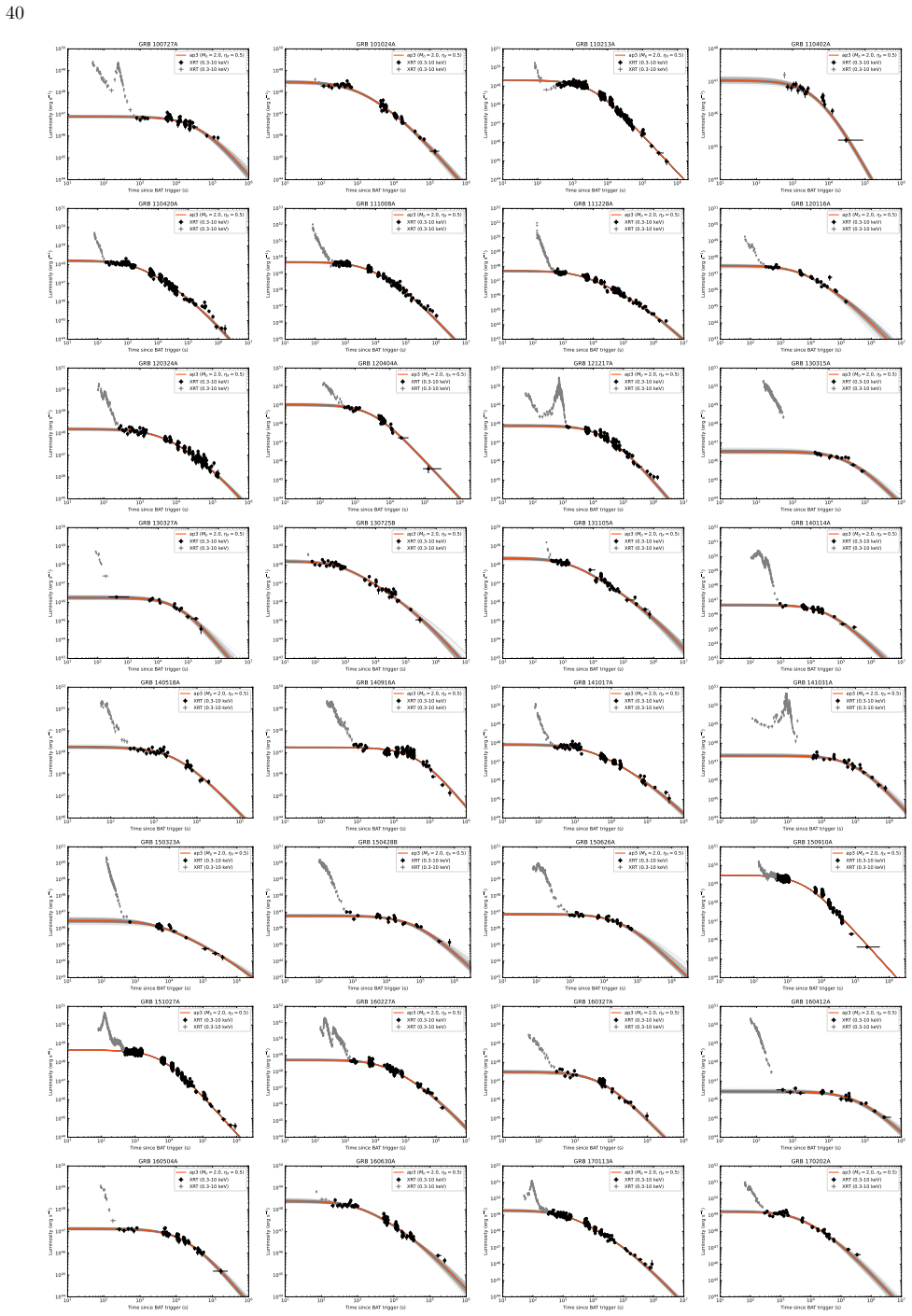
Summary. This paper presents a systematic re-analysis of 105 long GRBs with X-ray plateau emission from the Swift/XRT archive (detected before 2023 December). The authors fit each light curve with a smooth triple power law to separate the jet-emission and magnetar-wind phases, then run MCMC fits of a magnetar spin-down model that includes power-law-evolving radius and moment of inertia (R ∝ Ω^m, I ∝ Ω^k, with indices taken from Lan et al. 2021) under the assumption that the magnetic dipole moment μ = B_p R^3 is conserved, in order to infer B_p, P_0, and ε. The paper compares these results with the conventional constant-R/I fits, claims that neglecting R/I evolution biases B_p, P_0, and ε by 20–50%, reports 'universal' correlations (ε ∝ P_0^1.57±0.22, ε ∝ B_p^0.97±0.13, B_p ∝ P_0^1.30±0.16, and several jet–wind energy scaling relations), estimates EP/SVOM detectability of magnetar wind radiation, and evaluates aLIGO/ET detectability of GW emission, finding that only GRBs 150323A and 170607A could reach the ET sensitivity threshold.
Significance. If the results hold, the quantitative recalibration of magnetar parameters (initial period, dipole field, ellipticity) from X-ray plateaus, the uniform 105-GRB sample, and the explicit prospective-detector predictions would be a useful contribution to GRB central-engine studies. The paper's strengths include a transparent MCMC setup with stated uniform priors, per-GRB fit tables, K-S tests between the constant and evolving scenarios, closed-form spin-down solutions, and concrete falsifiable predictions (two ET-reachable sources and EP/FXT detection-rate numbers). The main impediments to accepting the claims as stated are internal: the radius-evolution mechanism contradicts the μ-conservation assumption adopted in Eq. (12), and the headline correlations are susceptible to the z=1 assignment for 62 of 105 events and to fitting degeneracies in ε, so the results as currently framed require substantial revision rather than minor polishing.
major comments (4)
- [Section 3, Eqs. (12)–(18)] The central 20–50% claim is framed in the abstract and Section 1 as an effect of 'R/I evolutionary effects,' with the Section 1 motivation L_dip ∝ R^6. But under the assumption stated beside Eq. (12) that μ ≡ B_p R^3 is conserved during spin-down, Eq. (2) gives L_dip = η_X μ^2 Ω^4/(6c^3), which is independent of R at fixed Ω and fixed μ; the R^6 scaling is only realized if B_p, not μ, is held fixed. Consistently, the analytic solutions in Eqs. (15)–(18) contain the I-evolution index k but never the R-evolution index m. Thus, within the paper's own framework, radius evolution has no independent effect on the dipole luminosity, and the claimed 20–50% bias, if real, must arise from I evolution alone. The authors must state which quantity (B_p or μ) is held fixed in the numerical integrations behind Figure 4 and the MCMC fits; if μ is conserved, the title, abstract, and Section 1 overstate the role of R and must be revised, and if B_p is held fixed, the analytic solutions are missing the m-dependence they should contain. Either way, the mechanism behind the headline bias needs to be restated.
- [Section 2 and Section 4.2 (Tables 13–14)] A redshift z = 1 is imposed for 62 of the 105 GRBs (Section 2), and every derived quantity that feeds the correlations — L_p, E_wind, E_jet,iso, and hence the fitted P_0, B_p, and ε — scales with D_L^2(z). The 'universal' correlations in Figures 11–13, 16–18 and Tables 13–14, as well as the E_wind–E_jet,iso relation of Eqs. (24)–(26), therefore mix a 43-event sample with measured redshifts with a 62-event sample whose luminosities are set by the arbitrary z=1 distance. The paper should rerun the correlation analysis using only the 43 GRBs with measured redshift (the EP/SVOM section already restricts to these 43) and report whether the slopes, signs, and significances survive; at minimum, a sensitivity test with an alternative assigned redshift (e.g., the median redshift of the measured subsample) is needed to show that the claimed correlations are not distance-assumption artifacts.
- [Section 4.1, Figures 11–13 and Eq. (19)] The near-unity slope of the reported ε ∝ B_p^0.97±0.13 correlation is close to what the fitting model itself enforces rather than an independent physical relation: in the EM+GW co-dominated regime the spectral break occurs near L_GW ≈ L_dip, which gives ε ∝ B_p R^3/(I Ω) = μ/(I Ω), i.e., a slope of unity in log-log space at fixed Ω. In the EM-dominated regime, by contrast, the dipole light curve is essentially independent of ε, so the narrow Gaussian-style ε posteriors shown in the Appendix (e.g., ε_3 = 0.05 ± 0.03 for GRB 050922B in Figure 24) need to be shown to be likelihood-driven rather than prior- or upper-limit-driven. Please provide likelihood slices or posterior profiles in ε for representative EM-dominated, GW-dominated, and co-dominated fits, and check whether the ε–P_0 and ε–B_p correlations persist when the analysis is restricted to GRBs for which ε is genuinely constrained by the data.
- [Section 4.1, Table 10 (and the abstract)] The abstract's blanket statement that neglecting R/I evolution biases B_p, P_0, and ε by 20–50% is not supported uniformly across the scenarios. In Table 10, the K-S test for B_p gives p < 10^-1 for both Mb = 2.5 M⊙ scenarios (η_X = 0.1 and 0.5), which does not reject the null at the conventional 5% level, and the corresponding B_p deviations in Section 4.1 are factors of 1.1 and 1.0, respectively. The averaged factor of 1.5 quoted in the conclusion conceals this range (factors from 1.0 to 2.0 across the four scenarios). The text following Table 10 states that the null hypothesis is rejected without qualifying these marginal cases; the abstract and conclusion should present the bias as scenario-dependent (quantified per EoS, M_b, and η_X) rather than as a uniform 20–50% systematic.
minor comments (6)
- [Section 1 heading] The heading 'INTRODUTION' should be 'INTRODUCTION'; the title header also contains the spacing error 'Swift/XR T data'.
- [Eqs. (15) and (17)] In Eqs. (15) and (17), B_p appears without a subscript; under the μ-conservation assumption of Eq. (12) the prefactor should be written with B_{p,0} (or directly with μ) so that the R-independence of the prefactor is explicit.
- [Section 4.3 and Conclusion] The FXT sensitivity threshold is 1×10^-11 erg s^-1 cm^-2 in Section 4.3 but 3×10^-11 in the conclusion bullet; these values should be made consistent.
- [Figure 18 caption] Figure 18's caption says 'correlations between the P0 and Ejet,iso' but the panels plot ε against E_jet; the caption should be corrected.
- [Section 4.1 and Conclusion] In Section 4.1, deviations such as '△(log Bp) ∼ 0.3 G' mix units: log B_p is dimensionless, so the shift should be quoted in dex; likewise, 'I ∼ 2.5×10^45 g cm^−2' in the conclusion should read g cm^2.
- [Table 10] The K-S p-values in Table 10 are reported only as upper bounds (p < 10^-n); reporting the actual p-values or the test statistics would allow readers to assess the marginal cases (p < 10^-1) that are central to the scenario-dependence discussion.
Circularity Check
No significant circularity: the central derivation is a self-contained data fit with external numerical input, and the apparent R-evolution inconsistency is a correctness issue rather than a circular step.
full rationale
The paper's empirical chain is largely self-contained: the spin-down solutions (Eqs. 15-18) are derived from the stated spin-down law and the piecewise power-law R/I forms (Eqs. 12-13), the magnetar parameters are MCMC fits to Swift/XRT light curves, and the 20-50% bias claims are model-comparison outputs on the same data rather than predictions constructed from the fitted values. The 'universal correlations' are least-squares summaries of posterior estimates, so they are empirical outputs that may be affected by statistical degeneracies, but they are not definitional reductions. The main self-citation is to Lan et al. (2021), which supplies RNS-based numerical R/I behavior as external input; it is load-bearing but is not an unverified uniqueness or ansatz claim smuggled in through citation. One genuine internal issue is that the stated assumption mu = BpR^3 conserved makes Bp^2R^6 = mu^2 in Eq. (2), so the analytical dipole luminosity in Eqs. (15)-(18) contains only the I-evolution index k and not the R-evolution index m; this means the 'radius evolutionary effect' is not actually realized in the paper's own analytic framework. That is a correctness and interpretation concern, not circularity, and the paper itself partially acknowledges model sensitivity in the Section 5 caveat that the R/I evolution effect 'would be reduced or even completely suppressed' under other physical conditions.
Assumptions & free parameters
free parameters (6)
- X-ray radiation efficiency eta_X =
0.1 and 0.5
- Baryonic mass Mb =
2.0 and 2.5 M_sun (SLy only 2.0)
- Redshift substitution z=1 =
z = 1 for 62 of 105 GRBs
- Jet opening angle theta_j =
5 degrees when not measured
- Uniform prior bounds for MCMC =
P0 in [0.3, 40 ms], Bp in [1e13, 1e16 G], epsilon in [1e-6, 1e-2]
- Power-law indices m, k and velocities Omega_k, Omega_1 =
values from Lan et al. (2021) per EoS and mass
assumptions (7)
- domain assumption The X-ray plateau is powered by isotropic EM dipole spin-down of a newborn millisecond magnetar, with the spin-down law of Eq. (2).
- domain assumption Vacuum dipole formula and quadrupole GW formula with a constant radiation efficiency eta_X.
- ad hoc to paper The magnetic dipole moment mu = Bp R^3 is conserved during spin-down.
- domain assumption R(Omega) and I(Omega) follow the piecewise power laws of Eqs. (12)-(13) with indices m, k from Lan et al. (2021).
- domain assumption A post-plateau decay slope in [-1, -2] identifies magnetar spin-down with GW- or EM-dominated losses.
- domain assumption Differential rotation and monopolar wind emission are negligible at plateau times (t > hundreds of seconds).
- standard math Flat LCDM cosmology with Planck 2020 parameters.
Cite this review
Pith. "Pith review of Constrain magnetar parameters by taking into account the evolutionary effects of radius and moment of inertia with \emph{Swift}/XRT data." pith.science (2026). https://pith.science/paper/I5JWPE53
@misc{pith2026250711110,
  author       = {Pith},
  title        = {Pith review of: Constrain magnetar parameters by taking into account the evolutionary effects of radius and moment of inertia with \emphSwift/XRT data},
  year         = {2026},
  howpublished = {\url{https://pith.science/paper/I5JWPE53}},
  note         = {Machine review of arXiv:2507.11110}
}
abstract
A newly born millisecond magnetar has been proposed as one possible central engine of some GRBs with X-ray plateau emission. In this work, we systematically analyzed the Swift/XRT data of long GRBs with plateau emission that were detected before 2023 December, and estimated the physical parameters by considering the $R/I$ evolutionary effects. We found that neglecting the $R/I$ evolutionary effects can lead to systematic overestimation or underestimation of magnetar parameters such as $B_p$, $P_0$, and $\epsilon$ from 20\% to 50\%. We also found that some tight correlations, which can be approximately expressed as $\epsilon\propto P_0^{1.57\pm0.22}$, $\epsilon\propto B_p^{0.97\pm0.13}$, $B_p\propto P_0^{1.30\pm0.16}$, $E_{\rm wind}\propto E_{\rm jet,iso}^{0.83\pm0.07}(E_{\rm jet}^{0.76\pm0.06})$, $P_0\propto E_{\rm jet,iso}^{-0.29\pm0.03}(E_{\rm jet}^{-0.26\pm0.02})$, $B_p\propto E_{\rm jet,iso}^{-0.58\pm0.06}(E_{\rm jet}^{-0.55\pm0.05})$, and $\epsilon\propto E_{\rm jet,iso}^{-0.55\pm0.07}(E_{\rm jet}^{-0.52\pm0.06})$ for our selected EoSs. The universal correlations suggest that a nascent magnetar with the faster $P_0$, lower $B_p$, and lower $\epsilon$ are more inclined to power a more energetic GRB jet, and the $\epsilon$ and $P_0$ of newborn magnetar are likely to originate from the magnetically induced distortion and correspond to the equilibrium spin period as a result of interaction between the magnetar and its accretion disk, respectively. Finally, we found that the GW signals from the remnants of those GW-dominated GRBs with redshift measurements cannot reach aLIGO sensitivity threshold, and only two cases (GRBs 150323A and 170607A) can reach ET sensitivity threshold. Future GW observations could not only offer the first smoking gun that a protomagnetar can serve as the central engine of GRBs but also play a crucial role in precisely constraining the neutron star EoS.
Figures


Figures from the paper (27 more)











Reference graph
Works this paper leans on
-
[1]
Aasi, J., Abadie, J., Abbott, B. P., et al. 2015, Classical and Quantum Gravity, 32, 115012, doi: 10.1088/0264-9381/32/11/115012
-
[2]
Abbott, B. P., Abbott, R., Abbott, T. D., et al. 2020a, Living Reviews in Relativity, 23, 3, doi: 10.1007/s41114-020-00026-9
-
[3]
Abbott, R., Abbott, T. D., Abraham, S., et al. 2020b, ApJL, 902, L21, doi: 10.3847/2041-8213/abb655 Agui Fernandez, J. F., de Ugarte Postigo, A., Izzo, L., et al. 2021, GRB Coordinates Network, 29552, 1 Agui Fernandez, J. F., Thoene, C. C., de Ugarte Postigo, A., et al. 2023, GRB Coordinates Network, 33629, 1
-
[4]
2021, ApJL, 915, L11, doi: 10.3847/2041-8213/ac097d
Ai, S., & Zhang, B. 2021, ApJL, 915, L11, doi: 10.3847/2041-8213/ac097d
-
[5]
Akmal, A., & Pandharipande, V. R. 1997, PhRvC, 56, 2261, doi: 10.1103/PhysRevC.56.2261
-
[6]
1998, ApJ, 502, 708, doi: 10.1086/305919 —
Andersson, N. 1998, ApJ, 502, 708, doi: 10.1086/305919 —. 2003, Classical and Quantum Gravity, 20, R105, doi: 10.1088/0264-9381/20/7/201
doi:10.1086/305919 1998
-
[7]
E., Treister, E., Schawinski, K., et al
Bauer, F. E., Treister, E., Schawinski, K., et al. 2017, MNRAS, 467, 4841, doi: 10.1093/mnras/stx417
-
[8]
Blandford, R. D., & Znajek, R. L. 1977, MNRAS, 179, 433, doi: 10.1093/mnras/179.3.433
Show all 154 references
-
[9]
S., Frail, D
Bloom, J. S., Frail, D. A., & Sari, R. 2001, AJ, 121, 2879, doi: 10.1086/321093
2001 doi
-
[10]
S., Perley, D
Bloom, J. S., Perley, D. A., & Chen, H. W. 2006, GRB Coordinates Network, 5826, 1
2006
- [11]
-
[13]
D., et al
Bucciantini, N., Quataert, E., Metzger, B. D., et al. 2009, MNRAS, 396, 2038, doi: 10.1111/j.1365-2966.2009.14940.x
2009
-
[14]
M., & Ipser, J
Butterworth, E. M., & Ipser, J. R. 1976, ApJ, 204, 200, doi: 10.1086/154163 C ¸ ıkınto˘ glu, S., S ¸a¸ smaz Mu¸ s, S., & Ek¸ si, K. Y. 2020, MNRAS, 496, 2183, doi: 10.1093/mnras/staa1556
1976 doi
-
[15]
2017, ApJ, 849, 119, doi: 10.3847/1538-4357/aa8f4a
Chen, W., Xie, W., Lei, W.-H., et al. 2017, ApJ, 849, 119, doi: 10.3847/1538-4357/aa8f4a
2017 doi
-
[16]
Chen, W.-X., & Beloborodov, A. M. 2007, ApJ, 657, 383, doi: 10.1086/508923
2007 doi
-
[17]
2014, GRB Coordinates Network, 16301, 1
Levan, A. 2014, GRB Coordinates Network, 16301, 1
2014
-
[18]
2009, ApJ, 702, 1171, doi: 10.1088/0004-637X/702/2/1171
Corsi, A., & M´ esz´ aros, P. 2009, ApJ, 702, 1171, doi: 10.1088/0004-637X/702/2/1171
2009 doi
-
[19]
Cucchiara, A., & Tanvir, N. R. 2012, GRB Coordinates Network, 13217, 1
2012
-
[20]
2002, PhRvD, 66, 084025, doi: 10.1103/PhysRevD.66.084025
Cutler, C. 2002, PhRvD, 66, 084025, doi: 10.1103/PhysRevD.66.084025
2002 doi
-
[21]
Cutler, C., & Jones, D. I. 2000, PhRvD, 63, 024002, doi: 10.1103/PhysRevD.63.024002
2000 doi
- [22]
-
[23]
G., Wang, X
Dai, Z. G., Wang, X. Y., Wu, X. F., & Zhang, B. 2006, Science, 311, 1127, doi: 10.1126/science.1123606
2006 doi
-
[24]
G., Cardone, V
Dainotti, M. G., Cardone, V. F., & Capozziello, S. 2008, MNRAS, 391, L79, doi: 10.1111/j.1745-3933.2008.00560.x
2008
-
[26]
2011, GRB Coordinates Network, 12759, 1
Dittmann, J., Laskar, T., & Berger, E. 2011, GRB Coordinates Network, 12759, 1
2011
-
[27]
2001, A&A, 380, 151, doi: 10.1051/0004-6361:20011402
Douchin, F., & Haensel, P. 2001, A&A, 380, 151, doi: 10.1051/0004-6361:20011402
2001 doi
- [28]
-
[29]
1996, ApJ, 469, 794, doi: 10.1086/177827
Ostgaard, E. 1996, ApJ, 469, 794, doi: 10.1086/177827
1996 doi
-
[30]
A., Willingale, R., Osborne, J
Evans, P. A., Willingale, R., Osborne, J. P., et al. 2010, A&A, 519, A102, doi: 10.1051/0004-6361/201014819 65
2010 doi
-
[31]
2013a, PhRvD, 88, 067304, doi: 10.1103/PhysRevD.88.067304
Fan, Y.-Z., Wu, X.-F., & Wei, D.-M. 2013a, PhRvD, 88, 067304, doi: 10.1103/PhysRevD.88.067304
-
[32]
2013b, ApJL, 779, L25, doi: 10.1088/2041-8205/779/2/L25
Fan, Y.-Z., Yu, Y.-W., Xu, D., et al. 2013b, ApJL, 779, L25, doi: 10.1088/2041-8205/779/2/L25
-
[33]
W., Lang, D., & Goodman, J
Foreman-Mackey, D., Hogg, D. W., Lang, D., & Goodman, J. 2013, PASP, 125, 306, doi: 10.1086/670067
2013 doi
-
[34]
A., Kulkarni, S
Frail, D. A., Kulkarni, S. R., Sari, R., et al. 2001, ApJL, 562, L55, doi: 10.1086/338119
2001 doi
-
[35]
C., D’Elia, V., et al
Fugazza, D., Thoene, C. C., D’Elia, V., et al. 2009, GRB Coordinates Network, 8892, 1
2009
-
[36]
2020, Frontiers of Physics, 15, 24603, doi: 10.1007/s11467-019-0945-9
Gao, H., Ai, S.-K., Cao, Z.-J., et al. 2020, Frontiers of Physics, 15, 24603, doi: 10.1007/s11467-019-0945-9
2020 doi
-
[37]
2017, ApJ, 844, 112, doi: 10.3847/1538-4357/aa7d00
Gao, H., Cao, Z., & Zhang, B. 2017, ApJ, 844, 112, doi: 10.3847/1538-4357/aa7d00
2017 doi
-
[38]
2016, PhRvD, 93, 044065, doi: 10.1103/PhysRevD.93.044065
Gao, H., Zhang, B., & L¨ u, H.-J. 2016, PhRvD, 93, 044065, doi: 10.1103/PhysRevD.93.044065
2016 doi
-
[39]
2006, ChJA&A, 6, 513, doi: 10.1088/1009-9271/6/5/01
Gao, W.-H., & Fan, Y.-Z. 2006, ChJA&A, 6, 513, doi: 10.1088/1009-9271/6/5/01
2006 doi
-
[40]
2004, ApJ, 611, 1005, doi: 10.1086/422091
Gehrels, N., Chincarini, G., Giommi, P., et al. 2004, ApJ, 611, 1005, doi: 10.1086/422091
2004 doi
-
[41]
2013, ApJL, 771, L26, doi: 10.1088/2041-8205/771/2/L26
Giacomazzo, B., & Perna, R. 2013, ApJL, 771, L26, doi: 10.1088/2041-8205/771/2/L26
2013 doi
-
[42]
L., Wynn, G
Gibson, S. L., Wynn, G. A., Gompertz, B. P., & O’Brien, P. T. 2017, MNRAS, 470, 4925, doi: 10.1093/mnras/stx1531 —. 2018, MNRAS, 478, 4323, doi: 10.1093/mnras/sty1363
2017 doi
-
[43]
2022, MNRAS, 511, 3365, doi: 10.1093/mnras/stac245
Giliberti, E., & Cambiotti, G. 2022, MNRAS, 511, 3365, doi: 10.1093/mnras/stac245
2022 doi
-
[44]
P., O’Brien, P
Gompertz, B. P., O’Brien, P. T., & Wynn, G. A. 2014, MNRAS, 438, 240, doi: 10.1093/mnras/stt2165
2014 doi
-
[45]
2013, MNRAS, 431, 1745, doi: 10.1093/mnras/stt293
Rowlinson, A. 2013, MNRAS, 431, 1745, doi: 10.1093/mnras/stt293
2013 doi
-
[46]
I., & Andersson, N
Haskell, B., Jones, D. I., & Andersson, N. 2006, MNRAS, 373, 1423, doi: 10.1111/j.1365-2966.2006.10998.x
2006
-
[48]
E., Fynbo, J
Heintz, K. E., Fynbo, J. P. U., & Malesani, D. 2018, GRB Coordinates Network, 22535, 1
2018
-
[49]
2011, Classical and Quantum Gravity, 28, 094013, doi: 10.1088/0264-9381/28/9/094013
Hild, S., Abernathy, M., Acernese, F., et al. 2011, Classical and Quantum Gravity, 28, 094013, doi: 10.1088/0264-9381/28/9/094013
2011 doi
-
[50]
2012, ApJ, 756, 187, doi: 10.1088/0004-637X/756/2/187
Hjorth, J., Malesani, D., Jakobsson, P., et al. 2012, ApJ, 756, 187, doi: 10.1088/0004-637X/756/2/187
2012 doi
-
[51]
2014, ApJ, 789, 145, doi: 10.1088/0004-637X/789/2/145
Hu, Y.-D., Liang, E.-W., Xi, S.-Q., et al. 2014, ApJ, 789, 145, doi: 10.1088/0004-637X/789/2/145
2014 doi
-
[52]
2022, PhRvD, 105, 103019, doi: 10.1103/PhysRevD.105.103019
Huang, J.-X., L¨ u, H.-J., Rice, J., & Liang, E.-W. 2022, PhRvD, 105, 103019, doi: 10.1103/PhysRevD.105.103019
2022 doi
-
[53]
2004, ApJ, 600, 296, doi: 10.1086/379650
Ioka, K., & Sasaki, M. 2004, ApJ, 600, 296, doi: 10.1086/379650
2004 doi
-
[54]
E., Malesani, D., et al
Izzo, L., Heintz, K. E., Malesani, D., et al. 2018, GRB Coordinates Network, 22567, 1
2018
-
[55]
Jakobsson, P., Vreeswijk, P., Fynbo, J. P. U., et al. 2006, GRB Coordinates Network, 5320, 1
2006
-
[56]
O., Thoene, C
Jaunsen, A. O., Thoene, C. C., Fynbo, J. P. U., Hjorth, J., & Vreeswijk, P. 2007, GRB Coordinates Network, 6202, 1
2007
-
[57]
2013, GRB Coordinates Network, 14264, 1 Kr¨ uhler, T., Malesani, D., Milvang-Jensen, B., et al
Kruehler, T., Malesani, D., Xu, D., et al. 2013, GRB Coordinates Network, 14264, 1 Kr¨ uhler, T., Malesani, D., Milvang-Jensen, B., et al. 2012, ApJ, 758, 46, doi: 10.1088/0004-637X/758/1/46 Kr¨ uhler, T., Malesani, D., Fynbo, J. P. U., et al. 2015, A&A, 581, A125, doi: 10.105...
2013 doi
-
[58]
2021, ApJ, 919, 14, doi: 10.3847/1538-4357/ac167d
Lan, L., Gao, H., Ai, S., & Li, S.-Z. 2021, ApJ, 919, 14, doi: 10.3847/1538-4357/ac167d
2021 doi
-
[59]
2020, ApJ, 890, 99, doi: 10.3847/1538-4357/ab6c64
Lan, L., L¨ u, H.-J., Rice, J., & Liang, E.-W. 2020, ApJ, 890, 99, doi: 10.3847/1538-4357/ab6c64
2020 doi
-
[60]
2023, ApJL, 949, L4, doi: 10.3847/2041-8213/accf93
Lan, L., Gao, H., Li, A., et al. 2023, ApJL, 949, L4, doi: 10.3847/2041-8213/accf93
2023 doi
-
[61]
Lander, S. K. 2014, MNRAS, 437, 424, doi: 10.1093/mnras/stt1894
2014 doi
-
[62]
K., & Jones, D
Lander, S. K., & Jones, D. I. 2012, MNRAS, 424, 482, doi: 10.1111/j.1365-2966.2012.21213.x
2012
-
[63]
Lasky, P. D. 2015, PASA, 32, e034, doi: 10.1017/pasa.2015.35
2015 doi
-
[64]
D., & Glampedakis, K
Lasky, P. D., & Glampedakis, K. 2016, MNRAS, 458, 1660, doi: 10.1093/mnras/stw435
2016 doi
-
[65]
D., Leris, C., Rowlinson, A., & Glampedakis, K
Lasky, P. D., Leris, C., Rowlinson, A., & Glampedakis, K. 2017, ApJL, 843, L1, doi: 10.3847/2041-8213/aa79a7
2017 doi
-
[66]
Lattimer, J. M. 2012, Annual Review of Nuclear and Particle Science, 62, 485, doi: 10.1146/annurev-nucl-102711-095018
2012 doi
-
[67]
K., Wijers, R
Lee, H. K., Wijers, R. A. M. J., & Brown, G. E. 2000, PhR, 325, 83, doi: 10.1016/S0370-1573(99)00084-8
2000 doi
-
[68]
H., Wang, D
Lei, W. H., Wang, D. X., Zhang, L., et al. 2009, ApJ, 700, 1970, doi: 10.1088/0004-637X/700/2/1970
2009 doi
-
[69]
2013, ApJ, 765, 125, doi: 10.1088/0004-637X/765/2/125
Lei, W.-H., Zhang, B., & Liang, E.-W. 2013, ApJ, 765, 125, doi: 10.1088/0004-637X/765/2/125
2013 doi
-
[70]
2000, ApJL, 533, L115, doi: 10.1086/312616
Li, L.-X. 2000, ApJL, 533, L115, doi: 10.1086/312616
2000 doi
-
[71]
2021, ApJ, 907, 87, doi: 10.3847/1538-4357/abcc70
Li, S.-Z., Yu, Y.-W., Gao, H., & Zhang, B. 2021, ApJ, 907, 87, doi: 10.3847/1538-4357/abcc70
2021 doi
-
[72]
Burrows, D. N. 2008, ApJ, 675, 528, doi: 10.1086/524701
2008 doi
-
[73]
2007, ApJ, 670, 565, doi: 10.1086/521870
Liang, E.-W., Zhang, B.-B., & Zhang, B. 2007, ApJ, 670, 565, doi: 10.1086/521870
2007 doi
-
[74]
2019, ApJ, 871, 160, doi: 10.3847/1538-4357/aaf72f 66
Lin, J., & Lu, R.-J. 2019, ApJ, 871, 160, doi: 10.3847/1538-4357/aaf72f 66
2019 doi
-
[75]
2020, ApJ, 895, 46, doi: 10.3847/1538-4357/ab88a7
Lin, J., Lu, R.-J., Lin, D.-B., & Wang, X.-G. 2020, ApJ, 895, 46, doi: 10.3847/1538-4357/ab88a7
2020 doi
-
[76]
2021b, ApJL, 914, L2, doi: 10.3847/2041-8213/ac004a
Lin, W., Wang, X., Wang, L., & Dai, Z. 2021b, ApJL, 914, L2, doi: 10.3847/2041-8213/ac004a
-
[77]
2017, NewAR, 79, 1, doi: 10.1016/j.newar.2017.07.001 L¨ u, H.-J., Lan, L., & Liang, E.-W
Liu, T., Gu, W.-M., & Zhang, B. 2017, NewAR, 79, 1, doi: 10.1016/j.newar.2017.07.001 L¨ u, H.-J., Lan, L., & Liang, E.-W. 2019, ApJ, 871, 54, doi: 10.3847/1538-4357/aaf71d L¨ u, H.-J., & Zhang, B. 2014, ApJ, 785, 74, doi: 10.1088/0004-637X/785/1/74 L¨ u, H.-J., Zhang, B., Lei,...
2017 doi
-
[78]
2012, ApJ, 745, 168, doi: 10.1088/0004-637X/745/2/168
Lu, R.-J., Wei, J.-J., Qin, S.-F., & Liang, E.-W. 2012, ApJ, 745, 168, doi: 10.1088/0004-637X/745/2/168
2012 doi
-
[81]
Melatos, A., & Payne, D. J. B. 2005, ApJ, 623, 1044, doi: 10.1086/428600
2005 doi
-
[82]
Meszaros, P., & Rees, M. J. 1993, ApJ, 405, 278, doi: 10.1086/172360
1993 doi
-
[83]
2011, MNRAS, 413, 2031, doi: 10.1111/j.1365-2966.2011.18280.x
Bucciantini, N., & Quataert, E. 2011, MNRAS, 413, 2031, doi: 10.1111/j.1365-2966.2011.18280.x
2011
-
[84]
D., & Piro, A
Metzger, B. D., & Piro, A. L. 2014, MNRAS, 439, 3916, doi: 10.1093/mnras/stu247
2014 doi
-
[85]
D., Quataert, E., & Thompson, T
Metzger, B. D., Quataert, E., & Thompson, T. A. 2008, MNRAS, 385, 1455, doi: 10.1111/j.1365-2966.2008.12923.x
2008
-
[86]
A., & Cenko, S
Milne, P. A., & Cenko, S. B. 2011, GRB Coordinates Network, 11708, 1
2011
-
[87]
S., Georganopoulos, M., Guiriec, S., et al
Nemmen, R. S., Georganopoulos, M., Guiriec, S., et al. 2012, Science, 338, 1445, doi: 10.1126/science.1227416
2012 doi
- [88]
-
[89]
P., Gehrels, N., & Scargle, J
Norris, J. P., Gehrels, N., & Scargle, J. D. 2010, ApJ, 717, 411, doi: 10.1088/0004-637X/717/1/411
2010 doi
- [90]
-
[91]
J., Lindblom, L., Cutler, C., et al
Owen, B. J., Lindblom, L., Cutler, C., et al. 1998, PhRvD, 58, 084020, doi: 10.1103/PhysRevD.58.084020
1998 doi
-
[92]
2014, ApJ, 795, 155, doi: 10.1088/0004-637X/795/2/155
Peng, F.-K., Liang, E.-W., Wang, X.-Y., et al. 2014, ApJ, 795, 155, doi: 10.1088/0004-637X/795/2/155
2014 doi
-
[93]
A., & Cenko, S
Perley, D. A., & Cenko, S. B. 2015, GRB Coordinates Network, 17616, 1
2015
-
[94]
A., Hillenbrand, L., & Prochaska, J
Perley, D. A., Hillenbrand, L., & Prochaska, J. X. 2015, GRB Coordinates Network, 18487, 1
2015
-
[95]
A., Cenko, S
Perley, D. A., Cenko, S. B., Bloom, J. S., et al. 2009, AJ, 138, 1690, doi: 10.1088/0004-6256/138/6/1690
2009 doi
-
[96]
A., Levan, A
Perley, D. A., Levan, A. J., Tanvir, N. R., et al. 2013, ApJ, 778, 128, doi: 10.1088/0004-637X/778/2/128
2013 doi
-
[97]
A., Kr¨ uhler, T., Schulze, S., et al
Perley, D. A., Kr¨ uhler, T., Schulze, S., et al. 2016, ApJ, 817, 7, doi: 10.3847/0004-637X/817/1/7
2016 doi
-
[98]
Pieterse, D., Fynbo, J. P. U., Izzo, L., et al. 2023, GRB Coordinates Network, 33521, 1
2023
-
[99]
L., & Ott, C
Piro, A. L., & Ott, C. D. 2011, ApJ, 736, 108, doi: 10.1088/0004-637X/736/2/108 Planck Collaboration, Aghanim, N., Akrami, Y., et al. 2020, A&A, 641, A6, doi: 10.1051/0004-6361/201833910
2011 doi
-
[100]
E., & Fryer, C
Popham, R., Woosley, S. E., & Fryer, C. 1999, ApJ, 518, 356, doi: 10.1086/307259
1999 doi
-
[101]
X., Foley, R
Prochaska, J. X., Foley, R. J., Holden, B., et al. 2008, GRB Coordinates Network, 7397, 1
2008
-
[102]
X., Thoene, C
Prochaska, J. X., Thoene, C. C., Malesani, D., Fynbo, J. P. U., & Vreeswijk, P. M. 2007, GRB Coordinates Network, 6698, 1
2007
-
[103]
2010, Classical and Quantum Gravity, 27, 194002, doi: 10.1088/0264-9381/27/19/194002
Punturo, M., Abernathy, M., Acernese, F., et al. 2010, Classical and Quantum Gravity, 27, 194002, doi: 10.1088/0264-9381/27/19/194002
2010 doi
-
[104]
L., Liang, E
Racusin, J. L., Liang, E. W., Burrows, D. N., et al. 2009, ApJ, 698, 43, doi: 10.1088/0004-637X/698/1/43
2009 doi
-
[105]
Ravi, V., & Lasky, P. D. 2014, MNRAS, 441, 2433, doi: 10.1093/mnras/stu720
2014 doi
-
[106]
P., Dainotti, M., et al
Rowlinson, A., Gompertz, B. P., Dainotti, M., et al. 2014, MNRAS, 443, 1779, doi: 10.1093/mnras/stu1277
2014 doi
-
[107]
T., Metzger, B
Rowlinson, A., O’Brien, P. T., Metzger, B. D., Tanvir, N. R., & Levan, A. J. 2013, MNRAS, 430, 1061, doi: 10.1093/mnras/sts683
2013 doi
-
[108]
T., Tanvir, N
Rowlinson, A., O’Brien, P. T., Tanvir, N. R., et al. 2010, MNRAS, 409, 531, doi: 10.1111/j.1365-2966.2010.17354.x
2010
- [109]
-
[110]
D., & Ashton, G
Sarin, N., Lasky, P. D., & Ashton, G. 2020a, MNRAS, 499, 5986, doi: 10.1093/mnras/staa3090 —. 2020b, PhRvD, 101, 063021, doi: 10.1103/PhysRevD.101.063021
-
[111]
B., Fynbo, J
Schneider, B., Malesani, D. B., Fynbo, J. P. U., et al. 2022, GRB Coordinates Network, 32595, 1 67
2022
-
[112]
L., & Teukolsky, S
Shapiro, S. L., & Teukolsky, S. A. 1983, Black holes, white dwarfs and neutron stars. The physics of compact objects, doi: 10.1002/9783527617661
1983 doi
-
[113]
Stergioulas, N., & Friedman, J. L. 1995, ApJ, 444, 306, doi: 10.1086/175605
1995 doi
-
[114]
2019, ApJ, 886, 129, doi: 10.3847/1538-4357/ab4bc7
Sun, H., Li, Y., Zhang, B.-B., et al. 2019, ApJ, 886, 129, doi: 10.3847/1538-4357/ab4bc7
2019 doi
-
[115]
2017, ApJ, 835, 7, doi: 10.3847/1538-4357/835/1/7
Sun, H., Zhang, B., & Gao, H. 2017, ApJ, 835, 7, doi: 10.3847/1538-4357/835/1/7
2017 doi
-
[116]
G., & Kokkotas, K
Suvorov, A. G., & Kokkotas, K. D. 2020, ApJL, 892, L34, doi: 10.3847/2041-8213/ab8296 —. 2021, MNRAS, 502, 2482, doi: 10.1093/mnras/stab153
2020 doi
-
[117]
C., Levan, A., Jakobsson, P., et al
Thoene, C. C., Levan, A., Jakobsson, P., et al. 2006, GRB Coordinates Network, 5373, 1
2006
-
[118]
1994, MNRAS, 270, 480, doi: 10.1093/mnras/270.3.480
Thompson, C. 1994, MNRAS, 270, 480, doi: 10.1093/mnras/270.3.480
1994 doi
-
[119]
Thompson, C., & Duncan, R. C. 1993, ApJ, 408, 194, doi: 10.1086/172580
1993 doi
-
[120]
A., Chang, P., & Quataert, E
Thompson, T. A., Chang, P., & Quataert, E. 2004, ApJ, 611, 380, doi: 10.1086/421969
2004 doi
-
[121]
T., et al
Troja, E., Cusumano, G., O’Brien, P. T., et al. 2007, ApJ, 665, 599, doi: 10.1086/519450
2007 doi
-
[122]
2000, MNRAS, 319, 902, doi: 10.1046/j.1365-8711.2000.03938.x
Ushomirsky, G., Cutler, C., & Bildsten, L. 2000, MNRAS, 319, 902, doi: 10.1046/j.1365-8711.2000.03938.x
2000
-
[123]
Usov, V. V. 1992, Nature, 357, 472, doi: 10.1038/357472a0
1992 doi
-
[124]
D., D’Avanzo, P., Malesani, D., et al
Vergani, S. D., D’Avanzo, P., Malesani, D., et al. 2010, GRB Coordinates Network, 10495, 1
2010
-
[125]
M., Fynbo, J
Vreeswijk, P. M., Fynbo, J. P. U., Malesani, D., Hjorth, J., & de Ugarte Postigo, A. 2008, GRB Coordinates Network, 8191, 1
2008
-
[126]
2018, ApJ, 859, 160, doi: 10.3847/1538-4357/aabc13
Wang, X.-G., Zhang, B., Liang, E.-W., et al. 2018, ApJ, 859, 160, doi: 10.3847/1538-4357/aabc13
2018 doi
- [127]
-
[128]
R., Cucchiara, A., Levan, A
Wiersema, K., Tanvir, N. R., Cucchiara, A., Levan, A. J., & Fox, D. 2009, GRB Coordinates Network, 10263, 1
2009
-
[129]
2011, GRB Coordinates Network, 12431, 1
Wiersema, K., Flores, H., D’Elia, V., et al. 2011, GRB Coordinates Network, 12431, 1
2011
-
[130]
B., Fiks, V., & Fabrocini, A
Wiringa, R. B., Fiks, V., & Fabrocini, A. 1988, PhRvC, 38, 1010, doi: 10.1103/PhysRevC.38.1010
1988 doi
-
[131]
2019, ApJ, 878, 62, doi: 10.3847/1538-4357/ab12da
Xiao, D., & Dai, Z.-G. 2019, ApJ, 878, 62, doi: 10.3847/1538-4357/ab12da
2019 doi
-
[132]
2022a, ApJ, 934, 125, doi: 10.3847/1538-4357/ac7c13
Xie, L., Wei, D.-M., Wang, Y., & Jin, Z.-P. 2022a, ApJ, 934, 125, doi: 10.3847/1538-4357/ac7c13
-
[133]
2022b, MNRAS, 513, 1365, doi: 10.1093/mnras/stac859
Xie, L., Wei, D.-M., Wang, Y., Li, L., & Jin, Z.-P. 2022b, MNRAS, 513, 1365, doi: 10.1093/mnras/stac859
-
[134]
Xu, D., Fynbo, J. P. U., Malesani, D., et al. 2016, GRB Coordinates Network, 19109, 1
2016
-
[135]
E., Malesani, D., & Fynbo, J
Xu, D., Heintz, K. E., Malesani, D., & Fynbo, J. P. U. 2017, GRB Coordinates Network, 20458, 1
2017
-
[136]
2013, GRB Coordinates Network, 15450, 1
Xu, D., Malesani, D., Tanvir, N., Kruehler, T., & Fynbo, J. 2013, GRB Coordinates Network, 15450, 1
2013
-
[137]
P., Wang, Y., et al
Xu, D., Zhu, Z. P., Wang, Y., et al. 2019, GRB Coordinates Network, 23629, 1
2019
-
[138]
Q., Zheng, X
Xue, Y. Q., Zheng, X. C., Li, Y., et al. 2019, Nature, 568, 198, doi: 10.1038/s41586-019-1079-5
2019 doi
-
[139]
2024, ApJ, 962, 6, doi: 10.3847/1538-4357/ad1756
Yu, W.-Y., L¨ u, H.-J., Yang, X., Lan, L., & Yang, Z. 2024, ApJ, 962, 6, doi: 10.3847/1538-4357/ad1756
2024 doi
- [140]
- [141]
- [142]
-
[143]
2013, ApJL, 763, L22, doi: 10.1088/2041-8205/763/1/L22 —
Zhang, B. 2013, ApJL, 763, L22, doi: 10.1088/2041-8205/763/1/L22 —. 2014, ApJL, 780, L21, doi: 10.1088/2041-8205/780/2/L21 —. 2018, The Physics of Gamma-Ray Bursts, doi: 10.1017/9781139226530
2013 doi
-
[144]
Z., Dyks, J., et al
Zhang, B., Fan, Y. Z., Dyks, J., et al. 2006, ApJ, 642, 354, doi: 10.1086/500723
2006 doi
-
[145]
2001, ApJL, 552, L35, doi: 10.1086/320255
Zhang, B., & M´ esz´ aros, P. 2001, ApJL, 552, L35, doi: 10.1086/320255
2001 doi
-
[146]
2011, ApJ, 726, 90, doi: 10.1088/0004-637X/726/2/90
Zhang, B., & Yan, H. 2011, ApJ, 726, 90, doi: 10.1088/0004-637X/726/2/90
2011 doi
-
[147]
2024, ApJ, 977, 206, doi: 10.3847/1538-4357/ad9005
Zhang, B., Zhong, S.-Q., Li, L., & Dai, Z.-G. 2024, ApJ, 977, 206, doi: 10.3847/1538-4357/ad9005
2024 doi
-
[148]
2007, ApJ, 666, 1002, doi: 10.1086/519548
Zhang, B.-B., Liang, E.-W., & Zhang, B. 2007, ApJ, 666, 1002, doi: 10.1086/519548
2007 doi
-
[149]
Briggs, M. S. 2014, ApJ, 787, 66, doi: 10.1088/0004-637X/787/1/66
2014 doi
-
[150]
2020, ApJ, 900, 112, doi: 10.3847/1538-4357/aba43a
Zhao, W., Zhang, J.-C., Zhang, Q.-X., et al. 2020, ApJ, 900, 112, doi: 10.3847/1538-4357/aba43a
2020 doi
-
[151]
2019, PhRvD, 100, 123014, doi: 10.1103/PhysRevD.100.123014
Zhong, S.-Q., Dai, Z.-G., & Li, X.-D. 2019, PhRvD, 100, 123014, doi: 10.1103/PhysRevD.100.123014
2019 doi
-
[152]
2024, ApJL, 963, L26, doi: 10.3847/2041-8213/ad2852
Zhong, S.-Q., Li, L., Xiao, D., et al. 2024, ApJL, 963, L26, doi: 10.3847/2041-8213/ad2852
2024 doi
-
[153]
P., Xu, D., Fu, S
Zhu, Z. P., Xu, D., Fu, S. Y., & Liu, X. 2021, GRB Coordinates Network, 30164, 1
2021
-
[154]
2024, ApJ, 973, 126, doi: 10.3847/1538-4357/ad6dd9
Zou, L., & Cheng, J.-G. 2024, ApJ, 973, 126, doi: 10.3847/1538-4357/ad6dd9
2024 doi
-
[155]
2022, MNRAS, 513, L89, doi: 10.1093/mnrasl/slac040
Zou, L., & Liang, E.-W. 2022, MNRAS, 513, L89, doi: 10.1093/mnrasl/slac040
2022 doi
-
[156]
2021a, ApJL, 921, L1, doi: 10.3847/2041-8213/ac2ee4
Zou, L., Zheng, T.-C., Yang, X., et al. 2021a, ApJL, 921, L1, doi: 10.3847/2041-8213/ac2ee4
-
[157]
2019, ApJ, 877, 153, doi: 10.3847/1538-4357/ab17dc 68
Zou, L., Zhou, Z.-M., Xie, L., et al. 2019, ApJ, 877, 153, doi: 10.3847/1538-4357/ab17dc 68
2019 doi
-
[158]
2021b, MNRAS, 508, 2505, doi: 10.1093/mnras/stab2766
Zou, L., Liang, E.-W., Zhong, S.-Q., et al. 2021b, MNRAS, 508, 2505, doi: 10.1093/mnras/stab2766
-
[159]
Zrake, J., & MacFadyen, A. I. 2013, ApJL, 769, L29, doi: 10.1088/2041-8205/769/2/L29
2013 doi
Reviewed August 6, 2026 · model on record in the stance chip above.
Discussion (0). Continue with ORCID to comment.