REVIEW 3 major objections 5 minor 5 references
A Simple Recommender Engine for Matching Final-Year Project Student with Supervisor
T0 review · 3 major / 5 minor · reviewed 2026-08-14 · deepseek-v4-flash
Pith's one-line read A minimal recommender engine built on Euclidean distance can rank final-year project supervisors from a student's ratings of five interest areas.
desk verdict A textbook recommender applied to a small admin task, undercut by a mislabeled example table that inverts the ranking. read the letter →
The pith
A machine-rendered reading of the paper's core claim, the machinery that carries it, and where it could break.
The reading
What carries the argument
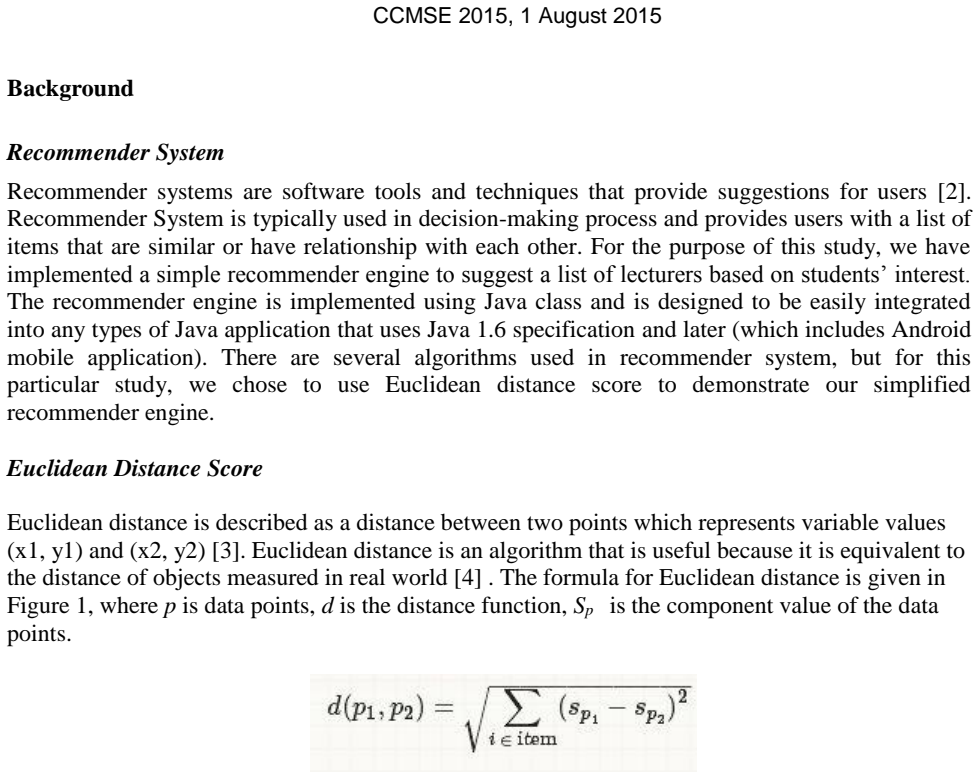
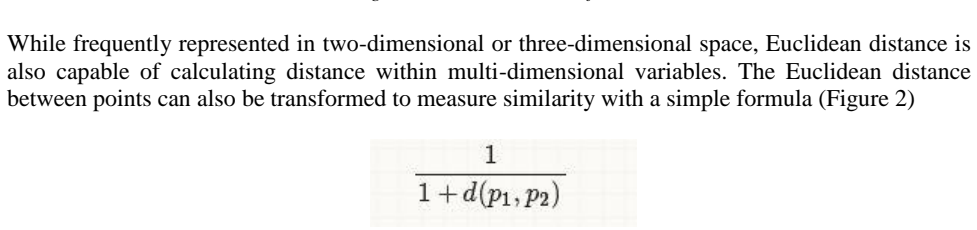
The machinery is the Euclidean distance score and its conversion to a bounded similarity value. Each Lecturer object is a vector $(p_1,\dots,p_5)$ over the five areas—Multimedia, Web Application, Network, Artificial Intelligence, and Mobile Application—and the student's questionnaire ratings form the query vector $(q_1,\dots,q_5)$. The engine computes $d(\mathbf{p},\mathbf{q}) = \sqrt{\sum_{i=1}^5 (p_i - q_i)^2}$, applies the Figure 2 conversion to map the distance into a similarity score between 0.0 and 1.0, and sorts descending to produce the recommendation. The work this machinery does is to convert an open-ended human decision—'who should supervise my project?'—into a fixed geometric ranking whose correctness depends entirely on how faithfully the five stored numbers capture each lecturer's actual expertise.
What would settle it
Have two independent coders build the five-area rating vector for each lecturer from the same project-title list, then run one fixed student query; if the top three recommended supervisors differ between the two codings, the ranking is an artifact of the CSV encoding rather than a stable measure of lecturer expertise.
Extended reading notes
Core claim
The paper's central claim is that a supervisor can be represented by a five-dimensional vector of interest-area ratings and a student by a matching query vector, and that ranking lecturers by Euclidean distance, converted into a 0-to-1 similarity score, returns a list of the lecturers who best fit the student's stated interests. The authors demonstrate this with sample output in which a student with strong Multimedia and Web Application interests receives a top-five list led by lecturers whose profiles sit closest in that five-dimensional space. They further claim that this result is enough to show the approach is feasible for the final-year-project matching problem, while acknowledging that the engine is far from complete and cannot reliably tell whether a group of lecturers has consistently similar interests.
Load-bearing premise
The load-bearing premise is that a lecturer's expertise can be captured accurately and stably by five fixed ratings derived from past project titles and students' supervisor choices; if that profile is wrong or unstable, the distance-based ranking is meaningless even though the software runs.
Editorial extensions
If this is right
- Other institutions with a similar project-allocation workflow could deploy the same engine with only a CSV of supervisor profiles and no training data.
- A student who spreads ratings evenly near the middle will receive a less discriminating list than one with strong preferences, because Euclidean distance compresses small differences across all dimensions into a short total distance.
- Because similarity is computed from raw distance, the engine cannot by itself tell whether two lecturers' interest patterns are consistently similar, which is why the authors flag Pearson correlation as future work.
- The five fixed categories define the ceiling of what the engine can express; adding more areas, as the authors plan, would change the geometry and therefore the rankings.
Reading between the lines
- An unstated consequence of choosing Euclidean distance is that two lecturers with the same average profile but opposite preference shapes—one strong in Multimedia and weak in Network, the other the reverse—are treated as very different, so the ranking rewards matching a student's overall interest level rather than their preference pattern.
- A natural extension the paper does not explore is to run the same engine in reverse: using lecturer profiles as queries would cluster students by interest, which could help supervisors form project groups or spot emerging interest areas before project allocation.
- The engine's transferability is untested: the five areas were induced from one faculty's project titles, so applying the same code elsewhere without re-deriving the area set would silently compress any missing specialty into the nearest existing category and could produce confidently wrong recommendations.
Signed reviews
Editorial analysis
A structured set of objections, weighed in public.
Referee Report
Summary. This manuscript describes a Java-based recommender engine intended to match final-year project students with potential supervisors at UiTM Perlis. The engine takes a student's ratings in five interest areas (Multimedia, Web Application, Network, Artificial Intelligence, Mobile Application) and computes Euclidean distances to lecturer profiles stored in CSV format, ranking supervisors by a similarity score derived from the distance. The authors report a single illustrative test with five supervisors and conclude that the approach 'seems to achieve the goal' while acknowledging the engine is only a proof-of-concept and far from complete.
Significance. If the demonstration were valid, the paper would provide a simple, transparent proof-of-concept for a content-based recommender in an academic advising context. The work has some praiseworthy elements: the algorithm is clearly stated (Euclidean distance with 1/(1+d) similarity conversion), the implementation is described as a reusable Java class, and the authors explicitly temper their claims by calling the system a proof-of-concept. However, the sole reported result is internally inconsistent with the stated formula, and the paper lacks the data and procedural detail needed to reproduce or evaluate the ranking. As it stands, the central feasibility claim is unsupported, and the manuscript is not publishable in its present form.
major comments (3)
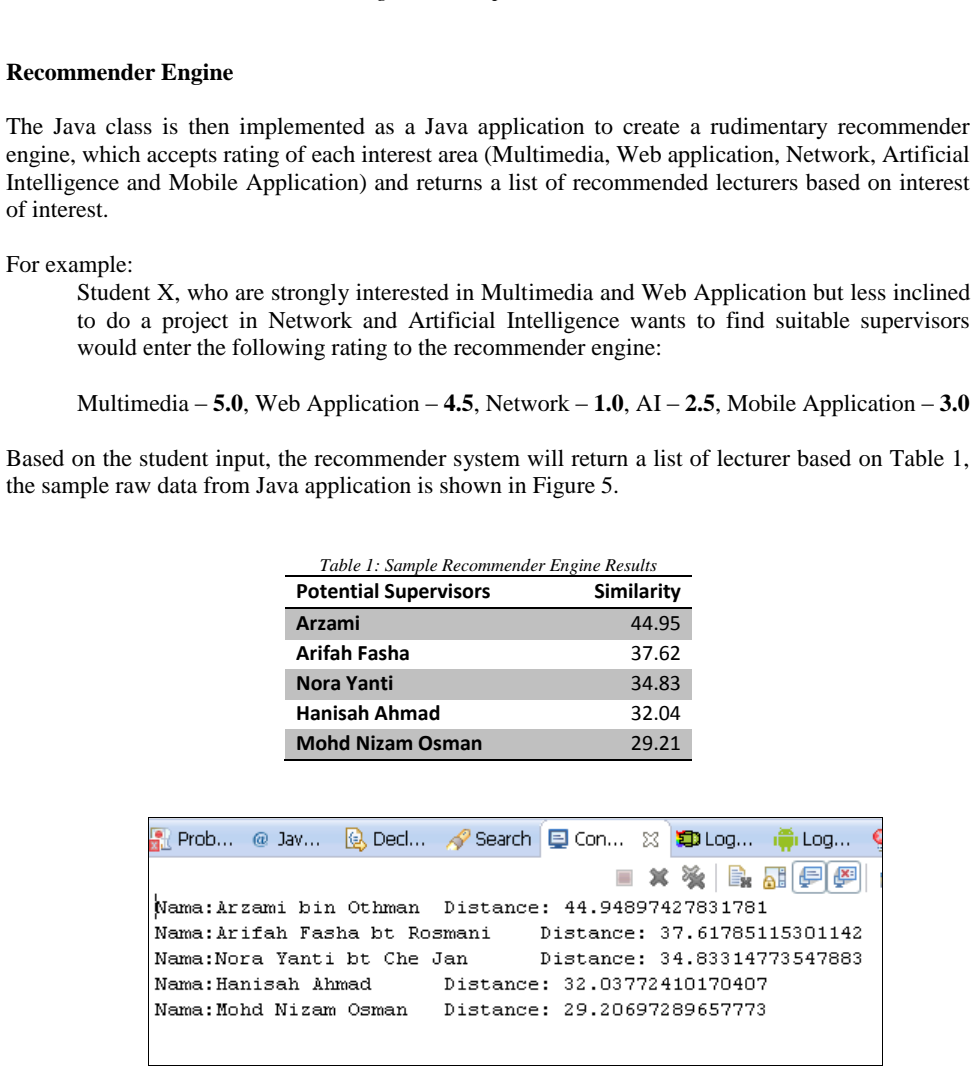
- [Recommender Engine, Table 1] Table 1 reports 'Similarity' values of 44.95, 37.62, 34.83, 32.04, and 29.21, but the conversion formula in Figure 2 (similarity = 1/(1+distance)) is bounded between 0.0 and 1.0. The reported values are therefore impossible as similarity scores. If they are actually raw Euclidean distances, the column is mislabeled and the ranking is inverted, since larger distance means less similar; the top-listed lecturer would then be the least suitable match. This inconsistency invalidates the only demonstration of the paper's central claim and makes the 'best match' ranking uninterpretable.
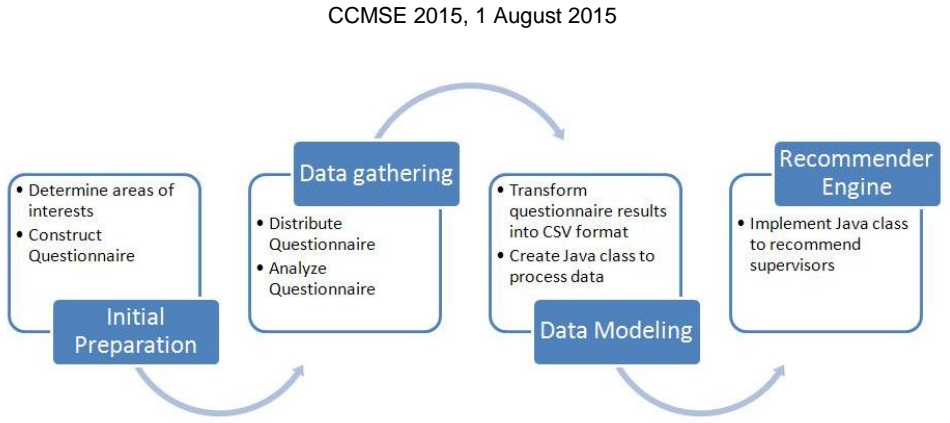
- [Data Modeling, Figure 4] The Data Modeling section states that lecturer profiles are transformed from previous project titles and chosen-supervisor data into a CSV of interest values, but it never specifies how the numeric value for each of the five interest dimensions is computed from those raw data. Without this construction rule, the Euclidean distances and the resulting recommendation list cannot be reproduced or checked, so the feasibility of the approach is not established.
- [Conclusion] The conclusion asserts that 'Euclidean distance seems to achieve the goal for recommending lecturers,' but the only supporting evidence is a single unvalidated output (Table 1/Figure 5). There is no ground-truth comparison, no baseline, no error analysis, and no measure of whether the recommended supervisors are actually suitable. The authors' own caveat that the engine is 'far from complete' is appropriate, but it does not compensate for the absence of any valid test of the ranking; the assertion therefore overstates what the experiments show.
minor comments (5)
- [Introduction] The Introduction says the project titles 'falls within four general areas' and then lists five: Multimedia, Web Application, Network, Artificial Intelligence, and Mobile Application. Please correct the count.
- [Figure 1 and throughout] The spelling 'Euclidian' appears in the Figure 1 caption; elsewhere the manuscript uses 'Euclidean'. Please unify.
- [References] Reference [5] contains a typo: 'Eidenburgh' should be 'Edinburgh'.
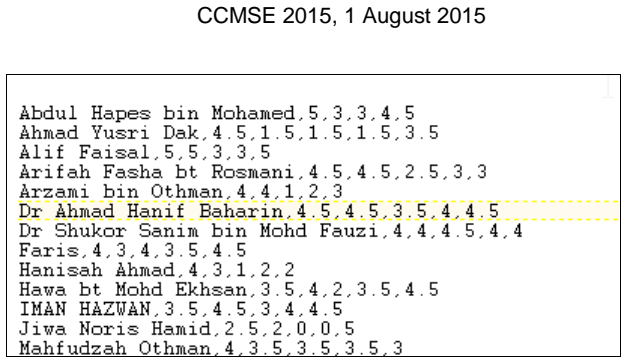
- [Figure 5] Figure 5 is described as sample raw output, but the typeset image is not legible; please provide a readable screenshot or reproduce the output in a table.
- [Data Modeling] Please clarify how missing or partial lecturer data (e.g., a new lecturer with no previous project titles) is handled in the vector construction.
Circularity Check
No circularity: the recommender ranking is a direct Euclidean-distance computation with no fitted parameters or load-bearing self-citations.
full rationale
The derivation chain is explicit and self-contained: the student supplies interest ratings, each lecturer is represented by a vector built from questionnaire/CSV data, the engine computes Euclidean distance and converts it to a similarity score via the stated 1/(1+d) formula, and the list is sorted by that score. No parameter is fitted to the predicted output, no lecturer profile is defined in terms of the recommended ranking, and no prior work by the same authors is cited to justify the algorithm or force the choice of formula. The reported Table 1 values (44.95, 37.62, etc.) are inconsistent with the paper's own bounded similarity formula, and the paper does not disclose exactly how the lecturer vector numeric values are derived from the questionnaire responses; however, these are correctness and reproducibility concerns, not circularity. The central claim is only that a proof-of-concept Euclidean-distance recommender is feasible, which is exactly what the stated computation would show if the data were internally consistent. Because nothing in the derivation reduces by construction to its own inputs, the circularity score is 0.
Assumptions & free parameters
assumptions (4)
- standard math The Euclidean distance formula (Figure 1) and the distance-to-similarity conversion (Figure 2) correctly compute dissimilarity and bounded similarity for numeric vectors.
- domain assumption Lecturer expertise can be represented as a fixed vector over the five chosen interest areas, built from previous project titles and student choices.
- domain assumption Students' 1-5 self-ratings of interest are reliable proxies for their actual project interests.
- domain assumption Euclidean distance is an appropriate similarity measure for this particular matching task.
Cite this review
Pith. "Pith review of A Simple Recommender Engine for Matching Final-Year Project Student with Supervisor." pith.science (2026). https://pith.science/paper/I5KFYCP2
@misc{pith2026190803475,
  author       = {Pith},
  title        = {Pith review of: A Simple Recommender Engine for Matching Final-Year Project Student with Supervisor},
  year         = {2026},
  howpublished = {\url{https://pith.science/paper/I5KFYCP2}},
  note         = {Machine review of arXiv:1908.03475}
}
read the original abstract
This paper discusses a simple recommender engine, which can match final year project student based on their interests with potential supervisors. The recommender engine is constructed based on Euclidean distance algorithm. The initial input data for the recommender system is obtained by distributing questionnaire to final year students and recording their response in CSV format. The recommender engine is implemented using Java class and application, and result of the initial tests has shown promises that the project is feasible to be pursued as it has the potential of solving the problem of final year students in finding their potential supervisors.
Figures
Figures from the paper (2 more)
Reference graph
Works this paper leans on
-
[1]
M. L. Yap, N. Abdul Manaf, W. N. A. Wan Hariri, A. Ahmad, N. Janom, S. Abdul Rahman, A. S. Abdullah, and N. S. Kamal Bashah, Essentials of Computing Sciences - Project Administration, 1st ed. Shah Alam, Selangor: Faculty of Computer and Mathematical Sciences
- [2]
-
[3]
A new distance between two bodies of evidence,
A.-L. Jousselme, D. Grenier, and É. Bossé, “A new distance between two bodies of evidence,” Inf. Fusion, vol. 2, no. 2, pp. 91–101, 2001
work page 2001
-
[4]
An efficient euclidean distance transform,
D. G. Bailey, “An efficient euclidean distance transform,” in Combinatorial Image Analysis, Springer, 2005, pp. 394–408
work page 2005
-
[5]
Similarity and recommender systems
H. Shimodaira, “Similarity and recommender systems.” School of Informatics, The University of Eidenburgh, 21-Jan-2014
work page 2014
Reviewed August 14, 2026 · model on record in the stance chip above.
Discussion (0). Continue with ORCID to comment.