REVIEW 6 minor 52 references
Optimality properties of Galerkin and Petrov-Galerkin methods for linear matrix equations
T0 review · 0 major / 6 minor · reviewed 2026-08-14 · deepseek-v4-flash
Pith's one-line read For a symmetric positive definite matrix-equation operator, the Galerkin condition on the residual is exactly equivalent to minimizing the error in that operator's norm, whatever the approximation spaces.
desk verdict Clean, honest generalization of Galerkin/Petrov-Galerkin optimality to matrix equations; main theorem holds, new results are modest but real, and the paper deserves refereeing. read the letter →
The pith
A machine-rendered reading of the paper's core claim, the machinery that carries it, and where it could break.
The reading
What carries the argument
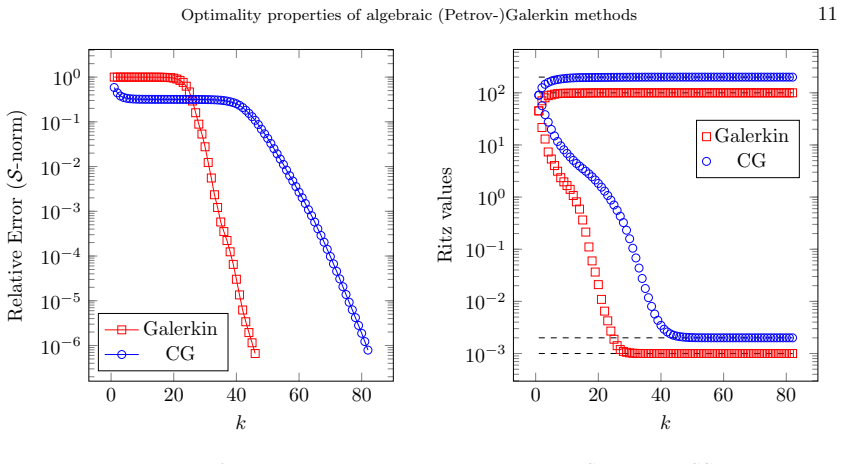
The load-bearing object is the linear operator $S: X \mapsto \sum_j A_j X B_j$ and its Kronecker representation $S_{\ell}=\sum_j B_j^T\otimes A_j$, together with the induced inner product $\langle X,Y\rangle_S=\operatorname{trace}(X^T S(Y))$. Under the spd assumption this inner product defines a true norm, and the Galerkin condition $V_k^T R_k W_k=0$ is precisely the normal equation of the least-squares projection onto $\operatorname{range}(W_k\otimes V_k)$ in that norm. The Petrov-Galerkin half is carried by choosing the test space $L_m=S_{\ell}K_m$, which turns residual minimization into a small reduced least-squares problem; for Lyapunov equations this reduced problem is a generalized Sylvester equation, and the paper's proposed novelty is to add the semidefiniteness constraint $Y\preceq 0$ to it.
What would settle it
For any proposed multiterm equation, explicitly compute the smallest eigenvalue of $S_{\ell}=\sum_j B_j^T\otimes A_j$, for instance for the six-term stochastic Galerkin example used in the paper, and compare its sign with the observed convergence history of the Galerkin iterates: if $\lambda_{\min}(S_{\ell})\le 0$, the hypothesis of Proposition 2.2 fails, and an observed increase in the $S$-norm error in such a case would show that the unconditional optimality claim is false; if $\lambda_{\min}(S_{\ell})>0$ and the error still increases, the proof itself would be contradicted.
Extended reading notes
Core claim
The paper's central discovery is that the classical optimality of projection methods survives the passage from vectors to matrices. For $S(X)=\sum_j A_j X B_j$ with $S_{\ell}=\sum_j B_j^T\otimes A_j$ symmetric positive definite, the Galerkin condition $V_k^T R_k W_k=0$ with $R_k=F-S(X_k)$ and $X_k=V_k Y_k W_k^T$ is exactly the stationarity condition for minimizing $\|X-Z\|_S$ over all $Z=V_k Y W_k^T$. Thus the Galerkin solution is the $S$-norm minimizer on the approximation set, and enlarging the spaces monotonically decreases the $S$-norm error, independently of how the spaces are constructed. For Sylvester equations $AX+XB=b_1b_2^T$ with $A,B$ symmetric positive definite, the paper derives an explicit exponential convergence bound in the Euclidean or Frobenius norm, with rates governed by shifted condition numbers $\hat\kappa_A$ and $\hat\kappa_B$. When $S$ is not spd, Galerkin optimality is lost, but the Petrov-Galerkin choice of test space $L_m=S_{\ell}K_m$ does yield residual minimization; for Lyapunov equations, the paper shows that the unconstrained reduced least-squares problem can lose semidefiniteness and proposes imposing $Y\preceq 0$ as an explicit constraint.
Load-bearing premise
The theorem's load-bearing assumption is that the operator $S$, equivalently the Kronecker matrix $\sum_j B_j^T\otimes A_j$, is symmetric positive definite; if that fails, the $S$-norm is not a norm and the Galerkin condition no longer guarantees error minimization, and the paper itself notes that this definiteness cannot in general be certified from the spectra of the individual $A_j$ and $B_j$.
Editorial extensions
If this is right
- Any Galerkin solver for a symmetric positive definite linear matrix equation inherits monotone convergence in the $S$-norm as the approximation spaces grow, regardless of how those spaces are chosen.
- For Sylvester equations with spd coefficients and rank-one right-hand side, the new bound gives an explicit iteration count to reach a prescribed accuracy, with a convergence factor governed by shifted condition numbers.
- Solving a Lyapunov equation in matrix form instead of applying conjugate gradients to the Kronecker-vector system improves the worst-case convergence factor from $\kappa$ to $(\kappa+1)/2$, since $\hat\kappa = \kappa/2 + 1/2$.
- For non-spd operators, Petrov-Galerkin methods remain optimal in residual norm, and the constrained formulation allows structural properties such as semidefiniteness to be preserved during the iteration.
Reading between the lines
- The error-minimization equivalence should extend to tensor-structured equations beyond matrices, whenever the corresponding operator is spd in the natural inner product; this is a direct generalization the paper does not pursue.
- The improved condition number $\hat\kappa=(\kappa+1)/2$ suggests a rule of thumb: for the same data, a matrix-oriented Galerkin solver can be expected to need about half as many iterations as CG on the Kronecker-vector system in the worst case; this is a consequence of the paper's bounds, not an empirical claim.
- The constrained residual-minimization idea could be applied to other equations whose exact solutions are known to lie in a convex cone, such as Sylvester equations with sign-definite right-hand sides, where preserving the cone during the iteration would improve reliability.
- Because $S_{\ell}$'s definiteness cannot be read off from the spectra of the summands, a practical code could add a cheap numerical check of the smallest eigenvalue of a projected $S_{\ell}$ before relying on Galerkin optimality.
Signed reviews
Editorial analysis
A structured set of objections, weighed in public.
Referee Report
Summary. The paper treats projection methods for the linear matrix equation S(X)=Σ_{j=1}^ℓ A_j X B_j=F. It proves that when S is symmetric positive definite (spd) in the sense of Definition 2.1, the Galerkin condition V_k^T R_k W_k=0 on the residual is equivalent to minimizing the S-norm of the error over all X_k=V_k Y W_k^T (Proposition 2.2). The proof identifies the matrix Galerkin condition with the normal equations of the vectorized least-squares problem. The paper then derives a convergence estimate for the Sylvester equation with Krylov subspaces (Proposition 3.2), contrasts the matrix Galerkin iteration with CG applied to the Kronecker-form linear system, and proposes a semidefinite-constrained minimal-residual Petrov-Galerkin formulation for Lyapunov equations. Numerical experiments illustrate monotone error decrease, the comparison with CG, and the effect of the semidefinite constraint.
Significance. If it holds, the central optimality theorem is a clean and useful unification: it shows that for any spd linear matrix-equation operator the optimality of the Galerkin condition is independent of the approximation spaces, and it recovers the classical normal-equation argument in Kronecker form. The proof of Proposition 2.2 is transparent and requires no hidden assumptions beyond the stated spd hypothesis and full column rank of V_k, W_k. The paper also extends the Simoncini-Druskin Lyapunov bound to Sylvester equations and offers a novel constrained-minimization viewpoint for preserving solution semidefiniteness in Petrov-Galerkin methods. The authors explicitly acknowledge that spd-ness of a general multiterm operator cannot always be checked from the spectra of the coefficient matrices; this limitation restricts the applicability of Proposition 2.2 but does not invalidate it.
minor comments (6)
- [Section 3, Proposition 3.2] The proof of Proposition 3.2 is only a reference to [45, Proposition 3.1] through the phrase 'same arguments', but the displayed constants, especially 2/(λmin(A)+λmin(B)) and the bracket terms, are not derived; since this is a new result, please give a complete proof or a detailed verification of the constants.
- [Section 4, Equation (4.5)] Equation (4.5) uses the lower bound ‖x‖₂ > 1/(λmax+λmin), which is not valid for all right-hand sides: for A=diag(1,100) and F=e2e2^T the exact solution has ‖X‖_F=1/200<1/101. The quoted constant 4(√κ̂+1)√κ̂ also appears inconsistent with (3.1); please correct the bound or clearly label the comparison as heuristic.
- [Section 5, Equation (5.3)] The normal-equation equivalence in (5.3) is missing the projection: it should read V_k^T S^*(F−S(V_k Y_k W_k^T)) W_k=0 (equivalently (W_k⊗V_k)^T S_l^T r_k=0), rather than S^*(F−S(...))=0.
- [Section 4, Equation (4.3)] The equality κ = λmax(A)/λmin(A) = λmax(A)/λmin(A) is ambiguous because the Kronecker matrix A = A⊗I+I⊗A has eigenvalues twice those of A; please use separate notation for the original and Kronecker matrices.
- [Section 2, after Remark 2.3] The acknowledged limitation that spd of a general multiterm operator cannot be checked from the spectra of the A_j, B_j should be reflected in the abstract and conclusions, where the phrase 'carry over' could otherwise be read as unconditional.
- [Section 3, Proposition 3.2] The expression (√κ̂_A+1)/√κ̂_A in Proposition 3.2 is ambiguous in the typeset text; if the intended factor is √(κ̂_A+1)/√κ̂_A, please typeset it with an unambiguous radical.
Circularity Check
No significant circularity: Proposition 2.2 is a direct normal-equations argument under an explicit spd hypothesis, and the convergence bounds are genuine extensions of independent prior theorems.
full rationale
The paper's central claim, Proposition 2.2, is not circular. Given the vectorization identity vec(AXB) = (B^T ⊗ A) vec(X), the matrix Galerkin condition V_k^T R_k W_k = 0 is exactly (W_k ⊗ V_k)^T r_k = 0, which is the normal equation for minimizing ‖X − Z‖_S over Z = V_k Y W_k^T when S_l is spd. The spd assumption is an explicit hypothesis, not a conclusion derived from the approximation; the S-norm is defined through S_l, and the equivalence is a standard least-squares projection argument. No parameter is fitted to data, and no quantity is renamed as a prediction. The only self-citations, notably [45] (Simoncini–Druskin) and [27] (Kressner–Tobler), are used as prior theorems: Proposition 3.1 restates a published bound, and Proposition 3.2 extends it to Sylvester equations by applying the same proof technique to additional integrals. These are not restatements of the present paper's conclusions, and the cited assumptions do not include the target result, so they do not make the derivation circular. The acknowledged limitation that spd of a multiterm operator may be hard to verify after Remark 2.3 narrows applicability but does not affect the internal validity of the optimality theorem. The apparent typo in equation (5.3), where the normal equation should involve V_k^T S^*(R) W_k = 0 rather than S^*(R) = 0, is a notation slip in a derived characterization and not a circular step.
Assumptions & free parameters
assumptions (4)
- standard math Kronecker product identity vec(A X B) = (B^T ⊗ A) vec(X)
- standard math Conjugate gradient convergence bound for spd linear systems (Golub and Van Loan Theorem 10.2.6)
- domain assumption Simoncini and Druskin's bound for Galerkin approximation of Lyapunov equations (Proposition 3.1 in [45])
- standard math Properties of Krylov subspaces: Ritz values lie within the spectral interval of A, so α_min(A_k) ≥ α_min(A)
Cite this review
Pith. "Pith review of Optimality properties of Galerkin and Petrov-Galerkin methods for linear matrix equations." pith.science (2026). https://pith.science/paper/I5ZX3JQW
@misc{pith2026190806016,
  author       = {Pith},
  title        = {Pith review of: Optimality properties of Galerkin and Petrov-Galerkin methods for linear matrix equations},
  year         = {2026},
  howpublished = {\url{https://pith.science/paper/I5ZX3JQW}},
  note         = {Machine review of arXiv:1908.06016}
}
read the original abstract
Galerkin and Petrov-Galerkin methods are some of the most successful solution procedures in numerical analysis. Their popularity is mainly due to the optimality properties of their approximate solution. We show that these features carry over to the (Petrov-)Galerkin methods applied for the solution of linear matrix equations. Some novel considerations about the use of Galerkin and Petrov-Galerkin schemes in the numerical treatment of general linear matrix equations are expounded and the use of constrained minimization techniques in the Petrov-Galerkin framework is proposed.
Figures


Figures from the paper (1 more)

Reference graph
Works this paper leans on
-
[45]
V. Simoncini and V. Druskin, Convergence analysis of projection methods for the numerical solution of large Lyapunov equations, SIAM J. Numer. Anal., Vol. 47, No. 2 (2009), pp. pp. 828–843
work page 2009
-
[27]
D. Kressner and C. Tobler, Krylov subspace methods for linear systems with tensor product structure, SIAM J. Matrix Analysis and Appl., 31 (2010), pp. 1688–1714
work page 2010
- [30]
-
[52]
B. Vandereycken and S. Vandewalle, A Riemannian optimization approach for computing low-rank solu- tions of Lyapunov equations , SIAM J. Matrix Analysis and Appl., 31 (2010), pp. 2553–2579
work page 2010
-
[1]
M. F. Anjos and J. B. Lasserre, eds., Handbook on semidefinite, conic and polynomial optimization , vol. 166 of International Series in Operations Research & Management Science, Springer, New York, 2012
work page 2012
-
[2]
A. C. Antoulas , Approximation of large-scale dynamical systems , vol. 6 of Advances in Design and Control, Society for Industrial and Applied Mathematics (SIAM), Philadelphia, PA, 2005
work page 2005
-
[3]
I. Babuˇska, R. Tempone, and G. E. Zouraris , Galerkin finite element approximations of stochastic elliptic partial differential equations, SIAM J. Numer. Anal., 42 (2004), pp. 800–825
work page 2004
-
[4]
R. H. Bartels and G. W. Stewart, Algorithm 432: Solution of the Matrix Equation AX +XB =C, Comm. ACM, 15 (1972), pp. 820–826
work page 1972
Show all 52 references
-
[5]
Baumann, R
M. Baumann, R. Astudillo, Y. Qiu, E. Y. M. Ang, M. B. van Gijzen, and R.- ´E. Plessix , An MSSS- preconditioned matrix equation approach for the time-harmonic elastic wave equation at multiple frequen- cies, Computational Geosciences, 22 (2018), pp. 43–61
2018
-
[6]
Beckermann, An Error Analysis for Rational Galerkin Projection applied to the Sylvester Equation , SIAM J
B. Beckermann, An Error Analysis for Rational Galerkin Projection applied to the Sylvester Equation , SIAM J. Numer. Anal., 49 (2011), pp. 2430–2450
2011
-
[7]
Beckermann, D
B. Beckermann, D. Kressner, and Ch. Tobler, An error analysis of Galerkin projection methods for linear systems with tensor product structure , SIAM J. Numer. Anal., 51 (2013), pp. 3307–3326
2013
-
[8]
Beckermann and A
B. Beckermann and A. B. J. Kuijlaars , Superlinear convergence of conjugate gradients , SIAM J. Numer. Anal., 39 (2001), pp. 300–329
2001
-
[9]
14, 2002, pp
, Superlinear CG convergence for special right-hand sides , vol. 14, 2002, pp. 1–19. Orthogonal polyno- mials, approximation theory, and harmonic analysis (Inzel, 2000)
2002
-
[10]
Benner and T
P. Benner and T. Breiten , Low rank methods for a class of generalized Lyapunov equations and related issues, Numer. Math., 124 (2013), pp. 441–470
2013
-
[11]
, Rational interpolation methods for symmetric Sylvester equations , Electron. Trans. Numer. Anal., 42 (2014), pp. 147–164. 16 D. Palitta and V. Simoncini
2014
-
[12]
Benner and T
P. Benner and T. Damm, Lyapunov equations, energy functionals, and model order reduction of bilinear and stochastic systems, SIAM J. Control Optim., 49 (2011), pp. 686–711
2011
-
[13]
Benner, V
P. Benner, V. Mehrmann, and D. C. Sorensen , eds., Dimension reduction of large-scale systems , vol. 45 of Lecture Notes in Computational Science and Engineering, Springer, Berlin, 2005
2005
-
[14]
Benner and J
P. Benner and J. Saak, Numerical solution of large and sparse continuous time algebraic matrix Riccati and Lyapunov equations: a state of the art survey , GAMM-Mitt., 36 (2013), pp. 32–52
2013
-
[15]
S. Boyd, L. El Ghaoui, E. Feron, and V. Balakrishnan , Linear matrix inequalities in system and control theory, vol. 15 of SIAM Studies in Applied Mathematics, Society for Industrial and Applied Mathematics (SIAM), Philadelphia, PA, 1994
1994
-
[16]
M. J. Corless and A. E. Frazho, Linear Systems and Control – An Operator Perspective, Pure Appl. Math., Marcel Dekker, New York, Basel, 2003
2003
-
[17]
Damm, Direct methods and ADI-preconditioned Krylov subspace methods for generalized Lyapunov equa- tions, Num
T. Damm, Direct methods and ADI-preconditioned Krylov subspace methods for generalized Lyapunov equa- tions, Num. Lin. Alg. with Appl., 15 (2008), pp. 853–871. Special issue on Matrix equations
2008
-
[18]
Druskin, L
V. Druskin, L. Knizhnerman, and V. Simoncini , Analysis of the rational Krylov subspace and ADI methods for solving the Lyapunov equation , SIAM J. Numer. Anal., 49 (2011), pp. 1875–1898
2011
-
[19]
M. A. Freitag and D. L. H. Green , A low-rank approach to the solution of weak constraint variational data assimilation problems, J. Comput. Phys., 357 (2018), pp. 263–281
2018
-
[20]
G. H. Golub and C. F. Van Loan, Matrix computations, Johns Hopkins Studies in the Mathematical Sciences, Johns Hopkins University Press, Baltimore, MD, fourth ed., 2013
2013
-
[21]
M. R. Hestenes and E. Stiefel , Methods of conjugate gradients for solving linear systems , J. Research Nat. Bur. Standards, 49 (1952), pp. 409–436 (1953)
1952
-
[22]
D. Y. Hu and L. Reichel , Krylov-subspace methods for the Sylvester equation , Linear Algebra Appl., 172 (1992), pp. 283–313. Second NIU Conference on Linear Algebra, Numerical Linear Algebra and Applications (DeKalb, IL, 1991)
1992
-
[23]
Jarlebring, G
E. Jarlebring, G. Mele, D. Palitta, and E. Ringh , Krylov methods for low-rank commuting generalized sylvester equations, Numerical Linear Algebra with Applications, 25 (2018). e2176
2018
-
[24]
Knizhnerman and V
L. Knizhnerman and V. Simoncini , Convergence analysis of the Extended Krylov Subspace Method for the Lyapunov equation, Numerische Mathematik, 118 (2011), pp. 567–586
2011
-
[25]
Konstantinov, V
M. Konstantinov, V. Mehrmann, and P. Petkov, On properties of Sylvester and Lyapunov operators, Linear Algebra Appl., 312 (2000), pp. 35–71
2000
-
[26]
Kressner and P
D. Kressner and P. Sirkovi´c, Truncated low-rank methods for solving general linear matrix equations, Numer. Linear Algebra Appl., 22 (2015), pp. 564–583
2015
-
[28]
Lancaster, Explicit solutions of linear matrix equations , SIAM Rev., 12 (1970), pp
P. Lancaster, Explicit solutions of linear matrix equations , SIAM Rev., 12 (1970), pp. 544–566
1970
-
[29]
Principles and Analysis , Oxford University Press, 2013
Joerg Liesen and Zdenek Strakos , Krylov Subspace Methods. Principles and Analysis , Oxford University Press, 2013
2013
-
[31]
L¨ofberg, YALMIP : A toolbox for modeling and optimization in MATLAB , in Proceedings of the CACSD Conference, Taipei, Taiwan, 2004
J. L¨ofberg, YALMIP : A toolbox for modeling and optimization in MATLAB , in Proceedings of the CACSD Conference, Taipei, Taiwan, 2004
2004
-
[32]
Malick, A dual approach to semidefinite least-squares problems , SIAM J
J. Malick, A dual approach to semidefinite least-squares problems , SIAM J. Matrix Anal. Appl., 26 (2004), pp. 272–284
2004
-
[33]
V. L. Mehrmann, The autonomous linear quadratic control problem , vol. 163 of Lecture Notes in Control and Information Sciences, Springer-Verlag, Berlin, 1991. Theory and numerical solution
1991
-
[34]
C. C. Paige and M. A. Saunders, Solutions of sparse indefinite systems of linear equations , SIAM J. Numer. Anal., 12 (1975), pp. 617–629
1975
-
[35]
Palitta and V
D. Palitta and V. Simoncini , Matrix-equation-based strategies for convection-diffusion equations , BIT, 56 (2016), pp. 751–776
2016
-
[36]
Palitta and V
D. Palitta and V. Simoncini , Computationally enhanced projection methods for symmetric Sylvester and Lyapunov equations, J. Comput. Appl. Math., 330 (2018), pp. 648–659
2018
-
[37]
C. E. Powell and H. C. Elman, Block-diagonal preconditioning for spectral stochastic finite-element systems, IMA J. Numer. Anal., 29 (2009), pp. 350–375
2009
-
[38]
C. E. Powell, D. Silvester, and V. Simoncini , An efficient reduced basis solver for stochastic Galerkin matrix equations, SIAM J. Scient.Comput., 39 (2017), pp. A141–A163
2017
-
[39]
Saad, Numerical Methods for Large Eigenvalue Problems , Halstead Press, New York, 1992
Y. Saad, Numerical Methods for Large Eigenvalue Problems , Halstead Press, New York, 1992
1992
-
[40]
Saad, Iterative methods for sparse linear systems , SIAM, Society for Industrial and Applied Mathematics, Philadelphia, PA, 2nd ed., 2003
Y. Saad, Iterative methods for sparse linear systems , SIAM, Society for Industrial and Applied Mathematics, Philadelphia, PA, 2nd ed., 2003. Optimality properties of algebraic (Petrov-)Galerkin methods 17
2003
-
[41]
Saad and M
Y. Saad and M. H. Schultz , GMRES: a generalized minimal residual algorithm for solving nonsymmetric linear systems, SIAM Journal on Scientific and Statistical Computing, No. 7 (1986), pp. pp. 856–869
1986
-
[42]
S. D. Shank, V. Simoncini, and D. B. Szyld , Efficient low-rank solution of generalized Lyapunov equations , Numer. Math., 134 (2016), pp. 327–342
2016
-
[43]
D. J. Silvester, A. Bespalov, and C. E. Powell , S-IFISS version 1.04 , 2017
2017
-
[44]
Simoncini, Computational methods for linear matrix equations , SIAM Rev., 58 (2016), pp
V. Simoncini, Computational methods for linear matrix equations , SIAM Rev., 58 (2016), pp. 377–441
2016
-
[46]
R. E. Skelton, T. Iwasaki, and K. M. Grigoriadis , A unified algebraic approach to linear control design , The Taylor & Francis Systems and Control Book Series, Taylor & Francis, Ltd., London, 1998
1998
-
[47]
Snyders and M
J. Snyders and M. Zakai, On nonnegative solutions of the equation AD +DA′ =−C, SIAM J. Appl. Math., 18 (1970), pp. 704–714
1970
-
[48]
Stoll and T
M. Stoll and T. Breiten , A low-rank in time approach to PDE-constrained optimization , SIAM J. Sci. Comput., 37 (2015), pp. B1–B29
2015
-
[49]
Strang and G
G. Strang and G. J. Fix , An Analysis of the Finite Element Method , Prentice-Hall, New York, 1973
1973
-
[50]
J. F. Sturm , Using SeDuMi 1.02, a MATLAB toolbox for optimization over symmetric cones , vol. 11/12, 1999, pp. 625–653. Interior point methods
1999
-
[51]
van der Sluis and H
A. van der Sluis and H. A. van der Vorst , The rate of convergence of conjugate gradients , Numer. Math., 48 (1986), pp. 543–560
1986
Reviewed August 14, 2026 · model on record in the stance chip above.
Discussion (0). Continue with ORCID to comment.