Phase diagram of the extended chequerboard J-Q model
Pith reviewed 2026-06-27 20:43 UTC · model grok-4.3
The pith
The extended chequerboard J-Q model exhibits only direct first-order transitions from antiferromagnetic to plaquette-singlet phases, with emergent O(4) symmetry along the transition line.
A machine-rendered reading of the paper's core claim, the machinery that carries it, and where it could break.
Core claim
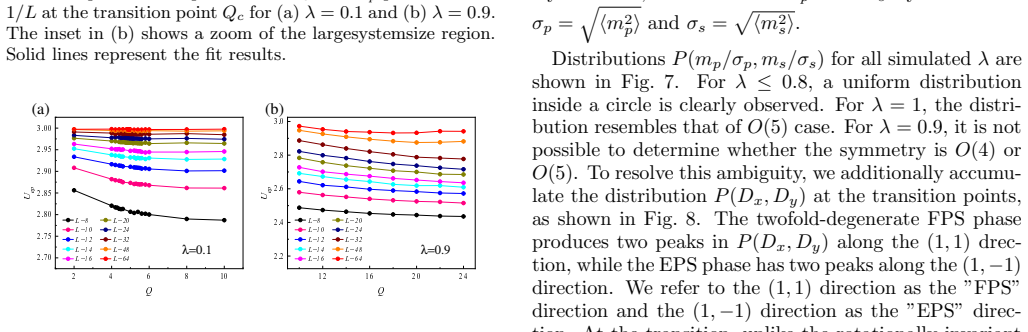
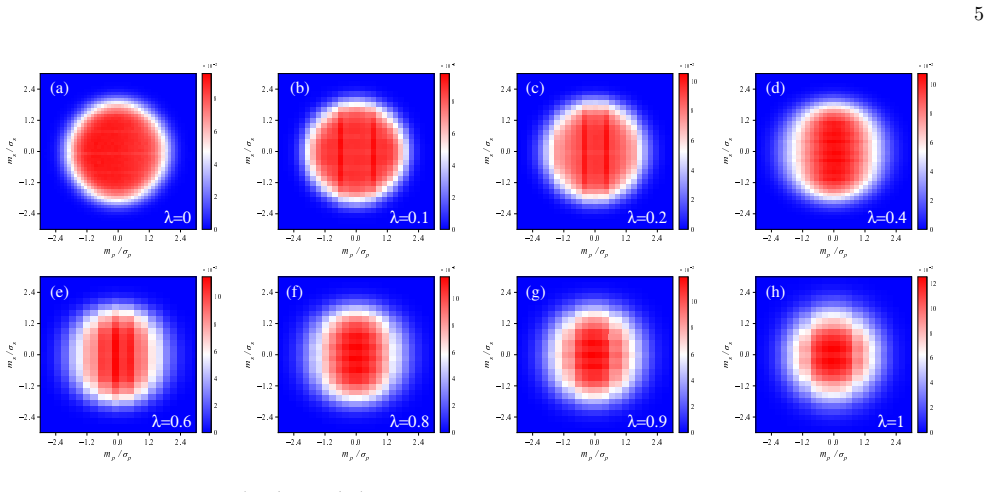
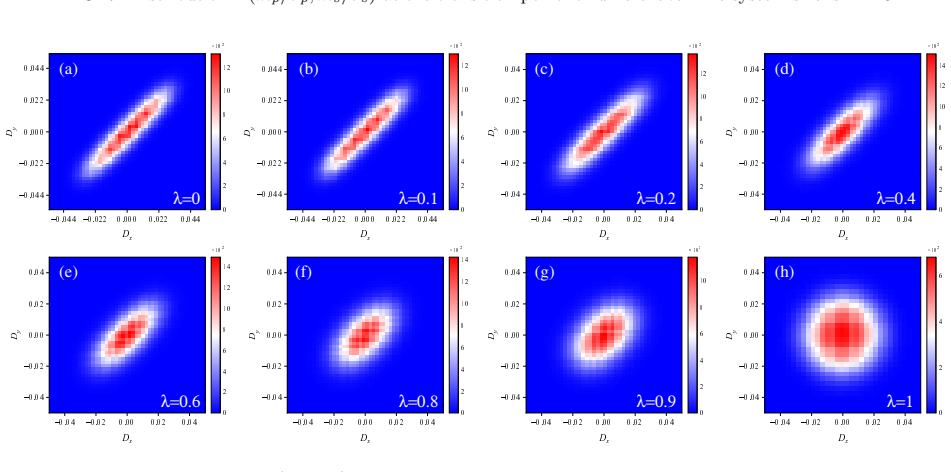
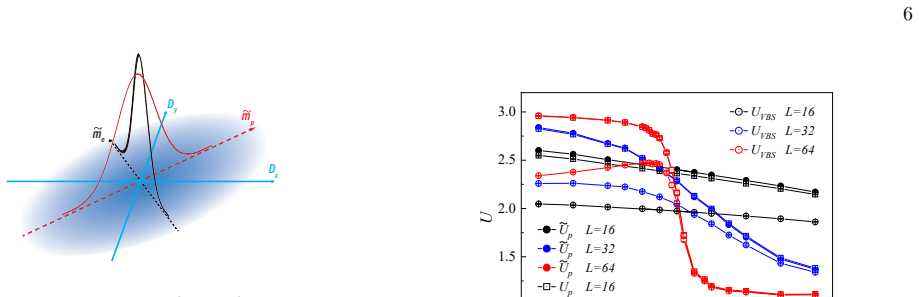
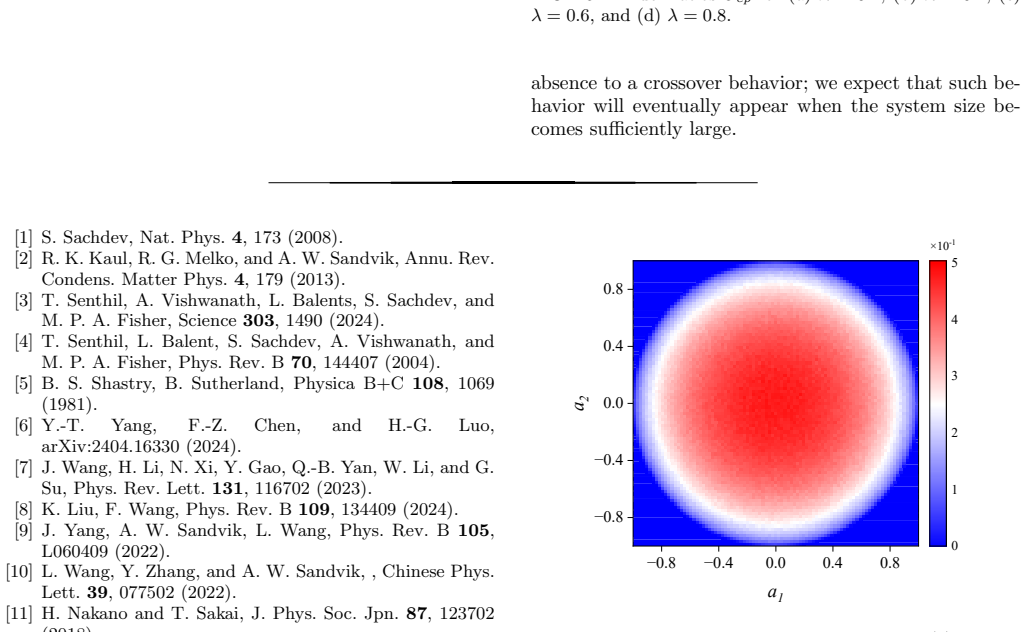
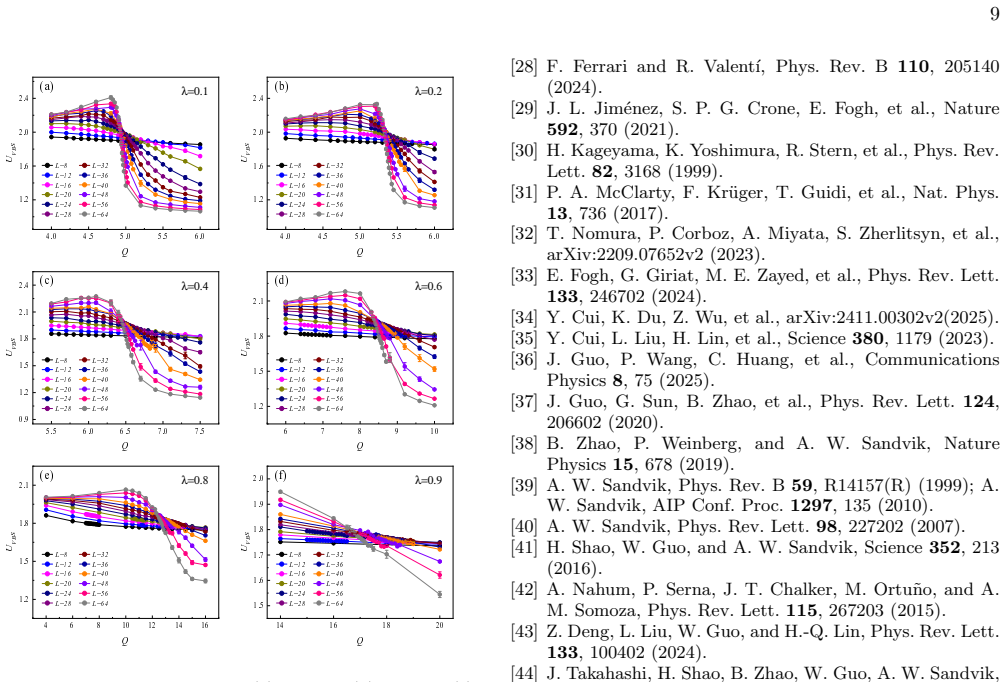
In the extended chequerboard J-Q model, Monte Carlo simulations find only a direct first-order phase transition from the antiferromagnetic (AFM) state to the plaquette-singlet (PS) solid state for every parameter set examined, with no intermediate phase present. Along the entire transition line the system displays an emergent O(4) symmetry. The Binder ratio of the columnar valence-bond solid state exhibits monotonic finite-size scaling, enabling accurate determination of the transition location.
What carries the argument
Monte Carlo simulations of the extended chequerboard J-Q Hamiltonian that track order parameters and Binder ratios to identify the character and location of the AFM-PS transition.
If this is right
- The model continues to realize a direct AFM-PS transition without additional phases, consistent with its original motivation to describe SrCu2(BO3)2.
- Emergent O(4) symmetry appears universally on the transition line for all parameter choices investigated.
- The Binder ratio of the columnar valence-bond solid state provides a monotonic scaling diagnostic that fixes the transition point more precisely than other observables.
- No parameter regime in the extended model introduces an intermediate phase between AFM and PS.
Where Pith is reading between the lines
- If the emergent O(4) symmetry persists in the thermodynamic limit, it may constrain the possible low-energy effective theories describing the transition.
- The direct-transition result could be tested by checking whether small extensions of the Hamiltonian, such as additional longer-range couplings, continue to suppress intermediate phases.
- The monotonic Binder-ratio scaling may apply to related J-Q models on other lattices where first-order transitions are suspected.
Load-bearing premise
The Monte Carlo simulations have reached the true ground state for the lattice sizes and update algorithms used, without undetected metastable states or incomplete equilibration altering the reported first-order nature or absence of an intermediate phase.
What would settle it
A larger-scale simulation or different update algorithm that reveals a stable intermediate phase between AFM and PS for any of the previously studied parameter values would falsify the claim of direct transitions.
Figures

read the original abstract
The chequerboard $J-Q$ model was proposed to describe the direct phase transition from the antiferromagnetic (AFM) state to the plaquette-sin glet (PS) solid state observed in SrCu$_2({\rm BO}_3)_2$. In this paper, we present a Monte Carlo study of the ground state of an extended ve rsion of this model. For all parameters investigated, we find only a direct first-order phase transitions from the AFM to the PS phase, with no intermediate phase between them. On the transition line, the system exhibits an emergent $O(4)$ symmetry. Furthermore, we find that the Bi nder ratio of the columnar valence-bond solid state can be used to locate the phase transition. It exhibits a monotonic finite-size scaling b ehavior, allowing for a precise determination of the transition point.
Editorial analysis
A structured set of objections, weighed in public.
Referee Report
Summary. The manuscript reports Monte Carlo simulations of an extended chequerboard J-Q model, concluding that for all parameters investigated there is only a direct first-order transition from the antiferromagnetic (AFM) to the plaquette-singlet (PS) phase with no intermediate phase, that the transition exhibits emergent O(4) symmetry, and that the Binder ratio of the columnar valence-bond solid state provides a monotonic finite-size scaling diagnostic for locating the transition point.
Significance. If the numerical results hold, the work would provide concrete evidence that the extended chequerboard J-Q model realizes a direct AFM-PS first-order line without intervening phases, together with an emergent O(4) symmetry at the transition; this is relevant to the physics of SrCu2(BO3)2 and to the broader question of how first-order transitions can host emergent continuous symmetries in quantum magnets. The proposed use of the columnar VBS Binder ratio as a practical locator is a potentially reusable technical observation.
major comments (1)
- [Abstract] Abstract and methods: the central claim of a direct first-order AFM-PS transition with no intermediate phase for all parameters, plus emergent O(4), rests entirely on the Monte Carlo data, yet no information is supplied on lattice sizes, update algorithms (SSE or otherwise), sweep counts, autocorrelation times, or equilibration diagnostics. Without these, it is impossible to evaluate whether critical slowing down, metastable states, or insufficient sampling could have hidden a narrow intervening phase or changed the apparent order of the transition.
minor comments (1)
- [Abstract] The abstract contains typographical spacing errors ('plaquette-sin glet', 've rsion', 'Bi nder') that should be corrected for readability.
Simulated Author's Rebuttal
We thank the referee for their careful reading of the manuscript and for highlighting the need for greater transparency in the numerical methods. We agree that these details are essential for assessing the robustness of the reported first-order transitions and emergent symmetry, and we will revise the manuscript to include them.
read point-by-point responses
-
Referee: [Abstract] Abstract and methods: the central claim of a direct first-order AFM-PS transition with no intermediate phase for all parameters, plus emergent O(4), rests entirely on the Monte Carlo data, yet no information is supplied on lattice sizes, update algorithms (SSE or otherwise), sweep counts, autocorrelation times, or equilibration diagnostics. Without these, it is impossible to evaluate whether critical slowing down, metastable states, or insufficient sampling could have hidden a narrow intervening phase or changed the apparent order of the transition.
Authors: We agree that the original manuscript omitted key technical details required to evaluate the Monte Carlo results. In the revised version we will add a dedicated Methods section that specifies: (i) the linear system sizes employed (L = 8, 12, 16, 20, 24, 28, 32); (ii) the stochastic series expansion (SSE) algorithm with directed-loop updates and the precise number of Monte Carlo sweeps per run (typically 10^5–10^6 after 10^4 equilibration sweeps); (iii) measured autocorrelation times for the relevant observables (energy, staggered magnetization, and VBS order parameters), which remain well below the total sweep count; and (iv) equilibration diagnostics, including convergence of Binder ratios from independent hot and cold starts and the absence of detectable hysteresis beyond the expected first-order coexistence window. These additions will allow readers to confirm that critical slowing down and metastable trapping do not obscure a possible narrow intermediate phase. revision: yes
Circularity Check
No circularity: direct numerical Monte Carlo results on lattice model
full rationale
The paper reports Monte Carlo simulations of the extended chequerboard J-Q Hamiltonian. Claims of direct first-order AFM-PS transitions, absence of intermediate phases, and emergent O(4) symmetry on the transition line are obtained from direct measurements of order parameters, Binder ratios, and histograms across parameter space. No derivation, ansatz, or prediction reduces by construction to fitted inputs, self-citations, or renamed known results. The Binder-ratio method for locating transitions is presented as an empirical observation within the study itself, without load-bearing external self-citations or uniqueness theorems. The work is a self-contained numerical exploration whose outputs are independent of any circular reduction.
Axiom & Free-Parameter Ledger
Reference graph
Works this paper leans on
-
[1]
Sachdev, Nat
S. Sachdev, Nat. Phys.4, 173 (2008)
2008
-
[2]
R. K. Kaul, R. G. Melko, and A. W. Sandvik, Annu. Rev. Condens. Matter Phys.4, 179 (2013)
2013
-
[3]
Senthil, A
T. Senthil, A. Vishwanath, L. Balents, S. Sachdev, and M. P. A. Fisher, Science303, 1490 (2024)
2024
-
[4]
Senthil, L
T. Senthil, L. Balent, S. Sachdev, A. Vishwanath, and M. P. A. Fisher, Phys. Rev. B70, 144407 (2004)
2004
-
[5]
B. S. Shastry, B. Sutherland, Physica B+C108, 1069 (1981)
1981
- [6]
-
[7]
J. Wang, H. Li, N. Xi, Y. Gao, Q.-B. Yan, W. Li, and G. Su, Phys. Rev. Lett.131, 116702 (2023)
2023
-
[8]
K. Liu, F. Wang, Phys. Rev. B109, 134409 (2024)
2024
-
[9]
J. Yang, A. W. Sandvik, L. Wang, Phys. Rev. B105, L060409 (2022)
2022
-
[10]
L. Wang, Y. Zhang, and A. W. Sandvik, , Chinese Phys. Lett.39, 077502 (2022)
2022
-
[11]
Nakano and T
H. Nakano and T. Sakai, J. Phys. Soc. Jpn.87, 123702 (2018)
2018
-
[12]
L. L. Viteritti, R. Rende, A. Parola, S. Goldt, and F. Becca, Phys. Rev. B111, 134411 (2025)
2025
-
[13]
Corboz, Y.Zhang, B
P. Corboz, Y.Zhang, B. Ponsioen, and F.Mila, phys. Rev. Lett.136, 186701 (2026)
2026
- [14]
-
[15]
Kele¸ s, E
A. Kele¸ s, E. Zhao, Phys. Rev. B105, L041115 (2022)
2022
- [16]
-
[17]
Corboz and F
P. Corboz and F. Mila, Phys. Rev. B87, 115144 (2013)
2013
- [18]
-
[19]
N. Xi, H. Chen, Z. Y. Xie, R. Yu, Phys. Rev. B107, L220408 (2023)
2023
- [20]
-
[21]
C. Boos, S. P. G. Crone, I. A. Niesen, P. Corboz, K. P. Schmidt, and F. Mila, Phys. Rev. B
-
[22]
Koga and N
A. Koga and N. Kawakami, Phys. Rev. Lett.84, 4461 (2000)
2000
-
[23]
Yang, W.-W
J.-. Yang, W.-W. Luo, W. Zhu, L. Wang, B. Yang, and P. Sengupta, Phys. Rev. B109, 20511 (2024) 9 ✁ ✂ ✄☎ ✄ ✆ ✄ ✄✁ ✄ ✝ ✆ ✄ ✝ ✞ ✄ ✝ ✂ ✆ ✝ ✄ ✟ ✠ ✡ ☛ ☞ ✌ ✍ ✎ ✏ ✌ ✍ ✎ ✑ ✌ ✍ ✒ ✓ ✌ ✍ ✒ ✔ ✌ ✍ ✕ ✑ ✌ ✍ ✑ ✒ ✌ ✍ ✔ ✌ ✍✖ ✏ ✌ ✍✖ ✑ ✌ ✍✏ ✓ ✌ ✍✏✒ ✌ ✍✏ ✔ ✗ ✘ ✙ ✁ ✂ ✁ ✄ ✂ ✁ ☎ ✁ ✄ ☎ ✁ ✄ ✁✆ ✝✁✞ ✝✁ ✝✁✟ ✞✁✝ ✞✁ ✠ ✡ ☛ ☞ ✌ ✍ ✎ ✏ ✑ ✒ ✎ ✏ ✑ ✓ ✎ ✏ ✔ ✕ ✎ ✏ ✔ ✖ ✎ ✏ ✗ ✓ ✎ ✏ ✓ ✔ ✘ ✙ ✚ ✎ ✏ ✖...
2024
-
[24]
Liu, X.-T
W.-Y. Liu, X.-T. Zhang, Zhe Wang, et al., Phys. Rev. Lett.133, 026502 (2024)
2024
-
[25]
J. Y. Lee, Y.-Z. You, S. Sachdev, and A. Vishwanath, Phys. Rev. X9, 041037 (2019)
2019
-
[26]
M. E. Zayed, C. R¨ uegg, J. Larrea, et al., Nat. Phys.13, 962 (2017)
2017
- [27]
-
[28]
Ferrari and R
F. Ferrari and R. Valent´ ı, Phys. Rev. B110, 205140 (2024)
2024
-
[29]
J. L. Jim´ enez, S. P. G. Crone, E. Fogh, et al., Nature 592, 370 (2021)
2021
-
[30]
Kageyama, K
H. Kageyama, K. Yoshimura, R. Stern, et al., Phys. Rev. Lett.82, 3168 (1999)
1999
-
[31]
P. A. McClarty, F. Kr¨ uger, T. Guidi, et al., Nat. Phys. 13, 736 (2017)
2017
- [32]
-
[33]
E. Fogh, G. Giriat, M. E. Zayed, et al., Phys. Rev. Lett. 133, 246702 (2024)
2024
- [34]
-
[35]
Y. Cui, L. Liu, H. Lin, et al., Science380, 1179 (2023)
2023
-
[36]
J. Guo, P. Wang, C. Huang, et al., Communications Physics8, 75 (2025)
2025
-
[37]
J. Guo, G. Sun, B. Zhao, et al., Phys. Rev. Lett.124, 206602 (2020)
2020
-
[38]
B. Zhao, P. Weinberg, and A. W. Sandvik, Nature Physics15, 678 (2019)
2019
-
[39]
A. W. Sandvik, Phys. Rev. B59, R14157(R) (1999); A. W. Sandvik, AIP Conf. Proc.1297, 135 (2010)
1999
-
[40]
A. W. Sandvik, Phys. Rev. Lett.98, 227202 (2007)
2007
-
[41]
H. Shao, W. Guo, and A. W. Sandvik, Science352, 213 (2016)
2016
-
[42]
Nahum, P
A. Nahum, P. Serna, J. T. Chalker, M. Ortu˜ no, and A. M. Somoza, Phys. Rev. Lett.115, 267203 (2015)
2015
-
[43]
Z. Deng, L. Liu, W. Guo, and H.-Q. Lin, Phys. Rev. Lett. 133, 100402 (2024)
2024
-
[44]
J. Takahashi, H. Shao, B. Zhao, W. Guo, A. W. Sandvik, arXiv:2405.06607 (2024)
-
[45]
Radtke, A
G. Radtke, A. Sa´ ul, H. A. Dabkowska, M. B. Salamon, and M. Jaime, Proc. Natl. Acad. Sci.112, 1971 (2015)
1971
-
[46]
Z. Shi, S. Dissanayake, P. Corboz, Nat. Commun.13, 2301 (2022)
2022
-
[47]
Bettler, L
S. Bettler, L. Stoppel, Z. Yan, S. Gvasaliya, and A. Zhe- ludev, Phys. Rev. Research2, 012010 (2020)
2020
-
[48]
Shimokawa, Phys
T. Shimokawa, Phys. Rev. B103, 134419 (2021)
2021
-
[49]
C. Li, H. Lin, R. Yu, J. Phys.: Condens. Matter36 355805 (2024)
2024
discussion (0)
Sign in with ORCID, Apple, or X to comment. Anyone can read and Pith papers without signing in.