REVIEW 3 major objections 5 minor 18 references
Extended ionized-gas structures in Seyfert 2 galaxy Mrk 78
T0 review · 3 major / 5 minor · reviewed 2026-08-14 · deepseek-v4-flash
Pith's one-line read The ionized-gas clouds 12-16 kpc from Mrk 78 are photoionized by its AGN, not by star formation, and the apparent nearby companion is a background galaxy.
desk verdict A modest but useful confirmation that Mrk 78's outer EELR clouds are AGN-photoionized; the evidence is plausible yet lacks error bars and contains a wavelength slip that needs checking. read the letter →
The pith
A machine-rendered reading of the paper's core claim, the machinery that carries it, and where it could break.
The reading
What carries the argument
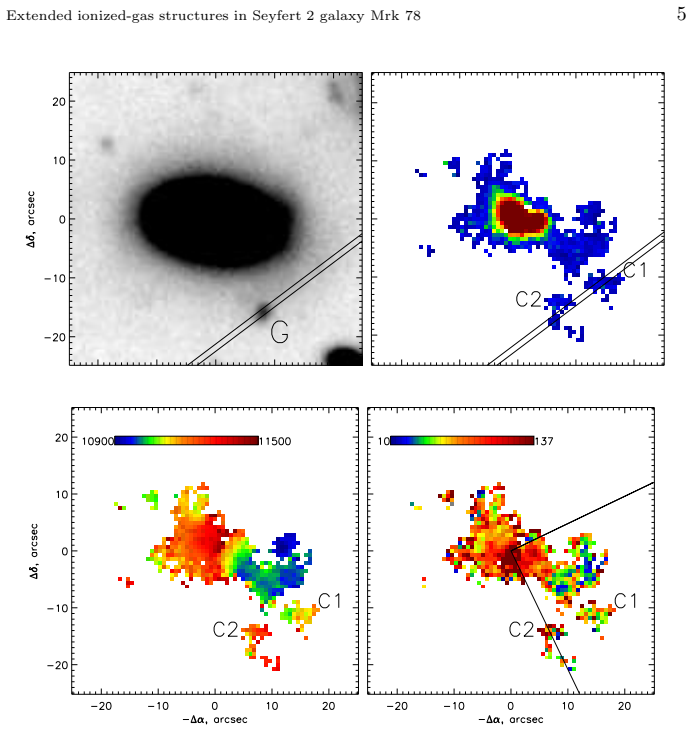
The central machinery is the BPT emission-line diagnostic diagram, introduced by Baldwin, Phillips, and Terlevich, using the ratios [N II]/Hα, [O III]/Hβ, and [S II]/Hα, with the AGN/HII boundary branches taken from Kewley et al. (2006). The integrated long-slit spectrum of C1 and C2 supplies the line ratios, while FPI [O III] maps provide the spatial distribution, velocities, and velocity dispersions of the clouds. The Fischer et al. (2011) ionization-cone model, based on inner-region HST kinematics, is overlaid on these maps to test whether the clouds fall within the projected cone.
What would settle it
Re-observe C1 and C2 at higher spectral resolution and signal-to-noise, resolve the [S II] λ6717,6731 doublet, and check for Hβ at 6718 Å from the z=0.382 background galaxy; if the corrected line ratios move off the Seyfert branch onto the HII-region branch, the central claim would be refuted.
Extended reading notes
Core claim
The paper's central discovery is that the ionized-gas clouds C1 and C2, at 12-16 kpc projected distance southwest of Mrk 78, are photoionized predominantly by Seyfert-type AGN radiation. Using emission-line ratio diagnostics from an integrated long-slit spectrum, the clouds fall on the AGN branch of the BPT diagrams, matching the ionization state of the inner extended emission-line region. Their positions are consistent with the projected borders of the ionization bicone derived from circumnuclear HST data, and their low velocity dispersion shows the gas is dynamically cold rather than part of an AGN-driven outflow. The nearby galaxy SDSS J074240.37+651021.4, once suspected to be a dwarf companion or tidal remnant, is instead a background galaxy at z=0.382, so the origin of the external clouds remains an open question.
Load-bearing premise
The conclusion assumes the faint spectra of the two clouds are measured cleanly enough to trust the line-ratio diagnostics, especially that redshifted Hβ from the distant galaxy behind the clouds does not contaminate the [S II] lines, as the authors themselves note, and that the small signal still gives reliable ratios.
Editorial extensions
If this is right
- If the clouds are truly AGN-photoionized, the AGN in Mrk 78 has illuminated gas at projected radii of 12-16 kpc, extending the known EELR to nearly twice the previously confirmed size.
- The dynamically cold kinematics imply the external clouds trace inflowing or tidally stripped gas rather than AGN-driven outflow, so such EELRs can serve as tracers of external gas accretion.
- The agreement with the ionization cone strengthens the unified-model picture in which the same collimated nuclear radiation shapes both the inner and outer ionized gas.
- With the nearby galaxy ruled out as a companion, searches for the origin of the external gas must focus on lower-mass or fully disrupted satellites, or on a previous interaction.
- The combined long-slit and 3D observations demonstrate that faint, kiloparsec-scale ionized clouds can be diagnosed even when they are located far outside the host galaxy's stellar disc.
Reading between the lines
- A decisive test would be to map C1 and C2 with an integral-field spectrograph at higher signal-to-noise: photoionization predicts radial gradients in line ratios and no broad component, while a shock model would produce enhanced [O I]/Hα.
- The authors note that Hβ from the z=0.382 background galaxy may blend with the [S II] λ6731 line in the C1 and C2 spectra; modeling or masking this contamination could shift the BPT positions, so a dedicated high-resolution re-observation would test the robustness of the AGN classification.
- The retrograde kinematics of the clouds could be compared with minor-merger simulations to see whether such off-plane, AGN-illuminated clouds naturally arise in the observed phase space.
- The same observational strategy could be applied to other Seyfert 2 galaxies with known ionization cones to search for similar distant, dynamically cold clouds, potentially revealing a population of accreted gas reservoirs around active galaxies.
Signed reviews
Editorial analysis
A structured set of objections, weighed in public.
Referee Report
Summary. This paper presents new 6-m SAO RAS spectroscopic observations of the Seyfert 2 galaxy Mrk 78, combining scanning Fabry-Perot interferometry, MPFS integral-field spectroscopy, and SCORPIO-2 long-slit spectroscopy. The authors report two ionized-gas clouds, C1 and C2, at projected distances of 12-16 kpc southwest of the nucleus, and argue from BPT line-ratio diagrams that these clouds are photoionized by the AGN rather than by star formation. They also show that the clouds fall within the projected ionization-cone borders derived by Fischer et al. (2011) and that the gas is dynamically cold, favoring an external accretion or tidal origin over an AGN outflow. Finally, they identify the nearby galaxy SDSS J074240.37+651021.4 as a distant background object at z=0.382 rather than a dwarf companion.
Significance. If the BPT classification is correct, the paper extends the known EELR of Mrk 78 to 12-16 kpc and provides an interesting consistency check of the biconical AGN illumination model. The use of multiple independent data sets (FPI, MPFS, long-slit) is a strength, and the ionization-cone overlay is properly used as a consistency check rather than a fitted parameter. The central claim, however, rests almost entirely on one integrated long-slit spectrum, so the reliability of the measured line ratios is decisive. The paper would be a useful short contribution if the contamination and uncertainty issues described below are addressed, but as presented the main conclusion is not fully secured.
major comments (3)
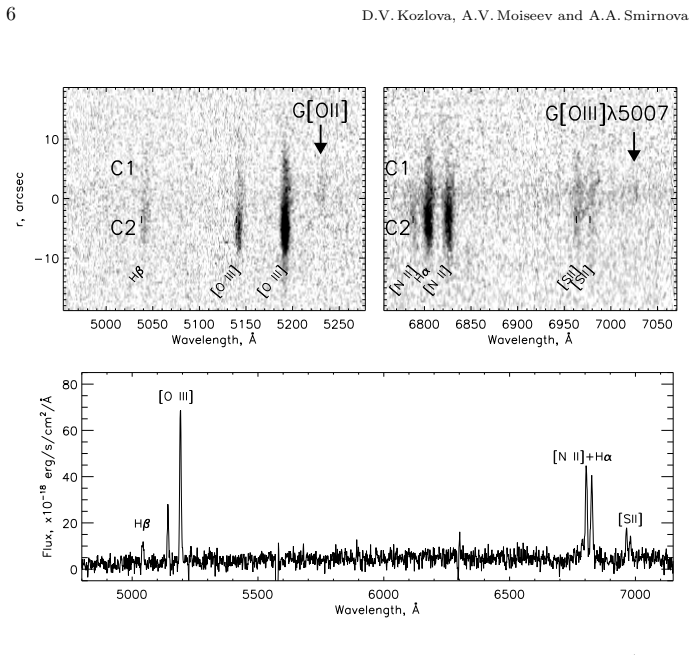
- [Section 4, Figs. 3 and 4] The paper's statement that the background Hβ 'should be blended with [S II] λ6731 in the C1 and C2 clouds' is not supported by the wavelength scales. At z=0.382, Hβ falls near 6718 Å, whereas Mrk 78's [S II] λ6717 and λ6731 lines appear near 6960-6980 Å in the observed frame given the velocities quoted in Section 3 (10900-11500 km/s). The features that actually threaten the BPT classification are the background [O III] λ5007 line at 7016 Å, within about 40 Å of Mrk 78's [S II] λ6731, and the background [O II] λ3727 line at 5230 Å, within about 40 Å of Mrk 78's [O III] λ5007 at ~5190 Å. Because the Seyfert classification of C1+C2 rests directly on [S II]/Hα and [O III]/Hβ, the authors must quantify or subtract the background galaxy's contribution in the C1/C2 extraction or demonstrate spatially that it is negligible. As written, the paper acknowledges a contamination channel but does not assess its effect on the diagnostic ratios.
- [Section 3, Fig. 4] No line-flux uncertainties or signal-to-noise ratios are reported for the integrated C1+C2 spectrum. The diamond marking the C1+C2 ratios in the BPT diagrams has no error bars, and the separation from the Kewley et al. (2006) boundary cannot be judged. Given that the clouds are faint extended structures at 12-16 kpc, the Hβ and [S II] fluxes may be uncertain by several tenths of a dex, which could change the classification. Please provide line fluxes, uncertainties, and detection significances for the relevant emission lines.
- [Section 4] The redshift of galaxy G is quoted as z=0.382, but the two identified lines at 5230 Å and 7016 Å imply z≈0.40 if they are [O II] λ3727 and [O III] λ5007, respectively. This discrepancy should be resolved because the predicted observed wavelength of the background Hβ line, and hence the contamination analysis, depends directly on the adopted redshift.
minor comments (5)
- [Section 2] The text uses 'Voight' fitting; this should be 'Voigt' fitting.
- [Abstract and Introduction] The word 'faction' appears where 'fraction' is intended; please correct this typo.
- [Section 3] The phrase 'intergral-field' should be 'integral-field'.
- [Section 3, Fig. 3] The extraction apertures used to produce the integrated C1+C2 spectrum and the spectrum of galaxy G are not described; please state the spatial windows along the slit.
- [Figure 4] The axis label 'HII Comp AGN' is unclear; please clarify what quantity is plotted along the horizontal axis of the lower panel.
Circularity Check
No significant circularity: the AGN-ionization claim rests on external BPT classification and prior HST cone geometry, not on fitted inputs or self-citation.
full rationale
The paper's central claim is that the external clouds C1 and C2 are photoionized by the AGN, supported by BPT diagnostic diagrams using emission-line ratios from an integrated long-slit spectrum. BPT classification boundaries (Baldwin et al. 1981; Kewley et al. 2006) are external, literature-based empirical benchmarks, not parameters fitted from the same data that the paper then 'predicts'. The overlay of the Fischer et al. (2011) ionization cone onto the FPI maps is a consistency check derived from independent HST observations of the circumnuclear region, not a fitted input used to define the clouds' ionization state. The authors cite their own previous work (Smirnova et al. 2018; Afanasiev & Moiseev 2005, 2011) only for data-reduction instruments and algorithms, which is not load-bearing for the physics conclusion. The possible blending of background-galaxy H-beta with [S II] lambda6717 is a data-quality and flux-uncertainty concern that could weaken the BPT classification, but it does not make the derivation circular. No self-definitional step, fitted-input-as-prediction, or self-citation chain is present; the analysis is self-contained against external diagnostics. Therefore the circularity score is 0.
Assumptions & free parameters
assumptions (4)
- domain assumption BPT diagnostic diagrams (Baldwin et al. 1981; Kewley et al. 2006) reliably separate HII-region photoionization from AGN photoionization based on [N II]/Hα, [O III]/Hβ, and [S II]/Hα ratios.
- domain assumption Distance to Mrk 78 is 165 Mpc (scale 0.80 kpc/arcsec), taken from NED.
- domain assumption The bicone opening angle and orientation from Fischer et al. (2011), derived from HST imaging of the inner r<4 arcsec region, can be projected to larger radii.
- domain assumption The two weak emission lines in the spectrum of galaxy 'G' are [O II] λ3727 and [O III] λ5007 at z=0.382, rather than other line identifications.
Cite this review
Pith. "Pith review of Extended ionized-gas structures in Seyfert 2 galaxy Mrk 78." pith.science (2026). https://pith.science/paper/IAQ4B5CD
@misc{pith2026190801376,
  author       = {Pith},
  title        = {Pith review of: Extended ionized-gas structures in Seyfert 2 galaxy Mrk 78},
  year         = {2026},
  howpublished = {\url{https://pith.science/paper/IAQ4B5CD}},
  note         = {Machine review of arXiv:1908.01376}
}
read the original abstract
Search for and study of extended emission-line regions (EELRs) related to AGN in early-type galaxies is interesting to probe the history of nuclear ionization activity and also to understand the process of external gas accretion. In this work, we present observations of the EELR in Mrk 78 obtained at the 6-m Russian telescope using the long-slit and 3D spectroscopy methods. We show that ionized-gas clouds at the 12-16 kpc projected distances from the nucleus are ionized by the AGN radiation. Also we have checked if the galaxy appearing in the optical images in the immediate neighbourhood of Mrk 78 near the external clouds is a dwarf companion or a part of a tidal structure. However, the spectrum of this galaxy, SDSS J074240.37+651021.4, obtained at the 6-m telescope corresponds to the distant background galaxy.
Figures

Figures from the paper (1 more)

Reference graph
Works this paper leans on
-
[1]
, " * write output.state after.block = add.period write newline
ENTRY address archiveprefix author booktitle chapter edition editor howpublished institution eprint journal key month note number organization pages publisher school series title type volume year doi label extra.label sort.label short.list INTEGERS output.state before.all mid.sentence after.sentence after.block FUNCTION init.state.consts #0 'before.all :=...
-
[2]
write newline
" write newline "" before.all 'output.state := FUNCTION n.dashify 't := "" t empty not t #1 #1 substring "-" = t #1 #2 substring "--" = not "--" * t #2 global.max substring 't := t #1 #1 substring "-" = "-" * t #2 global.max substring 't := while if t #1 #1 substring * t #2 global.max substring 't := if while FUNCTION word.in bbl.in " " * FUNCTION format....
-
[3]
Afanasiev , V. L., Dodonov , S. N., & Moiseev , A. V., Kinematics of Circumnuclear Regions of Galaxies: 2D Spectroscopy on SAO RAS 6m Telescope . 2001, in Stellar Dynamics: from Classic to Modern , ed. L. P. Ossipkov & I. I. Nikiforov , 103
work page 2001
-
[4]
Afanasiev, V. L. & Moiseev, A. V., The SCORPIO universal focal reducer of the 6-m telescope. 2005, Astronomy Letters , 31 , 194, DOI: 10.1134/1.1883351
-
[5]
Afanasiev , V. L. & Moiseev , A. V., Scorpio on the 6 m Telescope: Current State and Perspectives for Spectroscopy of Galactic and Extragalactic Objects . 2011, Baltic Astronomy , 20 , 363, DOI: 10.1515/astro-2017-0305
-
[6]
Afanasiev , V. L. & Silchenko , O. K., Gas Kinematics in the Central Regions of Seyfert Galaxies - Part Six - MARKARIAN:34 MARKARIAN:78 and MARKARIAN:270 . 1991, Astrofizicheskie Issledovaniia Izvestiya Spetsial'noj Astrofizicheskoj Observatorii , 33 , 144
work page 1991
-
[7]
S., Ahumada , R., Almeida , A., et al
Aguado , D. S., Ahumada , R., Almeida , A., et al. , The Fifteenth Data Release of the Sloan Digital Sky Surveys: First Release of MaNGA-derived Quantities, Data Visualization Tools, and Stellar Library . 2019, , 240 , 23, DOI: 10.3847/1538-4365/aaf651
-
[8]
Baldwin , J. A., Phillips , M. M., & Terlevich , R., Classification parameters for the emission-line spectra of extragalactic objects . 1981, , 93 , 5, DOI: 10.1086/130766
doi:10.1086/130766 1981
Show all 18 references
-
[9]
M., Spectroscopy and Imaging of Markarian 78 and I ZW 92
De Robertis , M. M., Spectroscopy and Imaging of Markarian 78 and I ZW 92 . 1987, , 316 , 597, DOI: 10.1086/165228
1987 doi
-
[10]
C., Crenshaw , D
Fischer , T. C., Crenshaw , D. M., Kraemer , S. B., et al. , Hubble Space Telescope Observations of the Double-peaked Emission Lines in the Seyfert Galaxy Markarian 78: Mass Outflows from a Single Active Galactic Nucleus . 2011, ApJ , 727 , 71, DOI: 10.1088/0004-637X/727/2/71
2011 doi
-
[11]
C., Bennert , V
Keel , W. C., Bennert , V. N., Pancoast , A., et al. , AGN photoionization of gas in companion galaxies as a probe of AGN radiation in time and direction . 2019, , 483 , 4847, DOI: 10.1093/mnras/sty3332
2019 doi
-
[12]
C., Chojnowski , S
Keel , W. C., Chojnowski , S. D., Bennert , V. N., et al. , The Galaxy Zoo survey for giant AGN-ionized clouds: past and present black hole accretion events . 2012, , 420 , 878, DOI: 10.1111/j.1365-2966.2011.20101.x
2012
-
[13]
C., Maksym , W
Keel , W. C., Maksym , W. P., Bennert , V. N., et al. , HST Imaging of Fading AGN Candidates. I. Host-galaxy Properties and Origin of the Extended Gas . 2015, AJ , 149 , 155, DOI: 10.1088/0004-6256/149/5/155
2015 doi
-
[14]
J., Groves , B., Kauffmann , G., & Heckman , T., The host galaxies and classification of active galactic nuclei
Kewley , L. J., Groves , B., Kauffmann , G., & Heckman , T., The host galaxies and classification of active galactic nuclei . 2006, MNRAS , 372 , 961, DOI: 10.1111/j.1365-2966.2006.10859.x
2006
-
[15]
J., et al
Pedlar , A., Meaburn , J., Axon , D. J., et al. , Collimated radio and optical emission associated with the Seyfert galaxy Markarian 78. 1989, , 238 , 863, DOI: 10.1093/mnras/238.3.863
1989 doi
-
[16]
A., Moiseev , A
Smirnova , A. A., Moiseev , A. V., & Dodonov , S. N., A close look at the well-known Seyfert galaxy: extended emission filaments in Mrk 6 . 2018, , 481 , 4542, DOI: 10.1093/mnras/sty2569
2018 doi
-
[17]
W., Pedlar , A., Axon , D
Unger , S. W., Pedlar , A., Axon , D. J., et al. , The extended narrow-line region in radio Seyferts : evidence for a collimated nuclear UV field ? 1987, , 228 , 671, DOI: 10.1093/mnras/228.3.671
1987 doi
-
[18]
& Wilson , A
Whittle , M. & Wilson , A. S., Jet-Gas Interactions in Markarian 78. I. Morphology and Kinematics . 2004, AJ , 127 , 606, DOI: 10.1086/380940
2004 doi
Reviewed August 14, 2026 · model on record in the stance chip above.
Discussion (0). Continue with ORCID to comment.