REVIEW 4 major objections 5 minor 37 references
From Embedding Geometry to Spectral Search: Energy Dispersion Networks For Vector Retrieval
T0 review · 4 major / 5 minor · reviewed 2026-07-14 · grok-4.5
Pith's one-line read Embedding spaces can be searched more coherently by mixing cosine geometry with a spectral energy signal taken from a feature-space graph Laplacian.
desk verdict Useful open-source spectral re-ranker with modest TREC gains; complementarity claim is still unisolated. read the letter →
The pith
A machine-rendered reading of the paper's core claim, the machinery that carries it, and where it could break.
The reading
What carries the argument
Spectral Indexing (SPIN): the lambda-aware distance dist_SPIN = alpha · sim_cos(q,i) + (1-alpha) · sim_lambda(q,i), where sim_lambda is the difference of bounded Rayleigh quotients on the feature-space Laplacian and alpha (called tau) is the geometric-versus-spectral mix weight.
What would settle it
Hold the embedding matrix fixed, replace the feature-space Laplacian with a randomized or degree-matched null graph that preserves degree sequence but destroys topology, and test whether the reported gains in tolerant recall, NDCG, and tail-shape metrics vanish; if they survive, the spectral claim fails.
Extended reading notes
Core claim
A graph Laplacian built on the feature-space of an embedding corpus yields a per-vector energy-dispersion signal (the Rayleigh quotient mapped into a bounded lambda-tau score) that encodes semantic correlations invisible to geometric search alone. Linearly combining that spectral signal with cosine similarity therefore produces ranked lists that are more head–tail coherent and more semantically aligned, while the mixing weight itself becomes a controllable handle for adaptive retrieval.
Load-bearing premise
The feature-space graph built after clustering the embeddings still carries semantic structure that is independent of, and complementary to, the geometry already present in those same embeddings.
Editorial extensions
If this is right
- Cosine retrieval can be augmented rather than replaced, keeping local geometry while adding corpus topology.
- RAG and agent pipelines can modulate tau mid-session—high for broad frame-setting, lower for fine semantic sieving.
- Long ranked lists need not collapse into noisy low-affinity tails; spectral re-ranking can keep relevance stable deeper into the list.
- Queries that land in high-energy or irregular regions of the feature manifold become visible as spectral outliers instead of silent geometric neighbors.
- The same feature-space Laplacian construction can serve as a multi-purpose structural index for data curation, drift detection, and generative retrieval identifiers.
Reading between the lines
- If the spectral score is truly a cheap one-dimensional complement, existing approximate-nearest-neighbor indexes could store a single lambda scalar per vector and reuse their infrastructure with almost no extra memory.
- The method is likely to degrade when the embeddings themselves lack a stable feature manifold (random projections, very sparse bags-of-words), giving a clean stress test that the paper leaves open.
- Tau-modulation naturally suggests a closed feedback loop that watches context entropy or generation quality and retunes the mix automatically, which the authors flag only as future work.
- Treating feature space as the semantic metadata layer of a corpus opens a route to spectral unique identifiers that could drive generative retrieval without a separate discrete codebook.
Signed reviews
Editorial analysis
A structured set of objections, weighed in public.
Referee Report
Summary. The paper argues that embedding spaces should be treated not only as geometric point clouds but as spectral energy networks induced by a feature-space graph Laplacian. It introduces Graph Wiring (GW) to build that Laplacian after centroid reduction of the embedding matrix, and Spectral Indexing (SPIN) which mixes cosine similarity with a bounded Rayleigh-quotient score λτ via a convex weight τ (tau). Empirically, hybrid and taumode settings improve head–tail score coherence on an industrial CVE corpus and yield modest gains in Relevance Recall@10 (~2.8%) and NDCG@10 (~2.6%) plus higher semantic uplift on the human-labeled TREC-COVID benchmark. The authors release the arrowspace library and frame the construction via an epiplexity / two-part MDL argument.
Significance. If the complementarity claim holds, SPIN would give RAG and domain retrieval a practical, tunable corpus-structure signal that pure cosine lacks, together with an open implementation. The feature-space (rather than item-space) Laplacian and the explicit tau-modulation idea are useful contributions. Strengths that should be credited include the open-source arrowspace library, dual evaluation on an industrial CVE workload and human-qrel TREC-COVID, extensive qualitative appendices, and an explicit limitations section that acknowledges circular Traditional Recall and the frozen encoder. The absolute gains remain small and the theoretical isolation of the spectral signal is incomplete, so significance is currently provisional rather than decisive.
major comments (4)
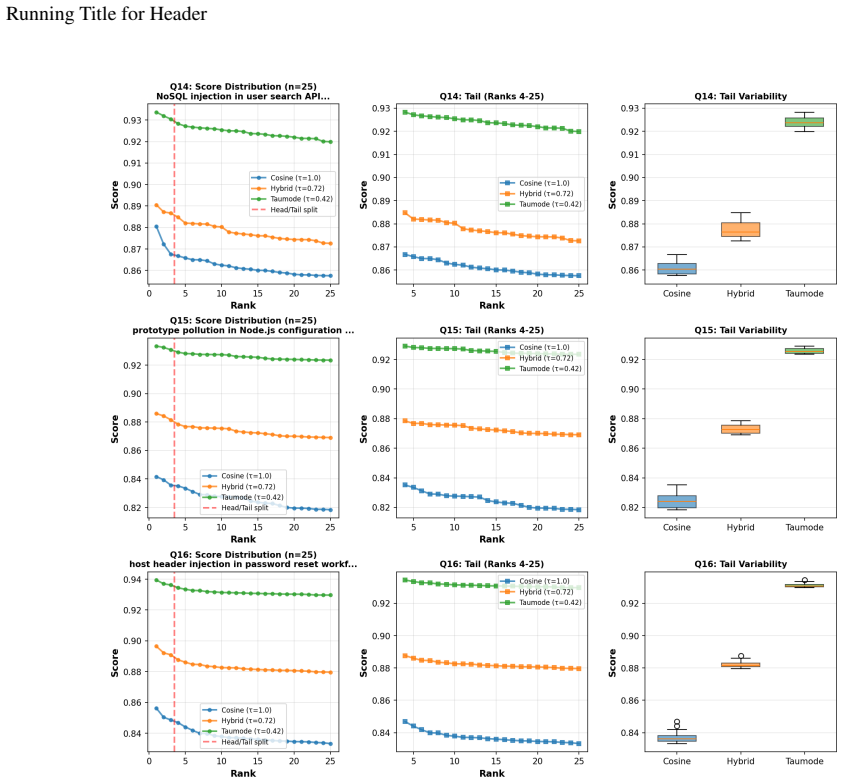
- The central complementarity claim (that LF + Rayleigh λτ encodes semantic structure independent of the geometry already present in the same embeddings) is never isolated experimentally. All reported gains use the convex mix dist_SPIN = α·sim_cos + (1-α)·sim_λ with τ and graph hyperparameters (ε, k, p, σ) chosen on the evaluation sets. Because LF is constructed from the identical embedding matrix that defines cosine, improvements could be re-weightings of existing geometry. A destroy-spectral control (e.g., degree-preserving edge randomization of LF, or permutation of the λτ marginals while holding embeddings fixed) is required to substantiate that the spectral term is complementary rather than redundant.
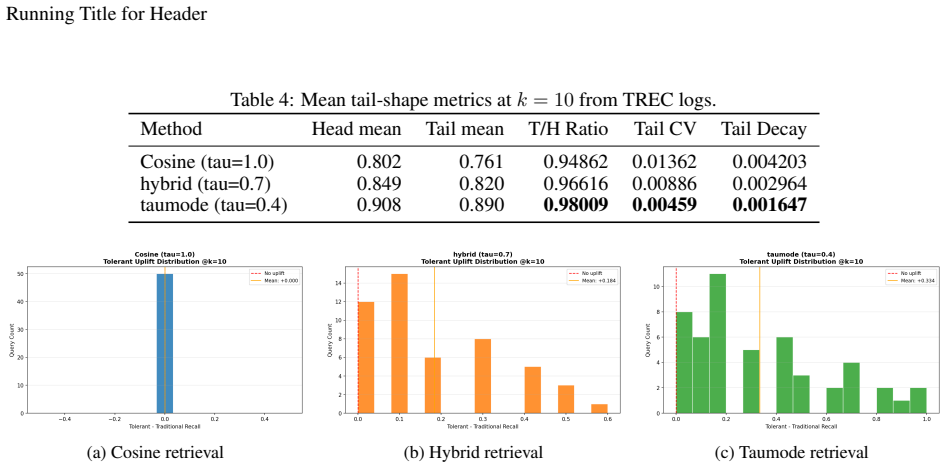
- §5.1 and Table 3: Traditional Recall@25 is defined against cosine-ranked neighbors, so cosine scores 1.0 by construction (explicitly admitted). Semantic Uplift and Tolerant Recall soften but do not remove reference dependence on the CVE experiment; many negative-uplift queries are then re-interpreted qualitatively rather than against independent labels. The load-bearing external evidence is therefore the TREC-COVID human-qrel results (§4.4, Fig. 3), whose absolute gains are modest (~0.508 o0.522 Relevance Recall@10; ~0.455 o0.467 NDCG@10) on only 50 queries with high per-query variance. Stronger claims of “fully-featured semantic search” and “SOTA performance” should be scaled to these effect sizes or supported by larger labeled sets and additional baselines (e.g., learned re-rankers, graph-based ANN).
- §1–§2 and the epiplexity citations: the theoretical foundation is asserted via two-part MDL / epiplexity pointing primarily to the authors’ contemporaneous notes ([9], [13], [28], [31]) rather than a self-contained derivation or an experimental MDL certificate computed on the same corpora used for retrieval. The paper states that the Laplacian “carries structural information beyond the original geometric scores” but does not report the compression test MDL_T(X) < N·F·b (or an equivalent diagnostic) for the CVE or TREC embeddings. Either supply that certificate on the evaluation data or demote epiplexity from “theoretical foundation” to related work / motivation.
- Free parameters and tuning: τ, graph hyperparameters (ε, k, p, σ), the ad-hoc embedding scale 1.12, centroid count C (JL), and the Rayleigh ε are all free. Pareto tuning is mentioned but not reported with held-out selection or sensitivity analysis that would show the gains survive reasonable hyperparameter perturbation. Without this, it is hard to separate method contribution from search over a flexible hybrid score.
minor comments (5)
- Notation for the mixing weight is overloaded: the text uses both α and τ (and “tau”) for the same convex coefficient; unify early (e.g., §3.1).
- Several appendix tables and figures (e.g., Fig. 5, Table 6) are referenced as available with code; for journal form they should be self-contained or moved to a permanent archive with stable DOIs.
- Typos and polish: “ODD item” (§3.1) should be OOD; “ttau” in §4.4; “SPectral INdexing” capitalization is inconsistent; arXiv id in header vs body.
- Related work on graph signal processing and spectral clustering is cited, but comparison to existing hybrid retrieval / learned sparse+dense or manifold-aware ANN methods is thin; a short positioning paragraph would help.
- CVE qualitative appendix is valuable but very long; consider moving the full 11-query walkthrough to supplementary material and keeping a compact summary of verdict categories in the main text.
Circularity Check
Admitted cosine-as-ground-truth metrics and self-cited epiplexity foundation create partial circularity; TREC human labels keep the central empirical claim independent.
-
self definitional
[§5.1 Limitations, Circular cosine baseline]
"The Traditional Recall metrics use a ground truth constructed from cosine-ranked neighbors; cosine therefore attains perfect recall by construction. This renders Traditional Recall an unreliable proxy for semantic quality and motivates the use of Tolerant Recall and Semantic Uplift as primary evaluation criteria"
Traditional Recall@k is defined against cosine-ranked neighbors, so cosine scores 1.0 by definition. Any comparison that treats this as evidence of cosine quality (or of SPIN degradation relative to it) is circular. The paper admits the issue but still reports Traditional Recall tables that encode this tautology.
-
self definitional
[§4.3 Semantic uplift; Fig. 2 caption; Appendix metrics]
"Semantic uplift is defined as the per-query difference Ruplift = Rtol − Rtrad. ... Cosine (left) provides no uplift, taumode (right) provides relevant uplift for most of queries"
Rtrad is measured against cosine-defined ground truth, so for cosine Rtrad = Rtol = 1 and Ruplift = 0 always. Presenting mean uplift 0.00 under cosine as an empirical result (Fig. 2a, Fig. 4a) is definitional, not a measured failure of geometric search. Positive SPIN uplift partly rewards divergence from that same cosine reference within a tolerance band.
2 more flagged steps
-
self citation load bearing
[Introduction, theoretical foundation paragraph; also claims list]
"The theoretical foundation of GW is supported through epiplexity, an information-theoretic framework showing that the graph Laplacian constructed by GW carries structural information. Following [13], where we use a two-part Minimum Description Length (MDL) criterion, together with independent structural diagnostics, to prove that the constructed spectral representation encodes information beyond the original geometric scores (details in [9])."
The load-bearing claim that LF encodes information beyond geometric scores is not proved in this paper; it is deferred to Moriondo's own contemporaneous note [9]. Finzi et al. [13] only define epiplexity generally. The paper's assertion that SPIN provides 'semantic lift ... by leveraging the structural information made evident by epiplexity' therefore rests on an unverified same-author citation rather than an independent derivation or external check.
-
self citation load bearing
[§1 closing; §5 Discussion opening]
"Finally, more generally, the epiplexity-based analysis [14] suggests that GW can expose additional structural information beyond purely geometric retrieval signals... The core idea of GW is that an item vector xi ∈ R^{N×F}, when blended with the graph Laplacian in the feature-space LF ∈ R^{F×F}, carries measurably more discriminative information than its geometric measurement in the item-space alone, as demonstrated in the terms of epiplexity framework and structural information in [28, 9]."
[14] is the authors' own PyArrowSpace repository and [28]/[9] are same-author GitHub/preprint materials. The 'measurable' surplus of structural information over pure geometry is asserted via this self-citation chain rather than by an ablation or independent certificate inside the present paper.
full rationale
The method definition (feature-space Laplacian, Rayleigh energy, convex mix with tau) is not circular by construction: it is a standard spectral construction applied in feature space and evaluated empirically. Circularity appears in two supporting pillars. First, Traditional Recall and the zero-uplift baseline for cosine are definitional once cosine neighbors are taken as ground truth; the paper admits this for Traditional Recall but still presents cosine semantic uplift as 0.00 as if it were an empirical finding. Second, the claim that the Laplacian encodes structural information beyond geometry is justified by epiplexity with the load-bearing proof deferred to the first author's contemporaneous note [9], not derived or independently verified in this manuscript (Finzi et al. [13] supplies only the general framework). These do not force the TREC NDCG/Relevance-Recall gains, which rest on external human labels, so the central retrieval claim retains independent content. Score 5 reflects partial circularity in theory and some metrics without collapse of the main empirical result.
Assumptions & free parameters
free parameters (5)
- tau (spectral mixing weight) =
0.42 (CVE), ~0.7 (TREC peak)
- graph hyperparameters (eps, k, p, sigma)
- embedding scale factor 1.12 =
1.12
- centroid count C (via JL lemma) =
C ~ O(sqrt(N))
- epsilon in lambda_tau = R/(R+eps)
assumptions (4)
- domain assumption The combinatorial/normalized Laplacian of a graph on feature dimensions encodes corpus-level semantic connectivity not already present in pairwise cosine geometry.
- standard math Rayleigh quotient R(x)=x^T L_F x / x^T x is a meaningful normalized Dirichlet energy that ranks items from 'smooth/typical' to 'rough/anomalous' on the feature manifold.
- ad hoc to paper Two-part MDL / epiplexity certifies that the constructed Laplacian carries non-trivial structural information beyond geometric scores.
- standard math Johnson-Lindenstrauss supplies a sufficient number of centroids C for the reduced feature matrix.
invented entities (4)
-
Graph Wiring (GW)
-
Spectral Indexing / SPIN
-
taumode / lambda_tau energy-dispersion score
-
epiplexity (as used here)
Cite this review
Pith. "Pith review of From Embedding Geometry to Spectral Search: Energy Dispersion Networks For Vector Retrieval." pith.science (2026). https://pith.science/paper/IAQRVIOD
@misc{pith2026260621535,
  author       = {Pith},
  title        = {Pith review of: From Embedding Geometry to Spectral Search: Energy Dispersion Networks For Vector Retrieval},
  year         = {2026},
  howpublished = {\url{https://pith.science/paper/IAQRVIOD}},
  note         = {Machine review of arXiv:2606.21535}
}
read the original abstract
High-dimensional vector spaces, particularly embedding spaces with dense semantic structure, are often interpreted primarily leveraging solely geometric relationships. In this work, we show that they can also be viewed as spectral energy networks induced by the topology of their underlying feature-space manifold with relevant improvements for downstream tasks. Building on this perspective, we introduce Graph Wiring, a general framework for exploiting feature-space spectral structure, together with Spectral Indexing, its task-specific instantiation for vector search. By coupling geometric similarity with spectral information, the proposed method improves Head-Tail coherence and semantic alignment relative to purely geometric retrieval methods. It further supports adaptive search behavior through tau-modulation, providing the flexibility increasingly required by modern Retrieval-Augmented Generation (RAG) pipelines. We present the complete algorithmic pipeline, establish its theoretical foundation through epiplexity, and evaluate the approach across benchmark and industrial settings using the open-source arrowspace library.
Figures


Figures from the paper (2 more)

Reference graph
Works this paper leans on
-
[9]
L. Moriondo. Epiplexity and graph wiring: An empirical study. https://doi.org/10.22541/au.177430060.02394540/ v1, 2026
- [13]
-
[28]
Graph wiring epiplexity
tuned-org-uk. Graph wiring epiplexity. https://github.com/tuned-org-uk/graph-wiring-epiplexity, 2026. GitHub repository
2026
-
[31]
L. Moriondo. Graph wiring: Eigenstructures for vector datasets and llm operations. https://www.techrxiv.org/doi/ full/10.36227/techrxiv.177220780.02840438/v1, 2026
-
[1]
Graph-based vector search: An experimental evaluation of the state-of-the-art.Proceedings of the ACM on Management of Data, 3(1):1–31, 2025
Ilias Azizi, Karima Echihabi, and Themis Palpanas. Graph-based vector search: An experimental evaluation of the state-of-the-art.Proceedings of the ACM on Management of Data, 3(1):1–31, 2025
2025
-
[2]
Results of the big ann: Neurips’23 competition.arXiv preprint arXiv:2409.17424, 2024
Harsha Vardhan Simhadri, Martin Aumüller, Amir Ingber, Matthijs Douze, George Williams, Magdalen Dobson Manohar, Dmitry Baranchuk, Edo Liberty, Frank Liu, Ben Landrum, et al. Results of the big ann: Neurips’23 competition.arXiv preprint arXiv:2409.17424, 2024
arXiv 2024
-
[3]
Steck, C
H. Steck, C. Ekanadham, and N. Kallus. Is cosine-similarity of embeddings really about similarity? InWWW ’24 Companion, 2024
2024
-
[4]
Kuffo, I
L. Kuffo, I. Tsakalidou, R. De Viti, A. Angel, J. Isa, and R. Lenhardt. Semantic recall for vector search. InSIGIR, 2026
2026
Show all 37 references
-
[5]
Bruckhaus
T. Bruckhaus. Rag does not work for enterprises.arXiv preprint arXiv:2406.04369, 2024
2024 arXiv
-
[6]
Rag problems persist
IBM. Rag problems persist. here are five ways to fix them. https://www.ibm.com/think/insights/rag-problems, 2025
2025
-
[7]
The role of local dimensionality measures in benchmarking nearest neighbor search.Information Systems, 101:101807, 2021
Martin Aumüller and Matteo Ceccarello. The role of local dimensionality measures in benchmarking nearest neighbor search.Information Systems, 101:101807, 2021
2021
-
[8]
Moriondo
L. Moriondo. Arrowspace: introducing spectral indexing for vector search.Journal of Open Source Software, 10(113):9002, 2025
2025
-
[10]
D. I. Shuman, S. K. Narang, P. Frossard, A. Ortega, and P. Vandergheynst. The emerging field of signal processing on graphs.IEEE Signal Processing Magazine, 30(3):83–98, 2013
2013
-
[11]
X. Dong, D. Thanou, P. Frossard, and P. Vandergheynst. Learning laplacian matrix in smooth graph signal representations.IEEE Transactions on Signal Processing, 64(23):6160–6173, 2016
2016
-
[12]
Sandryhaila and J
A. Sandryhaila and J. M. F. Moura. Discrete signal processing on graphs.IEEE Transactions on Signal Processing, 61(7):1644–1656, 2013
2013
-
[14]
PyArrowSpace
tuned-org-uk. PyArrowSpace. https://github.com/tuned-org-uk/pyarrowspace, 2026. GitHub repository
2026
-
[15]
P. M. B. Vitanyi and M. Li. Minimum description length induction, bayesianism, and kolmogorov complexity. IEEE Transactions on Information Theory, 46(2):446–464, 2000
2000
-
[16]
P. D. Grunwald.The Minimum Description Length Principle. MIT Press, 2007. 9 Running Title for Header
2007
-
[17]
D. A. Spielman. Spectral graph theory lecture notes. https://www.cs.yale.edu/..., 2007
2007
-
[18]
von Luxburg
U. von Luxburg. A tutorial on spectral clustering.Statistics and Computing, 17(4):395–416, 2007
2007
-
[19]
Johnson and Joram Lindenstrauss
William B. Johnson and Joram Lindenstrauss. Extensions of lipschitz mappings into a hilbert space.Contemporary Mathematics, 26:189–206, 1984
1984
-
[20]
Macmillan and Co., 1877
John William Strutt.The Theory of Sound, volume 1. Macmillan and Co., 1877. Reprinted 1945, Dover Publications
1945
-
[21]
Evans.Partial Differential Equations, volume 19 ofGraduate Studies in Mathematics
Lawrence C. Evans.Partial Differential Equations, volume 19 ofGraduate Studies in Mathematics. American Mathematical Society, Providence, RI, 1998
1998
-
[22]
F. Chung. The heat kernel as the pagerank of a graph.PNAS, 104(50):19735–19740, 2007
2007
-
[23]
PhD thesis, University of York, 2007
Xiao Bai.Heat Kernel Analysis on Graphs. PhD thesis, University of York, 2007
2007
-
[24]
Cve™: Common vulnerabilities and exposures dataset
MITRE Corporation. Cve™: Common vulnerabilities and exposures dataset. https://www.cve.org/Legal/ TermsOfUse, 2026
2026
-
[25]
V oorhees, William Hersh, Max Crammer, and Nancy Ide
Ellen M. V oorhees, William Hersh, Max Crammer, and Nancy Ide. Trec-covid: Constructing a pandemic information retrieval test collection.SIGIR Forum, 54(1):1–12, 2021
2021
-
[26]
Magesh, F
V . Magesh, F. Surani, M. Dahl, A. Sklar, R. Tseng, R. Guha, D. E. Ho, and C. D. Manning. Hallucination-free? assessing the reliability of leading ai legal research tools.Journal of Empirical Legal Studies, 22(2):216–242, 2025
2025
-
[27]
Sentence-bert: Sentence embeddings using siamese bert-networks
Nils Reimers and Iryna Gurevych. Sentence-bert: Sentence embeddings using siamese bert-networks. In Proceedings of the 2019 Conference on Empirical Methods in Natural Language Processing, pages 3982–3992. Association for Computational Linguistics, 2019
2019
-
[29]
N. D. Matsakis and J. Stone. Rayon: A data-parallelism library for rust. https://docs.rs/rayon/latest/rayon/, 2025
2025
-
[30]
Reimers and I
N. Reimers and I. Gurevych. Sentence-bert: Sentence embeddings using siamese bert-networks. InEMNLP, 2019
2019
-
[32]
Spectral-aware unique identifiers for generative retrieval and vector search.Authorea Preprints, 2026
Lorenzo Moriondo. Spectral-aware unique identifiers for generative retrieval and vector search.Authorea Preprints, 2026. 10 Running Title for Header Appendix: Retrieval Metrics We evaluate retrieval quality using both classical relevance metrics and graph-signal-aware measures...
2026
-
[33]
directory traversal
Large tail-shape improvement under spectral reranking: a substantially higher tail/head ratio or lower tail CV for Taumode than Cosine. Because test_17_CVE_neurips.py calls random.shuffle(queries) before evaluation, theeffectivequery order is the one preserved in the CSV outpu...
2006
-
[34]
the τ= 0.72 crossover already lies inside the spectral regime for this corpus
Hybrid is not always between Cosine and Taumode.Q2, Q9, Q47, and Q50 show Hybrid and Taumode agreeing with each other whilebothdiffer sharply from Cosine — i.e. the τ= 0.72 crossover already lies inside the spectral regime for this corpus. For Q27 the opposite holds: Hybrid tr...
-
[35]
The clearest semantic win in the selected set is Q47(arbitrary file upload → RCE), where Hybrid produces a semantic-recall jump from0.0to1.0while keeping all of cosine’s score-band leaders
-
[36]
(no title)
Many “(no title)” CVEs in this corpusmake individual verdicts uncertain: across the 11 selected queries, only a minority of the spectral top-5 entries are titled. A reproducibility recommendation for the paper is 21 Running Title for Header to extend extract_text to surface CV...
-
[37]
race condition in temporary file creation
The pattern is consistent with the paper’s headline claim —spectral reranking changes theshapeof the top- 25 score distribution and moves between embedding neighborhoods—while urging careful interpretation of NDCG and Kendall τ on small intersections, and acknowledging that fo...
2008
Reviewed July 14, 2026 · model on record in the stance chip above.
Discussion (0). Continue with ORCID to comment.