REVIEW 3 major objections 5 minor 136 references
Detecting dark matter sub-halos in the Galactic plane with the Cherenkov Telescope Array Observatory
T0 review · 3 major / 5 minor · reviewed 2026-08-10 · deepseek-v4-flash
Pith's one-line read The CTAO Galactic Plane Survey could detect the brightest Milky Way dark-matter sub-halo at 5σ if TeV-scale WIMPs annihilate to b-bbar with a cross section of about 3×10^-25 cm^3/s—an order of magnitude above the thermal value.
desk verdict First GPS forecast for extended DM subhalos, but the headline sensitivity is an outlier and Table I has an internal NFW inconsistency. read the letter →
The pith
A machine-rendered reading of the paper's core claim, the machinery that carries it, and where it could break.
The reading
What carries the argument
Three pieces carry the argument. The first is the SL17 semi-analytic model of the Milky Way sub-halo population, in two variants: 'fragile,' where a sub-halo is destroyed once its tidal radius drops below its scale radius, and 'resilient,' where it survives until the tidal radius is below $0.01$ times the scale radius; from each variant $10^{10}$ population realizations are drawn, and the J-factor—the line-of-sight integral of the squared dark-matter density—of every sub-halo is computed numerically from an NFW profile. The second is a template-based binned Poisson likelihood analysis using simulated CTAO observations built from prod5-v0.16 instrument response functions, with the interstellar emission model 'Base-Max' as the astrophysical background; detection is defined by a test statistic $\mathrm{TS}=25$ ($5\sigma$). The third is a position-dependent rescaling law for extended-source sensitivity, $F(\theta_{68})=A(x)\sqrt{\alpha\theta_{68}^2+\sigma_{\mathrm{PSF}}^2}$ with $\alpha=0.06$, which converts the survey's exposure map into an integrated-flux threshold for any sub-halo of angular extension $\theta_{68}$, the angular radius containing 68% of the sub-halo's total J-factor.
What would settle it
A concrete test: after the planned early-phase and long-term GPS exposures are accumulated, if no extended, multiwavelength-quiet source with the NFW-like surface-brightness profile modeled here is found and the derived upper limit on $\langle\sigma v\rangle$ for TeV-mass annihilation into $b\bar{b}$ remains above $\sim 3\times10^{-25}$ cm$^3$/s, the optimistic single-sub-halo claim fails. The population-level prediction would also be tested by searching for the predicted unresolved diffuse excess above $|b|>1^\circ$ at $\langle\sigma v\rangle\approx 3\times10^{-23}$ cm$^3$/s in the resilient scenario; its absence would disfavor the least-disrupted population model.
Extended reading notes
Core claim
This paper establishes that the Cherenkov Telescope Array Observatory's Galactic Plane Survey can act as a discovery channel for dark-matter sub-halos, treating them as extended gamma-ray sources rather than point sources. Using templates for NFW sub-halos drawn from the SL17 semi-analytic population model in its fragile and resilient variants, the authors find that the single brightest sub-halo across many realizations would be detectable at $5\sigma$ for an annihilation cross section $\langle\sigma v\rangle \approx 3\times10^{-25}$ cm$^3$/s when a TeV-scale WIMP annihilates into $b\bar{b}$, about an order of magnitude above the canonical thermal value. At the population level, detecting at least one sub-halo requires $\langle\sigma v\rangle$ in the range $\sim 10^{-23}$–$10^{-22}$ cm$^3$/s depending on the survival scenario. The paper also finds that the optimal sky region lies a few degrees above or below the Galactic plane, that the NFW surface-brightness profile allows morphological discrimination from point-like sources and Gaussian astrophysical sources, and that unresolved sub-halos may contribute a diffuse component at least comparable to the unresolved pulsar-wind-nebula population away from the plane.
Load-bearing premise
Every detection threshold inherits the SL17 semi-analytic model's predictions for how many sub-halos exist, where they sit, and how concentrated their inner density profiles are; if the real Milky Way sub-halo population is more disrupted, less concentrated, or distributed differently, the quoted cross sections shift, potentially by orders of magnitude.
Editorial extensions
If this is right
- A $5\sigma$ detection of the brightest individual sub-halo is within reach at $\langle\sigma v\rangle \sim 3\times10^{-25}$ cm$^3$/s for TeV-scale DM annihilating to $b\bar{b}$ without added systematics; 3% systematics worsen this by roughly a factor of two.
- For the full SL17 population, at least one sub-halo in the GPS band becomes detectable at $\langle\sigma v\rangle \sim 3.3\times10^{-23}$ cm$^3$/s (resilient) and $\sim 9.7\times10^{-23}$ cm$^3$/s (fragile) for a 1 TeV WIMP.
- The regions a few degrees above or below the plane are the most promising, because source confusion is lower there and the unresolved sub-halo population may dominate the diffuse emission at $|b|>1^\circ$ in the resilient scenario.
- Once detected, a sub-halo can be distinguished from a point-like or Gaussian source at only about 1.5 times the cross section needed for detection, but resolving its inner NFW-like profile into annuli requires about an order of magnitude higher cross section.
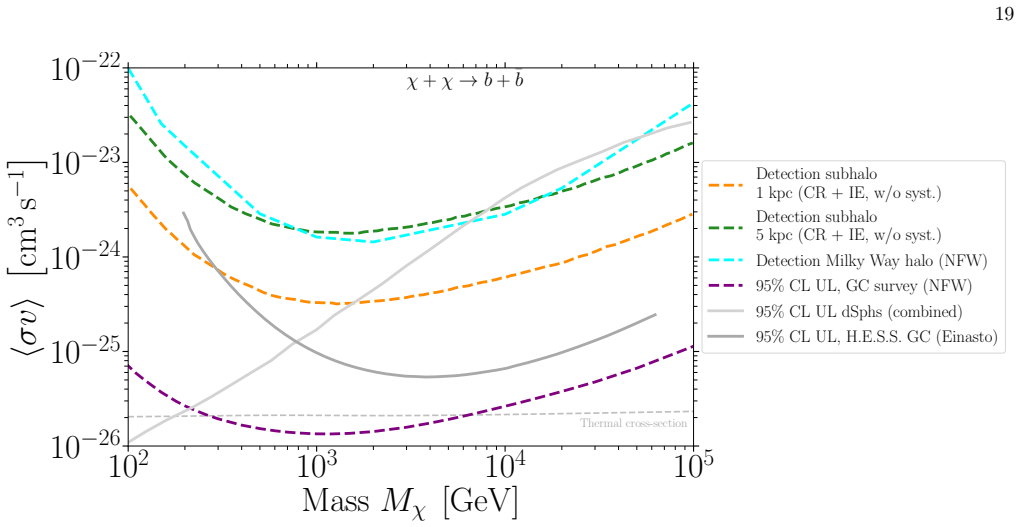
- If no sub-halo is found, the GPS can still constrain $\langle\sigma v\rangle$ at a level comparable to combined dwarf-spheroidal limits, providing a cross-check independent of Galactic-center profile uncertainties.
Reading between the lines
- The quoted single-sub-halo cross section is a statement about the luckiest realization; the model's realization scatter spans orders of magnitude, so a dedicated extreme-value treatment of the brightest-clump distribution would sharpen the discovery claim.
- Because the SL17 model assumes cuspy NFW inner profiles, applying the same analysis to cored sub-halos or to alternative substructure models such as prompt cusps would directly test how sensitive the GPS reach is to the small-scale dark-matter density structure.
- A null GPS search at the quoted population-level cross sections would be more than a constraint on particle physics: it would constrain the survival and concentration of Milky Way sub-halos, potentially favoring the fragile over the resilient scenario.
- The morphological discrimination machinery could be turned around: a population of extended, TeV-bright sources with no counterparts, concentrated at $|b|\approx 2$–$5^\circ$, would be a distinctive signature of cold-dark-matter substructure that would be hard to mimic with astrophysical source classes.
Editorial analysis
A structured set of objections, weighed in public.
Referee Report
Summary. This paper forecasts the sensitivity of CTAO's Galactic Plane Survey to gamma-ray emission from dark-matter subhalos. It adopts the SL17 semi-analytic model for the Milky Way subhalo population in fragile and resilient tidal variants, generates 10^10 Monte Carlo realizations, and selects the brightest subhalo overall for single-object studies and the median brightest subhalo for population studies. Using gammapy, CTAO prod5-v0.16 IRFs, and a binned Poisson likelihood ratio, it derives 5-sigma detection reaches for b-bbar annihilation for DM masses from 0.1 to 100 TeV, including the effects of interstellar emission and 1%, 3%, and 10% systematics. The headline single-object reach is <sigma v> of order 3 x 10^-25 cm^3/s at TeV masses, while the population-level reach is 10^-23 to 10^-22 cm^3/s. It also assesses morphological discrimination from point-like and Gaussian sources, angular profile reconstruction via annuli, cumulative diffuse emission from unresolved subhalos, and compares with main-halo and dwarf-spheroidal limits.
Significance. If the single-object reach were robust, the GPS would probe TeV WIMP annihilation cross sections an order of magnitude above the thermal value through Galactic substructure, complementing dwarf and Galactic-center searches. The paper has real strengths: it uses publicly available tools (CLUMPY, gammapy, CTAO prod5 IRFs), treats two tidal scenarios explicitly, tests three levels of instrumental systematics, and transparently labels the single-object case as the most optimistic. The population-level result (10^-23 to 10^-22 cm^3/s) is consistent with the median brightest subhalo J-factors and is the more defensible forecast. The quantitative single-object claim, however, is not yet reliable as printed because the benchmark template's tabulated NFW parameters are internally inconsistent and because the chosen object is an extreme order statistic over 10^10 realizations whose occurrence probability is not quantified.
major comments (3)
- [Sec. II B 2 / Table I] The benchmark 'overall brightest' subhalo parameters in the first row of Table I are internally inconsistent for a truncated NFW profile. With rho_s = 3.4 x 10^6 M_sun/kpc^3, r_s = 2.36 kpc, and r_Delta = 0.162 kpc, the enclosed mass is M(<r_Delta) = 4*pi*rho_s*r_s^3*[ln(1+x)-x/(1+x)] ~ 1.2 x 10^6 M_sun for x = r_Delta/r_s = 0.0686, a factor of four below the quoted M_Delta = 4.8 x 10^6 M_sun. The J-factor integrated to r_Delta is correspondingly about 6.4 x 10^20 GeV^2/cm^5, a factor of about 15 below the quoted J_tot = 9.56 x 10^21 GeV^2/cm^5. The quoted J_tot matches a truncated NFW profile with rho_s ~ 1.4 x 10^7 M_sun/kpc^3, not the listed value. Because this template drives the single-object sensitivity curves in Figs. 3-6 and the abstract's 3 x 10^-25 cm^3/s, the authors must correct the parameter set (or the J-factor) and re-derive the headline reach; as printed, the template does not correspond to a self-consistent SL17/CLUMPY output.
- [Abstract / Sec. II B 2 / Sec. V A] The 5-sigma sensitivity of <sigma v> ~ 3 x 10^-25 cm^3/s is obtained from the single realization with the largest J-factor among 10^10 SL17 Monte Carlo skies. Table I shows that the median brightest subhalos in the same model have J_tot = 8.94 x 10^19 (resilient) and 1.59 x 10^19 (fragile) GeV^2/cm^5, i.e., factors of 107 and 600 below the benchmark. Because the required cross section scales as 1/J (Eq. 1), the corresponding thresholds are about 3 x 10^-23 and 5 x 10^-23 cm^3/s, consistent with the population numbers in Sec. V A. The paper does not report the distribution of the brightest-subhalo J-factor over realizations, so the probability that the actual Milky Way contains such an extreme object is not quantified. The abstract and conclusions should either present this probability or explicitly frame the 3 x 10^-25 value as a 'best of 10^10 skies' upper envelope rather than as the GPS reach for a typical Milky Way; as written, the headline is easily misread as a robust single-object forecast.
- [Sec. III F / Eq. (8)] The population-level detection thresholds in Sec. V A are computed by applying the re-scaling formula F(theta_68) = A sqrt(alpha theta_68^2 + sigma_PSF^2) to every subhalo in the realizations. The parameter alpha is fitted to three benchmark templates (point-like and the two median subhalos), with a reported minimum error of order 15%. Because this formula is used to classify the full population, including objects whose theta_68 lies outside the calibrated range and whose NFW concentrations may differ substantially from the benchmarks, the authors should either validate Eq. (8) against direct likelihood simulations for a wider grid of theta_68 and profile shapes, or explicitly state that the 15% figure is only demonstrated at the three calibration points. Without this, the population numbers inherit an unquantified systematic from this empirical scaling.
minor comments (5)
- [Abstract / Sec. IV A 1] The abstract's 3 x 10^-25 cm^3/s value should be accompanied by the caveat that it is the no-systematics sensitivity; Sec. IV A 1 and Fig. 4 show that 3% systematics worsen the reach by roughly a factor of two and 10% systematics by an order of magnitude.
- [Sec. III F / Eq. (8)] The sentence "the minimal error we can achieve with this method is of the order of 15%, corresponding to a position-independent value of alpha = 0.06" is ambiguous: it should state whether alpha is fitted per position and then averaged, or fitted globally, and how the 15% error is defined and distributed over theta_68.
- [Fig. 1 / Sec. II B 2] Figure 1 shows the distribution of theta_68 for the brightest subhalo per realization, but the detection thresholds are driven by J-factor; showing the corresponding distribution of the maximum J-factor (and its percentiles) would directly address the probability content of the headline claim.
- [Sec. VI / Fig. 10] The main-halo sensitivity curve is derived from a simplified setup with only CR and interstellar emission backgrounds and with the region |l| < 12 deg excluded; the text notes this, but the figure caption should carry the same caveat so the comparison with subhalo curves is not overinterpreted.
- [Throughout] There are several typographical errors, including 'W design' in Sec. III F (should be 'We design'), 'SL-17' versus 'SL17' inconsistencies, and 'F ermi' in reference [77]; these should be corrected in a final proofread.
Circularity Check
No significant circularity — the paper is a matched-model sensitivity forecast built on external SL17 population inputs and CTAO IRFs, with no parameter fitted to real data and no load-bearing self-citation.
full rationale
The paper derives CTAO GPS detection sensitivities by forward-simulating mock observations with public CTAO IRFs, an external interstellar-emission model (Luque et al.), and the SL17 sub-halo population model, which is cited from independent work [105,110] not authored by the present authors. The headline cross-section value of ~3e-25 cm^3/s is obtained by converting a simulated flux threshold into a cross section through Eq. 1, using the J-factor of the most optimistic sub-halo explicitly labeled as the 'most optimistic scenario' and the study as a 'proof of principle' (Sec. I C, Sec. II B 2). This is a self-consistent sensitivity projection, not a measurement or an independent prediction extracted from a fitted quantity. The population-level thresholds (~1e-23 to 1e-22 cm^3/s) likewise follow from comparing same-model simulated sub-halo fluxes against sensitivity maps interpolated with Eq. 8, whose parameter alpha is fitted to simulated sensitivities; no real data are fitted and no physical constant is adjusted to data. The methodological citation to the authors' earlier pulsar-halo paper [93] concerns the template-fitting framework, but the present paper re-describes that framework fully enough (Poisson likelihood, TS definition, annulus reconstruction) that the self-citation is not load-bearing. The manuscript repeatedly flags limitations: tidal resilience is 'still under debate', no benchmark systematic model exists for CTAO, and the main-halo analysis is explicitly 'simplified'. These statements reinforce that the claims are conditional forecasts rather than forced derivations. No circular step can be exhibited from the paper's own equations or citations.
Assumptions & free parameters
free parameters (1)
- alpha =
0.06
assumptions (5)
- domain assumption All subhalos and the main halo follow an NFW density profile (Eq. 3).
- domain assumption The SL17 semi-analytic model and its tidal disruption scenarios correctly describe the MW subhalo population.
- domain assumption The gamma-ray spectrum from bbbar annihilation is taken from PPPC4DMID.
- standard math The Poisson likelihood test statistic follows a chi-square distribution with one degree of freedom (Wilks' theorem).
- ad hoc to paper Eq. (8), F(theta68) = A sqrt(alpha theta68^2 + sigma_PSF^2), with fitted alpha, interpolates the flux sensitivity for subhalos of any angular size.
Cite this review
Pith. "Pith review of Detecting dark matter sub-halos in the Galactic plane with the Cherenkov Telescope Array Observatory." pith.science (2026). https://pith.science/paper/IARWLGV5
@misc{pith2026250109789,
  author       = {Pith},
  title        = {Pith review of: Detecting dark matter sub-halos in the Galactic plane with the Cherenkov Telescope Array Observatory},
  year         = {2026},
  howpublished = {\url{https://pith.science/paper/IARWLGV5}},
  note         = {Machine review of arXiv:2501.09789}
}
abstract
Numerous observations confirm the existence of dark matter (DM) at astrophysical and cosmological scales. Theory and simulations of galaxy formation predict that DM should cluster on small scales in bound structures called sub-halos or DM clumps. While the most massive DM sub-halos host baryonic matter, less massive, unpopulated sub-halos could be abundant in the Milky Way (MW), as well and yield high-energy gamma rays as final products of DM annihilation. Recently, it has been highlighted that the brightest halos should also have a sizeable extension in the sky. In this study, we examine the prospects offered by the Cherenkov Telescope Array Observatory (CTAO), a next-generation gamma-ray instrument, for detecting and characterizing such objects. Previous studies have primarily focused on high-latitude observations; here, we assess the potential impact of the CTAO's Galactic Plane Survey, which will provide unprecedentedly deep survey data for the inner five degrees of the Galactic plane. Our modeling accounts for tidal effects on the sub-halo population, examining the conditions under which DM sub-halos can be detected and distinguished from conventional astrophysical sources. We find that regions a few degrees above or below the Galactic plane offer the highest likelihood for DM sub-halo detection. For an individual sub-halo -- the brightest from among various realizations of the MW subhalo population -- we find that detection at the 5$\sigma$ level is achievable for an annihilation cross section of $\langle \sigma v \rangle \sim 3\times10^{-25}$ cm$^3$/s for TeV-scale DM annihilating into $b\bar{b}$. For a full population study, depending on the distribution and luminosity model of Galactic sub-halos, yet unconstrained cross sections in the range $\langle \sigma v \rangle \sim 10^{-23}-10^{-22}$ cm$^3$/s for TeV DM candidates are necessary for the brightest sub-halos to be detected.
Figures


Figures from the paper (8 more)


Reference graph
Works this paper leans on
-
[1]
a genuine point-like source (PLS) and
-
[2]
integrated
the detection of the DM sub-halo up to a distance 0.0 0.5 1.0 1.5 2.0 2.5 3.0 θ [◦] 10−1 101 103 105 107 dN dΩ [ sr−1] θfragile 68 θresilient 68 Gaussian, σ = 0.1◦ Gaussian, σ = 0.2◦ point-like source SL17 fragile (median) SL17 resilient (median) FIG. 2. Comparison of the surface brightness angular profile (concentric annuli of width 0.1◦) of two DM sub-h...
-
[3]
Flux sensitivity for GPS conditions The spectral sensitivities, shown in Fig. 3, correspond to the benchmark brightest sub-halo in the simulated populations of sub-halos positioned at different distances from Earth (the first section of the sub-halo list shown in Tab. I). The sensitivity degrades with decreasing distance to the sub-halo which corresponds ...
-
[4]
3 and 4, we can assess the impact of the IE and systematics, respectively
Impact of IE and systematic uncertainties From the results presented in Figs. 3 and 4, we can assess the impact of the IE and systematics, respectively. While including the IE in our analysis does not signifi- cantly affect the derived sensitivities, the same cannot be said about the effect of systematics, which is most significant precisely at the energi...
-
[5]
a PLS and 14 10 1 100 E [TeV] 1 2 3 4Ratio wrt benchmark ( , b) = (40.0°, 0.0°) d = 0.92 kpc d = 30 kpc CR + IE (benchmark) CR-only 1% syst. 3% syst. 10% syst. FIG. 5. The differential sensitivity ratio with respect to the benchmark model, showing the effect of the IE (dashed lines) and two different levels of systematic uncertainty (1%, 3% and 10% levels...
-
[6]
Geminga-like
the detection of the DM sub-halo up to a distance of 30 pc (or ∼ 1.6◦ for this object at 1 kpc distance). For each DM mass and energy band, we scan the range of ⟨σv⟩ to determine the value that eventually yields this threshold value of the TS required for significant discrimination. The results of this scan are reported in the left panel of Fig. 6, in whi...
-
[7]
Bertone, D
G. Bertone, D. Hooper and J. Silk, Particle dark matter: evidence, candidates and constraints , Physics Reports 405 (2005) 279
2005
-
[8]
Aghanim et al., Planck 2018 results
Planck Collaboration, N. Aghanim et al., Planck 2018 results. VI. Cosmological parameters, Astron. Astrophys. 641 (2020) A6 [ 1807.06209]. [Erratum: Astron.Astrophys. 652, C4 (2021)]
arXiv 2020
Show all 136 references
-
[9]
Bergstr¨ om,Dark matter evidence, particle physics candidates and detection methods , Annalen der Physik 524 (2012) 479
L. Bergstr¨ om,Dark matter evidence, particle physics candidates and detection methods , Annalen der Physik 524 (2012) 479
2012
-
[10]
M. W. Goodman and E. Witten, Detectability of certain dark-matter candidates, Physical Review D 31 (1985) 3059
1985
-
[11]
Bertone, The moment of truth for wimp dark matter , Nature 468 (2010) 389
G. Bertone, The moment of truth for wimp dark matter , Nature 468 (2010) 389
2010
-
[12]
Smirnov and J
J. Smirnov and J. F. Beacom, TeV-Scale Thermal WIMPs: Unitarity and its Consequences , Phys. Rev. D 100 (2019) 043029 [ 1904.11503]
2019 arXiv
-
[13]
Baldes and K
I. Baldes and K. Petraki, Asymmetric thermal-relic dark matter: Sommerfeld-enhanced freeze-out, annihilation signals and unitarity bounds , JCAP 09 (2017) 028 [ 1703.00478]
2017 arXiv
-
[14]
Collaboration, H
H.E.S.S. Collaboration, H. Abdallah et al., Search for dark matter annihilations towards the inner Galactic halo from 10 years of observations with H.E.S.S , Phys. Rev. Lett. 117 (2016) 111301 [ 1607.08142]
2016 arXiv
-
[15]
Garrett and G
K. Garrett and G. Duda, Dark matter: A primer , Advances in Astronomy 2011 (2011) 1
2011
-
[16]
Schumann, Direct detection of wimp dark matter: concepts and status , Journal of Physics G: Nuclear and Particle Physics 46 (2019) 103003
M. Schumann, Direct detection of wimp dark matter: concepts and status , Journal of Physics G: Nuclear and Particle Physics 46 (2019) 103003
2019
-
[17]
Kahlhoefer, Review of LHC dark matter searches , International Journal of Modern Physics A 32 (2017) 1730006
F. Kahlhoefer, Review of LHC dark matter searches , International Journal of Modern Physics A 32 (2017) 1730006
2017
-
[18]
J. M. Gaskins, A review of indirect searches for particle dark matter , Contemporary Physics 57 (2016) 496
2016
-
[19]
Conrad and O
J. Conrad and O. Reimer, Indirect dark matter searches in gamma and cosmic rays , Nature Physics 13 (2017) 224
2017
-
[20]
Ackermann et al., The Fermi Galactic Center GeV Excess and Implications for Dark Matter , Astrophys
Fermi-LAT Collaboration, M. Ackermann et al., The Fermi Galactic Center GeV Excess and Implications for Dark Matter , Astrophys. J. 840 (2017) 43 [ 1704.03910]
2017 arXiv
-
[21]
M. G. Walker, C. Combet, J. A. Hinton, D. Maurin and M. I. Wilkinson, Dark Matter in the Classical Dwarf Spheroidal Galaxies: A Robust Constraint on the Astrophysical Factor for γ-Ray Flux Calculations , ApJ 733 (2011) L46 [ 1104.0411]
2011 arXiv
-
[22]
Ajello et al., Fermi-LAT Observations of High-Energy γ-Ray Emission Toward the Galactic Center , Astrophys
Fermi-LAT Collaboration, M. Ajello et al., Fermi-LAT Observations of High-Energy γ-Ray Emission Toward the Galactic Center , Astrophys. J. 819 (2016) 44 [1511.02938]
2016 arXiv
-
[23]
G. A. G´ omez-Vargas, M. A. S´ anchez-Conde, J.-H. Huh, M. Peir´ o, F. Prada, A. Morselli, A. Klypin, D. G. 21 Cerde˜ no, Y. Mambrini and C. Mu˜ noz,Constraints on WIMP annihilation for contracted dark matterin the inner Galaxy with the Fermi-LAT , JCAP 10 (2013) 029 [1308.3515]
2013 arXiv
-
[24]
Ackermann et al., Search for Gamma-ray Spectral Lines with the Fermi Large Area Telescope and Dark Matter Implications , Phys
Fermi-LAT Collaboration, M. Ackermann et al., Search for Gamma-ray Spectral Lines with the Fermi Large Area Telescope and Dark Matter Implications , Phys. Rev. D 88 (2013) 082002 [ 1305.5597]
2013 arXiv
-
[25]
Acharyya et al., Sensitivity of the Cherenkov Telescope Array to a dark matter signal from the Galactic centre , JCAP 01 (2021) 057 [2007.16129]
CTA Collaboration, A. Acharyya et al., Sensitivity of the Cherenkov Telescope Array to a dark matter signal from the Galactic centre , JCAP 01 (2021) 057 [2007.16129]
2021 arXiv
-
[26]
Collaboration, F
H.E.S.S. Collaboration, F. Aharonian et al., Discovery of very-high-energy gamma-rays from the galactic centre ridge, Nature 439 (2006) 695 [ astro-ph/0603021]
2006 arXiv
-
[27]
Ackermann et al., Dark Matter Constraints from Observations of 25 Milky Way Satellite Galaxies with the Fermi Large Area Telescope , Phys
Fermi-LAT Collaboration, M. Ackermann et al., Dark Matter Constraints from Observations of 25 Milky Way Satellite Galaxies with the Fermi Large Area Telescope , Phys. Rev. D 89 (2014) 042001 [ 1310.0828]
2014 arXiv
-
[28]
C. M. Karwin, S. Murgia, I. Moskalenko, S. Fillingham, A.-K. Burns and M. Fieg, Dark matter interpretation of the F ermi-LAT observations toward the outer halo of M31, Phys. Rev. D 103 (2021) 023027 [ 2010.08563]
2021 arXiv
-
[29]
MAGIC, Fermi-LATCollaboration, M. L. Ahnen et al., Limits to Dark Matter Annihilation Cross-Section from a Combined Analysis of MAGIC and Fermi-LAT Observations of Dwarf Satellite Galaxies , JCAP 02 (2016) 039 [ 1601.06590]
2016 arXiv
-
[30]
Alvarez, F
A. Alvarez, F. Calore, A. Genina, J. Read, P. D. Serpico and B. Zaldivar, Dark matter constraints from dwarf galaxies with data-driven J-factors , JCAP 09 (2020) 004 [ 2002.01229]
2020 arXiv
-
[31]
Di Mauro, M
M. Di Mauro, M. Stref and F. Calore, Investigating the effect of Milky Way dwarf spheroidal galaxies extension on dark matter searches with Fermi-LAT data , Phys. Rev. D 106 (2022) 123032 [ 2212.06850]
2022 arXiv
-
[32]
Kerszberg, Search for dark matter annihilation with a combined analysis of dwarf spheroidal galaxies from Fermi-LAT, HA WC, H.E.S.S., MAGIC and VERITAS , PoS ICRC2023 (2023) 1426
Fermi-LAT, HA WC, H.E.S.S., MAGIC, VERITAS Collaboration, D. Kerszberg, Search for dark matter annihilation with a combined analysis of dwarf spheroidal galaxies from Fermi-LAT, HA WC, H.E.S.S., MAGIC and VERITAS , PoS ICRC2023 (2023) 1426
2023
-
[33]
Butter, M
A. Butter, M. Kr¨ amer, S. Manconi and K. Nippel, Searching for dark matter subhalos in the Fermi-LAT catalog with Bayesian neural networks , JCAP 07 (2023) 033 [2304.00032]
2023 arXiv
-
[34]
Ackermann et al., Observations of M31 and M33 with the Fermi Large Area Telescope: A Galactic Center Excess in Andromeda?, Astrophys
Fermi-LAT Collaboration, M. Ackermann et al., Observations of M31 and M33 with the Fermi Large Area Telescope: A Galactic Center Excess in Andromeda?, Astrophys. J. 836 (2017) 208 [1702.08602]
2017 arXiv
-
[35]
Beck, Multi-frequency dark matter searches in Omega Centauri, PoS ICRC2023 (2023) 1414
G. Beck, Multi-frequency dark matter searches in Omega Centauri, PoS ICRC2023 (2023) 1414
2023
-
[36]
Ackermann et al., Constraints on Dark Matter Annihilation in Clusters of Galaxies with the Fermi Large Area Telescope, JCAP 05 (2010) 025 [ 1002.2239]
M. Ackermann et al., Constraints on Dark Matter Annihilation in Clusters of Galaxies with the Fermi Large Area Telescope, JCAP 05 (2010) 025 [ 1002.2239]
2010 arXiv
-
[37]
Ackermann et al., Search for extended gamma-ray emission from the Virgo galaxy cluster with Fermi-LAT , Astrophys
Fermi-LAT Collaboration, M. Ackermann et al., Search for extended gamma-ray emission from the Virgo galaxy cluster with Fermi-LAT , Astrophys. J. 812 (2015) 159 [ 1510.00004]
2015 arXiv
-
[38]
Di Mauro, J
M. Di Mauro, J. P´ erez-Romero, M. A. S´ anchez-Conde and N. Fornengo, Constraining the dark matter contribution of γ rays in clusters of galaxies using Fermi-LAT data, Phys. Rev. D 107 (2023) 083030 [2303.16930]
2023 arXiv
-
[39]
A. M. Brown, T. Lacroix, S. Lloyd, C. Bœhm and P. Chadwick, Understanding the γ-ray emission from the globular cluster 47 Tuc: evidence for dark matter? , Phys. Rev. D 98 (2018) 041301 [ 1806.01866]
2018 arXiv
-
[40]
Understanding the γ-ray emission from the globular cluster 47 Tuc: Evidence for dark matter?
R. Bartels and T. Edwards, Comment on “Understanding the γ-ray emission from the globular cluster 47 Tuc: Evidence for dark matter?” , Phys. Rev. D 100 (2019) 068301 [ 1807.08800]
2019 arXiv
-
[41]
A. M. Brown, T. Lacroix, S. Lloyd, C. Bœhm and P. Chadwick, Reply to ”Comment on ’Understanding the γ-ray emission from the globular cluster 47 Tuc: Evidence for dark matter?”’ , Phys. Rev. D 100 (2019) 068302 [1909.01773]
2019 arXiv
-
[42]
M. Doro, A decade of dark matter searches with ground-based cherenkov telescopes, Nuclear Instruments and Methods in Physics Research Section A: Accelerators, Spectrometers, Detectors and Associated Equipment 742 (2014) 99
2014
-
[43]
Diemand, M
J. Diemand, M. Kuhlen and P. Madau, Dark matter substructure and gamma-ray annihilation in the Milky Way halo , Astrophys. J. 657 (2007) 262 [astro-ph/0611370]
2007 arXiv
-
[44]
Anderhalden, A
D. Anderhalden, A. Schneider, A. V. Macci` o, J. Diemand and G. Bertone, Hints on the nature of dark matter from the properties of Milky Way satellites , JCAP 2013 (2013) 014 [ 1212.2967]
2013 arXiv
-
[45]
Kuhlen, P
M. Kuhlen, P. Madau and J. Silk, Exploring Dark Matter with Milky Way Substructure , Science 325 (2009) 970 [ 0907.0005]
2009 arXiv
-
[46]
Madau, J
P. Madau, J. Diemand and M. Kuhlen, Dark matter subhalos and the dwarf satellites of the Milky Way , Astrophys. J. 679 (2008) 1260 [ 0802.2265]
2008 arXiv
-
[47]
Calore, M
F. Calore, M. H¨ utten and M. Stref,Gamma-ray sensitivity to dark matter subhalo modelling at high latitudes, Galaxies 7 (2019) 90 [ 1910.13722]
2019 arXiv
-
[48]
Cirelli, G
M. Cirelli, G. Corcella, A. Hektor, G. Hutsi, M. Kadastik, P. Panci, M. Raidal, F. Sala and A. Strumia, PPPC 4 DM ID: A Poor Particle Physicist Cookbook for Dark Matter Indirect Detection , JCAP 03 (2011) 051 [ 1012.4515]. [Erratum: JCAP 10, E01 (2012)]
2011 arXiv
-
[49]
Diemand, M
J. Diemand, M. Kuhlen and P. Madau, Formation and evolution of galaxy dark matter halos and their substructure, Astrophys. J. 667 (2007) 859 [astro-ph/0703337]
2007 arXiv
-
[50]
M. Doro, M. A. S´ anchez-Conde and M. H¨ utten, Fundamental Physics Searches with IACTs , 2111.01198
- [51]
-
[52]
Collaboration, H
H.E.S.S. Collaboration, H. Abdalla et al., Search for Dark Matter Annihilation Signals in the H.E.S.S. Inner Galaxy Survey , Phys. Rev. Lett. 129 (2022) 111101 [2207.10471]
2022
-
[54]
L. G. van den Aarssen, T. Bringmann and Y. C. Goedecke, Thermal decoupling and the smallest subhalo mass in dark matter models with Sommerfeld-enhanced annihilation rates, Phys. Rev. D 85 (2012) 123512 [1202.5456]
2012 arXiv
-
[55]
Bringmann, H
T. Bringmann, H. T. Ihle, J. Kersten and P. Walia, 22 Suppressing structure formation at dwarf galaxy scales and below: late kinetic decoupling as a compelling alternative to warm dark matter , Phys. Rev. D 94 (2016) 103529 [ 1603.04884]
2016 arXiv
-
[56]
Molin´ e, M
A. Molin´ e, M. A. S´ anchez-Conde, S. Palomares-Ruiz and F. Prada, Characterization of subhalo structural properties and implications for dark matter annihilation signals, Mon. Not. Roy. Astron. Soc. 466 (2017) 4974 [1603.04057]
2017 arXiv
-
[57]
Bringmann, Particle Models and the Small-Scale Structure of Dark Matter , New J
T. Bringmann, Particle Models and the Small-Scale Structure of Dark Matter , New J. Phys. 11 (2009) 105027 [0903.0189]
2009 arXiv
-
[58]
Sawala et al., The chosen few: the low-mass haloes that host faint galaxies , Mon
T. Sawala et al., The chosen few: the low-mass haloes that host faint galaxies , Mon. Not. Roy. Astron. Soc. 456 (2016) 85 [ 1406.6362]
2016 arXiv
-
[59]
R. J. J. Grand, F. Marinacci, R. Pakmor, C. M. Simpson, A. J. Kelly, F. A. G´ omez, A. Jenkins, V. Springel, C. S. Frenk and S. D. M. White, Determining the full satellite population of a Milky Way-mass halo in a highly resolved cosmological hydrodynamic simulation, Mon. Not. ...
2021 arXiv
-
[60]
Diemand, M
J. Diemand, M. Kuhlen, P. Madau, M. Zemp, B. Moore, D. Potter and J. Stadel, Clumps and streams in the local dark matter distribution , Nature 454 (2008) 735 [0805.1244]
2008 arXiv
-
[61]
Springel, J
V. Springel, J. Wang, M. Vogelsberger, A. Ludlow, A. Jenkins, A. Helmi, J. F. Navarro, C. S. Frenk and S. D. M. White, The Aquarius Project: the subhalos of galactic halos , Mon. Not. Roy. Astron. Soc. 391 (2008) 1685 [0809.0898]
2008 arXiv
-
[62]
M. A. S´ anchez-Conde and F. Prada,The flattening of the concentration–mass relation towards low halo masses and its implications for the annihilation signal boost, Mon. Not. Roy. Astron. Soc. 442 (2014) 2271 [1312.1729]
2014 arXiv
-
[63]
J. Bovy, D. Erkal and J. L. Sanders, Linear perturbation theory for tidal streams and the small-scale CDM power spectrum, Mon. Not. Roy. Astron. Soc. 466 (2017) 628 [1606.03470]
2017 arXiv
-
[64]
Calore, V
F. Calore, V. De Romeri, M. Di Mauro, F. Donato and F. Marinacci, Realistic estimation for the detectability of dark matter sub-halos with Fermi-LAT , Phys. Rev. D 96 (2017) 063009 [ 1611.03503]
2017 arXiv
-
[65]
Erkal and V
D. Erkal and V. Belokurov, Forensics of subhalo-stream encounters: the three phases of gap growth , MNRAS 450 (2015) 1136 [ 1412.6035]
2015 arXiv
-
[66]
A. M. Price-Whelan and A. Bonaca, Off the Beaten Path: Gaia Reveals GD-1 Stars outside of the Main Stream, ApJ 863 (2018) L20 [ 1805.00425]
2018 arXiv
-
[67]
Bonaca, D
A. Bonaca, D. W. Hogg, A. M. Price-Whelan and C. Conroy, The Spur and the Gap in GD-1: Dynamical evidence for a dark substructure in the Milky Way halo , 1811.03631
-
[68]
Bonaca, C
A. Bonaca, C. Conroy, D. W. Hogg, P. A. Cargile, N. Caldwell, R. P. Naidu, A. M. Price-Whelan, J. S. Speagle and B. D. Johnson, High-resolution spectroscopy of the GD-1 stellar stream localizes the perturber near the orbital plane of Sagittarius , Astrophys. J. Lett. 892 (2020...
2020 arXiv
-
[69]
T. S. Li, S. E. Koposov, D. Erkal, A. P. Ji, N. Shipp, A. B. Pace, T. Hilmi, K. Kuehn, G. F. Lewis, D. Mackey, J. D. Simpson, Z. Wan, D. B. Zucker, J. Bland-Hawthorn, L. R. Cullinane, G. S. Da Costa, A. Drlica-Wagner, K. Hattori, S. L. Martell, S. Sharma and S5 Collaboration, ...
2021 arXiv
-
[70]
Wagner-Carena, J
LSST Dark Energy ScienceCollaboration, S. Wagner-Carena, J. W. Park, S. Birrer, P. J. Marshall, A. Roodman and R. H. Wechsler, Hierarchical Inference with Bayesian Neural Networks: An Application to Strong Gravitational Lensing, Astrophys. J. 909 (2021) 187 [2010.13787]
2021 arXiv
-
[71]
Drlica-Wagner et al., Probing the Fundamental Nature of Dark Matter with the Large Synoptic Survey Telescope, 1902.01055
LSST Dark Matter GroupCollaboration, A. Drlica-Wagner et al., Probing the Fundamental Nature of Dark Matter with the Large Synoptic Survey Telescope, 1902.01055
1902 arXiv
-
[72]
Vegetti, L
S. Vegetti, L. V. E. Koopmans, A. Bolton, T. Treu and R. Gavazzi, Detection of a dark substructure through gravitational imaging, MNRAS 408 (2010) 1969 [0910.0760]
2010 arXiv
-
[73]
Vegetti, D
S. Vegetti, D. J. Lagattuta, J. P. McKean, M. W. Auger, C. D. Fassnacht and L. V. E. Koopmans, Gravitational detection of a low-mass dark satellite galaxy at cosmological distance , Nature 481 (2012) 341 [1201.3643]
2012 arXiv
-
[74]
Vegetti, L
S. Vegetti, L. V. E. Koopmans, M. W. Auger, T. Treu and A. S. Bolton, Inference of the cold dark matter substructure mass function at z = 0.2 using strong gravitational lenses, MNRAS 442 (2014) 2017 [1405.3666]
2014 arXiv
-
[75]
A. c. S ¸eng¨ ul, C. Dvorkin, B. Ostdiek and A. Tsang, Substructure detection reanalysed: dark perturber shown to be a line-of-sight halo , Mon. Not. Roy. Astron. Soc. 515 (2022) 4391 [ 2112.00749]
2022 arXiv
-
[76]
Brehmer, S
J. Brehmer, S. Mishra-Sharma, J. Hermans, G. Louppe and K. Cranmer, Mining for Dark Matter Substructure: Inferring subhalo population properties from strong lenses with machine learning , Astrophys. J. 886 (2019) 49 [1909.02005]
2019 arXiv
-
[77]
Ackermann et al., Search for Dark Matter Satellites using the FERMI-LAT, vol
Fermi-LAT Collaboration, M. Ackermann et al., Search for Dark Matter Satellites using the FERMI-LAT, vol. 747, p. 121, 2012, 1201.2691, DOI
2012 arXiv
-
[78]
N. A. Montel, A. Coogan, C. Correa, K. Karchev and C. Weniger, Estimating the warm dark matter mass from strong lensing images with truncated marginal neural ratio estimation , Mon. Not. Roy. Astron. Soc. 518 (2022) 2746 [ 2205.09126]
2022 arXiv
-
[79]
Coronado-Blazquez, M
J. Coronado-Blazquez, M. A. Sanchez-Conde, A. Dominguez, A. Aguirre-Santaella, M. Di Mauro, N. Mirabal, D. Nieto and E. Charles, Unidentified Gamma-ray Sources as Targets for Indirect Dark Matter Detection with the Fermi-Large Area Telescope, JCAP 07 (2019) 020 [ 1906.11896]
2019 arXiv
-
[80]
Coronado-Bl´ azquez, M
J. Coronado-Bl´ azquez, M. A. S´ anchez-Conde, M. Di Mauro, A. Aguirre-Santaella, I. Ciuc˘ a, A. Dom ´ ınguez, D. Kawata and N. Mirabal,Spectral and spatial analysis of the dark matter subhalo candidates among F ermiLarge Area Telescope unidentified sources, JCAP 11 (2019) 045...
2019 arXiv
-
[81]
Bertoni, D
B. Bertoni, D. Hooper and T. Linden, Examining The Fermi-LAT Third Source Catalog In Search Of Dark Matter Subhalos , JCAP 12 (2015) 035 [ 1504.02087]
2015 arXiv
-
[82]
Schoonenberg, J
D. Schoonenberg, J. Gaskins, G. Bertone and J. Diemand, Dark matter subhalos and unidentified sources in the Fermi 3FGL source catalog , JCAP 05 23 (2016) 028 [ 1601.06781]
2016 arXiv
-
[83]
Berlin and D
A. Berlin and D. Hooper, Stringent Constraints on the Dark Matter Annihilation Cross Section From Subhalo Searches with the Fermi Gamma-Ray Space Telescope , Phys. Rev. D 89 (2014) 016014 [ 1309.0525]
2014 arXiv
-
[84]
H¨ utten, C
M. H¨ utten, C. Combet, G. Maier and D. Maurin,Dark matter substructure modelling and sensitivity of the Cherenkov Telescope Array to Galactic dark halos , JCAP 09 (2016) 047 [ 1606.04898]
2016 arXiv
-
[85]
H. S. Zechlin, M. V. Fernandes, D. Els¨ asser and D. Horns, Dark matter subhaloes as gamma-ray sources and candidates in the first Fermi-LAT catalogue , A&A 538 (2012) A93 [ 1111.3514]
2012 arXiv
-
[86]
HA WCCollaboration, A. U. Abeysekara et al., Searching for Dark Matter Sub-structure with HA WC , JCAP 07 (2019) 022 [ 1811.11732]
2019 arXiv
-
[87]
HA WCCollaboration, J. P. Harding and B. Dingus, Dark Matter Annihilation and Decay Searches with the High Altitude Water Cherenkov (HA WC) Observatory, PoS ICRC2015 (2016) 1227 [ 1508.04352]
2016 arXiv
-
[88]
Collaboration, D
H.E.S.S. Collaboration, D. Glawion, D. Malyshev, E. Moulin, L. Oakes, L. Rinchiuso and A. Viana, Unidentified Fermi Objects in the view of H.E.S.S. - Possible Dark Matter Clumps , PoS ICRC2019 (2021) 518 [1909.01072]
2021 arXiv
-
[89]
CTA ConsortiumCollaboration, B. S. Acharya et al., Science with the Cherenkov Telescope Array . WSP, 11, 2018, 10.1142/10986, [ 1709.07997]
2018 arXiv
-
[90]
Coronado-Bl´ azquez, M
J. Coronado-Bl´ azquez, M. Doro, M. A. S´ anchez-Conde and A. Aguirre-Santaella, Sensitivity of the Cherenkov Telescope Array to dark subhalos , Phys. Dark Univ. 32 (2021) 100845 [ 2101.10003]
2021 arXiv
-
[91]
CTA ConsortiumCollaboration, F. G. Saturni et al., Dark matter searches in dwarf spheroidal galaxies with the Cherenkov Telescope Array, PoS ICRC2023 (2023) 1366 [2309.09607]
2023 arXiv
-
[92]
Abe et al., Prospects for a survey of the Galactic plane with the Cherenkov Telescope Array, 2310.02828
CTA ConsortiumCollaboration, S. Abe et al., Prospects for a survey of the Galactic plane with the Cherenkov Telescope Array, 2310.02828
-
[93]
HEGRA Collaboration, F. A. Aharonian et al., A Search for TeV gamma-ray emission from SNRs, pulsars and unidentified GeV sources in the galactic plane in the longitude range between -2 deg and 85 deg , Astron. Astrophys. 395 (2002) 803 [ astro-ph/0209360]
2002 arXiv
-
[94]
VERITAS Collaboration, A. U. Abeysekara et al., A Very High Energy γ-Ray Survey towards the Cygnus Region of the Galaxy , Astrophys. J. 861 (2018) 134 [1805.05989]
2018 arXiv
-
[95]
Abdalla et al., The H.E.S.S
HESS Collaboration, H. Abdalla et al., The H.E.S.S. Galactic plane survey , Astron. Astrophys. 612 (2018) A1 [1804.02432]
2018 arXiv
-
[96]
Di Mauro, M
M. Di Mauro, M. Stref and F. Calore, Investigating the detection of dark matter subhalos as extended sources with Fermi-LAT, Phys. Rev. D 102 (2020) 103010 [2007.08535]
2020 arXiv
-
[97]
Hiroshima, M
N. Hiroshima, M. Hayashida and K. Kohri, Dependence of accessible dark matter annihilation cross-sections on the density profiles of dwarf spheroidal galaxies with the Cherenkov Telescope Array, Phys. Rev. D 99 (2019) 123017 [1905.12940]
2019 arXiv
-
[98]
H¨ utten, C
M. H¨ utten, C. Combet and D. Maurin,CLUMPY v3: γ-ray and ν signals from dark matter at all scales , Comput. Phys. Commun. 235 (2019) 336 [ 1806.08639]
2019 arXiv
-
[99]
Acharyya et al., Sensitivity of the Cherenkov Telescope Array to TeV photon emission from the Large Magellanic Cloud , Mon
Cherenkov Telescope ArrayCollaboration, A. Acharyya et al., Sensitivity of the Cherenkov Telescope Array to TeV photon emission from the Large Magellanic Cloud , Mon. Not. Roy. Astron. Soc. 523 (2023) 5353 [ 2305.16707]
2023 arXiv
-
[100]
Eckner, V
C. Eckner, V. Vodeb, P. Martin, G. Zaharijas and F. Calore, Detecting and characterizing pulsar haloes with the Cherenkov telescope array , Mon. Not. Roy. Astron. Soc. 521 (2023) 3793 [ 2212.11265]
2023 arXiv
-
[101]
Ackermann et al., Fermi-LAT Observations of the Diffuse Gamma-Ray Emission: Implications for Cosmic Rays and the Interstellar Medium , Astrophys
Fermi-LAT Collaboration, M. Ackermann et al., Fermi-LAT Observations of the Diffuse Gamma-Ray Emission: Implications for Cosmic Rays and the Interstellar Medium , Astrophys. J. 750 (2012) 3 [1202.4039]
2012 arXiv
-
[102]
P. D. l. T. Luque, D. Gaggero, D. Grasso, O. Fornieri, K. Egberts, C. Steppa and C. Evoli, Galactic diffuse gamma rays meet the PeV frontier , Astron. Astrophys. 672 (2023) A58 [ 2203.15759]
2023 arXiv
-
[103]
Charbonnier, C
A. Charbonnier, C. Combet and D. Maurin, CLUMPY: a code for gamma-ray signals from dark matter structures, Comput. Phys. Commun. 183 (2012) 656 [1201.4728]
2012 arXiv
-
[104]
Bonnivard, M
V. Bonnivard, M. H¨ utten, E. Nezri, A. Charbonnier, C. Combet and D. Maurin, CLUMPY : Jeans analysis, γ-ray and ν fluxes from dark matter (sub-)structures , Comput. Phys. Commun. 200 (2016) 336 [ 1506.07628]
2016 arXiv
-
[105]
Stref and J
M. Stref and J. Lavalle, Modeling dark matter subhalos in a constrained galaxy: Global mass and boosted annihilation profiles, Phys. Rev. D 95 (2017) 063003 [1610.02233]
2017 arXiv
-
[106]
D’Onghia, V
E. D’Onghia, V. Springel, L. Hernquist and D. Keres, Substructure Depletion in the Milky Way Halo by the Disk, ApJ 709 (2010) 1138 [ 0907.3482]
2010 arXiv
-
[107]
Q. Zhu, F. Marinacci, M. Maji, Y. Li, V. Springel and L. Hernquist, Baryonic impact on the dark matter distribution in Milky Way-sized galaxies and their satellites, Mon. Not. Roy. Astron. Soc. 458 (2016) 1559 [1506.05537]
2016 arXiv
-
[108]
Kelley, J
T. Kelley, J. S. Bullock, S. Garrison-Kimmel, M. Boylan-Kolchin, M. S. Pawlowski and A. S. Graus, Phat EL VIS: The inevitable effect of the Milky Way’s disc on its dark matter subhaloes , Mon. Not. Roy. Astron. Soc. 487 (2019) 4409 [ 1811.12413]
2019 arXiv
-
[109]
A. M. Green and S. P. Goodwin, On mini-halo encounters with stars , Mon. Not. Roy. Astron. Soc. 375 (2007) 1111 [ astro-ph/0604142]
2007 arXiv
-
[110]
Goerdt, O
T. Goerdt, O. Y. Gnedin, B. Moore, J. Diemand and J. Stadel, The survival and disruption of CDM micro-haloes: Implications for direct and indirect detection experiments, Mon. Not. Roy. Astron. Soc. 375 (2007) 191 [ astro-ph/0608495]
2007 arXiv
-
[111]
Berezinsky, V
V. Berezinsky, V. Dokuchaev and Y. Eroshenko, Remnants of dark matter clumps , Phys. Rev. D 77 (2008) 083519 [ 0712.3499]
2008 arXiv
-
[112]
Donath et al., Gammapy: A python package for gamma-ray astronomy, A&A 678 (2023) A157
A. Donath et al., Gammapy: A python package for gamma-ray astronomy, A&A 678 (2023) A157
2023
-
[113]
P. J. McMillan, The mass distribution and gravitational potential of the milky way , Monthly Notices of the Royal Astronomical Society 465 (2016) 76
2016
-
[114]
J. F. Navarro, C. S. Frenk and S. D. M. White, The structure of cold dark matter halos , The Astrophysical Journal 462 (1996) 563
1996
-
[115]
F. C. van den Bosch, G. Ogiya, O. Hahn and A. Burkert, Disruption of dark matter substructure: fact 24 or fiction? , Monthly Notices of the Royal Astronomical Society 474 (2017) 3043
2017
-
[116]
Errani and J
R. Errani and J. Pe˜ n arrubia,Can tides disrupt cold dark matter subhaloes? , Monthly Notices of the Royal Astronomical Society 491 (2019) 4591
2019
-
[117]
Stref, T
M. Stref, T. Lacroix and J. Lavalle, Remnants of Galactic subhalos and their impact on indirect dark matter searches, Galaxies 7 (2019) 65 [ 1905.02008]
2019 arXiv
-
[118]
C. T. A. Observatory and C. T. A. Consortium, CTAO Instrument Response Functions - prod5 version v0.1 , Sept., 2021. 10.5281/zenodo.5499840
2021 doi
-
[119]
M. Ibe, H. Murayama and T. T. Yanagida, Breit-Wigner Enhancement of Dark Matter Annihilation, Phys. Rev. D 79 (2009) 095009 [0812.0072]
2009 arXiv
-
[120]
Acero et al., Gammapy: Python toolbox for gamma-ray astronomy (v1.2) , Zenodo (2024)
F. Acero et al., Gammapy: Python toolbox for gamma-ray astronomy (v1.2) , Zenodo (2024)
2024
-
[121]
HA WCCollaboration, A. U. Abeysekara et al., Extended gamma-ray sources around pulsars constrain the origin of the positron flux at Earth , Science 358 (2017) 911 [ 1711.06223]
2017 arXiv
-
[122]
Cowan, K
G. Cowan, K. Cranmer, E. Gross and O. Vitells, Asymptotic formulae for likelihood-based tests of new physics, Eur. Phys. J. C 71 (2011) 1554 [ 1007.1727]. [Erratum: Eur.Phys.J.C 73, 2501 (2013)]
2011 arXiv
-
[123]
polluted
where we adopt a realization compatible with the reported posteriors’ centers: rs = 20.5 kpc, r⊙ = 8.3 kpc and ρ⊙ = 0.41 GeV/cm3. While the background compo- nents’ normalization may vary per energy bin, we assign a single parameter to the DM template that is directly related ...
-
[124]
Griest and D
K. Griest and D. Seckel, Three exceptions in the calculation of relic abundances , Phys. Rev. D 43 (1991) 3191
1991
-
[125]
Baer and J
H. Baer and J. O’Farrill, Probing neutralino resonance annihilation via indirect detection of dark matter , JCAP 04 (2004) 005 [ hep-ph/0312350]
2004 arXiv
-
[126]
Kakizaki, S
M. Kakizaki, S. Matsumoto, Y. Sato and M. Senami, Significant effects of second KK particles on LKP dark matter physics , Phys. Rev. D 71 (2005) 123522 [hep-ph/0502059]
2005 arXiv
-
[127]
Arina, T
C. Arina, T. Bringmann, J. Silk and M. Vollmann, Enhanced Line Signals from Annihilating Kaluza-Klein Dark Matter , Phys. Rev. D 90 (2014) 083506 [1409.0007]
2014 arXiv
-
[128]
Hisano, S
J. Hisano, S. Matsumoto, M. M. Nojiri and O. Saito, Non-perturbative effect on dark matter annihilation and gamma ray signature from galactic center , Phys. Rev. D 71 (2005) 063528 [ hep-ph/0412403]
2005 arXiv
-
[129]
Liu, The physics of pulsar halos: Research progress and prospect, Int
R.-Y. Liu, The physics of pulsar halos: Research progress and prospect, Int. J. Mod. Phys. A 37 (2022) 2230011 [2207.04011]
2022 arXiv
-
[130]
P. J. McMillan, The mass distribution and gravitational potential of the Milky Way , MNRAS 465 (2017) 76 [1608.00971]
2017 arXiv
-
[131]
E. V. Karukes, M. Benito, F. Iocco, R. Trotta and A. Geringer-Sameth, Bayesian reconstruction of the Milky Way dark matter distribution , JCAP 09 (2019) 046 [1901.02463]
2019 arXiv
-
[132]
Benito, F
M. Benito, F. Iocco and A. Cuoco, Uncertainties in the Galactic Dark Matter distribution: An update , Phys. Dark Univ. 32 (2021) 100826 [ 2009.13523]
2021 arXiv
-
[133]
Abdalla et al., Combined dark matter searches towards dwarf spheroidal galaxies with Fermi-LAT, HA WC, H.E.S.S., MAGIC, and VERITAS, PoS ICRC2021 (2021) 528 [ 2108.13646]
Hess, HA WC, VERITAS, MAGIC, H.E.S.S., Fermi-LAT Collaboration, H. Abdalla et al., Combined dark matter searches towards dwarf spheroidal galaxies with Fermi-LAT, HA WC, H.E.S.S., MAGIC, and VERITAS, PoS ICRC2021 (2021) 528 [ 2108.13646]
2021 arXiv
-
[134]
S. D. M. White, Prompt cusp formation from the gravitational collapse of peaks in the initial cosmological density field , Mon. Not. Roy. Astron. Soc. 517 (2022) L46 [2207.13565]
2022 arXiv
-
[135]
M. S. Delos and S. D. M. White, Prompt cusps and the dark matter annihilation signal , JCAP 10 (2023) 008 [2209.11237]
2023 arXiv
-
[136]
M. S. Delos, M. Korsmeier, A. Widmark, C. Blanco, T. Linden and S. D. M. White, Limits on dark matter annihilation in prompt cusps from the isotropic gamma-ray background, Phys. Rev. D 109 (2024) 083512 [2307.13023]
2024 arXiv
-
[137]
M. S. Delos, Can prompt cusps of WIMP dark matter be detected as individual gamma-ray sources? , Phys. Rev. D 109 (2024) 023532 [ 2310.15214]
2024 arXiv
Reviewed August 10, 2026 · model on record in the stance chip above.
Discussion (0). Continue with ORCID to comment.