REVIEW 3 major objections 5 minor 90 references
DeepConnect: A Visual Analytics System for Bridging Interdisciplinary Research Collaborations
T0 review · 3 major / 5 minor · reviewed 2026-08-06 · deepseek-v4-flash
Pith's one-line read DeepConnect claims that translating a collaboration goal into domain-specific tasks and grounding candidate search in retrieved papers lets researchers move from abstract intent to a shortlist of complementary collaborators.
desk verdict A coherent, genuinely integrated visual analytics system for pre-contact interdisciplinary discovery, with a solid qualitative evaluation but an unmeasured retrieval link that deserves attention before the central claim is taken at face value. read the letter →
The pith
A machine-rendered reading of the paper's core claim, the machinery that carries it, and where it could break.
The reading
What carries the argument
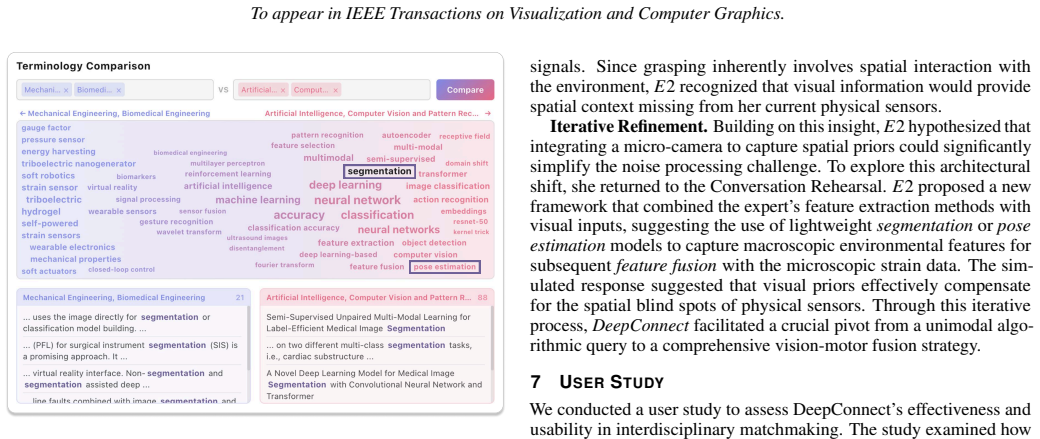
The load-bearing mechanism is a task-grounded retrieval-and-scoring chain. An LLM decomposes the user's goal into domain-specific tasks; a sentence-embedding model maps tasks and paper metadata into one semantic space and ranks papers by cosine similarity; candidate researchers are the authors of those papers; each candidate's task fit is computed by Time-Aware Task Match Scoring, which averages weighted relevance over the top-ranked papers using a temporal decay weight $w(p)=\alpha+(1-\alpha)\exp(-\lambda(Y_{\max}-Y_p))$ so recent work counts more while older work still counts. Terminology comparison uses a relative frequency ratio $R(w)=\mathrm{Freq}(w,D_A)/(\mathrm{Freq}(w,D_A)+\mathrm{Freq}(w,D_B))$ to place terms on a gap-to-overlap axis, and the conversation rehearsal conditions an LLM on the candidate's full publication abstracts so responses stay inside documented expertise.
What would settle it
Take a set of known successful interdisciplinary collaborations in the same university dataset, re-run each goal through DeepConnect's task decomposition and paper retrieval, and check whether the actual collaborating authors appear in the top-ranked candidate list; separately, build a gold set of papers that address the same methodological task but use different terminology across domains and measure retrieval recall. If recall on the cross-terminology gold set is low, the shortlist and all downstream views inherit that blind spot.
Extended reading notes
Core claim
The central claim is that interdisciplinary collaborator discovery should be reframed as a structured, evidence-based exploration in four steps: decompose the collaboration goal into up to five domain-specific tasks; retrieve papers for each task by semantic similarity so that the candidate pool is composed of authors who have verifiable publications on those tasks; score candidates with a time-aware average of task-to-paper relevance over their top matched papers; and prepare for contact by visualizing which terms are shared or domain-specific and by rehearsing dialogue against a simulation strictly conditioned on the candidate's own abstracts. DeepConnect argues this pipeline solves three identified challenges: extracting methodological needs from domain narratives, synthesizing expertise from fragmented literature, and bridging semantic gaps before first contact. The evaluation evidence is offered as two case studies, a twelve-researcher user study, and a component-level comparison of the scoring method against similarity-only and publication-count baselines.
Load-bearing premise
The whole candidate pool comes from embedding-based retrieval: task descriptions are matched to paper text by cosine similarity, so if a target discipline uses different terminology for the same method, those papers and their authors may never enter the candidate list.
Editorial extensions
If this is right
- If the pipeline works, researchers can enter only a high-level goal and receive a task breakdown, a paper-grounded candidate pool, and per-task match scores without manually combining search results.
- The recency weighting means candidates who were active on a task long ago and candidates who are active now are visibly distinguished in ranking and in the temporal scatterplot.
- The terminology view gives a concrete pre-contact artifact: shared terms to open with, domain-specific terms to learn or avoid, each linked to sentences in real papers.
- The publication-grounded rehearsal lets a user probe a candidate's knowledge boundaries and even sensitive stances before sending the first message, as reported in the user study.
Reading between the lines
- Editorial extension: the same translate-retrieve-compare-rehearse loop could apply to other high-stakes expert matching tasks, such as assembling clinical-trial teams, scouting industry partners, or forming grant consortia, wherever the requester cannot name the target field's vocabulary.
- Editorial extension: the paper's own case studies imply that the embedding model's cross-domain recall is the hidden bottleneck; a direct test would be to measure whether task queries retrieve papers that use different terminology for the same method.
- Editorial extension: the system is described as egocentric, but its components would naturally extend to bidirectional matching, where researchers publish their capabilities and collaboration intents and the same visual alignment tools help both sides evaluate each other.
Editorial analysis
A structured set of objections, weighed in public.
Referee Report
Summary. The paper presents DeepConnect, an LLM-augmented visual analytics system for interdisciplinary collaborator discovery. The system takes an open-ended collaboration goal, translates it into domain-specific tasks, retrieves relevant papers from OpenAlex via embedding-based similarity, identifies candidate researchers from the authors of those papers, scores candidates with a time-aware task-match formula, visualizes terminology gaps and overlaps across domains, and provides a publication-grounded conversation rehearsal module. The evaluation consists of two author-narrated case studies, a 12-participant user study with Likert ratings and qualitative interviews, and a component-level evaluation with six expert users. The paper claims that DeepConnect supports complementary team formation, idea refinement, and pre-contact communication preparation.
Significance. If correct, DeepConnect addresses a genuine and under-supported problem: translating an abstract interdisciplinary collaboration intention into grounded candidate selection and communication preparation. The paper contributes a design space analysis from a formative study, a plausible integration of LLM-based task decomposition with visual analytics, and several concrete visual/interaction designs (temporal scatterplot, comparison matrix, terminology word cloud, simulated conversation). The authors are appropriately explicit about the cross-sectional nature of the evaluation. However, the central value claim is supported only by subjective ratings from a small user study and author-narrated case studies, and the load-bearing retrieval step is never measured for cross-domain recall. These issues limit the strength of the conclusions, but they are addressable within the scope of a revision.
major comments (3)
- [§4.2–§4.3] The candidate pool is generated entirely by embedding-based retrieval: task embeddings from all-MiniLM-L6-v2 are cosine-matched against OpenAlex paper metadata, and candidates are extracted from the retrieved papers. The paper motivates the system by terminology mismatch across domains (C1, C3), but it reports no measure of retrieval recall or cross-domain coverage. If the embedding model fails to equate synonymous methodological language across fields, relevant papers never enter the candidate pool, and no downstream visualization or rehearsal can recover the omitted researchers. This is load-bearing for the central claim that DeepConnect supports interdisciplinary discovery. I request a retrieval experiment: construct tasks and goals from two or more domains, build a small set of known relevant papers per task, and report recall@k and cross-domain coverage; a comparison against exact-keyword search on the same corpus would also directly address the motivating terminology gap.
- [§8, Table 1, Eq. (1)] The component-level evaluation of the 'Recency' measure is circular. Eq. (1) applies a temporal weight w(p) = alpha + (1-alpha)exp(-lambda(Ymax - Yp)) inside the match score, so the time-aware ranking prioritizes recent publications by construction. The observed recency advantage (4.50 vs. 4.00 for Sim-only) is therefore a restatement of the scoring formula, not independent evidence that time-aware scoring is better for users. In addition, the reported differences among Time-aware, Sim-only, and Pub-count are not accompanied by significance tests, error bars, or effect sizes with n=6; the 'Task Fit' comparison (4.50 vs. 4.58) is within sampling noise. The evaluation should either define recency independently of the scoring formula or present a blind comparison in which the ranking method is not the only cue, and should report paired statistics or confidence intervals.
- [§7, §9.4] The user-study evidence for the system's effectiveness consists of Likert ratings from 12 participants who used self-selected goals, plus qualitative interview excerpts, and the two case studies are narrated by the authors rather than independently analyzed. The paper's own §9.4 acknowledges the cross-sectional design as a limitation. I do not consider the absence of a controlled experiment disqualifying for a visual analytics systems paper, but the abstract and introduction should be scoped to match the evidence: 'showing its value' overstates what 12 subjective ratings with no comparison condition can establish. A minimal baseline condition, such as the same tasks with a text-only LLM interface or an existing academic search engine, would substantially strengthen the claim that the coordinated visualizations, rather than the underlying LLM retrieval, are what helps users.
minor comments (5)
- [§3.1] The phrase 'athematic analysis' should be 'a thematic analysis'.
- [§4.2] The model names 'GPT-5.1' and 'GPT-4.1-mini' should include the exact version and access date, and the prompt templates for task extraction and terminology extraction should be provided for reproducibility.
- [§4.4] The 'top 1000 most relevant papers' threshold for terminology extraction is presented without justification or sensitivity analysis; since the terminology view depends on this corpus, a brief discussion of the choice would help.
- [§7, Figure 6] The score distribution rows under Figure 6 are visually difficult to interpret; a standard stacked bar chart with one row per question and counts per Likert level would be clearer.
- [§4.1] The description of the local-university dataset should include the number of researchers, disciplines, publications, and the data snapshot date, since all case studies and the user study depend on this subset.
Circularity Check
Component-level 'recency' finding restates the recency weight built into Eq. (1); the main system derivation is otherwise not circular.
-
self definitional
[Section 4.3 Eq. (1) and Section 8, Table 1 / Figure 7]
"Expertise Recency (Recency) Prioritizes recent task-relevant expertise. ... w(p)=α+(1−α)exp(−λ(Ymax−Yp)) (1) ... α∈[0,1] establishes a lower bound for the weight of older publications (set to 0.5 in our implementation). ... Time-aware maintained comparable task fit to Similarity-only (4.50 vs. 4.58) while improving recency (4.50 vs. 4.00)."
The 'Recency' measure asks raters whether the ranking prioritizes recent task-relevant expertise. The Time-aware scoring is constructed by multiplying each paper's relevance by w(p), a temporal weight that is larger for recent publications and decays exponentially for older ones (with a lower bound of α=0.5). The Similarity-only baseline has no such temporal term. Therefore the Time-aware ranking is recency-prioritizing by definition, and the reported recency advantage (4.50 vs. 4.00) is a restatement of the design choice in Eq. (1), not an independent empirical result.
full rationale
The paper's central derivation -- goal translation, task-embedding retrieval from OpenAlex, candidate extraction from retrieved papers, terminology scoring, and publication-grounded rehearsal -- is largely self-contained and externally grounded in OpenAlex metadata and human ratings. No load-bearing uniqueness theorem or ansatz is smuggled in via self-citation; the self-citations to embedding papers [14, 59-61] support the choice of an external model (all-MiniLM-L6-v2) and are not what forces the system's outputs. The only by-construction step found is the component-evaluation claim that Time-aware scoring improves 'Recency': Eq. (1) injects recency into the ranking by construction, so the observed 4.50 vs. 4.00 difference is a definitional consequence, not empirical confirmation. The unmeasured retrieval-recall issue is a genuine validity limitation but is not a circularity, because the paper never claims to have measured cross-domain recall. Overall, the core system claim retains independent content from the user study and case studies, so the circularity is partial and localized to one component finding.
Assumptions & free parameters
free parameters (5)
- alpha (temporal weight lower bound) =
0.5
- lambda (temporal decay rate) =
not reported
- x (number of top papers per task) =
5
- top-1000 papers for terminology extraction =
1000
- number of generated tasks =
up to 5
assumptions (5)
- domain assumption OpenAlex provides accurate and sufficiently complete publication metadata for the university subset used in the study.
- domain assumption Cosine similarity in the all-MiniLM-L6-v2 embedding space measures task-paper relevance across domain terminologies.
- domain assumption LLM-generated task decompositions and terminology extractions are faithful and reproducible.
- domain assumption Recent publications indicate current expertise and older ones indicate foundational expertise.
- domain assumption Grounding the simulated conversation in publication abstracts is sufficient to prevent materially misleading responses.
Cite this review
Pith. "Pith review of DeepConnect: A Visual Analytics System for Bridging Interdisciplinary Research Collaborations." pith.science (2026). https://pith.science/paper/IBVLCPP5
@misc{pith2026260805134,
  author       = {Pith},
  title        = {Pith review of: DeepConnect: A Visual Analytics System for Bridging Interdisciplinary Research Collaborations},
  year         = {2026},
  howpublished = {\url{https://pith.science/paper/IBVLCPP5}},
  note         = {Machine review of arXiv:2608.05134}
}
read the original abstract
Interdisciplinary research collaboration is crucial for scientific innovation, but it remains difficult to initiate in practice. Existing collaborator discovery approaches are often constrained by disciplinary boundaries and static researcher profiles that do not reflect the specific context of a new collaboration goal. As a result, researchers struggle to translate open-ended collaboration goals into domain-specific tasks, evaluate candidate researchers' fit and complementarity, and establish common ground before initial contact. To address these challenges, we present DeepConnect, an LLM-augmented visual analytics system for interdisciplinary collaborator discovery. DeepConnect translates collaboration ideas into domain-specific tasks, retrieves relevant papers to ground cross-domain exploration, and provides coordinated visualizations for exploring and comparing candidate researchers. It further reveals terminology gaps and overlaps across domains and supports publication-grounded conversation rehearsal to help users prepare for outreach. We evaluate DeepConnect through two case studies, a user study, and a component-level evaluation, showing its value for complementary team formation, idea refinement, and pre-contact preparation. The DeepConnect website is available at https://deepconnect.sg.
Figures


Figures from the paper (4 more)



Reference graph
Works this paper leans on
-
[1]
Balog, Y
K. Balog, Y . Fang, M. De Rijke, P. Serdyukov, L. Si, et al. Expertise retrieval.Found. Trends Inf. Retr., 6(2–3):127–256, 2012. doi: 10.1561/ 1500000024 2
2012
-
[2]
F. Beck. PUREsuggest: Citation-based literature search and visual ex- ploration with keyword-controlled rankings.IEEE Trans. Vis. Comput. Graph., 31(1):316–326, 2025. doi: 10.1109/TVCG.2024.3456199 1, 2
arXiv 2025
-
[3]
G. Békés and G. I. Ottaviano. Cultural homophily and collaboration in superstar teams.Manag. Sci., 71(10):8149–8168, 2025. doi: 10.1287/ mnsc.2022.01799 2
-
[4]
N. Berkta¸ s and H. Yaman. A branch-and-bound algorithm for team forma- tion on social networks.INFORMS J. Comput., 33(3):1162–1176, 2021. doi: 10.1287/ijoc.2020.1000 2
-
[5]
R. S. Burt. Structural holes and good ideas.Am. J. Sociol., 110(2):349–399,
-
[6]
M. Büyükboyaci and A. Robbett. Team formation with complementary skills.J. Econ. Manag. Strategy, 28(4):713–733, 2019. doi: 10.1111/jems. 12296 2
-
[7]
M. Caccamo, D. Pittino, and F. Tell. Boundary objects, knowledge inte- gration, and innovation management: A systematic review of the literature. Technovation, 122, art. no. 102645, 2023. doi: 10.1016/j.technovation. 2022.102645 2
arXiv 2023
-
[8]
C. Chen. CiteSpace II: Detecting and visualizing emerging trends and transient patterns in scientific literature.J. Am. Soc. Inf. Sci. Technol., 57(3):359–377, 2006. doi: 10.1002/asi.20317 2
Show all 90 references
-
[9]
Collins, F
C. Collins, F. B. Viegas, and M. Wattenberg. Parallel tag clouds to explore and analyze faceted text corpora. InProc. IEEE VAST, pp. 91–98. IEEE, Piscataway, 2009. doi: 10.1109/V AST.2009.5333443 2
2009
-
[10]
J. N. Cummings and S. Kiesler. Collaborative research across disciplinary and organizational boundaries.Soc. Stud. Sci., 35(5):703–722, 2005. doi: 10.1177/0306312705055535 1
2005 doi
-
[11]
T. Dang, H. N. Nguyen, and V . Pham. WordStream: Interactive visualiza- tion for topic evolution. In J. Johansson, F. Sadlo, and G. E. Marai, eds., EuroVis 2019 - Short Papers, pp. 103–107. The Eurographics Association,
2019
-
[12]
Fabbri, F
F. Fabbri, F. Bonchi, L. Boratto, and C. Castillo. The effect of homophily on disparate visibility of minorities in people recommender systems. In Proc. ICWSM, vol. 14, pp. 165–175. AAAI Press, Palo Alto, 2020. doi: 10.1609/icwsm.v14i1.7288 2
2020 doi
-
[13]
Y . Feng, H. Luo, Z. Lin, Y . Sun, P. Wei, L. B. Hsieh et al. OrchMAS: Orchestrated reasoning with multi collaborative heterogeneous scientific expert structured agents.arXiv preprint arXiv:2603.03005, 2026. doi: 10. 48550/arXiv.2603.03005 8
2026 doi
-
[14]
Y . Feng, Y . Sun, Y . Sun, M. Zhu, Q. Huang, A. K. H. Tung et al. Don’t reinvent the wheel: Efficient instruction-following text embedding based on guided space transformation. InProc. ACL, pp. 24511–24525. As- sociation for Computational Linguistics, Vienna, Austria, 2025. d...
2025
-
[15]
Fortunato, C
S. Fortunato, C. T. Bergstrom, K. Börner, J. A. Evans, D. Helbing, S. Milo- jevi´c et al. Science of science.Science, 359(6379):eaao0185, 2018. doi: 10.1126/science.aao0185 1
2018 doi
-
[16]
Fung, J.-K
T.-L. Fung, J.-K. Chou, and K.-L. Ma. A design study of personal biblio- graphic data visualization. InProc. IEEE PacificVis, pp. 244–248. IEEE, Piscataway, 2016. doi: 10.1109/PACIFICVIS.2016.7465279 2
2016
-
[17]
Gergle, R
D. Gergle, R. E. Kraut, and S. R. Fussell. Language efficiency and visual technology: Minimizing collaborative effort with visual infor- mation.J. Lang. Soc. Psychol., 23(4):491–517, 2004. doi: 10.1177/ 0261927X04269589 2
2004
-
[18]
M. S. Granovetter. The strength of weak ties.Am. J. Sociol., 78(6):1360– 1380, 1973. doi: 10.1086/225469 2
1973 doi
-
[19]
Z. Guo, J. Tao, S. Chen, N. V . Chawla, and C. Wang. SD2: Slicing and dicing scholarly data for interactive evaluation of academic performance. IEEE Trans. Vis. Comput. Graph., 29(8):3569–3585, 2023. doi: 10.1109/ TVCG.2022.3163727 2
2023
-
[20]
H. Hao, Y . Cui, Z. Wang, and Y .-S. Kim. Thirty-two years of IEEE VIS: Authors, fields of study and citations.IEEE Trans. Vis. Comput. Graph., 29(1):1016–1025, 2023. doi: 10.1109/TVCG.2022.3209422 2
2023
-
[21]
Hassan and M
D. Hassan and M. A. Hasan. Supervised link prediction in co- authorship networks based on author node-based features.arXiv preprint arXiv:2505.21673, 2025. doi: 10.48550/arXiv.2505.21673 2
2025 doi
-
[22]
Heer and M
J. Heer and M. Agrawala. Design considerations for collaborative visual analytics.Inf. Vis., 7(1):49–62, 2008. doi: 10.1057/palgrave.ivs.9500167 2
2008 doi
-
[24]
Homaeian, J
L. Homaeian, J. R. Wallace, and S. D. Scott. Joint action storyboards: A framework for visualizing communication grounding costs.Proc. ACM Hum.-Comput. Interact., 5(CSCW1), art. no. 28, 27 pp., 2021. doi: 10. 1145/3449102 2
2021
-
[25]
Huang, X
L. Huang, X. Ni, X. Chen, and Y . Zhang. Measuring interdisciplinary interactions using citation analysis and semantic analysis. InProceedings of the 1st Workshop on AI + Informetrics (AII 2021), co-located with iConference 2021, vol. 2871 ofCEUR Workshop Proceedings, pp. 140–
2021
-
[26]
Husain, N
O. Husain, N. Salim, R. A. Alias, S. Abdelsalam, and A. Hassan. Expert finding systems: A systematic review.Appl. Sci., 9(20), art. no. 4250,
-
[27]
Latif and F
S. Latif and F. Beck. VIS author profiles: Interactive descriptions of publi- cation records combining text and visualization.IEEE Trans. Vis. Comput. Graph., 25(1):152–161, 2019. doi: 10.1109/TVCG.2018.2865022 1
2019
- [28]
-
[29]
B. Lee, N. H. Riche, A. K. Karlson, and S. Carpendale. SparkClouds: Visu- alizing trends in tag clouds.IEEE Trans. Vis. Comput. Graph., 16(6):1182– 1189, 2010. doi: 10.1109/TVCG.2010.194 2
2010 doi
-
[30]
doi: 10.3390/app9204250 2
-
[31]
Z. Li, C. Zhang, S. Jia, and J. Zhang. Galex: Exploring the evolution and intersection of disciplines.IEEE Trans. Vis. Comput. Graph., 26(1):1182– 1192, 2020. doi: 10.1109/TVCG.2019.2934667 2
2020
-
[32]
J. Lu, B. Pan, J. Chen, Y . Feng, J. Hu, Y . Peng et al. AgentLens: Visual analysis for agent behaviors in LLM-based autonomous systems.IEEE Trans. Vis. Comput. Graph., 31(8):4182–4197, 2025. doi: 10.1109/TVCG. 2024.3394053 9
2025
-
[33]
L. F. Luna-Reyes, L. J. Black, W. Ran, D. L. Andersen, H. Jarman, G. P. Richardson et al. Modeling and simulation as boundary objects to facilitate interdisciplinary research.Syst. Res. Behav. Sci., 36(4):494–513, 2019. doi: 10.1002/sres.2564 2
2019 doi
-
[35]
Majeti, E
D. Majeti, E. Akleman, M. E. Ahmed, A. M. Petersen, B. Uzzi, and I. Pavlidis. Scholar Plot: Design and evaluation of an information interface for faculty research performance.Front. Res. Metr. Anal., 4, art. no. 6,
-
[36]
Y . Mao, D. Wang, M. Muller, K. R. Varshney, I. Baldini, C. Dugan et al. How data scientists work together with domain experts in scientific collaborations: To find the right answer or to ask the right question?Proc. ACM Hum.-Comput. Interact., 3(GROUP), art. no. 237, 23 pp., ...
2019 doi
-
[37]
S. M. McNee, J. Riedl, and J. A. Konstan. Being accurate is not enough: how accuracy metrics have hurt recommender systems. InExtended Abstracts of Proc. CHI, pp. 1097–1101. ACM, New York, 2006. doi: 10. 1145/1125451.1125659 2
2006
-
[38]
Y . Luo, L. Shi, M. Xu, Y . Ji, F. Xiao, C. Hu et al. Impact-oriented contextual scholar profiling using self-citation graphs. InProc. ACM SIGKDD, pp. 4572–4583. ACM, New York, 2023. doi: 10.1145/3580305. 3599845 2
2023 doi
-
[39]
Narechania, A
A. Narechania, A. Karduni, R. Wesslen, and E. Wall. VITALITY: Pro- moting serendipitous discovery of academic literature with transformers & visual analytics.IEEE Trans. Vis. Comput. Graph., 28(1):486–496, 2022. doi: 10.1109/TVCG.2021.3114820 2
2022
-
[40]
Institute of Medicine.Facilitating interdisciplinary research
National Academy of Sciences, National Academy of Engineering, and 10 To appear in IEEE Transactions on Visualization and Computer Graphics. Institute of Medicine.Facilitating interdisciplinary research. National Academies Press, Washington, DC, 2005. doi: 10.17226/11153 1
2005 doi
-
[41]
M. E. Newman. The structure of scientific collaboration networks.Proc. Natl. Acad. Sci. U.S.A., 98(2):404–409, 2001. doi: 10.1073/pnas.98.2.404 2
2001 doi
-
[42]
Newman-Griffis, V
D. Newman-Griffis, V . Sivaraman, A. Perer, E. Fosler-Lussier, and H. Hochheiser. TextEssence: A tool for interactive analysis of seman- tic shifts between corpora. InProc. NAACL-HLT Demos, pp. 106–115. Association for Computational Linguistics, Online, 2021. doi: 10.18653/ v1...
2021
-
[43]
McPherson, L
M. McPherson, L. Smith-Lovin, and J. M. Cook. Birds of a feather: Homophily in social networks.Annu. Rev. Sociol., 27(1):415–444, 2001. doi: 10.1146/annurev.soc.27.1.415 2
2001 doi
-
[44]
P. H. Nguyen, K. Xu, A. Wheat, B. W. Wong, S. Attfield, and B. Fields. SensePath: Understanding the sensemaking process through analytic provenance.IEEE Trans. Vis. Comput. Graph., 22(1):41–50, 2016. doi: 10.1109/TVCG.2015.2467611 2
2016
-
[45]
K. Okamura. Interdisciplinarity revisited: evidence for research impact and dynamism.Palgrave Commun., 5(1), art. no. 141, 2019. doi: 10. 1057/s41599-019-0352-4 1
2019
-
[46]
B. Pan, J. Lu, K. Wang, L. Zheng, Z. Wen, Y . Feng et al. AgentCoord: Visually exploring coordination strategy for LLM-based multi-agent col- laboration.Comput. Graph., 132, art. no. 104338, 2025. doi: 10.1016/j. cag.2025.104338 8
2025
-
[47]
D. Park, S. Kim, J. Lee, J. Choo, N. Diakopoulos, and N. Elmqvist. ConceptVector: Text visual analytics via interactive lexicon building using word embedding.IEEE Trans. Vis. Comput. Graph., 24(1):361–370, 2018. doi: 10.1109/TVCG.2017.2744478 2
2018
-
[48]
P. H. Nguyen, K. Xu, A. Bardill, B. Salman, K. Herd, and B. W. Wong. Sensemap: Supporting browser-based online sensemaking through ana- lytic provenance. InProc. IEEE VAST, pp. 91–100. IEEE, Piscataway,
-
[49]
Porter and I
A. Porter and I. Rafols. Is science becoming more interdisciplinary? measuring and mapping six research fields over time.Scientometrics, 81(3):719–745, 2009. doi: 10.1007/s11192-008-2197-2 1
2009 doi
-
[50]
Sacha, A
D. Sacha, A. Stoffel, F. Stoffel, B. C. Kwon, G. Ellis, and D. A. Keim. Knowledge generation model for visual analytics.IEEE Trans. Vis. Com- put. Graph., 20(12):1604–1613, 2014. doi: 10.1109/TVCG.2014.2346481 2
2014
-
[51]
Salton and C
G. Salton and C. Buckley. Term-weighting approaches in automatic text retrieval.Inf. Process. Manag., 24(5):513–523, 1988. doi: 10.1016/0306 -4573(88)90021-0 5
1988 doi
-
[52]
Schätzle, M
C. Schätzle, M. Hund, F. Dennig, M. Butt, and D. Keim. HistoBankVis: Detecting language change via data visualization. InProceedings of the NoDaLiDa 2017 workshop on processing historical language, pp. 32–39. Linköping University Electronic Press, Linköping, 2017. 2
2017
-
[53]
L. Shi, C. Wang, Z. Wen, H. Qu, C. Lin, and Q. Liao. 1.5D egocen- tric dynamic network visualization.IEEE Trans. Vis. Comput. Graph., 21(5):624–637, 2015. doi: 10.1109/TVCG.2014.2383380 2
2015
-
[54]
Pavlov and R
M. Pavlov and R. Ichise. Finding experts by link prediction in co- authorship networks.FEWS, 290:42–55, 2007. 2
2007
-
[55]
Sparck Jones
K. Sparck Jones. A statistical interpretation of term specificity and its ap- plication in retrieval.J. Doc., 28(1):11–21, 1972. doi: 10.1108/eb026526 5
1972 doi
-
[56]
Stirling
A. Stirling. A general framework for analysing diversity in science, tech- nology and society.J. R. Soc. Interface, 4(15):707–719, 2007. doi: 10. 1098/rsif.2007.0213 1
2007
-
[57]
Stokols, K
D. Stokols, K. L. Hall, B. K. Taylor, and R. P. Moser. The science of team science: overview of the field and introduction to the supplement.Am. J. Prev. Med., 35(2):S77–S89, 2008. doi: 10.1016/j.amepre.2008.05.002 1
2008 doi
-
[58]
Y . Sun, R. Barber, M. Gupta, C. C. Aggarwal, and J. Han. Co-author relationship prediction in heterogeneous bibliographic networks. InProc. ASONAM, pp. 121–128. IEEE, Piscataway, 2011. doi: 10.1109/ASONAM .2011.112 2
2011 doi
- [59]
-
[60]
M. Shin, A. Soen, B. T. Readshaw, S. M. Blackburn, M. Whitelaw, and L. Xie. Influence flowers of academic entities. InProc. IEEE VAST, pp. 1–10. IEEE, Piscataway, 2019. doi: 10.1109/V AST47406.2019.8986934 2
2019
-
[61]
Y . Sun, Q. Huang, Z. Xu, Y . Sun, Y . Tang, and A. K. H. Tung. One swallow does not make a summer: Understanding semantic structures in embedding spaces.arXiv preprint arXiv:2512.00852, 2025. doi: 10. 48550/arXiv.2512.00852 4
2025 doi
-
[62]
Y . Sun, Z. Liu, Y . Luo, L. Xia, and L. Shi. GeneticPrism: Multifaceted visualization of citation-based scholarly research evolution.IEEE Trans. Vis. Comput. Graph., 31(10):9024–9038, 2025. doi: 10.1109/TVCG.2025. 3589485 2
2025 doi
-
[63]
J. Tang, J. Zhang, L. Yao, J. Li, L. Zhang, and Z. Su. ArnetMiner: Extrac- tion and mining of academic social networks. InProc. ACM SIGKDD, pp. 990–998. ACM, New York, 2008. doi: 10.1145/1401890.1402008 2
2008
-
[64]
S.-O. Tergan. The use of digital concept maps as cognitive tools for man- aging knowledge and knowledge resources. InAAAI Spring Symposium: Reasoning with Mental and External Diagrams: Computational Modeling and Spatial Assistance, pp. 73–76. AAAI Press, Palo Alto, 2005. 2
2005
-
[65]
H. Tian, Y . Feng, Z. Wen, H. Li, M. Zhu, and W. Chen. RAGExplorer: A visual analytics system for the comparative diagnosis of RAG systems. IEEE Trans. Vis. Comput. Graph., 32(6):4807–4817, 2026. doi: 10.1109/ TVCG.2026.3694443 9
2026
- [66]
-
[67]
Van Eck and L
N. Van Eck and L. Waltman. Software survey: VOSviewer, a computer program for bibliometric mapping.Scientometrics, 84(2):523–538, 2010. doi: 10.1007/s11192-009-0146-3 2
2010 doi
-
[68]
K. Wang, B. Pan, Y . Feng, Y . Wu, J. Chen, M. Zhu et al. XGraphRAG: Interactive visual analysis for graph-based retrieval-augmented generation. InProc. IEEE PacificVis, pp. 1–11. IEEE, Piscataway, 2025. doi: 10. 1109/PacificVis64226.2025.00005 9
2025
-
[69]
W. Wang, J. Liu, T. Tang, S. Tuarob, F. Xia, Z. Gong et al. Attributed collaboration network embedding for academic relationship mining.ACM Trans. Web, 15(1), art. no. 4, 20 pp., 2020. doi: 10.1145/3409736 2
2020 doi
-
[70]
Wang, T.-Q
Y . Wang, T.-Q. Peng, H. Lu, H. Wang, X. Xie, H. Qu et al. Seek for success: A visualization approach for understanding the dynamics of academic careers.IEEE Trans. Vis. Comput. Graph., 28(1):475–485, 2022. doi: 10.1109/TVCG.2021.3114790 2
2022
-
[71]
Y . Wang, M. Yu, G. Shan, H.-W. Shen, and Z. Lu. VISPubComPAS: a comparative analytical system for visualization publication data.J. Vis., 22(5):941–953, 2019. doi: 10.1007/s12650-019-00585-2 2
2019 doi
-
[72]
B. Uzzi, S. Mukherjee, M. Stringer, and B. Jones. Atypical combinations and scientific impact.Science, 342(6157):468–472, 2013. doi: 10.1126/ science.1240474 1, 2
2013
-
[73]
S. Wu, L. Shi, L. Xia, C. Wu, Z. Liu, Y . Feng et al. Visualization of machine learning models through their spatial and temporal listeners. arXiv preprint arXiv:2603.27527, 2026. doi: 10.48550/arXiv.2603.27527 2
2026 doi
-
[74]
Y . Wu, N. Pitipornvivat, J. Zhao, S. Yang, G. Huang, and H. Qu. egoSlider: Visual analysis of egocentric network evolution.IEEE Trans. Vis. Comput. Graph., 22(1):260–269, 2016. doi: 10.1109/TVCG.2015.2468151 2
2016
-
[75]
Xiao and L
F. Xiao and L. Shi. GeneticFlow: Exploring scholar impact with interactive visualization. InProc. IEEE VIS, pp. 66–70. IEEE, Piscataway, 2023. doi: 10.1109/VIS54172.2023.00022 2
2023
-
[76]
Z. Xu, S. Jain, and M. Kankanhalli. Hallucination is inevitable: An innate limitation of large language models.arXiv preprint arXiv:2401.11817,
-
[77]
Q. Yu, C. Long, Y . Lv, H. Shao, P. He, and Z. Duan. Predicting co-author relationship in medical co-authorship networks.PLOS ONE, 9(7):e101214,
-
[78]
L. Weng, X. Wang, J. Lu, Y . Feng, Y . Liu, H. Feng et al. InsightLens: Augmenting LLM-powered data analysis with interactive insight manage- ment and navigation.IEEE Trans. Vis. Comput. Graph., 31(6):3719–3732,
-
[79]
Zhang, H
J. Zhang, H. Lv, and Z. Niu. AnchorTextVis: A visual analytics approach for fast comparison of text embeddings.IEEE Comput. Graph. Appl., 45(6):29–43, 2025. doi: 10.1109/MCG.2025.3598262 2
2025
-
[80]
Zhang, F
X. Zhang, F. Zhao, Y . Liu, P. Chen, Y . Wang, X. Wang et al. TreeQA: En- hanced LLM-RAG with logic tree reasoning for reliable and interpretable multi-hop question answering.Knowl.-Based Syst., 330, art. no. 114526,
-
[81]
Zhang, B
Z. Zhang, B. G. Patra, A. Yaseen, J. Zhu, R. Sabharwal, K. Roberts et al. Scholarly recommendation systems: a literature survey.Knowl. Inf. Syst., 65(11):4433–4478, 2023. doi: 10.1007/s10115-023-01901-x 1, 2
2023 doi
-
[82]
X. Zhou, L. Ding, Z. Li, and R. Wan. Collaborator recommendation in heterogeneous bibliographic networks using random walks.Inf. Retr. J., 20(4):317–337, 2017. doi: 10.1007/s10791-017-9300-3 2 11
2017 doi
-
[87]
W. Zeng, A. Dong, X. Chen, and Z. Cheng. VIStory: interactive storyboard for exploring visual information in scientific publications.J. Vis., 24(1):69– 84, 2021. doi: 10.1007/s12650-020-00688-1 2
2021 doi
-
[90]
doi: 10.1016/j.knosys.2025.114526 5
2025
-
[152]
CEUR-WS.org, 2021. 2
2021
-
[2004]
doi: 10.1086/421787 2
-
[2014]
doi: 10.1371/journal.pone.0101214 2
-
[2016]
doi: 10.1109/V AST.2016.7883515 2
2016
-
[2019]
doi: 10.2312/evs.20191178 2
-
[2020]
doi: 10.3389/frma.2019.00006 2
2019
- [2024]
-
[2025]
doi: 10.1109/TVCG.2025.3567131 2
2025
Reviewed August 6, 2026 · model on record in the stance chip above.
Discussion (0). Sign in to comment.