REVIEW 4 major objections 5 minor 34 references
Symbiosis Promotes Fitness Improvements in the Game of Life
T0 review · 4 major / 5 minor · reviewed 2026-08-14 · deepseek-v4-flash
Pith's one-line read Fusion, not extra size, boosts fitness in a Game of Life model
desk verdict A useful, reproducible demonstration of fusion in an artificial-life setting, undermined by a non-significant control that leaves the mutualism-vs-area question open and an overreaching open-endedness claim. read the letter →
The pith
A machine-rendered reading of the paper's core claim, the machinery that carries it, and where it could break.
The reading
What carries the argument
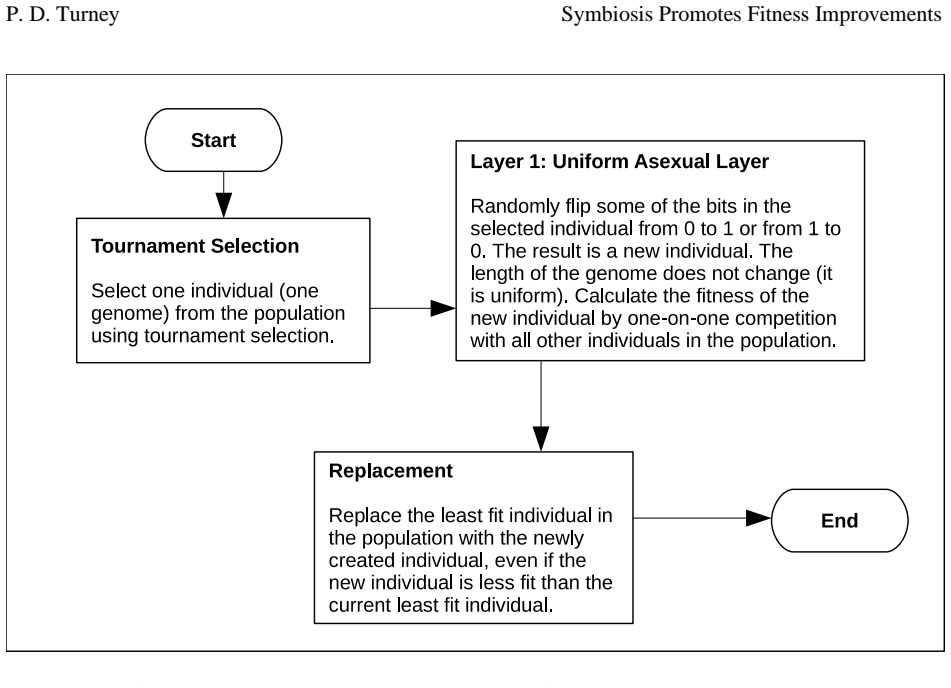
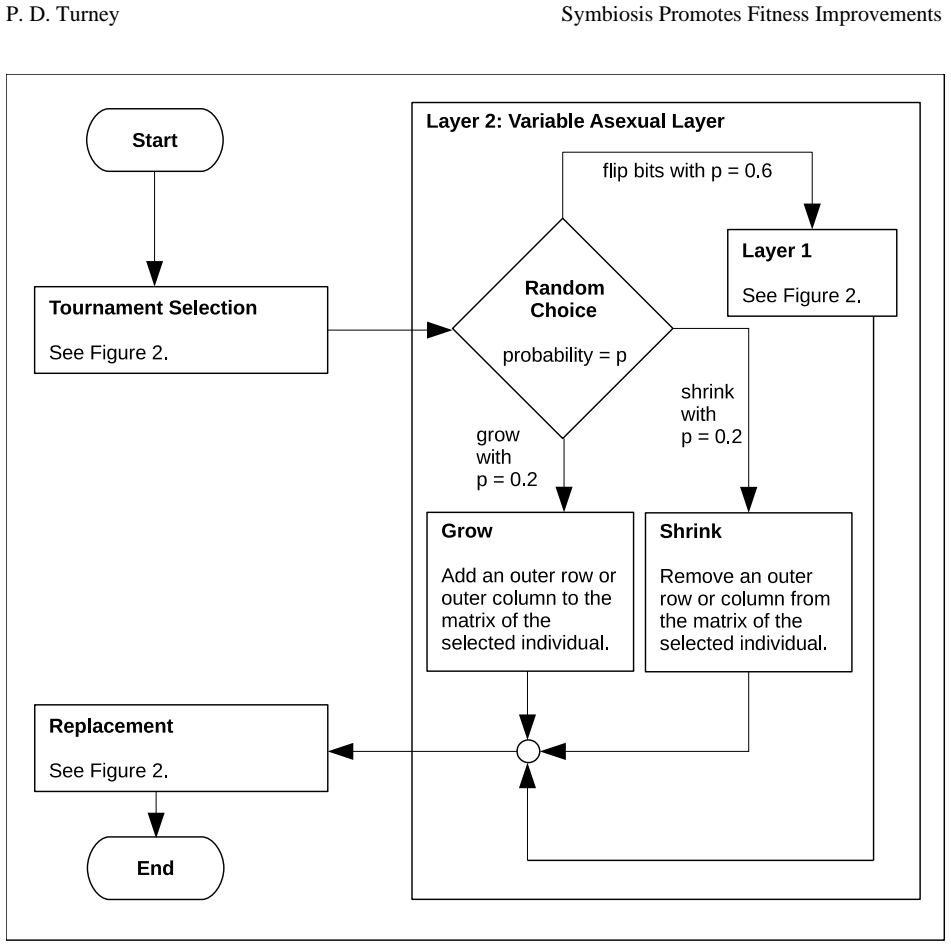
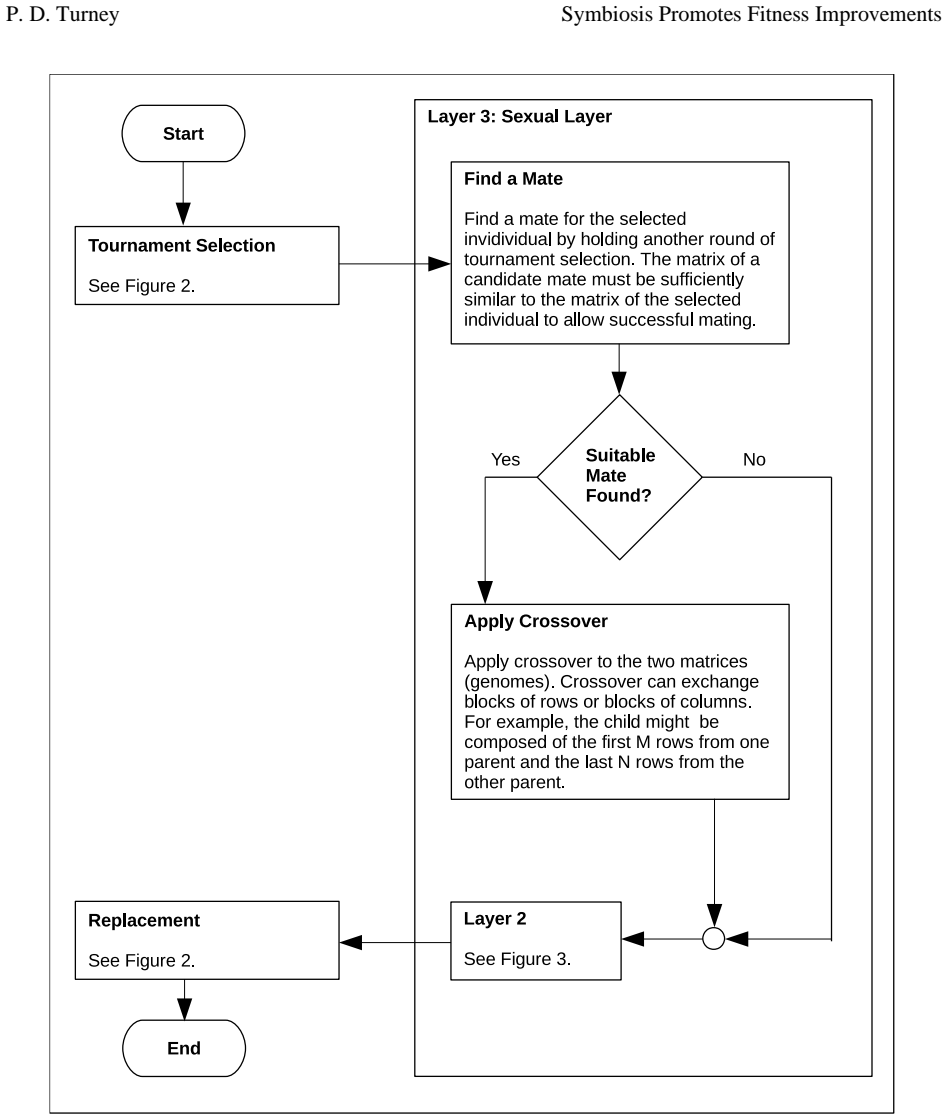
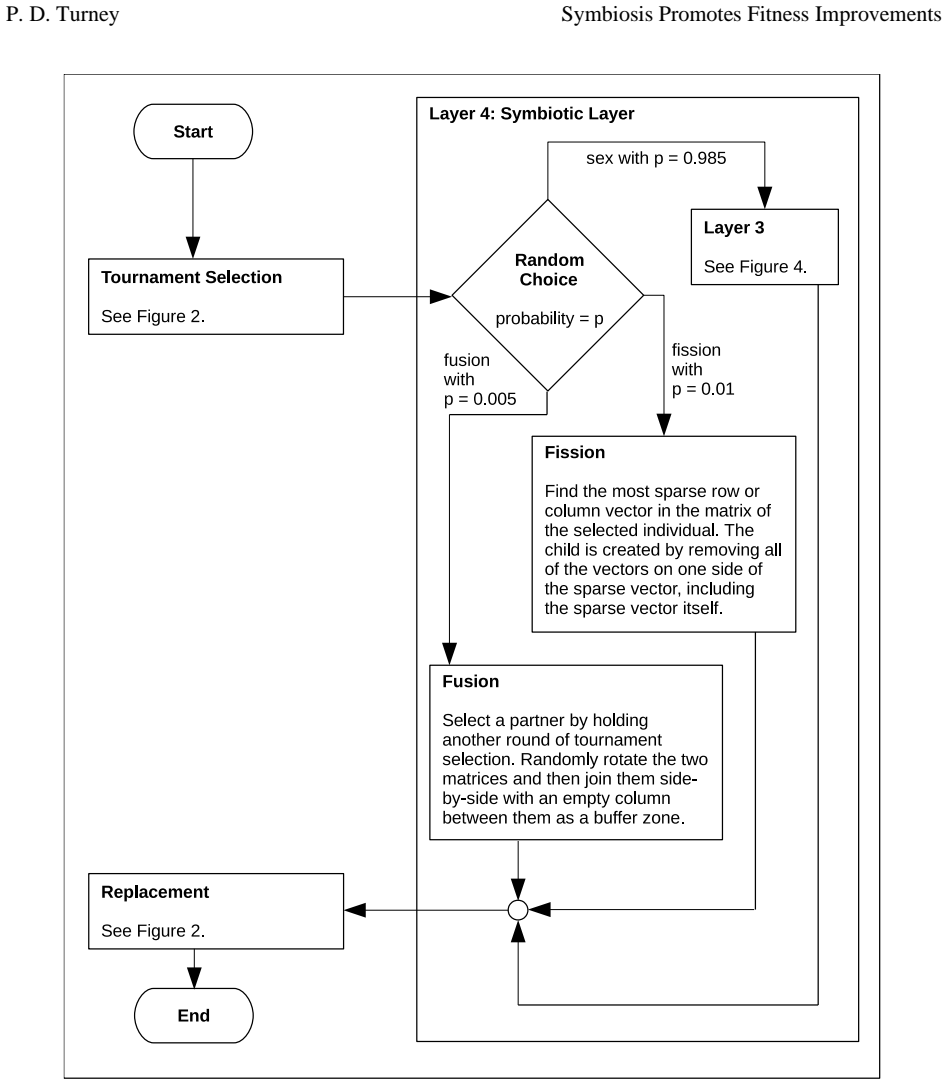
Model-S, a four-layer evolutionary system in which each layer adds a genetic operator: uniform asexual mutation, variable-size asexual reproduction, sexual crossover with similarity-based mating, and finally fusion with fission. Fusion joins two seed patterns side-by-side with a one-column buffer and treats the result as a single genome whose fitness is scored by the Immigration Game, a two-player, two-color version of the Game of Life where the winner is the color with the larger increase in live cells over the game. The load-bearing element is the fusion operator as a shifting of the level of selection: after fusion, the merged whole is selected as a unit, and the model records whether the whole's fitness exceeds both parts'. The shuffle control and the mutualism-required control are designed to separate the structural contribution of fusion from the size contribution.
What would settle it
A direct test would run the full model with fusion replaced by random padding, expanding a seed to the fused size by adding random or periodic cells, and compare external fitness; if the padded population matches the fused population's fitness, the observed gain is size-driven rather than structure-driven. A second check would measure whether the external fitness ranking survives when the Immigration Game's scoring is changed to reward ending live-cell count rather than increase; if the ranking flips, the central claim is an artifact of the score definition.
Extended reading notes
Core claim
The central discovery is that fusion as a genetic operator significantly increases fitness when added to mutation, growth and shrinkage, and sexual crossover, even though fusion occurs in only 1 of 200 births. The evidence is that the fitness curve for the full four-layer model stays well above the other layers when measured against random seeds matched for area, shape, and density; that shuffling one fused seed's structure lowers fitness early and reduces the incidence of mutualism from 15% to 8%, while leaving size and density unchanged; and that requiring mutual benefit before fusion yields the same fitness as unconditional fusion, showing that non-mutualistic fusions are neutral. From these results the paper argues that the fitness increase is due to structure that improves Immigration Game play, not to increased area.
Load-bearing premise
The conclusion that mutualism, not size, drives the fitness gain assumes that competing against random seeds matched for area, shape, and density is an unbiased yardstick, and that shuffling a seed destroys only fitness-relevant structure while preserving every size-related advantage.
Editorial extensions
If this is right
- Rare fusion events (probability 0.005) can outperform more frequent sexual crossover in raising population fitness, suggesting that the rate of symbiosis matters less than its ability to shift the level of selection.
- Because three external fitness measures agree, evolved Immigration Game seeds are genuinely better structured, not just larger, than random seeds of the same size and density.
- Open-ended evolution in this system is linked to unbounded genome area combined with fusion-induced structure; without fusion, the fixed-size layer stalls at a fitness plateau.
- The result that requiring mutualism matches unconditional fusion implies that harmful or neutral fusions can be discarded without losing adaptive progress, which is testable in any evolutionary system with a fusion-like operator.
Reading between the lines
- Editorial inference: the shuffling control destroys only one seed's structure; an even sharper test would shuffle both fused seeds, or shuffle a block while preserving local correlations, to map how much structure is needed for mutualism.
- Editorial inference: the same model could be extended to parasitism by allowing selection to act on parts separately after fusion, which the paper explicitly leaves for future work.
- Editorial inference: the unbounded fitness measure comparing current winners to past winners suggests a general way to detect open-endedness in any population whose internal fitness is relative; the paper only demonstrates it here, so applying it to other systems would test its generality.
Signed reviews
Editorial analysis
A structured set of objections, weighed in public.
Referee Report
Summary. The paper presents Model-S, a four-layer evolutionary simulation built on the Immigration Game, a two-player variant of Conway's Game of Life. Layer 1 implements uniform asexual reproduction, Layer 2 variable-size asexual reproduction, Layer 3 sexual reproduction with similarity-based mating, and Layer 4 adds rare fusion and fission operators. Fitness is measured internally by round-robin competitions within a population and externally by competitions against random seeds matched for size, shape, and density, against human-designed Game of Life patterns, and by a new unbounded cumulative measure. The paper reports that adding fusion significantly raises external fitness, argues that this increase is due to mutualistic interaction rather than merely increased seed area, and suggests that fusion can sustain open-ended evolution.
Significance. If the central mechanistic claim were established, the paper would make a useful contribution to artificial life and the study of major evolutionary transitions: it would demonstrate that a rarely applied fusion operator, acting as a shift in the level of selection, can substantially improve evolutionary search on a challenging competitive fitness landscape. The manuscript has real strengths: the model is clearly specified, the source code is released, the experiments use multiple external fitness measures, and the paper makes a genuine attempt at counterfactual controls (shuffled fusion and mutualism-only fusion). The human-designed pattern benchmark in Section 4.3 and the agreement among three fitness measures are valuable. However, the strongest conclusions—that mutualism rather than area drives the fitness gains and that fusion sustains open-ended evolution—are not yet supported by the evidence as presented.
major comments (4)
- [Section 4.2, Table 5] The only control intended to separate structure from size, Layer 4 versus Layer 4 Shuffled, is not significant over all generations (p=0.057) and is not significant at generation 100 (p=0.601); it is significant only at generation 30 (p=0.004). Since the abstract and Section 5 claim that the fitness increase from fusion is due to mutualistic interaction rather than increased area, this control does not establish that claim. Furthermore, as described in Section 3.5, the shuffling operation disrupts only one of the two fused seeds, so the other evolved seed still contributes fitness-relevant structure; the control therefore does not remove all non-area structure.
- [Section 4.1 and Section 4.2, Table 7] The primary Layer 4 versus Layer 3 comparison changes two operators at once (fusion and fission) and also changes realized area (average area 94.1 for Layer 4 versus 29.5 for Layer 3 in Table 7). The external fitness measure in Section 4.1 matches each seed to random seeds of its own size and density, so it measures structure-for-size; it does not control for the possibility that the larger area available to Layer 4 seeds is what permits the evolution of more effective structures. Because the paper's own argument acknowledges that increasing area is necessary for increasing fitness, an area-matched control (for example, Layer 3 or Layer 2 with artificially augmented seed area, or fusion of two random seeds to the same total area as fused evolved seeds) is needed to support the claim that mutualistic interaction, rather than the extra room provided by fusion, drives the observed advantage.
- [Section 4.4, unbounded fitness measure] The unbounded fitness measure f_n = sum_{i=0}^{n-1} (2 p_in - 1) is cumulative by construction: if the current best seed beats each past best seed, f_n necessarily rises. This makes it unsuitable as evidence for open-ended evolution, which the paper defines as producing a continual stream of novel organisms rather than settling into a quasi-stable state. In addition, the experiments run for only 100 generations under the linear area cap (max_area_first=120, max_area_last=170 in Table 1), which bounds the genome space; Section 3.1 itself lists unlimited genome size as a condition for open-ended evolution. Therefore the claim that fusion 'can sustain open-ended evolution' is not supported by Figure 11.
- [Section 4.2, Table 4 and Figure 10] The comparison between Layer 4 and Layer 4 Mutualism shows no significant fitness difference, but the interpretation that 'most of the fitness increase is due to mutualism' depends on the assumption that fusion events without mutual benefit are neutral rather than mildly harmful or unable to reach significance due to the small number of fusion events. With only 44.3 fusion events per run in Layer 4 and only 6.6 mutualistic events (Table 4), the statistical power of this comparison is limited; the manuscript should report effect sizes or confidence intervals, not only p-values, to support the neutral-impact interpretation.
minor comments (5)
- [Section 4.4, equation for f_n] The notation for f_n is slightly ambiguous at n=0 and n=1; the paper should state how f_0 is defined or that the sum starts at a generation where a past winner exists.
- [Section 4.4, Tables 9 and 10] The text after Table 10 refers to 'Table 8 (0.767) and Table 9 (0.765)', but the first correlation appears in Table 9 and the second in Table 10; the cross-references should be corrected.
- [Figure 11 caption] The caption says 'from top to bottom: Layer 4, Layer 2, Layer 3, Layer 1', but Figure 11 is described in the text as also including Layer 4 Shuffled and Layer 4 Mutualism near the top; the caption should list all six curves or state that the three Layer 4 variants are indistinguishable at the plotted scale.
- [Section 3.1] The paper states that validating all the listed conditions for open-ended evolution is left to future work, yet the abstract and conclusion phrase the open-endedness suggestion as if it is supported by the reported experiments; the claims should be scaled back to match this stated limitation.
- [Throughout] There are minor typographical issues, including 'lkegami' for 'Ikegami' in the sentence about Ikegami's work in Section 1.
Circularity Check
No significant circularity: the central fitness claims are externally benchmarked and the open-endedness inference is an explicitly hedged hypothesis.
full rationale
The paper's main claim—that a small amount of fusion significantly increases fitness—is supported by external benchmarks rather than by re-using the model's internal selection signal. In Section 4.1, absolute fitness is measured by competitions against randomly generated seeds matched for area, shape, and density, so the comparison isolates structure; the same measure is independently corroborated by competitions against human-designed Golly patterns in Section 4.3. The mutualism-versus-area question in Section 4.2 uses a shuffled-fusion control that preserves size, shape, and density, and a mutualism filter defined by comparing whole vs. part fitness; these are genuine counterfactuals, and their outcomes are empirical. Although the Layer 4 vs. Layer 4 Shuffled difference is not significant overall (p=0.057, Table 5), that is a statistical weakness of the evidence, not a circular reduction. The Section 4.4 unbounded measure f_n = Σ(2p_in−1) is constructed to have directional and slope consistency, but the probabilities p_in are estimated from head-to-head Immigration Games, so the rising curve in Figure 11 reflects empirical wins, not a definitional tautology. The self-citations [27,28] for 'a finite seed area implies an upper bound to fitness' are parameter-free background arguments that do not assume the target result, and [29] is used only for terminology; neither is load-bearing. The open-ended-evolution conclusion is explicitly framed as a hypothesis ('We hypothesize that the trends in Figure 11 will continue indefinitely'), and Section 6 acknowledges the linear area cap and limited parameter exploration; these are stated limitations, not hidden inputs. No step in the derivation chain reduces to its own inputs by construction.
Assumptions & free parameters
free parameters (11)
- prob_fusion =
0.005
- prob_fission =
0.01
- max_area_first / max_area_last =
120 / 170
- seed_density =
0.375
- mutation_rate =
0.01
- prob_flip/prob_grow/prob_shrink =
0.6/0.2/0.2
- min_similarity/max_similarity =
0.8/0.99
- width_factor/height_factor/time_factor =
6.0/3.0/6.0
- tournament_size =
2
- pop_size/num_generations/num_trials/elite_size =
200/100/2/50
- min_s_xspan/min_s_yspan/s_xspan/s_yspan =
5/5/5/5
assumptions (5)
- domain assumption Conway's Game of Life rules B3/S23 and the Immigration Game color-update rules define a meaningful competitive fitness landscape.
- domain assumption The external fitness measure, win rate against random seeds matched for area, shape, and density, is an unbiased measure of non-random structure.
- domain assumption The toroid size and time limit, scaled by width_factor, height_factor, and time_factor from the larger seed, give fair competitions across different seed sizes.
- domain assumption The three conditions for evolution by natural selection plus the listed extra conditions are sufficient for open-ended evolution.
- standard math Finite seed area implies an upper bound on fitness, hence unbounded area is necessary for open-ended evolution.
Cite this review
Pith. "Pith review of Symbiosis Promotes Fitness Improvements in the Game of Life." pith.science (2026). https://pith.science/paper/IC5NCNV4
@misc{pith2026190807034,
  author       = {Pith},
  title        = {Pith review of: Symbiosis Promotes Fitness Improvements in the Game of Life},
  year         = {2026},
  howpublished = {\url{https://pith.science/paper/IC5NCNV4}},
  note         = {Machine review of arXiv:1908.07034}
}
read the original abstract
We present a computational simulation of evolving entities that includes symbiosis with shifting levels of selection. Evolution by natural selection shifts from the level of the original entities to the level of the new symbiotic entity. In the simulation, the fitness of an entity is measured by a series of one-on-one competitions in the Immigration Game, a two-player variation of Conway's Game of Life. Mutation, reproduction, and symbiosis are implemented as operations that are external to the Immigration Game. Because these operations are external to the game, we are able to freely manipulate the operations and observe the effects of the manipulations. The simulation is composed of four layers, each layer building on the previous layer. The first layer implements a simple form of asexual reproduction, the second layer introduces a more sophisticated form of asexual reproduction, the third layer adds sexual reproduction, and the fourth layer adds symbiosis. The experiments show that a small amount of symbiosis, added to the other layers, significantly increases the fitness of the population. We suggest that the model may provide new insights into symbiosis in biological and cultural evolution.
Figures

Figures from the paper (7 more)


Reference graph
Works this paper leans on
-
[1]
Aron, J. (2010). First replicating creature spawned in life simulator . New Scientist, Issue 2765, June. https://www.newscientist.com/article/mg20627653-800-first-replicating-creature-spawned-in-life- simulator/
work page 2010
-
[2]
Banzhaf, W., Baumgaertner, B., Beslon, G., Doursat, R., et al. (2016). Defining and simulating open - ended novelty: Requirements, guidelines, and challenges. Theory in Biosciences, 135:131-161
work page 2016
-
[3]
Beer, R. D. (2004). Autopoiesis and cognition in the game of life. Artificial Life, 10(3), 309-326
work page 2004
-
[4]
Beer, R. D. (2014). The cognitive domain of a glider in the game of life. Artificial life, 20(2), 183-206
work page 2014
-
[5]
Beer, R. D. (2015). Characterizing autopoiesis in the game of life. Artificial Life, 21(1), 1-19
work page 2015
-
[6]
Brandon, R. N. (1996). Concepts and methods in evolutiona ry biology. Cambridge, UK: Cambridge University Press
work page 1996
-
[7]
Douglas, A. (2010). The Symbiotic Habit. Princeton, New Jersey: Princeton University Press
work page 2010
-
[8]
Gardner, M. (1970). Mathematical Games – The fantastic combinations of John Conway’s new solitaire game "life". Scientific American, 223(4): 120-123
work page 1970
Show all 34 references
-
[9]
Godfrey-Smith, P. (2007). Conditions for evolution by natura l selection. The Journal of Philosophy , 104:489-516
2007
-
[10]
Ikegami, T. (1994). From genetic evolution to emergence of game strategies. Physica D: Nonlinear Phenomena, 75(1-3):310-327
1994
-
[11]
Johnston, N. (2009). Longest-lived soup density in Conway ’s game of life. http://www.njohnston.ca/ 2009/06/longest-lived-soup-density-in-conways-game-of-life/
2009
-
[12]
Koestler, A. (1967). The ghost in the machine. London, UK: Hutchinson
1967
-
[13]
Margulis, L. (1970). Origin of eukaryotic cells. New Haven, CT: Yale University Press
1970
-
[14]
Margulis, L. (1981). Symbiosis in cell evolution. San Francisco, CA: W. H. Freeman
1981
-
[15]
Maynard Smith, J., & Szathmáry, E. (1995). The major transitions in evolution. Oxford, UK: Oxford University Press
1995
-
[16]
McShea, D. W. , & Brandon, R. N. (2011). Biology’s first law: The tendency for diversity and complexity to increase in evolutionary systems. Chicago, IL: University of Chicago Press
2011
-
[17]
A., & Ofria, C
Moreno, M. A., & Ofria, C. (2019). Toward open-ended fraternal transitions in individuality. Artificial Life, 25:117-133
2019
-
[18]
Nolan, P., & Lenski, G. E. (2010). Human societies: An introduction to macrosociology. Boulder, CO: Paradigm Publishers, 11th edition
2010
-
[19]
Poundstone, W. (2013). The recursive universe: Cosmic complexity and the limits of scientific knowledge. Mineola, NY: Dover Publications. P. D. Turney Symbiosis Promotes Fitness Improvements 29 Artificial Life
2013
-
[20]
Ridley, M. (1993). The red queen: Sex and the evolution o f human nature . New York, NY: Harper Perennial
1993
-
[21]
Simon, D. (2013). Evolutionary optimization algorithms. Hoboken, NJ: John Wiley & Sons
2013
-
[22]
Simon, H. A. (1962). The architecture of complexity. Proceedings of the American Philosophical Society, 106:467-482
1962
-
[23]
Sterelny, K. (2011). Evolvability reconsidered. In B. Calcott & K. Sterelny (Eds.), The major transitions in evolution revisited (pp. 83-100). Cambridge, MA: MIT Press
2011
-
[24]
Taylor, T. (2015). Requirements for open-ended evolution in natural and artificial systems. In EvoEvo Workshop at the 13th European Conference on Artificial Life (ECAL 2015), University of York, UK. http://arxiv.org/abs/1507.07403
2015 arXiv
-
[25]
Taylor, T., Bedau, M., Channon, A., Ackley, D., et al. (2016). Open-ended evolution: Perspectives from the OEE workshop in York. Artificial Life, 22:408-423
2016
-
[26]
Trevorrow, A., Rokicki, T., Hutton, T., Greene, D., Summers, J., Verver, M., Munafo, R., Bostick, B., & Rowett, C. (2019). Golly 3.2 for Windows. http://golly.sourceforge.net/
2019
-
[27]
Turney, P. D. (1999) . Increasing evolvability considered as a large -scale trend in evolution . In Proceedings of the 1999 Genetic and Evolutionary Computation Conference (GECCO -99) Workshop Program (pp. 43–46). Orlando, Florida
1999
-
[28]
Turney, P. D. (2000). A simple model of unbounded evolutionary versatility as a largest-scale trend in organismal evolution. Artificial Life, 6:109-128
2000
-
[29]
Turney, P. D. (2018) . Conditions for major transitions in biological and cultural evolution . In Proceedings of the Third Workshop on Open -Ended Evolution (OEE3) at the 2018 Conference on Artificial Life. Tokyo, Japan. http://www.alife.org/workshops/oee3/papers/turney-oee3-final.pdf
2018
-
[30]
Turney, P. D. (2020). Model-S source code. https://github.com/pdturney/modeling-symbiosis-revised
2020
-
[31]
Wainwright, R. T. (1971). Lifeline Volume 2. http://www.conwaylife.com/wiki/Lifeline_Volume_2
1971
-
[32]
A., & Pollack, J
Watson, R. A., & Pollack, J. B. (2003). A computational model of symbiotic composition in evolutionary transitions. Biosystems, 69:187-209
2003
-
[33]
Whitley, D., & Kauth, J. (1988). GENITOR: A different genetic algorithm. In Proceedings of the Rocky Mountain Conference on Artificial Intelligence. Denver, CO
1988
-
[34]
Whitley, D. (1989). The GENITOR algorithm and selective pressure: Why rank-based allocation of reproductive trials is best. In D. Schaffer (ed.), Third International Conference on Genetic Algorithms (pp. 116-121). San Francisco, CA: Morgan Kaufmann. P. D. Turney Symbiosis Prom...
1989
Reviewed August 14, 2026 · model on record in the stance chip above.
Discussion (0). Continue with ORCID to comment.