REVIEW 2 major objections 1 minor 98 references
High-ionization coronal lines trace quasar-like activity in recently quenched galaxies at high redshift
T0 review · 2 major / 1 minor · reviewed 2026-06-29 · grok-4.3
Pith's one-line read Intense black hole accretion persists for hundreds of millions of years after galaxies quench at high redshift.
desk verdict The paper reports [NeV] detections in six recently quenched high-z galaxies and ties them to ongoing high-Eddington black hole accretion, but the result stands or falls on whether that line is truly free of any non-AGN contribution. read the letter →
The pith
A machine-rendered reading of the paper's core claim, the machinery that carries it, and where it could break.
The reading
What carries the argument
The [NeV]λ3427 coronal emission line, which serves as a clean tracer of nuclear supermassive black hole accretion because its high ionization potential rules out production by star formation.
What would settle it
Finding [NeV]λ3427 emission in old quenched galaxies that show no recent star formation, or finding spectroscopic evidence that [NeV] can arise from star-forming regions in systems with similar stellar masses and metallicities.
Extended reading notes
Core claim
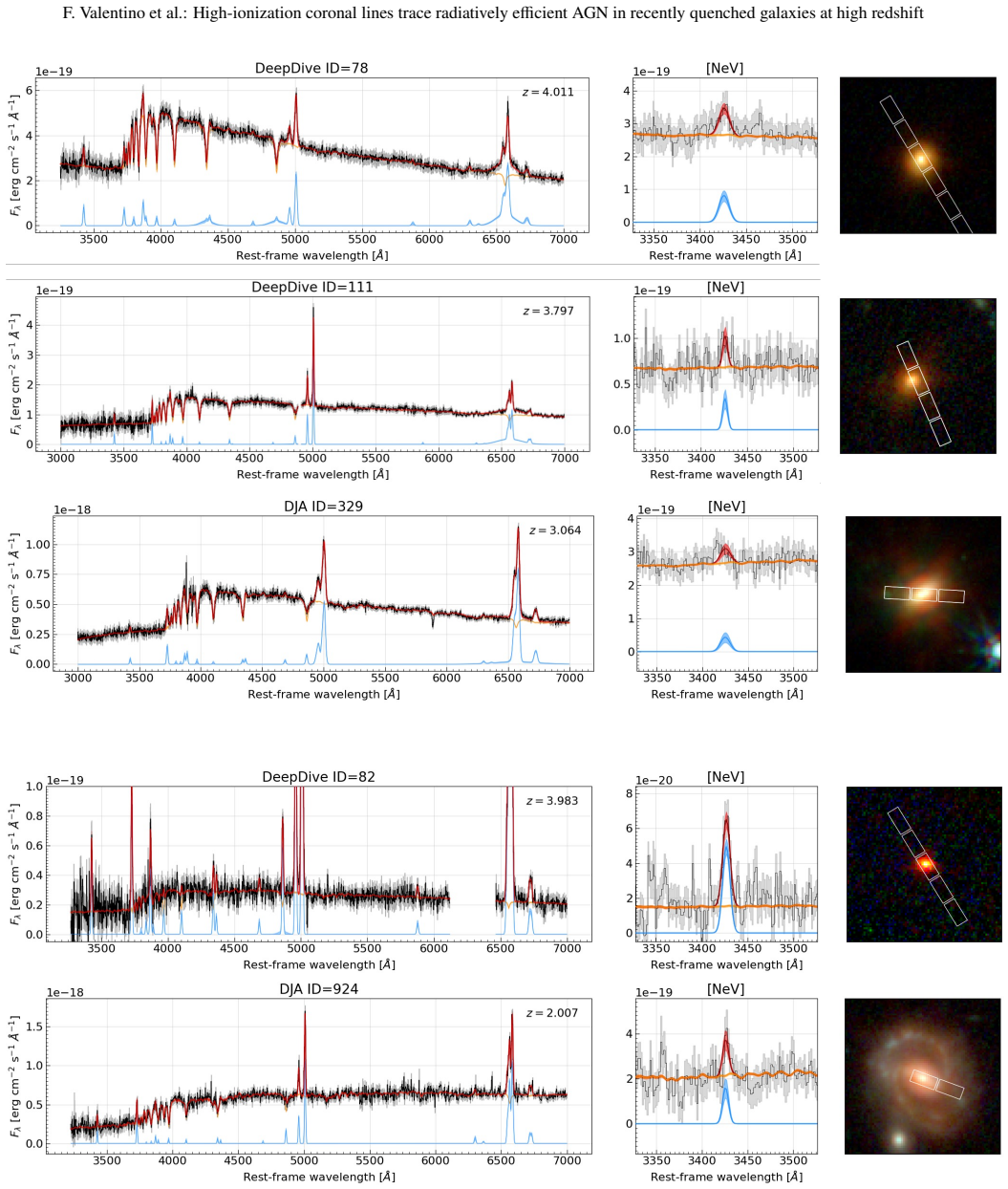
We report the detection of the high-ionization line [NeV]λ3427 in the JWST/NIRSpec archival spectra of 6 massive quenched galaxies at z ∼ 1.5-4.5, identified from a parent sample of 87 systems. With an ionization potential of approximately 97 eV, [NeV] can only be produced by strong nuclear activity in these massive systems, providing a clean and unambiguous tracer of highly accreting supermassive black holes uncontaminated by residual star formation. These results reveal that intense, radiatively efficient SMBH growth can persist several hundred Myr after the main quenching epoch, with duty cycles of approximately 100-200 Myr.
Load-bearing premise
The [NeV]λ3427 emission arises solely from nuclear accretion and is not produced or contaminated by any residual star formation in the quenched galaxies.
Editorial extensions
If this is right
- Black hole masses derived from broad Hα line widths fall in the range 10^8.5-9.5 solar masses and follow local scaling relations with stellar mass and velocity dispersion.
- The implied black hole accretion rates reach a few solar masses per year and can equal or exceed residual star formation rates in the most extreme cases.
- The strongest [NeV] emitters appear in the youngest post-starburst galaxies while older quenched systems show no such activity, a pattern also seen in theoretical models.
- Models aiming to reproduce the earliest quenched galaxies must incorporate episodes of very high black hole accretion rates lasting 100-200 Myr after quenching.
Reading between the lines
- Continued accretion after quenching could mean that AGN feedback operates in a maintenance mode rather than as the initial trigger for quiescence.
- These systems may contribute to the high-redshift quasar population in ways that current luminosity function estimates do not yet capture.
- Spatially resolved spectroscopy could test whether the [NeV] emission is strictly nuclear or extended on kiloparsec scales.
Editorial analysis
A structured set of objections, weighed in public.
Referee Report
Summary. The manuscript reports detections of the high-ionization coronal line [NeV]λ3427 in JWST/NIRSpec spectra of 6 massive quenched galaxies at z∼1.5–4.5 drawn from a parent sample of 87 systems. These are interpreted as unambiguous tracers of quasar-like SMBH accretion (L_bol∼10^45–46 erg s^−1, λ_Edd∼10–50%) persisting several hundred Myr after quenching, supported by broad Hα detections yielding M_BH∼10^8.5–9.5 M_⊙ in four objects, a preference for young post-starburst systems (D_n4000≲1.3), and rough agreement with theoretical models; the authors infer AGN duty cycles of ∼100–200 Myr.
Significance. If the central interpretation holds, the result supplies direct observational evidence that radiatively efficient black-hole growth can continue after the main quenching epoch at high redshift, with consequences for the timing of AGN feedback in galaxy-evolution models. The reported trend with stellar-population age and the match to model predictions constitute a concrete, falsifiable link between observation and theory.
major comments (2)
- [Abstract] Abstract: the assertion that the 97 eV ionization potential ensures [NeV]λ3427 'can only be produced by strong nuclear activity' and is 'uncontaminated by residual star formation' is load-bearing for the claim that the six detections trace post-quenching SMBH growth, yet the abstract supplies neither quantitative upper limits on possible contributions from shocks, extreme stellar populations, or low-level residual SF nor alternative diagnostic ratios to support the exclusivity.
- [Abstract] Abstract (and implied § on derived quantities): bolometric luminosities and Eddington ratios are obtained via a standard but unspecified bolometric correction applied to [NeV] luminosities; the resulting λ_Edd range of 10–50% and the inference of duty cycles ∼100–200 Myr therefore inherit an unquantified systematic uncertainty that directly affects the strength of the 'quasar-like activity persisting after quenching' conclusion.
minor comments (1)
- [Abstract] The abstract omits signal-to-noise ratios, formal uncertainties on line luminosities, and details of the line-fitting procedure used to establish the six detections; these should be stated explicitly even in the abstract for a detection paper.
Simulated Author's Rebuttal
We thank the referee for their constructive comments, which help clarify the presentation of our results. We address each major comment below.
read point-by-point responses
-
Referee: [Abstract] Abstract: the assertion that the 97 eV ionization potential ensures [NeV]λ3427 'can only be produced by strong nuclear activity' and is 'uncontaminated by residual star formation' is load-bearing for the claim that the six detections trace post-quenching SMBH growth, yet the abstract supplies neither quantitative upper limits on possible contributions from shocks, extreme stellar populations, or low-level residual SF nor alternative diagnostic ratios to support the exclusivity.
Authors: We agree the abstract statement is concise and would benefit from added context. In the revised version we will insert a short clause referencing established literature (e.g., studies showing [NeV] is absent in pure star-forming systems and requires AGN-level ionization) and noting that our spectra show no accompanying shock indicators such as enhanced [O I] or [S II] ratios. While we do not introduce new quantitative upper-limit modeling in this work, the full text already discusses why residual SF or shocks cannot account for the observed line strengths in these massive galaxies; the revision will make this explicit in the abstract without changing the scientific claim. revision: yes
-
Referee: [Abstract] Abstract (and implied § on derived quantities): bolometric luminosities and Eddington ratios are obtained via a standard but unspecified bolometric correction applied to [NeV] luminosities; the resulting λ_Edd range of 10–50% and the inference of duty cycles ∼100–200 Myr therefore inherit an unquantified systematic uncertainty that directly affects the strength of the 'quasar-like activity persisting after quenching' conclusion.
Authors: We accept that the abstract does not name the bolometric correction. The manuscript applies the standard [NeV]-to-bolometric correction used in prior AGN studies (typically a factor of ~100–300 depending on the reference). In revision we will state the adopted correction explicitly and add a one-sentence note on the associated systematic uncertainty (~0.3–0.5 dex). This uncertainty does not alter the conclusion that the sources exhibit quasar-like luminosities and high Eddington ratios; the duty-cycle estimate of 100–200 Myr is driven primarily by the observed trend with stellar-population age rather than the precise numerical value of λ_Edd. revision: yes
Circularity Check
No significant circularity; purely observational result
full rationale
The paper reports JWST detections of [NeV]λ3427 in 6 quenched galaxies, broad Hα lines for BH mass estimates via standard methods, and infers post-quenching AGN activity from the 97 eV ionization potential (a standard fact) plus observed luminosities and Eddington ratios. No derivation chain, equations, or self-citations reduce any central claim to fitted inputs by construction. The duty-cycle estimate follows from the observed preference for youngest post-starburst systems (Dn4000 trend) without statistical forcing or renaming. This is a standard observational analysis with independent external benchmarks (ionization physics, local scaling relations).
Assumptions & free parameters
free parameters (1)
- bolometric correction factor
assumptions (1)
- domain assumption [NeV]λ3427 can only be produced by strong nuclear activity and is uncontaminated by residual star formation
Cite this review
Pith. "Pith review of High-ionization coronal lines trace quasar-like activity in recently quenched galaxies at high redshift." pith.science (2026). https://pith.science/paper/ICDHZLKO
@misc{pith2026260530424,
  author       = {Pith},
  title        = {Pith review of: High-ionization coronal lines trace quasar-like activity in recently quenched galaxies at high redshift},
  year         = {2026},
  howpublished = {\url{https://pith.science/paper/ICDHZLKO}},
  note         = {Machine review of arXiv:2605.30424}
}
abstract
We report the detection of the high-ionization line [NeV]$\lambda$3427 in the JWST/NIRSpec archival spectra of 6 massive quenched galaxies at $z \sim 1.5-4.5$, identified from a parent sample of 87 systems. With an ionization potential of approximately 97 eV, [NeV] can only be produced by strong nuclear activity in these massive systems, providing a clean and unambiguous tracer of highly accreting supermassive black holes uncontaminated by residual star formation. For 4 of the 6 [NeV]-detected systems, we detect broad H$\alpha$ emission ($\mathrm{FWHM} \gtrsim 4000$ km s$^{-1}$), yielding black hole masses of $M_{\rm BH} = 10^{8.5-9.5}\,M_\odot$, consistent with local scaling relations with stellar mass and velocity dispersion. The [NeV] luminosities imply quasar-like bolometric outputs ($L_{\rm bol} = 10^{45-46}$ erg s$^{-1}$) and Eddington ratios of $\lambda_{\rm Edd} \approx 10$-$50$%, with black hole accretion rates of a few $M_\odot$ yr$^{-1}$ that match or exceed the residual star formation rates in the most extreme cases. The strongest [NeV] emitters are preferentially found in the youngest post-starburst systems ($D_n4000 \lesssim 1.3$), while old quenched galaxies are systematically devoid of such activity, a trend independently reproduced by theoretical models. These results reveal that intense, radiatively efficient SMBH growth can persist several hundred Myr after the main quenching epoch, with duty cycles of approximately 100-200 Myr. They also underscore the importance of very high accretion episodes and rates in the theoretical models that seek to reproduce the earliest quenched galaxies in the universe.
Figures


Figures from the paper (5 more)


Reference graph
Works this paper leans on
-
[1]
2024, Nature, 627, 281
Abuter, R., Allouche, F., Amorim, A., et al. 2024, Nature, 627, 281
2024
-
[2]
M., Hickox, R
Alexander, D. M., Hickox, R. C., Aird, J., et al. 2025, New A Rev., 101, 101733
2025
-
[3]
2025, MNRAS, 539, 3568
Almaini, O., Wild, V ., Maltby, D., et al. 2025, MNRAS, 539, 3568
2025
-
[4]
2025, ApJ, 978, 90
Antwi-Danso, J., Papovich, C., Esdaile, J., et al. 2025, ApJ, 978, 90
2025
-
[5]
K., Sodré, Jr., L., et al
Araya-Araya, P., Cochrane, R. K., Sodré, Jr., L., et al. 2026, A&A, 707, A305
2026
-
[6]
2025, MNRAS, 536, 3677 Bañados, E., Venemans, B
Arita, J., Kashikawa, N., Onoue, M., et al. 2025, MNRAS, 536, 3677 Bañados, E., Venemans, B. P., Mazzucchelli, C., et al. 2018, Nature, 553, 473
2025
-
[7]
A., Phillips, M
Baldwin, J. A., Phillips, M. M., & Terlevich, R. 1981, PASP, 93, 5
1981
-
[8]
L., Morris, S
Balogh, M. L., Morris, S. L., Yee, H. K. C., Carlberg, R. G., & Ellingson, E. 1999, ApJ, 527, 54
1999
Show all 98 references
-
[9]
2025, MN- RAS[arXiv:2511.19602]
Barchiesi, L., Marchetti, L., Vaccari, M., et al. 2025, MN- RAS[arXiv:2511.19602]
2025
-
[10]
2024, A&A, 685, A141
Barchiesi, L., Vignali, C., Pozzi, F., et al. 2024, A&A, 685, A141
2024
-
[11]
L., et al
Belli, S., Park, M., Davies, R. L., et al. 2024, Nature, 630, 54
2024
-
[12]
Bravo, M., Lagos, C. d. P., Proctor, K. L., Chandro-Gómez, Á., & Power, C. 2025, ApJ, 993, 107
2025
-
[13]
S., van Breugel, W., Stanford, S
Brotherton, M. S., van Breugel, W., Stanford, S. A., et al. 1999, ApJ, 520, L87
1999
-
[14]
& Charlot, S
Bruzual, G. & Charlot, S. 2003, MNRAS, 344, 1000
2003
-
[15]
2025, ApJ, 981, 25
Bugiani, L., Belli, S., Park, M., et al. 2025, ApJ, 981, 25
2025
-
[16]
J., Conroy, C., & Johnson, B
Byler, N., Dalcanton, J. J., Conroy, C., & Johnson, B. D. 2017, ApJ, 840, 44
2017
-
[17]
Cales, S. L. & Brotherton, M. S. 2015, MNRAS, 449, 2374
2015
-
[18]
L., Brotherton, M
Cales, S. L., Brotherton, M. S., Shang, Z., et al. 2013, ApJ, 762, 90
2013
-
[19]
C., et al
Calzetti, D., Armus, L., Bohlin, R. C., et al. 2000, ApJ, 533, 682
2000
-
[20]
2011, PASA, 28, 128
Cameron, E. 2011, PASA, 28, 128
2011
-
[21]
2017, MNRAS, 466, 798
Cappellari, M. 2017, MNRAS, 466, 798
2017
-
[22]
C., Cullen, F., McLure, R
Carnall, A. C., Cullen, F., McLure, R. J., et al. 2024, MNRAS, 534, 325
2024
-
[23]
C., McLeod, D
Carnall, A. C., McLeod, D. J., McLure, R. J., et al. 2022, arXiv e-prints, arXiv:2208.00986
2022
-
[24]
C., McLure, R
Carnall, A. C., McLure, R. J., Dunlop, J. S., & Davé, R. 2018, MNRAS, 480, 4379
2018
-
[25]
C., McLure, R
Carnall, A. C., McLure, R. J., Dunlop, J. S., et al. 2023, Nature, 619, 716
2023
-
[26]
2026, arXiv e-prints, arXiv:2601.15207 Chandro-Gómez, Á., Lagos, C
Chaikin, E., Schaye, J., Huško, F., et al. 2026, arXiv e-prints, arXiv:2601.15207 Chandro-Gómez, Á., Lagos, C. d. P., Power, C., et al. 2025, arXiv e-prints, arXiv:2512.16208
2026
-
[27]
A., Endsley, R., et al
Chisholm, J., Berg, D. A., Endsley, R., et al. 2024, MNRAS, 534, 2633
2024
-
[28]
J., Yang, G., Papovich, C., et al
Cleri, N. J., Yang, G., Papovich, C., et al. 2023, ApJ, 948, 112
2023
-
[29]
& Gunn, J
Conroy, C. & Gunn, J. E. 2010, ApJ, 712, 833
2010
-
[30]
J., Springel, V ., White, S
Croton, D. J., Springel, V ., White, S. D. M., et al. 2006, MNRAS, 365, 11 Davé, R., Anglés-Alcázar, D., Narayanan, D., et al. 2019, MNRAS, 486, 2827
2006
-
[31]
L., Belli, S., Park, M., et al
Davies, R. L., Belli, S., Park, M., et al. 2024, MNRAS, 528, 4976 de Graaff, A., Brammer, G., Weibel, A., et al. 2025a, A&A, 697, A189 de Graaff, A., Setton, D. J., Brammer, G., et al. 2025b, Nature Astronomy, 9, 280 De Lucia, G., Fontanot, F., Xie, L., & Hirschmann, M. 2024, ...
2024
-
[32]
2025, ApJS, 280, 57
Doan, S., Satyapal, S., Reefe, M., et al. 2025, ApJS, 280, 57
2025
-
[33]
2025, The Open Journal of Astro- physics, 8, 12
Ellison, S., Ferreira, L., Bickley, R., et al. 2025, The Open Journal of Astro- physics, 8, 12
2025
-
[34]
L., Viswanathan, A., Patton, D
Ellison, S. L., Viswanathan, A., Patton, D. R., et al. 2019, MNRAS, 487, 2491
2019
-
[35]
L., Wilkinson, S., Woo, J., et al
Ellison, S. L., Wilkinson, S., Woo, J., et al. 2022, MNRAS, 517, L92 Euclid Collaboration, Vergani, D., Quai, S., et al. 2025, arXiv e-prints, arXiv:2511.03025
2022
-
[36]
A., Becker, R
Fan, X., Strauss, M. A., Becker, R. H., et al. 2006, AJ, 132, 117
2006
-
[37]
S., et al
Farcy, M., Hirschmann, M., Somerville, R. S., et al. 2025, MNRAS (submitted), arXiv:2504.08041
2025
-
[38]
2020, MNRAS, 496, 3943
Fontanot, F., De Lucia, G., Hirschmann, M., et al. 2020, MNRAS, 496, 3943
2020
-
[39]
2025, arXiv e-prints, arXiv:2511.15789
Fontanot, F., Decarli, R., De Lucia, G., et al. 2025, arXiv e-prints, arXiv:2511.15789
2025
-
[40]
B., Watson, D., et al
Fujimoto, S., Brammer, G. B., Watson, D., et al. 2022, Nature, 604, 261
2022
-
[41]
L., Springel, V ., et al
Genel, S., Bryan, G. L., Springel, V ., et al. 2019, ApJ, 871, 21
2019
-
[42]
2010, A&A, 519, A92
Gilli, R., Vignali, C., Mignoli, M., et al. 2010, A&A, 519, A92
2010
-
[43]
2024, Nature, 628, 277
Glazebrook, K., Nanayakkara, T., Schreiber, C., et al. 2024, Nature, 628, 277
2024
-
[44]
E., Strader, J., & Ho, L
Greene, J. E., Strader, J., & Ho, L. C. 2020, ARA&A, 58, 257
2020
-
[45]
L., Whitaker, K
Hamadouche, M. L., Whitaker, K. E., Valentino, F., et al. 2026, arXiv e-prints, arXiv:2602.02485
2026
-
[46]
2024, ApJ, 962, 152
He, W., Akiyama, M., Enoki, M., et al. 2024, ApJ, 962, 152
2024
-
[47]
M., Kauffmann, G., Brinchmann, J., et al
Heckman, T. M., Kauffmann, G., Brinchmann, J., et al. 2004, ApJ, 613, 109
2004
-
[48]
E., Brammer, G
Heintz, K. E., Brammer, G. B., Watson, D., et al. 2025, A&A, 693, A60
2025
-
[49]
F., Hernquist, L., Cox, T
Hopkins, P. F., Hernquist, L., Cox, T. J., et al. 2006, ApJS, 163, 1
2006
-
[50]
2022, ApJ, 929, 53
Ito, K., Tanaka, M., Miyaji, T., et al. 2022, ApJ, 929, 53
2022
-
[51]
2024, ApJ, 964, 192
Ito, K., Valentino, F., Brammer, G., et al. 2024, ApJ, 964, 192
2024
-
[52]
2025b, arXiv e-prints, arXiv:2506.22642
Ito, K., Valentino, F., Brammer, G., et al. 2025b, arXiv e-prints, arXiv:2506.22642
-
[53]
2026, arXiv e-prints, arXiv:2604.21007
Kakimoto, T., Tanaka, M., Ito, K., et al. 2026, arXiv e-prints, arXiv:2604.21007
2026 arXiv
-
[54]
J., Dopita, M
Kewley, L. J., Dopita, M. A., Leitherer, C., et al. 2013, ApJ, 774, 100
2013
-
[55]
C., Remus, R.-S., Seidel, B., et al
Kimmig, L. C., Remus, R.-S., Seidel, B., et al. 2025, ApJ, 979, 15
2025
-
[56]
Kormendy, J. & Ho, L. C. 2013, ARA&A, 51, 511
2013
-
[57]
D., Wild, V ., Hewett, P
Krishna, S. D., Wild, V ., Hewett, P. C., & Villforth, C. 2025, MNRAS, 543, 1535
2025
-
[58]
2001, MNRAS, 322, 231
Kroupa, P. 2001, MNRAS, 322, 231
2001
-
[59]
Lagos, C. d. P., Bravo, M., Tobar, R., et al. 2024, MNRAS, 531, 3551
2024
-
[60]
Lagos, C. d. P., Valentino, F., Wright, R. J., et al. 2025, MNRAS, 536, 2324
2025
-
[61]
Leung, G. C. K., Coil, A. L., Rupke, D. S. N., & Perrotta, S. 2021, ApJ, 914, 17
2021
-
[62]
2024, A&A, 691, A145
Maiolino, R., Scholtz, J., Curtis-Lake, E., et al. 2024, A&A, 691, A145
2024
-
[63]
P., Brammer, G., et al
Matthee, J., Naidu, R. P., Brammer, G., et al. 2024, ApJ, 963, 129
2024
-
[64]
J., Ma, C.-P., Gebhardt, K., et al
McConnell, N. J., Ma, C.-P., Gebhardt, K., et al. 2011, Nature, 480, 215
2011
-
[65]
D., Satyapal, S., Laor, A., et al
McKaig, J. D., Satyapal, S., Laor, A., et al. 2024, ApJ, 976, 130
2024
-
[66]
2025, The Open Journal of Astro- physics, 8, E170
Merlin, E., Fortuni, F., Calabró, A., et al. 2025, The Open Journal of Astro- physics, 8, E170
2025
-
[67]
2013, A&A, 556, A29
Mignoli, M., Vignali, C., Gilli, R., et al. 2013, A&A, 556, A29
2013
-
[68]
& Ostriker, J
Naab, T. & Ostriker, J. P. 2017, ARA&A, 55, 59
2017
-
[69]
2024, Scientific Reports, 14, 3724
Nanayakkara, T., Glazebrook, K., Jacobs, C., et al. 2024, Scientific Reports, 14, 3724
2024
-
[70]
B., Gu, M., Belli, S., et al
Newman, A. B., Gu, M., Belli, S., et al. 2025, arXiv e-prints, arXiv:2503.17478
2025 arXiv
-
[71]
D., et al
Onoue, M., Ding, X., Silverman, J. D., et al. 2025, Nature Astronomy [arXiv:2409.07113]
2025
-
[72]
M., Taj Aldeen, L., Wild, V ., et al
Pawlik, M. M., Taj Aldeen, L., Wild, V ., et al. 2018, MNRAS, 477, 1708
2018
-
[73]
E., Greene, J
Reines, A. E., Greene, J. E., & Geha, M. 2013, ApJ, 775, 116
2013
-
[74]
Reines, A. E. & V olonteri, M. 2015, ApJ, 813, 82
2015
-
[75]
2025, ApJ, 989, 88
Reiss, T., Trakhtenbrot, B., Ricci, C., et al. 2025, ApJ, 989, 88
2025
-
[76]
& Kimmig, L
Remus, R.-S. & Kimmig, L. C. 2025, ApJ, 982, 30 Rodríguez-Ardila, A. & Cerqueira-Campos, F. 2025, Frontiers in Astronomy and Space Sciences, 12, 1548632
2025
-
[77]
P., et al
Rusakov, V ., Watson, D., Nikopoulos, G. P., et al. 2026, Nature, 649, 574
2026
-
[78]
2025, A&A, 697, A175
Scholtz, J., Maiolino, R., D’Eugenio, F., et al. 2025, A&A, 697, A175
2025
-
[79]
2018, A&A, 618, A85
Schreiber, C., Glazebrook, K., Nanayakkara, T., et al. 2018, A&A, 618, A85
2018
-
[80]
Somerville, R. S. & Davé, R. 2015, ARA&A, 53, 51
2015
-
[81]
D., Carnall, A
Stevenson, S. D., Carnall, A. C., Leung, H.-H., et al. 2026, MNRAS, 545, staf2087
2026
-
[82]
2019, ApJ, 885, L34
Tanaka, M., Valentino, F., Toft, S., et al. 2019, ApJ, 885, L34
2019
-
[83]
C., Maltby, D., et al
Taylor, E., Carnall, A. C., Maltby, D., et al. 2026, arXiv e-prints, arXiv:2601.02269
2026 arXiv
-
[84]
2025, ApJ, 992, L27
Trakhtenbrot, B., Ricci, C., Treister, E., et al. 2025, ApJ, 992, L27
2025
-
[85]
Valentino, F., Brammer, G., Gould, K. M. L., et al. 2023, ApJ, 947, 20
2023
-
[86]
E., Brammer, G., et al
Valentino, F., Heintz, K. E., Brammer, G., et al. 2025, A&A, 699, A358
2025
-
[87]
2020, ApJ, 889, 93
Valentino, F., Tanaka, M., Davidzon, I., et al. 2020, ApJ, 889, 93
2020
-
[88]
2018, A&A, 620, A193
Vergani, D., Garilli, B., Polletta, M., et al. 2018, A&A, 620, A193
2018
-
[89]
J., et al
Weibel, A., de Graaff, A., Setton, D. J., et al. 2025, ApJ, 983, 11
2025
-
[90]
2016, MNRAS, 463, 832
Wild, V ., Almaini, O., Dunlop, J., et al. 2016, MNRAS, 463, 832
2016
-
[91]
2010, MNRAS, 405, 933
Wild, V ., Heckman, T., & Charlot, S. 2010, MNRAS, 405, 933
2010
-
[92]
2024, ApJ, 966, L2
Xie, L., De Lucia, G., Fontanot, F., et al. 2024, ApJ, 966, L2
2024
-
[93]
2020, MNRAS, 491, 740
Yang, G., Boquien, M., Buat, V ., et al. 2020, MNRAS, 491, 740
2020
-
[94]
2023, ApJ, 951, L5
Yang, J., Wang, F., Fan, X., et al. 2023, ApJ, 951, L5
2023
-
[95]
2025, arXiv e-prints, arXiv:2510.12235
Yang, T., Wang, T., Xu, K., et al. 2025, arXiv e-prints, arXiv:2510.12235
2025
-
[96]
M., Faber, S
Yesuf, H. M., Faber, S. M., Trump, J. R., et al. 2014, ApJ, 792, 84
2014
-
[97]
2026, arXiv e-prints, arXiv:2602.17767 1 Cosmic Dawn Center (DAWN), Denmark 2 DTU Space, Technical University of Denmark, Elektrovej 327, DK- 2800 Kgs
Zhu, P., Ito, K., Valentino, F., et al. 2026, arXiv e-prints, arXiv:2602.17767 1 Cosmic Dawn Center (DAWN), Denmark 2 DTU Space, Technical University of Denmark, Elektrovej 327, DK- 2800 Kgs. Lyngby, Denmark 3 École Polytechnique Fédérale de Lausanne (EPFL), Observatoire de
2026 arXiv
-
[98]
nev Table A.1: Measurements and physical properties of the [NeV] detected sample
Street, Cambridge, MA 02139, USA 28 Graduate Institute of Astrophysics, National Taiwan University, Taipei 10617, Taiwan Appendix A: Data table Article number, page 13 of 14 A&A proofs:manuscript no. nev Table A.1: Measurements and physical properties of the [NeV] detected sam...
2013
Reviewed June 29, 2026 · model on record in the stance chip above.
Discussion (0). Sign in to comment.